

A global mass budget for positively buoyant macroplastic debris in the ocean
Open accessThe DOI matches its Crossref record; 29 of the 29 references it cites were found in a registry or an index.
Abstract
Predicted global figures for plastic debris accumulation in the ocean surface layer range on the order of hundreds of thousands of metric tons, representing only a few percent of estimated annual emissions into the marine environment. The current accepted explanation for this difference is that positively buoyant macroplastic objects do not persist on the ocean surface. Subject to degradation into microplastics, the major part of the mass is predicted to have settled below the surface. However, we argue that such a simple emission-degradation model cannot explain the occurrence of decades-old objects collected by oceanic expeditions. We show that debris circulation dynamics in coastal environments may be a better explanation for this difference. The results presented here suggest that there is a significant time interval, on the order of several years to decades, between terrestrial emissions and representative accumulation in offshore waters. Importantly, our results also indicate that the current generation of secondary microplastics in the global ocean is mostly a result of the degradation of objects produced in the 1990s and earlier. Finally, we propose a series of future emission scenarios until 2050, discussing the necessity to rapidly reduce emissions and actively remove waste accumulated in the environment to mitigate further microplastic contamination in the global ocean.
Overview
The claims and statistics of this paper haven’t been checked yet.
Free: it reads the open-access text and checks the first 5 claims that cite a source we can check. Create a free account to check every claim.
Integrity signals
Registry
Cites
Statistics
Figures
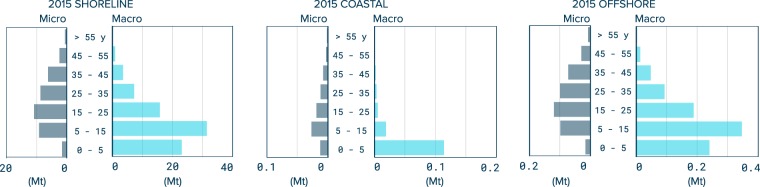
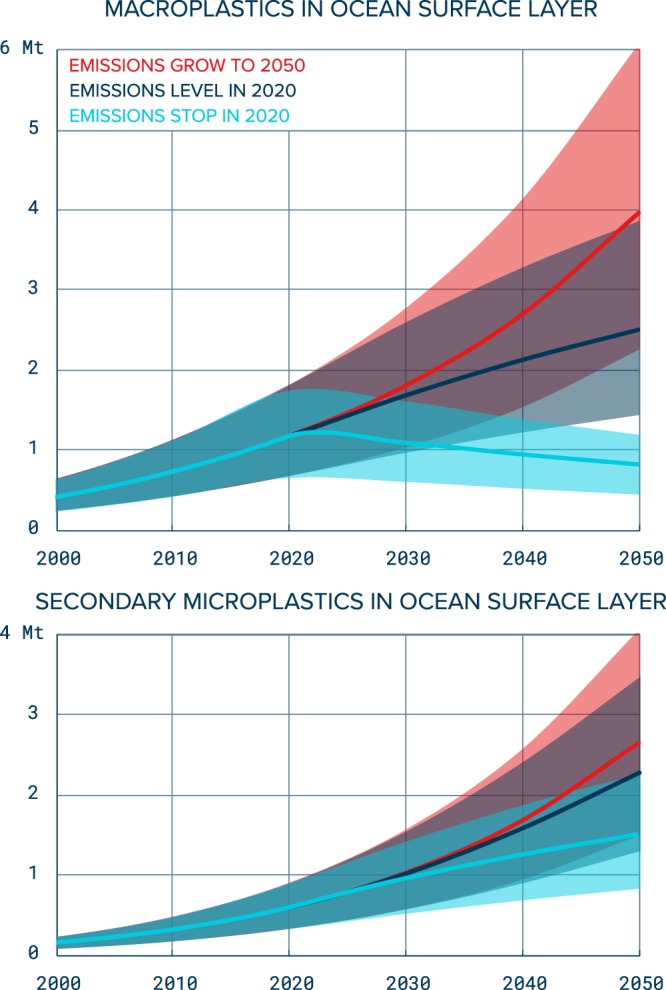
Verification
Claims the paper makes
The claims and statistics of this paper haven’t been checked yet.
Free: it reads the open-access text and checks the first 5 claims that cite a source we can check. Create a free account to check every claim.
Self-check
Percentages, sums and reported differences re-computed from the paper’s own numbers.
The self-check needs the paper’s full text.
Citations
Cites
Production, use, and fate of all plastics ever made
Geyer, R., Jambeck, J. R., & Law, K. L. (2017) · Science Advances · doi:10.1126/sciadv.1700782 · Cited by 18,606
Plastic waste inputs from land into the ocean
Jambeck, J. R., Geyer, R., Wilcox, C., Siegler, T. R., Perryman, M., Andrady, A., Narayan, R., & Law, K. L. (2015) · Science · doi:10.1126/science.1260352 · Cited by 13,163
Microplastics in the marine environment
Andrady, A. L. (2011) · Marine Pollution Bulletin · doi:10.1016/j.marpolbul.2011.05.030 · Cited by 8,105
Accumulation and fragmentation of plastic debris in global environments
Barnes, D. K. A., Galgani, F., Thompson, R. C., & Barlaz, M. (2009) · Philosophical Transactions of the Royal Society B: Biological Sciences · doi:10.1098/rstb.2008.0205 · Cited by 6,126
Eriksen, M., Lebreton, L. C. M., Carson, H. S., Thiel, M., Moore, C. J., Borerro, J. C., Galgani, F., Ryan, P. G., & Reisser, J. (2014) · PLoS ONE · doi:10.1371/journal.pone.0111913 · Cited by 4,710 · cited 1×
“= + ∗ − O y y d O y y ( , ) (1 ) ( 1, ) (8) m O M 0 0”
Self-citationRiver plastic emissions to the world’s oceans
Lebreton, L. C. M., van der Zwet, J., Damsteeg, J.-W., Slat, B., Andrady, A., & Reisser, J. (2017) · Nature Communications · doi:10.1038/ncomms15611 · Cited by 4,011
Self-citationPlastic debris in the open ocean
Cózar, A., Echevarría, F., González-Gordillo, J. I., Irigoien, X., Úbeda, B., Hernández-León, S., Palma, Á. T., Navarro, S., García-de-Lomas, J., Ruiz, A., et al. (2014) · Proceedings of the National Academy of Sciences · doi:10.1073/pnas.1314705111 · Cited by 3,133
What a Waste : A Global Review of Solid Waste Management
Hoornweg, D., & Bhada-Tata, P. (2012) · doi:10.1596/17388 · Cited by 3,129
Evidence that the Great Pacific Garbage Patch is rapidly accumulating plastic
Lebreton, L., Slat, B., Ferrari, F., Sainte-Rose, B., Aitken, J., Marthouse, R., Hajbane, S., Cunsolo, S., Schwarz, A., Levivier, A., et al. (2018) · Scientific Reports · doi:10.1038/s41598-018-22939-w · Cited by 1,839
Self-citationA global inventory of small floating plastic debris
van Sebille, E., Wilcox, C., Lebreton, L., Maximenko, N., Hardesty, B. D., van Franeker, J. A., Eriksen, M., Siegel, D., Galgani, F., & Law, K. L. (2015) · Environmental Research Letters · doi:10.1088/1748-9326/10/12/124006 · Cited by 1,713
Self-citation
Cited by
Items 401–500 of 563
Estimating plastic pollution levels in rivers through harmonized monitoring strategiesPreprint
van Emmerik, T. H. M., Kirschke, S., Schreyers, L., Nath, S., Schmidt, C., & Wendt‐Potthoff, K. (2023) · Research Square · doi:10.21203/rs.3.rs-2401406/v1 · Cited by 3
Significant benefits from international cooperation over marine plastic pollutionPreprint
de Vries, F. P., Beaumont, N., Börger, T., Clark, J. R., Hanley, N., Johnston, R. J., Meginnis, K., & Stapenhurst, C. (2023) · Research Square · doi:10.21203/rs.3.rs-3328986/v1 · Cited by 5
Hussain, T., Summer, M., Ali, S., Khan, R. R. M., Pervaiz, M. A., & Saeed, Z. (2025) · Water Air & Soil Pollution · doi:10.1007/s11270-025-08063-2 · Cited by 2
“The majority of forecast studies (Geyer et al., 2017a, 2017b; Lebreton et al., 2019; OECD, 2022b; Williams & Rangel-Buitrago, 2022) concentrate on patterns of plastic production or future pollution levels in aquatic ecosystems, showing that the number of MPs in the surface ocean may quadruple by…”
Savage, J., Harris, J. L., Koldewey, H. J., Letessier, T. B., Rowcliffe, J. M., & Morritt, D. (2025) · Conservation Science and Practice · doi:10.1111/csp2.70059 · Cited by 2
“Due to their fragmentation, plastic debris items in the ocean and indeed in organisms are getting smaller (Lebreton et al., 2019; Lindeque et al., 2020; Ryan, 2008).”
Li, W., Cai, X., & Lu, J. (2025) · Journal of Applied Phycology · doi:10.1007/s10811-025-03553-6 · Cited by 2
“Certain studies have revealed that 1% of plastic in sediments is resuspended annually, whereas 97% of plastic settles around coastlines each year (Lebreton et al. 2019).”
Mineralization of photodegraded polyethylene by the marine-derived fungus Aspergillus terreus
Lesuis, C., Niemann, H., Kienhuis, M. V. M., van der Meer, M., Vielfaure, H., Polerecký, L., & Vaksmaa, A. (2025) · Total Environment Microbiology · doi:10.1016/j.temicr.2025.100027 · Cited by 3
Guillotreau, P., Diallo, S. S., Dissou, Y., Garabedian, S., Ouattara, A. F., Payet, S., & Cecchi, P. (2025) · Journal of Industrial Ecology · doi:10.1111/jiec.70081 · Cited by 2
Sagawa, N., Ichikawa, K., Furukawa, K., Morita, H., Takahara, A., & Hinata, H. (2025) · The Science of The Total Environment · doi:10.1016/j.scitotenv.2025.180172 · Cited by 5
Prasad, S. J., Mohanty, P. C., Nair, T. M. B., Joseph, S., & Kumar, T. S. (2025) · Environmental Pollution · doi:10.1016/j.envpol.2025.127045 · Cited by 2
da Luz, T. M., de Brito, R. R., Ferreira, R. D. O., Guimarães, A., Nunes, B. B. D. S., Rodrigues, A. S. D. L., Guimarães, A. T. B., Freitas, Í. N., Matos, S. G. D. S., Carvalho, É. P. B., et al. (2025) · Marine Pollution Bulletin · doi:10.1016/j.marpolbul.2025.119066 · Cited by 3
Vulnerability of Coral Reefs to Contaminants of Emerging Concern
Gardon, T., Dromard, C. R., Gaertner, J. C., & Gaertner‐Mazouni, N. (2025) · Coral reefs of the world · doi:10.1007/978-3-031-98584-3_6 · Cited by 3
Beyond Abiotic Decay: Fiddler Crabs Accelerate Plastic Fragmentation in Pollution Hotspots
Riascos, J. M., Díaz, D., Restrepo, L., & Galloway, T. S. (2025) · Global Change Biology · doi:10.1111/gcb.70651 · Cited by 2
“…mass balance budget models attempting to solve this puzzle consider degradation (the fragmentation of plastic materials into smaller particles) as a critical process for permanent plastic sinking, which depends on photodegradation, mechanical abrasion, and thermo-oxidation (Lebreton et al. 2019).”
InfluentialAre mangrove ecosystems plastic accumulation zones?
Tagalog, S. K. M., Paler, M. K. O., Walton, M. E. M., Skov, M. W., Hiddink, J. G., & Buque‐Taboada, E. M. (2025) · The Science of The Total Environment · doi:10.1016/j.scitotenv.2025.181208 · Cited by 2
Gholizadeh, M., & Bagheri, T. (2026) · Environmental Science and Pollution Research · doi:10.1007/s11356-026-37542-0 · Cited by 4
Lu, R., Lin, Z., Dong, J., Nan, H., Wu, Y., & Wu, Y. (2026) · Applied Optics · doi:10.1364/ao.586839 · Cited by 2
The faecal microplastic pump: Zooplankton efficiently transport microplastics to the ocean depths
Richon, C., Gorguès, T., Cole, M., & Aumont, O. (2026) · Environmental Pollution · doi:10.1016/j.envpol.2026.128070 · Cited by 4
Kim, S., Shin, J.-H., Ji, Y.-J., Seong, M.-J., Je, C.-Y., Kim, J., & Song, N.-S. (2026) · Journal of Hazardous Materials · doi:10.1016/j.jhazmat.2026.142508 · Cited by 3
Vertical mixing strategies in the Opendrift platform: analytical solution and Random Walk scheme
de Souza, N. G. S., Lugon, J., & Neto, A. J. D. S. (2023) · Scientia Plena · doi:10.14808/sci.plena.2023.119904 · Cited by 2
“It has been found microplastic presence in food webs in the ocean biota, increasing the concern over the risk of deleterious effects for the biota and consumers of these plants and animals [1, 2].”
BackgroundPraptiwi, R. A., Maharja, C., Cholifatullah, F., Subroto, D. C. J., Sainal, S., Miller, P. I., Cheung, V. V., Setia, T. M., Nasruddin, N., Datu, D., et al. (2025) · CLEAN - Soil Air Water · doi:10.1002/clen.70001 · Cited by 5
“These types of plastics are typically composed of polyethylene (PE) and polypropylene (PP), which have positive buoyancy in seawater [49] and have formed the majority of plastic strandings on Indonesian beaches [50].”
Rapljenović, A., Fajković, H., Kapetanović, D., Lakuš, I., Pikelj, K., Purgar, M., Stančec, V., & Cuculić, V. (2025) · Estuarine Coastal and Shelf Science · doi:10.1016/j.ecss.2025.109223 · Cited by 3
Goudriaan, M., Ndhlovu, R. T., Brouwer, M., Vreugdenhil, S., van der Meer, M. T. J., & Niemann, H. (2025) · Marine Pollution Bulletin · doi:10.1016/j.marpolbul.2025.117787 · Cited by 3
Plastjord – økologiske konsekvenser av at plast blir en del av naturen
Bødtker, G., Hovland, B., Bastesen, E., & Andersen, G. L. (2025) · Naturen · doi:10.18261/naturen.149.5.8 · Cited by 2
Aquatic plastic catchers: Overview of current technologies, knowledge gaps and future opportunities
Moulaert, I., Devriese, L., Sandra, M., & Pirlet, H. (2021) · Flanders Marine Institute (Flanders Marine Institute) · doi:10.48470/3 · Cited by 2
Occurrence of microplastics in air
Peng, X., Zhou, J., Guo, S., Chen, G., & Zhu, Z. (2022) · Comprehensive analytical chemistry · doi:10.1016/bs.coac.2022.07.002 · Cited by 2
Biodegradable Bio-based Plastics Toward Climate Change Mitigation
Morais, A. M. M. B., Morais, R. M. S. C., Drew, D., Mustakhimov, I. I., & Lackner, M. K. (2021) · Springer eBooks · doi:10.1007/978-1-4614-6431-0_91-2 · Cited by 3
The Vertical Distribution of Riverine Microplastics: The Role of Turbulence
Al-Zawaidah, H., Vermeulen, B., & Waldschläger, K. (2023) · Springer water · doi:10.1007/978-3-031-34455-8_29 · Cited by 2
Egger, M., van Vulpen, M., Spanowicz, K., Wada, K., Pham, Y., Wolter, H., Fuhrimann, S., & Lebreton, L. (2024) · Environmental Research Ecology · doi:10.1088/2752-664x/ad4f92 · Cited by 6
Self-citationUehara, T., Cordier, M., Baztan, J., & Jorgensen, B. (2023) · Frontiers in Sustainability · doi:10.3389/frsus.2023.1209626 · Cited by 1
“There have been growing publications on model simulations studying the way plastic pollution could change in the long run under different scenarios (Jambeck et al., 2015; Geyer et al., 2017; Cordier and Uehara, 2019; Lebreton and Andrady, 2019; Lebreton et al., 2019; van Wijnen et al., 2019; Borrelle et al., 2020; Hoh…”
BackgroundRemote Sensing of Coastal Marine Plastic Debris
Guffogg, J. A. (2023) · doi:10.3990/1.9789036557078 · Cited by 2
Introduction: Plastic Pollution in the Global Ocean
Horton, A. A. (2023) · WORLD SCIENTIFIC eBooks · doi:10.1142/9789811259111_0001 · Cited by 6
Wang, C., & Shen, J. (2025) · Comparative Biochemistry and Physiology Part C Toxicology & Pharmacology · doi:10.1016/j.cbpc.2025.110214 · Cited by 1
Coastal fronts as indicators for hotspots of floating marine debris
Le, P. T. D., Hardesty, B. D., Auman, H. J., & Fischer, A. M. (2025) · Environmental Pollution · doi:10.1016/j.envpol.2025.126634 · Cited by 2
Biodegradable Bio-Based Plastics Toward Climate Change Mitigation
Morais, A. M. M. B., Morais, R. M. S. C., & Lackner, M. K. (2025) · Springer eBooks · doi:10.1007/978-3-031-84483-6_91 · Cited by 7
Salim, S., & Vincent, S. G. T. (2025) · Environmental Modeling & Assessment · doi:10.1007/s10666-025-10085-3 · Cited by 2
“Based on the model output, plastics intro - duced into the marine environment since 1950 have not van-ished from the ocean surface due to the long-term impact of degradation [ 90].”
Atmospheric microplastics accumulation rate in a tropical Andean glacier over a hydrological year
Chancay, J., Rozas-Dávila, A., MOULATLET, G. M., Capparelli, M. V., Rodríguez-Barroso, R., Albendín, G., Cabrera, M., Maisincho, L., Cabrera, M. E., Conicelli, B., et al. (2025) · The Science of The Total Environment · doi:10.1016/j.scitotenv.2025.180973 · Cited by 1
Fayet, M.-O., Collard, F., Harju, M., Tulatz, F., & Gabrielsen, G. W. (2025) · Journal of Hazardous Materials Plastics · doi:10.1016/j.hazmp.2025.100031 · Cited by 3
Critical assessment of the reliability and provenance of global plastic pollution flow statistics
da Costa, J. P., & Desvaux, P. (2026) · Journal of Hazardous Materials Plastics · doi:10.1016/j.hazmp.2026.100043 · Cited by 1
A full-process global inventory of plastic emissions for treaty implementation
Han, Y., Zhang, Y., Liu, X., Bai, J., Xue, Y., Ma, W., & Wen, Z. (2026) · Environmental Impact Assessment Review · doi:10.1016/j.eiar.2026.108410 · Cited by 4
Modelling the cleanup of the North Pacific Garbage Patch based on 3 years of operational experience
Sainte-Rose, B., Lebreton, L., Pham, Y., Tjallema, A., & Maes, C. (2026) · Scientific Reports · doi:10.1038/s41598-026-40859-y · Cited by 1
“%) of the mass in the NPGP were considered in agreement with previous works 16,17 .”
Self-citationCHIBA, T. (2026) · Socio-Ecological Practice Research · doi:10.1007/s42532-026-00248-1 · Cited by 1
“Given the persistent nature of marine litter, reducing the existing stock through the collection of marine litter is essential (Lebreton et al. 2019, p. 9; Richon et al. 2023, pp. 3–5).”
Öztürk, A., IŞIK, F., & Çakir, Z. (2026) · Coastal Management · doi:10.1080/08920753.2026.2656063 · Cited by 1
“Marine pollution increases with coastal population (Lebreton et al. 2019; Chenillat et al. 2021) and intensity of tourism activities and decreases with distance from point sources such as fishing and industrial ports (De Veer et al. 2023).”
Ma, F., & Zhou, X. (2026) · Aquatic Ecology · doi:10.1007/s10452-026-10304-3 · Cited by 3
“Hydrodynamic modeling systems (HYCOM, NEMO) simulate plastic transport pathways, elucidating the spatiotemporal dispersion patterns of fishery-derived debris through Lagrangian particle tracking (Lebreton et al. 2019).”
Flick, H., Khan, F. R., Bokor, B., de Vries, F. P., Garrard, S. L., Abate, T. G., & Beaumont, N. (2026) · Marine Policy · doi:10.1016/j.marpol.2026.107173 · Cited by 2
Déniz-Martín, M. N., Machín, F., Navarro, J. L., Castrillón-Santana, M., Pérez, E. M. R., & Vega-Moreno, D. (2026) · Microchemical Journal · doi:10.1016/j.microc.2026.119042 · Cited by 1
Spatial Distribution and Index-Based Assessment of Microplastic Pollution in the Southern Black Sea
Akarsu, C. (2026) · Processes · doi:10.3390/pr14162632 · Cited by 1
Una inundación global de plásticos
Tortarolo, G. N. M., Serrano‐Medrano, M., & Miranda-Ackerman, M. A. (2021) · Revista Digital Universitaria · doi:10.22201/cuaieed.16076079e.2021.22.4.10 · Cited by 1
BIODEGRADASI PLASTIK LDPE OLEH Aspergillus niger DAN Pleurotus sp.
Suharpina, S., Aziz, I. R., & Sugiharto, A. (2021) · TEKNOSAINS MEDIA INFORMASI SAINS DAN TEKNOLOGI · doi:10.24252/teknosains.v15i3.22495 · Cited by 1
Unnerstall, T. (2022) · Springer eBooks · doi:10.1007/978-3-662-65558-0_14 · Cited by 1
An analogues-based forecasting system for Mediterranean marine-litter concentration
Jordá, G., & Soto‐Navarro, J. (2023) · Ocean science · doi:10.5194/os-19-485-2023 · Cited by 1
Olamigoke, O. (2023) · doi:10.54026/ctes/1022 · Cited by 1
Gardin, F., & Kerckhoven, S. V. (2023) · Springer optimization and its applications · doi:10.1007/978-3-031-39542-0_2 · Cited by 1
Salman, B., Yontuç, Y., & Sivri, N. (2024) · Journal of Anatolian Environmental and Animal Sciences · doi:10.35229/jaes.1404637 · Cited by 1
Recycling tendencies in plastic waste management for environmental sustainability
Adeel, M., Jamil, H., Taherzadeh, M. J., Schmidt, J. E., & Bilal, M. (2024) · Elsevier eBooks · doi:10.1016/b978-0-443-15660-1.00021-6 · Cited by 1
Djafar, I., Indrabayu, I., & Syarif, S. (2025) · International Conference on Advancement in Data Science, E-learning and Information System (ICADEIS) · doi:10.1109/icadeis65852.2025.10933237 · Cited by 2
“Waste from terrestrial sources that travel through rivers and greatly contribute to marine contamination make this problem worse [2].”
From Inshore To Offshore: Microplastic Flows in Three Areas of The MSFD Italian SubregionsPreprint
Sbrana, A., Valente, T., Bianchi, J., Franceschini, S., Piermarini, R., Saccomandi, F., de Lucia, A. G., Camedda, A., Matiddi, M., & Silvestri, C. (2021) · Research Square · doi:10.21203/rs.3.rs-1044167/v1 · Cited by 1
Hink, L., Holzinger, A., Sandfeld, T., Weig, A. R., Schramm, A., Feldhaar, H., & Horn, M. A. (2022) · bioRxiv (Cold Spring Harbor Laboratory) · doi:10.1101/2022.06.22.497054 · Cited by 1
“Although biodegradation by specialised microorganisms originating from plastic 27 polluted sites, landfills or animal intestines has been observed [4], MP only degrade slowly in 28 natural environments and persist over decades [5].”
BackgroundHigh Throughput FTIR Analysis of Macro and Microplastics with Plate ReadersPreprint
Cowger, W., Roscher, L., Chamas, A., Maurer, B., Gehrke, L., Jebens, H., Gerdts, G., & Primpke, S. (2023) · ChemRxiv · doi:10.26434/chemrxiv-2023-x88ss · Cited by 1
Niemcharoen, S. (2022) · Chula Digiverse · doi:10.58837/chula.the.2022.366 · Cited by 1
Quantifying land-based sources of plastic pollution in South Africa
Weideman, E. A. (2020) · Open University of Cape Town (University of Cape Town)
Macroplastic Debris Transfer in Rivers: A Travel Distance Approach
Newbould, R. A., Powell, M., & Whelan, M. (2021) · EGU General Assembly Conference Abstracts · doi:10.5194/egusphere-egu21-4498 · Cited by 3
(2021) · Ocean science · doi:10.5194/os-2021-83-rc3
Mikroplastik in limnischen Ökosystemen : Vorkommen, Interaktion mit Biota und Toxizität
Weber, A. (2021) · Publication Server of Goethe University Frankfurt am Main (Goethe University Frankfurt) · doi:10.21248/gups.64609
Kaandorp, M. (2021) · Ocean science · doi:10.5194/os-2021-83-ac2
Kaandorp, M. (2021) · Ocean science · doi:10.5194/os-2021-83-ac1
Pattiaratchi, C. B. (2021) · Ocean science · doi:10.5194/os-2020-127-ac2
Pattiaratchi, C. B. (2021) · Ocean science · doi:10.5194/os-2020-127-ac1
Pattiaratchi, C. B. (2021) · Ocean science · doi:10.5194/os-2020-127-ac3
Symonds, M. E. (2020) · Faculty Opinions – Post-Publication Peer Review of the Biomedical Literature · doi:10.3410/f.738519503.793577737
(2021) · Ocean science · doi:10.5194/os-2020-127-rc3
Barbier, E. B., & Burgess, J. C. (2021) · Springer eBooks · doi:10.1007/978-3-030-78698-4_8
(2021) · Ocean science · doi:10.5194/os-2021-83-rc1
(2021) · Ocean science · doi:10.5194/os-2021-83-rc2
Blue Seas: Freeing the Seas from Plastics
Heger, M., Vashold, L., Palacios, A., Alahmadi, M., Bromhead, M.-A., & Acerbi, M. (2022) · World Bank, Washington, DC eBooks · doi:10.1596/978-1-4648-1812-7_ch4
Ruiz, I. (2022) · doi:10.5194/egusphere-2022-316-ac2
Ruiz, I. (2022) · doi:10.5194/egusphere-2022-316-ac1
A Semi-Analytic Hierarchy Process to Assess the Plastic Waste and Contrive a Responsibility Index
Zhang, C. (2021) · Academic Journal of Environment & Earth Science · doi:10.25236/ajee.2021.030308
Pinnipeds in Arctic Canada show no evidence of retained microplastic pollution
Jardine, A. (2022) · Carleton University's Institutional Repository (MacOdrum Library, Carleton University) · doi:10.22215/etd/2022-15312 · Cited by 1
Polprasert, C., Koottatep, T., Winijkul, E., Pussayanavin, T., Jinda, K., & Kamngam, S. (2023) · IWA Publishing eBooks · doi:10.2166/9781789063202_0001
Rủi ro do ô nhiễm biển bởi “nhựa” đối với sinh vật biển và con người
Nguyễn, V. Q. B. (2022) · Tạp chí Khoa học - Công nghệ Thủy Sản Trường Đại học Nha Trang · doi:10.53818/jfst.4.2022.33
Pelegrini, K., Wertheimer, C. C. S., Teodoro, L. D. S., Basso, N. R. D. S., Ligabue, R. A., & Bogo, M. R. (2023) · SSRN Electronic Journal · doi:10.2139/ssrn.4471752
Kowalski, M., & Antunes, J. G. (2023) · doi:10.26619/978-989-9002-26-5 · Cited by 2
de Miranda, C. O., de Souza, J. J. L. L., Schaefer, C. E. G. R., Lwanga, E. H., & Villela, F. N. J. (2023) · SSRN Electronic Journal · doi:10.2139/ssrn.4667885
Decision: Reducing plastic production: Economic loss or environmental gain? — R3/PR15
(2024) · Cambridge Prisms Plastics · doi:10.1017/plc.2024.3.pr15
Recommendation: Reducing plastic production: Economic loss or environmental gain? — R3/PR14
(2024) · Cambridge Prisms Plastics · doi:10.1017/plc.2024.3.pr14
Author comment: Reducing plastic production: Economic loss or environmental gain? — R3/PR13
Cordier, M. (2024) · Cambridge Prisms Plastics · doi:10.1017/plc.2024.3.pr13
Decision: Reducing plastic production: Economic loss or environmental gain? — R2/PR12
(2024) · Cambridge Prisms Plastics · doi:10.1017/plc.2024.3.pr12
Recommendation: Reducing plastic production: Economic loss or environmental gain? — R2/PR11
(2023) · Cambridge Prisms Plastics · doi:10.1017/plc.2024.3.pr11
Review: Reducing plastic production: Economic loss or environmental gain? — R2/PR10
(2023) · Cambridge Prisms Plastics · doi:10.1017/plc.2024.3.pr10
Decision: Reducing plastic production: Economic loss or environmental gain? — R1/PR8
(2023) · Cambridge Prisms Plastics · doi:10.1017/plc.2024.3.pr8
Review: Reducing plastic production: Economic loss or environmental gain? — R1/PR6
(2023) · Cambridge Prisms Plastics · doi:10.1017/plc.2024.3.pr6
Decision: Reducing plastic production: Economic loss or environmental gain? — R0/PR4
(2023) · Cambridge Prisms Plastics · doi:10.1017/plc.2024.3.pr4
Recommendation: Reducing plastic production: Economic loss or environmental gain? — R0/PR3
(2023) · Cambridge Prisms Plastics · doi:10.1017/plc.2024.3.pr3
Review: Reducing plastic production: Economic loss or environmental gain? — R0/PR2
(2023) · Cambridge Prisms Plastics · doi:10.1017/plc.2024.3.pr2
Author comment: Reducing plastic production: Economic loss or environmental gain? — R0/PR1
Cordier, M. (2023) · Cambridge Prisms Plastics · doi:10.1017/plc.2024.3.pr1
Author comment: Reducing plastic production: Economic loss or environmental gain? — R2/PR9
Cordier, M. (2023) · Cambridge Prisms Plastics · doi:10.1017/plc.2024.3.pr9
Metadata
- Authors
- Lebreton, L., Egger, M., & Slat, B.
- Affiliations
- The Ocean Cleanup (NL)
- Corresponding author
- Lebreton, Laurent
- Venue
- Scientific Reports
- Published
- 2019-09-12
- Volume
- 9
- Issue
- 1
- Pages
- 12922-12922
- ISSN
- 2045-2322 (ISSN-L)
- PMC
- PMC6742645
- OpenAlex
- W2972672030
- Semantic Scholar
- 29aad97df0dcac562c973fe7ec6e062e985217a2
- Cited by
- 563
- References
- 29
- Citations by year
- 2026: 48 · 2025: 87 · 2024: 88 · 2023: 109 · 2022: 96 · 2021: 83 · 2020: 47 · 2019: 5
- FWCI
- 17.30
- Type
- journal article
- Language
- en
- Update notices
- correction (2020-01-30)
- Open access
- gold
- doi.org
- Licence
- cc-by
- creativecommons.org/licenses/by/4.0 (tdm)
- creativecommons.org/licenses/by/4.0 (vor)
- Locations
- Scientific Reports (publishedVersion, cc-by)
- PubMed Central (publishedVersion, cc-by)
- PubMed (publishedVersion)
- DOAJ (DOAJ: Directory of Open Access Journals) (submittedVersion)
- Topics
- Physical Sciences › Environmental Science › Pollution › Microplastics and Plastic Pollution
- Physical Sciences › Environmental Science › Pollution › Oil Spill Detection and Mitigation
- Physical Sciences › Environmental Science › Waste Management and Disposal › Waste Management and Recycling
- Keywords
- microplastics, plastic degradation, plastic emissions, secondary microplastics, marine plastic pollution, emission scenarios
About these checks
Registry, retraction, Cites and statistics results are computed, not judged, with one exception: a printed reference that no index lists is read once by a model before it counts as a citation error. Claims are extracted by a model and kept only when their quote appears verbatim in the text; each cited source is then checked, with a model’s help, for whether it says what the claim relies on. Those verdicts can be wrong — read the claim’s quote and the cited source before relying on one.
Statistics and arithmetic are recomputed, not judged.
Confidence bands are shown only for fields calibrated on our annotated test set. None is calibrated yet, so no band is shown.
What counts as a claim ›How we measure confidence ›How we check this ›
Are you an author, or do you see a problem with this page? Request a review
Data sources
Bibliographic data: Semantic Scholar, OpenAlex, Crossref.
Contains information from the Semantic Scholar Academic Graph Datasets, made available under the ODC Attribution License (ODC-BY 1.0).
Semantic Scholar’s data is described in: Kinney, R., et al. (2023). The Semantic Scholar Open Data Platform. arXiv:2301.10140.
