

The DOI matches its Crossref record; 80 of the 81 references it cites were found in a registry or an index.
Structural Brain Correlates of Loneliness among Older Adults
Open accessAbstract
Ample evidence indicates that loneliness in old age is associated with poor bodily and mental health. However, little is known about structural cerebral correlates of loneliness in healthy older adults. We examined such correlates in a magnetic resonance imaging (MRI) subsample of 319 older adults aged 61 to 82 years drawn from the Berlin Aging Study II. Using voxel-based morphometry (VBM) and structural equation modeling (SEM), latent hierarchical regression analyses were performed to examine associations of (i) loneliness, (ii) a range of covariates, and (iii) loneliness by covariate interactions with latent brain volume estimates of brain structures known to be involved in processing, expressing, and regulating emotions. Results from whole-brain VBM analyses showed that individuals with higher loneliness scores tended to have smaller gray matter volumes in three clusters comprising (i) the left amygdala/anterior hippocampus, (ii) the left posterior parahippocampus and (iii) the left cerebellum. Significant associations and interactions between loneliness and latent factors for the amygdala and the hippocampus were confirmed with a region-of-interest (ROI)-based approach. These findings suggest that individual differences in loneliness among older adults are correlated with individual differences in the volumes of brain regions that are central to cognitive processing and emotional regulation, also after correcting for confounders such as social network size. We discuss possible mechanisms underlying these associations and their implications.
Overview
The claims and statistics of this paper haven’t been checked yet.
Run the check — free, no account needed. It reads the open-access text and checks the sources it cites.
Integrity signals
Registry
Cites
Statistics
Figures
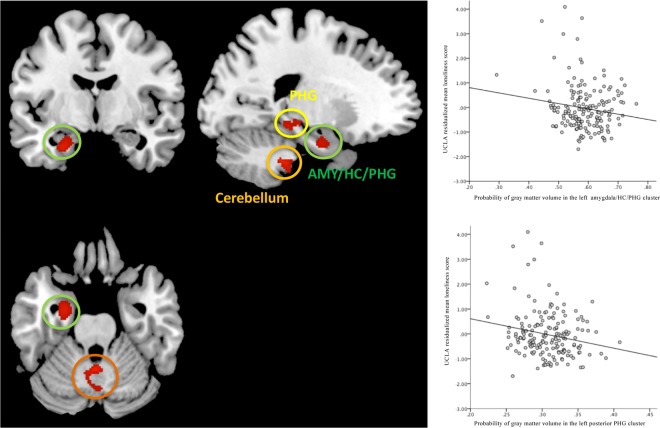
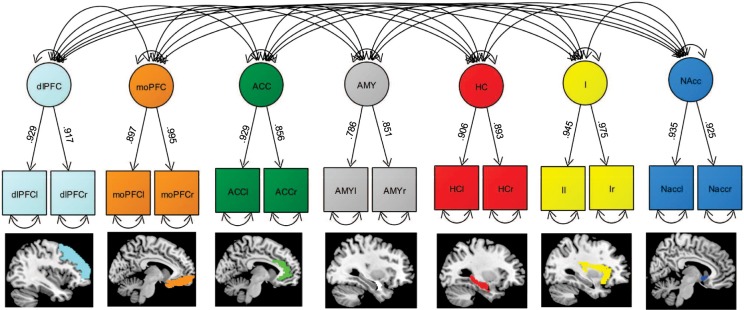
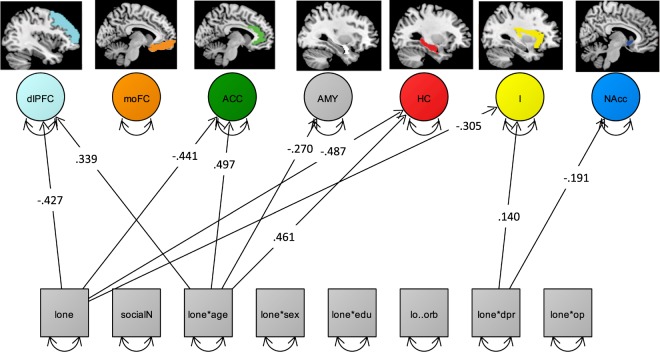
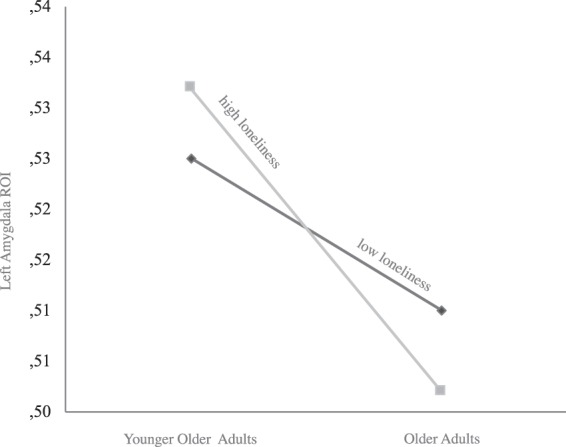
Verification
Claims the paper makes
The claims and statistics of this paper haven’t been checked yet.
Run the check — free, no account needed. It reads the open-access text and checks the sources it cites.
Claims other papers make about this one
Each is checked against this paper’s own text: does it say what the citing paper says it does?
In the citing paper
“greater loneliness has also been found to be significantly associated with reduced brain volume in areas in the left medial temporal lobe involved in memory and harshly affected by AD (10).”
From The impact of COVID-19 infection and enforced prolonged social isolation on neuropsychiatric symptoms in older adults with and without dementia: A review (2020) · cites this paper as [10]
Self-check
Percentages, sums and reported differences re-computed from the paper’s own numbers.
The self-check needs the paper’s full text.
Citations
Cites
Charlson, M. E., Pompei, P., Ales, K. L., & MacKenzie, C. R. (1987) · Journal of Chronic Diseases · doi:10.1016/0021-9681(87)90171-8 · Cited by 49,742
The need to belong: Desire for interpersonal attachments as a fundamental human motivation.
Baumeister, R. F., & Leary, M. R. (1995) · Psychological Bulletin · doi:10.1037//0033-2909.117.3.497 · Cited by 23,245
Structural Equations with Latent Variables
Bollen, K. A. (1989) · Wiley series in probability and statistics · doi:10.1002/9781118619179 · Cited by 17,944
Tzourio-Mazoyer, N., Landeau, B., Papathanassiou, D., Crivello, F., Etard, O., Delcroix, N., Mazoyer, B., & Joliot, M. (2002) · NeuroImage · doi:10.1006/nimg.2001.0978 · Cited by 16,319
From social integration to health: durkheim in the new millennium
Berkman, L. F., Glass, T., Brissette, I., & Seeman, T. E. (2000) · Social Science & Medicine · doi:10.1016/s0277-9536(00)00065-4 · Cited by 4,821
Loneliness matters: a theoretical and empirical review of consequences and mechanisms
Hawkley, L. C., & Cacioppo, J. T. (2010) · Annals of Behavioral Medicine · doi:10.1007/s12160-010-9210-8 · Cited by 4,782
Does Rejection Hurt? An fMRI Study of Social Exclusion
Eisenberger, N. I., Lieberman, M. D., & Williams, K. D. (2003) · Science · doi:10.1126/science.1089134 · Cited by 3,849
The PANAS-X: Manual for the Positive and Negative Affect Schedule - Expanded Form
Watson, D., & Clark, L. A. (1994) · doi:10.17077/48vt-m4t2 · Cited by 3,790
Ageing populations: the challenges ahead
Christensen, K., Doblhammer, G., Rau, R., & Vaupel, J. W. (2009) · The Lancet · doi:10.1016/s0140-6736(09)61460-4 · Cited by 3,011
Regional Brain Changes in Aging Healthy Adults: General Trends, Individual Differences and Modifiers
Raz, N., Lindenberger, U., Rodrigue, K. M., Kennedy, K. M., Head, D., Williamson, A., Dahle, C., Gerstorf, D., & Acker, J. D. (2005) · Cerebral Cortex · doi:10.1093/cercor/bhi044 · Cited by 2,875
Self-citation
Cited by
Sorted by citations
Items 101–111 of 111
Guenther, M. E., Lewis, J., Ebai, J. A., Elhai, J. D., Shao, Q., Wang, X., & Xie, H. (2026) · Journal of Affective Disorders Reports · doi:10.1016/j.jadr.2026.101030
The anatomy of insight: A brief review
Salvi, C. (2026) · The Cognitive Psychology Bulletin · doi:10.53841/bpscog.2026.1.11.13
Lonelier people feel less empathic despite intact neural empathy responses after meditation training
Dressel, M., Nero, N. M., Freeburg, P. A., Somers, M., Venticinque, J. S., VanMeter, J. W., Rhoads, S. A., & Marsh, A. A. (2026) · Social Cognitive and Affective Neuroscience · doi:10.1093/scan/nsag015
Liu, L., Huang, R., Shang, Y.-J., Li, S., & Cen, Y. (2026) · Cognitive Affective & Behavioral Neuroscience · doi:10.3758/s13415-026-01454-w
RetractedA policy brief on loneliness and addiction, an overlooked dual epidemic
Aghayan, S., & Mohseni, F. (2026) · Journal of Ethnicity in Substance Abuse · doi:10.1080/15332640.2026.2637613
The brain network underlying social participation: a multimodal, data-driven investigation
Casburn, M., Laighneach, A., Doherty, E., Quilligan, F., Fernandes, A., Corley, E., Donohoe, G. J., Broin, P. Ó., Morris, D. W., & Cannon, D. M. (2026) · Brain Imaging and Behavior · doi:10.1007/s11682-026-01165-3
Style przywiązania a objawy depresyjne. Rola samotności i samoregulacji
Subocz, D. (2026) · Rozprawy i Studia - Uniwersytet Szczeciński · doi:10.18276/978-83-8419-126-2
Amygdala and hippocampal volumes as neural correlates of resilience and loneliness in older adults
Hur, J. K., Shah, J. N., Huynh, N., Rashidi‐Ranjbar, N., Verhoeff, N. P. L. G., Fischer, C. E., Flint, A. J., Herrmann, N., Lanctôt, K. L., Pollock, B. G., et al. (2026) · Neurobiology of Aging · doi:10.1016/j.neurobiolaging.2026.06.011
Social disconnection in the brain: loneliness and age across networks using graph theory
Chen, Y., & Canli, T. (2026) · Oxford Open Neuroscience · doi:10.1093/oons/kvag006
Mamedova, D. I., Nedogreeva, O. A., Aniol, V. A., Kvichansky, A. A., Tret’yakova, L. V., Riga, V. D., Лазарева, Н. А., Gulyaeva, N. V., & Stepanichev, M. Y. (2026) · Neurochemical Research · doi:10.1007/s11064-026-04889-2
Martín‐Fuentes, I., Inagaki, T. K., Solis‐Urra, P., Oberlin, L. E., Sewell, K. R., Karikari, T. K., Zeng, X., Kang, C., Morris, J. K., Ripperger, H. S., et al. (2026) · GeroScience · doi:10.1007/s11357-026-02614-z
Metadata
- Authors
- Düzel, S., Drewelies, J., Gerstorf, D., Demuth, I., Steinhagen-Thiessen, E., Lindenberger, U., & Kühn, S.
- Affiliations
- Max Planck Institute for Human Development (DE)
- Humboldt-Universität zu Berlin (DE)
- University Medical Center Hamburg-Eppendorf (DE)
- Corresponding author
- Düzel, Sandra
- Venue
- Scientific Reports
- Published
- 2019-09-19
- Volume
- 9
- Issue
- 1
- Pages
- 13569-13569
- ISSN
- 2045-2322 (ISSN-L)
- PMC
- PMC6753249
- OpenAlex
- W2974655760
- Cited by
- 111
- References
- 81
- Citations by year
- 2026: 16 · 2025: 22 · 2024: 16 · 2023: 11 · 2022: 21 · 2021: 18 · 2020: 7
- FWCI
- 11.22
- Type
- journal article
- Language
- en
- Open access
- gold
- doi.org
- Locations
- Scientific Reports (publishedVersion, cc-by)
- PubMed Central (publishedVersion, cc-by)
- PubMed (publishedVersion)
- DOAJ (DOAJ: Directory of Open Access Journals) (submittedVersion)
- MPG.PuRe (Max Planck Society) (submittedVersion, other-oa)
- Funders
- Bundesministerium für Bildung und Forschung (16SV5537/16SV5837/16SV5538/16SV5536K/01UW0808/01UW0706)
- Topics
- Social Sciences › Health › Health disparities and outcomes
- Health Sciences › Medicine › Psychiatry and Mental health › Dementia and Cognitive Impairment Research
- Social Sciences › Psychology › Developmental and Educational Psychology › Aging and Gerontology Research
- Keywords
- loneliness, older adults, gray matter volume, amygdala, hippocampus, cerebellum, emotion regulation, brain structure, social network size, aging
- MeSH terms
- Aged, Aged, 80 and over, Amygdala, Brain Mapping, Female, Hippocampus, Humans, Loneliness, Magnetic Resonance Imaging, Male, Middle Aged, Multivariate Analysis, Gray Matter
About these checks
Registry, retraction, Cites and statistics results are computed, not judged, with one exception: a printed reference that no index lists is read once by a model before it counts as a citation error. Claims are extracted by a model and kept only when their quote appears verbatim in the text; each cited source is then checked, with a model’s help, for whether it says what the claim relies on. Those verdicts can be wrong — read the claim’s quote and the cited source before relying on one.
Statistics and arithmetic are recomputed, not judged.
Confidence bands are shown only for fields calibrated on our annotated test set. None is calibrated yet, so no band is shown.
What counts as a claim ›How we measure confidence ›How we check this ›
Are you an author, or do you see a problem with this page? Request a review
