

Scribble co-operatively binds multiple α1D-adrenergic receptor C-terminal PDZ ligands
Open accessThe DOI matches its Crossref record; 64 of the 64 references it cites were found in a registry or an index.
Abstract
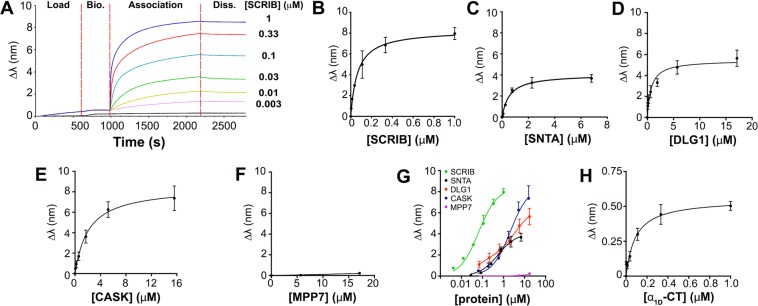
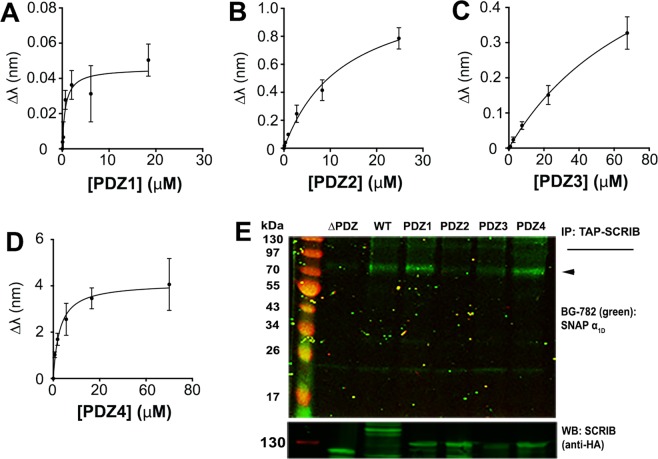
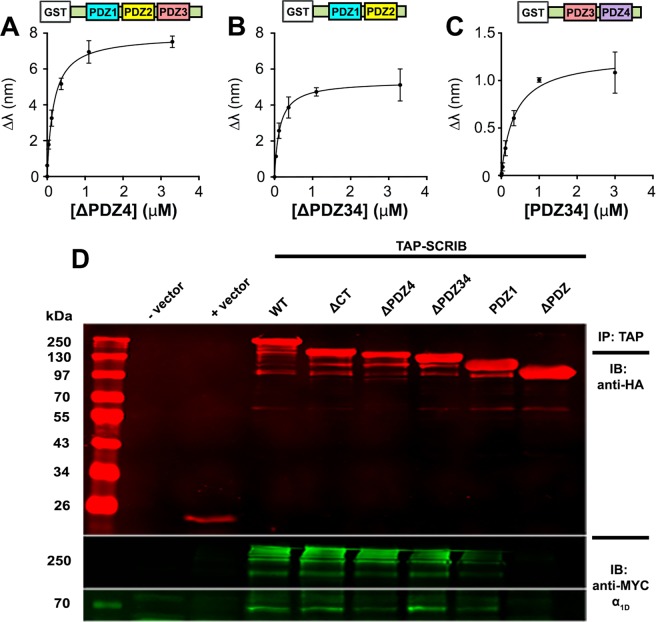
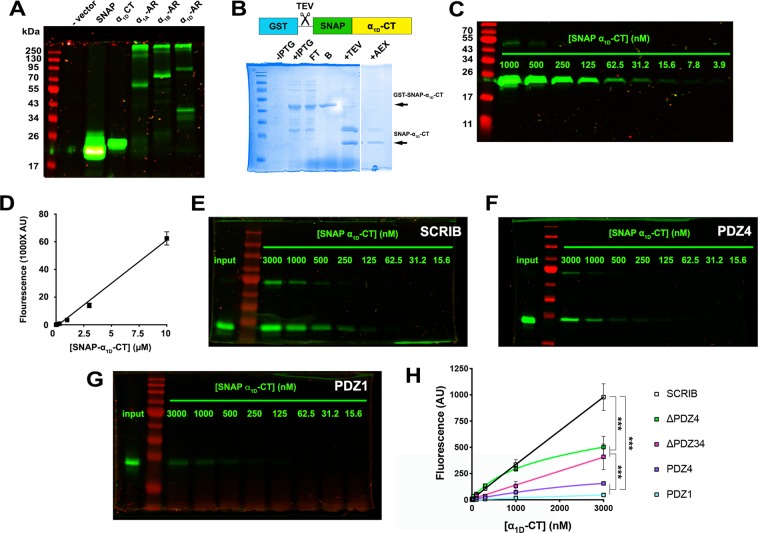
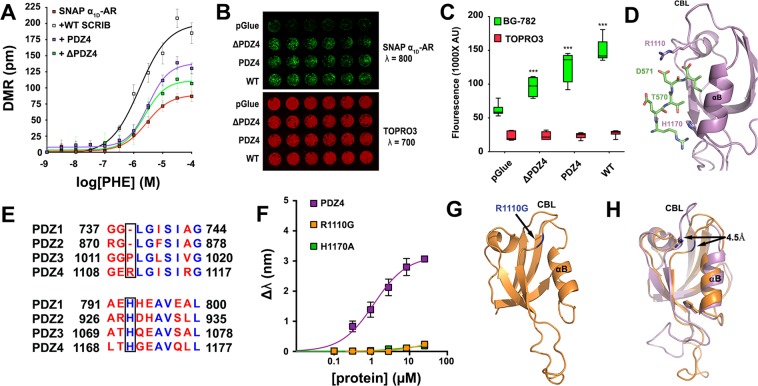
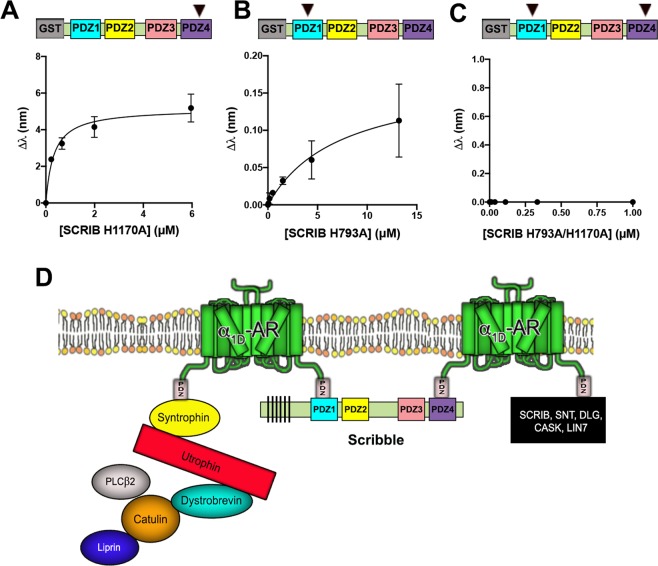
Many G protein-coupled receptors (GPCRs) are organized as dynamic macromolecular complexes in human cells. Unraveling the structural determinants of unique GPCR complexes may identify unique protein:protein interfaces to be exploited for drug development. We previously reported α 1D-adrenergic receptors (α 1D-ARs) – key regulators of cardiovascular and central nervous system function – form homodimeric, modular PDZ protein complexes with cell-type specificity. Towards mapping α 1D-AR complex architecture, biolayer interferometry (BLI) revealed the α 1D-AR C-terminal PDZ ligand selectively binds the PDZ protein scribble (SCRIB) with >8x higher affinity than known interactors syntrophin, CASK and DLG1. Complementary in situ and in vitro assays revealed SCRIB PDZ domains 1 and 4 to be high affinity α 1D-AR PDZ ligand interaction sites. SNAP-GST pull-down assays demonstrate SCRIB binds multiple α 1D-AR PDZ ligands via a co-operative mechanism. Structure-function analyses pinpoint R1110 PDZ4 as a unique, critical residue dictating SCRIB:α 1D-AR binding specificity. The crystal structure of SCRIB PDZ4 R1110G predicts spatial shifts in the SCRIB PDZ4 carboxylate binding loop dictate α 1D-AR binding specificity. Thus, the findings herein identify SCRIB PDZ domains 1 and 4 as high affinity α 1D-AR interaction sites, and potential drug targets to treat diseases associated with aberrant α 1D-AR signaling.
Overview
The claims and statistics of this paper haven’t been checked yet.
Free: it reads the open-access text and checks the first 5 claims that cite a source we can check. Create a free account to check every claim.
Integrity signals
Registry
Cites
Statistics
Figures
Verification
Claims the paper makes
The claims and statistics of this paper haven’t been checked yet.
Free: it reads the open-access text and checks the first 5 claims that cite a source we can check. Create a free account to check every claim.
Claims other papers make about this one
Each is checked against this paper’s own text: does it say what the citing paper says it does?
The source backs part of the claim, not all of it — or backs it for a different population, condition or comparison.
In the citing paper
“The finding that the isolated PDZ2 does not bind to TMIGD1 whereas the PDZ2 mutant in the context of the Scrib/PDZ domain construct impairs binding to TMIGD1 opens the possibility that regions adjacent to PDZ2 may influence ligand interactions with PDZ243,44.”
From Membrane recruitment of the polarity protein Scribble by the cell adhesion receptor TMIGD1 (2023) · cites this paper as [43]
Experimental — accuracy not yet measured
Self-check
Percentages, sums and reported differences re-computed from the paper’s own numbers.
The self-check needs the paper’s full text.
Citations
Cites
Coot : model-building tools for molecular graphics
Emsley, P., & Cowtan, K. (2004) · Acta Crystallographica Section D Biological Crystallography · doi:10.1107/s0907444904019158 · Cited by 30,571
PHENIX : a comprehensive Python-based system for macromolecular structure solution
Adams, P. D., Afonine, P. V., Bunkóczi, G., Chen, V. B., Davis, I. W., Echols, N., Headd, J. J., Hung, L.-W., Kapral, G. J., Grosse-Kunstleve, R. W., et al. (2010) · Acta Crystallographica Section D Biological Crystallography · doi:10.1107/s0907444909052925 · Cited by 23,716
Phaser crystallographic software
McCoy, A. J., Grosse-Kunstleve, R. W., Adams, P. D., Winn, M. D., Storoni, L. C., & Read, R. J. (2007) · Journal of Applied Crystallography · doi:10.1107/s0021889807021206 · Cited by 20,612
Kabsch, W. (2010) · Acta Crystallographica Section D Biological Crystallography · doi:10.1107/s0907444909047337 · Cited by 16,463
Overview of the CCP 4 suite and current developments
Winn, M. D., Ballard, C. C., Cowtan, K. D., Dodson, E. J., Emsley, P., Evans, P. R., Keegan, R. M., Krissinel, E. B., Leslie, A. G. W., McCoy, A., et al. (2011) · Acta Crystallographica Section D Biological Crystallography · doi:10.1107/s0907444910045749 · Cited by 12,353
PHENIX: a comprehensive Python-based system for macromolecular structure solution
Adams, P. D., Afonine, P. V., Bunkóczi, G., Chen, V. B., Davis, I. W., Echols, N., Headd, J. J., Hung, L.-W., Kapral, G. J., Grosse-Kunstleve, R. W., et al. (2012) · International Tables for Crystallography · doi:10.1107/97809553602060000865 · Cited by 7,334
Scaling and assessment of data quality
Evans, P. (2006) · Acta Crystallographica Section D Biological Crystallography · doi:10.1107/s0907444905036693 · Cited by 4,374
How many drug targets are there?
Overington, J. P., Al-Lazikani, B., & Hopkins, A. L. (2006) · Nature Reviews Drug Discovery · doi:10.1038/nrd2199 · Cited by 3,505
Recognition of Unique Carboxyl-Terminal Motifs by Distinct PDZ Domains
Songyang, Z., Fanning, A. S., Fu, C., Xu, J., Marfatia, S. M., Chishti, A. H., Crompton, A., Chan, A. C., Anderson, J. M., & Cantley, L. C. (1997) · Science · doi:10.1126/science.275.5296.73 · Cited by 1,385
Doyle, D. A., Lee, A., Lewis, J., Kim, E., Sheng, M., & MacKinnon, R. (1996) · Cell · doi:10.1016/s0092-8674(00)81307-0 · Cited by 1,142
A multivalent PDZ-domain protein assembles signalling complexes in a G-protein-coupled cascade
Tsunoda, S., Sierralta, J., Sun, Y., Bodner, R., Suzuki, E., Becker, A., Socolich, M., & Zuker, C. S. (1997) · Nature · doi:10.1038/40805 · Cited by 614
Hall, R. A., Premont, R. T., Chow, C.-W., Blitzer, J. T., Pitcher, J. A., Claing, A., Stoffel, R. H., Barak, L. S., Shenolikar, S., Weinman, E. J., et al. (1998) · Nature · doi:10.1038/33458 · Cited by 585
Butz, S., Okamoto, M., & Südhof, T. C. (1998) · Cell · doi:10.1016/s0092-8674(00)81736-5 · Cited by 548
Fine-tuning of GPCR activity by receptor-interacting proteins
Ritter, S. L., & Hall, R. A. (2009) · Nature Reviews Molecular Cell Biology · doi:10.1038/nrm2803 · Cited by 480
Raveh, B., London, N., & Schueler-Furman, O. (2010) · Proteins: Structure, Function, and Bioinformatics · doi:10.1002/prot.22716 · Cited by 430
Emerging paradigms of β-arrestin-dependent seven transmembrane receptor signaling
Shukla, A. K., Xiao, K., & Lefkowitz, R. J. (2011) · Trends in Biochemical Sciences · doi:10.1016/j.tibs.2011.06.003 · Cited by 418
Rosetta FlexPepDock web server—high resolution modeling of peptide–protein interactions
London, N., Raveh, B., Cohen, E., Fathi, G., & Schueler-Furman, O. (2011) · Nucleic Acids Research · doi:10.1093/nar/gkr431 · Cited by 402
Trial of prazosin for post-traumatic stress disorder in military veterans
Raskind, M. A., Peskind, E. R., Chow, B., Harris, C., Davis-Karim, A., Holmes, H. A., Hart, K. L., McFall, M., Mellman, T. A., Reist, C., et al. (2018) · New England Journal of Medicine · doi:10.1056/nejmoa1507598 · Cited by 342
SNX27 mediates PDZ-directed sorting from endosomes to the plasma membrane
Lauffer, B. E. L., Melero, C., Temkin, P., Lei, C., Hong, W., Kortemme, T., & von Zastrow, M. (2010) · Journal of Cell Biology · doi:10.1083/jcb.201004060 · Cited by 260
PDZ domain of neuronal nitric oxide synthase recognizes novel C-terminal peptide sequences
Stricker, N. L., Christopherson, K. S., Yi, B. A., Schatz, P. J., Raab, R. W., Dawes, G., Bassett, D. E., Bredt, D. S., & Li, M. (1997) · Nature Biotechnology · doi:10.1038/nbt0497-336 · Cited by 256
Borg, J.-P., Straight, S. W., Kaech, S. M., de Taddéo-Borg, M., Kroon, D. E., Karnak, D., Turner, R. S., Kim, S. K., & Margolis, B. (1998) · Journal of Biological Chemistry · doi:10.1074/jbc.273.48.31633 · Cited by 192
MODULATION OF BLADDER α1-ADRENERGIC RECEPTOR SUBTYPE EXPRESSION BY BLADDER OUTLET OBSTRUCTION
HAMPEL, C., DOLBER, P. C., SMITH, M. P., SAVIC, S. L., THÜROFF, J. W., THOR, K. B., & SCHWINN, D. A. (2002) · Journal of Urology · doi:10.1016/s0022-5347(05)65355-4 · Cited by 173
Romero, G., von Zastrow, M., & Friedman, P. A. (2011) · Advances in Pharmacology · doi:10.1016/b978-0-12-385952-5.00003-8 · Cited by 172
Grootjans, J. J., Reekmans, G., Ceulemans, H., & David, G. (2000) · Journal of Biological Chemistry · doi:10.1074/jbc.m002459200 · Cited by 170
Hague, C., Uberti, M. A., Chen, Z., Hall, R. A., & Minneman, K. P. (2004) · Journal of Biological Chemistry · doi:10.1074/jbc.m314014200 · Cited by 157
Self-citationScribble associates with two polarity proteins, Lgl2 and Vangl2, via distinct molecular domains
Kallay, L. M., McNickle, A., Brennwald, P. J., Hubbard, A. L., & Braiterman, L. T. (2006) · Journal of Cellular Biochemistry · doi:10.1002/jcb.20992 · Cited by 156
Supramodular structure and synergistic target binding of the N-terminal tandem PDZ domains of PSD-95
Long, J., Tochio, H., Wang, P., Fan, J., Sala, C., Niethammer, M., Sheng, M., & Zhang, M. (2003) · Journal of Molecular Biology · doi:10.1016/s0022-2836(03)00113-x · Cited by 154
Xu, J., Paquet, M., Lau, A. G., Wood, J. D., Ross, C. A., & Hall, R. A. (2001) · Journal of Biological Chemistry · doi:10.1074/jbc.m107480200 · Cited by 147
Lee, S., Fan, S., Makarova, O., Straight, S., & Margolis, B. (2002) · Molecular and Cellular Biology · doi:10.1128/mcb.22.6.1778-1791.2002 · Cited by 145
Mathew, D., Gramates, L. S., Packard, M., Thomas, U., Bilder, D., Perrimon, N., Gorczyca, M., & Budnik, V. (2002) · Current Biology · doi:10.1016/s0960-9822(02)00758-3 · Cited by 134
Stephens, R., Lim, K., Portela, M., Kvansakul, M., Humbert, P. O., & Richardson, H. E. (2018) · Journal of Molecular Biology · doi:10.1016/j.jmb.2018.01.011 · Cited by 132
PDZ Protein Regulation of G Protein–Coupled Receptor Trafficking and Signaling Pathways
Dunn, H. A., & Ferguson, S. S. G. (2015) · Molecular Pharmacology · doi:10.1124/mol.115.098509 · Cited by 128
Walden, P. D., GERARDI, C., & Lepor, H. (1999) · The Journal of Urology · doi:10.1016/s0022-5347(01)61986-4 · Cited by 100
The nNOS-p38MAPK Pathway Is Mediated by NOS1AP during Neuronal Death
Li, L.-L., Ginet, V., Liu, X., Vergun, O., Tuittila, M., Mathieu, M., Bonny, C., Puyal, J., Truttmann, A. C., & Courtney, M. J. (2013) · The Journal of Neuroscience · doi:10.1523/jneurosci.4578-12.2013 · Cited by 98
Stucke, V. M., Timmerman, E., Vandekerckhove, J., Gevaert, K., & Hall, A. (2007) · Molecular Biology of the Cell · doi:10.1091/mbc.e06-11-0980 · Cited by 90
Olson, V. G., Rockett, H. R., Reh, R. K., Redila, V. A., Tran, P. M., Venkov, H. A., DeFino, M. C., Hague, C., Peskind, E. R., Szot, P., et al. (2011) · Biological Psychiatry · doi:10.1016/j.biopsych.2010.11.029 · Cited by 89
Self-citationThe Binding of the PDZ Tandem of Syntenin to Target Proteins,
Grembecka, J., Cierpicki, T., Devedjiev, Y., Derewenda, U., Kang, B. S., Bushweller, J. H., & Derewenda, Z. S. (2006) · Biochemistry · doi:10.1021/bi052225y · Cited by 87
NOS1AP associates with Scribble and regulates dendritic spine development
Richier, L., Williton, K., Clattenburg, L., Colwill, K., O'Brien, M., Tsang, C., Kolar, A., Zinck, N., Metalnikov, P., Trimble, W. S., et al. (2010) · The Journal of Neuroscience · doi:10.1523/jneurosci.3726-09.2010 · Cited by 81
The PDZ Protein Mupp1 Promotes Gi Coupling and Signaling of the Mt1 Melatonin Receptor
Guillaume, J.-L., Daulat, A. M., Maurice, P., Levoye, A., Migaud, M., Brydon, L., Malpaux, B., Borg-Capra, C., & Jockers, R. (2008) · Journal of Biological Chemistry · doi:10.1074/jbc.m802069200 · Cited by 77
Takizawa, S., Nagasaka, K., Nakagawa, S., Yano, T., Nakagawa, K., Yasugi, T., Takeuchi, T., Kanda, T., Huibregtse, J. M., Akiyama, T., et al. (2006) · Genes to Cells · doi:10.1111/j.1365-2443.2006.00954.x · Cited by 77
Gage, R. M., Matveeva, E. A., Whiteheart, S. W., & von Zastrow, M. (2005) · Journal of Biological Chemistry · doi:10.1074/jbc.m406934200 · Cited by 67
Phosphorylation-dependent interaction between tumor suppressors Dlg and Lgl
Zhu, J., Shang, Y., Wan, Q., Xia, Y., Chen, J., Du, Q., & Zhang, M. (2014) · Cell Research · doi:10.1038/cr.2014.16 · Cited by 64
Blood Pressure Is Regulated by an α1D-Adrenergic Receptor/Dystrophin Signalosome
Lyssand, J. S., DeFino, M. C., Tang, X.-B., Hertz, A. L., Feller, D. B., Wacker, J. L., Adams, M. E., & Hague, C. (2008) · Journal of Biological Chemistry · doi:10.1074/jbc.m801860200 · Cited by 60
Self-citationZheng, W., Umitsu, M., Jagan, I., Tran, C. W., Ishiyama, N., BeGora, M., Araki, K., Ohashi, P. S., Ikura, M., & Muthuswamy, S. K. (2016) · Nature Cell Biology · doi:10.1038/ncb3413 · Cited by 60
Peptides Targeting the PDZ Domain of PTPN4 Are Efficient Inducers of Glioblastoma Cell Death
Babault, N., Cordier, F., Lafage, M., Cockburn, J. J. B., Haouz, A., Prehaud, C. J. N., Rey, F. A., Delepierre, M., BUC, H. C., Lafon, M., et al. (2011) · Structure · doi:10.1016/j.str.2011.07.007 · Cited by 55
Scribble1/AP2 complex coordinates NMDA receptor endocytic recycling
Piguel, N. H., Fievre, S., Blanc, J.-M., Carta, M., Moreau, M. M., Moutin, E., Pinheiro, V. L., Medina, C., Ezan, J., Lasvaux, L., et al. (2014) · Cell Reports · doi:10.1016/j.celrep.2014.09.017 · Cited by 52
Syntrophins Regulate α1D-Adrenergic Receptors through a PDZ Domain-mediated Interaction
Chen, Z., Hague, C., Hall, R. A., & Minneman, K. P. (2006) · Journal of Biological Chemistry · doi:10.1074/jbc.m508651200 · Cited by 51
Self-citationLiu, J., Julnes, P. S., Chen, J., Ehrlich, S., Walton, E., & Calhoun, V. D. (2015) · Schizophrenia Research · doi:10.1016/j.schres.2015.08.035 · Cited by 38
Carey, L. M., Lee, W.-H., Gutierrez, T., Kulkarni, P. M., Thakur, G. A., Lai, Y. Y., & Hohmann, A. G. (2017) · Neuroscience · doi:10.1016/j.neuroscience.2017.02.055 · Cited by 35
The polarity protein Scribble positions DLC3 at adherens junctions to regulate Rho signaling
Hendrick, J., Franz-Wachtel, M., Moeller, Y., Schmid, S., Macek, B., & Olayioye, M. A. (2016) · Journal of Cell Science · doi:10.1242/jcs.190074 · Cited by 32
Endogenous N-terminal Domain Cleavage Modulates α1D-Adrenergic Receptor Pharmacodynamics
Kountz, T. S., Lee, K.-S., Aggarwal-Howarth, S., Curran, E. C., Park, J.-M., Harris, D.-A., Stewart, A., Hendrickson, J., Camp, N. D., Wolf‐Yadlin, A., et al. (2016) · Journal of Biological Chemistry · doi:10.1074/jbc.m116.729517 · Cited by 31
Self-citationLyssand, J. S., Whiting, J. L., Lee, K.-S., Kastl, R., Wacker, J. L., Bruchas, M. R., Miyatake, M., Langeberg, L. K., Chavkin, C., Scott, J. D., et al. (2010) · Proceedings of the National Academy of Sciences · doi:10.1073/pnas.1010819107 · Cited by 28
Self-citationDisruption of nNOS–NOS1AP protein–protein interactions suppresses neuropathic pain in mice
Lee, W.-H., Li, L., Chawla, A., Hudmon, A., Lai, Y. Y., Courtney, M. J., & Hohmann, A. G. (2018) · Pain · doi:10.1097/j.pain.0000000000001152 · Cited by 25
Interdomain interface-mediated target recognition by the Scribble PDZ34 supramodule
Ren, J., Feng, L., Bai, Y., Pei, H., Yuan, Z., & Feng, W. (2015) · Biochemical Journal · doi:10.1042/bj20141473 · Cited by 21
Petrovska, R., Kāpa, I., Kloviņš, J., Schiöth, H. B., & Uhlén, S. (2005) · British Journal of Pharmacology · doi:10.1038/sj.bjp.0706087 · Cited by 21
Garcı́a-Cazarı́n, M. L., Smith, J. L., Olszewski, K. A., McCune, D. F., Simmerman, L. A., Hadley, R. W., Kraner, S. D., & Piascik, M. T. (2008) · Journal of Molecular Signaling · doi:10.1186/1750-2187-3-6 · Cited by 21
Individual protomers of a G protein-coupled receptor dimer integrate distinct functional modules
Camp, N. D., Lee, K.-S., Wacker-Mhyre, J. L., Kountz, T. S., Park, J.-M., Harris, D.-A., Estrada, M., Stewart, A., Wolf‐Yadlin, A., & Hague, C. (2015) · Cell Discovery · doi:10.1038/celldisc.2015.11 · Cited by 20
Self-citationLee, W.-H., Carey, L. M., Li, L., Xu, Z., Lai, Y. Y., Courtney, M. J., & Hohmann, A. G. (2018) · Molecular Pain · doi:10.1177/1744806918801224 · Cited by 20
Camp, N. D., Lee, K.-S., Cherry, A. E., Wacker-Mhyre, J. L., Kountz, T. S., Park, J.-M., Harris, D.-A., Estrada, M., Stewart, A., Stella, N., et al. (2016) · Pharmacological Research · doi:10.1016/j.phrs.2016.01.003 · Cited by 14
Self-citationSever, P. (1999) · Current Medical Research and Opinion · doi:10.1185/03007999909113369 · Cited by 13
Mamonova, T., Zhang, Q., Chandra, M., Collins, B. M., Sarfo, E. K., Bu, Z., Xiao, K., Bisello, A., & Friedman, P. A. (2017) · Biochemistry · doi:10.1021/acs.biochem.7b00078 · Cited by 13
Syntrophin isoforms play specific functional roles in the α1D-adrenergic receptor/DAPC signalosome
Lyssand, J. S., Lee, K.-S., DeFino, M. C., Adams, M. E., & Hague, C. (2011) · Biochemical and Biophysical Research Communications · doi:10.1016/j.bbrc.2011.08.004 · Cited by 11
Self-citationThe binding affinity of PTPN13’s tandem PDZ2/3 domain is allosterically modulated
Dicks, M., Kock, G., Kohl, B., Zhong, X., Pütz, S., Heumann, R., Erdmann, K. S., & Stoll, R. (2019) · BMC Molecular and Cell Biology · doi:10.1186/s12860-019-0203-6 · Cited by 8
Doxazosin dropped from ALLHAT study
Miller, J. L. (2000) · American Journal of Health-System Pharmacy · doi:10.1093/ajhp/57.8.718 · Cited by 2
Cited by
Li, Q., Yin, G., Wang, J., Li, L., Liang, Q., Zhao, X., Chen, Y., Zheng, X., & Zhao, X. (2022) · TrAC Trends in Analytical Chemistry · doi:10.1016/j.trac.2022.116728 · Cited by 32
Predicting Drug-Target Interaction Via Self-Supervised Learning
Chen, J., Zhang, L., Cheng, K., Jin, B., Lu, X., & Che, C. (2022) · IEEE Transactions on Computational Biology and Bioinformatics · doi:10.1109/tcbb.2022.3153963 · Cited by 31
“structure-based (or molecular docking-based) strategy [4], the ligand-based strategy [5] and machine learning-based approaches [1], [2], [6], [7], [8], [9].”
MethodUnraveling the Functional Significance of Unstructured Regions in G Protein-Coupled Receptors
Maggio, R., Fasciani, I., Petragnano, F., Coppolino, M. F., Scarselli, M., & Rossi, M. (2023) · Biomolecules · doi:10.3390/biom13101431 · Cited by 23
“As mentioned earlier, the free COOH-terminal peptide of the C-terminus of several GPCRs have the ability to bind PDZ domains [57,58].”
BackgroundChristensen, N. R., Pedersen, C. P., Sereikaité, V., Pedersen, J. N., Vistrup-Parry, M., Sørensen, A. T., Otzen, D. E., Teilum, K., Madsen, K. L., & Strømgaard, K. (2022) · iScience · doi:10.1016/j.isci.2022.103808 · Cited by 16
Janezic, E. M., Lauer, S. M., Williams, R. G., Chungyoun, M., Lee, K.-S., Navaluna, E. D., Lau, H.-T., Ong, S., & Hague, C. (2020) · Scientific Reports · doi:10.1038/s41598-020-64102-4 · Cited by 15
Self-citation
Metadata
- Authors
- Janezic, E. M., Harris, D.-A., Dinh, D., Lee, K.-S., Stewart, A., Hinds, T. R., Hsu, P. L., Zheng, N., & Hague, C.
- Affiliations
- University of Washington (US)
- Howard Hughes Medical Institute (US)
- Corresponding author
- Hague, Chris
- Venue
- Scientific Reports
- Published
- 2019-10-01
- Volume
- 9
- Issue
- 1
- Pages
- 14073-14073
- ISSN
- 2045-2322 (ISSN-L)
- PMC
- PMC6773690
- OpenAlex
- W2977907496
- Cited by
- 15
- References
- 64
- Citations by year
- 2026: 1 · 2025: 1 · 2024: 1 · 2023: 4 · 2022: 4 · 2021: 2 · 2020: 2
- FWCI
- 0.66
- Type
- journal article
- Language
- en
- Open access
- gold
- doi.org
- Licence
- cc-by
- creativecommons.org/licenses/by/4.0 (tdm)
- creativecommons.org/licenses/by/4.0 (vor)
- Locations
- Scientific Reports (publishedVersion, cc-by)
- PubMed Central (publishedVersion, cc-by)
- PubMed (publishedVersion)
- DOAJ (DOAJ: Directory of Open Access Journals) (submittedVersion)
- Funders
- U.S. Department of Health & Human Services | NIH | National Institute of General Medical Sciences (T32GM007750, R01GM100893)
- Howard Hughes Medical Institute
- Topics
- Life Sciences › Biochemistry, Genetics and Molecular Biology › Molecular Biology › Receptor Mechanisms and Signaling
- Life Sciences › Neuroscience › Cellular and Molecular Neuroscience › Neuroscience and Neuropharmacology Research
- Life Sciences › Biochemistry, Genetics and Molecular Biology › Molecular Biology › Protein Kinase Regulation and GTPase Signaling
- Keywords
- alpha1D-adrenergic receptor, Scribble, PDZ ligand, receptor homodimerization, syntrophin, CASK, DLG1, binding specificity, protein-protein interaction, therapeutic target
- MeSH terms
- Binding Sites, Humans, Interferometry, Membrane Proteins, Structure-Activity Relationship, Receptors, Adrenergic, alpha-1, Crystallography, X-Ray, Tumor Suppressor Proteins, Immunoprecipitation, PDZ Domains, HEK293 Cells, Molecular Docking Simulation
About these checks
Registry, retraction, Cites and statistics results are computed, not judged, with one exception: a printed reference that no index lists is read once by a model before it counts as a citation error. Claims are extracted by a model and kept only when their quote appears verbatim in the text; each cited source is then checked, with a model’s help, for whether it says what the claim relies on. Those verdicts can be wrong — read the claim’s quote and the cited source before relying on one.
Statistics and arithmetic are recomputed, not judged.
Confidence bands are shown only for fields calibrated on our annotated test set. None is calibrated yet, so no band is shown.
What counts as a claim ›How we measure confidence ›How we check this ›
Are you an author, or do you see a problem with this page? Request a review
Data sources
Bibliographic data: Semantic Scholar, OpenAlex, Crossref.
Contains information from the Semantic Scholar Academic Graph Datasets, made available under the ODC Attribution License (ODC-BY 1.0).
Semantic Scholar’s data is described in: Kinney, R., et al. (2023). The Semantic Scholar Open Data Platform. arXiv:2301.10140.
