

Intrinsic Functional Connectivity is Organized as Three Interdependent Gradients
Open accessThe DOI matches its Crossref record; 153 of the 154 references it cites were found in a registry or an index.
Abstract
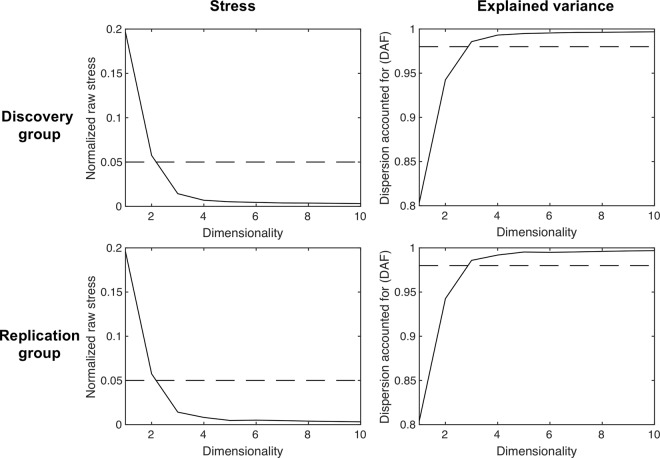
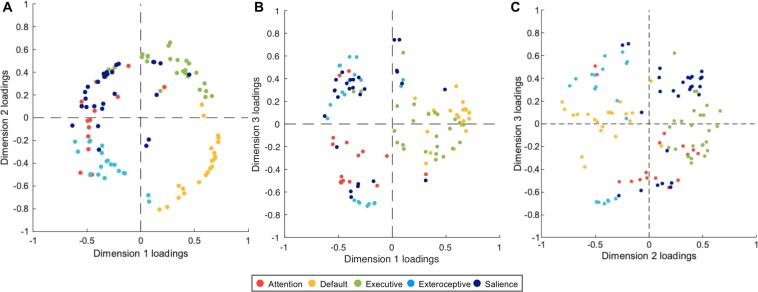
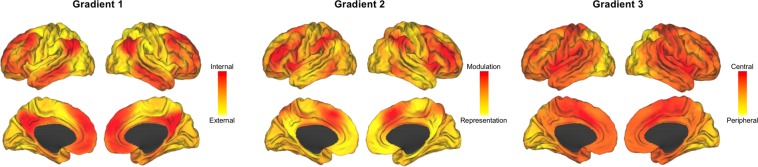
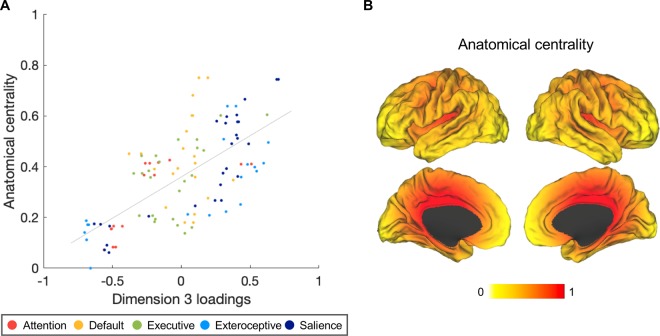
The intrinsic functional architecture of the brain supports moment-to-moment maintenance of an internal model of the world. We hypothesized and found three interdependent architectural gradients underlying the organization of intrinsic functional connectivity within the human cerebral cortex. We used resting state fMRI data from two samples of healthy young adults (N’s = 280 and 270) to generate functional connectivity maps of 109 seeds culled from published research, estimated their pairwise similarities, and multidimensionally scaled the resulting similarity matrix. We discovered an optimal three-dimensional solution, accounting for 98% of the variance within the similarity matrix. The three dimensions corresponded to three gradients, which spatially correlate with two functional features (external vs. internal sources of information; content representation vs. attentional modulation) and one structural feature (anatomically central vs. peripheral) of the brain. Remapping the three dimensions into coordinate space revealed that the connectivity maps were organized in a circumplex structure, indicating that the organization of intrinsic connectivity is jointly guided by graded changes along all three dimensions. Our findings emphasize coordination between multiple, continuous functional and anatomical gradients, and are consistent with the emerging predictive coding perspective.
Overview
The claims and statistics of this paper haven’t been checked yet.
Free: it reads the open-access text and checks the first 5 claims that cite a source we can check. Create a free account to check every claim.
Integrity signals
Registry
Cites
Statistics
Figures
Verification
Claims the paper makes
The claims and statistics of this paper haven’t been checked yet.
Free: it reads the open-access text and checks the first 5 claims that cite a source we can check. Create a free account to check every claim.
Claims other papers make about this one
Each is checked against this paper’s own text: does it say what the citing paper says it does?
The cited source says what the claim attributes to it.
In the citing paper
“Predictive processing to guide the performance of allostasis is rooted in the brain's cortical cytoarchitecture.”
From A new science of emotion: implications for functional neurological disorder (2022) · cites this paper as [128]
The cited source says what the claim attributes to it.
In the citing paper
“Predictions in the cortex run from less laminated structures (i.e.four-layered agranular tissue referred to as limbic cortices including: ventral anterior insula, cingulate and posterior orbitofrontal/ventromedial prefrontal cortex; and the primary motor cortex with a small granular layer) to higher laminated structures (i.e.six-layered eulaminate areas such as the mid-to-posterior insula as the p”
From A new science of emotion: implications for functional neurological disorder (2022) · cites this paper as [128]
Self-check
Percentages, sums and reported differences re-computed from the paper’s own numbers.
The self-check needs the paper’s full text.
Citations
Cites
Control of goal-directed and stimulus-driven attention in the brain
Corbetta, M., & Shulman, G. L. (2002) · Nature Reviews Neuroscience · doi:10.1038/nrn755 · Cited by 12,881
An Integrative Theory of Prefrontal Cortex Function
Miller, E. K., & Cohen, J. D. (2001) · Annual Review of Neuroscience · doi:10.1146/annurev.neuro.24.1.167 · Cited by 12,803
Functional connectivity in the motor cortex of resting human brain using echo‐planar mri
Biswal, B., Zerrin Yetkin, F., Haughton, V. M., & Hyde, J. S. (1995) · Magnetic Resonance in Medicine · doi:10.1002/mrm.1910340409 · Cited by 9,812
The organization of the human cerebral cortex estimated by intrinsic functional connectivity
Thomas Yeo, B. T., Krienen, F. M., Sepulcre, J., Sabuncu, M. R., Lashkari, D., Hollinshead, M., Roffman, J. L., Smoller, J. W., Zöllei, L., Polimeni, J. R., et al. (2011) · Journal of Neurophysiology · doi:10.1152/jn.00338.2011 · Cited by 9,182
The human brain is intrinsically organized into dynamic, anticorrelated functional networks
Fox, M. D., Snyder, A. Z., Vincent, J. L., Corbetta, M., Van Essen, D. C., & Raichle, M. E. (2005) · Proceedings of the National Academy of Sciences · doi:10.1073/pnas.0504136102 · Cited by 8,553
The free-energy principle: a unified brain theory?
Friston, K. (2010) · Nature Reviews Neuroscience · doi:10.1038/nrn2787 · Cited by 8,120
Dissociable intrinsic connectivity networks for salience processing and executive control
Seeley, W. W., Menon, V., Schatzberg, A. F., Keller, J., Glover, G. H., Kenna, H., Reiss, A. L., & Greicius, M. D. (2007) · The Journal of Neuroscience · doi:10.1523/jneurosci.5587-06.2007 · Cited by 7,426
The organization of the human cerebellum estimated by intrinsic functional connectivity
Buckner, R. L., Krienen, F. M., Castellanos, A., Diaz, J. C., & Yeo, B. T. T. (2011) · Journal of Neurophysiology · doi:10.1152/jn.00339.2011 · Cited by 7,304
Spontaneous fluctuations in brain activity observed with functional magnetic resonance imaging
Fox, M. D., & Raichle, M. E. (2007) · Nature Reviews Neuroscience · doi:10.1038/nrn2201 · Cited by 6,700
Functional connectivity in the resting brain: a network analysis of the default mode hypothesis
Greicius, M. D., Krasnow, B., Reiss, A. L., & Menon, V. (2003) · Proceedings of the National Academy of Sciences · doi:10.1073/pnas.0135058100 · Cited by 6,358
Research works printed but not linked: 4
- Davison, M. L. Multidimensional Scaling. (John Wiley & Sons Inc, 1983).
- Guttman, L. In Mathematical thinking in the social sciences (ed Lazarsfeld, P. F.) 258–348 (Columbia University Press, 1957).
- Larsen, R. J. & Diener, E. Promises and problems with the circumplex model of emotion., Vol. 13 25–59 (Sage, 1992).
- Mesulam, M. M. Patterns in behavioral neuroanatomy. Association area, the limbic system, and hemispheric specialization., 1–70 (Oxford University Press, 1985).
Cited by
Dispersion of functional gradients across the adult lifespan
Bethlehem, R. A. I., Paquola, C., Seidlitz, J., Ronan, L., Bernhardt, B., Consortium, C.-C., & Tsvetanov, K. A. (2020) · NeuroImage · doi:10.1016/j.neuroimage.2020.117299 · Cited by 217
“This data-driven procedure resulted in sensory-transmodal and somatomotor-visual functional gradients that closely correspond with previous studies (Margulies et al., 2016; Zhang et al., 2019; Hong et al., 2020), however, the third functional gradient depicted a more restricted pattern than previous studies.”
A new science of emotion: implications for functional neurological disorder
Jungilligens, J., Paredes-Echeverri, S., Popkirov, S., Barrett, L. F., & Perez, D. L. (2022) · Brain · doi:10.1093/brain/awac204 · Cited by 164
Self-citationThe secret life of predictive brains: what’s spontaneous activity for?
Pezzulo, G., Zorzi, M., & Corbetta, M. (2021) · Trends in Cognitive Sciences · doi:10.1016/j.tics.2021.05.007 · Cited by 163
What have we really learned from functional connectivity in clinical populations?
Zhang, J., Kucyi, A., Raya, J., Nielsen, A. N., Nomi, J. S., Damoiseaux, J. S., Greene, D. J., Horovitz, S. G., Uddin, L. Q., & Whitfield, S. (2021) · NeuroImage · doi:10.1016/j.neuroimage.2021.118466 · Cited by 142
“…method that also circumvents idiosyncrasies in aming conventions is gradient-based FC approaches ( Guell et al., 2018 ; argulies et al., 2016 ; Tian et al., 2020 ; Zhang et al., 2019 ), which se dimension-reduction techniques to show the relationship between rain topology and FC organization.”
Self-citationInteroception as modeling, allostasis as control
Sennesh, E., Theriault, J., Brooks, D., van de Meent, J.-W., Barrett, L. F., & Quigley, K. S. (2022) · Biological Psychology · doi:10.1016/j.biopsycho.2021.108242 · Cited by 107
Self-citationDynamic expression of brain functional systems disclosed by fine-scale analysis of edge time series
Sporns, O., Faskowitz, J., Teixeira, A. S., Cutts, S. A., & Betzel, R. F. (2021) · Network Neuroscience · doi:10.1162/netn_a_00182 · Cited by 96
Allostasis, action and affect in depression: Insights from the theory of constructed emotion
Shaffer, C., Westlin, C., Quigley, K. S., Whitfield-Gabrieli, S., & Barrett, L. F. (2022) · Annual Review of Clinical Psychology · doi:10.1146/annurev-clinpsy-081219-115627 · Cited by 94
“This hypothesis is consistent with functional evidence that brain activity is organized along a similar gradient (e.g., Katsumi et al. 2021 and references therein, Zhang et al. 2019).”
BackgroundSelf-citationTschantz, A., Barca, L., Maisto, D., Buckley, C. L., Seth, A. K., & Pezzulo, G. (2022) · Biological Psychology · doi:10.1016/j.biopsycho.2022.108266 · Cited by 124
Katsumi, Y., Kamona, N., Zhang, J., Bunce, J. G., Hutchinson, J. B., Yarossi, M., Tunik, E., Quigley, K. S., Dickerson, B. C., & Barrett, L. F. (2021) · doi:10.1101/2021.09.01.456844 · Cited by 89
“To interpret the correspondence between cerebellar/hippocampal and cerebral cortical connectivity gradients, we computed gradient-weighted functional connectivity in cortical space 36,59 and quantified the degree of spatial correlation while non-parametrically accounting for autocorrelations 63 .”
BackgroundMethodResultInfluentialSelf-citation(2023) · doi:10.1038/s42003-023-04796-0 · Cited by 89
Self-citationAllostasis as a core feature of hierarchical gradients in the human brain
Katsumi, Y., Theriault, J. E., Quigley, K. S., & Barrett, L. F. (2022) · Network Neuroscience · doi:10.1162/netn_a_00240 · Cited by 88
“…architecture (for example, a lamination gradient in the cerebral cortex; e.g., Barbas, 2015; Hilgetag & Goulas, 2020; Margulies et al., 2016; Zhang et al., 2019), and (b) predictive regulation of the body’s energy resources, called allostasis (Schulkin & Sterling, 2019; Sennesh et al.,…”
BackgroundSelf-citationSong, H., Shim, W. M., & Rosenberg, M. D. (2023) · eLife · doi:10.7554/elife.85487 · Cited by 87
Seewoo, B. J., Joos, A., & Feindel, K. W. (2020) · Neuroscience Research · doi:10.1016/j.neures.2020.05.006 · Cited by 56
Spontaneous neuronal oscillations in the human insula are hierarchically organized traveling waves
Das, A., Myers, J. C., Mathura, R. K., Shofty, B., Metzger, B. A., Bijanki, K. R., Wu, C., Jacobs, J., & Sheth, S. A. (2022) · eLife · doi:10.7554/elife.76702 · Cited by 49
“Global brain intrinsic gradients have been known to be closely associated with the structural connectivity of the brain areas and the degree of task-related activations ( Huntenburg et al., 2018 ; Paquola et al., 2019 ; Zhang et al., 2019 ).”
It’s not the thought that counts: Allostasis at the core of brain function
Theriault, J. E., Katsumi, Y., Reimann, H. M., Zhang, J., Deming, P., Dickerson, B. C., Quigley, K. S., & Barrett, L. F. (2025) · Neuron · doi:10.1016/j.neuron.2025.09.028 · Cited by 74
Self-citationA dynamic gradient architecture generates brain activity states
Brown, J. A., Lee, A. J., Pasquini, L., & Seeley, W. W. (2022) · NeuroImage · doi:10.1016/j.neuroimage.2022.119526 · Cited by 43
“Recent work indicates that these dimensions reflect gradients of continuous spatial variation in regional functional connectivity (Haak et al., 2018; Margulies et al., 2016; Zhang et al., 2019) and cytoarchitecture (Burt et al.”
BackgroundResultAnterior dorsal attention network tau drives visual attention deficits in posterior cortical atrophy
Katsumi, Y., Putcha, D., Eckbo, R., Wong, B., Quimby, M., McGinnis, S. M., Touroutoglou, A., & Dickerson, B. C. (2022) · Brain · doi:10.1093/brain/awac245 · Cited by 37
Self-citationKatsumi, Y., Kondo, N., Dolcos, S. M., Dolcos, F., & Tsukiura, T. (2020) · NeuroImage · doi:10.1016/j.neuroimage.2020.117650 · Cited by 34
Self-citationDefault mode network tau predicts future clinical decline in atypical early Alzheimer’s disease
Katsumi, Y., Howe, I., Eckbo, R., Wong, B., Quimby, M., Hochberg, D., McGinnis, S. M., Putcha, D., Wolk, D. A., Touroutoglou, A., et al. (2024) · Brain · doi:10.1093/brain/awae327 · Cited by 32
Self-citationAn optomechanogram for assessment of the structural and mechanical properties of tissues
Lee, W., Moghaddam, A. O., Shen, S., Phillips, H., McFarlin, B. L., Johnson, A. J. W., & Toussaint, K. C. (2021) · Scientific Reports · doi:10.1038/s41598-020-79602-6 · Cited by 22
A consideration of physiological regulation from the perspective of Bayesian enactivism
Colditz, I. G. (2019) · Physiology & Behavior · doi:10.1016/j.physbeh.2019.112758 · Cited by 23
Functional hierarchy of the human neocortex across the lifespan
Taylor, H. P., Huynh, K. M., Thung, K., Lin, G., Lyu, W., Lin, W., Ahmad, S., & Yap, P. (2026) · Nature · doi:10.1038/s41586-026-10219-x · Cited by 44
Altered functional connectivity of cortical networks in semantic variant primary progressive aphasia
Popal, H., Quimby, M., Hochberg, D., Dickerson, B. C., & Collins, J. A. (2020) · NeuroImage: Clinical · doi:10.1016/j.nicl.2020.102494 · Cited by 18
Self-citationTschantz, A., Barca, L., Maisto, D., Buckley, C. L., Seth, A. K., & Pezzulo, G. (2021) · bioRxiv (Cold Spring Harbor Laboratory) · doi:10.1101/2021.02.16.431365 · Cited by 18
The secret life of predictive brains: what's spontaneous activity for?Preprint
Pezzulo, G., Zorzi, M., & Corbetta, M. (2020) · PsyArXiv (OSF Preprints) · doi:10.31234/osf.io/qus3h · Cited by 19
Brain topology underlying executive functions across the lifespan: focus on the default mode network
Menardi, A., Spoa, M., & Vallesi, A. (2024) · Frontiers in Psychology · doi:10.3389/fpsyg.2024.1441584 · Cited by 11
“…cognitive demands (task difficulty) (Cocchi et al., 2013; Hearne et al., 2015), challenging the view of the DMN and FPN as competing and functionally segregated networks (Dixon et al., 2018; Hasson et al., 2015; Kam et al., 2019; Katsumi et al., 2023; Raut et al., 2020; Zhang et al., 2019).”
BackgroundHubs and interaction: the brain’s meta-loop
Weiller, C., Reisert, M., LeVan, P., Hosp, J. A., Coenen, V. A., & Rijntjes, M. (2025) · Cerebral Cortex · doi:10.1093/cercor/bhaf035 · Cited by 13
“A study of independent architectural gradients in rsfMRI data, contrasting between processing information from the external environment and the internal milieu resulted in the same four anatomical hubs as the first of three gradients (Zhang et al. 2019).”
Demir, U., Yang, W. F. Z., & Sacchet, M. D. (2025) · Cerebral Cortex · doi:10.1093/cercor/bhaf079 · Cited by 19
“However, it is important to note that there are some variations in functional organization reported within the secondary gradient in previous studies (Zhang et al. 2019; RAI et al. 2020; Jiang et al. 2023).”
Ahmed, M., AbdelSatar, Y., Darwish, E. M., & Zanaty, E. A. (2024) · Brain Informatics · doi:10.1186/s40708-023-00214-7 · Cited by 13
“These gradients correlated with external versus internal information sources, content representation versus attentional modulation, and central versus peripheral brain regions [32].”
BackgroundGell, M., Langner, R., Küppers, V., Cieslik, E. C., Satterthwaite, T. D., Eickhoff, S. B., & Müller, V. I. (2024) · Imaging Neuroscience · doi:10.1162/imag_a_00295 · Cited by 8
“This technique was recently used to determine spatial variation in both node-to-node (Margulies et al., 2016) and seed-to-voxel (J. Zhang et al., 2019) connectivity, as well as structural characteristics such as microstructure (Paquola et al., 2019) across the cortex.”
MethodHuman Fronto-Striatal Connectivity is Organized into Discrete Functional SubnetworksPreprint
Gordon, E. M., Laumann, T. O., Marek, S. A., Newbold, D. J., Hampton, J. M., Seider, N. A., Montez, D. F., Nielsen, A. M., Van, A. N., Zheng, A., et al. (2021) · bioRxiv (Cold Spring Harbor Laboratory) · doi:10.1101/2021.04.12.439415 · Cited by 8
“…previously identified across the cortex and subcortex (Huntenburg et al., 2018; Margulies et al., 2016; O’Rawe et al., 2019; Raut et al., 2020; Zhang et al., 2019) may also be best conceptualized as stepped rather than continuous gradients, composed of a series of mirrored network and…”
BackgroundLi, B., Xu, X., Wu, Y., Miao, X.-Q., Feng, Y., Chen, Y., Salvi, R., Xǔ, J., & Qi, J. (2024) · Brain Communications · doi:10.1093/braincomms/fcae317 · Cited by 7
“38 However, this theory has not been further confirmed.”
BackgroundKatsumi, Y., & Moore, M. (2022) · Frontiers in Behavioral Neuroscience · doi:10.3389/fnbeh.2022.910180 · Cited by 7
Self-citationTreatment Options in Mal de Débarquement Syndrome: A Scoping Review
Kinkhabwala, C. M., Yuen, E., Brennan, E. A., Tejada, A. C., & Rizk, H. G. (2023) · Otology & Neurotology · doi:10.1097/mao.0000000000003832 · Cited by 7
Westlin, C., Guthrie, A. J., Bleier, C., Finkelstein, S. A., Maggio, J., Ranford, J., MacLean, J., Godena, E. J., Millstein, D. J., Freeburn, J. L., et al. (2025) · Biological Psychiatry Cognitive Neuroscience and Neuroimaging · doi:10.1016/j.bpsc.2025.10.010 · Cited by 13
Self-citationrest2vec: Vectorizing the resting-state functional connectome using graph embedding
Morrissey, Z. D., Zhan, L., Ajilore, O., & Leow, A. (2020) · NeuroImage · doi:10.1016/j.neuroimage.2020.117538 · Cited by 4
Multiscale gradients of corticopontine structural connectivity
Rousseau, P.-N., Bazin, P., & Steele, C. J. (2025) · Scientific Reports · doi:10.1038/s41598-025-00886-7 · Cited by 4
“The approach of weighing a connectivity matrix by embedding values has previously been described by others who applied the same general method to gradients derived from functional connectivity 19,36,37 .”
Gao, Q. C., Xiang, Y., Zhang, J., Luo, N., Liang, M., Gong, L., Yu, J., Cui, Q., Sepulcre, J., & Chen, H. (2021) · NeuroImage · doi:10.1016/j.neuroimage.2021.118497 · Cited by 3
“Although brain unctional networks are highly variable, this core functional configuraion consistently emerged using different imaging techniques and modling methods ( Chu et al., 2012 ; Diez and Sepulcre, 2018 ; Park et al., 012 ; Senden et al., 2014 ; Zhang et al., 2019 ).”
MethodSelf-citationFunctional Hierarchy of the Human Neocortex from Cradle to GravePreprint
Taylor, H. P., Huynh, K. M., Thung, K., Lin, G., Lyu, W., Lin, W., Ahmad, S., & Yap, P. (2024) · bioRxiv (Cold Spring Harbor Laboratory) · doi:10.1101/2024.06.14.599109 · Cited by 2
Procrustes Alignment in Individual-level Analyses of Functional GradientsPreprint
Sasse, L., Paquola, C., Dukart, J., Hoffstaedter, F., Eickhoff, S. B., & Patil, K. R. (2024) · bioRxiv (Cold Spring Harbor Laboratory) · doi:10.1101/2024.11.26.625368 · Cited by 2
Clinical phenotype matters: structural and functional thalamic changes in neuropathic low-back pain
Yuan, R., Cole, M., Gewandter, J. S., Markman, J. D., Zhang, Z., & Geha, P. (2025) · Pain · doi:10.1097/j.pain.0000000000003843 · Cited by 1
Chen, D., Kragel, P. A., Savoca, P. W., Wald, L. L., Bianciardi, M., Wager, T. D., Quigley, K. S., Satpute, A. B., Barrett, L. F., & Theriault, J. E. (2022) · bioRxiv (Cold Spring Harbor Laboratory) · doi:10.1101/2022.12.09.519812 · Cited by 2
“In this procedure, subjects were randomly divided into two separate sub-groups (N = 20 in each sub-group; see also, Kleckner et al., 2017; J. Zhang et al., 2019).”
MethodSelf-citationTowards compositional probabilistic programming
Sennesh, E. (2023) · Digital Repository Service (Northeastern University) · doi:10.17760/d20618640
Visual experience shapes functional connectome gradientsPreprint
Koba, C., Falcó-Roget, J., Collignon, O., Rączy, K., Bedny, M., Tian, M., Szwed, M., & Stroh, A. (2025) · bioRxiv (Cold Spring Harbor Laboratory) · doi:10.1101/2025.02.28.640746
“…(G3) extends between areas of the brain that are typically involved in attentional modulation (fronto-parietal attention and control networks) and those that are involved in the sensory-motor and semantic content of representations (default mode, somatosensory/motor and visual networks) 17,18 .”
Language and Emotion Concepts in the Predictive Brain
Frye, N. G., & Lindquist, K. A. (2025) · Cambridge University Press eBooks · doi:10.1017/9781009342919.019 · Cited by 1
Emotion Perception and Elicitation
Armony, J., & Vuilleumier, P. (2025) · Cambridge University Press eBooks · doi:10.1017/9781009342919.012
Baron, G., Baggio, G., Facca, M., Benozzo, D., Chiuso, A., Zampieri, S., & Bertoldo, A. (2026) · iScience · doi:10.1101/2025.11.16.688716
Chu, C., Zhang, Z., Wang, J., Wang, Y., Ding, H., Muthuraman, M., Liu, C., & Zhang, C. (2025) · npj Parkinson s Disease · doi:10.1038/s41531-025-01184-9
Metadata
- Authors
- Zhang, J., Abiose, O., Katsumi, Y., Touroutoglou, A., Dickerson, B. C., & Barrett, L. F.
- Affiliations
- Northeastern University (US)
- Massachusetts General Hospital (US)
- Harvard University (US)
- Corresponding author
- Barrett, Lisa Feldman
- ORCID
- Venue
- Scientific Reports
- Published
- 2019-11-04
- Volume
- 9
- Issue
- 1
- Pages
- 15976-15976
- ISSN
- 2045-2322 (ISSN-L)
- PMC
- PMC6828953
- OpenAlex
- W2986902590
- Cited by
- 47
- References
- 154
- Citations by year
- 2026: 1 · 2025: 11 · 2024: 7 · 2023: 4 · 2022: 9 · 2021: 8 · 2020: 6 · 2019: 1
- FWCI
- 3.49
- Type
- journal article
- Language
- en
- Open access
- gold
- doi.org
- Licence
- cc-by
- creativecommons.org/licenses/by/4.0 (tdm)
- creativecommons.org/licenses/by/4.0 (vor)
- Locations
- Scientific Reports (publishedVersion, cc-by)
- PubMed Central (publishedVersion, cc-by)
- PubMed (publishedVersion)
- DOAJ (DOAJ: Directory of Open Access Journals) (submittedVersion)
- Funders
- U.S. Department of Health & Human Services | NIH | National Institute of Mental Health (R01 MH113234, R01 MH109464)
- U.S. Department of Health & Human Services | NIH | NCI | Division of Cancer Epidemiology and Genetics, National Cancer Institute (U01 CA193632)
- Topics
- Life Sciences › Neuroscience › Cognitive Neuroscience › Functional Brain Connectivity Studies
- Health Sciences › Medicine › Radiology, Nuclear Medicine and Imaging › Advanced Neuroimaging Techniques and Applications
- Health Sciences › Medicine › Radiology, Nuclear Medicine and Imaging › Advanced MRI Techniques and Applications
- Keywords
- intrinsic functional connectivity, resting-state fMRI, cerebral cortex, functional gradients, predictive coding, content representation, attentional modulation
- MeSH terms
- Adolescent, Adult, Brain, Brain Mapping, Female, Humans, Magnetic Resonance Imaging, Male, Stress, Physiological, Young Adult, Connectome
About these checks
Registry, retraction, Cites and statistics results are computed, not judged, with one exception: a printed reference that no index lists is read once by a model before it counts as a citation error. Claims are extracted by a model and kept only when their quote appears verbatim in the text; each cited source is then checked, with a model’s help, for whether it says what the claim relies on. Those verdicts can be wrong — read the claim’s quote and the cited source before relying on one.
Statistics and arithmetic are recomputed, not judged.
Confidence bands are shown only for fields calibrated on our annotated test set. None is calibrated yet, so no band is shown.
What counts as a claim ›How we measure confidence ›How we check this ›
Are you an author, or do you see a problem with this page? Request a review
Data sources
Bibliographic data: Semantic Scholar, OpenAlex, Crossref.
Contains information from the Semantic Scholar Academic Graph Datasets, made available under the ODC Attribution License (ODC-BY 1.0).
Semantic Scholar’s data is described in: Kinney, R., et al. (2023). The Semantic Scholar Open Data Platform. arXiv:2301.10140.
