

Resting States and Memory Consolidation: A Preregistered Replication and Meta-Analysis
Open accessThe DOI matches its Crossref record; 48 of the 48 references it cites were found in a registry or an index; 1 of the 60 sources its claims cite were checked for support.
Abstract
While several recent studies have found that a post-encoding period of quiet, eyes-closed waking rest benefits memory consolidation, others have reported null effects. To more precisely estimate this effect, we conducted a quasi-exact behavioural replication of a recent study from our lab, which found that post-training eyes-closed waking rest improved declarative memory relative to a distractor task. Contrary to our hypothesis, the observed effect was not significant; however, it did fall within the 95% confidence interval of our previous finding. Furthermore, a meta-analytic effect summarizing n = 10 similar studies indicates a moderately sized and significant benefit of waking rest for verbal memory (d = 0.38, p < 0.001). We argue that the apparently conflicting results in this literature are most parsimoniously explained by variability due to sampling and/or measurement error, in a group of studies often underpowered to detect a smaller-than-expected effect of rest. Additionally, exploratory analyses revealed that increased trait daydreaming frequency negatively correlated with memory retention during eyes-closed rest. Together with our replication and meta-analysis, these studies suggest that waking rest confers a small but significant benefit on memory consolidation, and that this benefit requires the mind to be free from attention to either external tasks or spontaneous thought.
Overview
CoChat Summary
TL;DR
In a preregistered within-subjects replication, 15 min of eyes-closed waking rest after story learning did not significantly improve delayed recall relative to a distractor task, contrary to the lab’s prior finding. A meta-analysis of similar studies indicated a small but significant benefit of waking rest for verbal memory (d = 0.38), and exploratory analyses linked higher trait daydreaming to worse retention over rest.
Key findings
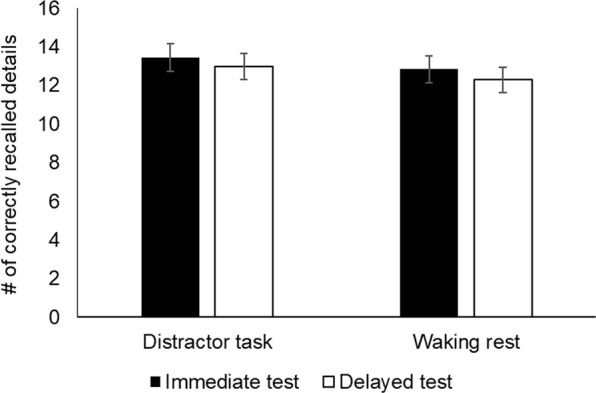
- The primary replication was null: rest vs. distractor did not differ for raw change in correct recall, t(30) = 0.37, p = 0.71, d = 0.09, or total recall, t(30) = 0.07, p = 0.95, d = 0.02; immediate-test performance also did not differ.
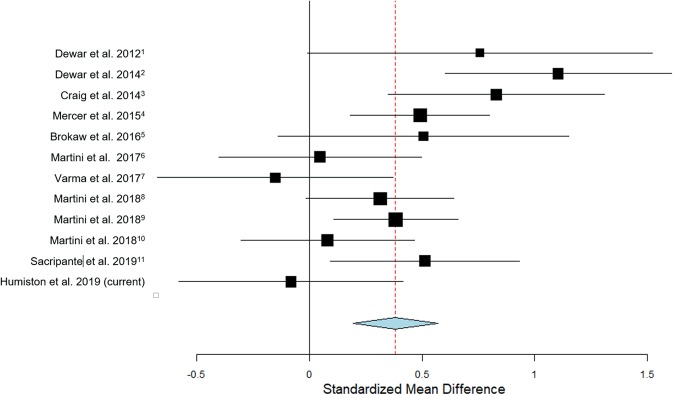
- The meta-analytic summary effect across prior studies was significant, d = 0.38, p = 0.001 (abstract: p < 0.001; abstract reports n = 10 similar studies, Methods reports n = 11 prior studies), and the current null effect fell within the 95% CI of Brokaw et al.’s prior effect.
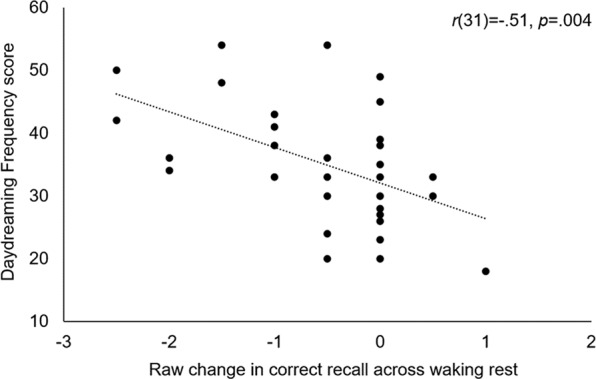
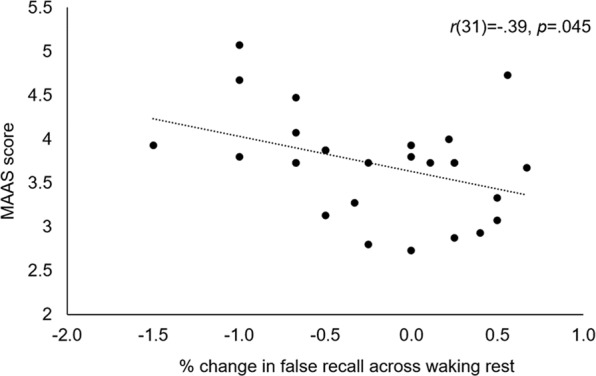
- Exploratory analyses: trait daydreaming frequency negatively correlated with raw change in correct recall over rest, r(31) = −0.51, p = 0.004, and with % change, r(31) = −0.47, p = 0.008; it positively correlated with % change in false recall over rest, r(31) = 0.41, p = 0.03. MAAS mindwandering negatively correlated with % change in false recall over rest, r(31) = −0.39, p = 0.045.
- Subjective experience differed: after rest, participants reported greater sleepiness at delayed test (t(30) = 2.04, p = 0.05, d = 0.40) and lower concentration (t(30) = 2.27, p = 0.03, d = 0.33), and more story-related thought/imagery during rest than distractor (thought t(30) = 2.99, p = 0.006, d = 0.62; imagery t(30) = 2.89, p = 0.007, d = 0.59).
Methods
- Preregistered quasi-exact behavioural replication of Brokaw et al. (2016), within-subjects; final n = 31 (22 females; mean age 18.90 ± 1.22, range 18–22) after exclusions from n = 48 enrolled; target n = 32 for power 0.90 to detect dz = 0.60.
- Participants listened to a short story, completed immediate free recall, then 15 min eyes-closed rest or Snood distractor, then delayed free recall and exit questionnaire; conditions on separate visits ≥24 hr apart, counterbalanced. Trait measures: MAAS and DFS.
- Analyses: paired t-tests on raw and % change in correct/false/total recall; correlations with trait/subjective measures; non-preregistered random-effects meta-analysis of prior studies using standardized mean differences (SMD) in OpenMeta Analyst.
Limitations
- Stated: the null replication may reflect sampling/measurement error and inadequate power to detect a smaller-than-expected effect; the meta-analytic estimate (d = 0.38) may be smaller than earlier estimates; heterogeneity across included studies (age, procedures, memory task) remains unquantified.
- Stated: the current replication omitted EEG recording; the meta-analysis was not preregistered; the sleeping–memory correlation was likely spurious, driven by one participant reporting 60% sleep, and excluding that participant left the null effect unchanged.
- Evident: final sample was small (n = 31) and drawn from young university students (mean age 18.9, range 18–22), limiting generalizability and power; exploratory trait correlations are correlational and not causal.
Model-written summary. Check it against the paper before relying on it.
Integrity signals
Registry
Cites
Statistics
Figures

Verification
Claims the paper makes
1 Valid · 0 Not valid · 19 Not checked · 65 Own results and interpretations
The cited sources support only part of this claim — read each source’s verdict below.
In the paper
“In several studies using declarative1,3,4,9,12, spatial8, or motor memory2 tasks, participants perform better on a delayed test when learning is followed by a short period of waking rest, rather than by an active wake control condition.”
§ Resting States and Memory Consolidation: A Preregistered Replication and Meta-Analysis > Introduction
What the sources say
- Not checked yetcites [1] Brokaw K Resting state EEG correlates of memory consolidation Neurobiology of Learning and Memory 2016 130 17 25 10.1016/j.nlm.2016.01.008 26802698 source
- Partly supportedcites [3] Dewar M Alber J Cowan N Della Sala S Boosting long-term memory via wakeful rest: Intentional rehearsal is not necessary, consolidation is sufficient PLoS ONE 2014 9 1 10 PMC4198139 25333957 sourceExperimental — accuracy not yet measured
Our copy of Dewar et al. (2014) supports only the declarative-memory part of the sentence: the Introduction states that 'Several studies show that both young and elderly people recall more newly learned verbal material after a 10-60-minute interval if this interval is filled with wakeful rest than with sensory stimulation [1]–[4]', and its own Experiments 1 and 2 show better 15-minute and 7-day free recall and recognition after a 10-minute wakeful rest than after a 10-minute spot-the-difference (active wake) control (Experiment 1 Results; Discussion). The spatial and motor memory tasks attributed to this sentence are not in our copy — the only spatial reference is a rodent ripple-suppression study (Girardeau et al., ref. [16]) and no motor-learning/rest comparison is reported or discussed. Thus the source backs declarative (verbal) rest benefits versus an active wake control, but not the spatial or motor extension. (LLM, conf=0.75)
- Not checked yetcites [4] Dewar M Alber J Butler C Cowan N Della Sala S Brief wakeful resting boosts new memories over the long term Psychological Science 2012 23 955 960 10.1177/0956797612441220 22829465 source
- Not checked yetcites [9] Mercer T Wakeful rest alleviates interference-based forgetting Memory 2015 23 127 137 10.1080/09658211.2013.872279 24410154 source
- Not checked yetcites [12] Martini Markus Martini Caroline Bernegger Christina Sachse Pierre Post‐encoding wakeful resting supports the retention of new verbal memories in children aged 13–14 years British Journal of Developmental Psychology 2018 37 2 199 210 10.1111/bjdp.12267 30255941 PMC6585679 source
- Not checked yetcites [8] Craig M Dewar M Sala SD Wolbers T Rest boosts the long-term retention of spatial associative and temporal order information Hippocampus 2015 25 1017 1027 10.1002/hipo.22424 25620400 source
- Not checked yetcites [2] Humiston GB Wamsley EJ A brief period of eyes-closed rest enhances motor skill consolidation Neurobiology of Learning and Memory 2018 155 1 6 10.1016/j.nlm.2018.06.002 29883710 PMC6281812 source
plainstates a cause- Asserted: passes — The authors put it forward as true.
- Checkable: passes — It can be checked against evidence.
- Load-bearing: passes — The paper’s conclusions depend on it.
- Based: passes — The paper gives a reason why it holds.
A result the paper reports from its own data — it cites no other source for it, so there is none to check. The quote shows it is in the paper.
In the paper
“a meta-analytic effect summarizing n = 10 similar studies indicates a moderately sized and significant benefit of waking rest for verbal memory (d = 0.38, p < 0.001).”
- Also stated in: § Preregistered exploratory analyses · plain
“Using a continuous random-effects model, the summary effect is significantly greater than zero (d = 0.38, p = 0.001; see Supplementary Table S8), and falls within the 95% confidence interval of the current study’s effect.”
§ Resting States and Memory Consolidation: A Preregistered Replication and Meta-Analysis > Abstract
plainstates a causen = 10- Asserted: passes — The authors put it forward as true.
- Checkable: passes — It can be checked against evidence.
- Load-bearing: passes — The paper’s conclusions depend on it.
- Based: passes — The paper gives a reason why it holds.
- Rests on an assumption not shown here.
- Also stated in: § Preregistered exploratory analyses · plain
In the paper
“however, it did fall within the 95% confidence interval of our previous finding.”
- Also stated in: § Discussion · plain
“Figure 4 illustrates that, while not statistically significant, the currently observed effect does lie within the 95% confidence interval of that reported by Brokaw et al.1.”
§ Resting States and Memory Consolidation: A Preregistered Replication and Meta-Analysis > Abstract
What the sources say
- Not checked yetcites [1] Brokaw K Resting state EEG correlates of memory consolidation Neurobiology of Learning and Memory 2016 130 17 25 10.1016/j.nlm.2016.01.008 26802698 source
plain- Asserted: passes — The authors put it forward as true.
- Checkable: passes — It can be checked against evidence.
- Load-bearing: passes — The paper’s conclusions depend on it.
- Based: passes — The paper gives a reason why it holds.
- Also stated in: § Discussion · plain
A result the paper reports from its own data — it cites no other source for it, so there is none to check. The quote shows it is in the paper.
In the paper
“Additionally, exploratory analyses revealed that increased trait daydreaming frequency negatively correlated with memory retention during eyes-closed rest.”
- Also stated in: § Preregistered exploratory analyses · boosted
“Daydreaming frequency was strongly negatively correlated with change in correct recall over waking rest (raw change: r(31) = −0.51, p = 0.004; % change: r(31) = −0.47, p = 0.008; Fig. 2)”
§ Resting States and Memory Consolidation: A Preregistered Replication and Meta-Analysis > Abstract
boostedstates an association- Asserted: passes — The authors put it forward as true.
- Checkable: passes — It can be checked against evidence.
- Load-bearing: passes — The paper’s conclusions depend on it.
- Based: passes — The paper gives a reason why it holds.
- Also stated in: § Preregistered exploratory analyses · boosted
A result the paper reports from its own data — it cites no other source for it, so there is none to check. The quote shows it is in the paper.
In the paper
“Contrary to our hypothesis, the observed effect was not significant; however, it did fall within the 95% confidence interval of our previous finding.”
- Also stated in: § Preregistered confirmatory analyses · plain
“Rest did not benefit raw change in memory relative to the distractor task (correct recall: t(30) = 0.37, p = 0.71, d = 0.09; total recall: t(30) = 0.07, p = 0.95, d = 0.02) (Table 1, Fig. 1).”
§ Resting States and Memory Consolidation: A Preregistered Replication and Meta-Analysis > Abstract
plain- Asserted: passes — The authors put it forward as true.
- Checkable: passes — It can be checked against evidence.
- Load-bearing: passes — The paper’s conclusions depend on it.
- Based: passes — The paper gives a reason why it holds.
- Also stated in: § Preregistered confirmatory analyses · plain
29 more claims
Create a free account to see all 85 claims and to verify the 58 references still open.
- It may state two separate claims as one. 26
- Probably not a substantial claim. 39
- The quote only partly states this claim. 1
Claims other papers make about this one
Each is checked against this paper’s own text: does it say what the citing paper says it does?
In the citing paper
“More importantly, the analysis did not distinguish between age groups.”
From Should we all just take 10? A meta-analysis of wakeful rest (2026) · cites this paper as Humiston et al., 2019
In the citing paper
“The potential influence of age was not accounted for, leading to unexplained variance.”
From Should we all just take 10? A meta-analysis of wakeful rest (2026) · cites this paper as Humiston et al., 2019
In the citing paper
“This prior analysis found a small but significant effect of wakeful rest.”
From Should we all just take 10? A meta-analysis of wakeful rest (2026) · cites this paper as Humiston et al., 2019
In the citing paper
“However, only 12 studies were used and they were limited to healthy populations.”
From Should we all just take 10? A meta-analysis of wakeful rest (2026) · cites this paper as Humiston et al., 2019
In the citing paper
“Indeed, a growing body of evidence suggests that wakefully resting after new learning can enhance subsequent memory performance compared to engaging in a cognitively demanding distractor task2–4.”
From Waking rest during retention facilitates memory consolidation, but so does social media use (2025) · cites this paper as [4]
Statistics that don’t add up
Each reported p-value recomputed from its test statistic and degrees of freedom, each partial η² from its F, and each ratio, mean difference or B printed with a p checked against its own confidence interval.
Rated minor: it would not touch a result — a value no result rests on, a p-value that stays on the same side of the significance level, or a conflict that is clerical, resolved elsewhere in the paper, or outside its own findings.
In the paper
“r(31) = −0.39, p = 0.045”
§ Resting States and Memory Consolidation: A Preregistered Replication and Meta-Analysis > Results > Preregistered exploratory analyses
Reported p = .045 · recomputed p = .025
Rated minor: it would not touch a result — a value no result rests on, a p-value that stays on the same side of the significance level, or a conflict that is clerical, resolved elsewhere in the paper, or outside its own findings.
In the paper
“r(31) = −0.48, p = 0.006”
§ Resting States and Memory Consolidation: A Preregistered Replication and Meta-Analysis > Results > Preregistered exploratory analyses
Reported p = .006 · recomputed p = .005
Rated minor: it would not touch a result — a value no result rests on, a p-value that stays on the same side of the significance level, or a conflict that is clerical, resolved elsewhere in the paper, or outside its own findings.
In the paper
“r(31) = −0.51, p = 0.004”
§ Resting States and Memory Consolidation: A Preregistered Replication and Meta-Analysis > Results > Preregistered exploratory analyses
Reported p = .004 · recomputed p = .002
Rated minor: it would not touch a result — a value no result rests on, a p-value that stays on the same side of the significance level, or a conflict that is clerical, resolved elsewhere in the paper, or outside its own findings.
In the paper
“r(31) = 0.41, p = 0.03”
§ Resting States and Memory Consolidation: A Preregistered Replication and Meta-Analysis > Results > Preregistered exploratory analyses
Reported p = .03 · recomputed p = .018
Rated minor: it would not touch a result — a value no result rests on, a p-value that stays on the same side of the significance level, or a conflict that is clerical, resolved elsewhere in the paper, or outside its own findings.
In the paper
“r(31) = −0.47, p = 0.008”
§ Resting States and Memory Consolidation: A Preregistered Replication and Meta-Analysis > Results > Preregistered exploratory analyses
Reported p = .008 · recomputed p = .006
Statistics recomputed
Every reported test result, recomputed from its test statistic and degrees of freedom. A result shows as not adding up only once an independent check has confirmed it.
- Doesn’t add upr(31) = -0.51reported p = .004 · recomputed p = .002
“r(31) = −0.51, p = .004”
- Doesn’t add upr(31) = -0.47reported p = .008 · recomputed p = .006
“r(31) = −0.47, p = .008”
- Doesn’t add upr(31) = 0.41reported p = .03 · recomputed p = .018
“r(31) = 0.41, p = .03”
- Doesn’t add upr(31) = -0.39reported p = .045 · recomputed p = .025
“r(31) = −0.39, p = .045”
- Doesn’t add upr(31) = -0.48reported p = .006 · recomputed p = .005
“r(31) = −0.48, p = .006”
22 more recomputed tests
Create a free account to see every test the Stats check recomputed.
Self-check
Percentages, sums and reported differences re-computed from the paper’s own numbers.
Self-check results appear here once an independent check has confirmed them.
Citations
Cites
A New Method for Measuring Daytime Sleepiness: The Epworth Sleepiness Scale
Johns, M. W. (1991) · Sleep · doi:10.1093/sleep/14.6.540 · Cited by 17,364
The benefits of being present: Mindfulness and its role in psychological well-being
Brown, K. W., & Ryan, R. M. (2003) · Journal of Personality and Social Psychology · doi:10.1037/0022-3514.84.4.822 · Cited by 13,448
Wandering minds: the default network and stimulus-independent thought
Mason, M. F., Norton, M. I., Van Horn, J. D., Wegner, D. M., Grafton, S. T., & Macrae, C. N. (2007) · Science · doi:10.1126/science.1131295 · Cited by 2,792
Quantification of Sleepiness: A New Approach
Hoddes, E., Zarcone, V., Smythe, H., Phillips, R., & Dement, W. C. (1973) · Psychophysiology · doi:10.1111/j.1469-8986.1973.tb00801.x · Cited by 2,538
Sleep-dependent memory consolidation
Stickgold, R. (2005) · Nature · doi:10.1038/nature04286 · Cited by 1,857
Reverse replay of behavioural sequences in hippocampal place cells during the awake state
Foster, D. J., & Wilson, M. A. (2006) · Nature · doi:10.1038/nature04587 · Cited by 1,727
Why Most Discovered True Associations Are Inflated
Ioannidis, J. P. A. (2008) · Epidemiology · doi:10.1097/ede.0b013e31818131e7 · Cited by 1,495
Practice with Sleep Makes Perfect
Walker, M. P., Brakefield, T., Morgan, A., Hobson, J. A., & Stickgold, R. (2002) · Neuron · doi:10.1016/s0896-6273(02)00746-8 · Cited by 1,307
The brain's default network and its adaptive role in internal mentation
Andrews-Hanna, J. R. (2012) · The Neuroscientist · doi:10.1177/1073858411403316 · Cited by 1,114
Effects of early and late nocturnal sleep on declarative and procedural memory
Plihal, W., & Born, J. (1997) · Journal of Cognitive Neuroscience · doi:10.1162/jocn.1997.9.4.534 · Cited by 1,026
Cited by
Sleep function: an evolutionary perspective
Siegel, J. M. (2022) · The Lancet Neurology · doi:10.1016/s1474-4422(22)00210-1 · Cited by 161
Offline memory consolidation during waking rest
Wamsley, E. J. (2022) · Nature Reviews Psychology · doi:10.1038/s44159-022-00072-w · Cited by 97
Self-citationRahrig, H., Vago, D. R., Passarelli, M. A., Auten, A., Lynn, N. A., & Brown, K. W. (2022) · Scientific Reports · doi:10.1038/s41598-022-15195-6 · Cited by 84
The sleep benefit in episodic memory: An integrative review and a meta-analysis.
Berres, S., & Erdfelder, E. (2021) · Psychological Bulletin · doi:10.1037/bul0000350 · Cited by 74
Is the role of sleep in memory consolidation overrated?
Dastgheib, M., Kulanayagam, A., & Dringenberg, H. C. (2022) · Neuroscience & Biobehavioral Reviews · doi:10.1016/j.neubiorev.2022.104799 · Cited by 70
Metadata
- Authors
- Humiston, G. B., Tucker, M. A., Summer, T., & Wamsley, E. J.
- Affiliations
- Furman University (US)
- University of South Carolina (US)
- Corresponding author
- Wamsley, Erin J.
- Venue
- Scientific Reports
- Published
- 2019-12-18
- Volume
- 9
- Issue
- 1
- Pages
- 19345-19345
- ISSN
- 2045-2322 (ISSN-L)
- PMC
- PMC6920145
- OpenAlex
- W2996591789
- Semantic Scholar
- 7608b78955a347ba1647f842ad0690b2c96b69af
- Cited by
- 57
- References
- 48
- Citations by year
- 2026: 12 · 2025: 14 · 2024: 11 · 2023: 4 · 2022: 8 · 2021: 7 · 2020: 1
- FWCI
- 0.43
- Type
- journal article
- Language
- en
- Open access
- gold
- doi.org
- Licence
- cc-by
- creativecommons.org/licenses/by/4.0 (tdm)
- creativecommons.org/licenses/by/4.0 (vor)
- Locations
- Scientific Reports (publishedVersion, cc-by)
- Europe PMC (PubMed Central) (publishedVersion, cc-by)
- PubMed Central (publishedVersion, cc-by)
- PubMed (publishedVersion)
- DOAJ (DOAJ: Directory of Open Access Journals) (submittedVersion)
- Funders
- U.S. Department of Health & Human Services | NIH | National Institute of Mental Health (R15MH107891)
- Topics
- Life Sciences › Neuroscience › Cognitive Neuroscience › Sleep and Wakefulness Research
- Life Sciences › Neuroscience › Cognitive Neuroscience › Memory Processes and Influences
- Life Sciences › Neuroscience › Cognitive Neuroscience › Memory and Neural Mechanisms
- Keywords
- memory consolidation, declarative memory, verbal memory, daydreaming, memory retention, spontaneous thought, underpowered studies, measurement error
- MeSH terms
- Memory Consolidation, Adolescent, Female, Humans, Male, Mental Recall, Rest, Reproducibility of Results
About these checks
Registry, retraction, Cites and statistics results are computed, not judged, with one exception: a printed reference that no index lists is read once by a model before it counts as a citation error. Claims are extracted by a model and kept only when their quote appears verbatim in the text; each cited source is then checked, with a model’s help, for whether it says what the claim relies on. Those verdicts can be wrong — read the claim’s quote and the cited source before relying on one.
The claim verdicts this report counts are experimental: their accuracy is not yet measured.
A language model drew the claims from the paper on 2026-11-24, under version 3 of the claim definition (model deepseek-v4.1-flash, prompt extract-v3).
A second model labelled each claim on 2026-11-24 (model jev-1.13-20260917, definition revision gold-guideline-v0.2).
Cited sources are checked with a language model’s help (qwen3.8-omni-flash).
Statistics and arithmetic are recomputed, not judged.
Confidence bands are shown only for fields calibrated on our annotated test set. None is calibrated yet, so no band is shown.
What counts as a claim ›How we measure confidence ›How we check this ›
Are you an author, or do you see a problem with this page? Request a review
How to cite
Cite CoChat for the checks on this page, and the paper for its own findings.
- This page
- CoChat. (2026). Citation check: Resting States and Memory Consolidation: A Preregistered Replication and Meta-Analysis. https://app.cochat.ai/papers/10.1038/s41598-019-56033-6
- The paper
- Humiston, G. B., Tucker, M. A., Summer, T., & Wamsley, E. J. (2019). Resting States and Memory Consolidation: A Preregistered Replication and Meta-Analysis. Scientific Reports. https://doi.org/10.1038/s41598-019-56033-6
Data sources
Bibliographic data: Semantic Scholar, OpenAlex, Crossref.
Contains information from the Semantic Scholar Academic Graph Datasets, made available under the ODC Attribution License (ODC-BY 1.0).
Semantic Scholar’s data is described in: Kinney, R., et al. (2023). The Semantic Scholar Open Data Platform. arXiv:2301.10140.
