

Target prediction and validation of microRNAs expressed from FSHR and aromatase genes in human ovarian granulosa cells
The DOI matches its Crossref record; 70 of the 70 references it cites were found in a registry or an index.
Abstract
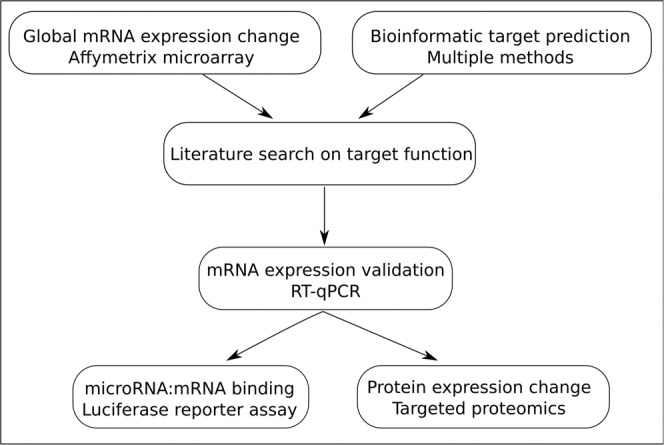
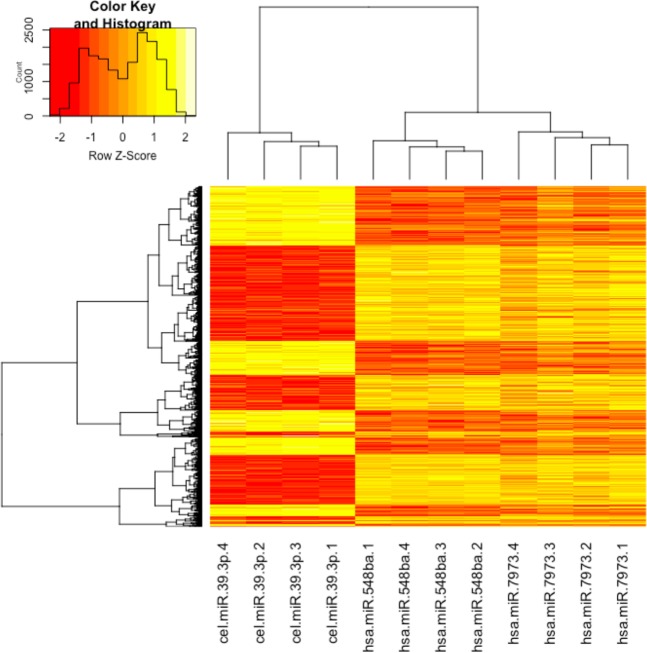
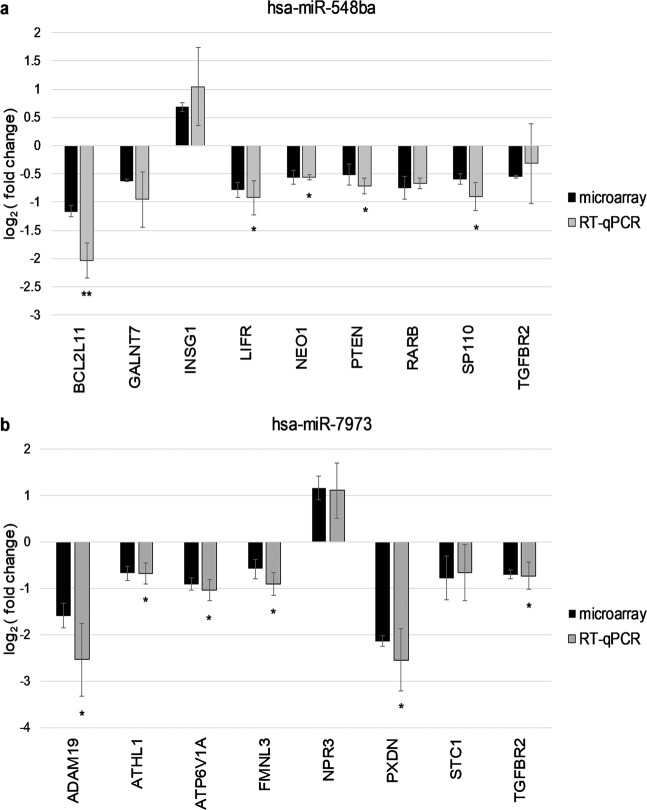
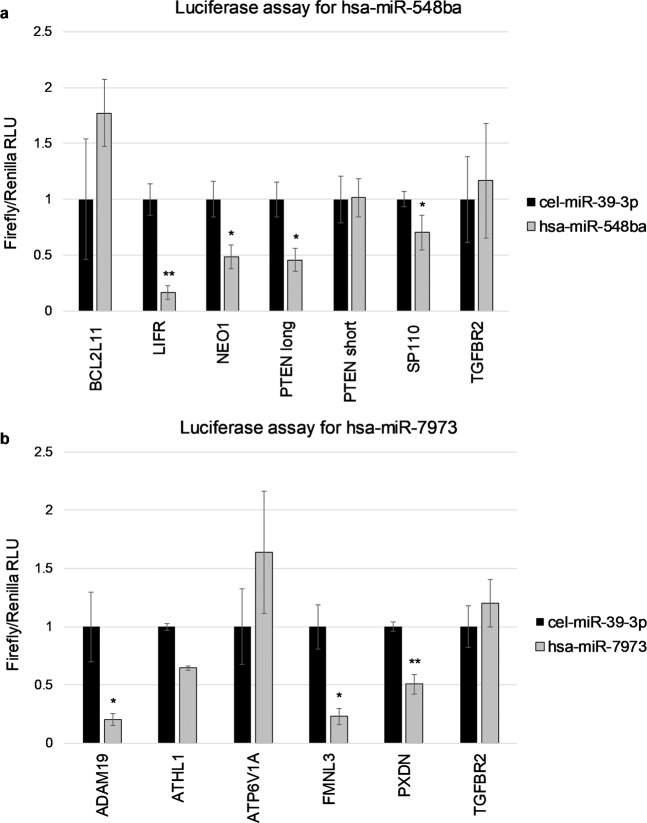
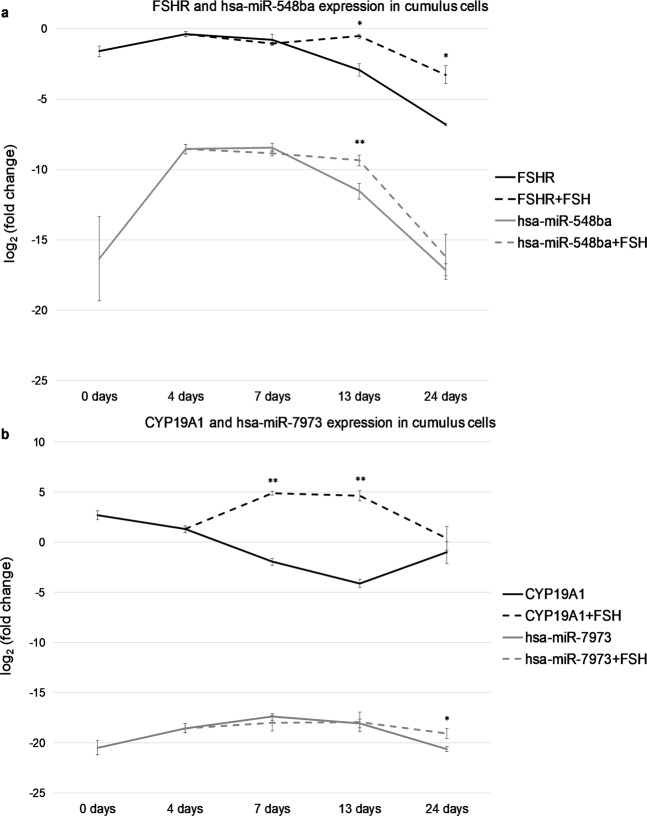
MicroRNAs (miRNAs) are known post-transcriptional regulators of various biological processes including ovarian follicle development. We have previously identified miRNAs from human pre-ovulatory ovarian granulosa cells that are expressed from the intronic regions of two key genes in normal follicular development: FSH receptor (FSHR) and CYP19A1, the latter encoding the aromatase enzyme. The present study aims to identify the target genes regulated by these miRNAs: hsa-miR-548ba and hsa-miR-7973, respectively. The miRNAs of interest were transfected into KGN cell line and the gene expression changes were analyzed by Affymetrix microarray. Potential miRNA-regulated genes were further filtered by bioinformatic target prediction algorithms and validated for direct miRNA:mRNA binding by luciferase reporter assay.LIFR,PTEN,NEO1 and SP110 were confirmed as targets for hsa-miR-548ba. Hsa-miR-7973 target genes ADAM19,PXDN and FMNL3 also passed all verification steps. Additionally, the expression pattern of the miRNAs was studied in human primary cumulus granulosa cell culture in relation to the expression of their host genes and FSH stimulation. Based on our findings we propose the involvement of hsa-miR-548ba in the regulation of follicle growth and activation via LIFR and PTEN. Hsa-miR-7973 may be implicated in the modulation of extracellular matrix and cell-cell interactions by regulating the expression of its identified targets.
Overview
The claims and statistics of this paper haven’t been checked yet.
Free: it reads the open-access text and checks the first 5 claims that cite a source we can check. Create a free account to check every claim.
Integrity signals
Registry
Cites
Statistics
Figures
Verification
Claims the paper makes
The claims and statistics of this paper haven’t been checked yet.
Free: it reads the open-access text and checks the first 5 claims that cite a source we can check. Create a free account to check every claim.
Claims other papers make about this one
Each is checked against this paper’s own text: does it say what the citing paper says it does?
In the citing paper
“It has been previously shown that the expression pattern of hsa-miR-548ba is similar to that of FSHR and FSH treatment upregulates hsa-miR-548ba expression levels in human granulosa cells [11].”
From Hsa-mir-548 family expression in human reproductive tissues (2021) · cites this paper as [11]
Self-check
Percentages, sums and reported differences re-computed from the paper’s own numbers.
The self-check needs the paper’s full text.
Citations
Cites
Analysis of Relative Gene Expression Data Using Real-Time Quantitative PCR and the 2−ΔΔCT Method
Livak, K. J., & Schmittgen, T. D. (2001) · Methods · doi:10.1006/meth.2001.1262 · Cited by 180,860
Controlling the False Discovery Rate: A Practical and Powerful Approach to Multiple Testing
Benjamini, Y., & Hochberg, Y. (1995) · Journal of the Royal Statistical Society Series B: Statistical Methodology · doi:10.1111/j.2517-6161.1995.tb02031.x · Cited by 109,482
limma powers differential expression analyses for RNA-sequencing and microarray studies
Ritchie, M. E., Phipson, B., Wu, D., Hu, Y., Law, C. W., Shi, W., & Smyth, G. K. (2015) · Nucleic Acids Research · doi:10.1093/nar/gkv007 · Cited by 40,458
A new mathematical model for relative quantification in real-time RT-PCR
Pfaffl, M. W. (2001) · Nucleic Acids Research · doi:10.1093/nar/29.9.e45 · Cited by 34,610
MicroRNAs: Target Recognition and Regulatory Functions
Bartel, D. P. (2009) · Cell · doi:10.1016/j.cell.2009.01.002 · Cited by 20,068
Cox, J., & Mann, M. (2008) · Nature Biotechnology · doi:10.1038/nbt.1511 · Cited by 14,855
The C. elegans heterochronic gene lin-4 encodes small RNAs with antisense complementarity to lin-14
Lee, R. C., Feinbaum, R. L., & Ambros, V. (1993) · Cell · doi:10.1016/0092-8674(93)90529-y · Cited by 12,948
Most mammalian mRNAs are conserved targets of microRNAs
Friedman, R. C., Farh, K. K.-H., Burge, C. B., & Bartel, D. P. (2009) · Genome Research · doi:10.1101/gr.082701.108 · Cited by 8,462
Circulating microRNAs as stable blood-based markers for cancer detection
Mitchell, P. S., Parkin, R. K., Kroh, E. M., Fritz, B. R., Wyman, S. K., Pogosova-Agadjanyan, E. L., Peterson, A., Noteboom, J., O'Briant, K. C., Allen, A., et al. (2008) · Proceedings of the National Academy of Sciences · doi:10.1073/pnas.0804549105 · Cited by 7,969
Predicting effective microRNA target sites in mammalian mRNAs
Agarwal, V., Bell, G. W., Nam, J.-W., & Bartel, D. P. (2015) · eLife · doi:10.7554/elife.05005 · Cited by 7,318
Cited by
Hsa-mir-548 family expression in human reproductive tissues
Rooda, I., Kaselt, B., Liivrand, M., Smolander, O.-P., Salumets, A., & Velthut-Meikas, A. (2021) · BMC Genomic Data · doi:10.1186/s12863-021-00997-w · Cited by 17
“It has been previously shown that the expression pattern of hsa-miR-548ba is similar to that of FSHR and FSH treatment upregulates hsa-miR548ba expression levels in human granulosa cells [11].”
BackgroundSelf-citation
Metadata
- Authors
- Rooda, I., Hensen, K., Kaselt, B., Kasvandik, S., Pook, M., Kurg, A., Salumets, A., & Velthut-Meikas, A.
- Venue
- Scientific Reports
- Published
- 2020-02-10
- Volume
- 10
- Issue
- 1
- ISSN
- 2045-2322
- PMC
- PMC7010774
- Semantic Scholar
- 6f545be9f6e246b5e99241c8a07798abd0b1cdbe
- Cited by
- 27
- References
- 70
- Language
- en
- Licence
- creativecommons.org/licenses/by/4.0 (tdm)
- creativecommons.org/licenses/by/4.0 (vor)
- Funders
- FP7 People: Marie-Curie Actions (EU324509)
- Haridus- ja Teadusministeerium (IUT34-16)
- Ettevõtluse Arendamise Sihtasutus (EU48695)
- Horizon 2020 (692065)
- MSCA-RISE-2015 program MOMENDO (691058)
About these checks
Registry, retraction, Cites and statistics results are computed, not judged, with one exception: a printed reference that no index lists is read once by a model before it counts as a citation error. Claims are extracted by a model and kept only when their quote appears verbatim in the text; each cited source is then checked, with a model’s help, for whether it says what the claim relies on. Those verdicts can be wrong — read the claim’s quote and the cited source before relying on one.
Statistics and arithmetic are recomputed, not judged.
Confidence bands are shown only for fields calibrated on our annotated test set. None is calibrated yet, so no band is shown.
What counts as a claim ›How we measure confidence ›How we check this ›
Are you an author, or do you see a problem with this page? Request a review
Data sources
Bibliographic data: Semantic Scholar, OpenAlex, Crossref.
Contains information from the Semantic Scholar Academic Graph Datasets, made available under the ODC Attribution License (ODC-BY 1.0).
Semantic Scholar’s data is described in: Kinney, R., et al. (2023). The Semantic Scholar Open Data Platform. arXiv:2301.10140.
