

A cadaver-based biomechanical model of acetabulum reaming for surgical virtual reality training simulators
Open accessThe DOI matches its Crossref record; 25 of the 27 references it cites were found in a registry or an index.
Abstract
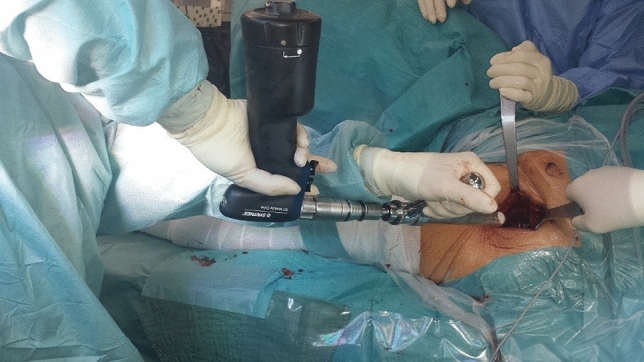
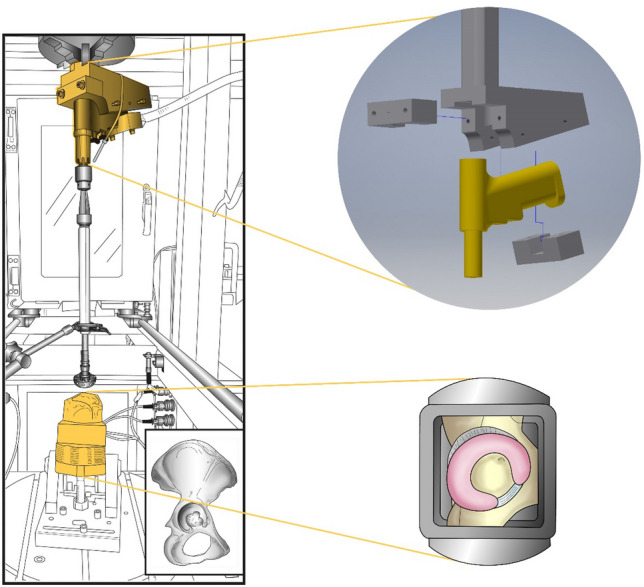
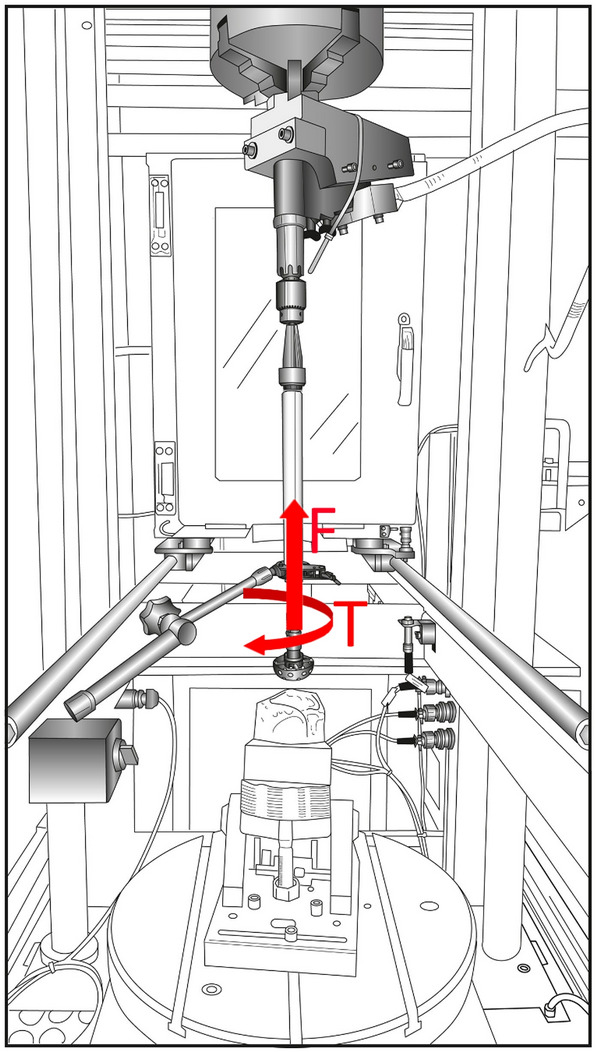
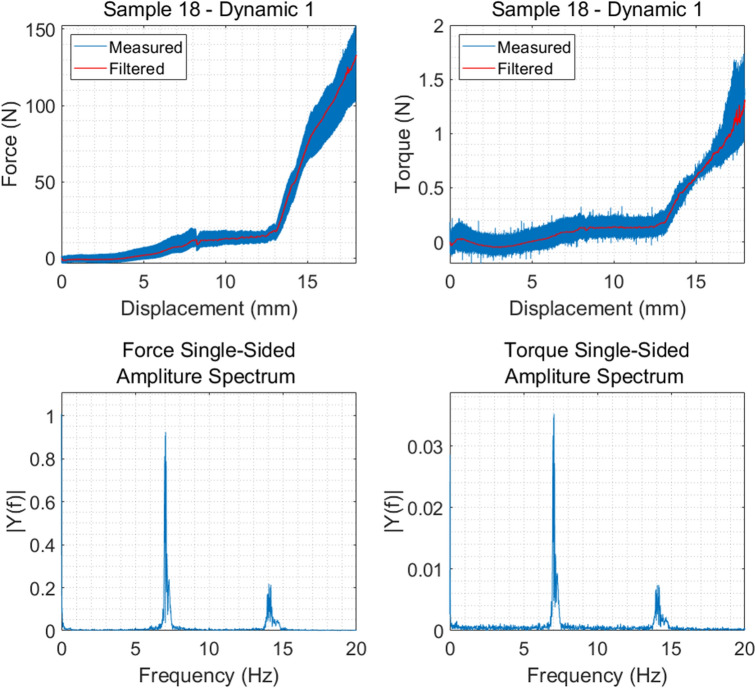
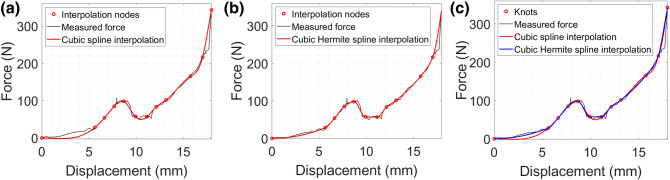
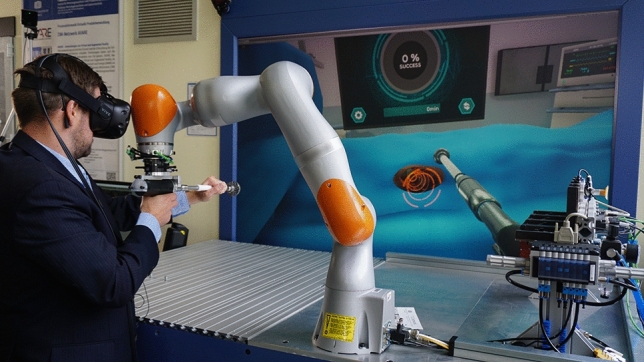
Total hip arthroplasty (THA) is a highly successful surgical procedure, but complications remain, including aseptic loosening, early dislocation and misalignment. These may partly be related to lacking training opportunities for novices or those performing THA less frequently. A standardized training setting with realistic haptic feedback for THA does not exist to date. Virtual Reality (VR) may help establish THA training scenarios under standardized settings, morphology and material properties. This work summarizes the development and acquisition of mechanical properties on hip reaming, resulting in a tissue-based material model of the acetabulum for force feedback VR hip reaming simulators. With the given forces and torques occurring during the reaming, Cubic Hermite Spline interpolation seemed the most suitable approach to represent the nonlinear force–displacement behavior of the acetabular tissues over Cubic Splines. Further, Cubic Hermite Splines allowed for a rapid force feedback computation below the 1 ms hallmark. The Cubic Hermite Spline material model was implemented using a three-dimensional-sphere packing model. The resulting forces were delivered via a human–machine-interaction certified KUKA iiwa robotic arm used as a force feedback device. Consequently, this novel approach presents a concept to obtain mechanical data from high-force surgical interventions as baseline data for material models and biomechanical considerations; this will allow THA surgeons to train with a variety of machining hardness levels of acetabula for haptic VR acetabulum reaming.
Overview
The claims and statistics of this paper haven’t been checked yet.
Free: it reads the open-access text and checks the first 5 claims that cite a source we can check. Create a free account to check every claim.
Integrity signals
Registry
Cites
Statistics
Figures
Verification
Claims the paper makes
The claims and statistics of this paper haven’t been checked yet.
Free: it reads the open-access text and checks the first 5 claims that cite a source we can check. Create a free account to check every claim.
Claims other papers make about this one
Each is checked against this paper’s own text: does it say what the citing paper says it does?
The check wasn’t confident either way, so it gives no verdict — never disputed.
In the citing paper
“The gaze tracking features of the HTC VIVE Pro Eye was used for identifying distracted learners [60] and for foveated rendering in procedural task training [80]”
From A systematic review of immersive virtual reality for industrial skills training (2021) · cites this paper as [80]
Experimental — accuracy not yet measured
Self-check
Percentages, sums and reported differences re-computed from the paper’s own numbers.
The self-check needs the paper’s full text.
Citations
Cites
de Boor, C. (1978) · Applied Mathematical Sciences · doi:10.1007/978-1-4612-6333-3 · Cited by 11,944
The operation of the century: total hip replacement
Learmonth, I. D., Young, C., & Rorabeck, C. (2007) · The Lancet · doi:10.1016/s0140-6736(07)60457-7 · Cited by 2,848
Singh, J. A., Yu, S., Chen, L., & Cleveland, J. D. (2019) · The Journal of Rheumatology · doi:10.3899/jrheum.170990 · Cited by 1,190
Factors affecting the Z-Width of a haptic display
Colgate, J. E., & Brown, J. M. (2002) · Proceedings of the 1994 IEEE International Conference on Robotics and Automation · doi:10.1109/robot.1994.351077 · Cited by 635
Simulation in surgical training: educational issues and practical implications
Kneebone, R. (2003) · Medical Education · doi:10.1046/j.1365-2923.2003.01440.x · Cited by 619
The Role of Haptics in Medical Training Simulators: A Survey of the State of the Art
Coles, T. R., Meglan, D., & John, N. W. (2011) · IEEE Transactions on Haptics · doi:10.1109/toh.2010.19 · Cited by 484
Athanasiou, K. A., Agarwal, A., & Dzida, F. J. (1994) · Journal of Orthopaedic Research · doi:10.1002/jor.1100120306 · Cited by 343
A Review of Simulators with Haptic Devices for Medical Training
Escobar-Castillejos, D., Noguez, J., Neri, L., Magana, A., & Benes, B. (2016) · Journal of Medical Systems · doi:10.1007/s10916-016-0459-8 · Cited by 245
Dawe, S. R., Windsor, J. A., Broeders, J. A. J. L., Cregan, P. C., Hewett, P. J., & Maddern, G. J. (2014) · Annals of Surgery · doi:10.1097/sla.0000000000000245 · Cited by 219
Epperson, J. F. (1987) · The American Mathematical Monthly · doi:10.1080/00029890.1987.12000642 · Cited by 180
Stress distributions in the acetabular region—I. Before and after total joint replacement
Vasu, R., Carter, D. R. P., & Harris, W. H. (1982) · Journal of Biomechanics · doi:10.1016/0021-9290(82)90247-0 · Cited by 127
Deformation behavior of the iliotibial tract under different states of fixation
Steinke, H., Lingslebe, U., Böhme, J., Slowik, V., Shim, V., Hädrich, C., & Hammer, N. (2012) · Medical Engineering & Physics · doi:10.1016/j.medengphy.2011.12.009 · Cited by 73
Self-citationEthanol and formaldehyde fixation irreversibly alter bones' organic matrix
Hammer, N., Voigt, C., Werner, M., Hoffmann, F., Bente, K., Kunze, H., Scholz, R., & Steinke, H. (2013) · Journal of the mechanical behavior of biomedical materials/Journal of mechanical behavior of biomedical materials · doi:10.1016/j.jmbbm.2013.09.008 · Cited by 51
Self-citationA unified approach for physically-based simulations and haptic rendering
Weller, R., & Zachmann, G. (2009) · ACM SIGGRAPH Symposium on Video Games (Sandbox) · doi:10.1145/1581073.1581097 · Cited by 49
Self-citationTensile properties of the human acetabular labrum—the first report
Ishiko, T., Naito, M., & Moriyama, S. (2005) · Journal of Orthopaedic Research® · doi:10.1016/j.orthres.2004.08.025.1100230630 · Cited by 49
Stability and quantization-error analysis of haptic rendering of virtual stiffness and damping
Colonnese, N., & Okamura, A. M. (2015) · The International Journal of Robotics Research · doi:10.1177/0278364915596234 · Cited by 40
Contact Stability Analysis of Virtual Walls
Love, L. J., & Book, W. J. (1995) · ASME International Mechanical Engineering Congress and Exposition (IMECE) · doi:10.1115/imece1995-0835 · Cited by 29
Neugebauer, R., Werner, M., Voigt, C., Steinke, H., Scholz, R., Scherer, S., & Quickert, M. (2011) · Journal of Biomechanics · doi:10.1016/j.jbiomech.2011.03.005 · Cited by 29
Self-citationUsing Industrial Robots as Haptic Devices for VR-Training
Knopp, S., Lorenz, M., Pelliccia, L., & Klimant, P. (2018) · IEEE Conference on Virtual Reality and 3D User Interfaces (VR) · doi:10.1109/vr.2018.8446614 · Cited by 25
Self-citationHIPS - A Virtual Reality Hip Prosthesis Implantation Simulator
Kaluschke, M., Weller, R., Zachmann, G., Pelliccia, L., Lorenz, M., Klimant, P., Knopp, S., Atze, J. P. G., & Mockel, F. (2018) · IEEE Conference on Virtual Reality and 3D User Interfaces (VR) · doi:10.1109/vr.2018.8446370 · Cited by 19
Self-citationA Virtual Hip Replacement Surgery Simulator with Realistic Haptic Feedback
Kaluschke, M., Weller, R., Zachmann, G., Pelliccia, L., Lorenz, M., Klimant, P., Knopp, S., Atze, J. P. G., & Mockel, F. (2018) · IEEE Conference on Virtual Reality and 3D User Interfaces (VR) · doi:10.1109/vr.2018.8446462 · Cited by 13
Self-citationRealistic Haptic Feedback for Material Removal in Medical Simulations
Kaluschke, M., Weller, R., Hammer, N., Pelliccia, L., Lorenz, M., & Zachmann, G. (2020) · IEEE Haptics Symposium · doi:10.1109/haptics45997.2020.ras.hap20.74.13165668 · Cited by 12
Self-citationMöbius, R., Schleifenbaum, S., Grunert, R., Löffler, S., Werner, M., Prietzel, T., & Hammer, N. (2016) · Orthopaedics & Traumatology Surgery & Research · doi:10.1016/j.otsr.2016.06.007 · Cited by 2
Self-citationA Continuous Material Cutting Model with Haptic Feedback for Medical Simulations
Kaluschke, M., Weller, R., Zachmann, G., & Lorenz, M. (2019) · IEEE Conference on Virtual Reality and 3D User Interfaces (VR) · doi:10.1109/vr.2019.8798268 · Cited by 2
Self-citation(2018) · American Psychological Association eBooks · doi:10.2307/j.ctv1chs6hx.38 · Cited by 1
Research works printed but not linked: 3
- Erdogan K Spline interpolation techniques J. Tech. Sci. Technol. 2014 2 47 52
- Kaluschke, M., Weller, R., Zachmann, G. & Lorenz, M. A continuous material cutting model with haptic feedback for medical simulations. In 2019 IEEE Conference on Virtual Reality and 3D User Interfaces (VR) 1002–1003 (IEEE, New York, 2019).
- Knopp, S., Lorenz, M., Pelliccia, L. & Klimant, P. Using industrial robots as haptic devices for VR-training. In 2018 IEEE Conference on Virtual Reality and 3D User Interfaces (VR) 607–608 (IEEE, New York, 2018).
Cited by
A systematic review of immersive virtual reality for industrial skills training
Radhakrishnan, U., Koumaditis, K., & Chinello, F. (2021) · Behaviour & Information Technology · doi:10.1080/0144929x.2021.1954693 · Cited by 200
Tokgöz, E. (2022) · Springer eBooks · doi:10.1007/978-3-031-08927-5_8 · Cited by 12
Lorenz, M., Hoffmann, A., Kaluschke, M., Ziadeh, T., Pillen, N., Kusserow, M., Perret, J., Knopp, S., Dettmann, A., Klimant, P., et al. (2023) · Scientific Reports · doi:10.1038/s41598-023-38201-x · Cited by 12
Self-citationLorenz, M., Kaluschke, M., Melzer, A., Pillen, N., Sanrow, M., Hoffmann, A., Schmidt, D., Dettmann, A., Bullinger, A. C., Perret, J., et al. (2025) · IEEE Transactions on Visualization and Computer Graphics · doi:10.1109/tvcg.2025.3549896 · Cited by 11
“…a progression from the conventional Virtuose 6D, characterized by elevated torques across all motors, resulting in a peak force of 70 N in translation (5 Nm in rotation) at the wrist within the entire workspace, which covers a fair spectrum of forces occurring during acetabula reaming [16].”
Self-citationWang, J., Hua, J., Ding, R., Zou, L., Li, H., Zhang, L., Sun, Q., & He, D. (2023) · Quantitative Imaging in Medicine and Surgery · doi:10.21037/qims-22-1239 · Cited by 8
“Generating a smooth curve by discrete data to simulate the actual situation was performed by cubic splint data, mathematical method (23,24).”
Metadata
- Authors
- Pelliccia, L., Lorenz, M., Heyde, C.-E., Kaluschke, M., Klimant, P., Knopp, S., Schleifenbaum, S., Rotsch, C., Weller, R., Werner, M., Zachmann, G., Zajonz, D., & Hammer, N.
- Affiliations
- Chemnitz University of Technology (DE)
- Medical University of Graz (AT)
- University Hospital Leipzig (DE)
- University of Bremen (DE)
- Fraunhofer Institute for Machine Tools and Forming Technology (DE)
- Corresponding author
- Hammer, Niels
- ORCID
- Venue
- Scientific Reports
- Published
- 2020-09-03
- Volume
- 10
- Issue
- 1
- Pages
- 14545-14545
- ISSN
- 2045-2322 (ISSN-L)
- PMC
- PMC7471911
- OpenAlex
- W3081768073
- Cited by
- 20
- References
- 27
- Citations by year
- 2026: 3 · 2025: 4 · 2024: 5 · 2023: 3 · 2022: 3 · 2021: 2
- FWCI
- 1.83
- Type
- journal article
- Language
- en
- Open access
- gold
- doi.org
- Licence
- cc-by
- creativecommons.org/licenses/by/4.0 (tdm)
- creativecommons.org/licenses/by/4.0 (vor)
- Locations
- Scientific Reports (publishedVersion, cc-by)
- PubMed Central (publishedVersion, cc-by)
- PubMed (publishedVersion)
- Publikationsdatenbank der Fraunhofer-Gesellschaft (Fraunhofer-Gesellschaft) (submittedVersion, other-oa)
- Fraunhofer-Publica (Fraunhofer-Gesellschaft) (submittedVersion)
- Qucosa (Saxon State and University Library Dresden) (submittedVersion, cc-by)
- Funders
- Projekt DEAL
- Topics
- Health Sciences › Medicine › Surgery › Surgical Simulation and Training
- Physical Sciences › Engineering › Biomedical Engineering › Anatomy and Medical Technology
- Health Sciences › Medicine › Surgery › Orthopaedic implants and arthroplasty
- Keywords
- total hip arthroplasty, surgical training simulator, virtual surgery, haptic feedback, force feedback, force-displacement behavior
- MeSH terms
- Virtual Reality, Acetabulum, Biomechanical Phenomena, Computer Simulation, Hip Prosthesis, Humans, Arthroplasty, Replacement, Hip
About these checks
Registry, retraction, Cites and statistics results are computed, not judged, with one exception: a printed reference that no index lists is read once by a model before it counts as a citation error. Claims are extracted by a model and kept only when their quote appears verbatim in the text; each cited source is then checked, with a model’s help, for whether it says what the claim relies on. Those verdicts can be wrong — read the claim’s quote and the cited source before relying on one.
Statistics and arithmetic are recomputed, not judged.
Confidence bands are shown only for fields calibrated on our annotated test set. None is calibrated yet, so no band is shown.
What counts as a claim ›How we measure confidence ›How we check this ›
Are you an author, or do you see a problem with this page? Request a review
Data sources
Bibliographic data: Semantic Scholar, OpenAlex, Crossref.
Contains information from the Semantic Scholar Academic Graph Datasets, made available under the ODC Attribution License (ODC-BY 1.0).
Semantic Scholar’s data is described in: Kinney, R., et al. (2023). The Semantic Scholar Open Data Platform. arXiv:2301.10140.
