

A measure for intrinsic information
Open accessThe DOI matches its Crossref record; 21 of the 23 references it cites were found in a registry or an index.
Abstract
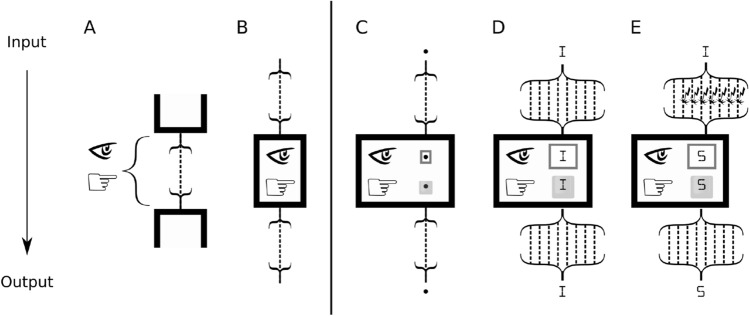
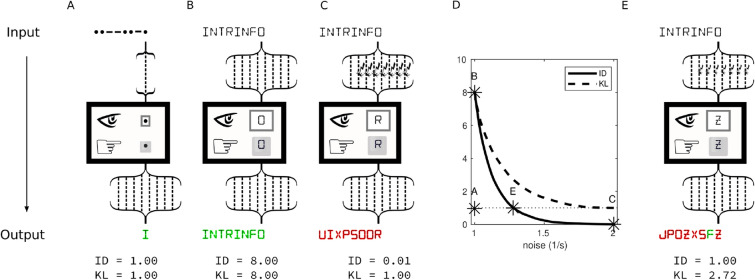
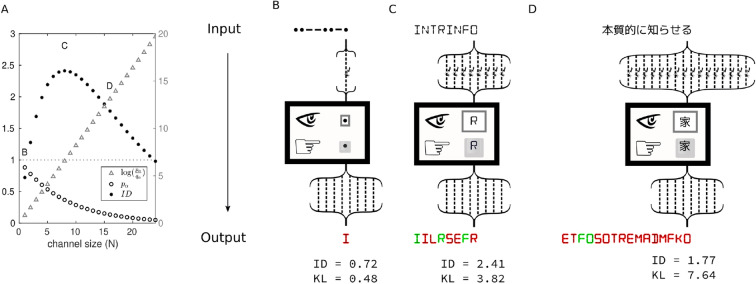
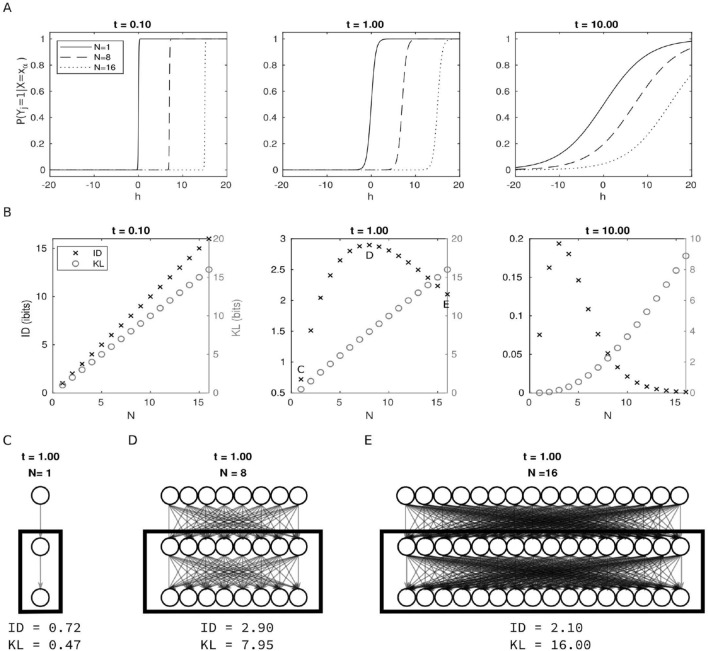
We introduce an information measure that reflects the intrinsic perspective of a receiver or sender of a single symbol, who has no access to the communication channel and its source or target. The measure satisfies three desired properties—causality, specificity, intrinsicality—and is shown to be unique. Causality means that symbols must be transmitted with probability greater than chance. Specificity means that information must be transmitted by an individual symbol. Intrinsicality means that a symbol must be taken as such and cannot be decomposed into signal and noise. It follows that the intrinsic information carried by a specific symbol increases if the repertoire of symbols increases without noise (expansion) and decreases if it does so without signal (dilution). An optimal balance between expansion and dilution is relevant for systems whose elements must assess their inputs and outputs from the intrinsic perspective, such as neurons in a network.
Overview
The claims and statistics of this paper haven’t been checked yet.
Free: it reads the open-access text and checks the first 5 claims that cite a source we can check. Create a free account to check every claim.
Integrity signals
Registry
Cites
Statistics
Figures
Verification
Claims the paper makes
The claims and statistics of this paper haven’t been checked yet.
Free: it reads the open-access text and checks the first 5 claims that cite a source we can check. Create a free account to check every claim.
Claims other papers make about this one
Each is checked against this paper’s own text: does it say what the citing paper says it does?
The source backs part of the claim, not all of it — or backs it for a different population, condition or comparison.
In the citing paper
“This is a measure of the difference between two probability distributions which uniquely satisfies three properties (causality, intrinsicality, and specificity) that align with the postulates of IIT (but also have independent justification):”
From Integrated information theory (IIT) 4.0: Formulating the properties of phenomenal existence in physical terms (2023) · cites this paper as [14]
Experimental — accuracy not yet measuredThe source backs part of the claim, not all of it — or backs it for a different population, condition or comparison.
In the citing paper
“Selectivity means that if p < 1, the system’s causal power becomes subadditive (dilution) (see [14] for details).”
From Integrated information theory (IIT) 4.0: Formulating the properties of phenomenal existence in physical terms (2023) · cites this paper as [14]
Experimental — accuracy not yet measuredThe cited source says what the claim attributes to it.
In the citing paper
“Intrinsic information is formulated as a product of selectivity and informativeness based on the notion of intrinsic difference (ID) [14].”
From Integrated information theory (IIT) 4.0: Formulating the properties of phenomenal existence in physical terms (2023) · cites this paper as [14]
The check wasn’t confident either way, so it gives no verdict — never disputed.
In the citing paper
“It is possible that macro grain systems can have more integrated information than their corresponding micro-grain systems [34,38,39].”
From Dissociating Artificial Intelligence from Artificial Consciousness (2024) · cites this paper as [38]
Experimental — accuracy not yet measured
Self-check
Percentages, sums and reported differences re-computed from the paper’s own numbers.
The self-check needs the paper’s full text.
Citations
Cites
A Mathematical Theory of Communication
Shannon, C. E. (1948) · Bell System Technical Journal · doi:10.1002/j.1538-7305.1948.tb01338.x · Cited by 88,486
Information theory and statistics
(1959) · Journal of the Franklin Institute · doi:10.1016/0016-0032(59)90368-0 · Cited by 7,094
Theoretical Neuroscience: Computational and Mathematical Modeling of Neural Systems
Dayan, P., & Abbott, L. F. (2001) · Cited by 4,162
On Measures of Entropy and Information
Rényi, A. (1961) · Project Euclid (Cornell University) · Cited by 4,031
Modeling Brain Function: The World of Attractor Neural Networks
Amit, D. J. (1989) · Cambridge University Press eBooks · doi:10.1017/cbo9780511623257 · Cited by 2,227
Neural Networks: A Systematic Introduction
Rojas, R. (1996) · Medical Entomology and Zoology · Cited by 2,138
Rényi Divergence and Kullback-Leibler Divergence
van Erven, T., & Harremoes, P. (2014) · IEEE Transactions on Information Theory · doi:10.1109/tit.2014.2320500 · Cited by 1,555
Toward Massive, Ultrareliable, and Low-Latency Wireless Communication With Short Packets
Durisi, G., Koch, T., & Popovski, P. (2016) · Proceedings of the IEEE · doi:10.1109/jproc.2016.2537298 · Cited by 1,154
(1967) · Cited by 853
On Measures of Information and their Characterizations
(1975) · Mathematics in Science and Engineering · doi:10.1016/s0076-5392(08)x6157-0 · Cited by 811 · cited 3×
“In both cases, it is intuitive to design information measures that are additive for all independent probability distributions 9,11,14,15 .”
BackgroundInfluentialRojas, R. (1996) · doi:10.1007/978-3-642-61068-4 · Cited by 810
Information and Self-Organization: A Macroscopic Approach to Complex Systems
Haken, H., & Fraser, A. M. (1989) · American Journal of Physics · doi:10.1119/1.15809 · Cited by 615 · cited 2×
“More recently, these measures have been extended to natural systems 2,3 —for example, sensory and motor pathways in the brain 4 .”
BackgroundInfluentialGeneralized information functions
Daróczy, Z. (1970) · Information and Control · doi:10.1016/s0019-9958(70)80040-7 · Cited by 495
Foundations of Information Theory
Feinstein, A., & Weiss, G. (1958) · Physics Today · doi:10.1063/1.3062338 · Cited by 308
Axiomatic Characterizations of Information Measures
Csiszár, I. (2008) · Entropy · doi:10.3390/e10030261 · Cited by 282
Generalized entropy-based criterion for consistent testing
Tsallis, C. (1998) · Physical Review E · doi:10.1103/physreve.58.1442 · Cited by 262
An information-theoretic primer on complexity, self-organization, and emergence
Prokopenko, M., Boschetti, F., & Ryan, A. J. (2009) · Complexity · doi:10.1002/cplx.20249 · Cited by 251
Smooth renyi entropy and applications
Renner, R., & Wolf, S. (2004) · International Symposium onInformation Theory, 2004. ISIT 2004. Proceedings. · doi:10.1109/isit.2004.1365269 · Cited by 174
Why the Shannon and Hartley entropies are ‘natural’
Aczél, J., Forte, B., & Ng, C. T. (1974) · Advances in Applied Probability · doi:10.1017/s0001867800039744 · Cited by 133
Characterizations Of Information Measures
Ebanks, B. R., Sahoo, P. K., & Sander, W. (1998) · WORLD SCIENTIFIC eBooks · doi:10.1142/9789812817167 · Cited by 83
One-shot capacity of discrete channels
da Costa, R. A., Langberg, M., & Barros, J. (2010) · IEEE International Symposium on Information Theory (ISIT) · doi:10.1109/isit.2010.5513244 · Cited by 25
Cited by
Albantakis, L., Barbosa, L., Findlay, G., Grasso, M., Haun, A. M., Marshall, W., Mayner, W. G. P., Zaeemzadeh, A., Boly, M., Juel, B. E., et al. (2023) · PLoS Computational Biology · doi:10.1371/journal.pcbi.1011465 · Cited by 292
“Chief among them are a more accurate translation of the axioms into postulates and mathematical expressions, the introduction of an Intrinsic Difference (ID) measure [15,17] that is uniquely consistent with IIT’s postulates, and the explicit assessment of causal relations [14].”
InfluentialSelf-citationThe strength of weak integrated information theory
Mediano, P. A. M., Rosas, F. E., Bor, D., Seth, A. K., & Barrett, A. B. (2022) · Trends in Cognitive Sciences · doi:10.1016/j.tics.2022.04.008 · Cited by 108
“Work is ongoing on characterising probability distribution spaces in an intrinsic way [24,31].”
BackgroundGreater than the parts: a review of the information decomposition approach to causal emergence
Mediano, P. A. M., Rosas, F. E., Luppi, A. I., Jensen, H. J., Seth, A. K., Barrett, A. B., Carhart-Harris, R. L., & Bor, D. (2022) · Philosophical Transactions of the Royal Society A Mathematical Physical and Engineering Sciences · doi:10.1098/rsta.2021.0246 · Cited by 113
“In this view, measuring the mutual information between parts of a complex system does not require assuming one is ‘sending bits’ to the other over some channel—instead, mutual information can be seen as the strength of the evidence supporting a statistical model in which the two parts are coupled (although see [17] fo…”
BackgroundMechanism Integrated Information
Barbosa, L. S., Marshall, W., Albantakis, L., & Tononi, G. (2021) · Entropy · doi:10.3390/e23030362 · Cited by 72
“Recently, we introduced an information measure, called intrinsic difference [5], which captures three postulates of IIT—existence, intrinsicality and information—and is unique.”
BackgroundMethodSelf-citationLuppi, A. I., Mediano, P. A. M., Rosas, F. E., Harrison, D. J., Carhart-Harris, R. L., Bor, D., & Stamatakis, E. A. (2021) · Neuroscience of Consciousness · doi:10.1093/nc/niab027 · Cited by 51
Metadata
- Authors
- Barbosa, L. S., Marshall, W., Streipert, S., Albantakis, L., & Tononi, G.
- Affiliations
- University of Wisconsin–Madison (US)
- Corresponding author
- Tononi, Giulio
- Venue
- Scientific Reports
- Published
- 2020-11-02
- Volume
- 10
- Issue
- 1
- Pages
- 18803-18803
- ISSN
- 2045-2322 (ISSN-L)
- PMC
- PMC7606539
- OpenAlex
- W3095411193
- Cited by
- 42
- References
- 23
- Citations by year
- 2026: 5 · 2025: 3 · 2024: 10 · 2023: 10 · 2022: 8 · 2021: 4 · 2020: 2
- FWCI
- 2.54
- Type
- journal article
- Language
- en
- Open access
- gold
- doi.org
- Licence
- cc-by
- creativecommons.org/licenses/by/4.0 (tdm)
- creativecommons.org/licenses/by/4.0 (vor)
- Locations
- Scientific Reports (publishedVersion, cc-by)
- PubMed Central (publishedVersion, cc-by)
- PubMed (publishedVersion)
- Funders
- Templeton World Charity Foundation (#TWCF0216)
- Topics
- Physical Sciences › Physics and Astronomy › Statistical and Nonlinear Physics › Complex Systems and Dynamics
- Physical Sciences › Computer Science › Artificial Intelligence › Diverse Interdisciplinary Research Studies
- Physical Sciences › Physics and Astronomy › Statistical and Nonlinear Physics › Advanced Thermodynamics and Statistical Mechanics
- Keywords
- intrinsic information, information measures, causality, specificity, information theory, neural information processing
About these checks
Registry, retraction, Cites and statistics results are computed, not judged, with one exception: a printed reference that no index lists is read once by a model before it counts as a citation error. Claims are extracted by a model and kept only when their quote appears verbatim in the text; each cited source is then checked, with a model’s help, for whether it says what the claim relies on. Those verdicts can be wrong — read the claim’s quote and the cited source before relying on one.
Statistics and arithmetic are recomputed, not judged.
Confidence bands are shown only for fields calibrated on our annotated test set. None is calibrated yet, so no band is shown.
What counts as a claim ›How we measure confidence ›How we check this ›
Are you an author, or do you see a problem with this page? Request a review
Data sources
Bibliographic data: Semantic Scholar, OpenAlex, Crossref.
Contains information from the Semantic Scholar Academic Graph Datasets, made available under the ODC Attribution License (ODC-BY 1.0).
Semantic Scholar’s data is described in: Kinney, R., et al. (2023). The Semantic Scholar Open Data Platform. arXiv:2301.10140.
