

A measure for intrinsic information
Open accessThe DOI matches its Crossref record; 21 of the 23 references it cites were found in a registry or an index.
Abstract
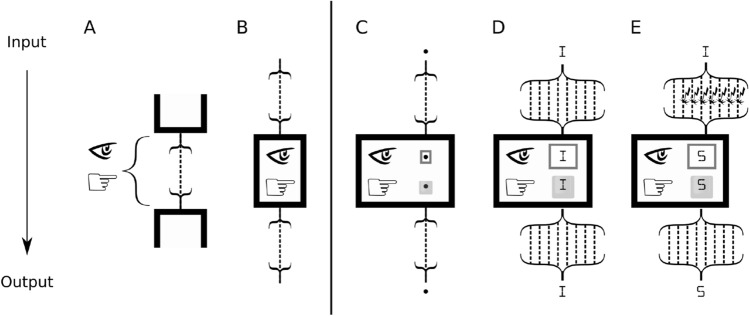
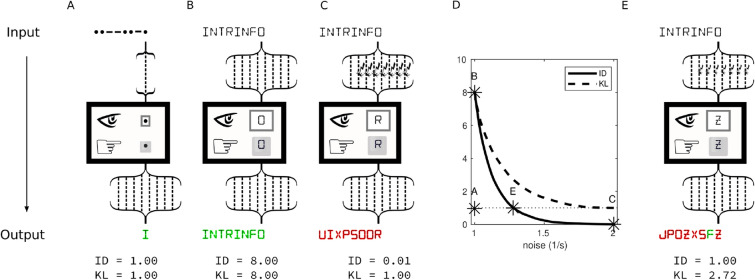
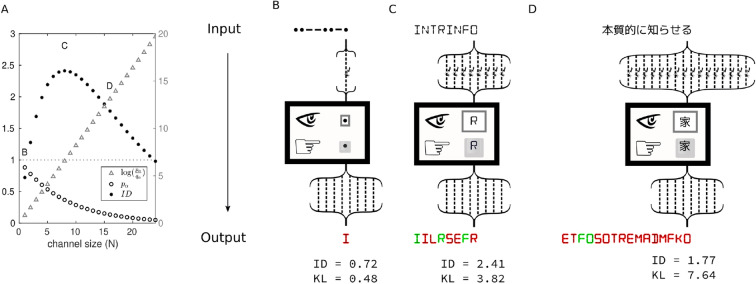
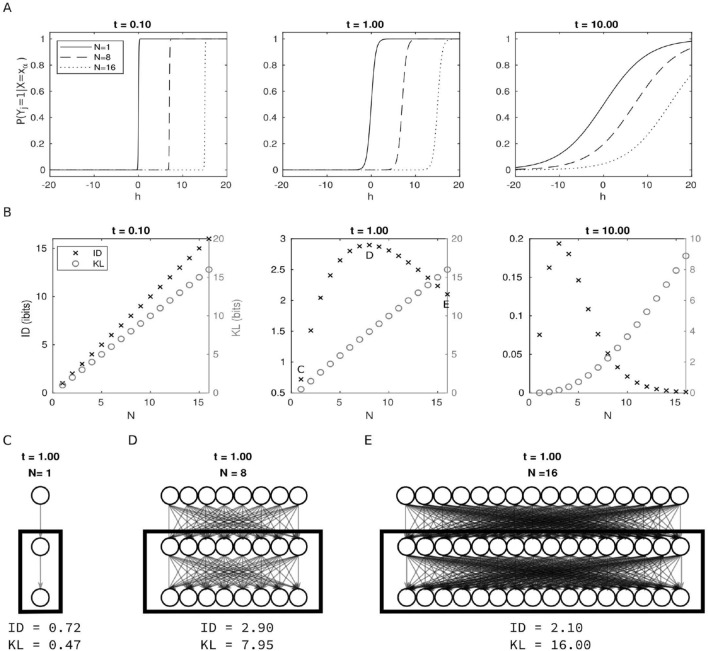
We introduce an information measure that reflects the intrinsic perspective of a receiver or sender of a single symbol, who has no access to the communication channel and its source or target. The measure satisfies three desired properties—causality, specificity, intrinsicality—and is shown to be unique. Causality means that symbols must be transmitted with probability greater than chance. Specificity means that information must be transmitted by an individual symbol. Intrinsicality means that a symbol must be taken as such and cannot be decomposed into signal and noise. It follows that the intrinsic information carried by a specific symbol increases if the repertoire of symbols increases without noise (expansion) and decreases if it does so without signal (dilution). An optimal balance between expansion and dilution is relevant for systems whose elements must assess their inputs and outputs from the intrinsic perspective, such as neurons in a network.
Overview
The claims and statistics of this paper haven’t been checked yet.
Free: it reads the open-access text and checks the first 5 claims that cite a source we can check. Create a free account to check every claim.
Integrity signals
Registry
Cites
Statistics
Figures
Verification
Claims the paper makes
The claims and statistics of this paper haven’t been checked yet.
Free: it reads the open-access text and checks the first 5 claims that cite a source we can check. Create a free account to check every claim.
Claims other papers make about this one
Each is checked against this paper’s own text: does it say what the citing paper says it does?
The source backs part of the claim, not all of it — or backs it for a different population, condition or comparison.
In the citing paper
“This is a measure of the difference between two probability distributions which uniquely satisfies three properties (causality, intrinsicality, and specificity) that align with the postulates of IIT (but also have independent justification):”
From Integrated information theory (IIT) 4.0: Formulating the properties of phenomenal existence in physical terms (2023) · cites this paper as [14]
Experimental — accuracy not yet measuredThe source backs part of the claim, not all of it — or backs it for a different population, condition or comparison.
In the citing paper
“Selectivity means that if p < 1, the system’s causal power becomes subadditive (dilution) (see [14] for details).”
From Integrated information theory (IIT) 4.0: Formulating the properties of phenomenal existence in physical terms (2023) · cites this paper as [14]
Experimental — accuracy not yet measuredThe cited source says what the claim attributes to it.
In the citing paper
“Intrinsic information is formulated as a product of selectivity and informativeness based on the notion of intrinsic difference (ID) [14].”
From Integrated information theory (IIT) 4.0: Formulating the properties of phenomenal existence in physical terms (2023) · cites this paper as [14]
The check wasn’t confident either way, so it gives no verdict — never disputed.
In the citing paper
“It is possible that macro grain systems can have more integrated information than their corresponding micro-grain systems [34,38,39].”
From Dissociating Artificial Intelligence from Artificial Consciousness (2024) · cites this paper as [38]
Experimental — accuracy not yet measured
Self-check
Percentages, sums and reported differences re-computed from the paper’s own numbers.
The self-check needs the paper’s full text.
Citations
Cites
A Mathematical Theory of Communication
Shannon, C. E. (1948) · Bell System Technical Journal · doi:10.1002/j.1538-7305.1948.tb01338.x · Cited by 88,486
Information theory and statistics
(1959) · Journal of the Franklin Institute · doi:10.1016/0016-0032(59)90368-0 · Cited by 7,094
Theoretical Neuroscience: Computational and Mathematical Modeling of Neural Systems
Dayan, P., & Abbott, L. F. (2001) · Cited by 4,162
On Measures of Entropy and Information
Rényi, A. (1961) · Project Euclid (Cornell University) · Cited by 4,031
Modeling Brain Function: The World of Attractor Neural Networks
Amit, D. J. (1989) · Cambridge University Press eBooks · doi:10.1017/cbo9780511623257 · Cited by 2,227
Neural Networks: A Systematic Introduction
Rojas, R. (1996) · Medical Entomology and Zoology · Cited by 2,138
Rényi Divergence and Kullback-Leibler Divergence
van Erven, T., & Harremoes, P. (2014) · IEEE Transactions on Information Theory · doi:10.1109/tit.2014.2320500 · Cited by 1,555
Toward Massive, Ultrareliable, and Low-Latency Wireless Communication With Short Packets
Durisi, G., Koch, T., & Popovski, P. (2016) · Proceedings of the IEEE · doi:10.1109/jproc.2016.2537298 · Cited by 1,154
(1967) · Cited by 853
On Measures of Information and their Characterizations
(1975) · Mathematics in Science and Engineering · doi:10.1016/s0076-5392(08)x6157-0 · Cited by 811 · cited 3×
“In both cases, it is intuitive to design information measures that are additive for all independent probability distributions 9,11,14,15 .”
BackgroundInfluential
Cited by
Albantakis, L., Barbosa, L., Findlay, G., Grasso, M., Haun, A. M., Marshall, W., Mayner, W. G. P., Zaeemzadeh, A., Boly, M., Juel, B. E., et al. (2023) · PLoS Computational Biology · doi:10.1371/journal.pcbi.1011465 · Cited by 292
“Chief among them are a more accurate translation of the axioms into postulates and mathematical expressions, the introduction of an Intrinsic Difference (ID) measure [15,17] that is uniquely consistent with IIT’s postulates, and the explicit assessment of causal relations [14].”
InfluentialSelf-citationThe strength of weak integrated information theory
Mediano, P. A. M., Rosas, F. E., Bor, D., Seth, A. K., & Barrett, A. B. (2022) · Trends in Cognitive Sciences · doi:10.1016/j.tics.2022.04.008 · Cited by 108
“Work is ongoing on characterising probability distribution spaces in an intrinsic way [24,31].”
BackgroundGreater than the parts: a review of the information decomposition approach to causal emergence
Mediano, P. A. M., Rosas, F. E., Luppi, A. I., Jensen, H. J., Seth, A. K., Barrett, A. B., Carhart-Harris, R. L., & Bor, D. (2022) · Philosophical Transactions of the Royal Society A Mathematical Physical and Engineering Sciences · doi:10.1098/rsta.2021.0246 · Cited by 113
“In this view, measuring the mutual information between parts of a complex system does not require assuming one is ‘sending bits’ to the other over some channel—instead, mutual information can be seen as the strength of the evidence supporting a statistical model in which the two parts are coupled (although see [17] fo…”
BackgroundMechanism Integrated Information
Barbosa, L. S., Marshall, W., Albantakis, L., & Tononi, G. (2021) · Entropy · doi:10.3390/e23030362 · Cited by 72
“Recently, we introduced an information measure, called intrinsic difference [5], which captures three postulates of IIT—existence, intrinsicality and information—and is unique.”
BackgroundMethodSelf-citationLuppi, A. I., Mediano, P. A. M., Rosas, F. E., Harrison, D. J., Carhart-Harris, R. L., Bor, D., & Stamatakis, E. A. (2021) · Neuroscience of Consciousness · doi:10.1093/nc/niab027 · Cited by 51
Only what exists can cause: An intrinsic powers view of free will
Tononi, G., Albantakis, L., Boly, M., Cirelli, C., Grasso, M., & Koch, C. (2022) · arXiv · doi:10.48550/arxiv.2206.02069 · Cited by 46
“Because the irreducibility φ is based on a measure intrinsic difference, it is sensitive to a tension between expansion and dilution ((Barbosa et al., 2020)).”
Self-citationDissociating Artificial Intelligence from Artificial Consciousness
Findlay, G., Marshall, W., Albantakis, L., David, I., Mayner, W. G., Koch, C., & Tononi, G. (2024) · arXiv · doi:10.48550/arxiv.2412.04571 · Cited by 41
“…is a complex, one evaluates its system integrated information ( φ s )—the extent to which the system’s intrinsic information (capturing the postulates of intrinsicality and information) [37] is affected by its minimum partition into causally independent parts (capturing the integration postulate).”
Self-citationEnriched category as a model of qualia structure based on similarity judgements
Tsuchiya, N., Phillips, S. D., & Saigo, H. (2022) · Consciousness and Cognition · doi:10.1016/j.concog.2022.103319 · Cited by 35
Consilience in Causation: Causal Emergence Is Found Across Measures of Causation
Comolatti, R., & Hoel, E. P. (2025) · Entropy · doi:10.3390/e27080825 · Cited by 32
“…specific criticisms of info-theoretic accounts of causation (e.g., recent work on grounding integrated information in axiomatic considerations [29,30]), it is a reasonable question whether causal emergence is a general phenomenon or some peculiar quirk of merely a few measures of causation…”
Unravelling consciousness and brain function through the lens of time, space, and information
Luppi, A. I., Rosas, F. E., Mediano, P. A. M., Demertzi, A., Menon, D. K., & Stamatakis, E. A. (2024) · Trends in Neurosciences · doi:10.1016/j.tins.2024.05.007 · Cited by 32
“…[111] and non-Shannon quantities developed in recent versions of the integrated information theory of consciousness (IIT) [112 – 116], which posit that ‘ information is a shape in concept space ’ [112] and propose an alternative, stronger formalisation of ‘ intrinsic ’ information [117,118].”
BackgroundComputing the Integrated Information of a Quantum Mechanism
Albantakis, L., Prentner, R., & Durham, I. T. (2023) · Entropy · doi:10.3390/e25030449 · Cited by 29
“Otherwise, the QID is subadditive, as desired [24].”
BackgroundMethodResultInfluentialSelf-citationConsciousness and complexity: Neurobiological naturalism and integrated information theory
Ellia, F., & Chis-Ciure, R. (2022) · Consciousness and Cognition · doi:10.1016/j.concog.2022.103281 · Cited by 24
A measure centrality index for systematic empirical comparison of consciousness theories
Chis-Ciure, R., Melloni, L., & Northoff, G. (2024) · Neuroscience & Biobehavioral Reviews · doi:10.1016/j.neubiorev.2024.105670 · Cited by 22
Marshall, W., Grasso, M., Mayner, W. G. P., Zaeemzadeh, A., Barbosa, L. S., Chastain, E., Findlay, G., Sasai, S., Albantakis, L., & Tononi, G. (2023) · Entropy · doi:10.3390/e25020334 · Cited by 20
“Recently, the mathematical framework has been updated by introducing a measure that uniquely satisfies the postulates of existence, intrinsicality, and information [6,9].”
BackgroundInfluentialSelf-citationPsychedelics and disorders of consciousness: the current landscape and the path forward
Cardone, P., Alnagger, N., Annen, J., Bicego, A., Gosseries, O., & Martial, C. (2024) · Neuroscience of Consciousness · doi:10.1093/nc/niae025 · Cited by 20
IIT, half masked and half disfigured
Tononi, G., Boly, M., Grasso, M., Hendren, J., Juel, B. E., Mayner, W. G. P., Marshall, W., & Koch, C. (2022) · Behavioral and Brain Sciences · doi:10.1017/s0140525x21001990 · Cited by 19
Self-citationOlesen, C., Waade, P. T., Albantakis, L., & Mathys, C. D. (2023) · PLoS Computational Biology · doi:10.1371/journal.pcbi.1011346 · Cited by 17
Self-citationInfo-Autopoiesis and the Limits of Artificial General Intelligence
Cárdenas-García, J. F. (2023) · Computers · doi:10.3390/computers12050102 · Cited by 16
Computing Integrated Information (Φ) in Discrete Dynamical Systems with Multi-Valued Elements
Gomez, J. D., Mayner, W. G. P., Beheler-Amass, M., Tononi, G., & Albantakis, L. (2020) · Entropy · doi:10.3390/e23010006 · Cited by 14
“‘AID’ stands for “absolute intrinsic difference” and implements the intrinsic difference (ID) measure that was introduced in [42].”
BackgroundMethodSelf-citationEmergentist Integrated Information Theory
Negro, N. (2022) · Erkenntnis · doi:10.1007/s10670-022-00612-z · Cited by 14
“IIT informational language is based instead on an intrinsic notion of information (Barbosa et al., 2020 ).”
Hoel, E. P. (2025) · arXiv (Cornell University) · doi:10.48550/arxiv.2512.12802 · Cited by 14
“becoming a popular theory of consciousness, since it is expressed in a math-ematically formalized way [4, 5].”
Intrinsic units: identifying a system’s causal grain
Marshall, W., Findlay, G., Albantakis, L., & Tononi, G. (2024) · bioRxiv · doi:10.1093/nc/niag013 · Cited by 16
“In IIT 4.0, this increased selectivity is captured naturally by ϕ s because of its formulation in terms of intrinsic information (Barbosa et al. 2020; 2021; Marshall et al. 2023).”
InfluentialSelf-citationNon-Separability of Physical Systems as a Foundation of Consciousness
Arkhipov, A. S. (2022) · Entropy · doi:10.3390/e24111539 · Cited by 12
Shannon information and integrated information: message and meaningPreprint
Zaeemzadeh, A., & Tononi, G. (2024) · arXiv (Cornell University) · doi:10.48550/arxiv.2412.10626 · Cited by 11
“A key role is played by the intrinsic difference [54] between probability distributions, a measure that uniquely satisfies the 0 th and first two postulates—being causal, intrinsic, and specific (much like Shannon’s entropy function).”
Self-citationIntrinsic meaning, perception, and matchingPreprint
Mayner, W., Juel, B., & Tononi, G. (2024) · arXiv (Cornell University) · doi:10.48550/arxiv.2412.21111 · Cited by 4
“This is the state for which system intrinsic information (ii s ) is maximal [14].”
Self-citationChis-Ciure, R. (2022) · Synthese · doi:10.1007/s11229-022-03704-z · Cited by 9
“Nevertheless, IIT proponents made a notable attempt to uniquely derive the measure of intrinsic information from the postulates (Barbosa et al., 2020, 2021), which is a significant step forward out of this underdetermination quagmire.”
BackgroundUpper bounds for integrated information
Zaeemzadeh, A., & Tononi, G. (2024) · PLoS Computational Biology · doi:10.1371/journal.pcbi.1012323 · Cited by 9
“Barbosa et al [11, 12] showed the integrated information of an individual distinction can increase by adding reliable, not noisy, units to it.”
Self-citationWhat is a Mathematical Structure of Conscious Experience?Preprint
Kleiner, J., & Ludwig, T. (2023) · PsyArXiv (OSF Preprints) · doi:10.31234/osf.io/yhn8q · Cited by 9
Integrated Information Theory: A Consciousness-First Approach to What ExistsPreprint
Tononi, G., & Boly, M. (2025) · arXiv (Cornell University) · doi:10.48550/arxiv.2510.25998 · Cited by 9
“This implies that the system’s units must be able to interact very effectively and selectively 7, 9 .”
Self-citationNot All Structure and Dynamics Are Equal
Mindt, G. (2021) · Entropy · doi:10.3390/e23091226 · Cited by 8
“0 [11,14,27,28,45,46], which present developments and refinements since IIT 3.”
BackgroundWhen do parts form wholes? Integrated information as the restriction on mereological composition
McQueen, K. J., & Tsuchiya, N. (2023) · Neuroscience of Consciousness · doi:10.1093/nc/niad013 · Cited by 7
“(2014), Tononi (2015), Tononi (2016), Tegmark (2016), Tsuchiya (2017), McQueen (2019a), Mø rch (2019), Haun and Tononi (2019), Barbosa et al. (2020), Ellia et al.”
Visual continuum in non-human animals: serial dependence revealed in dogs
Lõoke, M., Guerineau, C., Broseghini, A., Mongillo, P., & Marinelli, L. (2024) · Proceedings of the Royal Society B Biological Sciences · doi:10.1098/rspb.2024.0051 · Cited by 6
COVID-19 vaccines and vaccinations coverage on news portals: Framing, Tone, and Source Analysis
Demuyakor, J., Avenyo, S. J., & Amankwah, A. S. (2024) · Communication and the Public · doi:10.1177/20570473231225299 · Cited by 5
“The published COVID-19 vaccines and vaccination news articles from the four websites or news portals enabled the researchers to identify and explain in detail the intrinsic information conveyed statistically (Barbosa et al., 2020; Sutton & Austin, 2015).”
Rahman, A. (2023) · Current Medicinal Chemistry · doi:10.2174/0929867331666230707123345 · Cited by 4
Intrinsic Cause–Effect Power: The Tradeoff Between Differentiation and Specification
Mayner, W. G. P., Marshall, W., & Tononi, G. (2026) · Entropy · doi:10.3390/e28040410 · Cited by 4
“The ID is a unique measure of the difference between two probability distributions that satisfies a set of properties motivated by the postulates of IIT [8].”
Self-citationSanfey, J. (2024) · Entropy · doi:10.3390/e26080647 · Cited by 4
“The ID measure identifies which of the possible MIC repertoires maximises the information ‘received and sent correctly from and to the system’ and is most likely to be the one chosen by the system [5,23].”
BackgroundThe Nature of Information, Semantics, and Effectiveness for Artificial Intelligence and CognitionPreprint
Brown, K. (2021) · OSF Preprints (OSF Preprints) · doi:10.31219/osf.io/dehkj · Cited by 4
Information integration and the latent consciousness of human groups
Watson, J. R., Maier, A., Novillo, Á., Echegoyen, I., Resta, R., del Campo, R. L., & Buldú, J. M. (2025) · Chaos Solitons & Fractals · doi:10.1016/j.chaos.2025.117627 · Cited by 3
On the utility of toy models for theories of consciousnessPreprint
Albantakis, L. (2025) · arXiv (Cornell University) · doi:10.48550/arxiv.2508.00190 · Cited by 3
Self-citationFrom the Visible to the Invisible: On the Phenomenal Gradient of Appearance
Pinna, B., Porcheddu, D., & Šķilters, J. (2026) · Brain Sciences · doi:10.3390/brainsci16010114 · Cited by 2
“This aligns with theories of consciousness that propose multi-level or hierarchical models, such as the Global Workspace Theory [40–44] or Integrated Information Theory [45–51].”
Quantum Superpositions of Conscious States in a Minimal Integrated Information Model
McQueen, K. J., Durham, I. T., & Müller, M. P. (2026) · Entropy · doi:10.3390/e28040394 · Cited by 2
Two Levels of Integrated Information Theory: From Autonomous Systems to Conscious Life
Ruan, Z., & Li, H. (2024) · Entropy · doi:10.3390/e26090761 · Cited by 4
Chis-Ciure, R. (2025) · Philosophical Explorations · doi:10.1080/13869795.2025.2550245 · Cited by 3
“In IIT, the constitutive a priori identity enables applying the information-theoretic formalism to subjective experience, thus obtaining a real notion of intrinsic information (Albantakis et al. 2023; Barbosa et al. 2020).”
On the Shape of Intrinsic Information: A Unified Framework from Dynamical Systems
Carvalho, A. N., Langa, J. A., & Toscano, F. S. (2026) · Foundations of Science · doi:10.1007/s10699-026-10042-7 · Cited by 1
Integrated Information, a Complexity Measure for Optimal PartitionsPreprint
Citton, O., & Caticha, N. (2024) · SSRN Electronic Journal · doi:10.2139/ssrn.4781216 · Cited by 1
Integrated Information in the Active Inference FrameworkPreprint
Langer, C., van Oostrum, J., & Ay, N. (2026) · arXiv (Cornell University) · doi:10.48550/arxiv.2608.14165 · Cited by 1
“The perhaps most notable change is the introduction of a new difference measure, called the “intrinsic difference” [4], which is consistent with IIT’s postulates.”
Chen, P., Zhang, N., Xu, Y., & Zhang, S.-Y. (2026) · arXiv (Cornell University) · doi:10.48550/arxiv.2610.41604 · Cited by 1
“…claimed module files exist, vs. pervasive dangling references in the primary system), and its flagship claim, a polynomial-time IIT-ϕ computation [32], is precisely defect) in its purest observed form: the defect is localized to one dictionary entry, the repair is to add the missing substrate…”
Integrated Information and Complexity Measures for Disordered Systems
Citton, O. (2023) · Digital Library of Theses and Dissertations (Universidade de São Paulo) · doi:10.11606/d.43.2023.tde-15062023-052053
“On its current state (see [8] and [9]), the postulates which try to translate the properties of the conscious experience, can be summarized as follows: • Existence - (or causality) Experience exists.”
BackgroundOntological conceptions of information cannot account for consciousness
Tse, P. U. (2024) · Consciousness and Cognition · doi:10.1016/j.concog.2024.103772
“In Barbosa et al. (2020), ID is derived within an epistemological framework in which a symbol transmitted by a sender is decoded by a receiver, as in the traditional Shannonesque conception of information.”
InfluentialA K-Means-Based Strategy for Estimating the MIP in Integrated Information Theory
Guerrero, L. E., Arango‐López, J., Castillo, L., & Moreira, F. (2026) · Lecture notes in networks and systems · doi:10.1007/978-3-032-10721-3_46
Separable cellular correlates of visual acuity and lifespan in mammalian primary visual cortexPreprint
Miller, D. J., & Kaas, J. H. (2026) · bioRxiv (Cold Spring Harbor Laboratory) · doi:10.64898/2026.04.08.716558
Formalizing consciousness: a comparative mathematical analysis of leading theories
Yan, T., Tsukahara, J., Williford, K., Rudrauf, D., & Sergeant-Perthuis, G. (2026) · Biological Cybernetics · doi:10.1007/s00422-026-01068-y
Quantifying Spacetime Integration across a Partition with SynergyPreprint
Griffith, V. (2026) · arXiv (Cornell University) · doi:10.48550/arxiv.2604.18635
“However, since IIT4, IIT prefers the Intrinsic Difference 4 (ID) [13]. into a specific state y ∈ Y , defined as, We are not arguing that all those using Shannon-based partial information decomposition synergy should instead use the Intrinsic Difference.”
Tuan, N. M., & Ratasukharom, N. (2026) · Research Square · doi:10.21203/rs.3.rs-9711456/v1
Completely Measured: Integrated Information Theory and Identity
MacDonald, C. (n.d.) · PhilPapers (PhilPapers Foundation)
Metadata
- Authors
- Barbosa, L. S., Marshall, W., Streipert, S., Albantakis, L., & Tononi, G.
- Affiliations
- University of Wisconsin–Madison (US)
- Corresponding author
- Tononi, Giulio
- Venue
- Scientific Reports
- Published
- 2020-11-02
- Volume
- 10
- Issue
- 1
- Pages
- 18803-18803
- ISSN
- 2045-2322 (ISSN-L)
- PMC
- PMC7606539
- OpenAlex
- W3095411193
- Cited by
- 42
- References
- 23
- Citations by year
- 2026: 5 · 2025: 3 · 2024: 10 · 2023: 10 · 2022: 8 · 2021: 4 · 2020: 2
- FWCI
- 2.54
- Type
- journal article
- Language
- en
- Open access
- gold
- doi.org
- Licence
- cc-by
- creativecommons.org/licenses/by/4.0 (tdm)
- creativecommons.org/licenses/by/4.0 (vor)
- Locations
- Scientific Reports (publishedVersion, cc-by)
- PubMed Central (publishedVersion, cc-by)
- PubMed (publishedVersion)
- Funders
- Templeton World Charity Foundation (#TWCF0216)
- Topics
- Physical Sciences › Physics and Astronomy › Statistical and Nonlinear Physics › Complex Systems and Dynamics
- Physical Sciences › Computer Science › Artificial Intelligence › Diverse Interdisciplinary Research Studies
- Physical Sciences › Physics and Astronomy › Statistical and Nonlinear Physics › Advanced Thermodynamics and Statistical Mechanics
- Keywords
- intrinsic information, information measures, causality, specificity, information theory, neural information processing
About these checks
Registry, retraction, Cites and statistics results are computed, not judged, with one exception: a printed reference that no index lists is read once by a model before it counts as a citation error. Claims are extracted by a model and kept only when their quote appears verbatim in the text; each cited source is then checked, with a model’s help, for whether it says what the claim relies on. Those verdicts can be wrong — read the claim’s quote and the cited source before relying on one.
Statistics and arithmetic are recomputed, not judged.
Confidence bands are shown only for fields calibrated on our annotated test set. None is calibrated yet, so no band is shown.
What counts as a claim ›How we measure confidence ›How we check this ›
Are you an author, or do you see a problem with this page? Request a review
Data sources
Bibliographic data: Semantic Scholar, OpenAlex, Crossref.
Contains information from the Semantic Scholar Academic Graph Datasets, made available under the ODC Attribution License (ODC-BY 1.0).
Semantic Scholar’s data is described in: Kinney, R., et al. (2023). The Semantic Scholar Open Data Platform. arXiv:2301.10140.
