

The DOI matches its Crossref record; 110 of the 112 references it cites were found in a registry or an index.
A review of some techniques for inclusion of domain-knowledge into deep neural networks
Open accessAbstract
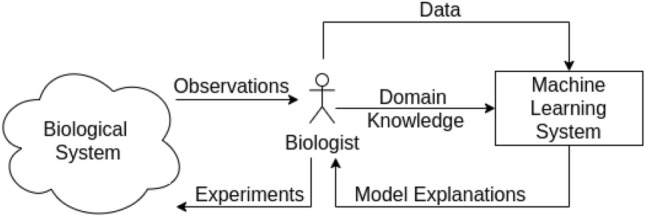
We present a survey of ways in which existing scientific knowledge are included when constructing models with neural networks. The inclusion of domain-knowledge is of special interest not just to constructing scientific assistants, but also, many other areas that involve understanding data using human-machine collaboration. In many such instances, machine-based model construction may benefit significantly from being provided with human-knowledge of the domain encoded in a sufficiently precise form. This paper examines the inclusion of domain-knowledge by means of changes to: the input, the loss-function, and the architecture of deep networks. The categorisation is for ease of exposition: in practice we expect a combination of such changes will be employed. In each category, we describe techniques that have been shown to yield significant changes in the performance of deep neural networks.
Overview
The claims and statistics of this paper haven’t been checked yet.
Run the check — free, no account needed. It reads the open-access text and checks the sources it cites.
Integrity signals
Registry
Cites
Statistics
Figures
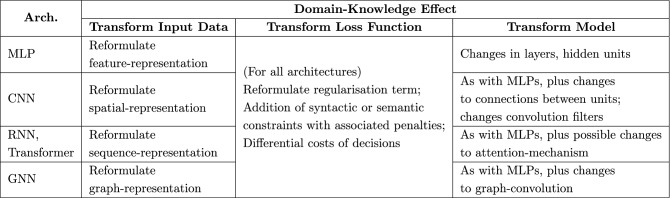
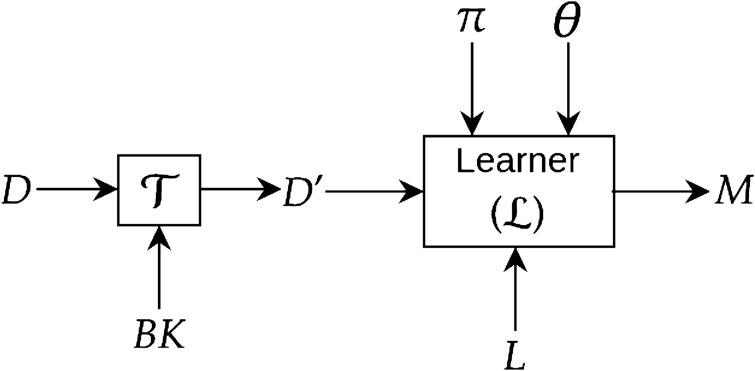
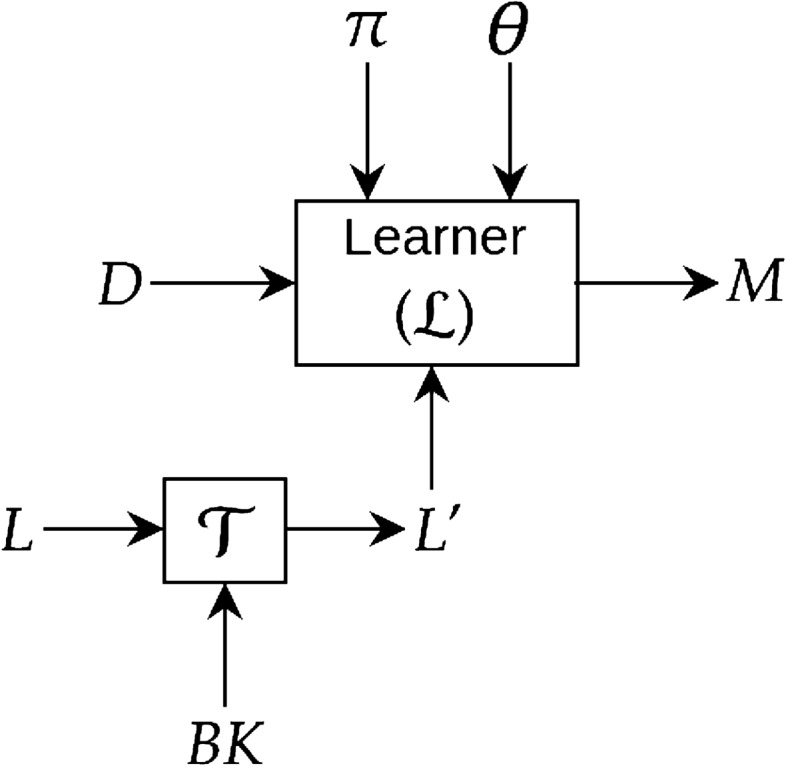
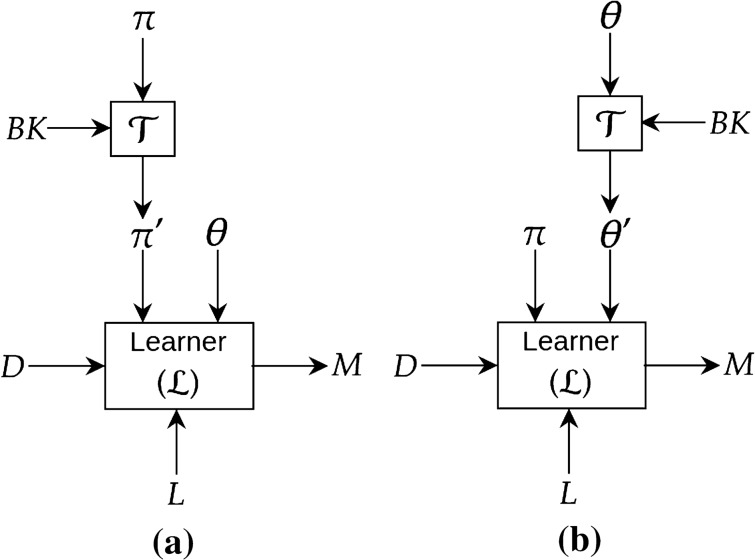
Verification
Claims the paper makes
The claims and statistics of this paper haven’t been checked yet.
Run the check — free, no account needed. It reads the open-access text and checks the sources it cites.
Claims other papers make about this one
Each is checked against this paper’s own text: does it say what the citing paper says it does?
The source backs part of the claim, not all of it — or backs it for a different population, condition or comparison.
In the citing paper
“However, integrating external domain knowledge into emotion recognition models is usually a complex and timeconsuming process [19].”
From Emotion Classification With Visibility Graphs (2025) · cites this paper as [19]
Experimental — accuracy not yet measured
Self-check
Percentages, sums and reported differences re-computed from the paper’s own numbers.
The self-check needs the paper’s full text.
Citations
Cites
Vaswani, A., Shazeer, N., Parmar, N., Uszkoreit, J., Jones, L., Gomez, A. N., Kaiser, L., & Polosukhin, I. (2017) · arXiv · doi:10.48550/arxiv.1706.03762 · Cited by 120,404
Jakubův, J., Chvalovský, K., Goertzel, Z., et al. (2023) · DROPS (Schloss Dagstuhl – Leibniz Center for Informatics) · doi:10.4230/lipics.itp.2023.19 · Cited by 76,648
Language Models are Few-Shot Learners
Brown, T. B., Mann, B., Ryder, N., Subbiah, M., Kaplan, J., Dhariwal, P., Neelakantan, A., Shyam, P., Sastry, G., Askell, A., et al. (2020) · arXiv · doi:10.48550/arxiv.2005.14165 · Cited by 23,372
Advances in neural information processing systems 7
Cios, K. J., & Shields, M. E. (1997) · Neurocomputing · doi:10.1016/s0925-2312(97)90018-7 · Cited by 22,093
Distilling the Knowledge in a Neural Network
Hinton, G., Vinyals, O., & Dean, J. (2015) · arXiv · doi:10.48550/arxiv.1503.02531 · Cited by 14,204 · cited 1×
“This is done via a modifica-tion to the knowledge-distillation loss proposed by Hinton et al. [65].”
Barredo Arrieta, A., Díaz-Rodríguez, N., Del Ser, J., Bennetot, A., Tabik, S., Barbado, A., Garcia, S., Gil-Lopez, S., Molina, D., Benjamins, R., et al. (2020) · Information Fusion · doi:10.1016/j.inffus.2019.12.012 · Cited by 10,423 · cited 1×
“Understanding models constructed by deep neural networks is an area of intense research activity, and good summaries exist elsewhere [3; 4].”
A Comprehensive Survey on Transfer Learning
Zhuang, F., Qi, Z., Duan, K., Xi, D., Zhu, Y., Zhu, H., Xiong, H., & He, Q. (2021) · Proceedings of the IEEE · doi:10.1109/jproc.2020.3004555 · Cited by 6,678
The global landscape of AI ethics guidelines
Jobin, A., Ienca, M., & Vayena, E. (2019) · Nature Machine Intelligence · doi:10.1038/s42256-019-0088-2 · Cited by 6,220 · cited 1×
“It is now accepted that trust comes through understanding of how decisions are made by the machine-constructed models [112], and what are the determining factors in these decisions.”
BackgroundA Survey on Bias and Fairness in Machine Learning
Mehrabi, N., Morstatter, F., Saxena, N., Lerman, K., & Galstyan, A. (2022) · ACM Computing Surveys · doi:10.1145/3457607 · Cited by 5,812 · cited 1×
“Domain-knowledge can also be used to correct biases [114] built into a deep network either declaratively, through the use of constraints, or through the use of loss functions that include “ethical penalty” terms.”
BackgroundModeling Relational Data with Graph Convolutional Networks
Schlichtkrull, M., Kipf, T. N., Bloem, P., van den Berg, R., Titov, I., & Welling, M. (2018) · Lecture Notes in Computer Science · doi:10.1007/978-3-319-93417-4_38 · Cited by 5,570 · cited 2×
“The computational machinery available in GNN then aggregates and combines the information available in the knowledge graph (an example of this kind of aggregation and pooling of relational information is in [46]).”
MethodLipton, Z. C. (2018) · Queue · doi:10.1145/3236386.3241340 · Cited by 5,427 · cited 1×
“Understanding models constructed by deep neural networks is an area of intense research activity, and good summaries exist elsewhere [3; 4 ] .”
Bayesian Learning for Neural Networks
Neal, R. M. (1996) · Lecture Notes in Statistics · doi:10.1007/978-1-4612-0745-0 · Cited by 4,276 · cited 1×
“The work by [77] on Bayesian learning for neural networks also showed how domain-knowledge could help build a prior probability distribution over neural network parameters.”
BackgroundDBpedia - A large-scale, multilingual knowledge base extracted from Wikipedia
Lehmann, J., Isele, R., Jakob, M., Jentzsch, A., Kontokostas, D., Mendes, P. N., Hellmann, S., Morsey, M., van Kleef, P., Auer, S., et al. (2015) · Semantic Web · doi:10.3233/sw-140134 · Cited by 3,737 · cited 2×
“In this work, the authors treat an external knowledge graph, such as DBpedia [50], as a source of domain-knowledge allowing entities to be enriched with this knowledge.”
A theory of learning from different domains
Ben-David, S., Blitzer, J., Crammer, K., Kulesza, A., Pereira, F., & Vaughan, J. W. (2010) · Machine Learning · doi:10.1007/s10994-009-5152-4 · Cited by 3,515 · cited 2×
“This form of learning is viewed as an instance of domain-adaptation [34].”
BackgroundDeep visual domain adaptation: A survey
Wang, M., & Deng, W. (2018) · Neurocomputing · doi:10.1016/j.neucom.2018.05.083 · Cited by 2,209 · cited 1×
“There are some recent surveys along these lines: [83; 84].”
Handbook of Constraint Programming
Rossi, F., van Beek, P., & Walsh, T. (2006) · Foundations of artificial intelligence · doi:10.1016/s1574-6526(06)x8001-x · Cited by 1,845 · cited 1×
“[ 70 ] inject domain knowledge at training time via an approach that combines semantic based regularisation and constraint programming [ 71 ] .”
Inductive Logic Programming: Theory and methods
Muggleton, S., & de Raedt, L. (1994) · The Journal of Logic Programming · doi:10.1016/0743-1066(94)90035-3 · Cited by 1,537 · cited 1×
“Techniques for automatic construction of Boolean-valued features from relational domain-knowledge have a long history in the field of ILP [ 15; 16; 17 ] , originating from the LINUS [ 7 ] .”
BackgroundUniversal Sentence Encoder for English
Cer, D. M., Yang, Y., Kong, S.-Y., Hua, N., Limtiaco, N., John, R. S., Constant, N., Guajardo-Céspedes, M., Yuan, S., Tar, C., et al. (2018) · Conference on Empirical Methods in Natural Language Processing: System Demonstrations (EMNLP) · doi:10.18653/v1/d18-2029 · Cited by 1,431 · cited 1×
“One recent example of embedding is demonstrated in [21] where the authors use different text-embedding approaches such as sentence encoder [22] and GPT2 [23] to transform textual domain-knowledge into embedding vectors.”
Muggleton, S. (1995) · New Generation Computing · doi:10.1007/bf03037227 · Cited by 1,411 · cited 2×
“The simplification used in vertex-enrichment has been made unnecessary in a recent proposal for transforming the most-specific clause constructed by ILP systems employing mode-directed inverse entailment (MDIE [27]).”
Knowledge Graph Convolutional Networks for Recommender Systems
Wang, H., Zhao, M., Xie, X., Li, W., & Guo, M. (2019) · International World Wide Web Conference (WWW) · doi:10.1145/3308558.3313417 · Cited by 1,230 · cited 3×
“The intuition is that the nodes (in a problem involving recommender systems, as in [48], a node represents an entity) in the knowledge-graph can be represented with an aggregated neighbourhood information with bias while adopting the central idea of aggregate-and-combine in GNNs.”
BackgroundMethodSimultaneous Deep Transfer Across Domains and Tasks
Tzeng, E., Hoffman, J., Darrell, T., & Saenko, K. (2015) · IEEE/CVF International Conference on Computer Vision (ICCV) · doi:10.1109/iccv.2015.463 · Cited by 1,220
The "Wake-Sleep" Algorithm for Unsupervised Neural Networks
Hinton, G. E., Dayan, P., Frey, B. J., & Neal, R. M. (1995) · Science · doi:10.1126/science.7761831 · Cited by 1,070 · cited 1×
“Higher-level domain-concepts are then abduced as compositions of these primitives via a neurally-guided search procedure based on a version of the Bayesian “wake-sleep” algorithm [ 33 ] .”
Muggleton, S. (1991) · New Generation Computing · doi:10.1007/bf03037089 · Cited by 1,044
von Rueden, L., Mayer, S., Beckh, K., Georgiev, B., Giesselbach, S., Heese, R., Kirsch, B., Walczak, M., Pfrommer, J., Pick, A., et al. (2021) · IEEE Transactions on Knowledge and Data Engineering · doi:10.1109/tkde.2021.3079836 · Cited by 999
Pereira, F. C. N., & Warren, D. H. D. (1980) · Artificial Intelligence · doi:10.1016/0004-3702(80)90003-x · Cited by 978
Knowledge-based artificial neural networks
Towell, G. G., & SHAVLIK, J. W. (1994) · Artificial Intelligence · doi:10.1016/0004-3702(94)90105-8 · Cited by 770 · cited 1×
“In KBANN, the domain knowledge is represented as a set of hierarchically structured propositional rules that directly determines a fixed topological structure of a neural network [86].”
Extracting Refined Rules from Knowledge-Based Neural Networks
Towell, G. G., & SHAVLIK, J. W. (1993) · Machine Learning · doi:10.1023/a:1022683529158 · Cited by 756
ProbLog: A probabilistic Prolog and its application in link discovery
Raedt, L. D., Kimmig, A., & Toivonen, H. T. T. (2006) · Lirias · Cited by 698
Harnessing Deep Neural Networks with Logic Rules
Hu, Z., Ma, X., Liu, Z., Hovy, E. H., & Xing, E. P. (2016) · Proceedings of the conference - Association for Computational Linguistics. Meeting · doi:10.18653/v1/p16-1228 · Cited by 629
Learning Explanatory Rules from Noisy Data
Evans, R., & Grefenstette, E. (2018) · Journal of Artificial Intelligence Research · doi:10.1613/jair.5714 · Cited by 426
Refinement of approximate domain theories by knowledge-based neural networks
Towell, G. G., SHAVLIK, J. W., & Noordewier, M. O. (1990) · Cited by 374
Buntine, W., & Weigend, A. S. (1991) · Complex Systems · Cited by 357
Ai for social good: unlocking the opportunity for positive impact
Tomašev, N., Cornebise, J., Hutter, F., Mohamed, S., Picciariello, A., Connelly, B., Belgrave, D. C. M., Ezer, D., Haert, F. C. V. D., Mugisha, F., et al. (2020) · Nature Communications · doi:10.1038/s41467-020-15871-z · Cited by 357 · cited 1×
“But it is not just the construction of scientific-assistants that can benefit from this form of man-machine collaboration, and “human-in-the-loop” AI systems are likely to play an increasingly important role in engineering, medicine, healthcare, agriculture, environment and so on [8].”
BackgroundDeep learning based forecasting of photovoltaic power generation by incorporating domain knowledge
Luo, X., Zhang, D., & Zhu, X. (2021) · Energy · doi:10.1016/j.energy.2021.120240 · Cited by 328 · cited 2×
“…ILBKRME [30] MLP HDNNLR [64] CNN, RNN SBR [68] MLP SBR [69] CNN DL2 [ 66 ] CNN Semantic Loss [ 63 ] CNN LENSR [ 91 ] GNN DANN [ 67 ] MLP PC-LSTM [ 72 ] RNN DomiKnowS [ 73 ] DNN* MultiplexNet [ 74 ] MLP, CNN Analogy Model [ 75 ] RNN Transforming Model KBANN [ 86 ] MLP Cascade-ARTMAP [ 89 ] ARTMAP…”
BackgroundTowards Knowledge-Based Recommender Dialog System
Chen, Q., Lin, J., Zhang, Y., Ding, M., Cen, Y., Yang, H., & Tang, J. (2019) · Conference on Empirical Methods in Natural Language Processing (EMNLP) · doi:10.18653/v1/d19-1189 · Cited by 317 · cited 2×
“…for use Principal Approach Work (Reference) Type of Learner Transforming Data DRM [24; 25] MLP CILP++ [28] MLP R-GCN [46] GNN KGCN [48] GNN KBRD [49] GNN DG-RNN [44] RNN DreamCoder [32] DNN ∗ Gated-K-BERT [38] Transformer VEGNN [5] GNN BotGNN [6] GNN KRISP [45] GNN, Transformer Transforming…”
Neural Unsupervised Domain Adaptation in NLP—A Survey
Ramponi, A., & Plank, B. (2020) · International Conference on Computational Linguistics · doi:10.18653/v1/2020.coling-main.603 · Cited by 311 · cited 1×
“There are some recent surveys along these lines: [83; 84].”
ResultA Semantic Loss Function for Deep Learning with Symbolic KnowledgePreprint
Xu, J., Zhang, Z., Friedman, T., Liang, Y., & den Broeck, G. V. (2017) · arXiv (Cornell University) · doi:10.48550/arxiv.1711.11157 · Cited by 283 · cited 3×
“The general intuition behind this idea is that the semantic loss is proportional to a negative logarithm of the probability of generating a state that satis-fies the constraint when sampling values according to some probability distribution.”
InfluentialInjecting Logical Background Knowledge into Embeddings for Relation Extraction
Rocktäschel, T., Singh, S., & Riedel, S. (2015) · North American Chapter of the Association for Computational Linguistics · doi:10.3115/v1/n15-1118 · Cited by 281
Jointly Embedding Knowledge Graphs and Logical Rules
Guo, S., Wang, Q., Wang, L., Wang, B., & Guo, L. (2016) · Conference on Empirical Methods in Natural Language Processing (EMNLP) · doi:10.18653/v1/d16-1019 · Cited by 278 · cited 1×
“[56] proposed a joint model, called KALE, which embeds facts from knowledge-graphs and logical rules, simultaneously.”
Propositionalization Approaches to Relational Data Mining
Krämer, S., Lavrač, N., & Flach, P. A. (2001) · Springer eBooks · doi:10.1007/978-3-662-04599-2_11 · Cited by 273
Regularization for Deep Learning: A TaxonomyPreprint
Kukačka, J., Golkov, V., & Cremers, D. (2017) · arXiv (Cornell University) · doi:10.48550/arxiv.1710.10686 · Cited by 254 · cited 1×
“The optimiser minimises the loss along with the regularisation term resulting in a less complex model in terms of parameters [Kukačka et al., 2017].”
Logic Tensor Networks: Deep Learning and Logical Reasoning from Data and KnowledgePreprint
Serafini, L., & Garcez, A. D. (2016) · arXiv (Cornell University) · doi:10.48550/arxiv.1606.04422 · Cited by 251 · cited 1×
“Learning and inference can then be conducted on these matrices (or tensors) [ 104; 105 ] allowing faster computation.”
Neural-Symbolic Learning and Reasoning: A Survey and InterpretationPreprint
Besold, T. R., Garcez, A. D., Bader, S., Bowman, H., Domingos, P., Hitzler, P., Kühnberger, K., Lamb, L. C., Lowd, D., Lima, P. M. V., et al. (2017) · arXiv (Cornell University) · doi:10.48550/arxiv.1711.03902 · Cited by 243
DeepProbLog: Neural Probabilistic Logic Programming
Manhaeve, R., Dumančić, S., Kimmig, A., Demeester, T., & De Raedt, L. (2018) · arXiv · doi:10.48550/arxiv.1805.10872 · Cited by 239
KRISP: Integrating Implicit and Symbolic Knowledge for Open-Domain Knowledge-Based VQA
Marino, K., Chen, X., Parikh, D., Gupta, A., & Rohrbach, M. (2021) · IEEE Computer Society Conference on Computer Vision and Pattern Recognition/Proceedings - IEEE Computer Society Conference on Computer Vision and Pattern Recognition/Proceedings · doi:10.1109/cvpr46437.2021.01389 · Cited by 211 · cited 3×
“While the above methods use the relational knowledge from a knowledge-graph by altering or adding an attention module within the deep sequence model, a recent method called KRISP [45] introduces such external knowledge at the output (prediction) layer of BERT.”
The Modern Mathematics of Deep Learning
Berner, J., Grohs, P., Gitta Kutyniok, B., & Petersen, P. (2022) · Cambridge University Press eBooks · doi:10.1017/9781009025096.002 · Cited by 199 · cited 1×
“DNN based methods arguably work best if the domainknowledge is used to inspire their architecture choices [85].”
Adversarial and Domain-Aware BERT for Cross-Domain Sentiment Analysis
Du, C., Sun, H., Wang, J., Qi, Q., & Liao, J. (2020) · Proceedings of the conference - Association for Computational Linguistics. Meeting · doi:10.18653/v1/2020.acl-main.370 · Cited by 186 · cited 2×
“An example of this kind of learning is in [ 82 ] where a BERT model is fine-tuned with data from multiple domains.”
MethodIncorporating Prior Domain Knowledge into Deep Neural Networks
Muralidhar, N., Islam, M. R., Marwah, M., Karpatne, A., & Ramakrishnan, N. (2018) · IEEE International Conference on Big Data (BigData) · doi:10.1109/bigdata.2018.8621955 · Cited by 180 · cited 3×
“In a similar line, [67] proposed domain-adapted neural network (DANN) that works with a balanced loss function at the intersection of models based on purely domain-based loss or purely inductive loss.”
Estimating Node Importance in Knowledge Graphs Using Graph Neural Networks
Park, N., Kan, A., Dong, X. L., Zhao, T., & Faloutsos, C. (2019) · ACM SIGKDD Conference on Knowledge Discovery and Data Mining (KDD) · doi:10.1145/3292500.3330855 · Cited by 178 · cited 1×
“Some recent works are in [47; 48], where a GNN is used for estimation of node importance in a knowledge-graph.”
Embedding Logical Queries on Knowledge Graphs
Hamilton, W. L., Bajaj, P., Zitnik, M., Jurafsky, D., & Leskovec, J. (2018) · arXiv · doi:10.48550/arxiv.1806.01445 · Cited by 176 · cited 1×
“[Hamilton et al., 2018] incorporate first-order logic into low dimensional spaces by embedding graphs nodes and represent logical operators as learned geometric relations in the space.”
Semantic-based regularization for learning and inference
Diligenti, M., Gori, M., & Saccà, C. (2015) · Artificial Intelligence · doi:10.1016/j.artint.2015.08.011 · Cited by 166 · cited 3×
“Another work that translates domain-knowledge in first-order logic into a deep neural network architecture consisting of the input layer (grounded atoms), propositional layer, quantifier layer and output layer is [ 68 ] .”
BackgroundMethodLearning nonrecursive definitions of relations with linus
Nada Lavrač, A., Džeroski, S., & Grobelnik, M. (1991) · Lecture notes in computer science · doi:10.1007/bfb0017020 · Cited by 164 · cited 4×
“Techniques for automatic construction of Boolean-valued features from relational domainknowledge have a long history in the field of ILP [15; 16; 17], originating from the LINUS [7].”
InfluentialKitano, H. (2016) · AI Magazine · doi:10.1609/aimag.v37i1.2642 · Cited by 158
Gaur, M., Faldu, K., & Sheth, A. (2021) · IEEE Internet Computing · doi:10.1109/mic.2020.3031769 · Cited by 149 · cited 1×
“Fusing the information in a knowledge-graph in this way into various level of hidden representations in a deep network could also allow quantitative and qualitative assessment of its functioning, leading to knowledge-infused interpretability [42].”
Knowledge-based connectionism for revising domain theories
Fu, L.-M. (1993) · IEEE Transactions on Systems Man and Cybernetics · doi:10.1109/21.214775 · Cited by 147 · cited 1×
“A similar study is KBCNN [ 87 ] , which first identifies and links domain attributes and concepts consistent with initial domain knowledge.”
ResultProbabilistic Entity-Relationship Models, PRMs, and Plate Models
Heckerman, D. E., Meek, C., & Koller, D. (2007) · The MIT Press eBooks · doi:10.7551/mitpress/7432.003.0009 · Cited by 142
Lifted Rule Injection for Relation Embeddings
Demeester, T., Rocktäschel, T., & Riedel, S. (2016) · Conference on Empirical Methods in Natural Language Processing (EMNLP) · doi:10.18653/v1/d16-1146 · Cited by 142 · cited 1×
“[ 60 ] proposed ordering of embedding space based on rules mined from WordNet and found it to better prior knowledge and generalisation capabilities using these relational embeddings.”
ILP turns 20: Biography and future challenges
Muggleton, S., De Raedt, L., Poole, D., Bratko, I., Flach, P., Inoue, K., & Srinivasan, A. (2012) · Machine Learning · doi:10.1007/s10994-011-5259-2 · Cited by 126 · cited 1×
“Techniques for automatic construction of Boolean-valued features from relational domain-knowledge have a long history in the field of ILP [ 15; 16; 17 ] , originating from the LINUS [ 7 ] .”
BackgroundSelf-citationDreamCoder: growing generalizable, interpretable knowledge with wake–sleep Bayesian program learning
Ellis, K., Wong, L., Nye, M., Sablé-Meyer, M., Cary, L., Anaya Pozo, L., Hewitt, L., Solar-Lezama, A., & Tenenbaum, J. B. (2023) · Philosophical Transactions of the Royal Society A: Mathematical, Physical and Engineering Sciences · doi:10.1098/rsta.2022.0050 · Cited by 125 · cited 2×
“…Type of Learner Transforming Data DRM [24; 25] MLP CILP++ [28] MLP R-GCN [46] GNN KGCN [48] GNN KBRD [49] GNN DG-RNN [44] RNN DreamCoder [32] DNN ∗ Gated-K-BERT [38] Transformer VEGNN [5] GNN BotGNN [6] GNN KRISP [45] GNN, Transformer Transforming Loss IPKFL [78] CNN ILBKRME [30] MLP…”
Improving the Interpretability of Deep Neural Networks with Knowledge Distillation
Liu, X., Wang, X., & Matwin, S. (2018) · IEEE ... International Conference on Data Mining workshops · doi:10.1109/icdmw.2018.00132 · Cited by 120 · cited 1×
“Transfer learning need not be restricted to deep networks only: in a recent study, [ 80 ] proposes a model that transfers knowledge from a neural network to a decision tree using knowledge distillation framework.”
From Statistical Relational to Neuro-Symbolic Artificial Intelligence
Raedt, L. D., Dumančić, S., Manhaeve, R., & Marra, G. (2020) · International Joint Conference on Artificial Intelligence · doi:10.24963/ijcai.2020/688 · Cited by 117 · cited 1×
“If the domain-knowledge expressed in a symbolic form (for example, logical relations that are known to hold in the domain), then the broad area of hybrid neural-symbolic systems (see for example, [9; 10]) is clearly relevant to the material in this paper.”
Fast relational learning using bottom clause propositionalization with artificial neural networks
França, M. V. M., Zaverucha, G., & Garcez, A. D. (2013) · Machine Learning · doi:10.1007/s10994-013-5392-1 · Cited by 114 · cited 1×
“CILP++ [28] uses bottom-clauses for data instances to construct feature-vectors for neural networks.”
MethodIntegrating Prior Knowledge into Deep Learning
Diligenti, M., Roychowdhury, S., & Gori, M. (2017) · International Conference on Machine Learning and Applications · doi:10.1109/icmla.2017.00-37 · Cited by 112 · cited 2×
“…VEGNN [5] GNN BotGNN [6] GNN KRISP [45] GNN, Transformer Transforming Loss IPKFL [78] CNN ILBKRME [30] MLP HDNNLR [64] CNN, RNN SBR [68] MLP SBR [69] CNN DL2 [ 66 ] CNN Semantic Loss [ 63 ] CNN LENSR [ 91 ] GNN DANN [ 67 ] MLP PC-LSTM [ 72 ] RNN DomiKnowS [ 73 ] DNN* MultiplexNet [ 74 ] MLP,…”
Commonsense Knowledge in Machine Intelligence
Tandon, N., Varde, A. S., & de Melo, G. (2018) · ACM SIGMOD Record · doi:10.1145/3186549.3186562 · Cited by 107 · cited 1×
“…of these formal representations may continue to be needed for the construction of scientific assistants, the flexibility of natural language may be especially useful in communicating commonsense knowledge to day-to-day machine assistants that need to an informal knowledge of the world [ 110; 111 ] .”
BackgroundTensorLog: A Probabilistic Database Implemented Using Deep-Learning Infrastructure
Cohen, W. W., Yang, F., & Mazaitis, K. (2020) · Journal of Artificial Intelligence Research · doi:10.1613/jair.1.11944 · Cited by 100
Turning 30: New Ideas in Inductive Logic Programming
Cropper, A., Dumančić, S., & Muggleton, S. (2020) · International Joint Conference on Artificial Intelligence · doi:10.24963/ijcai.2020/673 · Cited by 98 · cited 2×
“Techniques for automatic construction of Boolean-valued features from relational domain-knowledge have a long history in the field of ILP [ 15; 16; 17 ] , originating from the LINUS [ 7 ] .”
BackgroundCascade ARTMAP: integrating neural computation and symbolic knowledge processing
Tan, A. (1997) · IEEE Transactions on Neural Networks · doi:10.1109/72.557661 · Cited by 96
Riegel, R., Gray, A., Luus, F., Khan, N., Makondo, N., Akhalwaya, I. Y., Qian, H., Fagin, R., Barahona, F., Sharma, U., et al. (2020) · arXiv · doi:10.48550/arxiv.2006.13155 · Cited by 95 · cited 1×
“Template-based construction of deep network structure can be also seen in Logical Neural Networks (LNNs: [102]).”
Augmenting Neural Networks with First-order Logic
Li, T., & Srikumar, V. (2019) · Proceedings of the conference - Association for Computational Linguistics. Meeting · doi:10.18653/v1/p19-1028 · Cited by 87
Domain Knowledge Guided Deep Learning with Electronic Health Records
Yin, C., Zhao, R., Qian, B., Lv, X., & Zhang, P. (2019) · Proceedings · doi:10.1109/icdm.2019.00084 · Cited by 86 · cited 2×
“…Approach Work (Reference) Type of Learner Transforming Data DRM [24; 25] MLP CILP++ [28] MLP R-GCN [46] GNN KGCN [48] GNN KBRD [49] GNN DG-RNN [44] RNN DreamCoder [32] DNN ∗ Gated-K-BERT [38] Transformer VEGNN [5] GNN BotGNN [6] GNN KRISP [45] GNN, Transformer Transforming Loss IPKFL [78] CNN…”
Knowledge Graphs and Knowledge Networks: The Story in Brief
Sheth, A., Padhee, S., & Gyrard, A. (2019) · IEEE Internet Computing · doi:10.1109/mic.2019.2928449 · Cited by 82 · cited 1×
“Knowledge graphs have been used successfully in variety of problems arising in information processing domains such as search, recommendation, summarisation [37].”
Lifted Relational Neural Networks: Efficient Learning of Latent Relational Structures
Šír, G., Aschenbrenner, V., Železný, F., Schockaert, S., & Kuželka, O. (2018) · Journal of Artificial Intelligence Research · doi:10.1613/jair.1.11203 · Cited by 81 · cited 1×
“However, it requires the use of a language of Lifted Relational Neural Networks (LRNNs) [101].”
MethodMetamathematics of fuzzy logic
Höhle, U. (2002) · Fuzzy Sets and Systems · doi:10.1016/s0165-0114(02)00356-1 · Cited by 74
DL2: Training and Querying Neural Networks with Logic.
Fischer, M., Balunović, M., Drachsler-Cohen, D., Gehr, T., Zhang, C., & Vechev, M. (2019) · International Conference on Machine Learning · Cited by 67
Shades of Knowledge-Infused Learning for Enhancing Deep Learning
Sheth, A., Gaur, M., Kursuncu, U., et al. (2019) · IEEE Internet Computing · doi:10.1109/mic.2019.2960071 · Cited by 65 · cited 1×
“Incorporation of the information in a knowledge-graph into deep neural models–termed “knowledge-infused learning”–is described in [Kursuncu et al., 2019; Sheth et al., 2019].”
Knowledge Infused Learning (K-IL): Towards Deep Incorporation of Knowledge in Deep LearningPreprint
Kursuncu, U., Gaur, M., & Sheth, A. (2019) · arXiv (Cornell University) · doi:10.48550/arxiv.1912.00512 · Cited by 62 · cited 3×
“Incorporation of the information in a knowledge-graph into deep neural models–termed “knowledge-infused learning”–is described in [40; 41].”
InfluentialLow-Dimensional Embeddings of Logic
Rocktäschel, T., Bošnjak, M., Singh, S., & Riedel, S. (2014) · Annual Meeting of the Association for Computational Linguistics · doi:10.3115/v1/w14-2409 · Cited by 62 · cited 1×
“[55] was perhaps the first method of regularising embeddings from declarative knowledge encoded in first-order logic.”
DeepStochLog: Neural Stochastic Logic Programming
Winters, T., Marra, G., Manhaeve, R., & Raedt, L. D. (2022) · Proceedings of the AAAI Conference on Artificial Intelligence · doi:10.1609/aaai.v36i9.21248 · Cited by 56 · cited 3×
“A recent approach called DeepStochLog [94] is a framework that extends the idea of neural predicates in DeepProbLog to defi-nite clause grammars [96].”
Embedding Symbolic Knowledge into Deep NetworksPreprint
Xie, Y., Xu, Z., Kankanhalli, M., Meel, K. S., & Soh, H. (2019) · arXiv (Cornell University) · doi:10.48550/arxiv.1909.01161 · Cited by 53 · cited 2×
“KBANN [Towell and Shavlik, 1994] Propositional logic MLP Cascade-ARTMAP [Tan, 1997] Propositional logic ARTMAP CILP [Avila Garcez and Zaverucha, 1999] Propositional logic RNN LENSR [Xie et al., 2019] Canonical Normal Form Loss function GNN CILP++ [França et al.”
kLog: A language for logical and relational learning with kernels
Frasconi, P., Costa, F., Raedt, L. D., & Grave, K. D. (2014) · Artificial Intelligence · doi:10.1016/j.artint.2014.08.003 · Cited by 48 · cited 1×
“For instance, in kLog [97] the transformed representation is an undirected bipartite graph in the form of ‘Probabilistic Entity-Relationship model’ [98] which allows the use of a graph-kernel [99] for data classification purpose, where each data instance is represented as a logic program constructed…”
MethodMultiplexNet: Towards Fully Satisfied Logical Constraints in Neural Networks
Hoernle, N., Karampatsis, R.-M., Belle, V., & Gal, K. (2022) · Proceedings of the AAAI Conference on Artificial Intelligence · doi:10.1609/aaai.v36i5.20512 · Cited by 47 · cited 3×
“One challenge that is pointed out in a recent study [74] is that incorporating domain-knowledge in this manner (that is: adding a domain-based loss to the standard problem-specific loss) may not always be suitable while dealing with safety-critical domains where 100% constraint satisfaction is…”
InfluentialIncorporating Prior Knowledge on Features into Learning
Krupka, E., & Tishby, N. (2007) · Cited by 46
Augmenting Neural Networks with First-order LogicPreprint
Li, T., & Srikumar, V. (2019) · arXiv (Cornell University) · doi:10.48550/arxiv.1906.06298 · Cited by 46
Dong, T., Qi, Q., Wang, J., Liu, A. X., Sun, H., Zhuang, Z., & Liao, J. (2021) · IEEE Transactions on Network and Service Management · doi:10.1109/tnsm.2021.3077249 · Cited by 40 · cited 1×
“In [35], for example, a feature-encoder ensures that the feature representation for the target domain that is the same as the one used for the source.”
Propositionalization and embeddings: two sides of the same coin
Lavrač, N., Škrlj, B., & Robnik-Šikonja, M. (2020) · Machine Learning · doi:10.1007/s10994-020-05890-8 · Cited by 34 · cited 1×
“There is a long history of propositionalisation: see [18] for a review of some of early use of this technique, and [19; 20] who examine the links between propositionalisation and modern-day use of embeddings in neural networks.”
Incorporating symbolic domain knowledge into graph neural networks
Dash, T., Srinivasan, A., & Vig, L. (2021) · Machine Learning · doi:10.1007/s10994-021-05966-z · Cited by 30 · cited 5×
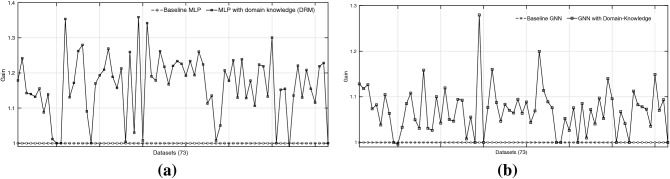
“The results reported in [5] show significant improvements in the predictive accuracy of GNNs across a large number datasets.”
BackgroundMethodResultInfluentialSelf-citationToward Greater Intelligence in Route Planning: A Graph-Aware Deep Learning Approach
Zhuang, Z., Wang, J., Qi, Q., Sun, H., & Liao, J. (2019) · IEEE Systems Journal · doi:10.1109/jsyst.2019.2922217 · Cited by 30
Combining Prior Symbolic Knowledge and Constructive Neural Network Learning
Fletcher, J., & OBRADOVICgrave, Z. (1993) · Connection Science · doi:10.1080/09540099308915705 · Cited by 29 · cited 1×
“Some of the limitations described above could be overcome with the proposal of a hybrid system by Fletcher and Obradovic [ 88 ] .”
BackgroundEthical-Advice Taker: Do Language Models Understand Natural Language Interventions?
Zhao, J., Khashabi, D., Khot, T., Sabharwal, A., & Chang, K.-W. (2021) · Findings of the Association for Computational Linguistics: ACL (Findings of ACL) · doi:10.18653/v1/2021.findings-acl.364 · Cited by 25 · cited 1×
“While the precision of these formal representations may continue to be needed for the construction of scientific assistants, the flexibility of natural language may be especially useful in communicating commonsense knowledge to day-to-day machine assistants that need to an informal knowledge of the world [110; 111].”
BackgroundLodhi, H. M. (2013) · Lecture notes in computer science · doi:10.1007/978-3-642-42042-9_27 · Cited by 22 · cited 2×
“Secondly, it can provide concepts that are meaningful for use Principal Approach Work (Reference) Type of Learner Transforming Data DRM [24; 25] MLP CILP++ [28] MLP R-GCN [46] GNN KGCN [48] GNN KBRD [49] GNN DG-RNN [44] RNN DreamCoder [32] DNN ∗ Gated-K-BERT [38] Transformer VEGNN [5] GNN BotGNN…”
Large-Scale Assessment of Deep Relational Machines
Dash, T., Srinivasan, A., Vig, L., Orhobor, O. I., & King, R. D. (2018) · Lecture Notes in Computer Science · doi:10.1007/978-3-319-99960-9_2 · Cited by 19 · cited 3×
“Conceptually, there is no variable-sharing between two or more first-order logic features [25].”
BackgroundMethodSelf-citationIntroduction to knowledge-based neural networks
Fu, L. (1995) · Knowledge-Based Systems · doi:10.1016/0950-7051(96)81914-9 · Cited by 19 · cited 1×
“[Fu, 1995] was one of the earliest works in this domain, in which they proposed a strategy to establish constraints by designating each node in a Hopfield Net to represent a concept and edges to represent their relationships and learn these nets by finding the solution which maximises the greatest number of these cons…”
Knowledge Graphs to Empower Humanity-Inspired AI Systems
Purohit, H., Shalin, V. L., & Sheth, A. (2020) · IEEE Internet Computing · doi:10.1109/mic.2020.3013683 · Cited by 19 · cited 1×
“A knowledge graph provides a structure representation for knowledge that is accessible to both humans and machines [36].”
Beyond graph neural networks with lifted relational neural networks
Šír, G., Železný, F., & Kuželka, O. (2021) · Machine Learning · doi:10.1007/s10994-021-06017-3 · Cited by 19 · cited 6×
“The intuition is that the nodes (in a problem involving recommender systems, as in [48], a node represents an entity) in the knowledge-graph can be represented with an aggregated neighbourhood information with bias while adopting the central idea of aggregate-and-combine in GNNs.”
InfluentialInclusion of domain-knowledge into GNNs using mode-directed inverse entailment
Dash, T., Srinivasan, A., & Baskar, A. (2021) · Machine Learning · doi:10.1007/s10994-021-06090-8 · Cited by 18 · cited 3×
“…CILP++ [28] MLP R-GCN [46] GNN KGCN [48] GNN KBRD [49] GNN DG-RNN [44] RNN DreamCoder [32] DNN ∗ Gated-K-BERT [38] Transformer VEGNN [5] GNN BotGNN [6] GNN KRISP [45] GNN, Transformer Transforming Loss IPKFL [78] CNN ILBKRME [30] MLP HDNNLR [64] CNN, RNN SBR [68] MLP SBR [69] CNN DL2 [ 66 ] CNN…”
BackgroundMethodInfluentialSelf-citationLogical Explanations for Deep Relational Machines Using Relevance InformationPreprint
Srinivasan, A., Vig, L., & Bain, M. (2018) · arXiv (Cornell University) · doi:10.48550/arxiv.1807.00595 · Cited by 17
Self-citationYadav, S., Lokala, U., Daniulaityte, R., Thirunarayan, K., Lamy, F. R., & Sheth, A. (2021) · PLoS ONE · doi:10.1371/journal.pone.0248299 · Cited by 13 · cited 3×
“…Transforming Data DRM [24; 25] MLP CILP++ [28] MLP R-GCN [46] GNN KGCN [48] GNN KBRD [49] GNN DG-RNN [44] RNN DreamCoder [32] DNN ∗ Gated-K-BERT [38] Transformer VEGNN [5] GNN BotGNN [6] GNN KRISP [45] GNN, Transformer Transforming Loss IPKFL [78] CNN ILBKRME [30] MLP HDNNLR [64] CNN, RNN SBR…”
Ji, Y., & Gao, S. (2023) · DROPS (Schloss Dagstuhl – Leibniz Center for Informatics) · doi:10.4230/lipics.giscience.2023.43 · Cited by 10
Analogical Reasoning With Deep Learning-Based Symbolic Processing
Honda, H., & Hagiwara, M. (2021) · IEEE Access · doi:10.1109/access.2021.3109443 · Cited by 9 · cited 2×
“…CNN Semantic Loss [ 63 ] CNN LENSR [ 91 ] GNN DANN [ 67 ] MLP PC-LSTM [ 72 ] RNN DomiKnowS [ 73 ] DNN* MultiplexNet [ 74 ] MLP, CNN Analogy Model [ 75 ] RNN Transforming Model KBANN [ 86 ] MLP Cascade-ARTMAP [ 89 ] ARTMAP CIL 2 P [ 29 ] RNN DeepProbLog [ 93 ] CNN LRNN [ 101 ] MLP TensorLog [ 105…”
An Investigation into the Role of Domain-Knowledge on the Use of Embeddings
Vig, L., Srinivasan, A., Bain, M., & Verma, A. (2018) · Lecture notes in computer science · doi:10.1007/978-3-319-78090-0_12 · Cited by 9 · cited 1×
“There is a long history of propositionalisation: see [ 18 ] for a review of some of early use of this technique, and [ 19; 20 ] who examine the links between propositionalisation and modern-day use of embed-dings in neural networks.”
BackgroundSelf-citationDiscrete Stochastic Search and Its Application to Feature-Selection for Deep Relational Machines
Dash, T., Srinivasan, A., Joshi, R. S., & Baskar, A. (2019) · Lecture notes in computer science · doi:10.1007/978-3-030-30484-3_3 · Cited by 9 · cited 1×
“The sampling technique is refined further in [26].”
Self-citationNeuro-Symbolic Inductive Logic Programming with Logical Neural NetworksPreprint
Sen, P., Carvalho, B. W., Riegel, R., et al. (2021) · arXiv (Cornell University) · doi:10.48550/arxiv.2112.03324 · Cited by 9 · cited 2×
“LNNs resemble a tree structure where the leaf nodes represent the facts in the data and background knowledge, the internal nodes implement logical connectives (and, or, implication, etc.) using t -norm operators derived from real-valued logic, and the outputs represent the rules [103].”
Using Domain-Knowledge to Assist Lead Discovery in Early-Stage Drug Design
Dash, T., Srinivasan, A., Vig, L., & Roy, A. (2022) · Lecture notes in computer science · doi:10.1007/978-3-030-97454-1_6 · Cited by 8
Self-citationDomiKnowS: A Library for Integration of Symbolic Domain Knowledge in Deep Learning
Faghihi, H. R., Guo, Q., Uszok, A., Nafar, A., & Kordjamshidi, P. (2021) · Conference on Empirical Methods in Natural Language Processing: System Demonstrations (EMNLP) · doi:10.18653/v1/2021.emnlp-demo.27 · Cited by 8 · cited 2×
“Alibraryfor integrating symbolic domain-knowledge with deep neural networks was introduced recently in [73].”
Li, L., Feng, M., Jin, L., et al. (2018) · Journal of Information Technology Research · doi:10.4018/jitr.2018100109 · Cited by 7 · cited 1×
“The result could be thought of as learning weighted forms of the antecedents present in the rules.”
Gaur, M., Roy, K., Sharma, A., Srivastava, B., & Sheth, A. (2021) · IEEE International Conference on Healthcare Informatics (ICHI) · doi:10.1109/ichi52183.2021.00049 · Cited by 7
Injecting Domain Knowledge in Neural Networks: A Controlled Experiment on a Constrained Problem
Silvestri, M., Lombardi, M., & Milano, M. (2021) · Lecture notes in computer science · doi:10.1007/978-3-030-78230-6_17 · Cited by 5 · cited 2×
“[ 70 ] inject domain knowledge at training time via an approach that combines semantic based regularisation and constraint programming [ 71 ] .”
BackgroundNeuralLog: a Neural Logic LanguagePreprint
Guimarães, V., & Costa, V. S. (2021) · arXiv (Cornell University) · doi:10.48550/arxiv.2105.01442 · Cited by 4 · cited 2×
“…[ 89 ] ARTMAP CIL 2 P [ 29 ] RNN DeepProbLog [ 93 ] CNN LRNN [ 101 ] MLP TensorLog [ 105 ] MLP Domain-Aware BERT [ 82 ] Transformer NeuralLog [ 106 ] MLP DeepStochLog [ 94 ] DNN* LNN [ 103 ] MLP Table 1: Some selected works, in no particular order, showing the principal approach of domain…”
Special issue: Knowledge-based neural networks
Fu, L. (1995) · Knowledge-Based Systems · doi:10.1016/0950-7051(95)90000-4 · Cited by 3
Knowledge-Based Distant Regularization in Learning Probabilistic ModelsPreprint
Takeishi, N., & Akimoto, K. (2018) · arXiv (Cornell University) · doi:10.48550/arxiv.1806.11332 · Cited by 3
Research works printed but not linked: 9
- Lipton, Z. C. The mythos of model interpretability. arXiv preprint arXiv:1606.03490 (2016). · arXiv
- Garcez, A. S. d., Broda, K. B. & Gabbay, D. M. Neural-symbolic learning systems: foundations and applications (Springer, 2012).
- Radford, A. et al. Language models are unsupervised multitask learners. OpenAI Blog. 1, 9 (2019).
- Ellis, K., Morales, L., Meyer, M. S., Solar-Lezama, A. & Tenenbaum, J. B. Dreamcoder: Bootstrapping domain-specific languages for neurally-guided bayesian program learning. In Proceedings of the 2nd Workshop on Neural Abstract Machines and Program Induction (2018).
- Hogan, A. et al. Knowledge graphs. arXiv preprint arXiv:2003.02320 (2020). · arXiv
- Devlin, J., Chang, M.-W., Lee, K. & Toutanova, K. Bert: Pre-training of deep bidirectional transformers for language understanding. In NAACL-HLT (1), 4171–4186 (2019). https://aclweb.org/anthology/papers/N/N19/N19-1423/.
- Vishwanathan, S. V. N., Schraudolph, N. N., Kondor, R. & Borgwardt, K. M. Graph kernels. J. Mach. Learn. Res. 11, 1201–1242 (2010).
- Sourek, G., Aschenbrenner, V., Zelezny, F., Schockaert, S. & Kuzelka, O. Lifted relational neural networks: Efficient learning of latent relational structures. J. Artif. Intell. Res. 62, 69–100 (2018). · DOI
- Anderson, M., Anderson, S. & Armen, C. Medethex: Toward a medical ethics advisor (Caring Machines, In AAAI Fall Symposium, 2005).
Cited by
Sorted by citations
A Survey on Graph Representation Learning Methods
Khoshraftar, S., & An, A. (2023) · ACM Transactions on Intelligent Systems and Technology · doi:10.1145/3633518 · Cited by 278
“This knowledge can be included in the models by changing the input, loss function, and model architecture [49].”
Towards artificial intelligence-enabled extracellular vesicle precision drug delivery
Greenberg, Z., Graim, K. S., & He, M. (2023) · Advanced Drug Delivery Reviews · doi:10.1016/j.addr.2023.114974 · Cited by 166
Advancements in remote sensing for active fire detection: A review of datasets and methods
Yang, S., Huang, Q., & Yu, M. (2024) · The Science of The Total Environment · doi:10.1016/j.scitotenv.2024.173273 · Cited by 103
3D molecular generative framework for interaction-guided drug design
(2024) · doi:10.1038/s41467-024-47011-2 · Cited by 88
“From the reference ligands of their original complexes, we extracted initial core structures, which were azabicyclo[2.2.1]heptane, 2-(oxan-3-yloxy)oxane, and benzene, respectively.”
InfluentialMontero, A. M. B., Bibal, A., Huet‐Dastarac, M., Draguet, C., Valdés, G., Nguyen, D. T. D., Willems, S., Vandewinckele, L., Holmström, M., Löfman, F., et al. (2022) · Physics in Medicine and Biology · doi:10.1088/1361-6560/ac678a · Cited by 91
“Early works of including domain knowledge into the loss function date from the mid nineties ( Fu 1995, Dash et al 2022 ) .”
Background
Metadata
- Authors
- Dash, T., Chitlangia, S., Ahuja, A., & Srinivasan, A.
- Affiliations
- Birla Institute of Technology and Science, Pilani - Goa Campus (IN)
- Corresponding author
- Dash, Tirtharaj
- Venue
- Scientific Reports
- Published
- 2022-01-20
- Volume
- 12
- Issue
- 1
- Pages
- 1040-1040
- ISSN
- 2045-2322 (ISSN-L)
- PMC
- PMC8776800
- OpenAlex
- W4205511145
- Semantic Scholar
- 8f00fca03482af9c7aaf3c5ff60f8a0f69178935
- Cited by
- 196
- References
- 112
- Citations by year
- 2026: 30 · 2025: 52 · 2024: 52 · 2023: 49 · 2022: 11
- FWCI
- 13.49
- Type
- journal article
- Language
- en
- Open access
- gold
- doi.org
- Locations
- Scientific Reports (publishedVersion, cc-by)
- PubMed Central (publishedVersion, cc-by)
- PubMed (publishedVersion)
- arXiv (Cornell University) (submittedVersion)
- DOAJ (DOAJ: Directory of Open Access Journals) (submittedVersion, cc-by-sa)
- arXiv (Cornell University)
- Funders
- University of New South Wales
- Birla Institute of Technology and Science, Pilani
- Topics
- Physical Sciences › Computer Science › Artificial Intelligence › Neural Networks and Applications
- Physical Sciences › Computer Science › Artificial Intelligence › Domain Adaptation and Few-Shot Learning
- Physical Sciences › Physics and Astronomy › Statistical and Nonlinear Physics › Model Reduction and Neural Networks
- Keywords
- domain knowledge, deep neural network, loss functions, network architecture, input encoding, human-machine collaboration
About these checks
Registry, retraction, Cites and statistics results are computed, not judged, with one exception: a printed reference that no index lists is read once by a model before it counts as a citation error. Claims are extracted by a model and kept only when their quote appears verbatim in the text; each cited source is then checked, with a model’s help, for whether it says what the claim relies on. Those verdicts can be wrong — read the claim’s quote and the cited source before relying on one.
Statistics and arithmetic are recomputed, not judged.
Confidence bands are shown only for fields calibrated on our annotated test set. None is calibrated yet, so no band is shown.
What counts as a claim ›How we measure confidence ›How we check this ›
Are you an author, or do you see a problem with this page? Request a review
