

The DOI matches its Crossref record; 109 of the 109 references it cites were found in a registry or an index.
A multilayer multimodal detection and prediction model based on explainable artificial intelligence for Alzheimer’s disease
Open accessAbstract
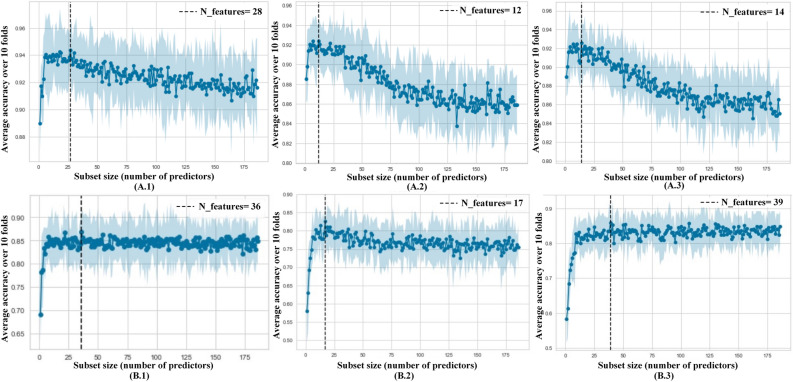
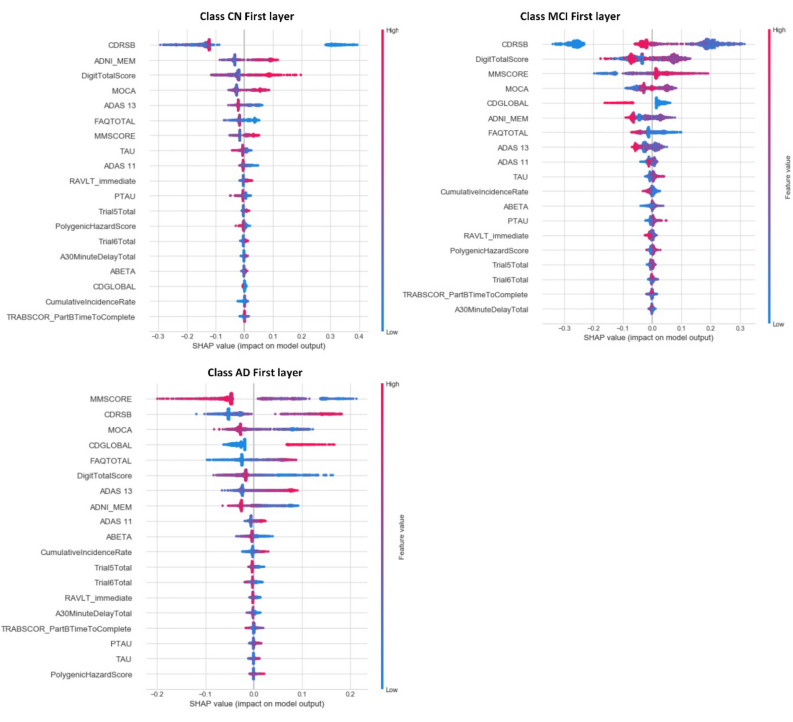
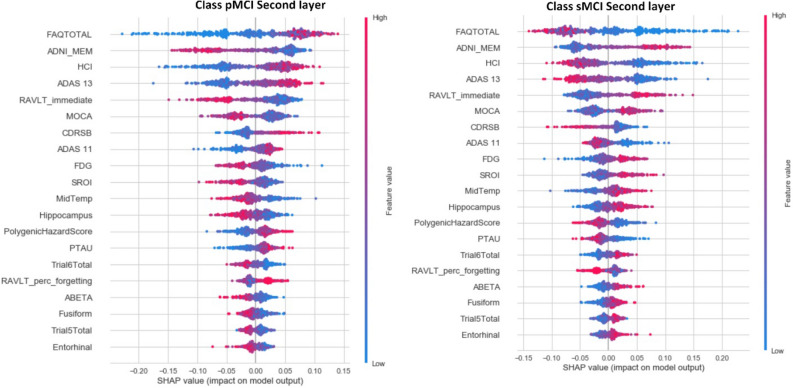
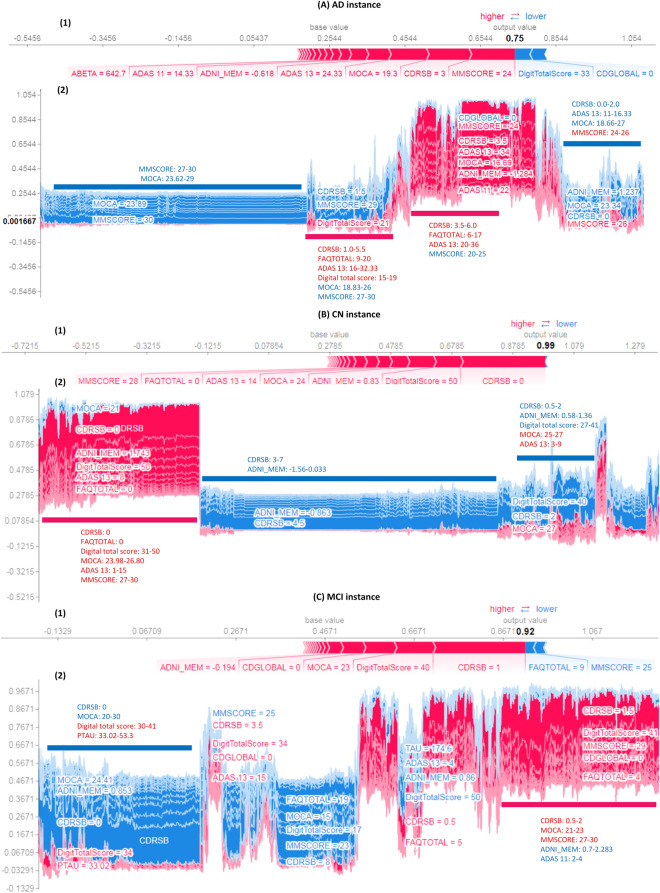
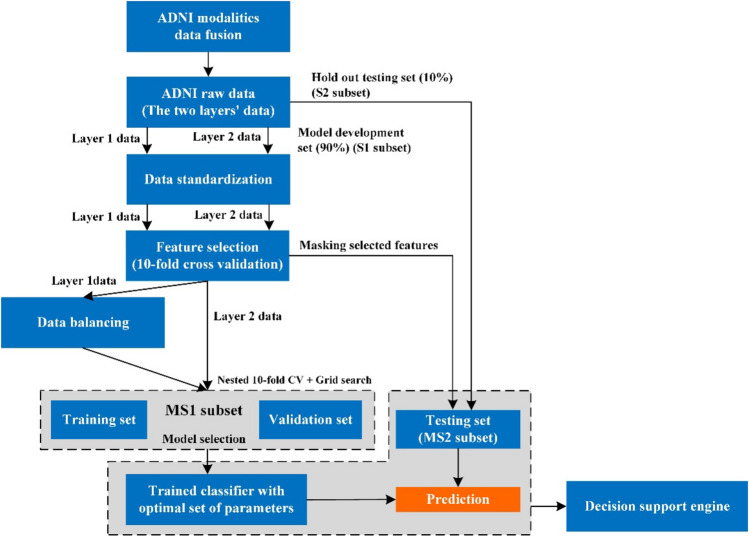
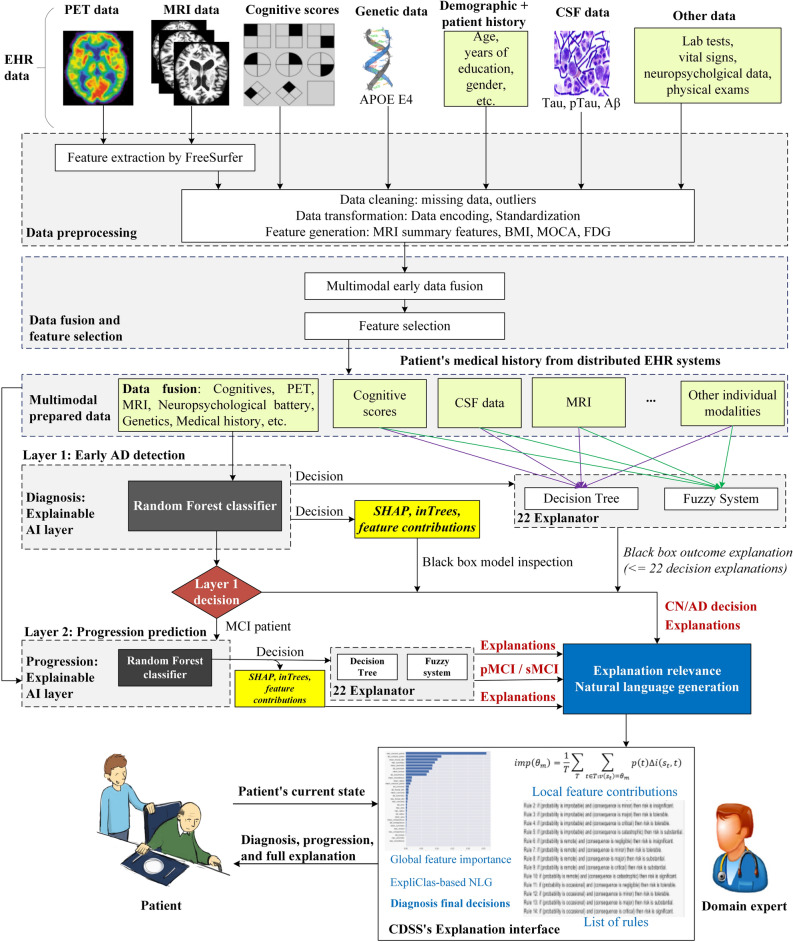
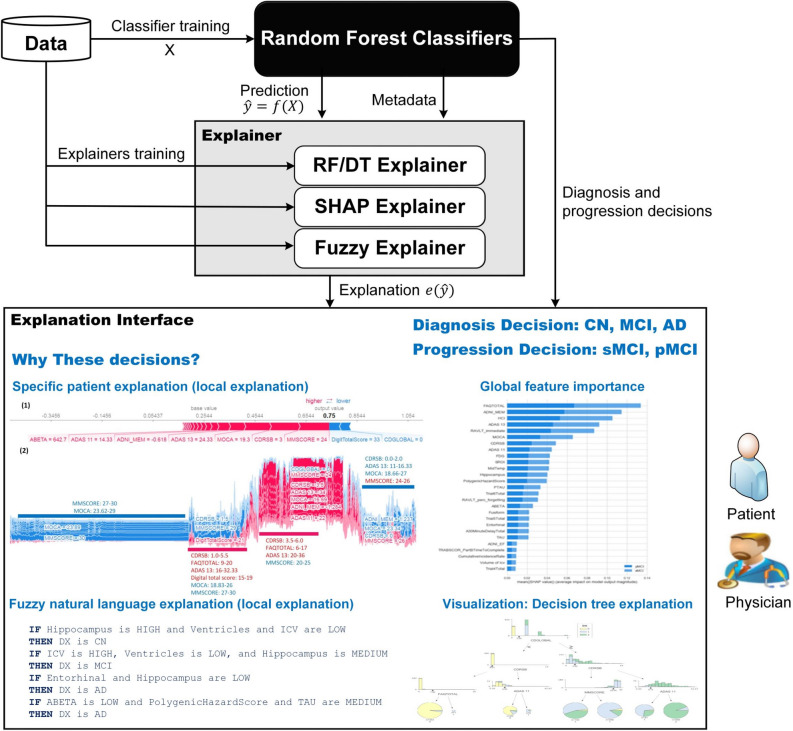
Alzheimer’s disease (AD) is the most common type of dementia. Its diagnosis and progression detection have been intensively studied. Nevertheless, research studies often have little effect on clinical practice mainly due to the following reasons: (1) Most studies depend mainly on a single modality, especially neuroimaging; (2) diagnosis and progression detection are usually studied separately as two independent problems; and (3) current studies concentrate mainly on optimizing the performance of complex machine learning models, while disregarding their explainability. As a result, physicians struggle to interpret these models, and feel it is hard to trust them. In this paper, we carefully develop an accurate and interpretable AD diagnosis and progression detection model. This model provides physicians with accurate decisions along with a set of explanations for every decision. Specifically, the model integrates 11 modalities of 1048 subjects from the Alzheimer’s Disease Neuroimaging Initiative (ADNI) real-world dataset: 294 cognitively normal, 254 stable mild cognitive impairment (MCI), 232 progressive MCI, and 268 AD. It is actually a two-layer model with random forest (RF) as classifier algorithm. In the first layer, the model carries out a multi-class classification for the early diagnosis of AD patients. In the second layer, the model applies binary classification to detect possible MCI-to-AD progression within three years from a baseline diagnosis. The performance of the model is optimized with key markers selected from a large set of biological and clinical measures. Regarding explainability, we provide, for each layer, global and instance-based explanations of the RF classifier by using the SHapley Additive exPlanations (SHAP) feature attribution framework. In addition, we implement 22 explainers based on decision trees and fuzzy rule-based systems to provide complementary justifications for every RF decision in each layer. Furthermore, these explanations are represented in natural language form to help physicians understand the predictions. The designed model achieves a cross-validation accuracy of 93.95% and an F1-score of 93.94% in the first layer, while it achieves a cross-validation accuracy of 87.08% and an F1-Score of 87.09% in the second layer. The resulting system is not only accurate, but also trustworthy, accountable, and medically applicable, thanks to the provided explanations which are broadly consistent with each other and with the AD medical literature. The proposed system can help to enhance the clinical understanding of AD diagnosis and progression processes by providing detailed insights into the effect of different modalities on the disease risk.
Overview
The claims and statistics of this paper haven’t been checked yet.
Run the check — free, no account needed. It reads the open-access text and checks the sources it cites.
Integrity signals
Registry
Cites
Statistics
Figures

Verification
Claims the paper makes
The claims and statistics of this paper haven’t been checked yet.
Run the check — free, no account needed. It reads the open-access text and checks the sources it cites.
Claims other papers make about this one
Each is checked against this paper’s own text: does it say what the citing paper says it does?
The source backs part of the claim, not all of it — or backs it for a different population, condition or comparison.
In the citing paper
“El-Sappagh et al. performed early and late fusion to create an interpretable Alzheimer’s diagnosis and progression detection model158. Their best performing model was one that implemented instance-based explanations of the random forest classifier by using the SHapley Additive exPlanations (SHAP) feature attribution. Despite using clinical, genomic, and imaging data, the most influential feature”
From Multimodal machine learning in precision health: A scoping review (2022) · cites this paper as [158]
Experimental — accuracy not yet measured
Self-check
Percentages, sums and reported differences re-computed from the paper’s own numbers.
The self-check needs the paper’s full text.
Citations
Cites
Breiman, L. (2001) · Machine Learning · doi:10.1023/a:1010933404324 · Cited by 133,538
SMOTE synthetic minority over-sampling technique
Chawla, N. V., Bowyer, K. W., Hall, L. O., & Kegelmeyer, W. P. (2002) · Journal of Artificial Intelligence Research · doi:10.1613/jair.953 · Cited by 32,865
McKhann, G., Drachman, D., Folstein, M., Katzman, R., Price, D., & Stadlan, E. M. (1984) · Neurology · doi:10.1212/wnl.34.7.939 · Cited by 27,915
A Unified Approach to Interpreting Model Predictions
Lundberg, S., & Lee, S.-I. (2017) · arXiv · doi:10.48550/arxiv.1705.07874 · Cited by 23,707 · cited 2×
“SHAP is based on the Shapely value concept from game theory 91,92 .”
Method(1992) · Cited by 23,431
Advances in neural information processing systems 7
Cios, K. J., & Shields, M. E. (1997) · Neurocomputing · doi:10.1016/s0925-2312(97)90018-7 · Cited by 22,093
"Why Should I Trust You?": Explaining the Predictions of Any Classifier
Ribeiro, M. T., Singh, S., & Guestrin, C. (2016) · Proceedings of the 22nd ACM SIGKDD International Conference on Knowledge Discovery and Data Mining · doi:10.1145/2939672.2939778 · Cited by 17,555 · cited 3×
“Fernandez-Delgado et al. 40 evaluated 179 classifiers using different UCI datasets, and concluded that RF outperforms other classifiers, including SVMs and neural networks.”
BackgroundMethodRor2 signaling regulates Golgi structure and transport through IFT20 for tumor invasiveness
Nishita, M., Park, S.-Y., Nishio, T., Kamizaki, K., Wang, Z., Tamada, K., Takumi, T., Hashimoto, R., Otani, H., Pazour, G. J., et al. (2017) · Scientific Reports · doi:10.1038/s41598-016-0028-x · Cited by 15,947
Desikan, R. S., Ségonne, F., Fischl, B., Quinn, B. T., Dickerson, B. C., Blacker, D., Buckner, R. L., Dale, A. M., Maguire, R. P., Hyman, B. T., et al. (2006) · NeuroImage · doi:10.1016/j.neuroimage.2006.01.021 · Cited by 13,324
A Study of Cross-Validation and Bootstrap for Accuracy Estimation and Model Selection
Kohavi, R. (1995) · Zenodo · doi:10.5281/zenodo.19712698 · Cited by 10,909
Research works printed but not linked: 2
- Fernandez-Delgado, M., Cernadas, E., Barro, S. & Amorim, D. Do we need hundreds of classifiers to solve real world classification problems. J. Mach. Learn. Res. 15, 3133–3181 (2014).
- Elisseeff, A. & Pontil, M. Leave-one-out error and stability of learning algorithms with applications. In NATO science series sub series iii computer and systems sciences 111–130 (ISO Press, 2003).
Cited by
Sorted by citations
Items 301–363 of 363
Prediction of Acute Traumatic Coagulation Based on Interpretable Algorithm
Liao, M., & Li, J. (2024) · Lecture notes in operations research · doi:10.1007/978-981-97-4045-1_28
ADC-RBK: a multimodal approach for early detection of chronic diseases and focusing on Alzheimer’s
Irene, D. S., Lakshmi, M. N., Kumar, L. R., & Kishore, T. R. (2024) · Progress in Artificial Intelligence · doi:10.1007/s13748-024-00327-y
“El-Sappagh et al. [17] implemented the Multilayer multi-modal model to detect and predict Alzheimer’s disease based on Explainable Artificial Intelligence (AI).”
Jain, R., & Khanna, K. (2024) · Journal of Student Research · doi:10.47611/jsrhs.v13i1.6303
Developing Explainable AI Models to Identify Perimenopause Symptoms
Sarkar, P. (2024) · Advances in medical technologies and clinical practice book series · doi:10.4018/979-8-3693-2342-7.ch009
Gupta, D. K., Chaudhuri, A., & Kanrar, A. (2025) · Archives of Medicine and Health Sciences · doi:10.4103/amhs.amhs_261_24
Next generation technologies for diagnosis
Astell, A. J., Watermeyer, T., & Semple, J. M. (2025) · Elsevier eBooks · doi:10.1016/b978-0-12-822240-9.00018-1
Unlocking Neural Transparency: Jacobian Maps for Explainable AI in Alzheimer’s Detection
Mustafa, Y., Elmahallawy, M., & Luo, T. (2025) · Lecture notes in computer science · doi:10.1007/978-981-96-8197-6_17
Early Detection and Prevention of Dementia: An AI-Driven Multimodal Approach
Huang, A., Manias, G., Ferreira, R., Sangiovanni, M., Borovits, N., Tamburri, D. A., Ntanasi, E., Scarmeas, N., & van den Heuvel, W. (2025) · IFIP advances in information and communication technology · doi:10.1007/978-3-031-97313-0_16
MCI detection using transformers for EEG-HRV fusionPreprint
Boudaya, A., Chaabene, S., Bouaziz, B., & Chaâri, L. (2025) · Research Square · doi:10.21203/rs.3.rs-6893576/v1
Research on Intelligent Evaluation Model Based on Large Models
Wang, P., Chen, W., Wang, Z., Xu, T., & Liu, J. (2025) · Lecture notes in computer science · doi:10.1007/978-981-96-9875-2_5
The Magic of Artificial Intelligence-1
Nazir, A., Hussain, A. B., Singh, M., & Assad, A. (2025) · Springer eBooks · doi:10.1007/978-981-96-8176-1_1
Artificial Intelligence-Enabled Federated Learning Techniques in Healthcare Sector
Sharma, S., & Gour, R. (2025) · Advances in Science, Technology & Innovation/Advances in science, technology & innovation · doi:10.1007/978-3-031-80949-1_4
Construction of Trusted Route Prediction Model Based on Deep Learning Algorithm
Yin, D., & Xu, L. (2025) · Lecture notes in networks and systems · doi:10.1007/978-981-96-6124-4_20
Leveraging Explainable AI in Healthcare Using Precision Medicine for Treatment of Multiple Diseases
Pote, A. A., Marathe, L. N., Patil, S. A., Kanawade, S., Hajare, D. S., Pandagre, V., Singh, A., & Kachore, R. (2025) · Lecture notes in networks and systems · doi:10.1007/978-981-96-7807-5_23
xAITC: an approach for explaining and improving opaque-based depression classification
Burbano, R. N., Rendón, O. M. C., & Astudillo, C. A. (2025) · IEEE Colombian Conference on Communications and Computing (COLCOM) · doi:10.1109/colcom66267.2025.11185791
“Despite diverse approaches [9]–[11] have used eXplainable Artificial Intelligence (XAI) techniques, such as Local Inter-pretable Model-Agnostic Explanations (LIME) [12], Anchors [13], and Shapley Additive exPlanations (SHAP) [14], to understand how ML models make decisions in domains like health,…”
Salimiparsa, M., Lizotte, D. J., & Sedig, K. (2025) · Springer eBooks · doi:10.1007/978-3-031-91379-2_1
Huynh, T., Pham, X. H., Nguyen, N. V. Q., Nguyen, T. T., Ha, H., & Ngo, L. T. (2025) · Asia-Pacific Signal and Information Processing Association Annual Summit and Conference (APSIPA ASC) · doi:10.1109/apsipaasc65261.2025.11249326
Haque, A. H. M. O., al Fahad, A., Rahman, M. S., & Samee, M. (2025) · bioRxiv · doi:10.1101/2025.11.27.690894
“Hernandez et al. 20 and El-Sappagh et al. 21 utilized SHAP for feature importance analysis; however, neither explored how features interact with each other nor how their importance evolves.”
Explaining Multimodal Features for Screening of Cognitive Impairment Using Shapley Values
Brauße, E., Koenen, N., Wright, M. N., & Schultz, T. (2025) · Annual International Conference of the IEEE Engineering in Medicine and Biology Society (EMBC) · doi:10.1109/embc58623.2025.11251859
“For example, [11] have provided explanations using SHAP values for their multi-modal AD screening models based on 11 modalities, including MRI, cognitive test scores, and medical history.”
Lazarjani, H. G., Zarei, S., Aboutorabi, F., Shalbaf, R., & Shalbaf, A. (2025) · Archives of Computational Methods in Engineering · doi:10.1007/s11831-025-10471-w · Cited by 2
LIANG, Y.-F., Zheng, H.-R., Huang, D.-W., Nai, J., Wang, Y., Cui, W., Feng, L.-N., Li, X.-S., Fan, M.-G., Luo, Y.-F., et al. (2022) · Research Square · doi:10.21203/rs.3.rs-2350370/v1
Liang, Y.-F., Zheng, H.-R., Huang, D.-W., Nai, J., Wang, Y., An, X., Luo, Y.-F., Chen, C., Cui, W., Wang, Q.-T., et al. (2022) · Research Square · doi:10.21203/rs.3.rs-2081119/v1
Júnior, C. A. L., Medeiros, C. M. D. S., Mendes, M. K. D. A., Dantas, C., Andrade, T. A., & de Jesus, J. R. (2025) · Advances in protein chemistry and structural biology · doi:10.1016/bs.apcsb.2025.10.022
Sekar, K. T. A., Vs, B., Nandhini, R., M., H., Mellam, M. R., & Kopiya, S. (2025) · International Conference for Advancement in Technology (ICONAT) · doi:10.1109/iconat66879.2025.11362565
Agentic ElderFedLearn: A Differential Privacy-Based Approach for Elderly Disease Prediction
Khowaja, S. A., Dev, K., Thakur, D., & Fortino, G. (2026) · IEEE Transactions on Computational Social Systems · doi:10.1109/tcss.2026.3654436
“We also compared our method to Venugopalan et al. [11], which reported an accuracy of 85% using EHR data and 86% on MRI data in a centralized setting, while the study in [12] achieved 90.2% accuracy with MRI data.”
InfluentialEmploying Capsule Neural Networks for the Detection of Alzheimer’s Disease
Masthan, S. K., Ajay, S., Reddy, S. V., & Kumar, N. S. S. S. G. (2026) · Communications in computer and information science · doi:10.1007/978-3-032-18293-7_4
A novel method of fusing Bert-LSTM and XAI for social media disinformation identification
Xia, H., Islam, N., Zhu, D. L., Zhang, Z., Behl, A., & Roohanifar, M. (2026) · Annals of Operations Research · doi:10.1007/s10479-026-07063-7 · Cited by 1
Cognitive Meta-Learning-Based AI Models for Multimodal Signals
Bose, A., Das, B., Das, C., & Mandal, A. (2026) · Elsevier eBooks · doi:10.1016/b978-0-443-40379-8.00011-9
Predicting sepsis prognosis using deep learning with routine biomarkers
Gan, Q. Y., Li, X., Xue, Y., Deng, H., Huang, Y. H., & Li, Z. N. (2026) · Frontiers in Medicine · doi:10.3389/fmed.2026.1783369
Digital Tools and Artificial Intelligence in Alzheimer’s diagnosis
Yadav, S. D., Goel, S., Tyagi, A., & Bansal, K. (2026) · BENTHAM SCIENCE PUBLISHERS eBooks · doi:10.2174/9798898814953126010008
Review of Explainable Artificial Intelligence Methods for Alzheimer's Disease
Nurbolat, N., & Mohamad, K. (2026) · International Conference on Electronics, Computer and Computation · doi:10.1109/icecco67619.2026.11488807
“In contrast, the work in [9] integrated SHAP to quantify the contribution of 11 clinical features and introduced a natural language explanation system that generated clinician-readable reports.”
Kiani, I., Hajiasadi, E., Torkamani, Z. T., Bagherzadeh, Y., Abbasifar, P., Zare, A. K., Moqadam, A. H. M., Mohammadzadeh, S., Kakadiya, J., Khosravi, B., et al. (2026) · European Journal of Radiology Artificial Intelligence · doi:10.1016/j.ejrai.2026.100094
Alzheimer’s Disease Classification using Deep Learning Models with SMOTE-based Data Balancing
Maheshwari, A., Jahirabadkar, S., Kale, S., Game, A., & Phakatkar, A. (2026) · International Conference on Inventive Computation Technologies (ICICT) · doi:10.1109/icict68280.2026.11511116
Multi-view ensemble of fine-tuned CNNs for Alzheimer’s disease detection from 3D MRI
Chamak, T. R., & Sahasrabudhe, M. Y. (2026) · Array · doi:10.1016/j.array.2026.100886
Use of Artificial Intelligence for the Early Detection and Prediction of Alzheimer’s Disease
Khangsar, L. T., & Boileau, A. J. (2026) · Cureus · doi:10.7759/cureus.109138
“In a retrospective machine learning study, El-Sappagh et al. [27] developed a two-layer RF model to simultaneously diagnose AD and predict MCI progression to AD.”
InfluentialExplainable techniques for trustworthy artificial intelligence
Sarica, A., & Gramigna, V. (2026) · Elsevier eBooks · doi:10.1016/b978-0-443-13545-3.00012-8
An empirical analysis of explainable artificial intelligence tool for solar radiation prediction
Santona, C. F. T., Sharmin, N., Sevas, M. S., Islam, R., & Sagor, S. R. (2026) · Discover Geoscience · doi:10.1007/s44288-026-00554-x
“One of ELI5’s primary purposes is bridging the gap between technical experts and non-experts, fostering meaningful discussions about AI’s potential benefits and risks [1].”
Bagade, V. V., Dongre, Y. V., & Bewoor, L. (2026) · Biomedical Engineering Applications Basis and Communications · doi:10.4015/s1016237226500080
Generative AI-Based Cognitive Twin for Early Alzheimer's Detection and Monitoring
Hemalatha, R., Humaira, I., Mahalakshmi, B., & A, K. S. (2026) · doi:10.1109/iccsp68173.2026.11539230
Suksuphew, S., & Horkaew, P. (2026) · Intelligent Systems with Applications · doi:10.1016/j.iswa.2026.200692
Machine Learning for Early Alzheimer’s Detection Using Blood-Based Biomarkers: A Focused Survey
Mohamed, Y., Fadlullah, Z. M., & Fouda, M. M. (2026) · Intermountain Engineering, Technology and Computing (IETC) · doi:10.1109/ietc69527.2026.11568628
Wang, J., Chen, J., & Wang, K. (2026) · Frontiers in Medicine · doi:10.3389/fmed.2026.1834291
“Although the SHAP framework proposed by Lundberg and Lee (17–19) has been widely applied in cardiovascular (20, 21), neurological (22), and oncological (23) domains, work systematically introducing a full-dimensional SHAP interpretation framework into early RA prediction research remains very…”
InfluentialMultimodal Deep Learning with MRI and Clinical Biomarkers for Explainable Alzheimer's Classification
Verma, V., Patel, K., Prakash, J., & Srivastava, A. (2026) · IEEE International Conference on Computing, Power and Communication Technologies (IC2PCT) · doi:10.1109/ic2pct68894.2026.11584454
“Study [15] combined 11 heterogeneous modalities using a two-layer random forest model, whereas attention-driven modeling in [16] and SHAP-based clinical attribution in [17] improved explainability but remained limited in multimodal depth.”
Madhuri, J., & Bhargavi, M. S. (2026) · Springer eBooks · doi:10.1007/978-981-95-3811-9_4
Ameur, N. B., Chaieb, M., & Ghazouani, H. (2026) · Intelligence in Business and Industry (IBI) · doi:10.1109/ibi68858.2026.11604062
“This includes cognitive scores [8], liquid biomarker profiles [9], genetic risk factors [2], neuroimaging findings [10], and detailed clinical histories.”
Walia, S., & Borah, M. D. (2026) · International Conference on Cognitive Computing and Networking Systems (ICC-CNS) · doi:10.1109/icc-cns70518.2026.11606070
“[11], the Functional Activities Questionnaire (FAQ), neuropsychiatric inventory (NPI-Q), geriatric depression scale (GDS), vascular risk factors, and biomarker flags (APOE ε 4 ) [1], [11].”
Organizational factors influencing the adoption of AI technologies in preventive healthcare
Akar, E., Bozanta, A., & Hakyemez, T. C. (2026) · Journal of Health Organization and Management · doi:10.1108/jhom-10-2025-0647
Automated Multilabel Mpox Research Classification With Explainable Transformer Models
Aurpa, T. T. (2026) · Applied Computational Intelligence and Soft Computing · doi:10.1155/acis/8986650
Suketha, Naik, P. J., Kumar, S., Varsha, G. D., & Varshith (2026) · Lecture notes in networks and systems · doi:10.1007/978-3-032-31526-7_24
Maladkar, A., Hiremath, M., & Turuk, M. (2026) · Lecture notes in networks and systems · doi:10.1007/978-3-032-34789-3_18
Awaji, B. H. (2026) · Innovation and Emerging Technologies · doi:10.1142/s2737599426400128
Menezes, J., Barbosa, M. I. A., & Rodrigues, P. M. (2026) · Sensors · doi:10.3390/s26175489
Dafali, S. M., Kissi, M., & Beggar, O. E. (2026) · Results in Engineering · doi:10.1016/j.rineng.2026.112856 · Cited by 1
Wang, J., Li, Z., Wang, T., Jiang, L., Sharif, A., Takechi, R., Li, T., Chong, L. H., Fang, F., Pang, Z., et al. (2026) · Acta Pharmaceutica Sinica B · doi:10.1016/j.apsb.2026.09.013
Islam, M. A., Biswas, M. A., Laila, A., Hai, D. M. S., & Mim, S. U. A. (2026) · Journal of Information Technology Cybersecurity and Artificial Intelligence · doi:10.70715/jitcai.2026.v3.i5.088
Sharmin, N., Sifat, S. J., & Hossain, M. S. (2026) · Discover Civil Engineering · doi:10.1007/s44290-026-00650-4
“Several XAI techniques like SHAP, LIME, and ELI5 have been widely adopted in various industries, including healthcare and banking, to offer post hoc explanations for machine learning models [20, 21].”
Поляков, Д. А., & Аль-Фурайджи, Х. Т. (2026) · Vestnik of Russian New University Series «Complex systems models analysis management» · doi:10.18137/rnu.v9187.26.03.p.183
Recent advances of AI-assisted diagnostic methods for neurological diseases
Wen, J., Yin, J., Fan, L., Fang, M., Wei, X., & Li, P. (2026) · Neurocomputing · doi:10.1016/j.neucom.2026.135385
Omarov, B. (2026) · Frontiers in Human Neuroscience · doi:10.3389/fnhum.2026.1963855
Position Paper: Deep Learning in Hilbert Lattices
Kaburlasos, V. G. (2026) · International Joint Conference on Neural Networks (IJCNN) · doi:10.1109/ijcnn69854.2026.11728911
Federated Explainable AI-Based Alzheimer's Disease Prediction With Multimodal Data
Patel, S. A. (2026) · International Journal of Advanced Research in Science Communication and Technology · doi:10.48175/ijarsct-40152
Chinese expert consensus on AI-assisted clinical decision-making in organ transplantation
Liu, Y.-H., Qiao, Y., Gan, Z.-W., Ye, S., Ding, C.-G., Dong, J.-H., Tan, X., Lu, D., Wu, H., Li, L.-X., et al. (2026) · Hepatobiliary & pancreatic diseases international · doi:10.1016/j.hbpd.2026.10.001
Metadata
- Authors
- El-Sappagh, S., Alonso, J. M., Islam, S. M. R., Sultan, A. M., & Kwak, K. S.
- Affiliations
- Sejong University (KR)
- Inha University (KR)
- Corresponding author
- Kwak, Kyung Sup
- Venue
- Scientific Reports
- Published
- 2021-01-29
- Volume
- 11
- Issue
- 1
- Pages
- 2660-2660
- ISSN
- 2045-2322 (ISSN-L)
- PMC
- PMC7846613
- OpenAlex
- W3125069671
- Cited by
- 363
- References
- 108
- Citations by year
- 2026: 62 · 2025: 96 · 2024: 80 · 2023: 58 · 2022: 56 · 2021: 11
- FWCI
- 36.77
- Type
- journal article
- Language
- en
- Open access
- gold
- doi.org
- Locations
- Scientific Reports (publishedVersion, cc-by)
- PubMed Central (publishedVersion, cc-by)
- PubMed (publishedVersion)
- Aberdeen University Research Archive (Aberdeen University) (submittedVersion)
- LA Referencia (Red Federada de Repositorios Institucionales de Publicaciones Científicas) (submittedVersion, cc-by)
- DOAJ (DOAJ: Directory of Open Access Journals) (submittedVersion, cc-by-sa)
- Hispana (submittedVersion, cc-by)
- Repositorio institucional da Universidade de Santiago de Compostela (University of Santiago de Compostela) (submittedVersion, other-oa)
- Greater South Information System
- Funders
- National Research Foundation of Korea-Grant funded by the Korean Government (NRF-2017R1A2B2012337)
- Topics
- Health Sciences › Medicine › Psychiatry and Mental health › Dementia and Cognitive Impairment Research
- Health Sciences › Health Professions › Health Information Management › Artificial Intelligence in Healthcare
- Physical Sciences › Computer Science › Artificial Intelligence › Explainable Artificial Intelligence (XAI)
- Keywords
- Alzheimer's disease, Alzheimer's disease diagnosis, multimodal fusion, explainable AI, SHAP feature attribution, random forest, fuzzy rule-based systems, natural language explanations, clinical decision support, Alzheimer's Disease Neuroimaging Initiative, biomarker selection, model interpretability
- MeSH terms
- Aged, Aged, 80 and over, Alzheimer Disease, Artificial Intelligence, Brain, Female, Follow-Up Studies, Humans, Magnetic Resonance Imaging, Male, Middle Aged, Models, Neurological, Databases, Factual, Neuroimaging
About these checks
Registry, retraction, Cites and statistics results are computed, not judged, with one exception: a printed reference that no index lists is read once by a model before it counts as a citation error. Claims are extracted by a model and kept only when their quote appears verbatim in the text; each cited source is then checked, with a model’s help, for whether it says what the claim relies on. Those verdicts can be wrong — read the claim’s quote and the cited source before relying on one.
Statistics and arithmetic are recomputed, not judged.
Confidence bands are shown only for fields calibrated on our annotated test set. None is calibrated yet, so no band is shown.
What counts as a claim ›How we measure confidence ›How we check this ›
Are you an author, or do you see a problem with this page? Request a review
