

The physiological correlates of interpersonal space
Open accessThe DOI matches its Crossref record; 59 of the 59 references it cites were found in a registry or an index.
Abstract
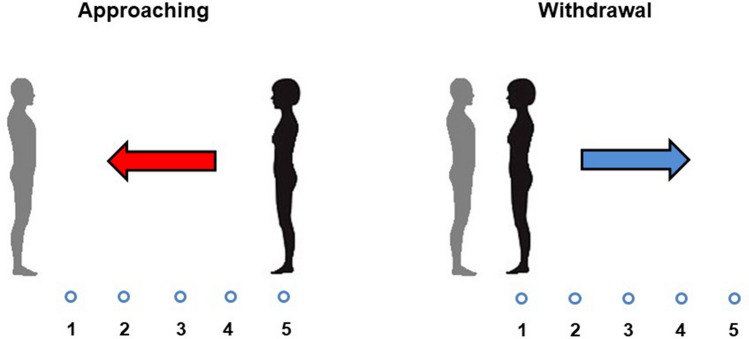
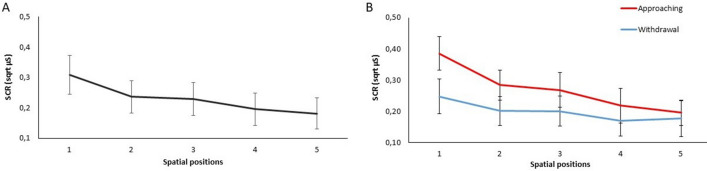
Interpersonal space (IPS) is the area around the body that individuals maintain between themselves and others during social interactions. When others violate our IPS, feeling of discomfort rise up, urging us to move farther away and reinstate an appropriate interpersonal distance. Previous studies showed that when individuals are exposed to closeness of an unknown person (a confederate), the skin conductance response (SCR) increases. However, if the SCR is modulated according to participant’s preferred IPS is still an open question. To test this hypothesis, we recorded the SCR in healthy participants when a confederate stood in front of them at various distances simulating either an approach or withdrawal movement (Experiment 1). Then, the comfort-distance task was adopted to measure IPS: participants stop the confederate, who moved either toward or away from them, when they felt comfortable with other’s proximity (Experiment 2). We found higher SCR when the confederate stood closer to participants simulating an IPS intrusion, compared to when the confederate moved farther away. Crucially, we provide the first evidence that SCR, acting as a warning signal, contributes to interpersonal distance preference suggesting a functional link between behavioral components of IPS regulation and the underlying physiological processes.
Overview
The claims and statistics of this paper haven’t been checked yet.
Free: it reads the open-access text and checks the first 5 claims that cite a source we can check. Create a free account to check every claim.
Integrity signals
Registry
Cites
Statistics
Figures
Verification
Claims the paper makes
The claims and statistics of this paper haven’t been checked yet.
Free: it reads the open-access text and checks the first 5 claims that cite a source we can check. Create a free account to check every claim.
Claims other papers make about this one
Each is checked against this paper’s own text: does it say what the citing paper says it does?
The source backs part of the claim, not all of it — or backs it for a different population, condition or comparison.
In the citing paper
“Recent evidence in support to this possibility comes from a study showing enhanced skin conductance response in participants when a confederate approached compared to when he moved farther away in the stop distance paradigm (Candini, Battaglia, Benassi, di Pellegrino, & Frassinetti, 2021).”
From The Peripersonal Space in a social world (2021) · cites this paper as Candini et al., 2021
Experimental — accuracy not yet measured
Self-check
Percentages, sums and reported differences re-computed from the paper’s own numbers.
The self-check needs the paper’s full text.
Citations
Cites
(1970) · Cited by 24,983
Handbook of environmental psychology
Stokols, D., & Altman, I. (1987) · Wiley eBooks · Cited by 3,187
Eye-Contact, Distance and Affiliation
Argyle, M., & Dean, J. (1965) · Sociometry · doi:10.2307/2786027 · Cited by 1,779
Publication Recommendations for Electrodermal Measurements
Fowles, D. C., Christie, M. J., Edelberg, R., GRINGS, W. W., Lykken, D. T., & Venables, P. H. (1981) · Psychophysiology · doi:10.1111/j.1469-8986.1981.tb03024.x · Cited by 1,699
Publication recommendations for electrodermal measurements
Society for Psychophysiological Research Ad Hoc Committee on Electrodermal Measures (2012) · Psychophysiology · doi:10.1111/j.1469-8986.2012.01384.x · Cited by 1,288
Handbook of environmental psychology
Bechtel, R. B., & Churchman, A. (2002) · Cited by 1,166
LeDoux, J. E. (2014) · Proceedings of the National Academy of Sciences · doi:10.1073/pnas.1400335111 · Cited by 891
The role of the amygdala in human fear: automatic detection of threat
Öhman, A. (2005) · Psychoneuroendocrinology · doi:10.1016/j.psyneuen.2005.03.019 · Cited by 691
"Psychic blindness" and other symptoms following bilateral temporal lobectomy in Rhesus monkeys.
Klüver, H., & Bucy, P. C. (1937) · American Journal of Physiology-Legacy Content · Cited by 545
Adolphs, R. (2013) · Current Biology · doi:10.1016/j.cub.2012.11.055 · Cited by 524
Research works printed but not linked: 2
- Hall ET Distances in Man: The Hidden Dimension 1966 New York Double Day
- Pedrabissi L Santinello M STAI State-Trait Anxiety Inventory Forma Y Manuale 1989 Florence Organizzazioni Speciali
Cited by
Neural Decoding of EEG Signals with Machine Learning: A Systematic Review
Saeidi, M., Karwowski, W., Farahani, F. V., Fiok, K., Taiar, R., Hancock, P. A., & Al-Juaid, A. (2021) · Brain Sciences · doi:10.3390/brainsci11111525 · Cited by 258
“Moreover, environmental factors, such as approaching direction [223] have contributed to clarifying the effects of behavioral responses (i.e., defensive responses).”
BackgroundTanaka, M., Szabó, Á., Spekker, E., Polyák, H., Tóth, F., & Vécsei, L. (2022) · Cells · doi:10.3390/cells11162607 · Cited by 153
The Peripersonal Space in a social world
Bogdanova, O. V., Bogdanov, V. B., Dureux, A., Farnè, A., & Hadj-Bouziane, F. (2021) · Cortex · doi:10.1016/j.cortex.2021.05.005 · Cited by 86
“Recent evidence in support to this possibility comes from a study showing enhanced skin conductance response in participants when a confederate approached compared to when he moved farther away in the stop distance paradigm (Candini et al., 2021).”
Tanaka, M., Spekker, E., Szabó, Á., Polyák, H., & Vécsei, L. (2022) · Journal of Neural Transmission · doi:10.1007/s00702-022-02513-5 · Cited by 86
Play therapy in children with autism: Its role, implications, and limitations
Elbeltagi, R. M., Al‐Beltagi, M., Saeed, N. K., & Alhawamdeh, R. (2023) · World Journal of Clinical Pediatrics · doi:10.5409/wjcp.v12.i1.1 · Cited by 112
The Neurobiological Correlates of Gaze Perception in Healthy Individuals and Neurologic Patients
Battaglia, S., Fabius, J. H., Moravkova, K., Fracasso, A., & Borgomaneri, S. (2022) · Biomedicines · doi:10.3390/biomedicines10030627 · Cited by 62
Self-citationTanaka, M., & Vécsei, L. (2022) · International Journal of Molecular Sciences · doi:10.3390/ijms23136991 · Cited by 61
“Evidence in healthy participants may suggest that these proprioceptive and motor mechanisms might be impaired in PD patients [38,39].”
BackgroundTörök, N., Maszlag-Török, R., Molnár, K., Szolnoki, Z., Somogyvári, F., Boda, K., Tanaka, M., Klivènyi, P., & Vécsei, L. (2022) · Frontiers in Bioscience-Landmark · doi:10.31083/j.fbl2709265 · Cited by 45
The Impact of SARS-CoV-2 Infection on Youth Mental Health: A Narrative Review
Brasso, C., Bellino, S., Blua, C., Bozzatello, P., & Rocca, P. (2022) · Biomedicines · doi:10.3390/biomedicines10040772 · Cited by 40
Küçükkarapınar, M., Yay-Pence, A., Yıldız, Y., Büyükkörük, M., Aydın, G. Y., Bulut, T. S. D., Gülbahar, Ö., Şenol, E., & Candansayar, S. (2022) · Journal of Neural Transmission · doi:10.1007/s00702-022-02525-1 · Cited by 39
A Carryover Effect in HRI: Beyond Direct Social Effects in Human-Robot Interaction
Erel, H., Carsenti, E., & Zuckerman, O. (2022) · ACM/IEEE International Conference on Human-Robot Interaction (HRI) · doi:10.1109/hri53351.2022.9889554 · Cited by 45
“Prosocial tendencies after an ostracism experience are also indicated by interpersonal space (i.e. distance and orientation between two people) that is adjusted to meet participants’ need for intimate social interactions [48], [49].”
BackgroundInfluentialViruses and autism: A Bi-mutual cause and effect
Al‐Beltagi, M., Saeed, N. K., Elbeltagi, R. M., Bediwy, A. S., Aftab, S. A. S., & Alhawamdeh, R. (2023) · World Journal of Virology · doi:10.5501/wjv.v12.i3.172 · Cited by 36
A Decade of Dedication: Pioneering Perspectives on Neurological Diseases and Mental Illnesses
Tanaka, M., & Vécsei, L. (2024) · Biomedicines · doi:10.3390/biomedicines12051083 · Cited by 28
Tanaka, M., & Vécsei, L. (2024) · Journal of Neural Transmission · doi:10.1007/s00702-024-02812-z · Cited by 22
Psychological and physiological evidence for an initial ‘Rough Sketch’ calculation of personal space
Tootell, R. B. H., Zapetis, S. L., Babadi, B., Nasiriavanaki, Z., Hughes, D., Mueser, K. T., Otto, M. W., Pace-Schott, E. F., & Holt, D. J. (2021) · Scientific Reports · doi:10.1038/s41598-021-99578-1 · Cited by 30
α-Synuclein at the Presynaptic Axon Terminal as a Double-Edged Sword
Tan, L. Y., Tang, K. H., Lim, L. Y. Y., Ong, J. X., Park, H., & Jung, S. (2022) · Biomolecules · doi:10.3390/biom12040507 · Cited by 23
Dissociative Model in Patients With Resistant Schizophrenia
Panov, G. (2022) · Frontiers in Psychiatry · doi:10.3389/fpsyt.2022.845493 · Cited by 26
Khadem-Reza, Z. K., & Zare, H. (2022) · The Egyptian Journal of Neurology Psychiatry and Neurosurgery · doi:10.1186/s41983-022-00576-5 · Cited by 28
“These social impairments may be related to the interpretation of social signals: evidence from healthy individuals suggest that potentially threatening situations such as others’ proximity can trigger a number of physiological responses that help regulate the distance between themselves and others during social intera…”
BackgroundSimulated proximity enhances perceptual and physiological responses to emotional facial expressions
Bogdanova, O. V., Bogdanov, V. B., Miller, L. E., & Hadj‐Bouziane, F. (2022) · Scientific Reports · doi:10.1038/s41598-021-03587-z · Cited by 20
Ionescu, T. C., Fetecau, B. I., Boșcaiu, V., & Tudose, C. (2021) · Brain Sciences · doi:10.3390/brainsci11111541 · Cited by 21
“The interpersonal space (IPS) is the area around one’s own body where social interactions normally take place [14].”
BackgroundMy social comfort zone: Attachment anxiety shapes peripersonal and interpersonal space
von Mohr, M., Silva, P. C., Vagnoni, E., Bracher, A., Bertoni, T., Serino, A., Banissy, M. J., Jenkinson, P. M., & Fotopoulou, A. (2023) · iScience · doi:10.1016/j.isci.2023.105955 · Cited by 16
“Nevertheless, it is worthwhile noticing that by merely being present, the other person plays a passive role relative to other interpersonal space paradigms (e.g., see 45,46 ).”
Ren, H., Qiu, W., Zhu, B., Li, Q., Peng, C., & Chen, X. (2023) · Advances in Clinical and Experimental Medicine · doi:10.17219/acem/168241 · Cited by 17
Lee, Y., & Chen, Y. (2021) · Frontiers in Psychology · doi:10.3389/fpsyg.2021.692404 · Cited by 18
Wearing a Mask Shapes Interpersonal Space during COVID-19 Pandemic
Biggio, M., Bisio, A., Bruno, V., Garbarini, F., & Bove, M. (2022) · Brain Sciences · doi:10.3390/brainsci12050682 · Cited by 18
How interpersonal distance varies throughout the lifespan
Mirlisenna, I., Bonino, G., Mazza, A., Capiotto, F., Cappi, G. R., Cariola, M., Valvo, A., Francesco, L. D., & Monte, O. D. (2024) · Scientific Reports · doi:10.1038/s41598-024-74532-z · Cited by 17
Early Markers in Resistant Schizophrenia: Effect of the First Antipsychotic Drug
Panov, G. (2022) · Diagnostics · doi:10.3390/diagnostics12040803 · Cited by 16
Altered interpersonal distance regulation in autism spectrum disorder
Farkas, K., Pesthy, O., Guttengéber, A., Weigl, A. S., Veres, A., Székely, A., Komoróczy, E., Szuromi, B., Janacsek, K., Réthelyi, J., et al. (2023) · PLoS ONE · doi:10.1371/journal.pone.0283761 · Cited by 16
“In social situations, not just the baseline but also the regulatory capacity must be taken into account, skin conductance is elevated at closer distances among healthy participants [46].”
BackgroundSun, H., Soh, K. G., Wazir, M. R. W. N., Ding, C., Xu, T., & Zhang, D. (2022) · Frontiers in Public Health · doi:10.3389/fpubh.2022.904374 · Cited by 17
Akdeniz, G. (2023) · Advances in Clinical and Experimental Medicine · doi:10.17219/acem/162922 · Cited by 17
Veranič, K., Ewing, L., Sambrook, T. D., Watson, E. A. G., Zhao, M., & Bayliss, A. P. (2025) · Social Cognitive and Affective Neuroscience · doi:10.1093/scan/nsaf008 · Cited by 11
Intersubject correlation as a predictor of attention: a systematic review
Liu, Q., Lin, Y., & Zhang, W. (2025) · BMC Psychology · doi:10.1186/s40359-025-02879-7 · Cited by 12
“…indicators (e.g., GSR and HR variability) to build a more comprehensive cognitive state assessment system will help to better understand the neural mechanisms involved in complex cognitive and emotional processes, which can drive its future research and application in related fields [88].”
Dahbour, S. S., Murr, M. J. A., Oweis, L., Al‐Antary, N., Mohsen, M., & Fegi, S. A. (2022) · The Egyptian Journal of Neurology Psychiatry and Neurosurgery · doi:10.1186/s41983-022-00559-6 · Cited by 12
“There are still further issues that need to be studied in PD patients including studies to assess modulation of autonomic nervous system for behavioral regulation as manifested by response to interpersonal space (IPS) changes by methods like skin conductance response (SCR) which was quite sensitive in normal persons […”
BackgroundHu, W., Zhao, M., Lian, J., Li, D., Wen, J., & Tan, J. (2022) · CNS & Neurological Disorders - Drug Targets · doi:10.2174/1871527321666220825114236 · Cited by 9
Wang, L., Xie, T., Ma, H., Xu, M., & Xie, X. (2022) · Autism Research · doi:10.1002/aur.2710 · Cited by 9
Farkas, K., Pesthy, O., Janacsek, K., & Németh, D. (2023) · Perspectives on Psychological Science · doi:10.1177/17456916231180593 · Cited by 8
“IPD is modulated by many external and internal factors, and its regulation can be altered or impaired in several conditions (Candini et al., 2021; Kennedy et al., 2009).”
BackgroundJang, H., & Lee, J. (2025) · CHI Conference on Human Factors in Computing Systems · doi:10.1145/3706598.3714264 · Cited by 7
“Second, previous studies on social distance have reported differential physiological responses [22, 57] and variations in interpersonal distance [64, 96] between approaching and withdrawing scenarios.”
Multiple Sclerosis Treatment in the COVID-19 Era: A Risk-Benefit Approach
Immovilli, P., Morelli, N., Terracciano, C., Rota, E., Marchesi, E., Vollaro, S., Mitri, P. D., Zaino, D., Bazzurri, V., & Guidetti, D. (2022) · Neurology International · doi:10.3390/neurolint14020030 · Cited by 6
“Indeed, it directly modulates amygdala activation [19], and social distancing indirectly modulates peri-personal space interaction neural pathways, determining autonomic reactions [47] and negative psychosocial effects [48].”
BackgroundAbra, Y., Mirams, L., & Fairhurst, M. T. (2024) · Heliyon · doi:10.1016/j.heliyon.2024.e36487 · Cited by 9
Close encounters: Interpersonal proximity amplifies social appraisals
Veranič, K., Bayliss, A. P., Zhao, M., Stephen, I. D., & Ewing, L. (2025) · British Journal of Psychology · doi:10.1111/bjop.12781 · Cited by 5
“…and regulation of ‘comfortable’ interpersonal distances are influenced by a range of factors (e.g., gender, personality, context) and constitutes an important social signalling mechanism (e.g., via approaching versus avoiding; Candini et al., 2021; Iachini et al., 2016; Perry et al., 2013).”
Personality Traits Modulate the Effect of tDCS on Reading Speed of Social Sentences
Reyes, C., Padrón, I., Yagual, S. N., & Marrero, H. (2021) · Brain Sciences · doi:10.3390/brainsci11111464 · Cited by 5
Yin, W., & Lee, Y. (2024) · Cognitive Processing · doi:10.1007/s10339-024-01179-z · Cited by 5
“For the SCR measures, Candini et al. (2021) reported that the distance (25, 45, 65, 85 and 105 cm) between human interactions significantly impacted SCR.”
InfluentialSultan, S. (2022) · The Egyptian Journal of Neurology Psychiatry and Neurosurgery · doi:10.1186/s41983-022-00578-3 · Cited by 5
“Proximity to others can trigger autonomic symptoms that helps maintains distance between themselves and others exhibiting the critical role of social signal interpretation in social interaction [20].”
BackgroundAn Ecological Approach to Dynamic and Static Camera Framing Techniques
Cores-Sarría, L. (2024) · Ecological Psychology · doi:10.1080/10407413.2024.2355889 · Cited by 6
“Research on interpersonal distance in real-life scenarios has found that skin conductance, which is a physiological indicator of emotional arousal, increases when a confederate increased proximity with the subject (Candini et al., 2021).”
BackgroundMusic as a Tool for Affiliative Bonding: A Second-Person Approach to Musical Engagement
Reybrouck, M. (2024) · Multimodal Technologies and Interaction · doi:10.3390/mti8090082 · Cited by 4
Facial Expression Recognition is Modulated by Approach-Avoidance Behavior
Kobayashi, Y., Tamura, H., Nakauchi, S., & Minami, T. (2025) · International Journal of Affective Engineering · doi:10.5057/ijae.ijae-d-24-00049 · Cited by 4
Neural correlates of personal space regulation in psychosis: role of the inferior parietal cortex
Vinke, L. N., Avanaki, M., Jeffrey, C., Harikumar, A., Mow, J. L., Tootell, R. B. H., DeTore, N. R., & Holt, D. J. (2025) · Molecular Psychiatry · doi:10.1038/s41380-025-02906-4 · Cited by 4
Modelling interpersonal discomfort ratings in third-person settings: An exploratory study
Bogdanova, O. V., Amestoy, A., Cazalets, J., Hadj‐Bouziane, F., & Bogdanov, V. B. (2025) · Cortex · doi:10.1016/j.cortex.2025.06.006 · Cited by 3
Electrocardiographic activity depends on the relative position between intimate persons
Mukai, K., Isomura, T., Onagawa, R., & Watanabe, K. (2024) · Scientific Reports · doi:10.1038/s41598-024-54439-5 · Cited by 3
“…responses at only one interpersonal distance in the current study, it has been suggested that individual differences exist in comfortable spaces with others, and that psychological and physiological responses may differ even when another person is physically present at the same distance 19 .”
BackgroundMethodInfluentialMeasuring the auditory bubble: How mobile music listening affects personal space
Schurig, E. (2024) · Jahrbuch der Deutschen Gesellschaft für Musikpsychologie/Jahrbuch Musikpsychologie · doi:10.5964/jbdgm.179 · Cited by 3
“In a study applying skin-conductance measures, higher levels were measured when an unfamiliar person was approach ing (Candini et al., 2021), meaning that knowing the person who is approaching decreases the required personal space.”
BackgroundLi, S., Li, A., & Li, X. (2024) · International Conference on Human-Computer Interaction with Mobile Devices and Services (MobileHCI) · doi:10.1145/3640471.3680457 · Cited by 6
“Previous study demonstrates that biosignals, particularly the skin conductance response (SCR), exhibit significant fluctuations during the regulation of IPS [8].”
Kiernan, G., Kohl, P., Tas, E., Berg, F., Wolf, M., Nguyen, P.-M., Valmaggia, L., & Rus‐Calafell, M. (2025) · Social Psychiatry and Psychiatric Epidemiology · doi:10.1007/s00127-025-02871-x · Cited by 3
Interpersonal Distance Preferences in Deaf Signers and Hearing Individuals
Arioli, M., Ruotolo, F., Ruggiero, G., Candini, M., Iachini, T., & Cattaneo, Z. (2025) · Multisensory Research · doi:10.1163/22134808-bja10142 · Cited by 2
Self-citationKinoe, Y., Matsuo, H., & Takahashi, A. (2026) · Lecture notes in computer science · doi:10.1007/978-3-032-12660-3_4 · Cited by 1
Characteristics of Personal Space during Human-Robot Interactions: A Systematic Review
Yamanaka, R., Akiyama, T., Blaquera, A. P., Bollos, L. A. C., Ito, H., Yoshihiro, K. A. I., Yoshida, C. S., & Tanioka, T. (2024) · Journal of Computer and Communications · doi:10.4236/jcc.2024.125008 · Cited by 2
Social distancing between personal belongings during the COVID-19 pandemic
Guo, W. J., Ikeda, A., Takashima, K., Masuda, Y., Ueda, K., Ariga, A., Sasaki, K., & Yamada, Y. (2025) · F1000Research · doi:10.12688/f1000research.130662.3 · Cited by 2
McCall, C. (2024) · doi:10.21428/e2759450.399d520e · Cited by 1
Personal space regulation is affected by unilateral temporal lesions beyond the amygdala
Dureux, A., Zigiotto, L., Sarubbo, S., Desoche, C., Farnè, A., Bolognini, N., & Hadj‐Bouziane, F. (2022) · Cerebral Cortex Communications · doi:10.1093/texcom/tgac031 · Cited by 2
“The results in controls resonate with previous evidence reporting an increase of HR frequency (Dureux et al. 2021) or skin conductance response (Candini et al. 2021) associated with social proximity.”
Abra, Y., Mirams, L., & Fairhurst, M. T. (2024) · doi:10.31234/osf.io/afpcy
Chill or Warmth: Exploring Temperature's Impact on Interpersonal Boundaries in VR
Battistel, L., Gottsacker, M., Bruder, G., Welch, G., Parin, R., & Zampini, M. (2024) · IEEE Conference on Virtual Reality and 3D User Interfaces Abstracts and Workshops (VRW) · doi:10.1109/vrw62533.2024.00121 · Cited by 1
“Interpersonal space (IPS), defined as the spatial distance individuals maintain during social interactions for comfort, plays a crucial role in shaping our social experiences [4].”
Background(2025) · Elsevier eBooks · doi:10.1016/b978-3-437-21835-4.00116-5
The Effect of Interpersonal Distance and Context Valence on Trait ImpressionsPreprint
Veranič, K., Bayliss, A. P., Stephen, I. D., Zhao, M., & Ewing, L. (2025) · SSRN Electronic Journal · doi:10.2139/ssrn.5252818
SensPS: Sensing Personal Space Comfortable Distance Between Human-Human Using Multimodal Sensors
Watanabe, K., Förster, N., & Ishimaru, S. (2025) · Lecture notes in computer science · doi:10.1007/978-3-031-93718-7_17 · Cited by 3
“Personal space [11, 14, 31], also known as Peripersonal space, is a fundamental aspect of human social interaction, representing the comfortable distance indi-a viduals maintain from others.”
A Review of Autism Spectrum Disorder and Interpersonal Space Perception
Li, R. C., Zhang, S., He, R., & Zhang, M. (2025) · IEEE Integrated STEM Education Conference (ISEC) · doi:10.1109/isec64801.2025.11147259
“Within the broad domain of social communication, interpersonal space (IPS) is defined as the space around the individual while engaging in social activity [3].”
Intimacy-informed passenger clustering and territorial conflicts in subway environments
Ji, P., Zhang, X., Luan, Z., Li, K., & Zhao, Z. (2025) · Results in Engineering · doi:10.1016/j.rineng.2025.107642
Placidi, V., Lisi, M. P., Vabba, A., Frisanco, A., & Aglioti, S. M. (2026) · International Journal of Human-Computer Interaction · doi:10.1080/10447318.2026.2690102 · Cited by 3
Mirlisenna, I., Bonino, G., Cappi, G. R., Valvo, A., Cariola, M., & Monte, O. D. (2026) · International Journal of Psychophysiology · doi:10.1016/j.ijpsycho.2026.113403 · Cited by 1
Dimension sociale de l’espace péri-personnel des primates
Dureux, A. (2021) · theses.fr (ABES) · doi:10.70675/624f12eaz695fz4433zbd0aza56128110325
The effect of interpersonal distance and background context on trait impressions
Veranič, K., Bayliss, A. P., Stephen, I. D., Zhao, M., & Ewing, L. (2026) · Acta Psychologica · doi:10.1016/j.actpsy.2026.106770
Lisi, M. P., Frisanco, A., Giometti, A., Perrone, G., Ferri, D., & Aglioti, S. M. (2026) · Computers in Human Behavior · doi:10.1016/j.chb.2026.109089 · Cited by 2
Pseudohaptic Social Touch Enhances Social Connection and Physiological Regulation in Virtual RealityPreprint
Valori, I., Gambaretti, G. A., Desnoyers-Stewart, J., Stepanova, E. R., Riecke, B. E., & Fairhurst, M. (2026) · Research Square · doi:10.21203/rs.3.rs-10057006/v1
Dahech, H., Minami, T., Nakauchi, S., & Tamura, H. (2026) · bioRxiv (Cold Spring Harbor Laboratory) · doi:10.64898/2026.08.06.743152
Wei, J., & Qian, Z. (2026) · Frontiers in Psychology · doi:10.3389/fpsyg.2026.1881465
Baggio, T., Patané, I., Ferrante, D., Chang, M., Scarano, A., Bizzego, A., & Grecucci, A. (2026) · Journal of Affective Disorders · doi:10.1016/j.jad.2026.122677
Metadata
- Authors
- Candini, M., Battaglia, S., Benassi, M., di Pellegrino, G., & Frassinetti, F.
- Affiliations
- Istituti Clinici Scientifici Maugeri (IT)
- University of Bologna (IT)
- Corresponding author
- Candini, Michela
- Venue
- Scientific Reports
- Published
- 2021-01-28
- Volume
- 11
- Issue
- 1
- Pages
- 2611-2611
- ISSN
- 2045-2322 (ISSN-L)
- PMC
- PMC7844010
- OpenAlex
- W3123776796
- Cited by
- 73
- References
- 59
- Citations by year
- 2026: 9 · 2025: 15 · 2024: 14 · 2023: 7 · 2022: 21 · 2021: 7
- FWCI
- 6.44
- Type
- journal article
- Language
- en
- Open access
- gold
- doi.org
- Licence
- cc-by
- creativecommons.org/licenses/by/4.0 (tdm)
- creativecommons.org/licenses/by/4.0 (vor)
- Locations
- Scientific Reports (publishedVersion, cc-by)
- PubMed Central (publishedVersion, cc-by)
- PubMed (publishedVersion)
- Archivio istituzionale della ricerca (Alma Mater Studiorum Università di Bologna) (submittedVersion, cc-by)
- DOAJ (DOAJ: Directory of Open Access Journals) (submittedVersion, cc-by-sa)
- Funders
- Ricerca Fondamentale Orientata, University of Bologna
- Topics
- Life Sciences › Neuroscience › Cognitive Neuroscience › Tactile and Sensory Interactions
- Physical Sciences › Computer Science › Human-Computer Interaction › Virtual Reality Applications and Impacts
- Life Sciences › Neuroscience › Cognitive Neuroscience › Embodied and Extended Cognition
- Keywords
- personal space, skin conductance response, physiological correlates, social discomfort, warning signs, social interaction
- MeSH terms
- Adult, Anxiety, Female, Galvanic Skin Response, Humans, Interpersonal Relations, Male, Personal Space, Spatial Behavior, Young Adult
About these checks
Registry, retraction, Cites and statistics results are computed, not judged, with one exception: a printed reference that no index lists is read once by a model before it counts as a citation error. Claims are extracted by a model and kept only when their quote appears verbatim in the text; each cited source is then checked, with a model’s help, for whether it says what the claim relies on. Those verdicts can be wrong — read the claim’s quote and the cited source before relying on one.
Statistics and arithmetic are recomputed, not judged.
Confidence bands are shown only for fields calibrated on our annotated test set. None is calibrated yet, so no band is shown.
What counts as a claim ›How we measure confidence ›How we check this ›
Are you an author, or do you see a problem with this page? Request a review
Data sources
Bibliographic data: Semantic Scholar, OpenAlex, Crossref.
Contains information from the Semantic Scholar Academic Graph Datasets, made available under the ODC Attribution License (ODC-BY 1.0).
Semantic Scholar’s data is described in: Kinney, R., et al. (2023). The Semantic Scholar Open Data Platform. arXiv:2301.10140.
