

The physiological correlates of interpersonal space
Open accessThe DOI matches its Crossref record; 59 of the 59 references it cites were found in a registry or an index.
Abstract
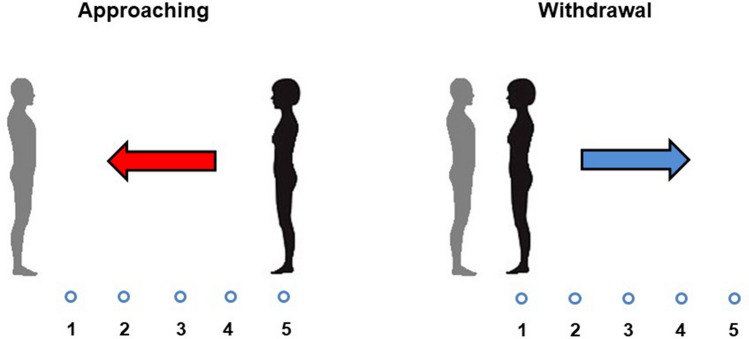
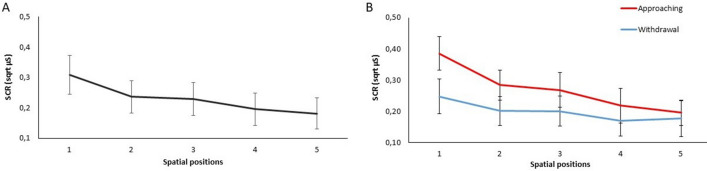
Interpersonal space (IPS) is the area around the body that individuals maintain between themselves and others during social interactions. When others violate our IPS, feeling of discomfort rise up, urging us to move farther away and reinstate an appropriate interpersonal distance. Previous studies showed that when individuals are exposed to closeness of an unknown person (a confederate), the skin conductance response (SCR) increases. However, if the SCR is modulated according to participant’s preferred IPS is still an open question. To test this hypothesis, we recorded the SCR in healthy participants when a confederate stood in front of them at various distances simulating either an approach or withdrawal movement (Experiment 1). Then, the comfort-distance task was adopted to measure IPS: participants stop the confederate, who moved either toward or away from them, when they felt comfortable with other’s proximity (Experiment 2). We found higher SCR when the confederate stood closer to participants simulating an IPS intrusion, compared to when the confederate moved farther away. Crucially, we provide the first evidence that SCR, acting as a warning signal, contributes to interpersonal distance preference suggesting a functional link between behavioral components of IPS regulation and the underlying physiological processes.
Overview
The claims and statistics of this paper haven’t been checked yet.
Free: it reads the open-access text and checks the first 5 claims that cite a source we can check. Create a free account to check every claim.
Integrity signals
Registry
Cites
Statistics
Figures
Verification
Claims the paper makes
The claims and statistics of this paper haven’t been checked yet.
Free: it reads the open-access text and checks the first 5 claims that cite a source we can check. Create a free account to check every claim.
Claims other papers make about this one
Each is checked against this paper’s own text: does it say what the citing paper says it does?
The source backs part of the claim, not all of it — or backs it for a different population, condition or comparison.
In the citing paper
“Recent evidence in support to this possibility comes from a study showing enhanced skin conductance response in participants when a confederate approached compared to when he moved farther away in the stop distance paradigm (Candini, Battaglia, Benassi, di Pellegrino, & Frassinetti, 2021).”
From The Peripersonal Space in a social world (2021) · cites this paper as Candini et al., 2021
Experimental — accuracy not yet measured
Self-check
Percentages, sums and reported differences re-computed from the paper’s own numbers.
The self-check needs the paper’s full text.
Citations
Cites
(1970) · Cited by 24,983
Handbook of environmental psychology
Stokols, D., & Altman, I. (1987) · Wiley eBooks · Cited by 3,184
Eye-Contact, Distance and Affiliation
Argyle, M., & Dean, J. (1965) · Sociometry · doi:10.2307/2786027 · Cited by 1,779
Publication Recommendations for Electrodermal Measurements
Fowles, D. C., Christie, M. J., Edelberg, R., GRINGS, W. W., Lykken, D. T., & Venables, P. H. (1981) · Psychophysiology · doi:10.1111/j.1469-8986.1981.tb03024.x · Cited by 1,699
Publication recommendations for electrodermal measurements
Society for Psychophysiological Research Ad Hoc Committee on Electrodermal Measures (2012) · Psychophysiology · doi:10.1111/j.1469-8986.2012.01384.x · Cited by 1,288
Handbook of environmental psychology
Bechtel, R. B., & Churchman, A. (2002) · Cited by 1,166
LeDoux, J. E. (2014) · Proceedings of the National Academy of Sciences · doi:10.1073/pnas.1400335111 · Cited by 891
The role of the amygdala in human fear: automatic detection of threat
Öhman, A. (2005) · Psychoneuroendocrinology · doi:10.1016/j.psyneuen.2005.03.019 · Cited by 691
"Psychic blindness" and other symptoms following bilateral temporal lobectomy in Rhesus monkeys.
Klüver, H., & Bucy, P. C. (1937) · American Journal of Physiology-Legacy Content · Cited by 545
Adolphs, R. (2013) · Current Biology · doi:10.1016/j.cub.2012.11.055 · Cited by 524
Personal-space—where we now stand
Hayduk, L. A. (1983) · Psychological Bulletin · doi:10.1037/0033-2909.94.2.293 · Cited by 502
Sommer, R. (1959) · Sociometry · doi:10.2307/2785668 · Cited by 473
Personal space regulation by the human amygdala
Kennedy, D. P., Gläscher, J., Tyszka, J. M., & Adolphs, R. (2009) · Nature Neuroscience · doi:10.1038/nn.2381 · Cited by 450
From Fear to Safety and Back: Reversal of Fear in the Human Brain
Schiller, D., Levy, I., Niv, Y., LeDoux, J. E., & Phelps, E. A. (2008) · The Journal of Neuroscience · doi:10.1523/jneurosci.2265-08.2008 · Cited by 429
Sleep loss causes social withdrawal and loneliness
Ben Simon, E., & Walker, M. P. (2018) · Nature Communications · doi:10.1038/s41467-018-05377-0 · Cited by 352
Personal space and self-protection.
Dosey, M. A., & Meisels, M. (1969) · Journal of Personality and Social Psychology · doi:10.1037/h0027040 · Cited by 302
Oxytocin Modulates Social Distance between Males and Females
Scheele, D., Striepens, N., Güntürkün, O., Deutschländer, S., Maier, W., Kendrick, K. M., & Hurlemann, R. (2012) · The Journal of Neuroscience · doi:10.1523/jneurosci.2755-12.2012 · Cited by 301
Crowding and personal space invasion on the train: Please don’t make me sit in the middle
Evans, G. W., & Wener, R. E. (2007) · Journal of Environmental Psychology · doi:10.1016/j.jenvp.2006.10.002 · Cited by 294
Personal space: An evaluative and orienting overview.
Hayduk, L. A. (1978) · Psychological Bulletin · doi:10.1037//0033-2909.85.1.117 · Cited by 291
Emery, N. J., Capitanio, J. P., Mason, W. A., Machado, C. J., Mendoza, S. P., & Amaral, D. G. (2001) · Behavioral Neuroscience · doi:10.1037/0735-7044.115.3.515 · Cited by 273
Iachini, T., Coello, Y., Frassinetti, F., & Ruggiero, G. (2014) · PLoS ONE · doi:10.1371/journal.pone.0111511 · Cited by 236
Self-citationNichols, K. A., & Champness, B. G. (1971) · Journal of Experimental Social Psychology · doi:10.1016/0022-1031(71)90024-2 · Cited by 234
Baldassare, M. (1978) · Annual Review of Sociology · doi:10.1146/annurev.so.04.080178.000333 · Cited by 194
Social Proximity Effects on Galvanic Skin Responses in Adult Humans
McBride, G., King, M. G., & James, J. W. (1965) · The Journal of Psychology · doi:10.1080/00223980.1965.10544805 · Cited by 177
Hecht, H., Welsch, R., Viehoff, J., & Longo, M. R. (2019) · Acta Psychologica · doi:10.1016/j.actpsy.2018.12.009 · Cited by 139
The influence of biological sex, sexuality and gender role on interpersonal distance
Uzzell, D., & Horne, N. (2006) · British Journal of Social Psychology · doi:10.1348/014466605x58384 · Cited by 133
Lloyd, D. M. (2009) · Neuroscience & Biobehavioral Reviews · doi:10.1016/j.neubiorev.2008.09.007 · Cited by 128 · cited 1×
“Thus, the SCR is influenced by the interaction between two factors (1) the confederate’s closeness to participant, and (2) the social context within which the movement is performed: a potential threat and danger in the approaching condition, and a harmless and safe situation in the withdrawal condition.”
BackgroundPersonal Space Regulation in Childhood Autism Spectrum Disorders
Gessaroli, E., Santelli, E., di Pellegrino, G., & Frassinetti, F. (2013) · PLoS ONE · doi:10.1371/journal.pone.0074959 · Cited by 126
Self-citationDon’t stand so close to me: a behavioral and ERP study of preferred interpersonal distance
Perry, A., Rubinsten, O., Peled, L., & Shamay-Tsoory, S. G. (2013) · NeuroImage · doi:10.1016/j.neuroimage.2013.07.042 · Cited by 118
Social perception of others shapes one's own multisensory peripersonal space
Pellencin, E., Paladino, M. P., Herbelin, B., & Serino, A. (2018) · Cortex · doi:10.1016/j.cortex.2017.08.033 · Cited by 117
Virtual Social Interactions in Social Anxiety—The Impact of Sex, Gaze, and Interpersonal Distance
Wieser, M. J., Pauli, P., Grosseibl, M., Molzow, I., & Mühlberger, A. (2010) · Cyberpsychology, Behavior, and Social Networking · doi:10.1089/cyber.2009.0432 · Cited by 115
Neural correlates of personal space intrusion
Holt, D. J., Cassidy, B. S., Yue, X., Rauch, S. L., Boeke, E. A., Nasr, S., Tootell, R. B. H., & Coombs, G. (2014) · The Journal of Neuroscience · doi:10.1523/jneurosci.0686-13.2014 · Cited by 114
Increased personal space of patients with schizophrenia in a virtual social environment
Park, S.-H., Ku, J., Kim, J.-J., Jang, H. J., Kim, S. Y., Kim, S. H., Kim, C.-H., Lee, H., Kim, I. Y., & Kim, S. I. (2009) · Psychiatry Research · doi:10.1016/j.psychres.2008.06.039 · Cited by 94
Social anxiety predicts avoidance behaviour in virtual encounters
Rinck, M., Rörtgen, T., Lange, W.-G., Dotsch, R., Wigboldus, D. H. J., & Becker, E. S. (2010) · Cognition & Emotion · doi:10.1080/02699930903309268 · Cited by 82
Personal space in a digital age.
Sommer, R. (2002) · Cited by 81
Reduced Personal Space in Individuals with Autism Spectrum Disorder
Asada, K., Tojo, Y., Osanai, H., Saito, A., Hasegawa, T., & Kumagaya, S. (2016) · PLOS ONE · doi:10.1371/journal.pone.0146306 · Cited by 79
Closing the gap between the inside and the outside: interoceptive sensitivity and social distances
Ferri, F., Ardizzi, M., Ambrosecchia, M., & Gallese, V. (2013) · PLoS ONE · doi:10.1371/journal.pone.0075758 · Cited by 74
Abnormalities in personal space and parietal–frontal function in schizophrenia
Holt, D. J., Boeke, E. A., Coombs, G., DeCross, S. N., Cassidy, B. S., Stufflebeam, S., Rauch, S. L., & Tootell, R. B. H. (2015) · NeuroImage: Clinical · doi:10.1016/j.nicl.2015.07.008 · Cited by 72
Bilateral Skin Conductance Responses to Emotional Faces
Banks, S. J., Bellerose, J., Douglas, D., & Jones‐Gotman, M. (2012) · Applied Psychophysiology and Biofeedback · doi:10.1007/s10484-011-9177-7 · Cited by 71
I-Space: The Effects of Emotional Valence and Source of Music on Interpersonal Distance
Tajadura-Jiménez, A., Pantelidou, G., Rebacz, P., Västfjäll, D., & Tsakiris, M. (2011) · PLoS ONE · doi:10.1371/journal.pone.0026083 · Cited by 70
Interpersonal distance and social anxiety in autistic spectrum disorders: A behavioral and ERP study
Perry, A., Levy-Gigi, E., Richter-Levin, G., & Shamay-Tsoory, S. G. (2015) · Social Neuroscience · doi:10.1080/17470919.2015.1010740 · Cited by 65
Candini, M., Giuberti, V., Manattini, A., Grittani, S., di Pellegrino, G., & Frassinetti, F. (2017) · Autism Research · doi:10.1002/aur.1637 · Cited by 64
Self-citationCooperative tool-use reveals peripersonal and interpersonal spaces are dissociable
Patané, I., Farnè, A., & Frassinetti, F. (2017) · Cognition · doi:10.1016/j.cognition.2017.04.013 · Cited by 62
Self-citationSpatial proximity amplifies valence in emotional memory and defensive approach-avoidance
Åhs, F., Dunsmoor, J. E., Zielinski, D., & LaBar, K. S. (2015) · Neuropsychologia · doi:10.1016/j.neuropsychologia.2014.12.018 · Cited by 58
Meyer, C., Padmala, S., & Pessoa, L. (2019) · Journal of Cognitive Neuroscience · doi:10.1162/jocn_a_01363 · Cited by 52
Disentangling Action from Social Space: Tool-Use Differently Shapes the Space around Us
Patané, I., Iachini, T., Farnè, A., & Frassinetti, F. (2016) · PLOS ONE · doi:10.1371/journal.pone.0154247 · Cited by 50
Self-citationSchienle, A., Wabnegger, A., Schöngassner, F., & Leutgeb, V. (2015) · Social Cognitive and Affective Neuroscience · doi:10.1093/scan/nsv034 · Cited by 49
The spatial effect of fearful faces in the autonomic response
Ellena, G., Battaglia, S., & Làdavas, E. (2020) · Experimental Brain Research · doi:10.1007/s00221-020-05829-4 · Cited by 46
Self-citationNonconscious control of autonomic responses: A role for Pavlovian conditioning?
Öhman, A. (1988) · Biological Psychology · doi:10.1016/0301-0511(88)90045-2 · Cited by 43
An Enhanced Default Approach Bias Following Amygdala Lesions in Humans
Harrison, L., Hurlemann, R., & Adolphs, R. (2015) · Psychological Science · doi:10.1177/0956797615583804 · Cited by 34
Neuronal correlates of personal space intrusion in violent offenders
Schienle, A., Wabnegger, A., Leitner, M., & Leutgeb, V. (2017) · Brain Imaging and Behavior · doi:10.1007/s11682-016-9526-5 · Cited by 34
When social and action spaces diverge: A study in children with typical development and autism
Candini, M., Giuberti, V., Santelli, E., di Pellegrino, G., & Frassinetti, F. (2019) · Autism · doi:10.1177/1362361318822504 · Cited by 33
Self-citationThe plasticity of the interpersonal space in autism spectrum disorder
Candini, M., di Pellegrino, G., & Frassinetti, F. (2020) · Neuropsychologia · doi:10.1016/j.neuropsychologia.2020.107589 · Cited by 33
Self-citationInvisible body illusion modulates interpersonal space
D’Angelo, M., di Pellegrino, G., & Frassinetti, F. (2017) · Scientific Reports · doi:10.1038/s41598-017-01441-9 · Cited by 32
Self-citationApproaching threatening stimuli cause an expansion of defensive peripersonal space
Bufacchi, R. J. (2017) · Journal of Neurophysiology · doi:10.1152/jn.00316.2017 · Cited by 30
(1973) · Environment and Behavior · doi:10.1177/001391657300500104 · Cited by 27
Gradual extinction reduces reinstatement
Shiban, Y., Wittmann, J., Weißinger, M., & Mühlberger, A. (2015) · Frontiers in Behavioral Neuroscience · doi:10.3389/fnbeh.2015.00254 · Cited by 27
Differential amygdala activation during simulated personal space intrusion by men and women
Wabnegger, A., Leutgeb, V., & Schienle, A. (2016) · Neuroscience · doi:10.1016/j.neuroscience.2016.05.023 · Cited by 26 · cited 4×
“4 cm), as well as for the participant’s Gender [F(1,21) = 0.”
BackgroundMethodInfluentialThe role of oxytocin in implicit personal space regulation: An fMRI study
Cohen, D., Perry, A., Mayseless, N., Kleinmintz, O. M., & Shamay‐Tsoory, S. (2018) · Psychoneuroendocrinology · doi:10.1016/j.psyneuen.2018.02.036 · Cited by 20
Research works printed but not linked: 2
- Hall ET Distances in Man: The Hidden Dimension 1966 New York Double Day
- Pedrabissi L Santinello M STAI State-Trait Anxiety Inventory Forma Y Manuale 1989 Florence Organizzazioni Speciali
Cited by
Neural Decoding of EEG Signals with Machine Learning: A Systematic Review
Saeidi, M., Karwowski, W., Farahani, F. V., Fiok, K., Taiar, R., Hancock, P. A., & Al-Juaid, A. (2021) · Brain Sciences · doi:10.3390/brainsci11111525 · Cited by 258
“Moreover, environmental factors, such as approaching direction [223] have contributed to clarifying the effects of behavioral responses (i.e., defensive responses).”
BackgroundTanaka, M., Szabó, Á., Spekker, E., Polyák, H., Tóth, F., & Vécsei, L. (2022) · Cells · doi:10.3390/cells11162607 · Cited by 153
The Peripersonal Space in a social world
Bogdanova, O. V., Bogdanov, V. B., Dureux, A., Farnè, A., & Hadj-Bouziane, F. (2021) · Cortex · doi:10.1016/j.cortex.2021.05.005 · Cited by 86
“Recent evidence in support to this possibility comes from a study showing enhanced skin conductance response in participants when a confederate approached compared to when he moved farther away in the stop distance paradigm (Candini et al., 2021).”
Tanaka, M., Spekker, E., Szabó, Á., Polyák, H., & Vécsei, L. (2022) · Journal of Neural Transmission · doi:10.1007/s00702-022-02513-5 · Cited by 86
Play therapy in children with autism: Its role, implications, and limitations
Elbeltagi, R. M., Al‐Beltagi, M., Saeed, N. K., & Alhawamdeh, R. (2023) · World Journal of Clinical Pediatrics · doi:10.5409/wjcp.v12.i1.1 · Cited by 112
Metadata
- Authors
- Candini, M., Battaglia, S., Benassi, M., di Pellegrino, G., & Frassinetti, F.
- Affiliations
- Istituti Clinici Scientifici Maugeri (IT)
- University of Bologna (IT)
- Corresponding author
- Candini, Michela
- Venue
- Scientific Reports
- Published
- 2021-01-28
- Volume
- 11
- Issue
- 1
- Pages
- 2611-2611
- ISSN
- 2045-2322 (ISSN-L)
- PMC
- PMC7844010
- OpenAlex
- W3123776796
- Cited by
- 73
- References
- 59
- Citations by year
- 2026: 9 · 2025: 15 · 2024: 14 · 2023: 7 · 2022: 21 · 2021: 7
- FWCI
- 6.44
- Type
- journal article
- Language
- en
- Open access
- gold
- doi.org
- Licence
- cc-by
- creativecommons.org/licenses/by/4.0 (tdm)
- creativecommons.org/licenses/by/4.0 (vor)
- Locations
- Scientific Reports (publishedVersion, cc-by)
- PubMed Central (publishedVersion, cc-by)
- PubMed (publishedVersion)
- Archivio istituzionale della ricerca (Alma Mater Studiorum Università di Bologna) (submittedVersion, cc-by)
- DOAJ (DOAJ: Directory of Open Access Journals) (submittedVersion, cc-by-sa)
- Funders
- Ricerca Fondamentale Orientata, University of Bologna
- Topics
- Life Sciences › Neuroscience › Cognitive Neuroscience › Tactile and Sensory Interactions
- Physical Sciences › Computer Science › Human-Computer Interaction › Virtual Reality Applications and Impacts
- Life Sciences › Neuroscience › Cognitive Neuroscience › Embodied and Extended Cognition
- Keywords
- personal space, skin conductance response, physiological correlates, social discomfort, warning signs, social interaction
- MeSH terms
- Adult, Anxiety, Female, Galvanic Skin Response, Humans, Interpersonal Relations, Male, Personal Space, Spatial Behavior, Young Adult
About these checks
Registry, retraction, Cites and statistics results are computed, not judged, with one exception: a printed reference that no index lists is read once by a model before it counts as a citation error. Claims are extracted by a model and kept only when their quote appears verbatim in the text; each cited source is then checked, with a model’s help, for whether it says what the claim relies on. Those verdicts can be wrong — read the claim’s quote and the cited source before relying on one.
Statistics and arithmetic are recomputed, not judged.
Confidence bands are shown only for fields calibrated on our annotated test set. None is calibrated yet, so no band is shown.
What counts as a claim ›How we measure confidence ›How we check this ›
Are you an author, or do you see a problem with this page? Request a review
Data sources
Bibliographic data: Semantic Scholar, OpenAlex, Crossref.
Contains information from the Semantic Scholar Academic Graph Datasets, made available under the ODC Attribution License (ODC-BY 1.0).
Semantic Scholar’s data is described in: Kinney, R., et al. (2023). The Semantic Scholar Open Data Platform. arXiv:2301.10140.
