

Predicting chromosome damage in astronauts participating in international space station missions
Open accessThe DOI matches its Crossref record; 57 of the 58 references it cites were found in a registry or an index.
Abstract
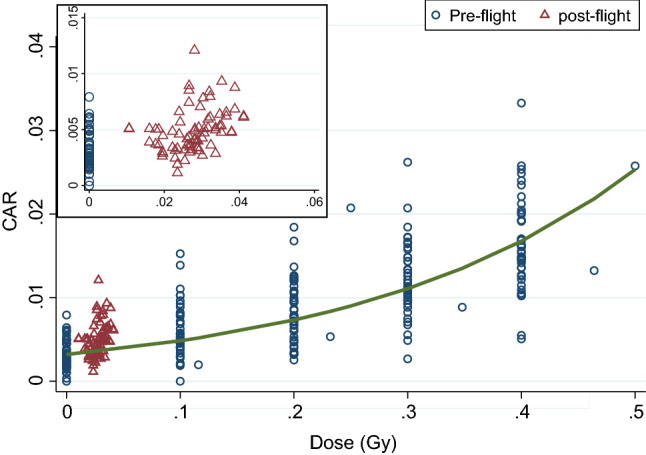
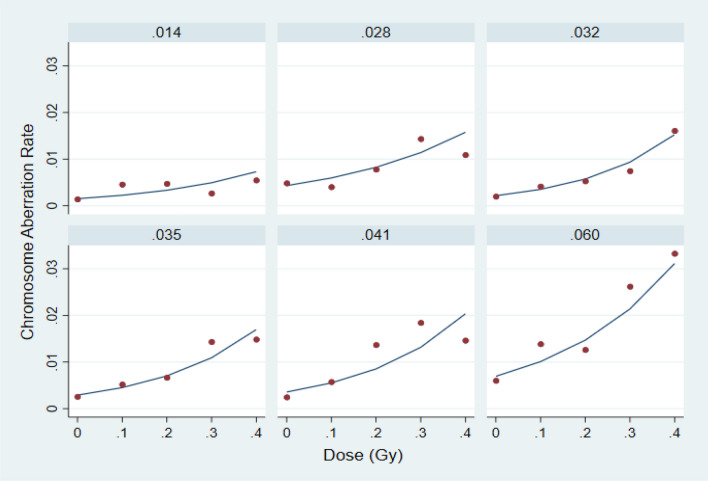
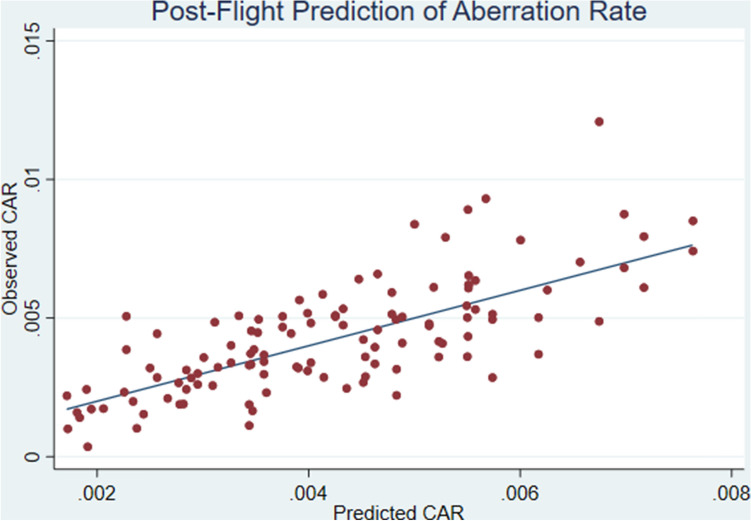
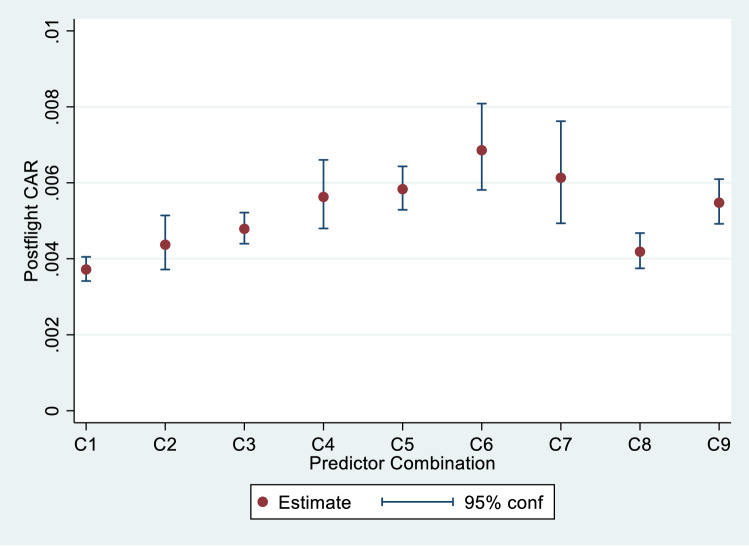
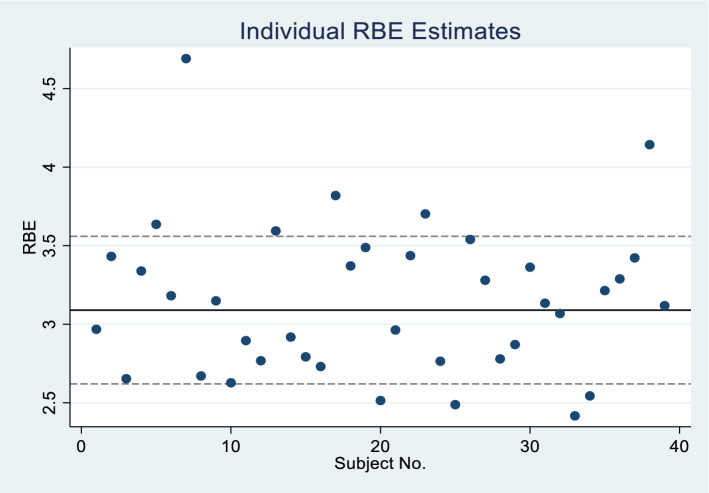
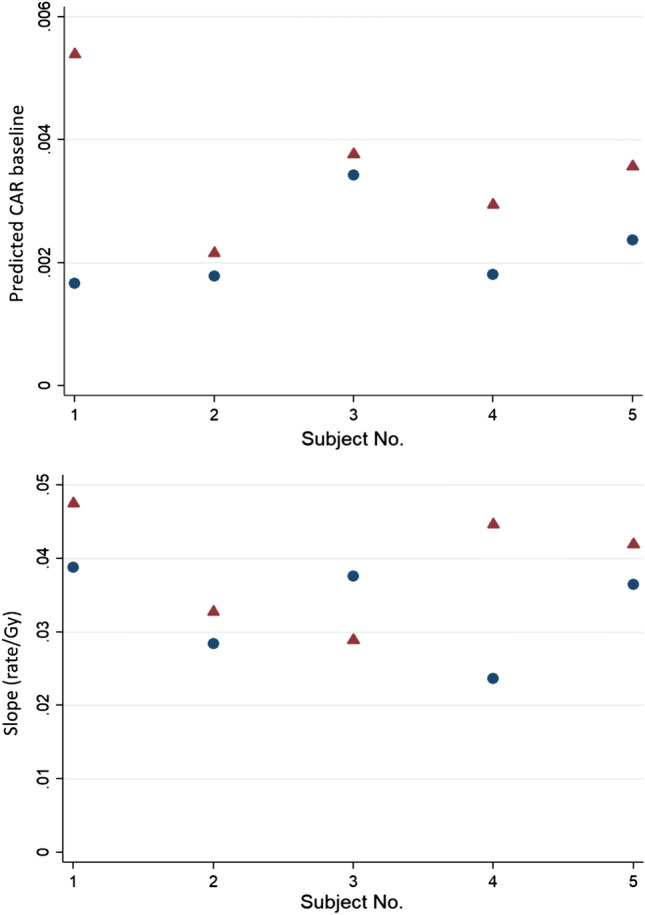
Space radiation consists of energetic protons and other heavier ions. During the International Space Station program, chromosome aberrations in lymphocytes of astronauts have been analyzed to estimate received biological doses of space radiation. More specifically, pre-flight blood samples were exposed ex vivo to varying doses of gamma rays, while post-flight blood samples were collected shortly and several months after landing. Here, in a study of 43 crew-missions, we investigated whether individual radiosensitivity, as determined by the ex vivo dose–response of the pre-flight chromosome aberration rate (CAR), contributes to the prediction of the post-flight CAR incurred from the radiation exposure during missions. Random-effects Poisson regression was used to estimate subject-specific radiosensitivities from the preflight dose–response data, which were in turn used to predict post-flight CAR and subject-specific relative biological effectiveness (RBEs) between space radiation and gamma radiation. Covariates age, gender were also considered. Results indicate that there is predictive value in background CAR as well as radiosensitivity determined preflight for explaining individual differences in post-flight CAR over and above that which could be explained by BFO dose alone. The in vivo RBE for space radiation was estimated to be approximately 3 relative to the ex vivo dose response to gamma irradiation. In addition, pre-flight radiosensitivity tended to be higher for individuals having a higher background CAR, suggesting that individuals with greater radiosensitivity can be more sensitive to other environmental stressors encountered in daily life. We also noted that both background CAR and radiosensitivity tend to increase with age, although both are highly variable. Finally, we observed no significant difference between the observed CAR shortly after mission and at > 6 months post-mission.
Overview
The claims and statistics of this paper haven’t been checked yet.
Free: it reads the open-access text and checks the first 5 claims that cite a source we can check. Create a free account to check every claim.
Integrity signals
Registry
Cites
Statistics
Figures
Verification
Claims the paper makes
The claims and statistics of this paper haven’t been checked yet.
Free: it reads the open-access text and checks the first 5 claims that cite a source we can check. Create a free account to check every claim.
Claims other papers make about this one
Each is checked against this paper’s own text: does it say what the citing paper says it does?
The cited source doesn’t support the claim as written.
In the citing paper
“Based on the long experience accumulated in the NASA biodosimetry program [13]; it became clear that, even if chromosomal aberration dosimetry elegantly proved that risk estimates are solid and consistent with biological observables, experimental uncertainties are too high and will cover any significant inter-individual variability in response.”
From Space agency-specific standards for crew dose and risk assessment of ionising radiation exposures for the International Space Station (2024) · cites this paper as [13]
Checked by a reasoning model — may be wrong.
Experimental — accuracy not yet measured
Self-check
Percentages, sums and reported differences re-computed from the paper’s own numbers.
The self-check needs the paper’s full text.
Citations
Cites
Recommendations of the International Commission on Radiological Protection
(1959) · Health Physics · doi:10.1097/00004032-195901000-00001 · Cited by 1,703
Generalized Latent Variable Modeling
Skrondal, A., & Rabe-Hesketh, S. (2004) · Chapman & Hall/CRC eBooks · doi:10.1201/9780203489437 · Cited by 1,484
Heavy ion carcinogenesis and human space exploration
Durante, M., & Cucinotta, F. A. (2008) · Nature Reviews Cancer · doi:10.1038/nrc2391 · Cited by 578
Space radiation dosimetry in low-Earth orbit and beyond
Benton, E. R., & Benton, E. V. (2001) · Nuclear Instruments and Methods in Physics Research Section B: Beam Interactions with Materials and Atoms · doi:10.1016/s0168-583x(01)00748-0 · Cited by 538
The 1990 recommendations of the International Commission on Radiological Protection
Vennart, J. (1991) · Journal of Radiological Protection · doi:10.1088/0952-4746/11/3/006 · Cited by 371
In vivo estimates of division and death rates of human T lymphocytes.
Mclean, A. R., & Michie, C. A. (1995) · Proceedings of the National Academy of Sciences · doi:10.1073/pnas.92.9.3707 · Cited by 270
Prediction in Multilevel Generalized Linear Models
Skrondal, A., & Rabe-Hesketh, S. (2009) · Journal of the Royal Statistical Society Series A: Statistics in Society · doi:10.1111/j.1467-985x.2009.00587.x · Cited by 225
Radiation Induced Non-targeted Response: Mechanism and Potential Clinical Implications
K. Hei, T., Zhou, H., Chai, Y., Ponnaiya, B., & N. Ivanov, V. (2011) · Current Molecular Pharmacology · doi:10.2174/1874467211104020096 · Cited by 211
Physical and biological organ dosimetry analysis for international space station astronauts
Cucinotta, F. A., Kim, M.-H. Y., Willingham, V., & George, K. A. (2008) · Radiation Research · doi:10.1667/rr1330.1 · Cited by 196
Self-citationLimitations in predicting the space radiation health risk for exploration astronauts
Chancellor, J. C., Blue, R. S., Cengel, K. A., Auñón-Chancellor, S. M., Rubins, K. H., Katzgraber, H. G., & Kennedy, A. R. (2018) · npj Microgravity · doi:10.1038/s41526-018-0043-2 · Cited by 183
Interplay of space radiation and microgravity in DNA damage and DNA damage response
Moreno-Villanueva, M., Wong, M., Lu, T., Zhang, Y., & Wu, H. (2017) · npj Microgravity · doi:10.1038/s41526-017-0019-7 · Cited by 181
Self-citationLimitations in predicting the space radiation health risk for exploration astronauts
Chancellor, J. C., Blue, R. S., Cengel, K. A., Auñón-Chancellor, S. M., Rubins, K., Katzgraber, H. G., & Kennedy, A. R. (2018) · Civil War Book Review · Cited by 174
International study of factors affecting human chromosome translocations
Sigurdson, A. J., Ha, M., Hauptmann, M., Bhatti, P., Šrám, R. J., Beskid, O., Tawn, E. J., Whitehouse, C. A., Lindholm, C., Nakano, M., et al. (2008) · Mutation Research/Genetic Toxicology and Environmental Mutagenesis · doi:10.1016/j.mrgentox.2008.01.005 · Cited by 158
Chromosome aberration dosimetry in cosmonauts after single or multiple space flights
Durante, M., Snigiryova, G., Akaeva, E., Bogomazova, A., Druzhinin, S., Fedorenko, B., Greco, O., Novitskaya, N., Rubanovich, A., Shevchenko, V., et al. (2003) · Cytogenetic and Genome Research · doi:10.1159/000076288 · Cited by 146
Westera, L., Drylewicz, J., den Braber, I., Mugwagwa, T., van der Maas, I., Kwast, L., Volman, T., van de Weg-Schrijver, E. H. R., Bartha, I., Spierenburg, G., et al. (2013) · Blood · doi:10.1182/blood-2013-03-488411 · Cited by 136
Chromosome aberrations in the blood lymphocytes of astronauts after space flight
George, K., Durante, M., Wu, H., Willingham, V., Badhwar, G., & Cucinotta, F. A. (2001) · Radiation Research · doi:10.1667/0033-7587(2001)156[0731:caitbl]2.0.co;2 · Cited by 119
Self-citationAdvanced age increases chromosome structural abnormalities in human spermatozoa
Templado, C., Donate, A., Giraldo, J., Bosch, M., & Estop, A. M. (2010) · European Journal of Human Genetics · doi:10.1038/ejhg.2010.166 · Cited by 117
Biodosimetry Results from Space Flight Mir-18
Yang, T. C., George, K., Johnson, A. S., Durante, M., & Fedorenko, B. S. (1997) · Radiation Research · doi:10.2307/3579712 · Cited by 101
Self-citationLiu, Q., Cao, J., Li, K. Q., Miao, X. H., Li, G., Fan, F. Y., & Zhao, Y. C. (2008) · Environmental Science and Pollution Research · doi:10.1007/s11356-008-0087-z · Cited by 96
Sproull, M. T., & Camphausen, K. A. (2016) · Radiation Research · doi:10.1667/rr14452.1 · Cited by 77
Costa, S., Carvalho, S., Costa, C., Coelho, P., Silva, S., Santos, L. S., Gaspar, J., Porto, B., Laffón, B., & Teixeira, J. P. (2015) · Mutagenesis · doi:10.1093/mutage/gev002 · Cited by 75
Uncertainties in estimates of the risks of late effects from space radiation
Cucinotta, F. A., Schimmerling, W., Wilson, J. W., Peterson, L. E., Saganti, P. B., & Dicello, J. F. (2004) · Advances in Space Research · doi:10.1016/j.asr.2003.10.053 · Cited by 60
Fedorenko, B. S., Druzhinin, S., Yudaeva, L., Petrov, V. M., Akatov, Y. A., Snigiryova, G. P., Novitskaya, N., Shevchenko, V. A., & Rubanovich, A. V. (2001) · Advances in Space Research · doi:10.1016/s0273-1177(01)00011-4 · Cited by 58
Sloter, E. D., Marchetti, F., Eskenazi, B., Weldon, R. H., Nath, J., Cabreros, D., & Wyrobek, A. J. (2007) · Fertility and Sterility · doi:10.1016/j.fertnstert.2006.08.112 · Cited by 56
George, K., Rhone, J., Beitman, A., & Cucinotta, F. A. (2013) · Mutation Research/Genetic Toxicology and Environmental Mutagenesis · doi:10.1016/j.mrgentox.2013.04.007 · Cited by 54
Self-citationHuber, R., Braselmann, H., Geinitz, H., Jaehnert, I., Baumgartner, A., Thamm, R., Figel, M., Molls, M., & Zitzelsberger, H. F. (2011) · Radiation Oncology · doi:10.1186/1748-717x-6-32 · Cited by 53
Richardson, D. B., & Wing, S. (1999) · International Journal of Epidemiology · doi:10.1093/ije/28.3.428 · Cited by 47
Tawn, E. J., Whitehouse, C. A., & Tarone, R. E. (2004) · Radiation Research · doi:10.1667/rr3214 · Cited by 44
George, K. A., Willingham, V., Wu, H., Gridley, D. S., Nelson, G. A., & Cucinotta, F. A. (2002) · Advances in Space Research · doi:10.1016/s0273-1177(02)00406-4 · Cited by 41
Self-citationBiological dosimetry in Russian and Italian astronauts
Greco, O., Durante, M., Gialanella, G., Grossi, G., Pugliese, M., Scampoli, P., Snigiryova, G. P., & Obe, G. (2003) · Advances in Space Research · doi:10.1016/s0273-1177(03)00087-5 · Cited by 40
Technical report. The G2 chromosomal radiosensitivity assay
Bryant, P. E., Gray, L. H., Riches, A., Steel, C., Finnon, P., Howe, O. L., Kesterton, I., Vral, A., Curwen, G. B., Smart, V., et al. (2002) · International Journal of Radiation Biology · doi:10.1080/09553000210144484 · Cited by 40
Induction of Chromosomal Aberrations at Fluences of Less Than One HZE Particle per Cell Nucleus
Hada, M., Chappell, L. J., Wang, M., George, K. A., & Cucinotta, F. A. (2014) · Radiation Research · doi:10.1667/rr13721.1 · Cited by 39
Self-citationSchuster, B., Ellmann, A., Mayo, T., Auer, J., Haas, M., Hecht, M., Fietkau, R., & Distel, L. V. (2018) · BMC Geriatrics · doi:10.1186/s12877-018-0799-y · Cited by 39
Wu, H., Durante, M., Furusawa, Y., George, K. A., Kawata, T., & Cucinotta, F. A. (2003) · Radiation Research · doi:10.1667/rr3061 · Cited by 38
Self-citationEffects of Sex and Gender on Adaptation to Space: Immune System
Kennedy, A. R., Crucian, B. E., Huff, J. L., Klein, S. L., Morens, D. M., Murasko, D. M., Nickerson, C. A., & Sonnenfeld, G. (2014) · Journal of Women s Health · doi:10.1089/jwh.2014.4913 · Cited by 36
Self-citationEffects of Very Low Fluences of High-Energy Protons or Iron Ions on Irradiated and Bystander Cells
Yang, H., Magpayo, N., Rusek, A., Chiang, I.-H., Sivertz, M., & Held, K. D. (2011) · Radiation Research · doi:10.1667/rr2674.1 · Cited by 35
Maximum Likelihood Estimation for Cytogenetic Dose-Response Curves
Frome, E. L., & DuFrain, R. J. (1986) · Biometrics · doi:10.2307/2531244 · Cited by 34
Yao, B., Li, Y., Liu, G., Guo, M. L., Bai, J., Man, Q., Qiu, L., & Ai, H. (2012) · Mutation Research/Genetic Toxicology and Environmental Mutagenesis · doi:10.1016/j.mrgentox.2012.11.005 · Cited by 34
In vivo and in vitro measurements of complex-type chromosomal exchanges induced by heavy ions
George, K. A., Durante, M., Wu, H., Willingham, V., & Cucinotta, F. A. (2003) · Advances in Space Research · doi:10.1016/s0273-1177(03)00088-7 · Cited by 33
Self-citationKalfalah, F., Seggewiß, S., Walter, R., Tigges, J., Moreno-Villanueva, M., Bürkle, A., Ohse, S., Busch, H., Boerries, M., Hildebrandt, B., et al. (2015) · Aging · doi:10.18632/aging.100723 · Cited by 33
Self-citationWang, L., Bondy, M. L., de Andrade, M., Strom, S. S., Wang, X., Sigurdson, A. J., Spitz, M. R., & Wei, Q. (2000) · Radiation Research · doi:10.1667/0033-7587(2000)154[0020:gdiseo]2.0.co;2 · Cited by 32
Hoff, J. L., Townsend, L. W., & Zapp, E. N. (2004) · Advances in Space Research · doi:10.1016/j.asr.2003.08.056 · Cited by 29
Relative proportions of mitotic T and B cells in PHA-stimulated lymphocyte cultures
Knuutila, S., & Kovanen, P. E. (1987) · Cancer Genetics and Cytogenetics · doi:10.1016/0165-4608(87)90042-2 · Cited by 28
Chromosome aberrations of clonal origin are present in astronauts’ blood lymphocytes
George, K., Durante, M., Willingham, V., & Cucinotta, F. A. (2004) · Cytogenetic and Genome Research · doi:10.1159/000077498 · Cited by 26
Self-citationIndividual radiosensitivity in a breast cancer collective is changed with the patients’ age
Auer, J., Keller, U., Schmidt, M., Ott, O. J., Fietkau, R., & Distel, L. V. (2013) · Radiology and Oncology · doi:10.2478/raon-2013-0061 · Cited by 24
Chromosome aberrations among cigarette smokers in Colombia
Sierra, M. S., Arboleda‐Moreno, Y. Y., Hoyos‐Giraldo, L. S., & Sierra-Torres, C. H. (2004) · Mutation Research/Genetic Toxicology and Environmental Mutagenesis · doi:10.1016/j.mrgentox.2004.05.006 · Cited by 24
Radiation and microgravity – Associated stress factors and carcinogensis
Moreno‐Villanueva, M., & Wu, H. (2019) · REACH · doi:10.1016/j.reach.2019.100027 · Cited by 20
Self-citationApproaches to radiation guidelines for space travel
Fry, R. J. (1984) · Advances in Space Research · doi:10.1016/0273-1177(84)90234-5 · Cited by 18
Wu, H., George, K. A., Willingham, V., & Cucinotta, F. A. (2001) · PubMed · Cited by 14
Self-citationLiu, Q.-J., Lü, X., Zhao, X.-T., Feng, J.-B., Lü, Y.-M., Jiang, E.-H., Zhang, S., Chen, D., Jia, T.-Z., & Li, L. (2013) · Mutation Research/Genetic Toxicology and Environmental Mutagenesis · doi:10.1016/j.mrgentox.2013.07.016 · Cited by 11
Komova, O. V., Krasavin, E. A., Nasonova, E. A., Мельникова, Л. А., Shmakova, N. L., Cunha, M., Testa, É., & Beuve, M. (2017) · International Journal of Radiation Biology · doi:10.1080/09553002.2018.1399226 · Cited by 11
Beaton-Green, L. A., Lachapelle, S., Straube, U., & Wilkins, R. C. (2015) · Mutation Research/Genetic Toxicology and Environmental Mutagenesis · doi:10.1016/j.mrgentox.2015.07.013 · Cited by 10
In vitroradiosensitivity of peripheral blood lymphocytes in multiple sclerosis patients
Petcu, I., Savu, D., Thierens, H., Nagels, G., & Vral, A. (2006) · International Journal of Radiation Biology · doi:10.1080/09553000600932976 · Cited by 10
Whole-blood immunoassay for γH2AX as a radiation biodosimetry assay with minimal sample preparation
Johnston, M. L., Young, E. F., & Shepard, K. L. (2015) · Radiation and Environmental Biophysics · doi:10.1007/s00411-015-0595-4 · Cited by 9
Kodama, Y., Ohtaki, K., Awa, A. A., Nakano, M., Itoh, M., & Nakamura, N. (1999) · Radiation Research · doi:10.2307/3580154 · Cited by 9
Cadwell, K. K., Whitehouse, C. A., Tarone, R. E., & Tawn, E. J. (2008) · Journal of Radiological Protection · doi:10.1088/0952-4746/28/1/n01 · Cited by 5
DOSE-RATE AND CELL-KILLING SENSITIVITY OF HIGH-LINEAR ENERGY TRANSFER ION BEAM
Furusawa, Y., Matsumoto, Y., Hirayama, R., Ohsawa, D., & Konishi, T. (2018) · Radiation Protection Dosimetry · doi:10.1093/rpd/ncy267 · Cited by 3
Research works printed but not linked: 3
- Yucker WR Computerized Anatomical Female Body Self-Shielding Distributions 1992 Huntington Beach, CA McDonnell Douglas Space Systems Company
- Billings M Yucker WR Summary of Final Report: The Computerized Anatomical Man (CAM) Model 1973 Huntington Beach McDonnell Douglas Astronautics Company
- StataCorp. Stata Statistical Software: Release 16 2019 College Station, TX StataCorp LLC
Cited by
Development of Polymer Composites in Radiation Shielding Applications: A Review
Zeng, C., Kang, Q., Duan, Z., Qin, B., Feng, X., Lu, H., & Lin, Y. (2023) · Journal of Inorganic and Organometallic Polymers and Materials · doi:10.1007/s10904-023-02725-6 · Cited by 133
Genomic Changes Driven by Radiation-Induced DNA Damage and Microgravity in Human Cells
Beheshti, A., McDonald, J. T., Hada, M., Takahashi, A., Mason, C. E., & Mognato, M. (2021) · International Journal of Molecular Sciences · doi:10.3390/ijms221910507 · Cited by 100
Carcinogenesis induced by space radiation: A systematic review
Guo, Z., Zhou, G., & Hu, W. (2022) · Neoplasia · doi:10.1016/j.neo.2022.100828 · Cited by 99
Shavers, M., Semones, E., Tomi, L., Chen, J., Straube, U., Komiyama, T., Shurshakov, V., Li, C., & Rühm, W. (2024) · Zeitschrift für Medizinische Physik · doi:10.1016/j.zemedi.2023.06.005 · Cited by 41
“Based on the long experience accumulated in the NASA biodosimetry program [13]; it became clear that, even if chromosomal aberration dosimetry ele-gantly proved that risk estimates are solid and consistent with biological observables, experimental uncertainties are too high and will cover any…”
BackgroundSelf-citationAstroimmunology: the effects of spaceflight and its associated stressors on the immune system
Winer, D. A., Du, H., Kim, J., Chang, V., Burke, M., Winer, S., Costes, S. V., Frippiat, J., Sams, C. F., Paul, A. M., et al. (2025) · Nature reviews. Immunology · doi:10.1038/s41577-025-01226-6 · Cited by 38
Self-citation
Metadata
- Authors
- Feiveson, A., George, K., Shavers, M., Moreno-Villanueva, M., Zhang, Y., Babiak-Vazquez, A., Crucian, B., Semones, E., & Wu, H.
- Affiliations
- Johnson Space Center (US)
- KBR (United States) (US)
- Kennedy Space Center (US)
- Corresponding author
- Wu, Honglu
- Venue
- Scientific Reports
- Published
- 2021-03-05
- Volume
- 11
- Issue
- 1
- Pages
- 5293-5293
- ISSN
- 2045-2322 (ISSN-L)
- PMC
- PMC7935859
- OpenAlex
- W3134868578
- Semantic Scholar
- 571b27e33a855369f7a392e32f98ce78ac96031c
- Cited by
- 19
- References
- 58
- Citations by year
- 2026: 6 · 2025: 4 · 2024: 1 · 2023: 4 · 2022: 2 · 2021: 2
- FWCI
- 1.19
- Type
- journal article
- Language
- en
- Open access
- gold
- doi.org
- Licence
- cc-by
- creativecommons.org/licenses/by/4.0 (tdm)
- creativecommons.org/licenses/by/4.0 (vor)
- Locations
- Scientific Reports (publishedVersion, cc-by)
- PubMed Central (publishedVersion, cc-by)
- PubMed (publishedVersion)
- DOAJ (DOAJ: Directory of Open Access Journals) (submittedVersion, cc-by-sa)
- KOPS (University of Konstanz) (submittedVersion, cc-by)
- Funders
- National Aeronautics and Space Administration
- Johnson Space Center
- Topics
- Health Sciences › Medicine › Radiology, Nuclear Medicine and Imaging › Effects of Radiation Exposure
- Health Sciences › Medicine › Physiology (medical) › Spaceflight effects on biology
- Physical Sciences › Physics and Astronomy › Radiation › Radiation Therapy and Dosimetry
- Keywords
- space radiation, chromosomal abnormalities, astronauts, International Space Station, individual radiosensitivity, relative biological effectiveness, biological dosimetry, ex vivo irradiation, lymphocytes, heavy ions
About these checks
Registry, retraction, Cites and statistics results are computed, not judged, with one exception: a printed reference that no index lists is read once by a model before it counts as a citation error. Claims are extracted by a model and kept only when their quote appears verbatim in the text; each cited source is then checked, with a model’s help, for whether it says what the claim relies on. Those verdicts can be wrong — read the claim’s quote and the cited source before relying on one.
Statistics and arithmetic are recomputed, not judged.
Confidence bands are shown only for fields calibrated on our annotated test set. None is calibrated yet, so no band is shown.
What counts as a claim ›How we measure confidence ›How we check this ›
Are you an author, or do you see a problem with this page? Request a review
Data sources
Bibliographic data: Semantic Scholar, OpenAlex, Crossref.
Contains information from the Semantic Scholar Academic Graph Datasets, made available under the ODC Attribution License (ODC-BY 1.0).
Semantic Scholar’s data is described in: Kinney, R., et al. (2023). The Semantic Scholar Open Data Platform. arXiv:2301.10140.
