

The DOI matches its Crossref record; 41 of the 43 references it cites were found in a registry or an index.
COVID-19 diagnosis by routine blood tests using machine learning
Open accessAbstract
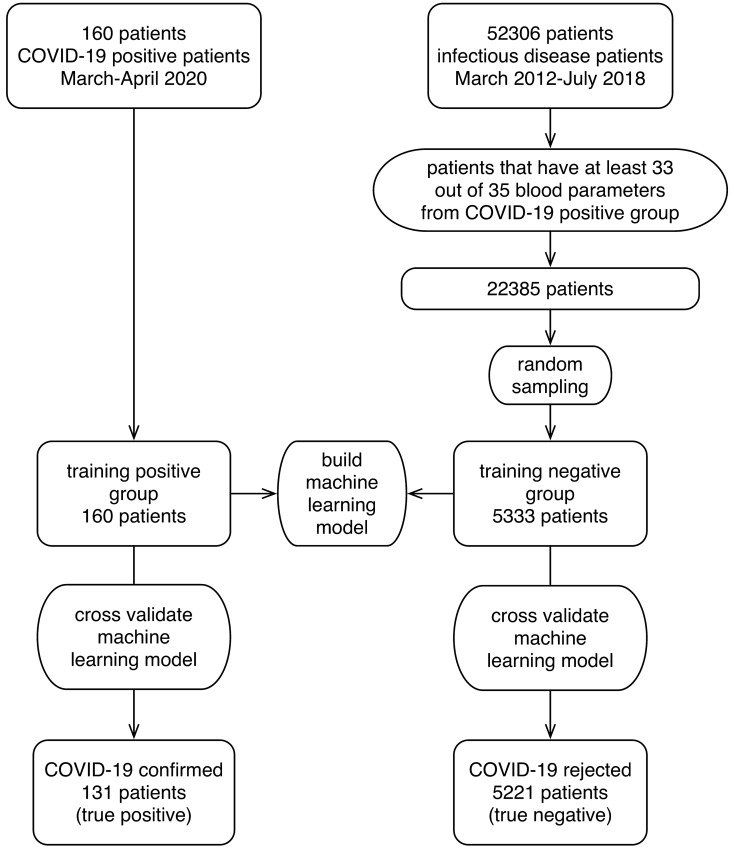
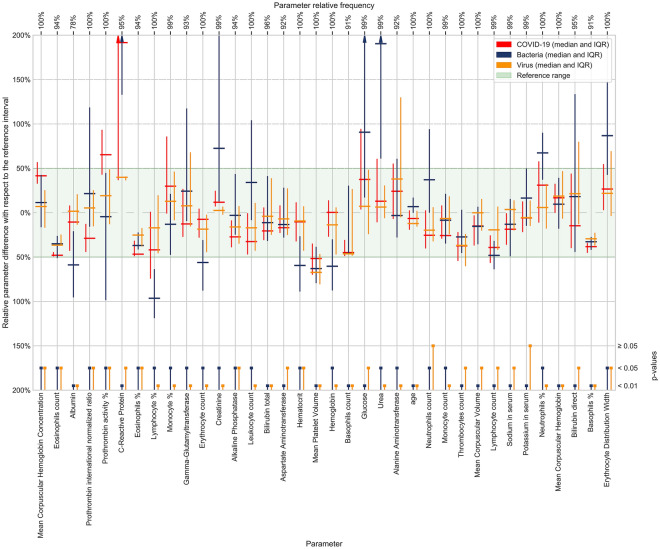
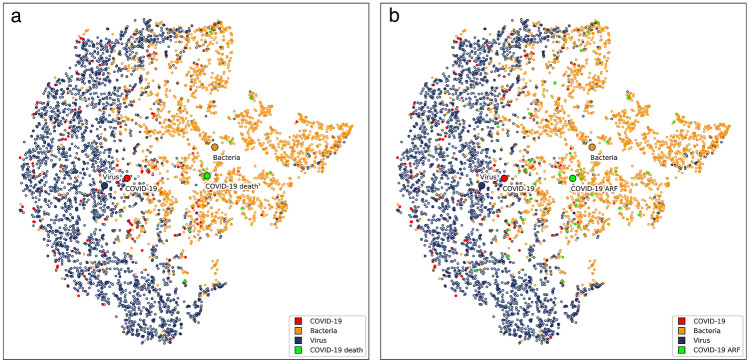
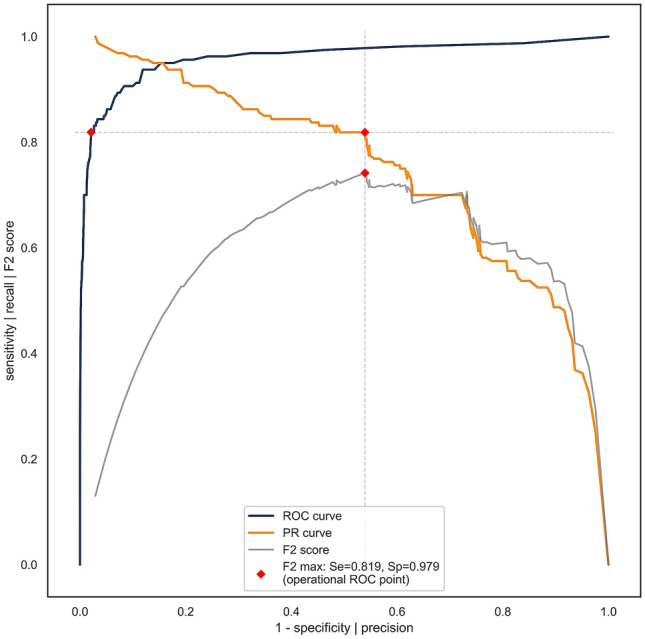
Physicians taking care of patients with COVID-19 have described different changes in routine blood parameters. However, these changes hinder them from performing COVID-19 diagnoses. We constructed a machine learning model for COVID-19 diagnosis that was based and cross-validated on the routine blood tests of 5333 patients with various bacterial and viral infections, and 160 COVID-19-positive patients. We selected the operational ROC point at a sensitivity of 81.9% and a specificity of 97.9%. The cross-validated AUC was 0.97. The five most useful routine blood parameters for COVID-19 diagnosis according to the feature importance scoring of the XGBoost algorithm were: MCHC, eosinophil count, albumin, INR, and prothrombin activity percentage. t-SNE visualization showed that the blood parameters of the patients with a severe COVID-19 course are more like the parameters of a bacterial than a viral infection. The reported diagnostic accuracy is at least comparable and probably complementary to RT-PCR and chest CT studies. Patients with fever, cough, myalgia, and other symptoms can now have initial routine blood tests assessed by our diagnostic tool. All patients with a positive COVID-19 prediction would then undergo standard RT-PCR studies to confirm the diagnosis. We believe that our results represent a significant contribution to improvements in COVID-19 diagnosis.
Overview
The claims and statistics of this paper haven’t been checked yet.
Run the check — free, no account needed. It reads the open-access text and checks the sources it cites.
Integrity signals
Registry
Cites
Statistics
Figures
Verification
Claims the paper makes
The claims and statistics of this paper haven’t been checked yet.
Run the check — free, no account needed. It reads the open-access text and checks the sources it cites.
Claims other papers make about this one
Each is checked against this paper’s own text: does it say what the citing paper says it does?
The cited source says what the claim attributes to it.
In the citing paper
“However, owing to limited specificity of individual predictors, artificial intelligence approaches applied to richer predictor sets are necessary to achieve clinically-acceptable performance.21”
Self-check
Percentages, sums and reported differences re-computed from the paper’s own numbers.
The self-check needs the paper’s full text.
Citations
Cites
XGBoost: A Scalable Tree Boosting System
Chen, T., & Guestrin, C. (2016) · Proceedings of the 22nd ACM SIGKDD International Conference on Knowledge Discovery and Data Mining · doi:10.1145/2939672.2939785 · Cited by 54,569
Clinical features of patients infected with 2019 novel coronavirus in Wuhan, China
Huang, C., Wang, Y., Li, X., Ren, L., Zhao, J., Hu, Y., Zhang, L., Fan, G., Xu, J., Gu, X., et al. (2020) · The Lancet · doi:10.1016/s0140-6736(20)30183-5 · Cited by 48,884
(2008) · Journal of Machine Learning Research · Cited by 33,051
SMOTE synthetic minority over-sampling technique
Chawla, N. V., Bowyer, K. W., Hall, L. O., & Kegelmeyer, W. P. (2002) · Journal of Artificial Intelligence Research · doi:10.1613/jair.953 · Cited by 32,865
Greedy function approximation: A gradient boosting machine
Friedman, J. H. (2001) · The Annals of Statistics · doi:10.1214/aos/1013203451 · Cited by 30,731
Clinical characteristics of coronavirus disease 2019 in China
Guan, W.-J., Ni, Z.-Y., Hu, Y., Liang, W.-H., Ou, C.-Q., He, J.-X., Liu, L., Shan, H., Lei, C.-L., Hui, D. S. C., et al. (2020) · New England Journal of Medicine · doi:10.1056/nejmoa2002032 · Cited by 30,246
A novel coronavirus from patients with pneumonia in China, 2019
Zhu, N., Zhang, D., Wang, W., Li, X., Yang, B., Song, J., Zhao, X., Huang, B., Shi, W., Lu, R., et al. (2020) · New England Journal of Medicine · doi:10.1056/nejmoa2001017 · Cited by 28,244
Gorbalenya, A. E., Baker, S. C., Baric, R. S., de Groot, R. J., Drosten, C., Gulyaeva, A. A., Haagmans, B. L., Lauber, C., Leontovich, A. M., Neuman, B. W., et al. (2020) · Nature Microbiology · doi:10.1038/s41564-020-0695-z · Cited by 8,745
Detection of 2019 novel coronavirus (2019-nCoV) by real-time RT-PCR
Corman, V. M., Landt, O., Kaiser, M., Molenkamp, R., Meijer, A., Chu, D. K. W., Bleicker, T., Brünink, S., Schneider, J. A., Schmidt, M. L., et al. (2020) · Eurosurveillance · doi:10.2807/1560-7917.es.2020.25.3.2000045 · Cited by 7,266
Friedman, J. H. (2002) · Computational Statistics & Data Analysis · doi:10.1016/s0167-9473(01)00065-2 · Cited by 7,067
Research works printed but not linked: 2
- Nielsen, D. Tree boosting with XGBoost – why does XGBoost win “every” machine learning competition? [Master’s thesis] (Norwegian University of Science and Technology, 2016).
- Flach, P., Hernández-Orallo, J. & Ferri, C. A coherent interpretation of AUC as a measure of aggregated classification performance. In The 28th International Conference on Machine Learning, ICML’11 (eds Getoor, L. & Scheffer, T.) 657–664 (Omnipress, 2011).
Cited by
Sorted by citations
Items 101–179 of 179
Saidi, M., Gheibi, M., Ghazikhani, A., Lotfata, A., Chahkandi, B., Familsamavati, S., & Behzadian, K. (2025) · Soft Computing · doi:10.1007/s00500-025-10538-7 · Cited by 4
SARS-CoV-2 severity prediction in young adults using artificial intelligence
Валерьевна, К. К., Kozlov, K. V., Zhdanov, K. V., Lapikov, I. I., & Belikov, V. V. (2022) · Journal Infectology · doi:10.22625/2072-6732-2022-14-5-14-25 · Cited by 4
Detection of COVID-19 from Chest X-ray Images: A Deep Learning Approach
Mohan, V. (2021) · doi:10.1109/ee-rds53766.2021.9708594 · Cited by 4
Machine-Learning-Based COVID-19 and Dyspnoea Prediction Systems for the Emergency Department
Salvia, M. L., Torti, E., Secco, G., Bellazzi, C., Salinaro, F., Lago, P., Danese, G., Perlini, S., & Leporati, F. (2022) · Applied Sciences · doi:10.3390/app122110869 · Cited by 3
Gazeau, S., Deng, X., Ooi, H. K., Mostefai, F., Hussin, J., Heffernan, J. M., Jenner, A. L., & Craig, M. (2023) · ImmunoInformatics · doi:10.1016/j.immuno.2023.100021 · Cited by 3
An automated machine learning model for diagnosing coronavirus disease 2019 (COVID-19) infection
Maher, N., & Yousif, S. A. (2023) · IAES International Journal of Artificial Intelligence · doi:10.11591/ijai.v12.i3.pp1360-1369 · Cited by 3
Harrou, F., Dairi, A., Dorbane, A., Kadri, F., & Sun, Y. (2023) · Diagnostics · doi:10.3390/diagnostics13081466 · Cited by 3
Applied Intelligence for Industry 4.0
Siddique, N. H., Arefin, M. S., Kaiser, M. S., & Kayes, A. S. M. (2023) · Chapman & Hall/CRC eBooks · doi:10.1201/9781003256083 · Cited by 3
Salama, G. M., Mohamed, A., & Abd-Ellah, M. K. (2024) · Soft Computing · doi:10.1007/s00500-024-10362-5 · Cited by 4
Artificial Intelligence for Infectious Disease Prediction and Prevention: A Comprehensive Review
Laboratoire LITAN, É. S. E. S. E. T. D. L. E. D. N., Melchane, S., Elmir, Y., Laboratoire LITAN, É. S. E. S. E. T. D. L. E. D. N., Kacimi, F., Laboratoire LITAN, É. S. E. S. E. T. D. L. E. D. N., & Boubchir, L. (2025) · Acta Universitatis Sapientiae Informatica · doi:10.47745/ausi-2024-0010 · Cited by 3
Weiser, E. B. (2025) · Journal of Scientific Innovation in Medicine · doi:10.29024/jsim.216 · Cited by 2
Yang, Y., Huang, L., Gu, Y., Wang, Z., Liu, S., Chen, Q., Ning, W., & Hong, G. (2025) · Scientific Reports · doi:10.1038/s41598-025-94682-y · Cited by 2
Data mining and machine learning techniques for coronavirus (COVID-19) pandemic: A review study
Ghazi, A., Alisawi, M., Hammood, L., Abdullah, S. S., Al-dawoodi, A., Ali, A. H., Almallah, A. N., Hazzaa, N. M., Wahab, Y. M., & Nawaf, A. Y. (2023) · AIP conference proceedings · doi:10.1063/5.0167882 · Cited by 2
Xiaoyan, L., Zhongying, B., Shuhong, D., Sun, J. P., Yijie, Z., Jie, Z., & Jingxin, L. (2025) · Frontiers in Medicine · doi:10.3389/fmed.2025.1597082 · Cited by 2
Neural Networks Architecture for COVID-19 Early Detection
Zgheib, R., Chahbandarian, G., Kamalov, F., & Labban, O. E. (2021) · International Symposium on Networks, Computers and Communications (ISNCC) · doi:10.1109/isncc52172.2021.9615883 · Cited by 2
Machine Learning based COVID-19 Mortality Prediction using Common Patient Data
Agrawal, S., & Patil, N. (2022) · IEEE International Conference for Convergence in Technology (I2CT) · doi:10.1109/i2ct54291.2022.9824470 · Cited by 2
Machine-Aided Detection of SARS-CoV-2 from Complete Blood Count
Klaudel, B., Obuchowski, A., Dąbrowska, M., Sałaga-Zaleska, K., & Kowalczuk, Z. (2022) · Lecture notes in networks and systems · doi:10.1007/978-3-031-16159-9_2 · Cited by 2
Clinical data-driven approach to identifying COVID-19 and influenza from a gradient-boosting model
Kim, D. T., Lang, T. V., & Nguyen, T. Q. (2023) · Cogent Engineering · doi:10.1080/23311916.2023.2188683 · Cited by 3
Sensecor: A framework for COVID-19 variants severity classification and symptoms detection
Balaji, T., Bablani, A., Sreeja, S. R., & Misra, H. (2023) · Evolving Systems · doi:10.1007/s12530-023-09558-1 · Cited by 2
Melchane, S., Elmir, Y., & Kacimi, F. (2024) · Procedia Computer Science · doi:10.1016/j.procs.2024.06.223 · Cited by 2
Ma, X., Guo, W., Gu, M., Usvyat, L. A., Kotanko, P., & Wang, Y. (2024) · The Annals of Applied Statistics · doi:10.1214/23-aoas1871 · Cited by 2
Al-Khafaji, A. J. A., & Sjarif, N. N. A. (2024) · International Journal of Power Electronics and Drive Systems/International Journal of Electrical and Computer Engineering · doi:10.11591/ijece.v14i4.pp4167-4174 · Cited by 4
Efficient COVID-19 Diagnosis Using Ensemble Learning Model
El‐Shekheby, S., El-Naby, S. A., & Rizk, R. Y. (2024) · Lecture notes on data engineering and communications technologies · doi:10.1007/978-3-031-77299-3_21 · Cited by 1
Lavakumar, Y., & Nagaraju, V. (2025) · AIP conference proceedings · doi:10.1063/5.0263367 · Cited by 1
A Correlative Analysis between CoVID-19 Severity Patient Blood Report and Lung Conditions
Singh, D. P., Jaiswal, A., Singh, N., Kumar, S., & Kumar, A. (2025) · International Conference on Trends in Engineering Systems and Technologies (ICTEST) · doi:10.1109/ictest64710.2025.11042398 · Cited by 1
Predicting the severity of COVID-19 using machine learning methods
Ezati, M., Masroor, B., Kahramfar, Z., Najafi‐Vosough, R., & Amiri, F. (2026) · BMC Medical Informatics and Decision Making · doi:10.1186/s12911-026-03411-6 · Cited by 1
Challenges of Multiplex Assays for COVID-19 Research: A Machine Learning Perspective
Guest, P. C., Popovic, D., & Steiner, J. H. (2022) · Methods in molecular biology · doi:10.1007/978-1-0716-2395-4_3 · Cited by 1
A Screening System for COVID-19 Severity using Machine Learning
Yusuf, A. M. I. A., Rosli, M. M., & Yusop, N. S. M. (2022) · International Journal of Advanced Computer Science and Applications · doi:10.14569/ijacsa.2022.0130746 · Cited by 1
Study of Ensemble Learners to identify the COVID-19 positive patients
Pandey, N., Varghese, E. G., Lohani, R., Suresh, V., Sikder, S., & Bhattacharjee, P. (2022) · International Conference on Computational Intelligence and Sustainable Engineering Solutions (CISES) · doi:10.1109/cises54857.2022.9844357 · Cited by 1
Huyut, M. T. (2023) · Jundishapur Journal of Health Sciences · doi:10.5812/jjhs-136913 · Cited by 1
COVID-19 Detection via Blood Tests using an Automated Machine Learning Tool (Auto-Sklearn)
Maher, N., & Yousif, S. A. (2023) · Iraqi Journal of Science · doi:10.24996/ijs.2023.64.11.43 · Cited by 1
Using bi-dimensional representations to understand patterns in COVID-19 blood exam data
Bezzan, V. P., & Rocco, C. D. (2021) · Informatics in Medicine Unlocked · doi:10.1016/j.imu.2021.100828 · Cited by 1
Artificial intelligence in identifying COVID-19 patients based on inflammatory parameters
Adilovic, A., Barbic, F., Becirovic, F., Bečić, E., Deumić, A., & Spahić, L. (2022) · Mediterranean Conference on Embedded Computing (MECO) · doi:10.1109/meco55406.2022.9797206 · Cited by 1
Lee, Y., Kim, Y.-S., Lee, D., Jeong, S., Kang, G. H., Jang, Y. S., Kim, W., Choi, H. Y., & Kim, J. G. (2023) · Viruses · doi:10.3390/v15020304 · Cited by 1
Optimization Of Genetic Algorithm Using PSO In Food Menu Recommendation System
Andriani, R., Pujianto, A., Yaqin, A., Fatta, H. A., Kraugusteeliana, K., & Indriana, I. H. (2023) · International Conference on Informatics, Multimedia, Cyber and Information System (ICIMCIS) · doi:10.1109/icimcis60089.2023.10348618 · Cited by 1
Cabrera, J. J., Larrañaga, A., Pérez‐Castro, S., Martínez, J. M., Lamas, L. M., Daviña‐Núñez, C., del Campo-Pérez, V., Luque, S. S., Regueiro, B. J., & Porteiro, J. (2021) · medRxiv · doi:10.1101/2021.11.12.21266286 · Cited by 1
Lee, Y., Kim, Y.-S., Lee, D., Jeong, S., Kang, G.-H., Jang, Y. S., Kim, W., Choi, H. Y., & Kim, J. G. (2022) · SSRN Electronic Journal · doi:10.2139/ssrn.4068372 · Cited by 1
Srivastava, M., Reinhart, A., & Mejia, R. (2023) · medRxiv · doi:10.1101/2023.02.03.23285405 · Cited by 1
Molokwu, B. C., Shuvo, S. B., Kobti, Z., & Snowdon, A. W. (2021) · arXiv (Cornell University) · doi:10.48550/arxiv.2108.09402
Risk Group Determination in Case of COVID-19 Infection
Biletskyy, B. A., & Gupal, A. M. (2021) · Lecture notes in computer science · doi:10.1007/978-3-030-88163-4_36
Sonthalia, S., Muharoom, M. A., Sumulyo, S. A. K., Kamilah, F. Z., Aldila, F., Rabbani, B., Tirtawisata, A., Herlinda, O., Khaimani, J., Sani, L. L., et al. (2021) · medRxiv · doi:10.1101/2021.10.15.21265021
Lee, Y., Kim, Y.-S., Lee, D., Jeong, S., Kang, G.-H., Jang, Y. S., Kim, W., Choi, H. Y., Kim, J. G., & Choi, S.-H. (2021) · Research Square · doi:10.21203/rs.3.rs-900395/v1
Tracking influenza a virus infection in the lung from hematological data with machine learningPreprint
Jhutty, S. S., Boehme, J. D., Jeron, A., Volckmar, J., Schultz, K., Schreiber, J., Schughart, K., Zhou, K., Steinheimer, J., Horst Stöcker, B., et al. (2022) · bioRxiv (Cold Spring Harbor Laboratory) · doi:10.1101/2022.02.23.481638
Cardozo, G., Tirloni, S. F., Moro, A. R. P., & Marques, J. L. B. (2022) · doi:10.2196/preprints.40473
A Review of Machine Learning Techniques to Detect and Treat COVID-19 Using EHR Data
Nayak, S., Ganguly, C., & Gupta, A. K. (2022) · Studies in computational intelligence · doi:10.1007/978-3-031-04597-4_2
Sonthalia, S., Muharrom, M. A., Sani, L. L., Khaimani, J., Herlinda, O., Sumulyo, S. A. K., Kamilah, F. Z., Hapsari, R., Irwanto, A. K., Aldila, F., et al. (2022) · Research Square · doi:10.21203/rs.3.rs-1996286/v1
KAPUCU, V., Turhan, S., Pıçakçıefe, M., & Doğu, E. (2022) · Karya Journal of Health Science · doi:10.52831/kjhs.1117894
Sonthalia, S., Muharrom, M. A., Sani, L. L., Khaimani, J., Herlinda, O., Sumulyo, S. A. K., Kamilah, F. Z., Hapsari, R., Irwanto, A. K., Aldila, F., et al. (2022) · Research Square · doi:10.21203/rs.3.rs-1996286/v2
Review of Machine Learning-Based Disease Diagnosis and Severity Estimation of COVID-19
Ayyavaraiah, M., & Venkateswarlu, B. (2023) · Advances in intelligent systems and computing · doi:10.1007/978-981-19-9819-5_1
Prediction System for Covid-19 Upcoming Cases Using Ensemble Classification
Mythili, M. (2023) · JOURNAL OF ADVANCED APPLIED SCIENTIFIC RESEARCH · doi:10.46947/joaasr542023683
An unexpected association between the blood bilirubin level and eosinophil count
Chung, S. J., Lee, S., Lee, S.-H., & Kim, S.-S. (2023) · Allergy Asthma & Respiratory Disease · doi:10.4168/aard.2023.11.3.151
Cristea, A.-M., Zaharia, D.-C., Jipa, D., Dumitrache‐Rujinski, S., Parlițeanu, O. A., Bogdan, A., & Toma, C. (2023) · Experimental and Therapeutic Medicine · doi:10.3892/etm.2023.12137
Research progress of artificial intelligence technology in COVID-19
Yang, J., Yan, L., & Wang, X. (2023) · International Conference on Biomedical and Intelligent Systems (IC-BIS) · doi:10.1117/12.2687857
Payandeh, A., Esmaily, H., Salehi, M., Jahanshahi, S. M. A., Salari, M., Alamdaran, S. A., & Bolouri, A. (2023) · JP Journal of Biostatistics · doi:10.17654/0973514323016
Detection of Canine Parvovirus using ELM and Support Vector Machine Algorithm from Blood Tests
Kole, S., & Kuppili, V. (2023) · International Conference on Computer, Electronics & Electrical Engineering & their Applications (IC2E3) · doi:10.1109/ic2e357697.2023.10262676
Hospitalized COVID-19 Patients Characteristics, Comorbidities, and Outcomes: A Retrospective Study
Wani, F. A., Thirunavukkarasu, A., Alzarea, N. A., Alzarea, W. A., Alshaya, O. M., Alanazi, A., Aldeghmani, A. M., Alruwaili, L. D., Alruwaili, M., & Alruwaili, A. H. F. (2023) · Archives of Pharmacy Practice · doi:10.51847/meikv96yqx
AI based Clinical Analysis of COVID-19 Infected Patients
Yousuff, M., Babu, M. R., Anusha, R., & Matheen, M. A. (2023) · BENTHAM SCIENCE PUBLISHERS eBooks · doi:10.2174/9789815080650123010008
Machine learning methods applied to COVID-19 patient data
Bezzan, V. P. (2021) · doi:10.47749/t/unicamp.2021.1232336
Kakulapati, V., & Jayanthiladevi, A. (2023) · Lecture notes in electrical engineering · doi:10.1007/978-981-99-5997-6_21
Convolutional Neural Network Based Identification of Respiratory Disease (CNN-IRD)
Umer, Q., Naveed, Z., Lee, C., Ali, A., & Saeed, M. K. (2023) · International Conference on Information and Communication Technology Convergence (ICTC) · doi:10.1109/ictc58733.2023.10392766
On the explanation of COVID-19 blood test variables using fuzzy models
Téllez‐Velázquez, A., Delice, P. A., Salgado-Leyva, R., & Cruz‐Barbosa, R. (2024) · Journal of Intelligent & Fuzzy Systems · doi:10.3233/jifs-219372
Anemia Detection and Classification Using Data Analysis of Blood Samples
Bahadure, N. B., Khomane, R. B., Nittala, A., Singh, A., Chadalwada, D., Bonde, O., Nagar, S., & Raju, N. (2023) · International Conference on Artificial Intelligence for Innovations in Healthcare Industries (ICAIIHI) · doi:10.1109/icaiihi57871.2023.10489465
Machine Learning for Affordable Diagnosis of SARS-COV-2 from Hematological and Biochemical TestsPreprint
da Silva, R. J., Júnior, C. R. D. S., Abreu, T., MINUSSI, C. R., & Lopes, M. L. M. (2024) · Preprints.org · doi:10.20944/preprints202404.0956.v1
Alshammari, B. M. (2024) · Journal of Computer Science · doi:10.3844/jcssp.2024.465.486
de Lima, T. E., Ferraz, M. V. F., de Brito, C. A. A., Ximenes, P. D. B., MARIZ, C. A., Braga, C., Wallau, G. L., Viana, I. F. T., & Lins, R. D. (2024) · Anais da Academia Brasileira de Ciências · doi:10.1590/0001-376520242023089
A Robust Development to Predict Black Fungus Disease with Enhanced Learning Principles
Valarmathi, P., Vasudevan, P., Suganya, Y., & JahirHussain, T. (2024) · International Conference on Science Technology Engineering and Mathematics (ICONSTEM) · doi:10.1109/iconstem60960.2024.10568773
Probabilistic Decision Tree Ensembles for Detecting Infectious Diseases using Routine Blood Tests
Melchane, S., Elmir, Y., Kacimi, F., & Boubchir, L. (2024) · Conference on Human System Interactions · doi:10.1109/hsi61632.2024.10613555
Mahdavian, A., Pouran, F., Aghazadeh, H., Zamani, E. R., & Navidinia, M. (2024) · Archives of Clinical Infectious Diseases · doi:10.5812/archcid-139296
Makine Öğrenmesi Yöntemleri ile Kan Tahlilinden Covid-19 Teşhisi
Çakı, B., Egesoy, A., & Topaloğlu, N. Y. (2024) · Bilgisayar bilimleri ve mühendisliği dergisi. · doi:10.54525/bbmd.1595417
Introduction to Deep Learning for Disease Prediction
Thakur, A., & Kumar, A. (2025) · Springer eBooks · doi:10.1007/978-981-96-4241-0_3
Integrating Robotics and AI into Workplace Biorisk Management
Singh, T. (2025) · Advances in computational intelligence and robotics book series · doi:10.4018/979-8-3693-9301-7.ch009
Sex‐specific changes in vital signs and common blood tests on the day of influenza diagnosis
Showmaker, K. C., & Martin, B. E. (2025) · Physiological Reports · doi:10.14814/phy2.70486
Melchane, S., Elmir, Y., Kacimi, F., & Boubchir, L. (2025) · Network Modeling Analysis in Health Informatics and Bioinformatics · doi:10.1007/s13721-025-00593-3
Detection of COVID-19 Using Machine Learning Techniques
Jérome, D. D., Edwige, J. G. Y., Sandjé, M., & MENSAH, P. E. (2025) · Lecture notes of the Institute for Computer Sciences, Social Informatics and Telecommunications Engineering · doi:10.1007/978-3-032-01910-3_20
Developing High-Altitude Acclimatization Metrics from Hematological Signatures
Pathak, S., & Khurana, P. (2026) · SN Comprehensive Clinical Medicine · doi:10.1007/s42399-026-02273-3
A Review of Machine Learning Algorithms for Respiratory Disease Diagnosis
Iftekhar, N., & Alam, B. (2026) · Lecture notes in networks and systems · doi:10.1007/978-3-032-19681-1_37
Tecles, F., Árense-Gonzalo, J. J., Muñoz-Prieto, A., Tvarijonaviciute, A., Martı́nez-Subiela, S., Manzanilla, E. G., & Cerón, J. M. C. (2026) · Veterinary Quarterly · doi:10.1080/01652176.2026.2715555
Shuchami, A., Lazebnik, T., Ashkenazi, S., Cohen, A. H., Reichenberg, Y., & Zemer, V. S. (2026) · PLoS ONE · doi:10.1371/journal.pone.0352682
Machine Learning and Transfer Learning in Pandemic-Scale Healthcare
Boadu, D. O., Mensah, S., Osei, I., Boafo, F., & Appati, J. K. (2026) · Advances in computational intelligence and robotics book series · doi:10.4018/979-8-2600-4599-2.ch007
Metadata
- Authors
- Kukar, M., Gunčar, G., Vovko, T., Podnar, S., Černelč, P., Brvar, M., Zalaznik, M., Notar, M., Moškon, S., & Notar, M.
- Affiliations
- University of Ljubljana (SI)
- Ljubljana University Medical Centre (SI)
- Corresponding author
- Notar, Mateja
- Notar, Marko
- Venue
- Scientific Reports
- Published
- 2021-05-24
- Volume
- 11
- Issue
- 1
- Pages
- 10738-10738
- ISSN
- 2045-2322 (ISSN-L)
- PMC
- PMC8144373
- OpenAlex
- W3033612360
- Cited by
- 179
- References
- 43
- Citations by year
- 2026: 7 · 2025: 18 · 2024: 25 · 2023: 47 · 2022: 50 · 2021: 27
- FWCI
- 11.80
- Type
- journal article
- Language
- en
- Open access
- gold
- doi.org
- Locations
- Scientific Reports (publishedVersion, cc-by)
- PubMed Central (publishedVersion, cc-by)
- PubMed (publishedVersion)
- arXiv (Cornell University) (submittedVersion)
- DOAJ (DOAJ: Directory of Open Access Journals) (submittedVersion, cc-by-sa)
- arXiv (Cornell University)
- Funders
- Smart Blood Analytics Swiss SA
- Topics
- Health Sciences › Medicine › Infectious Diseases › COVID-19 Clinical Research Studies
- Health Sciences › Medicine › Radiology, Nuclear Medicine and Imaging › COVID-19 diagnosis using AI
- Health Sciences › Medicine › Infectious Diseases › SARS-CoV-2 detection and testing
- Keywords
- COVID-19 diagnosis, routine blood tests, machine learning, XGBoost, feature importance, mean corpuscular hemoglobin concentration, eosinophil count, albumin, international normalized ratio, prothrombin activity, t-SNE visualization, diagnostic accuracy
- MeSH terms
- Machine Learning, COVID-19, SARS-CoV-2, Aged, Eosinophils, Female, Hematologic Tests, Humans, Male, Prothrombin, ROC Curve, Sensitivity and Specificity, Serum Albumin, Severity of Illness Index, Thorax, Tomography, X-Ray Computed, Biomarkers, Area Under Curve
About these checks
Registry, retraction, Cites and statistics results are computed, not judged, with one exception: a printed reference that no index lists is read once by a model before it counts as a citation error. Claims are extracted by a model and kept only when their quote appears verbatim in the text; each cited source is then checked, with a model’s help, for whether it says what the claim relies on. Those verdicts can be wrong — read the claim’s quote and the cited source before relying on one.
Statistics and arithmetic are recomputed, not judged.
Confidence bands are shown only for fields calibrated on our annotated test set. None is calibrated yet, so no band is shown.
What counts as a claim ›How we measure confidence ›How we check this ›
Are you an author, or do you see a problem with this page? Request a review
