

The DOI matches its Crossref record; 41 of the 43 references it cites were found in a registry or an index.
COVID-19 diagnosis by routine blood tests using machine learning
Open accessAbstract
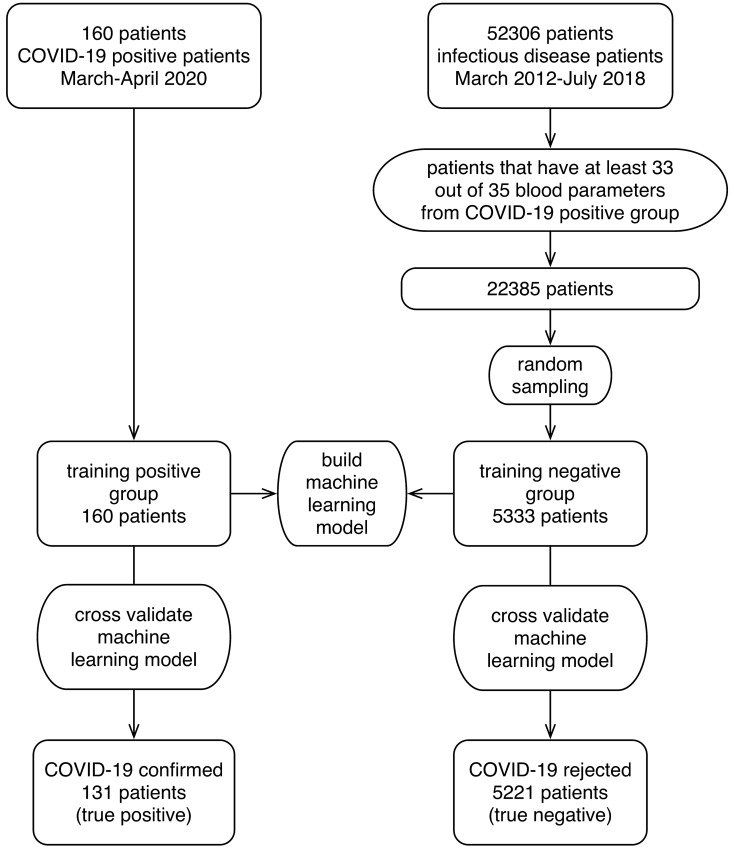
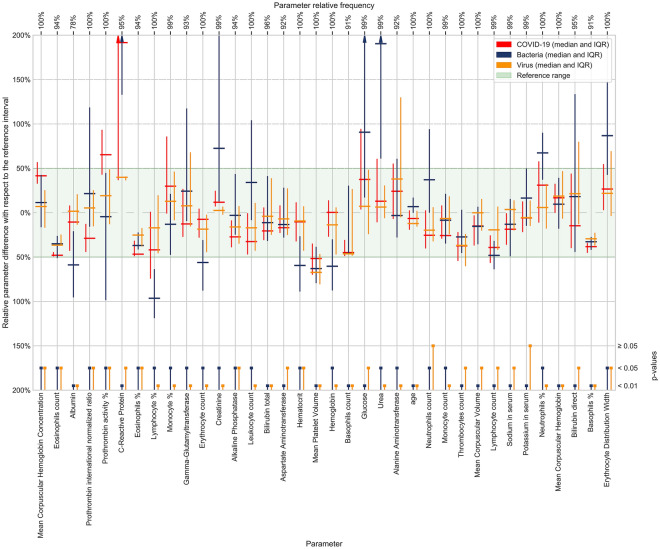
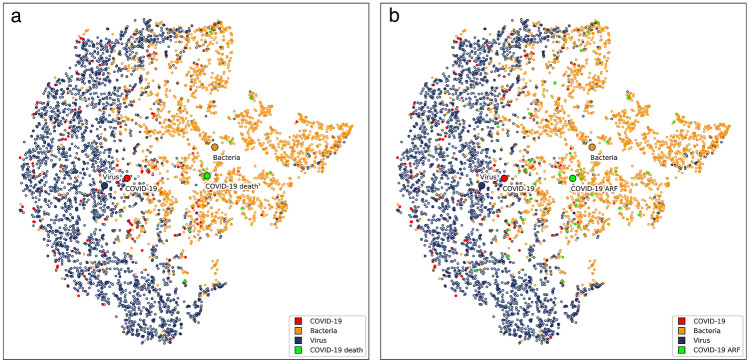
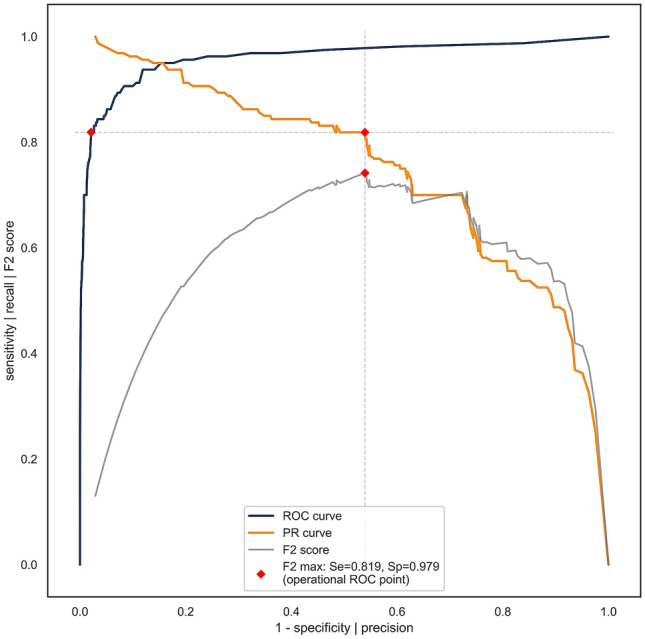
Physicians taking care of patients with COVID-19 have described different changes in routine blood parameters. However, these changes hinder them from performing COVID-19 diagnoses. We constructed a machine learning model for COVID-19 diagnosis that was based and cross-validated on the routine blood tests of 5333 patients with various bacterial and viral infections, and 160 COVID-19-positive patients. We selected the operational ROC point at a sensitivity of 81.9% and a specificity of 97.9%. The cross-validated AUC was 0.97. The five most useful routine blood parameters for COVID-19 diagnosis according to the feature importance scoring of the XGBoost algorithm were: MCHC, eosinophil count, albumin, INR, and prothrombin activity percentage. t-SNE visualization showed that the blood parameters of the patients with a severe COVID-19 course are more like the parameters of a bacterial than a viral infection. The reported diagnostic accuracy is at least comparable and probably complementary to RT-PCR and chest CT studies. Patients with fever, cough, myalgia, and other symptoms can now have initial routine blood tests assessed by our diagnostic tool. All patients with a positive COVID-19 prediction would then undergo standard RT-PCR studies to confirm the diagnosis. We believe that our results represent a significant contribution to improvements in COVID-19 diagnosis.
Overview
The claims and statistics of this paper haven’t been checked yet.
Run the check — free, no account needed. It reads the open-access text and checks the sources it cites.
Integrity signals
Registry
Cites
Statistics
Figures
Verification
Claims the paper makes
The claims and statistics of this paper haven’t been checked yet.
Run the check — free, no account needed. It reads the open-access text and checks the sources it cites.
Claims other papers make about this one
Each is checked against this paper’s own text: does it say what the citing paper says it does?
The cited source says what the claim attributes to it.
In the citing paper
“However, owing to limited specificity of individual predictors, artificial intelligence approaches applied to richer predictor sets are necessary to achieve clinically-acceptable performance.21”
Self-check
Percentages, sums and reported differences re-computed from the paper’s own numbers.
The self-check needs the paper’s full text.
Citations
Cites
XGBoost: A Scalable Tree Boosting System
Chen, T., & Guestrin, C. (2016) · Proceedings of the 22nd ACM SIGKDD International Conference on Knowledge Discovery and Data Mining · doi:10.1145/2939672.2939785 · Cited by 54,569
Clinical features of patients infected with 2019 novel coronavirus in Wuhan, China
Huang, C., Wang, Y., Li, X., Ren, L., Zhao, J., Hu, Y., Zhang, L., Fan, G., Xu, J., Gu, X., et al. (2020) · The Lancet · doi:10.1016/s0140-6736(20)30183-5 · Cited by 48,884
(2008) · Journal of Machine Learning Research · Cited by 33,051
SMOTE synthetic minority over-sampling technique
Chawla, N. V., Bowyer, K. W., Hall, L. O., & Kegelmeyer, W. P. (2002) · Journal of Artificial Intelligence Research · doi:10.1613/jair.953 · Cited by 32,865
Greedy function approximation: A gradient boosting machine
Friedman, J. H. (2001) · The Annals of Statistics · doi:10.1214/aos/1013203451 · Cited by 30,731
Clinical characteristics of coronavirus disease 2019 in China
Guan, W.-J., Ni, Z.-Y., Hu, Y., Liang, W.-H., Ou, C.-Q., He, J.-X., Liu, L., Shan, H., Lei, C.-L., Hui, D. S. C., et al. (2020) · New England Journal of Medicine · doi:10.1056/nejmoa2002032 · Cited by 30,246
A novel coronavirus from patients with pneumonia in China, 2019
Zhu, N., Zhang, D., Wang, W., Li, X., Yang, B., Song, J., Zhao, X., Huang, B., Shi, W., Lu, R., et al. (2020) · New England Journal of Medicine · doi:10.1056/nejmoa2001017 · Cited by 28,244
Gorbalenya, A. E., Baker, S. C., Baric, R. S., de Groot, R. J., Drosten, C., Gulyaeva, A. A., Haagmans, B. L., Lauber, C., Leontovich, A. M., Neuman, B. W., et al. (2020) · Nature Microbiology · doi:10.1038/s41564-020-0695-z · Cited by 8,745
Detection of 2019 novel coronavirus (2019-nCoV) by real-time RT-PCR
Corman, V. M., Landt, O., Kaiser, M., Molenkamp, R., Meijer, A., Chu, D. K. W., Bleicker, T., Brünink, S., Schneider, J. A., Schmidt, M. L., et al. (2020) · Eurosurveillance · doi:10.2807/1560-7917.es.2020.25.3.2000045 · Cited by 7,266
Friedman, J. H. (2002) · Computational Statistics & Data Analysis · doi:10.1016/s0167-9473(01)00065-2 · Cited by 7,067
The relationship between Precision-Recall and ROC curves
Davis, J., & Goadrich, M. (2006) · Proceedings of the 23rd international conference on Machine learning - ICML '06 · doi:10.1145/1143844.1143874 · Cited by 6,559
Ai, T., Yang, Z., Hou, H., Zhan, C., Chen, C., Lv, W., Tao, Q., Sun, Z., & Xia, L. (2020) · Radiology · doi:10.1148/radiol.2020200642 · Cited by 5,793
Interval Estimation for a Binomial Proportion
Brown, L. D., Cai, T., & Dasgupta, A. (2001) · Statistical Science · doi:10.1214/ss/1009213286 · Cited by 3,746
Tang, N., Bai, H., Chen, X., Gong, J., Li, D., & Sun, Z. (2020) · Journal of Thrombosis and Haemostasis · doi:10.1111/jth.14817 · Cited by 3,615
Clinical, laboratory and imaging features of COVID-19: A systematic review and meta-analysis
Rodriguez-Morales, A. J., Cardona-Ospina, J. A., Gutiérrez-Ocampo, E., Villamizar-Peña, R., Holguin-Rivera, Y., Escalera-Antezana, J. P., Alvarado-Arnez, L. E., Bonilla-Aldana, D. K., Franco-Paredes, C., Henao-Martinez, A. F., et al. (2020) · Travel Medicine and Infectious Disease · doi:10.1016/j.tmaid.2020.101623 · Cited by 2,542
Accelerating t-SNE using tree-based algorithms
van der Maaten, L. J. P. (2014) · Journal of machine learning research · doi:10.5555/2627435.2697068 · Cited by 2,211
High Contagiousness and Rapid Spread of Severe Acute Respiratory Syndrome Coronavirus 2
Sanche, S., Lin, Y. T., Xu, C., Romero-Severson, E., Hengartner, N., & Ke, R. (2020) · Emerging Infectious Diseases · doi:10.3201/eid2607.200282 · Cited by 1,619
SMOTE for high-dimensional class-imbalanced data
Blagus, R., & Lusa, L. (2013) · BMC Bioinformatics · doi:10.1186/1471-2105-14-106 · Cited by 1,224
The art of using t-SNE for single-cell transcriptomics
Kobak, D., & Berens, P. (2019) · Nature Communications · doi:10.1038/s41467-019-13056-x · Cited by 1,161
Scientific and ethical basis for social-distancing interventions against COVID-19
Lewnard, J. A., & Lo, N. C. (2020) · The Lancet Infectious Diseases · doi:10.1016/s1473-3099(20)30190-0 · Cited by 957
Bossuyt, P. M., Reitsma, J. B., Bruns, D. E., Gatsonis, C., Glasziou, P., Irwig, L., Lijmer, J. G., Moher, D., Rennie, D., & de Vet, H. C. W. (2003) · PubMed · doi:10.1373/49.1.1 · Cited by 867
Wattenberg, M., Viégas, F., & Johnson, I. (2016) · Distill · doi:10.23915/distill.00002 · Cited by 854
Yang, Y., Yang, M., Shen, C., Wang, F., Yuan, J., Li, J., Zhang, M., Wang, Z., Xing, L., Wei, J., et al. (2020) · doi:10.1101/2020.02.11.20021493 · Cited by 836
Laboratory diagnosis of emerging human coronavirus infections – the state of the art
Loeffelholz, M. J., & Tang, Y. (2020) · Emerging Microbes & Infections · doi:10.1080/22221751.2020.1745095 · Cited by 826
Interventions to mitigate early spread of SARS-CoV-2 in Singapore: a modelling study
Koo, J. R., Cook, A. R., Park, M., Sun, Y., Sun, H., Lim, J. T., Tam, C. C., & Dickens, B. S. L. (2020) · The Lancet Infectious Diseases · doi:10.1016/s1473-3099(20)30162-6 · Cited by 742
Lippi, G., Šimundić, A.-M., & Plebani, M. (2020) · Clinical Chemistry and Laboratory Medicine (CCLM) · doi:10.1515/cclm-2020-0285 · Cited by 617
K-Sample Anderson–Darling Tests
Scholz, F., & Stephens, M. A. (1987) · Journal of the American Statistical Association · doi:10.1080/01621459.1987.10478517 · Cited by 532
COVID-19 epidemic in Switzerland: on the importance of testing, contact tracing and isolation
Salathé, M., Althaus, C. L., Neher, R. A., Stringhini, S., Hodcroft, E. B., Fellay, J., Zwahlen, M., Senti, G., Battegay, M., Wilder‐Smith, A., et al. (2020) · Swiss Medical Weekly · doi:10.4414/smw.2020.20225 · Cited by 494
K-Sample Anderson-Darling Tests
Scholz, F. W., & Stephens, M. A. (1987) · Journal of the American Statistical Association · doi:10.2307/2288805 · Cited by 386
Li, D., Wang, D., Dong, J., Wang, N., Huang, H., Haiwang, X., & Chen, X. (2020) · Korean Journal of Radiology · doi:10.3348/kjr.2020.0146 · Cited by 372
An alternative SMOTE oversampling strategy for high-dimensional datasets
Maldonado, S., López, J., & Vairetti, C. (2018) · Applied Soft Computing · doi:10.1016/j.asoc.2018.12.024 · Cited by 246
An application of machine learning to haematological diagnosis
Gunčar, G., Kukar, M., Notar, M., Brvar, M., Černelč, P., Notar, M., & Notar, M. (2018) · Scientific Reports · doi:10.1038/s41598-017-18564-8 · Cited by 237
Self-citationSARS‐CoV‐2, bacterial co‐infections, and AMR: the deadly trio in COVID‐19?
Bengoechea, J. A., & Bamford, C. (2020) · EMBO Molecular Medicine · doi:10.15252/emmm.202012560 · Cited by 229
Polidoro, R. B., Hagan, R. S., Santiago, R. R. D. S., & Schmidt, N. W. (2020) · Frontiers in Immunology · doi:10.3389/fimmu.2020.01626 · Cited by 208
COVID-19 diagnosis prediction in emergency care patients: a machine learning approachPreprint
Batista, A. F. D. M., Miraglia, J. L., Donato, T. H. R., & Filho, A. D. P. C. (2020) · medRxiv · doi:10.1101/2020.04.04.20052092 · Cited by 199
A role for CT in COVID-19? What data really tell us so far
Hope, M. D., Raptis, C. A., Shah, A. B., Hammer, M. M., & Henry, T. S. (2020) · The Lancet · doi:10.1016/s0140-6736(20)30728-5 · Cited by 188
Wu, J., Zhang, P., Zhang, L., Meng, W., Li, J., Tong, C., Li, Y., Cai, J., Yang, Z., Zhu, J., et al. (2020) · medRxiv · doi:10.1101/2020.04.02.20051136 · Cited by 178
openTSNE: a modular Python library for t-SNE dimensionality reduction and embeddingPreprint
Poličar, P. G., Stražar, M., & Zupan, B. (2019) · bioRxiv (Cold Spring Harbor Laboratory) · doi:10.1101/731877 · Cited by 155
Early evidence of effectiveness of digital contact tracing for SARS-CoV-2 in Switzerland
Salathé, M., Althaus, C. L., Anderegg, N., Antonioli, D., Ballouz, T., Bugnion, E., Čapkun, S., Jackson, D., Kim, S.-I., Larus, J. R., et al. (2020) · Swiss Medical Weekly · doi:10.4414/smw.2020.20457 · Cited by 129
Diagnosing brain tumours by routine blood tests using machine learning
Podnar, S., Kukar, M., Gunčar, G., Notar, M., Gošnjak, N., & Notar, M. (2019) · Scientific Reports · doi:10.1038/s41598-019-51147-3 · Cited by 39
Self-citationA Regularization-Based eXtreme Gradient Boosting Approach in Foodborne Disease Trend Forecasting
Chen, S., Xu, J., Lili, C., Xi, Z., Zhang, L., & Li, J. (2019) · Studies in health technology and informatics · doi:10.3233/shti190360 · Cited by 14
Research works printed but not linked: 2
- Nielsen, D. Tree boosting with XGBoost – why does XGBoost win “every” machine learning competition? [Master’s thesis] (Norwegian University of Science and Technology, 2016).
- Flach, P., Hernández-Orallo, J. & Ferri, C. A coherent interpretation of AUC as a measure of aggregated classification performance. In The 28th International Conference on Machine Learning, ICML’11 (eds Getoor, L. & Scheffer, T.) 657–664 (Omnipress, 2011).
Cited by
Sorted by citations
Machine learning approaches in COVID-19 diagnosis, mortality, and severity risk prediction: A review
Alballa, N., & Al-Turaiki, I. M. (2021) · Informatics in Medicine Unlocked · doi:10.1016/j.imu.2021.100564 · Cited by 232
Applications of artificial intelligence in battling against covid-19: A literature review
Tayarani N., M.-H. (2021) · Chaos, Solitons & Fractals · doi:10.1016/j.chaos.2020.110338 · Cited by 210
Cabitza, F., Campagner, A., Ferrari, D., Resta, C. D., Ceriotti, D., Sabetta, E., Colombini, A., Vecchi, E. D., Banfi, G., Locatelli, M., et al. (2020) · Clinical Chemistry and Laboratory Medicine (CCLM) · doi:10.1515/cclm-2020-1294 · Cited by 174
Time series prediction of COVID-19 transmission in America using LSTM and XGBoost algorithms
Luo, J., Zhang, Z.-L., Fu, Y., & Rao, F. (2021) · Results in Physics · doi:10.1016/j.rinp.2021.104462 · Cited by 167
Ensemble learning model for diagnosing COVID-19 from routine blood tests
AlJame, M., Ahmad, I., Imtiaz, A., & Mohammed, A. (2020) · Informatics in Medicine Unlocked · doi:10.1016/j.imu.2020.100449 · Cited by 153
Metadata
- Authors
- Kukar, M., Gunčar, G., Vovko, T., Podnar, S., Černelč, P., Brvar, M., Zalaznik, M., Notar, M., Moškon, S., & Notar, M.
- Affiliations
- University of Ljubljana (SI)
- Ljubljana University Medical Centre (SI)
- Corresponding author
- Notar, Mateja
- Notar, Marko
- Venue
- Scientific Reports
- Published
- 2021-05-24
- Volume
- 11
- Issue
- 1
- Pages
- 10738-10738
- ISSN
- 2045-2322 (ISSN-L)
- PMC
- PMC8144373
- OpenAlex
- W3033612360
- Cited by
- 179
- References
- 43
- Citations by year
- 2026: 7 · 2025: 18 · 2024: 25 · 2023: 47 · 2022: 50 · 2021: 27
- FWCI
- 11.80
- Type
- journal article
- Language
- en
- Open access
- gold
- doi.org
- Locations
- Scientific Reports (publishedVersion, cc-by)
- PubMed Central (publishedVersion, cc-by)
- PubMed (publishedVersion)
- arXiv (Cornell University) (submittedVersion)
- DOAJ (DOAJ: Directory of Open Access Journals) (submittedVersion, cc-by-sa)
- arXiv (Cornell University)
- Funders
- Smart Blood Analytics Swiss SA
- Topics
- Health Sciences › Medicine › Infectious Diseases › COVID-19 Clinical Research Studies
- Health Sciences › Medicine › Radiology, Nuclear Medicine and Imaging › COVID-19 diagnosis using AI
- Health Sciences › Medicine › Infectious Diseases › SARS-CoV-2 detection and testing
- Keywords
- COVID-19 diagnosis, routine blood tests, machine learning, XGBoost, feature importance, mean corpuscular hemoglobin concentration, eosinophil count, albumin, international normalized ratio, prothrombin activity, t-SNE visualization, diagnostic accuracy
- MeSH terms
- Machine Learning, COVID-19, SARS-CoV-2, Aged, Eosinophils, Female, Hematologic Tests, Humans, Male, Prothrombin, ROC Curve, Sensitivity and Specificity, Serum Albumin, Severity of Illness Index, Thorax, Tomography, X-Ray Computed, Biomarkers, Area Under Curve
About these checks
Registry, retraction, Cites and statistics results are computed, not judged, with one exception: a printed reference that no index lists is read once by a model before it counts as a citation error. Claims are extracted by a model and kept only when their quote appears verbatim in the text; each cited source is then checked, with a model’s help, for whether it says what the claim relies on. Those verdicts can be wrong — read the claim’s quote and the cited source before relying on one.
Statistics and arithmetic are recomputed, not judged.
Confidence bands are shown only for fields calibrated on our annotated test set. None is calibrated yet, so no band is shown.
What counts as a claim ›How we measure confidence ›How we check this ›
Are you an author, or do you see a problem with this page? Request a review
