

Effects of SGLT2 inhibitors on stroke and its subtypes in patients with type 2 diabetes: a systematic review and meta-analysis.
Open accessThe DOI matches its Crossref record; 38 of the 38 references it cites were found in a registry or an index.
Abstract
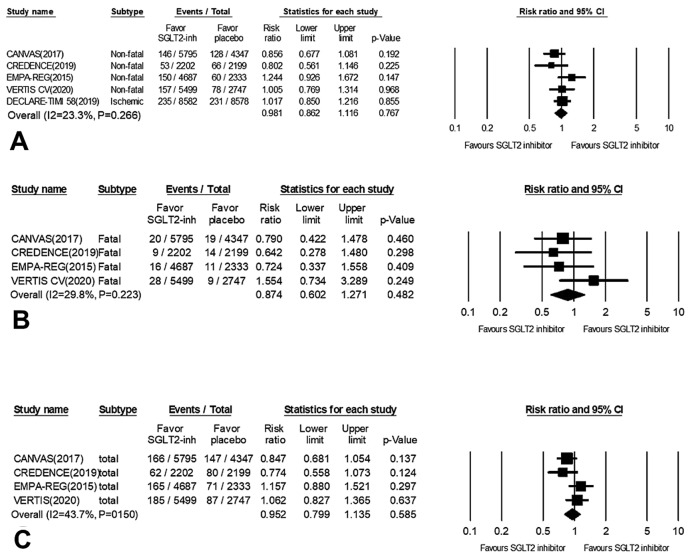
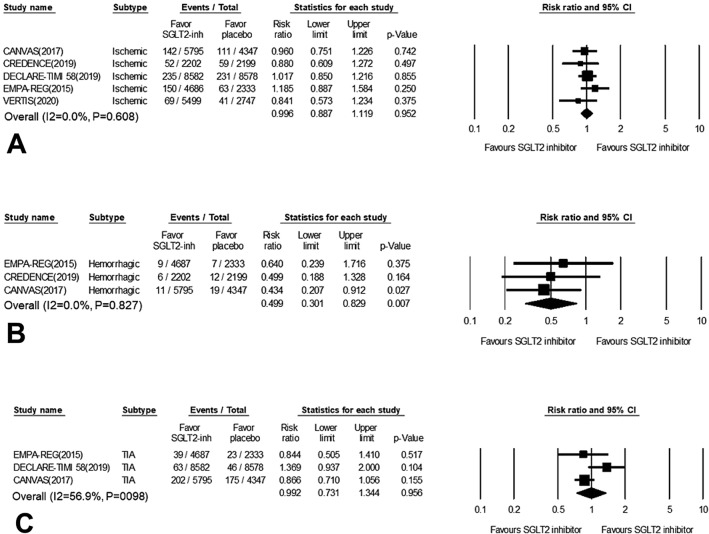
Sodium-glucose cotransporter 2 (SGLT2) inhibitors have shown impressive effects in reducing major vascular events in several randomized controlled trials (RCTs). The purpose of this study was to perform a meta-analysis to evaluate the effect of SGLT2 inhibitors on the risk of stroke and its subtypes. All data from prospective RCTs up to 20 October 2020 involving SGLT2 inhibitors that reported stroke events as the primary endpoint or safety in subjects with type 2 diabetes were subjected to meta-analysis. Five eligible RCTs (EMPA-REG, CANVAS, DECLARE-TIMI 58, CREDENCE and VERTIS CV) involving 46,969 participants were included. Pooled analysis of the RCTs showed no significant effect of SGLT2 inhibitors on total stroke [risk ratio (RR) = 0.95; 95% confidence interval (CI) 0.79–1.13, P = 0.585]. Subgroup analysis indicated that SGLT2 inhibitors had no significant effect against fatal stroke, non-fatal stroke, ischemic stroke or transient ischemic attack. When only hemorrhagic stroke was included, SGLT2 inhibitors were associated with a significant 50% reduction compared with placebo (RR = 0.49, 95% CI 0.30–0.82, P = 0.007). This meta-analysis shows that SGLT2 inhibitors have a neutral effect on the risk of stroke and its subtypes but a potential protective effect against hemorrhagic stroke.
Overview
The claims and statistics of this paper haven’t been checked yet.
Free: it reads the open-access text and checks the first 5 claims that cite a source we can check. Create a free account to check every claim.
Integrity signals
Registry
Cites
Statistics
Figures
Verification
Claims the paper makes
The claims and statistics of this paper haven’t been checked yet.
Free: it reads the open-access text and checks the first 5 claims that cite a source we can check. Create a free account to check every claim.
Claims other papers make about this one
Each is checked against this paper’s own text: does it say what the citing paper says it does?
The source backs part of the claim, not all of it — or backs it for a different population, condition or comparison.
In the citing paper
“When individual components of MACE were analyzed separately, GLP-1 RA reduced all three outcomes, with a more pronounced effect on stroke followed by cardiovascular death and myocardial infarction (253,254).”
From Management of Hyperglycemia in Type 2 Diabetes, 2022. A Consensus Report by the American Diabetes Association (ADA) and the European Association for the Study of Diabetes (EASD) (2022) · cites this paper as [254]
Experimental — accuracy not yet measuredIn the citing paper
“Indirect comparison also suggests that GLP-1RAs may have a larger magnitude of effect on cardiovascular risk than SGLT2is.16,57”
From Cardioprotective Glucose-Lowering Agents and Dementia Risk: A Systematic Review and Meta-Analysis (2025) · cites this paper as [57]
Self-check
Percentages, sums and reported differences re-computed from the paper’s own numbers.
The self-check needs the paper’s full text.
Citations
Cites
Empagliflozin, Cardiovascular Outcomes, and Mortality in Type 2 Diabetes
Zinman, B., Wanner, C., Lachin, J. M., Fitchett, D., Bluhmki, E., Hantel, S., Mattheus, M., Devins, T., Johansen, O. E., Woerle, H. J., et al. (2015) · New England Journal of Medicine · doi:10.1056/nejmoa1504720 · Cited by 12,315
Canagliflozin and Cardiovascular and Renal Events in Type 2 Diabetes
Neal, B., Perkovic, V., Mahaffey, K. W., de Zeeuw, D., Fulcher, G., Erondu, N., Shaw, W., Law, G., Desai, M., & Matthews, D. R. (2017) · New England Journal of Medicine · doi:10.1056/nejmoa1611925 · Cited by 7,830
Dapagliflozin and Cardiovascular Outcomes in Type 2 Diabetes
Wiviott, S. D., Raz, I., Bonaca, M. P., Mosenzon, O., Kato, E. T., Cahn, A., Silverman, M. G., Zelniker, T. A., Kuder, J. F., Murphy, S. A., et al. (2019) · New England Journal of Medicine · doi:10.1056/nejmoa1812389 · Cited by 6,382
Canagliflozin and Renal Outcomes in Type 2 Diabetes and Nephropathy
Perkovic, V., Jardine, M. J., Neal, B., Bompoint, S., Heerspink, H. J. L., Charytan, D. M., Edwards, R., Agarwal, R., Bakris, G., Bull, S., et al. (2019) · New England Journal of Medicine · doi:10.1056/nejmoa1811744 · Cited by 6,189
Zelniker, T. A., Wiviott, S. D., Raz, I., Im, K., Goodrich, E. L., Bonaca, M. P., Mosenzon, O., Kato, E. T., Cahn, A., Furtado, R. H. M., et al. (2019) · The Lancet · doi:10.1016/s0140-6736(18)32590-x · Cited by 2,845
Cardiovascular outcomes with ertugliflozin in type 2 diabetes
Cannon, C. P., Pratley, R., Dagogo-Jack, S., Mancuso, J., Huyck, S., Masiukiewicz, U., Charbonnel, B., Frederich, R., Gallo, S., Cosentino, F., et al. (2020) · New England Journal of Medicine · doi:10.1056/nejmoa2004967 · Cited by 1,514
Ray, K. K., Seshasai, S. R. K., Wijesuriya, S., Sivakumaran, R., Nethercott, S., Preiss, D., Erqou, S., & Sattar, N. (2009) · The Lancet · doi:10.1016/s0140-6736(09)60697-8 · Cited by 1,383
Mortality and causes of death in the WHO Multinational Study of Vascular Disease in Diabetes
and the WHO Multinational Study Group, Morrish, N. J., Wang, S.-L., Stevens, L. K., Fuller, J. H., & Keen, H. (2001) · Diabetologia · doi:10.1007/pl00002934 · Cited by 1,288 · cited 1×
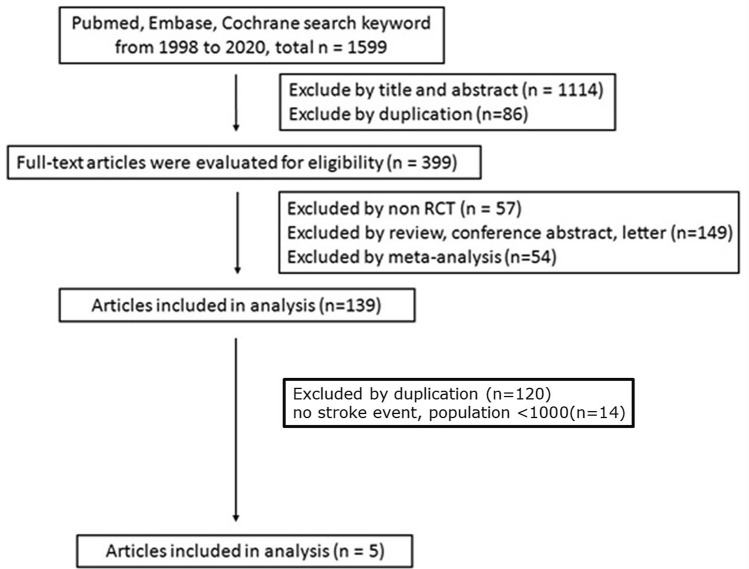
“Criteria for inclusion of a study derived from all previously published meta-analysis in this area were: (1) RCTs design; (2) comparison of SGLT2 inhibitors with control (eg, placebo or other glucose-lowering agents); and (3) Studies with at least 1000 patients above 18 years of age.”
MethodXie, X., Atkins, E., Lv, J., Bennett, A., Neal, B., Ninomiya, T., Woodward, M., MacMahon, S., Turnbull, F., Hillis, G. S., et al. (2016) · The Lancet · doi:10.1016/s0140-6736(15)00805-3 · Cited by 980
CV Protection in the EMPA-REG OUTCOME Trial: A “Thrifty Substrate” Hypothesis
Ferrannini, E., Mark, M., & Mayoux, E. (2016) · Diabetes Care · doi:10.2337/dc16-0330 · Cited by 975
SGLT2 inhibition — a novel strategy for diabetes treatment
Chao, E. C., & Henry, R. R. (2010) · Nature Reviews Drug Discovery · doi:10.1038/nrd3180 · Cited by 822 · cited 1×
“Criteria for inclusion of a study derived from all previously published meta-analysis in this area were: (1) RCTs design; (2) comparison of SGLT2 inhibitors with control (eg, placebo or other glucose-lowering agents); and (3) Studies with at least 1000 patients above 18 years of age.”
MethodLv, J., Neal, B., Ehteshami, P., Ninomiya, T., Woodward, M., Rodgers, A., Wang, H., MacMahon, S., Turnbull, F., Hillis, G., et al. (2012) · PLoS Medicine · doi:10.1371/journal.pmed.1001293 · Cited by 777
Blood pressure and cardiovascular disease in the Asia Pacific region
(2003) · Journal of Hypertension · doi:10.1097/00004872-200304000-00013 · Cited by 644
Tomlinson, D. R., & Gardiner, N. J. (2008) · Nature Reviews Neuroscience · doi:10.1038/nrn2294 · Cited by 564
Classification of Stroke Subtypes
Amarenco, P., Bogousslavsky, J., Caplan, L. R., Donnan, G. A., & Hennerici, M. G. (2009) · Cerebrovascular Diseases · doi:10.1159/000210432 · Cited by 472
Zelniker, T. A., Bonaca, M. P., Furtado, R. H. M., Mosenzon, O., Kuder, J. F., Murphy, S. A., Bhatt, D. L., Leiter, L. A., McGuire, D. K., Wilding, J. P. H., et al. (2020) · Circulation · doi:10.1161/circulationaha.119.044183 · Cited by 459
Baker, W. L., Smyth, L. R., Riche, D. M., Bourret, E. M., Chamberlin, K. W., & White, W. B. (2014) · Journal of the American Society of Hypertension · doi:10.1016/j.jash.2014.01.007 · Cited by 452
SGLT-2 inhibitors and cardiovascular risk: Proposed pathways and review of ongoing outcome trials
Inzucchi, S. E., Zinman, B., Wanner, C., Ferrari, R., Fitchett, D., Hantel, S., Espadero, R.-M., Woerle, H.-J., Broedl, U. C., & Johansen, O. E. (2015) · Diabetes and Vascular Disease Research · doi:10.1177/1479164114559852 · Cited by 399
Oelze, M., Kröller-Schön, S., Welschof, P., Jansen, T., Hausding, M., Mikhed, Y., Stamm, P., Mader, M., Zinßius, E., Agdauletova, S., et al. (2014) · PLoS ONE · doi:10.1371/journal.pone.0112394 · Cited by 293
Han, J. H., Oh, T. J., Lee, G., Maeng, H. J., Lee, D. H., Kim, K. M., Choi, S. H., Jang, H. C., Lee, H. S., Park, K. S., et al. (2017) · Diabetologia · doi:10.1007/s00125-016-4158-2 · Cited by 281
Sano, M., & Goto, S. (2019) · Circulation · doi:10.1161/circulationaha.118.038881 · Cited by 278
Patorno, E., Goldfine, A. B., Schneeweiss, S., Everett, B. M., Glynn, R. J., Liu, J., & Kim, S. C. (2018) · BMJ · doi:10.1136/bmj.k119 · Cited by 172
Ghosh-Swaby, O. R., Goodman, S. G., Leiter, L. A., Cheng, A., Connelly, K. A., Fitchett, D., Jüni, P., Farkouh, M. E., & Udell, J. A. (2020) · The Lancet Diabetes & Endocrinology · doi:10.1016/s2213-8587(20)30038-3 · Cited by 159
Pioglitazone for Secondary Stroke Prevention: A Systematic Review and Meta-Analysis
Lee, M., Saver, J. L., Liao, H.-W., Lin, C.-H., & Ovbiagele, B. (2017) · Stroke · doi:10.1161/strokeaha.116.013977 · Cited by 147
Zinman, B., Inzucchi, S. E., Lachin, J. M., Wanner, C., Fitchett, D., Kohler, S., Mattheus, M., Woerle, H. J., Broedl, U. C., Johansen, O. E., et al. (2017) · Stroke · doi:10.1161/strokeaha.116.015756 · Cited by 136
Zhou, Z., Jardine, M. J., Li, Q., Neuen, B. L., Cannon, C. P., de Zeeuw, D., Edwards, R., Levin, A., Mahaffey, K. W., Perkovic, V., et al. (2021) · Stroke · doi:10.1161/strokeaha.120.031623 · Cited by 117
Guo, M., Ding, J., Li, J., Wang, J., Zhang, T. D., Liu, C., Huang, W. G., Long, Y., Gao, C., & Xu, Y. (2018) · Diabetes Obesity and Metabolism · doi:10.1111/dom.13295 · Cited by 75
Hematocrit and the risk of cardiovascular disease in a Japanese community: The Hisayama Study
Gotoh, S., Hata, J., Ninomiya, T., Hirakawa, Y., Nagata, M., Mukai, N., Fukuhara, M., Ikeda, F., Ago, T., Kitazono, T., et al. (2015) · Atherosclerosis · doi:10.1016/j.atherosclerosis.2015.07.014 · Cited by 74
Zhou, Z., Lindley, R. I., Rådholm, K., Jenkins, B., Watson, J., Perkovic, V., Mahaffey, K. W., de Zeeuw, D., Fulcher, G., Shaw, W., et al. (2019) · Stroke · doi:10.1161/strokeaha.118.023009 · Cited by 72
The Effect of Hyperglycemia on Intracellular Calcium in Stroke
Araki, N., Greenberg, J. H., Sladky, J. T., Uematsu, D., Karp, A., & Reivich, M. (1992) · Journal of Cerebral Blood Flow & Metabolism · doi:10.1038/jcbfm.1992.64 · Cited by 69
The effect of diabetes and stroke at baseline and during follow-up on stroke mortality
Hu, G., Jousilahti, P., Sarti, C., Antikaínen, R., & Tuomilehto, J. O. (2006) · Diabetologia · doi:10.1007/s00125-006-0378-1 · Cited by 44 · cited 1×
“Criteria for inclusion of a study derived from all previously published meta-analysis in this area were: (1) RCTs design; (2) comparison of SGLT2 inhibitors with control (eg, placebo or other glucose-lowering agents); and (3) Studies with at least 1000 patients above 18 years of age.”
MethodBarkas, F., Elisaf, M., & Milionis, H. (2019) · European Journal of Neurology · doi:10.1111/ene.13905 · Cited by 43
Imaging the Effects of β-Hydroxybutyrate on Peri-Infarct Neurovascular Function and Metabolism
Bazzigaluppi, P., Lake, E. M. R., Beckett, T. L., Koletar, M. M., Weisspapir, I., Heinen, S., Mester, J. R., Lai, A. Y., Janik, R., Dorr, A. E., et al. (2018) · Stroke · doi:10.1161/strokeaha.118.020586 · Cited by 36
Barkas, F., Elisaf, M., Tsimihodimos, V., & Milionis, H. J. (2016) · Diabetes & Metabolism · doi:10.1016/j.diabet.2016.10.006 · Cited by 34
Yotsueda, R., Tanaka, S., Taniguchi, M., Fujisaki, K., Torisu, K., Masutani, K., Hirakata, H., Kitazono, T., & Tsuruya, K. (2017) · Nephrology Dialysis Transplantation · doi:10.1093/ndt/gfx305 · Cited by 25
Sato, K., Mano, T., Iwata, A., & Toda, T. (2019) · The Journal of Clinical Pharmacology · doi:10.1002/jcph.1561 · Cited by 21
Sodium-Glucose Cotransporter 2 (SGLT2) Inhibitors and Stroke
Kimura, G. (2017) · Circulation Journal · doi:10.1253/circj.cj-17-0040 · Cited by 13
Cited by
Davies, M. J., Aroda, V. R., Collins, B. S., Gabbay, R. A., Green, J., Maruthur, N. M., Rosas, S. E., Del Prato, S., Mathieu, C., Mingrone, G., et al. (2022) · Diabetes Care · doi:10.2337/dci22-0034 · Cited by 2,104
“When individual components of MACE were analyzed separately, GLP-1 RA reduced all three outcomes, with a more pronounced effect on stroke followed by cardiovascular death and myocardial infarction (253,254).”
BackgroundDavies, M. J., Aroda, V. R., Collins, B. S., Gabbay, R. A., Green, J., Maruthur, N. M., Rosas, S. E., Del Prato, S., Mathieu, C., Mingrone, G., et al. (2022) · Diabetologia · doi:10.1007/s00125-022-05787-2 · Cited by 1,048
“When individual components of MACE were analysed separately, GLP-1 RA reduced all three outcomes, with a more pronounced effect on stroke followed by cardiovascular death and myocardial infarction [253, 254].”
2024 ESC Guidelines for the management of peripheral arterial and aortic diseases
Mazzolai, L., Teixido-Tura, G., Lanzi, S., Boc, V., Bossone, E., Brodmann, M., Bura-Rivière, A., De Backer, J., Deglise, S., Della Corte, A., et al. (2024) · European Heart Journal · doi:10.1093/eurheartj/ehae179 · Cited by 993
Samson, S. L., Vellanki, P., Blonde, L., Christofides, E. A., Galindo, R. J., Hirsch, I. B., Isaacs, S. D., Izuora, K. E., Low Wang, C. C., Twining, C. L., et al. (2023) · Endocrine Practice · doi:10.1016/j.eprac.2023.02.001 · Cited by 375
SGLT2 inhibitors: from glucose-lowering to cardiovascular benefits
Preda, A., Montecucco, F., Carbone, F., Camici, G. G., Lüscher, T. F., Kraler, S., & Liberale, L. (2024) · Cardiovascular Research · doi:10.1093/cvr/cvae047 · Cited by 161
Metadata
- Authors
- Tsai, W.-H., Chuang, S.-M., Liu, S.-C., Lee, C.-C., Chien, M.-N., Leung, C.-H., Liu, S.-J., & Shih, H.-M.
- Affiliations
- Mackay Memorial Hospital (TW)
- National Taiwan University (TW)
- Corresponding author
- Chuang, Shih-Ming
- ORCID
- Venue
- Scientific Reports
- Published
- 2021-07-28
- Volume
- 11
- Issue
- 1
- Pages
- 15364-15364
- ISSN
- 2045-2322 (ISSN-L)
- PMC
- PMC8319393
- OpenAlex
- W3186786961
- Cited by
- 113
- References
- 38
- Citations by year
- 2026: 21 · 2025: 18 · 2024: 30 · 2023: 21 · 2022: 20 · 2021: 3
- FWCI
- 2.84
- Type
- journal article
- Language
- en
- Open access
- gold
- doi.org
- Licence
- cc-by
- creativecommons.org/licenses/by/4.0 (tdm)
- creativecommons.org/licenses/by/4.0 (vor)
- Locations
- Scientific Reports (publishedVersion, cc-by)
- PubMed Central (publishedVersion, cc-by)
- PubMed (publishedVersion)
- Tamkang University Institutional Repository (TKUIR) (submittedVersion)
- DOAJ (DOAJ: Directory of Open Access Journals) (submittedVersion, cc-by-sa)
- Funders
- Mackay Memorial Hospital
- Topics
- Health Sciences › Medicine › Endocrinology, Diabetes and Metabolism › Diabetes Treatment and Management
- Health Sciences › Medicine › Clinical Neurology › Acute Ischemic Stroke Management
- Health Sciences › Medicine › Cardiology and Cardiovascular Medicine › Blood Pressure and Hypertension Studies
- Keywords
- SGLT2 inhibitors, stroke, hemorrhagic stroke, ischemic stroke, transient ischemic attack, type 2 diabetes, drug safety, EMPA-REG, Canva, DECLARE-TIMI 58, degrees of belief
- MeSH terms
- Sodium-Glucose Transporter 2 Inhibitors, Hemorrhagic Stroke, Diabetes Mellitus, Type 2, Humans, Randomized Controlled Trials as Topic, Risk Assessment, Sodium-Glucose Transporter 2
About these checks
Registry, retraction, Cites and statistics results are computed, not judged, with one exception: a printed reference that no index lists is read once by a model before it counts as a citation error. Claims are extracted by a model and kept only when their quote appears verbatim in the text; each cited source is then checked, with a model’s help, for whether it says what the claim relies on. Those verdicts can be wrong — read the claim’s quote and the cited source before relying on one.
Statistics and arithmetic are recomputed, not judged.
Confidence bands are shown only for fields calibrated on our annotated test set. None is calibrated yet, so no band is shown.
What counts as a claim ›How we measure confidence ›How we check this ›
Are you an author, or do you see a problem with this page? Request a review
Data sources
Bibliographic data: Semantic Scholar, OpenAlex, Crossref.
Contains information from the Semantic Scholar Academic Graph Datasets, made available under the ODC Attribution License (ODC-BY 1.0).
Semantic Scholar’s data is described in: Kinney, R., et al. (2023). The Semantic Scholar Open Data Platform. arXiv:2301.10140.
