

The DOI matches its Crossref record; 86 of the 99 references it cites were found in a registry or an index.
Molecular diversity of Uzbekistan’s fishes assessed with DNA barcoding
Open accessPublished version of a preprint
Abstract
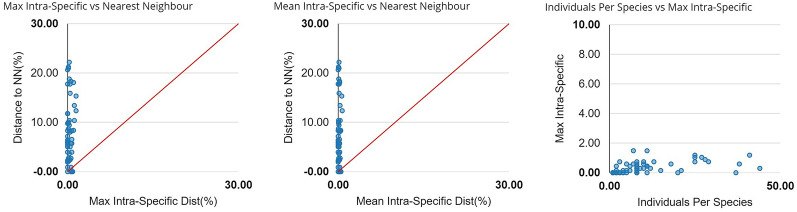
Uzbekistan is one of two doubly landlocked countries in the world, where all rivers are endorheic basins. Although fish diversity is relatively poor in Uzbekistan, the fish fauna of the region has not yet been fully studied. The aim of this study was to establish a reliable barcoding reference database for fish in Uzbekistan. A total of 666 specimens, belonging to 59 species within 39 genera, 17 families, and 9 orders, were subjected to polymerase chain reaction amplification in the barcode region and sequenced. The length of the 666 barcodes was 682 bp. The average K2P distances within species, genera, and families were 0.22%, 6.33%, and 16.46%, respectively. The average interspecific distance was approximately 28.8 times higher than the mean intraspecific distance. The Barcode Index Number (BIN) discordance report showed that 666 specimens represented 55 BINs, of which five were singletons, 45 were taxonomically concordant, and five were taxonomically discordant. The barcode gap analysis demonstrated that 89.3% of the fish species examined could be discriminated by DNA barcoding. These results provide new insights into fish diversity in the inland waters of Uzbekistan and can provide a basis for the development of further studies on fish fauna.
Overview
The claims and statistics of this paper haven’t been checked yet.
Run the check — free, no account needed. It reads the open-access text and checks the sources it cites.
Integrity signals
Registry
Cites
Statistics
Figures
Verification
Claims the paper makes
The claims and statistics of this paper haven’t been checked yet.
Run the check — free, no account needed. It reads the open-access text and checks the sources it cites.
Self-check
Percentages, sums and reported differences re-computed from the paper’s own numbers.
The self-check needs the paper’s full text.
Citations
Cites
MEGA7: Molecular Evolutionary Genetics Analysis Version 7.0 for Bigger Datasets
Kumar, S., Stecher, G., & Tamura, K. (2016) · Molecular Biology and Evolution · doi:10.1093/molbev/msw054 · Cited by 44,059
Kimura, M. (1980) · Journal of Molecular Evolution · doi:10.1007/bf01731581 · Cited by 29,778
MrBayes 3.2: Efficient Bayesian Phylogenetic Inference and Model Choice Across a Large Model Space
Ronquist, F., Teslenko, M., van der Mark, P., Ayres, D. L., Darling, A., Höhna, S., Larget, B., Liu, L., Suchard, M. A., & Huelsenbeck, J. P. (2012) · Systematic Biology · doi:10.1093/sysbio/sys029 · Cited by 27,843
Biological identifications through DNA barcodes
Hebert, P. D. N., Cywinska, A., Ball, S. L., & deWaard, J. R. (2003) · Proceedings of the Royal Society of London. Series B: Biological Sciences · doi:10.1098/rspb.2002.2218 · Cited by 13,376
Historical Overfishing and the Recent Collapse of Coastal Ecosystems
Jackson, J. B. C., Kirby, M. X., Berger, W. H., Bjorndal, K. A., Botsford, L. W., Bourque, B. J., Bradbury, R. H., Cooke, R., Erlandson, J., Estes, J. A., et al. (2001) · Science · doi:10.1126/science.1059199 · Cited by 6,652
Biological Identifications Through DNA Barcodes
Ramadan, H., & Baeshen, N. (2012) · doi:10.5772/49967 · Cited by 5,825
DNA barcoding Australia's fish species
Ward, R. D., Zemlak, T. S., Innes, B. H., Last, P. R., & Hebert, P. D. N. (2005) · Philosophical Transactions of the Royal Society B: Biological Sciences · doi:10.1098/rstb.2005.1716 · Cited by 4,332
Hebert, P. D. N., Penton, E. H., Burns, J. M., Janzen, D. H., & Hallwachs, W. (2004) · Proceedings of the National Academy of Sciences · doi:10.1073/pnas.0406166101 · Cited by 3,587
ABGD, Automatic Barcode Gap Discovery for primary species delimitation
PUILLANDRE, N., LAMBERT, A., BROUILLET, S., & ACHAZ, G. (2012) · Molecular Ecology · doi:10.1111/j.1365-294x.2011.05239.x · Cited by 3,324
Identification of Birds through DNA Barcodes
Hebert, P. D. N., Stoeckle, M. Y., Zemlak, T. S., & Francis, C. M. (2004) · PLoS Biology · doi:10.1371/journal.pbio.0020312 · Cited by 2,653
Research works printed but not linked: 8
- Ratnasingham, S. & Hebert, P. D. N. BOLD: The barcode of life data system. Mol. Ecol. Notes 7, 355–364 (2007). · DOI · Paper page
- Mirabdullaev, I. M. & Mullabaev, N. R. Ichthyofauna of Uzbekistan: Modern state and taxonomy. J. Biol. Uzbekistan 5, 43–49 (2020) (In Russian with English abstract).
- Atamuratova, M. S. Ichthyofauna of reservoirs in the Akhangaran river basin. (Ph.D. dissertation, Institute of Zoology, Tashkent, Uzbekistan, 2021) (In Uzbek).
- Berg, L. S. Fishes of Fresh Waters of the USSR and Adjacent Countries. Vol. 2. (Academy of Sciences of the USSR Press, 1949) (In Russian).
- Turdakov, F. A. Fishes of Kirghizia (Academy of Sciences of the Kyrgyz SSR Press, 1963) (In Russian).
- Prokofiev, A. M. Loaches of the subfamily Nemacheilinae of the World (Filigran, 2017) (In Russian).
- Berg, L. S. The Freshwater Fishes of the USSR and Adjacent Countries (Academy of Sciences of the USSR Press, 1948) (In Russian).
- Mirabdullaev, I. M., Mirzaev, U. T., Kuzmetov, A. R. & Kimsanov, Z. O. Keys to Fishes of Uzbekistan and Adjacent Regions (Sano-Standard Press, 2011) (In Uzbek).
Cited by
Mitochondrial DNA barcoding of mosquito species (Diptera: Culicidae) in Thailand
Chaiphongpachara, T., Changbunjong, T., Laojun, S., Nutepsu, T., Suwandittakul, N., Kuntawong, K., Sumruayphol, S., & Ruangsittichai, J. (2022) · PLoS ONE · doi:10.1371/journal.pone.0275090 · Cited by 54
DNA Barcoding of Fish Species Diversity in Guizhou, China
Tang, Q., Deng, L., Luo, Q., Duan, Q., Wang, X., & Zhang, R. (2023) · Diversity · doi:10.3390/d15020203 · Cited by 17
Afrand, M., Sourinejad, I., Shahdadi, A., & Vera, M. (2023) · Estuaries and Coasts · doi:10.1007/s12237-023-01306-7 · Cited by 9
“Its presence increases the effectiveness of DNA barcodes for species identification (Sheraliev and Peng 2021).”
Rozimov, A., Wang, Y.-F., Wang, M., Zou, M., Sobirov, J., Karimov, E., Kholmatov, B., Freyhof, J., Namozov, S., Wang, C., et al. (2025) · Zoosystematics and Evolution · doi:10.3897/zse.101.137787 · Cited by 8
“The K2P distance between Schizothorax sp. and other valid species ranges from 3.18% to 6.72%, while the distance between our sequenced Schizothorax sp. individual and that from previous study (Sheraliev and Peng 2021) is 0 (Fig.”
InfluentialRen, J., & Zhang, R.-Z. (2024) · Journal of Insect Science · doi:10.1093/jisesa/ieae083 · Cited by 8
“…of this approach has been successfully demonstrated across various taxonomic groups, including birds (Charles et al. 2004), fish (Ward et al. 2005, Sheraliev and Peng 2021), and, subsequently, insects (Park et al. 2011, Pramual and Adler 2014, Nzelu et al. 2015, Dinca et al. 2021, da Conceição…”
Background
Metadata
- Authors
- Sheraliev, B., & Peng, Z.
- Affiliations
- Southwest University (CN)
- Corresponding author
- Peng, Zuogang
- Venue
- Scientific Reports
- Published
- 2021-08-19
- Volume
- 11
- Issue
- 1
- Pages
- 16894-16894
- ISSN
- 2045-2322 (ISSN-L)
- PMC
- PMC8376971
- OpenAlex
- W3195447945
- Cited by
- 42
- References
- 99
- Citations by year
- 2026: 10 · 2025: 11 · 2024: 8 · 2023: 5 · 2022: 8
- FWCI
- 3.82
- Type
- journal article
- Language
- en
- Open access
- gold
- doi.org
- Licence
- cc-by
- creativecommons.org/licenses/by/4.0 (tdm)
- creativecommons.org/licenses/by/4.0 (vor)
- Locations
- Scientific Reports (publishedVersion, cc-by)
- bioRxiv (Cold Spring Harbor Laboratory) (acceptedVersion, cc-by-nc-nd)
- PubMed Central (publishedVersion, cc-by)
- PubMed (publishedVersion)
- DOAJ (DOAJ: Directory of Open Access Journals) (submittedVersion, cc-by-sa)
- Funders
- Foundation for Innovative Research Groups of the National Natural Science Foundation of China (31872204)
- Topics
- Life Sciences › Agricultural and Biological Sciences › Aquatic Science › Fish Biology and Ecology Studies
- Physical Sciences › Environmental Science › Ecology › Environmental DNA in Biodiversity Studies
- Life Sciences › Agricultural and Biological Sciences › Ecology, Evolution, Behavior and Systematics › Invertebrate Taxonomy and Ecology
- Keywords
- fish diversity, DNA barcoding, endorheic basin, landlocked countries, Barcode Index Number, barcode gap analysis, species identification, molecular taxonomy, inland waters
- MeSH terms
- Animals, Bayes Theorem, Electron Transport Complex IV, Fishes, Geography, Phylogeny, Species Specificity, Uzbekistan, Genetic Variation, Sample Size, DNA Barcoding, Taxonomic
About these checks
Registry, retraction, Cites and statistics results are computed, not judged, with one exception: a printed reference that no index lists is read once by a model before it counts as a citation error. Claims are extracted by a model and kept only when their quote appears verbatim in the text; each cited source is then checked, with a model’s help, for whether it says what the claim relies on. Those verdicts can be wrong — read the claim’s quote and the cited source before relying on one.
Statistics and arithmetic are recomputed, not judged.
Confidence bands are shown only for fields calibrated on our annotated test set. None is calibrated yet, so no band is shown.
What counts as a claim ›How we measure confidence ›How we check this ›
Are you an author, or do you see a problem with this page? Request a review
How to cite
Cite CoChat for the checks on this page, and the paper for its own findings.
- This page
- CoChat. (2026). Citation check: Molecular diversity of Uzbekistan’s fishes assessed with DNA barcoding. https://app.cochat.ai/papers/10.1038/s41598-021-96487-1
- The paper
- Sheraliev, B., & Peng, Z. (2021). Molecular diversity of Uzbekistan’s fishes assessed with DNA barcoding. Scientific Reports. https://doi.org/10.1038/s41598-021-96487-1
Data sources
Bibliographic data: Semantic Scholar, OpenAlex, Crossref.
Contains information from the Semantic Scholar Academic Graph Datasets, made available under the ODC Attribution License (ODC-BY 1.0).
Semantic Scholar’s data is described in: Kinney, R., et al. (2023). The Semantic Scholar Open Data Platform. arXiv:2301.10140.
