

The DOI matches its Crossref record; 44 of the 46 references it cites were found in a registry or an index, and 2 are not checked yet.
An explainable machine learning-based clinical decision support system for prediction of gestational diabetes mellitus
Open accessAbstract
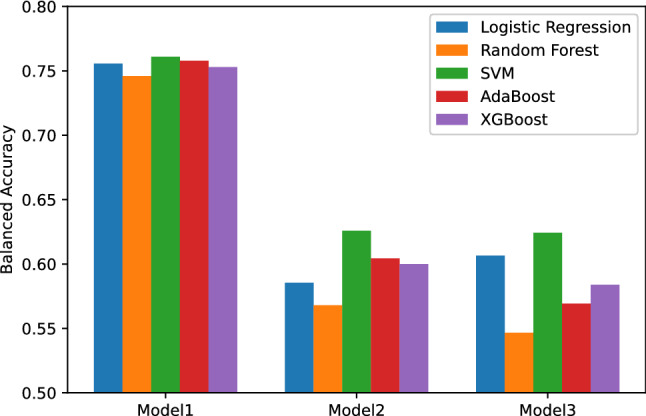
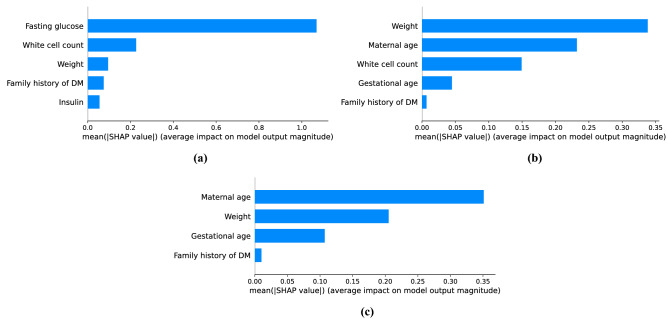
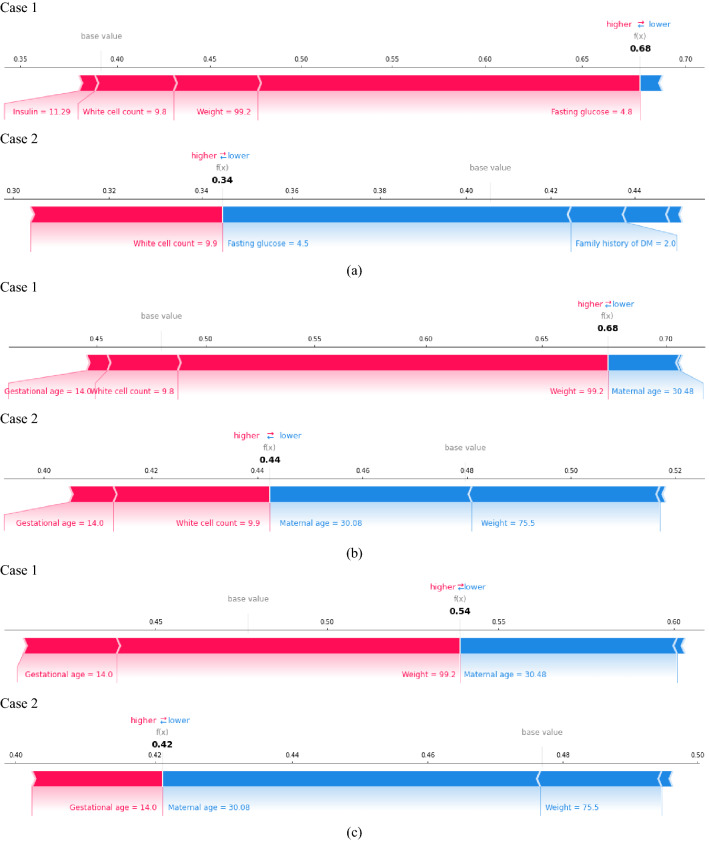
Gestational Diabetes Mellitus (GDM), a common pregnancy complication associated with many maternal and neonatal consequences, is increased in mothers with overweight and obesity. Interventions initiated early in pregnancy can reduce the rate of GDM in these women, however, untargeted interventions can be costly and time-consuming. We have developed an explainable machine learning-based clinical decision support system (CDSS) to identify at-risk women in need of targeted pregnancy intervention. Maternal characteristics and blood biomarkers at baseline from the PEARS study were used. After appropriate data preparation, synthetic minority oversampling technique and feature selection, five machine learning algorithms were applied with five-fold cross-validated grid search optimising the balanced accuracy. Our models were explained with Shapley additive explanations to increase the trustworthiness and acceptability of the system. We developed multiple models for different use cases: theoretical (AUC-PR 0.485, AUC-ROC 0.792), GDM screening during a normal antenatal visit (AUC-PR 0.208, AUC-ROC 0.659), and remote GDM risk assessment (AUC-PR 0.199, AUC-ROC 0.656). Our models have been implemented as a web server that is publicly available for academic use. Our explainable CDSS demonstrates the potential to assist clinicians in screening at risk patients who may benefit from early pregnancy GDM prevention strategies.
Overview
The claims and statistics of this paper haven’t been checked yet.
Run the check — free, no account needed. It reads the open-access text and checks the sources it cites.
Integrity signals
Registry
Cites
Statistics
Figures
Verification
Claims the paper makes
The claims and statistics of this paper haven’t been checked yet.
Run the check — free, no account needed. It reads the open-access text and checks the sources it cites.
Self-check
Percentages, sums and reported differences re-computed from the paper’s own numbers.
The self-check needs the paper’s full text.
Citations
Cites
Scikit-learn: Machine Learning in Python
Pedregosa, F., Varoquaux, G., Gramfort, A., Michel, V., Thirion, B., Grisel, O., Blondel, M., Müller, A., Nothman, J., Louppe, G., et al. (2012) · arXiv · doi:10.48550/arxiv.1201.0490 · Cited by 71,016
XGBoost: A Scalable Tree Boosting System
Chen, T., & Guestrin, C. (2016) · Proceedings of the 22nd ACM SIGKDD International Conference on Knowledge Discovery and Data Mining · doi:10.1145/2939672.2939785 · Cited by 54,569
Ror2 signaling regulates Golgi structure and transport through IFT20 for tumor invasiveness
Nishita, M., Park, S.-Y., Nishio, T., Kamizaki, K., Wang, Z., Tamada, K., Takumi, T., Hashimoto, R., Otani, H., Pazour, G. J., et al. (2017) · Scientific Reports · doi:10.1038/s41598-016-0028-x · Cited by 15,947
Ng, M., Fleming, T., Robinson, M., Thomson, B., Graetz, N., Margono, C., Mullany, E. C., Biryukov, S., Abbafati, C., Abera, S. F., et al. (2014) · The Lancet · doi:10.1016/s0140-6736(14)60460-8 · Cited by 11,952
Harris hawks optimization: Algorithm and applications
Heidari, A. A., Mirjalili, S., Faris, H., Aljarah, I., Mafarja, M., & Chen, H. (2019) · Future Generation Computer Systems · doi:10.1016/j.future.2019.02.028 · Cited by 6,324 · cited 1×
“We recognise that the performance of our models may require further improvement for use in a clinical setting, for example, by using some intelligent optimization algorithms 40–44 .”
MethodInternational Association of Diabetes and Pregnancy Study Groups Consensus Panel (2010) · Diabetes Care · doi:10.2337/dc09-1848 · Cited by 5,390
Proceedings of the 21st International Conference on Neural Information Processing Systems
Koller, D., Schuurmans, D., Bengio, Y., & Bottou, L. (2008) · Cited by 4,461
Slime mould algorithm: A new method for stochastic optimization
Li, S., Chen, H., Wang, M., Heidari, A. A., & Mirjalili, S. (2020) · Future Generation Computer Systems · doi:10.1016/j.future.2020.03.055 · Cited by 3,036 · cited 1×
“Our models included a very small set of features (4 or 5) compared with published models (4-2355), which means our models would be easier and faster to use.”
MethodAdaptive Control Processes: A Guided Tour
Bellman, R. E. (1961) · doi:10.1515/9781400874668 · Cited by 2,802
Intelligible Models for HealthCare: Predicting Pneumonia Risk and Hospital 30-day Readmission
Caruana, R., Lou, Y., Gehrke, J., Koch, P., Sturm, M., & Elhadad, N. (2015) · Proceedings of the 21th ACM SIGKDD International Conference on Knowledge Discovery and Data Mining · doi:10.1145/2783258.2788613 · Cited by 1,685 · cited 1×
“Our models included a very small set of features (4 or 5) compared with published models (4-2355), which means our models would be easier and faster to use.”
Method
Research works printed but not linked: 2
- Bellman, R. E. Adaptive Control Processes (Princeton University Press, Princeton, 2015).
- Lemaître, G., Nogueira, F. & Aridas, C. K. Imbalanced-learn: A python toolbox to tackle the curse of imbalanced datasets in machine learning. J. Mach. Learn. Res. 18, 1–5 (2017).
Cited by
Loh, H. W., Ooi, C. P., Seoni, S., Barua, P. D., Molinari, F., & Acharya, U. R. (2022) · Computer Methods and Programs in Biomedicine · doi:10.1016/j.cmpb.2022.107161 · Cited by 734
Albahri, A. S., Duhaim, A. M., Fadhel, M. A., Alnoor, A., Baqer, N. S., Alzubaidi, L., Albahri, O. S., Alamoodi, A. H., Bai, J., Salhi, A., et al. (2023) · Information Fusion · doi:10.1016/j.inffus.2023.03.008 · Cited by 716
Survey of Explainable AI Techniques in Healthcare
Chaddad, A., Peng, J., Xu, J., & Bouridane, A. (2023) · Sensors · doi:10.3390/s23020634 · Cited by 591
Harnessing the Power of Clinical Decision Support Systems: Challenges and Opportunities
Chen, Z., Liang, N., Zhang, H., Li, H., Yang, Y., Zong, X., Chen, Y., Wang, Y., & Shi, N. (2023) · Open Heart · doi:10.1136/openhrt-2023-002432 · Cited by 244
Explainable Artificial Intelligence-Based Decision Support Systems: A Recent Review
Kostopoulos, G., Davrazos, G., & Kotsiantis, S. B. (2024) · Electronics · doi:10.3390/electronics13142842 · Cited by 208
“Three explainable ML-based CDSSs were developed in [52] for predicting gestational diabetes mellitus in mothers with overweight and obesity utilizing the SVMs classifier, while exploiting maternal characteristics and blood biomarkers.”
Metadata
- Authors
- Du, Y., Rafferty, A. R., McAuliffe, F. M., Wei, L., & Mooney, C.
- Affiliations
- University College Dublin (IE)
- Corresponding author
- Mooney, Catherine
- Venue
- Scientific Reports
- Published
- 2022-01-21
- Volume
- 12
- Issue
- 1
- Pages
- 1170-1170
- ISSN
- 2045-2322 (ISSN-L)
- PMC
- PMC8782851
- OpenAlex
- W4206997722
- Cited by
- 128
- References
- 43
- Citations by year
- 2026: 20 · 2025: 32 · 2024: 33 · 2023: 32 · 2022: 11
- FWCI
- 20.24
- Type
- journal article
- Language
- en
- Open access
- gold
- doi.org
- Licence
- cc-by
- creativecommons.org/licenses/by/4.0 (tdm)
- creativecommons.org/licenses/by/4.0 (vor)
- Locations
- Scientific Reports (publishedVersion, cc-by)
- PubMed Central (publishedVersion, cc-by)
- PubMed (publishedVersion)
- DOAJ (DOAJ: Directory of Open Access Journals) (submittedVersion, cc-by-sa)
- Funders
- UCD School of Computer Science
- UCD School of Medicine
- Topics
- Health Sciences › Health Professions › Health Information Management › Artificial Intelligence in Healthcare
- Health Sciences › Medicine › Obstetrics and Gynecology › Gestational Diabetes Research and Management
- Physical Sciences › Computer Science › Artificial Intelligence › Machine Learning in Healthcare
- Keywords
- gestational diabetes mellitus, clinical decision support systems, explainable machine learning, SHAP, GDM risk prediction, GDM screening, prenatal care, blood biomarkers, maternal obesity, synthetic minority oversampling
- MeSH terms
- Smartphone, Machine Learning, Adult, Female, Humans, Maternal Age, Pregnancy, Risk Factors, ROC Curve, Models, Statistical, Randomized Controlled Trials as Topic, Diabetes, Gestational, Risk Assessment, Decision Support Systems, Clinical, Overweight, Mobile Applications
About these checks
Registry, retraction, Cites and statistics results are computed, not judged, with one exception: a printed reference that no index lists is read once by a model before it counts as a citation error. Claims are extracted by a model and kept only when their quote appears verbatim in the text; each cited source is then checked, with a model’s help, for whether it says what the claim relies on. Those verdicts can be wrong — read the claim’s quote and the cited source before relying on one.
Statistics and arithmetic are recomputed, not judged.
Confidence bands are shown only for fields calibrated on our annotated test set. None is calibrated yet, so no band is shown.
What counts as a claim ›How we measure confidence ›How we check this ›
Are you an author, or do you see a problem with this page? Request a review
How to cite
Cite CoChat for the checks on this page, and the paper for its own findings.
- This page
- CoChat. (2026). Citation check: An explainable machine learning-based clinical decision support system for prediction of gestational diabetes mellitus. https://app.cochat.ai/papers/10.1038/s41598-022-05112-2
- The paper
- Du, Y., Rafferty, A. R., McAuliffe, F. M., Wei, L., & Mooney, C. (2022). An explainable machine learning-based clinical decision support system for prediction of gestational diabetes mellitus. Scientific Reports. https://doi.org/10.1038/s41598-022-05112-2
Data sources
Bibliographic data: Semantic Scholar, OpenAlex, Crossref.
Contains information from the Semantic Scholar Academic Graph Datasets, made available under the ODC Attribution License (ODC-BY 1.0).
Semantic Scholar’s data is described in: Kinney, R., et al. (2023). The Semantic Scholar Open Data Platform. arXiv:2301.10140.
