

The DOI matches its Crossref record; 46 of the 47 references it cites were found in a registry or an index.
Partial randomized benchmarking
Open accessAbstract
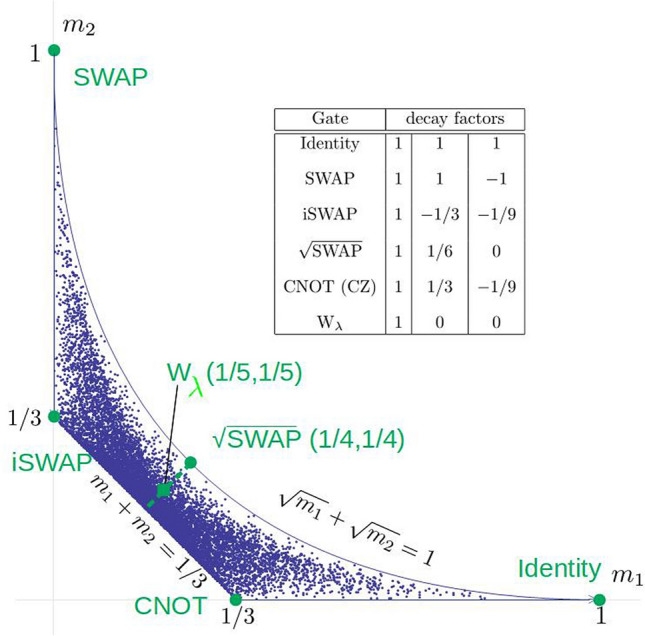
In randomized benchmarking of quantum logical gates, partial twirling can be used for simpler implementation, better scaling, and higher accuracy and reliability. For instance, for two-qubit gates, single-qubit twirling is easier to realize than full averaging. We analyze such simplified, partial twirling and demonstrate that, unlike for the standard randomized benchmarking, the measured decay of fidelity is a linear combination of exponentials with different decay rates (3 for two qubits and single-bit twirling). The evolution with the sequence length is governed by an iteration matrix, whose spectrum gives the decay rates. For generic two-qubit gates one slowest exponential dominates and characterizes gate errors in three channels. Its decay rate is close, but different from that in the standard randomized benchmarking, and we find the leading correction. Using relations to the local invariants of two-qubit gates we identify all exceptional gates with several slow exponentials and analyze possibilities to extract their decay rates from the measured curves.
Overview
The claims and statistics of this paper haven’t been checked yet.
Free: it reads the open-access text and checks the first 5 claims that cite a source we can check. Create a free account to check every claim.
Integrity signals
Registry
Cites
Statistics
Figures
Verification
Claims the paper makes
The claims and statistics of this paper haven’t been checked yet.
Free: it reads the open-access text and checks the first 5 claims that cite a source we can check. Create a free account to check every claim.
Self-check
Percentages, sums and reported differences re-computed from the paper’s own numbers.
The self-check needs the paper’s full text.
Citations
Cites
Quantum supremacy using a programmable superconducting processor
Arute, F., Arya, K., Babbush, R., Bacon, D., Bardin, J. C., Barends, R., Biswas, R., Boixo, S., Brandao, F. G. S. L., Buell, D. A., et al. (2019) · Nature · doi:10.1038/s41586-019-1666-5 · Cited by 7,720
Scheme for reducing decoherence in quantum computer memory
Shor, P. W. (1995) · Physical Review A · doi:10.1103/physreva.52.r2493 · Cited by 4,479 · cited 6×
“In principle, in the standard IRB errors in Vi ’s are accounted for by subtracting the decay constant for non-interleaved sequences of only Vi’s(23) (though accuracy of this approach (1) n = FWVn · · ·WV3WV2WV1,”
InfluentialError Correcting Codes in Quantum Theory
Steane, A. M. (1996) · Physical Review Letters · doi:10.1103/physrevlett.77.793 · Cited by 2,677 · cited 7×
“Then (2) �n = FW0�Vn · · ·W0�V3W0�V2W0�V1 = (U n�Un)(U n−1�Un−1) · · · (U 2�U2)(U 1�U1) ,”
InfluentialQuantum computations: algorithms and error correction
Kitaev, A. Y. (1997) · Russian Mathematical Surveys · doi:10.1070/rm1997v052n06abeh002155 · Cited by 1,424
Quantum error correction for quantum memories
Terhal, B. M. (2015) · Reviews of Modern Physics · doi:10.1103/revmodphys.87.307 · Cited by 1,354 · cited 2×
“(3) Ui ’s do not belong the group unless W0 is a single-qubit gate itself, and averaging over Ui ’s in Eq.”
Quantum State Tomography via Compressed Sensing
Gross, D., Liu, Y.-K., Flammia, S. T., Becker, S., & Eisert, J. (2010) · Physical Review Letters · doi:10.1103/physrevlett.105.150401 · Cited by 1,093
Randomized benchmarking of quantum gates
Knill, E., Leibfried, D., Reichle, R., Britton, J., Blakestad, R. B., Jost, J. D., Langer, C., Ozeri, R., Seidelin, S., & Wineland, D. J. (2008) · Physical Review A · doi:10.1103/physreva.77.012307 · Cited by 1,019 · cited 2×
“(20) M i1 +M i2 +M i3 = 1, i = 1, 2, 3,”
Prescription for experimental determination of the dynamics of a quantum black box
Chuang, I. L., & Nielsen, M. A. (1997) · Journal of Modern Optics · doi:10.1080/09500349708231894 · Cited by 949 · cited 2×
“(8) �n = F̃n(Ũ nW0�Ũn) · · · (Ũ 2W0�Ũ2)(Ũ 1W0�Ũ1),”
Scalable and Robust Randomized Benchmarking of Quantum Processes
Magesan, E., Gambetta, J. M., & Emerson, J. (2011) · Physical Review Letters · doi:10.1103/physrevlett.106.180504 · Cited by 724 · cited 2×
“Relations (20, 21) strongly constrain the structure of the iteration matrix M0 .”
Complete Characterization of a Quantum Process: The Two-Bit Quantum Gate
Poyatos, J. F., Cirac, J. I., & Zoller, P. (1997) · Physical Review Letters · doi:10.1103/physrevlett.78.390 · Cited by 694
Research works printed but not linked: 2
- Shor, P. W. Fault-tolerant quantum computation. In Proceedings of 37th Conference on Foundations of Computer Science, 56–65 (IEEE press, Los Alamitos, California, 1996).
- Meier, A. M. Randomized benchmarking of Clifford operators. Ph.D. thesis, University of Colorado at Boulder (2013).
Cited by
Simple formulation of no-cloning and no-hiding that admits efficient and robust verification
Girling, M., Cîrstoiu, C., & Jennings, D. (2024) · Physical Review Research · doi:10.1103/physrevresearch.6.023090 · Cited by 2
“A similar construction to the lower boundaries of this reversible CUP set appears in the context of interleaved fidelity randomized benchmarking [61].”
Metadata
- Authors
- Dubovitskii, K., & Makhlin, Y.
- Affiliations
- Moscow Institute of Physics and Technology (RU)
- National Research University Higher School of Economics (RU)
- Corresponding author
- Makhlin, Yuriy
- Venue
- Scientific Reports
- Published
- 2022-06-16
- Volume
- 12
- Issue
- 1
- Pages
- 10129-10129
- ISSN
- 2045-2322 (ISSN-L)
- PMC
- PMC9203587
- OpenAlex
- W4282961692
- Cited by
- 1
- References
- 47
- Citations by year
- 2024: 1
- FWCI
- 0.08
- Type
- journal article
- Language
- en
- Open access
- gold
- doi.org
- Licence
- cc-by
- creativecommons.org/licenses/by/4.0 (tdm)
- creativecommons.org/licenses/by/4.0 (vor)
- Locations
- Scientific Reports (publishedVersion, cc-by)
- PubMed Central (publishedVersion, cc-by)
- PubMed (publishedVersion)
- arXiv (Cornell University) (submittedVersion)
- DOAJ (DOAJ: Directory of Open Access Journals) (submittedVersion, cc-by-sa)
- arXiv (Cornell University)
- Funders
- Basic research program of HSE
- Topics
- Physical Sciences › Computer Science › Artificial Intelligence › Quantum Computing Algorithms and Architecture
- Physical Sciences › Physics and Astronomy › Atomic and Molecular Physics, and Optics › Quantum Information and Cryptography
- Physical Sciences › Physics and Astronomy › Atomic and Molecular Physics, and Optics › Quantum many-body systems
- Keywords
- gate fidelity, two-qubit gates, exponential decay rate
About these checks
Registry, retraction, Cites and statistics results are computed, not judged, with one exception: a printed reference that no index lists is read once by a model before it counts as a citation error. Claims are extracted by a model and kept only when their quote appears verbatim in the text; each cited source is then checked, with a model’s help, for whether it says what the claim relies on. Those verdicts can be wrong — read the claim’s quote and the cited source before relying on one.
Statistics and arithmetic are recomputed, not judged.
Confidence bands are shown only for fields calibrated on our annotated test set. None is calibrated yet, so no band is shown.
What counts as a claim ›How we measure confidence ›How we check this ›
Are you an author, or do you see a problem with this page? Request a review
How to cite
Cite CoChat for the checks on this page, and the paper for its own findings.
- This page
- CoChat. (2026). Citation check: Partial randomized benchmarking. https://app.cochat.ai/papers/10.1038/s41598-022-13813-x
- The paper
- Dubovitskii, K., & Makhlin, Y. (2022). Partial randomized benchmarking. Scientific Reports. https://doi.org/10.1038/s41598-022-13813-x
Data sources
Bibliographic data: Semantic Scholar, OpenAlex, Crossref.
Contains information from the Semantic Scholar Academic Graph Datasets, made available under the ODC Attribution License (ODC-BY 1.0).
Semantic Scholar’s data is described in: Kinney, R., et al. (2023). The Semantic Scholar Open Data Platform. arXiv:2301.10140.
