

Partial randomized benchmarking
Open accessThe DOI matches its Crossref record; 46 of the 47 references it cites were found in a registry or an index.
Abstract
In randomized benchmarking of quantum logical gates, partial twirling can be used for simpler implementation, better scaling, and higher accuracy and reliability. For instance, for two-qubit gates, single-qubit twirling is easier to realize than full averaging. We analyze such simplified, partial twirling and demonstrate that, unlike for the standard randomized benchmarking, the measured decay of fidelity is a linear combination of exponentials with different decay rates (3 for two qubits and single-bit twirling). The evolution with the sequence length is governed by an iteration matrix, whose spectrum gives the decay rates. For generic two-qubit gates one slowest exponential dominates and characterizes gate errors in three channels. Its decay rate is close, but different from that in the standard randomized benchmarking, and we find the leading correction. Using relations to the local invariants of two-qubit gates we identify all exceptional gates with several slow exponentials and analyze possibilities to extract their decay rates from the measured curves.
Overview
The claims and statistics of this paper haven’t been checked yet.
Free: it reads the open-access text and checks the first 5 claims that cite a source we can check. Create a free account to check every claim.
Integrity signals
Registry
Cites
Statistics
Figures
Verification
Claims the paper makes
The claims and statistics of this paper haven’t been checked yet.
Free: it reads the open-access text and checks the first 5 claims that cite a source we can check. Create a free account to check every claim.
Self-check
Percentages, sums and reported differences re-computed from the paper’s own numbers.
The self-check needs the paper’s full text.
Citations
Cites
Quantum supremacy using a programmable superconducting processor
Arute, F., Arya, K., Babbush, R., Bacon, D., Bardin, J. C., Barends, R., Biswas, R., Boixo, S., Brandao, F. G. S. L., Buell, D. A., et al. (2019) · Nature · doi:10.1038/s41586-019-1666-5 · Cited by 7,720
Scheme for reducing decoherence in quantum computer memory
Shor, P. W. (1995) · Physical Review A · doi:10.1103/physreva.52.r2493 · Cited by 4,479 · cited 6×
“In principle, in the standard IRB errors in Vi ’s are accounted for by subtracting the decay constant for non-interleaved sequences of only Vi’s(23) (though accuracy of this approach (1) n = FWVn · · ·WV3WV2WV1,”
InfluentialError Correcting Codes in Quantum Theory
Steane, A. M. (1996) · Physical Review Letters · doi:10.1103/physrevlett.77.793 · Cited by 2,677 · cited 7×
“Then (2) �n = FW0�Vn · · ·W0�V3W0�V2W0�V1 = (U n�Un)(U n−1�Un−1) · · · (U 2�U2)(U 1�U1) ,”
InfluentialQuantum computations: algorithms and error correction
Kitaev, A. Y. (1997) · Russian Mathematical Surveys · doi:10.1070/rm1997v052n06abeh002155 · Cited by 1,424
Quantum error correction for quantum memories
Terhal, B. M. (2015) · Reviews of Modern Physics · doi:10.1103/revmodphys.87.307 · Cited by 1,354 · cited 2×
“(3) Ui ’s do not belong the group unless W0 is a single-qubit gate itself, and averaging over Ui ’s in Eq.”
Quantum State Tomography via Compressed Sensing
Gross, D., Liu, Y.-K., Flammia, S. T., Becker, S., & Eisert, J. (2010) · Physical Review Letters · doi:10.1103/physrevlett.105.150401 · Cited by 1,093
Randomized benchmarking of quantum gates
Knill, E., Leibfried, D., Reichle, R., Britton, J., Blakestad, R. B., Jost, J. D., Langer, C., Ozeri, R., Seidelin, S., & Wineland, D. J. (2008) · Physical Review A · doi:10.1103/physreva.77.012307 · Cited by 1,019 · cited 2×
“(20) M i1 +M i2 +M i3 = 1, i = 1, 2, 3,”
Prescription for experimental determination of the dynamics of a quantum black box
Chuang, I. L., & Nielsen, M. A. (1997) · Journal of Modern Optics · doi:10.1080/09500349708231894 · Cited by 949 · cited 2×
“(8) �n = F̃n(Ũ nW0�Ũn) · · · (Ũ 2W0�Ũ2)(Ũ 1W0�Ũ1),”
Scalable and Robust Randomized Benchmarking of Quantum Processes
Magesan, E., Gambetta, J. M., & Emerson, J. (2011) · Physical Review Letters · doi:10.1103/physrevlett.106.180504 · Cited by 724 · cited 2×
“Relations (20, 21) strongly constrain the structure of the iteration matrix M0 .”
Complete Characterization of a Quantum Process: The Two-Bit Quantum Gate
Poyatos, J. F., Cirac, J. I., & Zoller, P. (1997) · Physical Review Letters · doi:10.1103/physrevlett.78.390 · Cited by 694
Exact and approximate unitary 2-designs and their application to fidelity estimation
Dankert, C., Cleve, R., Emerson, J., & Livine, E. (2009) · Physical Review A · doi:10.1103/physreva.80.012304 · Cited by 685
Knill, E., Laflamme, R., & Zurek, W. H. (1998) · Science · doi:10.1126/science.279.5349.342 · Cited by 663 · cited 1×
“(7) one finds that μn = μn decays exponentially with the sequence length n.”
Fault-tolerant quantum computation with constant error
Aharonov, D., & Ben-Or, M. (1997) · Proceedings of the twenty-ninth annual ACM symposium on Theory of computing - STOC '97 · doi:10.1145/258533.258579 · Cited by 631 · cited 1×
“where the angular brackets denote averaging over the subgroup (5), while the gate error superoperator was defined before Eq.”
Qubit Architecture with High Coherence and Fast Tunable Coupling
Chen, Y., Neill, C., Roushan, P., Leung, N., Fang, M., Barends, R., Kelly, J., Campbell, B., Chen, Z., Chiaro, B., et al. (2014) · Physical Review Letters · doi:10.1103/physrevlett.113.220502 · Cited by 584 · cited 1×
“(8) and use it to relate n+1 to n: (37) ”
Quantum logic with spin qubits crossing the surface code threshold
Xue, X., Russ, M., Samkharadze, N., Undseth, B., Sammak, A., Scappucci, G., & Vandersypen, L. M. K. (2022) · Nature · doi:10.1038/s41586-021-04273-w · Cited by 524
Scalable noise estimation with random unitary operators
Emerson, J., Alicki, R., & Życzkowski, K. (2005) · Journal of Optics B: Quantum and Semiclassical Optics · doi:10.1088/1464-4266/7/10/021 · Cited by 502 · cited 3×
“follows from the fact that an error-free operator n remains error-free after application of (19).”
InfluentialCharacterizing quantum gates via randomized benchmarking
Magesan, E., Gambetta, J. M., & Emerson, J. (2012) · Physical Review A · doi:10.1103/physreva.85.042311 · Cited by 464 · cited 2×
“This immediately proves the relation (22).”
Efficient Measurement of Quantum Gate Error by Interleaved Randomized Benchmarking
Magesan, E., Gambetta, J. M., Johnson, B. R., Ryan, C. A., Chow, J. M., Merkel, S. T., da Silva, M. P., Keefe, G. A., Rothwell, M. B., Ohki, T. A., et al. (2012) · Physical Review Letters · doi:10.1103/physrevlett.109.080505 · Cited by 428 · cited 1×
“Further, we found an explicit expression for the iteration matrix M0 (23) in terms of the local invariants: (28) 2|G1| + 1 ≥ |G2|,”
Quantum-process tomography: Resource analysis of different strategies
Mohseni, M., Rezakhani, A. T., & Lidar, D. A. (2008) · Physical Review A · doi:10.1103/physreva.77.032322 · Cited by 416
Geometric theory of nonlocal two-qubit operations
Zhang, J., Vala, J., Sastry, S., & Whaley, K. B. (2003) · Physical Review A · doi:10.1103/physreva.67.042313 · Cited by 415
DiVincenzo, D. P., Leung, D. W., & Terhal, B. M. (2002) · IEEE Transactions on Information Theory · doi:10.1109/18.985948 · Cited by 362
Quantum tomography via compressed sensing: error bounds, sample complexity and efficient estimators
Flammia, S. T., Gross, D., Liu, Y.-K., & Eisert, J. (2012) · New Journal of Physics · doi:10.1088/1367-2630/14/9/095022 · Cited by 358
Makhlin, Y. (2002) · Quantum Information Processing · doi:10.1023/a:1022144002391 · Cited by 353
Self-citationTwo-qubit silicon quantum processor with operation fidelity exceeding 99%
Mills, A. R., Guinn, C. R., Gullans, M. J., Sigillito, A. J., Feldman, M. M., Nielsen, E., & Petta, J. R. (2022) · Science Advances · doi:10.1126/sciadv.abn5130 · Cited by 329
Characterization of Addressability by Simultaneous Randomized Benchmarking
Gambetta, J. M., Córcoles, A. D., Merkel, S. T., Johnson, B. R., Smolin, J. A., Chow, J. M., Ryan, C. A., Rigetti, C., Poletto, S., Ohki, T. A., et al. (2012) · Physical Review Letters · doi:10.1103/physrevlett.109.240504 · Cited by 289
Complete Methods Set for Scalable Ion Trap Quantum Information Processing
Home, J. P., Hanneke, D., Jost, J. D., Amini, J. M., Leibfried, D., & Wineland, D. J. (2009) · Science · doi:10.1126/science.1177077 · Cited by 283 · cited 1×
“Further, we found an explicit expression for the iteration matrix M0 (23) in terms of the local invariants: (28) 2|G1| + 1 ≥ |G2|,”
Symmetrized Characterization of Noisy Quantum Processes
Emerson, J., Silva, M., Moussa, O., Ryan, C., Laforest, M., Baugh, J., Cory, D. G., & Laflamme, R. (2007) · Science · doi:10.1126/science.1145699 · Cited by 264
Characterizing large-scale quantum computers via cycle benchmarking
Erhard, A., Wallman, J. J., Postler, L., Meth, M., Stricker, R., Martinez, E. A., Schindler, P., Monz, T., Emerson, J., & Blatt, R. (2019) · Nature Communications · doi:10.1038/s41467-019-13068-7 · Cited by 253 · cited 1×
“(40) to n , and then only stage (2) remains:”
Process verification of two-qubit quantum gates by randomized benchmarking
Córcoles, A. D., Gambetta, J. M., Chow, J. M., Smolin, J. A., Ware, M., Strand, J., Plourde, B. L. T., & Steffen, M. (2013) · Physical Review A · doi:10.1103/physreva.87.030301 · Cited by 211
Process Tomography of Ion Trap Quantum Gates
Riebe, M., Kim, K., Schindler, P., Monz, T., Schmidt, P. O., Körber, T. K., Hänsel, W., Häffner, H., Roos, C. F., & Blatt, R. (2006) · Physical Review Letters · doi:10.1103/physrevlett.97.220407 · Cited by 194
Nielsen, E., Gamble, J. K., Rudinger, K., Scholten, T., Young, K., & Blume-Kohout, R. (2021) · Quantum · doi:10.22331/q-2021-10-05-557 · Cited by 189 · cited 1×
“Each averaged error operator n is characterized by a triple of numbers, which can be combined into a vector (11) n = ̄.”
Multiqubit Clifford groups are unitary 3-designs
Zhu, H. (2017) · Physical Review A · doi:10.1103/physreva.96.062336 · Cited by 181 · cited 1×
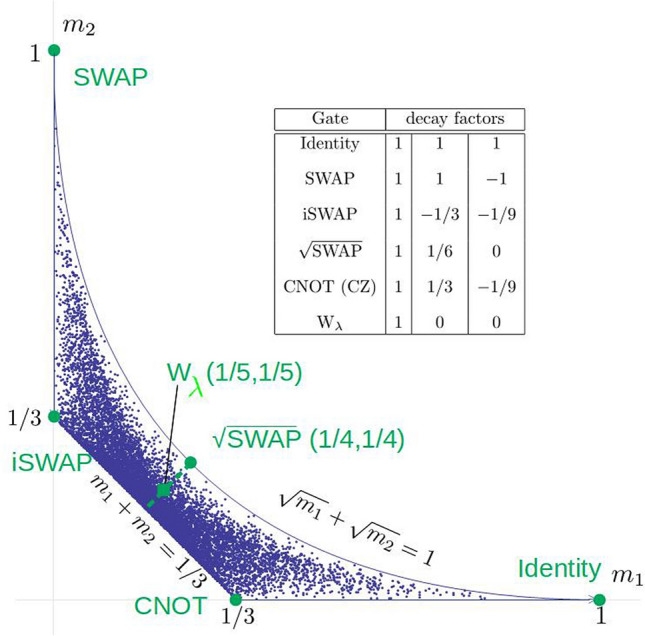
“(42) with the solid square showing the gate W especially suited for partial RB—with only a single decay factor (here cos π = −1/5 ), see discussion around Eq.”
Randomized benchmarking with confidence
Wallman, J. J., & Flammia, S. T. (2014) · New Journal of Physics · doi:10.1088/1367-2630/16/10/103032 · Cited by 164
Three-Qubit Randomized Benchmarking
McKay, D. C., Sheldon, S., Smolin, J. A., Chow, J. M., & Gambetta, J. M. (2019) · Physical Review Letters · doi:10.1103/physrevlett.122.200502 · Cited by 156 · cited 1×
“(31) G1 = tr2ω 16 , G2 = tr2ω − trω2 4 .”
Realization of a programmable two-qubit quantum processor
Hanneke, D., Home, J. P., Jost, J. D., Amini, J. M., Leibfried, D., & Wineland, D. J. (2010) · Nature Physics · doi:10.1038/nphys1453 · Cited by 150
Investigating the limits of randomized benchmarking protocols
Epstein, J. M., Cross, A. W., Magesan, E., & Gambetta, J. M. (2014) · Physical Review A · doi:10.1103/physreva.89.062321 · Cited by 135
Randomized Benchmarking of Multiqubit Gates
Gaebler, J. P., Meier, A. M., Tan, T. R., Bowler, R., Lin, Y., Hanneke, D., Jost, J. D., Home, J. P., Knill, E., Leibfried, D., et al. (2012) · Physical Review Letters · doi:10.1103/physrevlett.108.260503 · Cited by 127 · cited 4×
“(24) Spectrum of M : 1,m1 −m2, 5m1 + 5m2 − 2 3 .”
InfluentialDirect Randomized Benchmarking for Multiqubit Devices
Proctor, T. J., Carignan-Dugas, A., Rudinger, K., Nielsen, E., Blume-Kohout, R., & Young, K. (2019) · Physical Review Letters · doi:10.1103/physrevlett.123.030503 · Cited by 118
Entangling flux qubits with a bipolar dynamic inductance
Plourde, B. L. T., Zhang, J., Whaley, K. B., Wilhelm, F. K., Robertson, T. L., Hime, T., Linzen, S., Reichardt, P. A., Wu, C.-E., & Clarke, J. L. (2004) · Physical Review B · doi:10.1103/physrevb.70.140501 · Cited by 100
Gatemon Benchmarking and Two-Qubit Operations
Casparis, L., Larsen, T. W., Olsen, M. S., Kuemmeth, F., Krogstrup, P., Nygård, J., Petersson, K. D., & Marcus, C. M. (2016) · Physical Review Letters · doi:10.1103/physrevlett.116.150505 · Cited by 94
A new class of efficient randomized benchmarking protocols
Helsen, J., Xue, X., Vandersypen, L. M. K., & Wehner, S. (2019) · npj Quantum Information · doi:10.1038/s41534-019-0182-7 · Cited by 89 · cited 1×
“(39) μ = a+ b+ 3c 5 + (m1 −m2)(a− b) 2 10(1−m1 +m2) − 3(−2+ 5m1 + 5m2)(a+ b− 2c) 2 250(−1+m1 +m2) .”
Experimental Characterization of Crosstalk Errors with Simultaneous Gate Set Tomography
Rudinger, K., Hogle, C., Naik, R., Hashim, A., Lobser, D., Santiago, D., Grace, M., Nielsen, E., Proctor, T. J., Seritan, S., et al. (2021) · PRX Quantum · doi:10.1103/prxquantum.2.040338 · Cited by 86
Randomized Benchmarking for Individual Quantum Gates
Onorati, E., Werner, A. H., & Eisert, J. (2019) · Physical Review Letters · doi:10.1103/physrevlett.123.060501 · Cited by 65 · cited 4×
“(16), we obtain an error-free iteration matrix M0:”
InfluentialRandomized benchmarking with restricted gate sets
Brown, W. G., & Eastin, B. (2018) · Physical Review A · doi:10.1103/physreva.97.062323 · Cited by 41 · cited 1×
“(34) G2 = kx + ky + kz and |G1| = (2+ G(2) 2 − k(2))/8.”
Metric Structure of the Space of Two-Qubit Gates, Perfect Entanglers and Quantum Control
Watts, P., O'Connor, M., & Vala, J. (2013) · Entropy · doi:10.3390/e15061963 · Cited by 31
Improving the gate fidelity of capacitively coupled spin qubits
Wang, X., Barnes, E., & Sarma, S. D. (2015) · npj Quantum Information · doi:10.1038/npjqi.2015.3 · Cited by 24
Research works printed but not linked: 2
- Shor, P. W. Fault-tolerant quantum computation. In Proceedings of 37th Conference on Foundations of Computer Science, 56–65 (IEEE press, Los Alamitos, California, 1996).
- Meier, A. M. Randomized benchmarking of Clifford operators. Ph.D. thesis, University of Colorado at Boulder (2013).
Cited by
Simple formulation of no-cloning and no-hiding that admits efficient and robust verification
Girling, M., Cîrstoiu, C., & Jennings, D. (2024) · Physical Review Research · doi:10.1103/physrevresearch.6.023090 · Cited by 2
“A similar construction to the lower boundaries of this reversible CUP set appears in the context of interleaved fidelity randomized benchmarking [61].”
Metadata
- Authors
- Dubovitskii, K., & Makhlin, Y.
- Affiliations
- Moscow Institute of Physics and Technology (RU)
- National Research University Higher School of Economics (RU)
- Corresponding author
- Makhlin, Yuriy
- Venue
- Scientific Reports
- Published
- 2022-06-16
- Volume
- 12
- Issue
- 1
- Pages
- 10129-10129
- ISSN
- 2045-2322 (ISSN-L)
- PMC
- PMC9203587
- OpenAlex
- W4282961692
- Cited by
- 1
- References
- 47
- Citations by year
- 2024: 1
- FWCI
- 0.08
- Type
- journal article
- Language
- en
- Open access
- gold
- doi.org
- Licence
- cc-by
- creativecommons.org/licenses/by/4.0 (tdm)
- creativecommons.org/licenses/by/4.0 (vor)
- Locations
- Scientific Reports (publishedVersion, cc-by)
- PubMed Central (publishedVersion, cc-by)
- PubMed (publishedVersion)
- arXiv (Cornell University) (submittedVersion)
- DOAJ (DOAJ: Directory of Open Access Journals) (submittedVersion, cc-by-sa)
- arXiv (Cornell University)
- Funders
- Basic research program of HSE
- Topics
- Physical Sciences › Computer Science › Artificial Intelligence › Quantum Computing Algorithms and Architecture
- Physical Sciences › Physics and Astronomy › Atomic and Molecular Physics, and Optics › Quantum Information and Cryptography
- Physical Sciences › Physics and Astronomy › Atomic and Molecular Physics, and Optics › Quantum many-body systems
- Keywords
- gate fidelity, two-qubit gates, exponential decay rate
About these checks
Registry, retraction, Cites and statistics results are computed, not judged, with one exception: a printed reference that no index lists is read once by a model before it counts as a citation error. Claims are extracted by a model and kept only when their quote appears verbatim in the text; each cited source is then checked, with a model’s help, for whether it says what the claim relies on. Those verdicts can be wrong — read the claim’s quote and the cited source before relying on one.
Statistics and arithmetic are recomputed, not judged.
Confidence bands are shown only for fields calibrated on our annotated test set. None is calibrated yet, so no band is shown.
What counts as a claim ›How we measure confidence ›How we check this ›
Are you an author, or do you see a problem with this page? Request a review
Data sources
Bibliographic data: Semantic Scholar, OpenAlex, Crossref.
Contains information from the Semantic Scholar Academic Graph Datasets, made available under the ODC Attribution License (ODC-BY 1.0).
Semantic Scholar’s data is described in: Kinney, R., et al. (2023). The Semantic Scholar Open Data Platform. arXiv:2301.10140.
