

A computational model of inner speech supporting flexible goal-directed behaviour in Autism
Open accessThe DOI matches its Crossref record; 76 of the 78 references it cites were found in a registry or an index.
Abstract
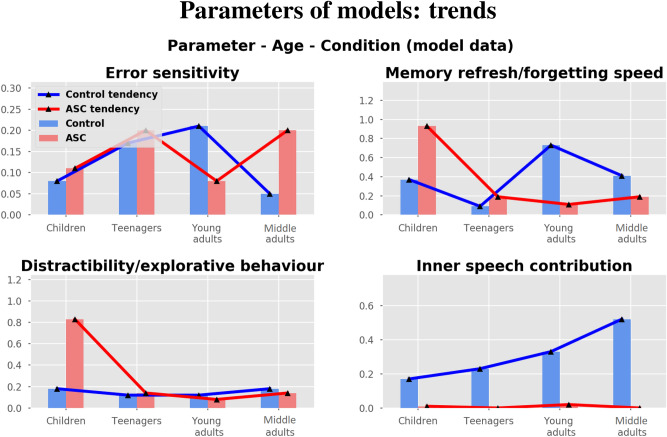
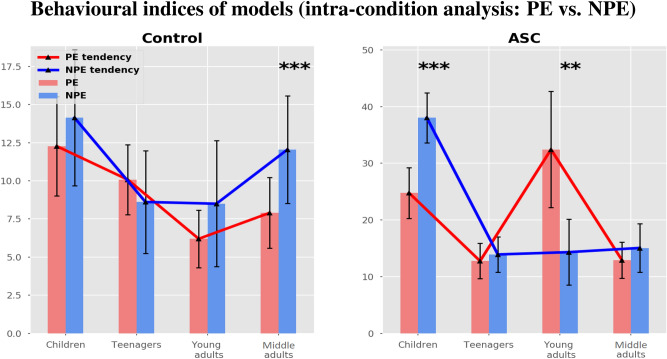
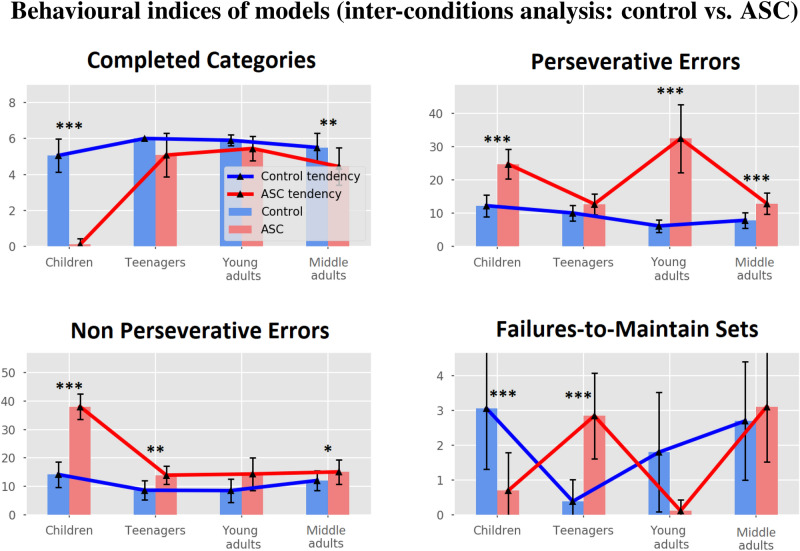
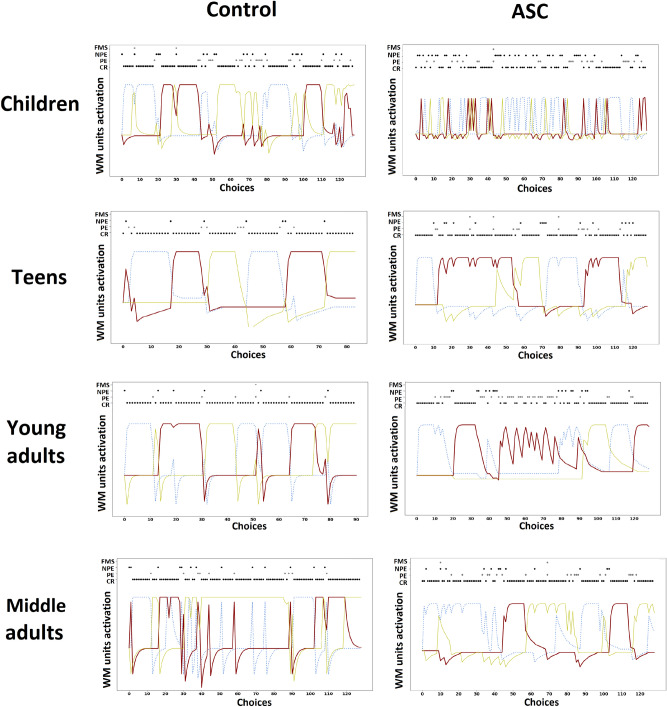
Experimental and computational studies propose that inner speech boosts categorisation skills and executive functions, making human behaviour more focused and flexible. In addition, many clinical studies highlight a relationship between poor inner-speech and an executive impairment in autism spectrum condition (ASC), but contrasting findings are reported. Here we directly investigate the latter issue through a previously implemented and validated computational model of the Wisconsin Cards Sorting Tests. In particular, the model was applied to explore potential individual differences in cognitive flexibility and inner speech contribution in autistic and neurotypical participants. Our model predicts that the use of inner-speech could increase along the life-span of neurotypical participants but would be reduced in autistic ones. Although we found more attentional failures (i.e., wrong behavioural rule switches) in autistic children/teenagers and more perseverative behaviours in autistic young/older adults, only autistic children and older adults exhibited a lower performance (i.e., fewer consecutive correct rule switches) than matched control groups. Overall, our results corroborate the idea that the reduced use of inner speech could represent a disadvantage for autistic children and autistic older adults. Moreover, the results suggest that cognitive-behavioural therapies should focus on developing inner speech skills in autistic children as this could provide cognitive support throughout their whole life span.
Overview
The claims and statistics of this paper haven’t been checked yet.
Free: it reads the open-access text and checks the first 5 claims that cite a source we can check. Create a free account to check every claim.
Integrity signals
Registry
Cites
Statistics
Figures
Verification
Claims the paper makes
The claims and statistics of this paper haven’t been checked yet.
Free: it reads the open-access text and checks the first 5 claims that cite a source we can check. Create a free account to check every claim.
Self-check
Percentages, sums and reported differences re-computed from the paper’s own numbers.
The self-check needs the paper’s full text.
Citations
Cites
Diagnostic and Statistical Manual of Mental Disorders
American Psychiatric Association (2013) · doi:10.1176/appi.books.9780890425596 · Cited by 116,369
Ror2 signaling regulates Golgi structure and transport through IFT20 for tumor invasiveness
Nishita, M., Park, S.-Y., Nishio, T., Kamizaki, K., Wang, Z., Tamada, K., Takumi, T., Hashimoto, R., Otani, H., Pazour, G. J., et al. (2017) · Scientific Reports · doi:10.1038/s41598-016-0028-x · Cited by 15,947
Diamond, A. (2013) · Annual Review of Psychology · doi:10.1146/annurev-psych-113011-143750 · Cited by 13,268
Metacognition and cognitive monitoring: A new area of cognitive–developmental inquiry
Flavell, J. H. (1979) · American Psychologist · doi:10.1037/0003-066x.34.10.906 · Cited by 11,282 · cited 1×
“Indeed, classical literature considered metacognition mainly as a form of ‘thinking about thinking’ 46 .”
Baddeley, A. (1992) · Science · doi:10.1126/science.1736359 · Cited by 5,258
Enhanced Perceptual Functioning in Autism: An Update, and Eight Principles of Autistic Perception
Mottron, L., Dawson, M., Soulières, I., Hubert, B., & Burack, J. (2006) · Journal of Autism and Developmental Disorders · doi:10.1007/s10803-005-0040-7 · Cited by 1,957 · cited 1×
“Indeed in autistic teenagers and young adults, compensating processes could emerge (e.g., higher visual skills and visual thinking with respect to neurotypical peoples 77–79 ).”
Tomasello, M., Kruger, A. C., & Ratner, H. H. (1993) · Behavioral and Brain Sciences · doi:10.1017/s0140525x0003123x · Cited by 1,891
Top-down modulation: bridging selective attention and working memory
Gazzaley, A., & Nobre, A. C. (2012) · Trends in Cognitive Sciences · doi:10.1016/j.tics.2011.11.014 · Cited by 1,404 · cited 1×
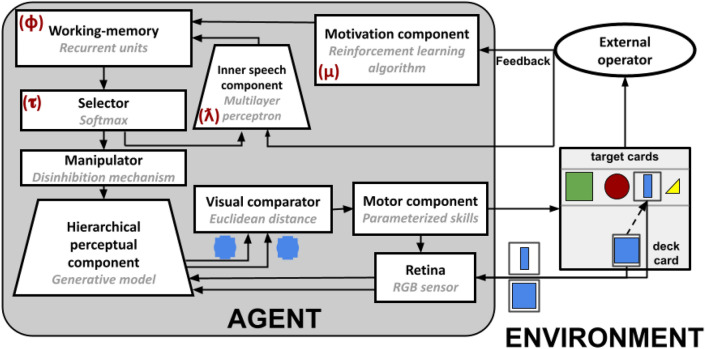
“The selector and manipulator functions reflect the top-down control that the fronto-parietal cortex and basal ganglia exert on the perceptual cortices 37,38 .”
The basal ganglia: a vertebrate solution to the selection problem?
Redgrave, P., Prescott, T. J., & Gurney, K. (1999) · Neuroscience · doi:10.1016/s0306-4522(98)00319-4 · Cited by 1,199 · cited 1×
“The selector and manipulator functions reflect the top-down control that the fronto-parietal cortex and basal ganglia exert on the perceptual cortices 37,38 .”
Gläscher, J., Daw, N., Dayan, P., & O'Doherty, J. P. (2010) · Neuron · doi:10.1016/j.neuron.2010.04.016 · Cited by 1,166 · cited 1×
“A motivational component exploits the external feedback to update the information in working memory, emulating the ventral basal ganglia 35,36 .”
Research works printed but not linked: 6
- Kosslyn, S. M. Image and Brain 4th edn. (The MIT Press, Cambridge, MA, 1999).
- Proust J Metacognition and mindreading: One or two functions Found. Metacogn.. 2012 234 51
- Cabeza R Dennis NA Frontal lobes and aging: Deterioration and compensation Princ. Frontal Lobe Funct. 2012 2 628 52
- Daselaar S Cabeza R Ochsne K Kosslyn S Age-related decline in working memory and episodic memory: Contributions of the prefrontal cortex and medial temporal lobes Oxf. Handb. Cogn. Neurosci. 2013 1 456 72
- John-Steiner V. Private Speech Among Adults. In Private Speech 295–306. (Psychology Press, 2014).
- Fernandes FDM Amato CADLH Molini-Avejonas DR Language therapy results with children of the autism spectrum Rev. Logopedia 2021 32 1 2 6
Cited by
Inner speech as language process and cognitive tool
Fernyhough, C., & Borghi, A. M. (2023) · Trends in Cognitive Sciences · doi:10.1016/j.tics.2023.08.014 · Cited by 101
“The model also reproduced experimental findings that autistic children (Box 4) and older adults (but not younger adults) show poorer performance than controls in rule-switching [59].”
ResultSelf-citationAbstract concepts: external influences, internal constraints, and methodological issues
Borghi, A. M., Shaki, S., & Fischer, M. H. (2022) · Psychological Research · doi:10.1007/s00426-022-01698-4 · Cited by 55
Self-citationFrom Affordances to Abstract Words: The Flexibility of Sensorimotor Grounding
Mazzuca, C., Fini, C., Michalland, A. H., Falcinelli, I., Rold, F. D., Tummolini, L., & Borghi, A. M. (2021) · Brain Sciences · doi:10.3390/brainsci11101304 · Cited by 53
Self-citationWhat can neurodiversity tell us about inner speech, and vice versa? A theoretical perspective
Alderson‐Day, B., & Pearson, A. (2023) · Cortex · doi:10.1016/j.cortex.2023.08.008 · Cited by 30
Granato, G., & Baldassarre, G. (2024) · Neural Networks · doi:10.1016/j.neunet.2024.106292 · Cited by 12
Self-citationGranato, G., Costanzo, R., Borghi, A. M., Mattera, A., Carruthers, S. P., Rossell, S. L., & Baldassarre, G. (2025) · Scientific Reports · doi:10.1038/s41598-025-89555-3 · Cited by 9
Self-citationGranato, G., Manzi, G., Giulio, J. D., Puzzo, C., Mattera, A., Adriani, W., Baldassarre, G., & Capobianco, M. (2025) · Frontiers in Behavioral Neuroscience · doi:10.3389/fnbeh.2025.1655310 · Cited by 7
Self-citationGranato, G., Mattera, A., Cartoni, E., & Baldassarre, G. (2026) · Scientific Reports · doi:10.1038/s41598-026-37612-w · Cited by 4
Self-citationModerate Empiricism and Machine Learning
Buckner, C. J. (2023) · Oxford University Press eBooks · doi:10.1093/oso/9780197653302.003.0001 · Cited by 2
Granato, G., Costanzo, R., Borghi, A. M., Mattera, A., Carruthers, S. P., Rossell, S. L., & Baldassarre, G. (2023) · PsyArXiv (OSF Preprints) · doi:10.31234/osf.io/n68yr · Cited by 2
Self-citationGranato, G., Giulio, J. D., Manzi, G., Puzzo, C., Mattera, A., Giocondo, F., Adriani, W., Capobianco, M., & Baldassarre, G. (2026) · Scientific Reports · doi:10.1038/s41598-026-75754-z · Cited by 1
Self-citationRethinking Inner Speech through Linguistic Active InferencePreprint
Yao, B. (2025) · PsyArXiv (OSF Preprints) · doi:10.31234/osf.io/b5ykj_v1 · Cited by 1
Granato, G., & Baldassarre, G. (2019) · arXiv (Cornell University) · doi:10.48550/arxiv.1912.13490 · Cited by 2
Self-citationNote on Abbreviated Citations to Historical Works
Buckner, C. J. (2023) · Oxford University Press eBooks · doi:10.1093/oso/9780197653302.002.0008
Buckner, C. J. (2023) · Oxford University Press eBooks · doi:10.1093/oso/9780197653302.003.0008
Buckner, C. J. (2023) · Oxford University Press eBooks · doi:10.1093/oso/9780197653302.003.0005
Buckner, C. J. (2023) · Oxford University Press eBooks · doi:10.1093/oso/9780197653302.003.0004
Buckner, C. J. (2023) · Oxford University Press eBooks · doi:10.1093/oso/9780197653302.002.0007
Buckner, C. J. (2023) · Oxford University Press eBooks · doi:10.1093/oso/9780197653302.003.0006
Buckner, C. J. (2023) · Oxford University Press eBooks · doi:10.1093/oso/9780197653302.003.0003
Buckner, C. J. (2023) · Oxford University Press eBooks · doi:10.1093/oso/9780197653302.002.0003
Buckner, C. J. (2023) · Oxford University Press eBooks · doi:10.1093/oso/9780197653302.003.0007 · Cited by 1
What Is Deep Learning, and How Should We Evaluate Its Potential?
Buckner, C. J. (2023) · Oxford University Press eBooks · doi:10.1093/oso/9780197653302.003.0002
Buckner, C. J. (2023) · Oxford University Press eBooks · doi:10.1093/oso/9780197653302.002.0004
Rethinking Inner Speech through Linguistic Active InferencePreprint
Yao, B. (2025) · PsyArXiv (OSF Preprints) · doi:10.31234/osf.io/b5ykj_v2
Echoes of Thought: Task Complexity, Inner Speech Analogs, and Prompt Design Shape LLMs' ResponsePreprint
Usée, F., & Schad, D. J. (2026) · PsyArXiv (OSF Preprints) · doi:10.31234/osf.io/mgq9r_v4
Inability to Control Inner Speech Linked to Negative Mental Health
Yan, X., Nedergaard, J., Waade, P. T., Mathys, C. D., Lœvenbruck, H., Lupyan, G., & Wallentin, M. (2026)
INNER SPEECH SEBAGAI MEKANISME REFLEKTIF DALAM KOGNISI MANUSIA: SEBUAH NARRATIVE REVIEW
Puspitasati, A. Y., Imanuel, D., & Evanytha, E. (2026) · PAEDAGOGY Jurnal Ilmu Pendidikan dan Psikologi · doi:10.51878/paedagogy.v6i4.16270
Metadata
- Authors
- Granato, G., Borghi, A. M., Mattera, A., & Baldassarre, G.
- Affiliations
- National Research Council (IT)
- Corresponding author
- Granato, Giovanni
- Venue
- Scientific Reports
- Published
- 2022-08-20
- Volume
- 12
- Issue
- 1
- Pages
- 14198-14198
- ISSN
- 2045-2322 (ISSN-L)
- PMC
- PMC9392752
- OpenAlex
- W4292487264
- Cited by
- 8
- References
- 77
- Citations by year
- 2026: 1 · 2025: 2 · 2024: 1 · 2023: 4
- FWCI
- 0.90
- Type
- journal article
- Language
- en
- Open access
- gold
- doi.org
- Licence
- cc-by
- creativecommons.org/licenses/by/4.0 (tdm)
- creativecommons.org/licenses/by/4.0 (vor)
- Locations
- Scientific Reports (publishedVersion, cc-by)
- PubMed Central (publishedVersion, cc-by)
- PubMed (publishedVersion)
- IRIS Research product catalog (Sapienza University of Rome) (submittedVersion, cc-by)
- DOAJ (DOAJ: Directory of Open Access Journals) (submittedVersion, cc-by-sa)
- Funders
- Horizon 2020 Framework Programme (713010)
- Topics
- Life Sciences › Neuroscience › Cognitive Neuroscience › Autism Spectrum Disorder Research
- Social Sciences › Psychology › Developmental and Educational Psychology › Child and Animal Learning Development
- Social Sciences › Psychology › Social Psychology › Social Representations and Identity
- Keywords
- inner speech, autism spectrum disorder, cognitive flexibility, executive function, Wisconsin Card Sorting Test, computational model, perseveration, rule switching, individual differences, lifespan development, cognitive behavioral therapy
- MeSH terms
- Autism Spectrum Disorder, Adolescent, Aged, Autistic Disorder, Child, Goals, Humans, Speech, Speech Disorders
About these checks
Registry, retraction, Cites and statistics results are computed, not judged, with one exception: a printed reference that no index lists is read once by a model before it counts as a citation error. Claims are extracted by a model and kept only when their quote appears verbatim in the text; each cited source is then checked, with a model’s help, for whether it says what the claim relies on. Those verdicts can be wrong — read the claim’s quote and the cited source before relying on one.
Statistics and arithmetic are recomputed, not judged.
Confidence bands are shown only for fields calibrated on our annotated test set. None is calibrated yet, so no band is shown.
What counts as a claim ›How we measure confidence ›How we check this ›
Are you an author, or do you see a problem with this page? Request a review
Data sources
Bibliographic data: Semantic Scholar, OpenAlex, Crossref.
Contains information from the Semantic Scholar Academic Graph Datasets, made available under the ODC Attribution License (ODC-BY 1.0).
Semantic Scholar’s data is described in: Kinney, R., et al. (2023). The Semantic Scholar Open Data Platform. arXiv:2301.10140.
