

Utility of fatty acid profile and in vitro immune cell activation for chemical and biological standardization of Arthrospira/Limnospira
Open accessThe DOI matches its Crossref record; 34 of the 34 references it cites were found in a registry or an index.
Abstract
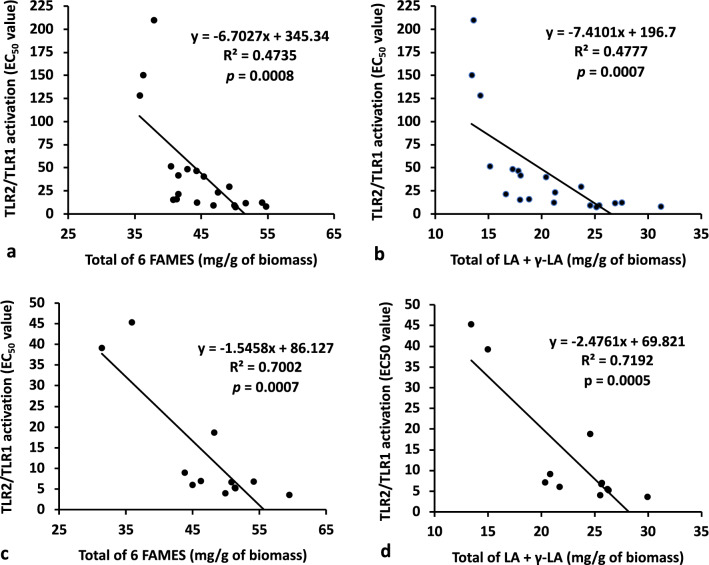
Commercially cultivated Limnospira (species formerly classified to genus Arthrospira) is a popular food/supplement consumed by millions of people worldwide for health benefits. The objective of the current research was to advance the standardization technology for Limnospira. Quantitative methods were established to detect fatty acids as potential chemical markers and immune-enhancing activity. Analysis of 20 different batches of biomass obtained from one commercial grower demonstrated that there was a statistically significant relationship between the sum of two fatty acids (linoleic and γ-linolenic) and Toll-like receptor (TLR)2/TLR1-dependent activation (R2 = 0.48, p = 0.0007). Investigation of 12 biomass samples sourced from growers in 10 different countries demonstrated that fatty acid content was again significantly correlated with biological activity (R2 = 0.72, p = 0.0005) and the content of fatty acids varied by twofold and activity by 12.5-fold. This large variation between different samples confirms the need to use the present standardization methods to ensure consistent and properly characterized biomass for consumers and for future scientific research.
Overview
The claims and statistics of this paper haven’t been checked yet.
Free: it reads the open-access text and checks the first 5 claims that cite a source we can check. Create a free account to check every claim.
Integrity signals
Registry
Cites
Statistics
Figures
Verification
Claims the paper makes
The claims and statistics of this paper haven’t been checked yet.
Free: it reads the open-access text and checks the first 5 claims that cite a source we can check. Create a free account to check every claim.
Claims other papers make about this one
Each is checked against this paper’s own text: does it say what the citing paper says it does?
The cited source says what the claim attributes to it.
In the citing paper
“FA content varies by two times, while activity varies by 12.5.”
From Spirulina/Arthrospira/Limnospira—Three Names of the Single Organism (2024) · cites this paper as [104]
The cited source says what the claim attributes to it.
In the citing paper
“A study of 12 biomass samples obtained from producers in 10 countries found an important connection between FA content (primarily linoleic and γ-linolenic acids) and biological (immune-stimulating) activity.”
From Spirulina/Arthrospira/Limnospira—Three Names of the Single Organism (2024) · cites this paper as [104]
Self-check
Percentages, sums and reported differences re-computed from the paper’s own numbers.
The self-check needs the paper’s full text.
Citations
Cites
16S ribosomal DNA amplification for phylogenetic study
Weisburg, W. G., Barns, S. M., Pelletier, D. A., & Lane, D. J. (1991) · Journal of Bacteriology · doi:10.1128/jb.173.2.697-703.1991 · Cited by 11,934
PCR primers to amplify 16S rRNA genes from cyanobacteria
Nübel, U., Garcia-Pichel, F., & Muyzer, G. (1997) · Applied and Environmental Microbiology · doi:10.1128/aem.63.8.3327-3332.1997 · Cited by 1,513
A call for transparent reporting to optimize the predictive value of preclinical research
Landis, S. C., Amara, S. G., Asadullah, K., Austin, C. P., Blumenstein, R., Bradley, E. W., Crystal, R. G., Darnell, R. B., Ferrante, R. J., Fillit, H., et al. (2012) · Nature · doi:10.1038/nature11556 · Cited by 1,196
Spirulina, the edible microorganism.
Ciferri, O. (1983) · Microbiological Reviews · doi:10.1128/mmbr.47.4.551-578.1983 · Cited by 745
Taton, A., Grubisic, S., Brambilla, E., De Wit, R., & Wilmotte, A. (2003) · Applied and Environmental Microbiology · doi:10.1128/aem.69.9.5157-5169.2003 · Cited by 475
Hantke, K., & Braun, V. (1973) · European Journal of Biochemistry · doi:10.1111/j.1432-1033.1973.tb02757.x · Cited by 444
Microalgae for “Healthy” Foods-Possibilities and Challenges
Chacón‐Lee, T. L., & González‐Mariño, G. E. (2010) · Comprehensive Reviews in Food Science and Food Safety · doi:10.1111/j.1541-4337.2010.00132.x · Cited by 428
Fatty Acid Composition of Chlorella and Spirulina Microalgae Species
Ötleş, S., & Pire, R. (2001) · Journal of AOAC INTERNATIONAL · doi:10.1093/jaoac/84.6.1708 · Cited by 255 · cited 1×
“Methyl α-linolenate was also evaluated since this fatty acid was included in the USP method 13,19 and it also served as a marker for detection of chlorella contamination 24,39,40 .”
Lipoproteins in bacteria: structures and biosynthetic pathways
Nakayama, H., Kurokawa, K., & Lee, B. L. (2012) · The FEBS Journal · doi:10.1111/febs.12041 · Cited by 230 · cited 1×
“Therefore, the presence of triacylated lipoproteins in Limnospira is consistent with the literature that this lipoprotein structure is also the most common type found in gram-negative bacteria 29 .”
Lipoproteins of Gram-Positive Bacteria: Key Players in the Immune Response and Virulence
Nguyen, M. T., & Götz, F. (2016) · Microbiology and Molecular Biology Reviews · doi:10.1128/mmbr.00028-16 · Cited by 190 · cited 1×
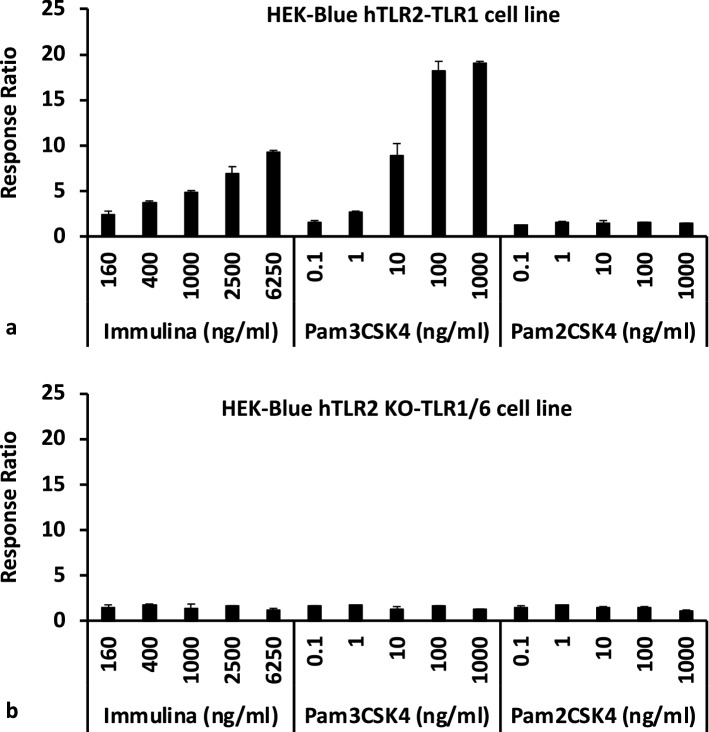
“Research over the past few decades has established the presence of these molecules in both Gram-negative and Gram-positive bacteria and determined that they are potent activators of immune cells through a Toll-like receptor (TLR)2-dependent pathway 26 .”
Nowicka-Krawczyk, P., Mühlsteinová, R., & Hauer, T. (2019) · Scientific Reports · doi:10.1038/s41598-018-36831-0 · Cited by 185
Self-citationDairy farm wastewater treatment and lipid accumulation by Arthrospira platensis
Hena, S., Znad, H. T., Heong, K. T., & Judd, S. J. (2017) · Water Research · doi:10.1016/j.watres.2017.10.057 · Cited by 150
Potential health benefits of spirulina microalgae*: A review of the existing literature
Capelli, B., & Cysewski, G. R. (2010) · Nutrafoods · doi:10.1007/bf03223332 · Cited by 147
The relevance of pharmacognosy in pharmacological research on herbal medicinal products
Pferschy‐Wenzig, E., & Bauer, R. (2015) · Epilepsy & Behavior · doi:10.1016/j.yebeh.2015.05.037 · Cited by 147 · cited 1×
“Similar to the variability observed for other botanicals 30 , our analysis of these commercial biomass samples demonstrated a twofold variation in total fatty acid content and a 12.5-fold variation in TLR2/TLR1-dependent activity (Table 1).”
InfluentialVariation in fatty acid composition of Arthrospira (Spirulina) strains
Mühling, M., Belay, A., & Whitton, B. A. (2005) · Journal of Applied Phycology · doi:10.1007/s10811-005-7213-9 · Cited by 136 · cited 2×
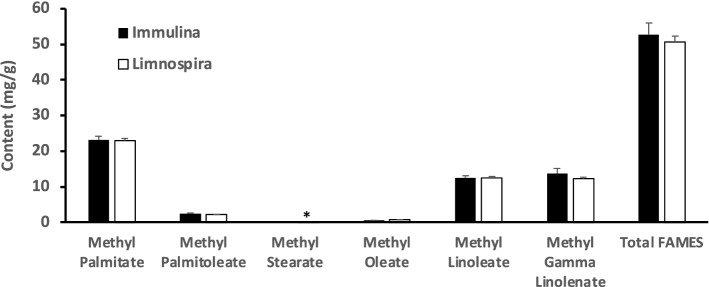
“As reported earlier 18,19 , the methyl esters of corresponding palmitic, linoleic, and γ-linolenic acids (γ-LA) were identified as dominant fatty acids, along with palmitoleic, stearic, and oleic acids as minor constituents in the dried biomass reference material (Supplementary Fig.”
Cavonius, L. R., Carlsson, N.-G., & Undeland, I. (2014) · Analytical and Bioanalytical Chemistry · doi:10.1007/s00216-014-8155-3 · Cited by 132
In situ transesterification of highly wet microalgae using hydrochloric acid
Kim, B., Im, H., & Lee, J. W. (2015) · Bioresource Technology · doi:10.1016/j.biortech.2015.02.092 · Cited by 125
Self-citationFatty acid composition of Spirulina strains grown under various environmental conditions
Cohen, Z., Vonshak, A., & Richmond, A. (1987) · Phytochemistry · doi:10.1016/s0031-9422(00)84694-4 · Cited by 118 · cited 4×
“As reported earlier 18,19 , the methyl esters of corresponding palmitic, linoleic, and γ-linolenic acids (γ-LA) were identified as dominant fatty acids, along with palmitoleic, stearic, and oleic acids as minor constituents in the dried biomass reference material (Supplementary Fig.”
InfluentialSüsswasserflora von mitteleuropa
Luther, H. U. (1979) · Aquatic Botany · doi:10.1016/0304-3770(79)90063-9 · Cited by 111
Balachandran, P., Pugh, N. D., Ma, G., & Pasco, D. S. (2006) · International Immunopharmacology · doi:10.1016/j.intimp.2006.08.001 · Cited by 109 · cited 1×
“This was previously demonstrated using two different approaches 28 .”
Self-citationShipkowski, K. A., Betz, J. M., Birnbaum, L. S., Bucher, J. R., Coates, P. M., Hopp, D. C., MacKay, D., Oketch‐Rabah, H. A., Walker, N. J., Welch, C., et al. (2018) · Food and Chemical Toxicology · doi:10.1016/j.fct.2018.04.007 · Cited by 81
Ratha, S. K., Renuka, N., Rawat, I., & Bux, F. (2021) · Nutrition · doi:10.1016/j.nut.2020.111089 · Cited by 70
Measurement of cytokines by bioassays: Theory and application
Meager, A. (2006) · Methods · doi:10.1016/j.ymeth.2005.11.005 · Cited by 65
Molecular species composition of glycolipids from Sprirulina platensis
Xue, C., Hu, Y., Saito, H., Zhang, Z., Li, Z., Yuepiao, C., Ou, C., Lin, H., & Imbs, A. B. (2002) · Food Chemistry · doi:10.1016/s0308-8146(01)00315-6 · Cited by 63 · cited 2×
“…digalactosyl diacylglycerol (MGDG, DGDG) and sulfolipid sulfoquinovosyl diacylglycerol (SQDG) from S pirulina platensis published by Xue et al. 20 (in which palmitic, linoleic and γ-LA were identified as major fatty acids) as well as the lipid profile of Limnospira biomass reported in the…”
Piersen, C. E., Booth, N., Sun, Y., Liang, W., Burdette, J. E., van Breemen, R. B., GELLER, S. E., Gu, C., Banuvar, S., SHULMAN, L. P., et al. (2004) · Current Medicinal Chemistry · doi:10.2174/0929867043365134 · Cited by 59
Nielsen, C., Balachandran, P., Christensen, O., Pugh, N., Tamta, H., Sufka, K., Wu, X., Walsted, A., Schjørring-Thyssen, M., Enevold, C., et al. (2010) · Planta Medica · doi:10.1055/s-0030-1250043 · Cited by 56 · cited 1×
“Our previous research determined that this class of lipoproteins fully accounts for the in vitro monocyte/macrophage stimulatory activity exhibited by Limnospira 14 .”
Self-citationLjubić, A., Safafar, H., Holdt, S. L., & Jacobsen, C. (2017) · Journal of Applied Phycology · doi:10.1007/s10811-017-1332-y · Cited by 51 · cited 1×
“…diacylglycerol (MGDG, DGDG) and sulfolipid sulfoquinovosyl diacylglycerol (SQDG) from S pirulina platensis published by Xue et al. 20 (in which palmitic, linoleic and γ-LA were identified as major fatty acids) as well as the lipid profile of Limnospira biomass reported in the literature 19,21–23 .”
Pugh, N. D., Edwall, D., Lindmark, L., Kousoulas, K. G., Iyer, A. V., Haron, M. H., & Pasco, D. S. (2014) · Phytomedicine · doi:10.1016/j.phymed.2014.12.006 · Cited by 49
Self-citationBest Practices in Bioassay Development to Support Registration of Biopharmaceuticals
White, J. R., Abodeely, M., Ahmed, S., Debauve, G., Johnson, E., Meyer, D. M., Mozier, N. M., Naumer, M., Pepe, A., Qahwash, I. M., et al. (2019) · BioTechniques · doi:10.2144/btn-2019-0031 · Cited by 42 · cited 1×
“Selecting an appropriate in vitro bioassay for biological standardization is driven based on the product’s mechanism of action 27 .”
Selection and authentication of botanical materials for the development of analytical methods
Applequist, W. L., & Miller, J. S. (2013) · Analytical and Bioanalytical Chemistry · doi:10.1007/s00216-012-6595-1 · Cited by 41
Ragaza (2020) · doi:10.1007/s00449-016-1726-2 · Cited by 41
Mühlsteinová, R., Hauer, T., Ley, P. D., & Pietrasiak, N. (2018) · Preslia · doi:10.23855/preslia.2018.151 · Cited by 41
Self-citationBiological and chemical standardization of a hop (Humulus lupulus) botanical dietary supplement
Krause, E. C., Yang, Y., Hajirahimkhan, A., Dong, H., Dietz, B. M., Nikolic, D. S., Pauli, G. F., Bolton, J. L., & van Breemen, R. B. (2014) · Biomedical Chromatography · doi:10.1002/bmc.3177 · Cited by 31 · cited 1×
“The value of this combination approach has been highlighted for other botanicals such as hops ( Humulus lupulus ) 31 and red clover ( Trifolium pratense ) 32 .”
Tudor, C., Gherasim, E. C., Dulf, F. V., & Pintea, A. (2021) · Food Science & Nutrition · doi:10.1002/fsn3.2150 · Cited by 24
Research works printed but not linked: 4
- Tomaselli L Palandri RM Tredici MR On the correct use of the Spirulina designation Algol. Stud. Archiv für Hydrobiol. 1996 83 539 548
- Komárek J Lund JW What is «Spirulina platensis» in fact? Algol. Stud. Archiv für Hydrobiologie 1990 85 1 13
- Ahsan, M., Habib, B., Parvin, M., Huntington, T. C. & Hasan, M. R. A review on culture, production and use of spirulina as food for humans and feeds for domestic animals (2008).
- Gomont, M. A. Monographie des Oscillariées:(Nostacacées Homocystées). Vol. 15 (Masson, 1893).
Cited by
Spirulina/Arthrospira/Limnospira—Three Names of the Single Organism
Sinetova, M. A., Kupriyanova, E. V., & Los, D. A. (2024) · Foods · doi:10.3390/foods13172762 · Cited by 51
“Quantitative methods have been developed for identifying FAs as potential chemical markers of immune-enhancing activity [104].”
MethodChwil, M., Mihelič, R., Matraszek, R., Terlecka, P., Skoczylas, M. M., & Terlecki, K. (2024) · Pharmaceuticals · doi:10.3390/ph17101321 · Cited by 41
“Inappropriate storage of spirulina affects its quality and the technological process of spirulina biomass production causes the loss of some pro-health active chemical compounds [216].”
BackgroundBanerjee, S., Lahiri, R., Choudhury, A. K., Mondal, A., Kim, J., MubarakAli, D., & Satpati, G. G. (2024) · Biocatalysis and Agricultural Biotechnology · doi:10.1016/j.bcab.2024.103421 · Cited by 13
Fahrion, J., Renaud, C., Coninx, I., Heylen, W., Mastroleo, F., Gupta, S., Bayon-Vicente, G., Wattiez, R., Leys, N., & Dussap, C. (2024) · Acta Astronautica · doi:10.1016/j.actaastro.2024.11.010 · Cited by 7
Immulina as an Immunostimulatory Supplement: Formulation and Pharmacological Studies
Li, Y., Ji, N., Wang, M., Pugh, N. D., Khan, I. A., & Tan, C. (2023) · Planta Medica · doi:10.1055/a-2156-4653 · Cited by 3
Self-citation
Metadata
- Authors
- Huh, J., Zhang, J., Hauerová, R., Lee, J., Haider, S., Wang, M., Hauer, T., Khan, I. A., Chittiboyina, A. G., & Pugh, N. D.
- Affiliations
- University of Mississippi (US)
- University of South Bohemia in České Budějovice (CZ)
- Agricultural Research Service (US)
- Corresponding author
- Chittiboyina, Amar G.
- Pugh, Nirmal D.
- ORCID
- Venue
- Scientific Reports
- Published
- 2022-09-19
- Volume
- 12
- Issue
- 1
- Pages
- 15657-15657
- ISSN
- 2045-2322 (ISSN-L)
- PMC
- PMC9485217
- OpenAlex
- W4296365698
- Cited by
- 14
- References
- 34
- Citations by year
- 2025: 1 · 2024: 10 · 2023: 3
- FWCI
- 2.38
- Type
- journal article
- Language
- en
- Open access
- gold
- doi.org
- Licence
- cc-by
- creativecommons.org/licenses/by/4.0 (tdm)
- creativecommons.org/licenses/by/4.0 (vor)
- Locations
- Scientific Reports (publishedVersion, cc-by)
- PubMed Central (publishedVersion, cc-by)
- PubMed (publishedVersion)
- DOAJ (DOAJ: Directory of Open Access Journals) (submittedVersion, cc-by-sa)
- Funders
- National Institutes of Health (U19AT010838)
- Agricultural Research Service (58-6060-6-015)
- Topics
- Life Sciences › Agricultural and Biological Sciences › Aquatic Science › Seaweed-derived Bioactive Compounds
- Health Sciences › Nursing › Nutrition and Dietetics › Fatty Acid Research and Health
- Physical Sciences › Energy › Renewable Energy, Sustainability and the Environment › Algal biology and biofuel production
- Keywords
- Arthrospira, Spirulina, fatty acid composition, linoleic acid, gamma-linolenic acid, immune cell activation, TLR2, TLR1, chemical markers, product standardization, dietary supplements
- MeSH terms
- Fatty Acids, Humans, Reference Standards, Toll-Like Receptor 1, Toll-Like Receptor 2, Spirulina
About these checks
Registry, retraction, Cites and statistics results are computed, not judged, with one exception: a printed reference that no index lists is read once by a model before it counts as a citation error. Claims are extracted by a model and kept only when their quote appears verbatim in the text; each cited source is then checked, with a model’s help, for whether it says what the claim relies on. Those verdicts can be wrong — read the claim’s quote and the cited source before relying on one.
Statistics and arithmetic are recomputed, not judged.
Confidence bands are shown only for fields calibrated on our annotated test set. None is calibrated yet, so no band is shown.
What counts as a claim ›How we measure confidence ›How we check this ›
Are you an author, or do you see a problem with this page? Request a review
Data sources
Bibliographic data: Semantic Scholar, OpenAlex, Crossref.
Contains information from the Semantic Scholar Academic Graph Datasets, made available under the ODC Attribution License (ODC-BY 1.0).
Semantic Scholar’s data is described in: Kinney, R., et al. (2023). The Semantic Scholar Open Data Platform. arXiv:2301.10140.
