

Deep language algorithms predict semantic comprehension from brain activity
Open accessThe DOI matches its Crossref record; 68 of the 68 references it cites were found in a registry or an index.
Abstract
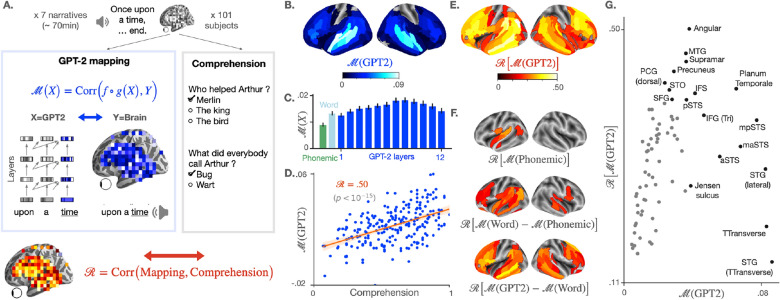
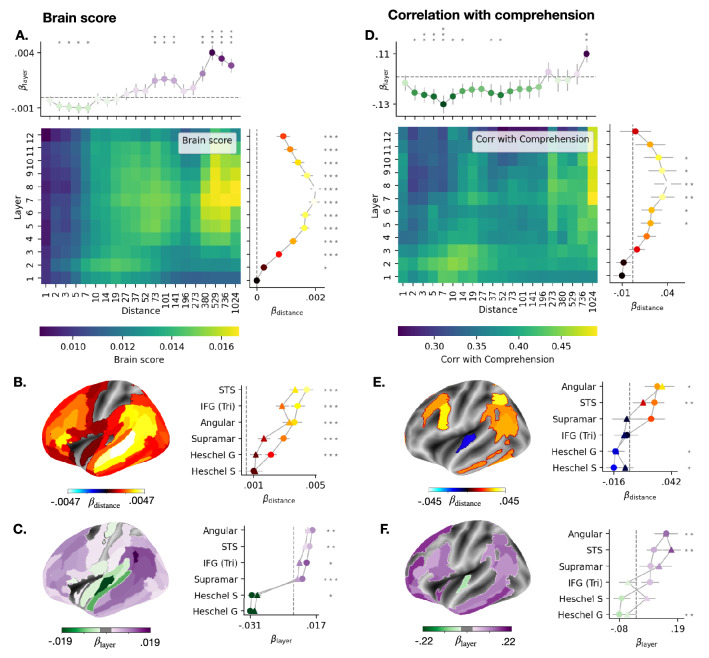
Deep language algorithms, like GPT-2, have demonstrated remarkable abilities to process text, and now constitute the backbone of automatic translation, summarization and dialogue. However, whether these models encode information that relates to human comprehension still remains controversial. Here, we show that the representations of GPT-2 not only map onto the brain responses to spoken stories, but they also predict the extent to which subjects understand the corresponding narratives. To this end, we analyze 101 subjects recorded with functional Magnetic Resonance Imaging while listening to 70 min of short stories. We then fit a linear mapping model to predict brain activity from GPT-2’s activations. Finally, we show that this mapping reliably correlates ($$\mathcal {R}=0.50, p<10^{-15}$$R=0.50,p<10-15) with subjects’ comprehension scores as assessed for each story. This effect peaks in the angular, medial temporal and supra-marginal gyri, and is best accounted for by the long-distance dependencies generated in the deep layers of GPT-2. Overall, this study shows how deep language models help clarify the brain computations underlying language comprehension.
Overview
The claims and statistics of this paper haven’t been checked yet.
Free: it reads the open-access text and checks the first 5 claims that cite a source we can check. Create a free account to check every claim.
Integrity signals
Registry
Cites
Statistics
Figures
Verification
Claims the paper makes
The claims and statistics of this paper haven’t been checked yet.
Free: it reads the open-access text and checks the first 5 claims that cite a source we can check. Create a free account to check every claim.
Claims other papers make about this one
Each is checked against this paper’s own text: does it say what the citing paper says it does?
The cited source doesn’t support the claim as written.
In the citing paper
“Previous studies in the neural encoding literature all used LLMs that were only aware of the short-term context, i.e., where the context window size was as large as several tens of words1–10.”
From Incremental accumulation of linguistic context in artificial and biological neural networks (2025) · cites this paper as [6]
Checked by a reasoning model — may be wrong.
Experimental — accuracy not yet measuredThe cited source says what the claim attributes to it.
In the citing paper
“Large Language Models (LLMs) have shown success in predicting neural signals associated with narrative processing”
From Incremental accumulation of linguistic context in artificial and biological neural networks (2025) · cites this paper as [6]
The cited source says what the claim attributes to it.
In the citing paper
“This was the case even though the participants in these studies were exposed to language stimuli that encompassed hundreds and even thousands of words.”
From Incremental accumulation of linguistic context in artificial and biological neural networks (2025) · cites this paper as [6]
Self-check
Percentages, sums and reported differences re-computed from the paper’s own numbers.
The self-check needs the paper’s full text.
Citations
Cites
BERT: Pre-training of Deep Bidirectional Transformers for Language Understanding
Devlin, J., Chang, M.-W., Lee, K., & Toutanova, K. (2018) · arXiv · doi:10.48550/arxiv.1810.04805 · Cited by 73,173
Scikit-learn: Machine Learning in Python
Pedregosa, F., Varoquaux, G., Gramfort, A., Michel, V., Thirion, B., Grisel, O., Blondel, M., Müller, A., Nothman, J., Louppe, G., et al. (2012) · arXiv · doi:10.48550/arxiv.1201.0490 · Cited by 71,016
Self-citationSciPy 1.0: fundamental algorithms for scientific computing in Python
Virtanen, P., Gommers, R., Oliphant, T. E., Haberland, M., Reddy, T., Cournapeau, D., Burovski, E., Peterson, P., Weckesser, W., Bright, J., et al. (2020) · Nature Methods · doi:10.1038/s41592-019-0686-2 · Cited by 38,430
Exploring the Limits of Transfer Learning with a Unified Text-to-Text Transformer
Raffel, C., Shazeer, N., Roberts, A., Lee, K., Narang, S., Matena, M., Zhou, Y., Li, W., & Liu, P. J. (2019) · arXiv · doi:10.48550/arxiv.1910.10683 · Cited by 31,859
Language Models are Few-Shot Learners
Brown, T. B., Mann, B., Ryder, N., Subbiah, M., Kaplan, J., Dhariwal, P., Neelakantan, A., Shyam, P., Sastry, G., Askell, A., et al. (2020) · arXiv · doi:10.48550/arxiv.2005.14165 · Cited by 23,372
Learning Transferable Visual Models From Natural Language Supervision
Radford, A., Kim, J. W., Hallacy, C., Ramesh, A., Goh, G., Agarwal, S., Sastry, G., Askell, A., Mishkin, P., Clark, J., et al. (2021) · arXiv · doi:10.48550/arxiv.2103.00020 · Cited by 15,293
SciPy 1.0: fundamental algorithms for scientific computing in Python
Virtanen, P., Gommers, R., Oliphant, T. E., Haberland, M., Reddy, T., Cournapeau, D., Burovski, E., Peterson, P., Weckesser, W., Bright, J., et al. (2019) · Apollo - University of Cambridge Repository · doi:10.17863/cam.64134 · Cited by 10,460
Transformers: State-of-the-Art Natural Language Processing
Wolf, T., Debut, L., Sanh, V., Chaumond, J., Delangue, C., Moi, A., Cistac, P., Rault, T., Louf, R., Funtowicz, M., et al. (2020) · Proceedings of the 2020 Conference on Empirical Methods in Natural Language Processing: System Demonstrations · doi:10.18653/v1/2020.emnlp-demos.6 · Cited by 8,741
XLNet: Generalized Autoregressive Pretraining for Language Understanding
Yang, Z., Dai, Z., Yang, Y., Carbonell, J., Salakhutdinov, R., & Le, Q. V. (2019) · arXiv · doi:10.48550/arxiv.1906.08237 · Cited by 6,687 · cited 4×
“Finally, by decomposing and manipulating GPT-2’s processes, we identify (1) the brain regions, (2) the levels of representations (phonological, lexical, compositional), and (3) the attentional gating that specifically relates to this prediction.”
BackgroundMethodInfluentialStatsmodels: Econometric and Statistical Modeling with Python
Seabold, S., & Perktold, J. (2010) · Proceedings of the Python in Science Conference · doi:10.25080/majora-92bf1922-011 · Cited by 6,465
Research works printed but not linked: 3
- Radford A Wu J Child R Luan D Amodei D Sutskever I Language models are unsupervised multitask learners OpenAI blog 2019 1 8 9
- Caucheteux, C., Gramfort, A., & King, J.-R. Disentangling syntax and semantics in the brain with deep networks. In International Conference on Machine Learning, 1336–1348. PMLR, (2021b).
- Reddy, A. J. & Wehbe, L. Syntactic representations in the human brain: Beyond effort-based metrics. preprint, Neuroscience (2020).
Cited by
Items 101–200 of 202
Sampling Data with Chains of Forward-Backward Diffusion StepsPreprint
Kang, H., Levi, N. I., Wegner, C. E., Korchinski, D. J., & Wyart, M. (2026) · arXiv (Cornell University) · doi:10.48550/arxiv.2605.27006 · Cited by 3
Making sense of transformer success
Angius, N., Perconti, P., Plebe, A., & Acciai, A. (2025) · Frontiers in Artificial Intelligence · doi:10.3389/frai.2025.1509338 · Cited by 2
Neural decoding of autobiographical mental image features with a general semantic model
Anderson, A. J., Fernandino, L., Gross, W. L., Rey, H. G., & Binder, J. R. (2025) · Nature Communications · doi:10.1038/s41467-025-65541-1 · Cited by 2
Moderate Empiricism and Machine Learning
Buckner, C. J. (2023) · Oxford University Press eBooks · doi:10.1093/oso/9780197653302.003.0001 · Cited by 2
Perplexity Games: Maoism vs. Literature through the Lens of Cognitive Stylometry
Kurzynski, M. (2024) · Journal of Data Mining & Digital Humanities · doi:10.46298/jdmdh.13131 · Cited by 2
Interpretability of statistical approaches in speech and language neurosciencePreprint
Bouton, S., Chambon, V., Golestani, N., Formisano, E., Proix, T., & Giraud, A. (2019) · PsyArXiv (OSF Preprints) · doi:10.31234/osf.io/8vwcs · Cited by 2
Orhan, P., Boubenec, Y., & King, J.-R. (2022) · arXiv (Cornell University) · doi:10.48550/arxiv.2202.07290 · Cited by 2
Self-citationReconstructing voice identity from noninvasive auditory cortex recordingsPreprint
Lamothe, C., Thoret, E., Trapeau, R., Giordano, B. L., Sein, J., Takerkart, S., Ayache, S., Artières, T., & Belin, P. (2024) · eLife · doi:10.7554/elife.98047 · Cited by 2
Information-making processes in the speaker’s brain drive human conversationsPreprint
Goldstein, A., Wang, H., Sheffer, T., Lioubashevski, D., Schain, M., Zada, Z., Niekerken, L., Aubrey, B., Nastase, S. A., Taubenfeld, A., et al. (2024) · bioRxiv (Cold Spring Harbor Laboratory) · doi:10.1101/2024.08.27.609946 · Cited by 2
Chen, P., Xiang, S., He, L., Chang, E. F., & Li, Y. (2024) · bioRxiv (Cold Spring Harbor Laboratory) · doi:10.1101/2024.12.28.630582 · Cited by 2
Reading ahead: Localized neural signatures of parafoveal word processing and skipping decisionsPreprint
Flick, G., & Pylkkänen, L. (2025) · bioRxiv (Cold Spring Harbor Laboratory) · doi:10.1101/2025.04.25.650296 · Cited by 1
Scholz, R., Bagga, K., Ahrends, C., & Barbano, C. A. (2025) · arXiv (Cornell University) · doi:10.48550/arxiv.2510.06235 · Cited by 2
Hong, Z., Wang, H., Zada, Z., Gazula, H., Turner, D., Aubrey, B., Niekerken, L., Doyle, W., Devore, S., Dugan, P., et al. (2024) · doi:10.1101/2024.06.12.598513 · Cited by 1
Linguistic Competence and New Empiricism in Philosophy and Science
Subotić, V. (2023) · PhilPapers (PhilPapers Foundation) · Cited by 2
Voice information processing by the primate brain
Lamothe, C., Giamundo, M., & Belin, P. (2026) · Trends in Cognitive Sciences · doi:10.1016/j.tics.2026.02.005 · Cited by 1
Zhang, Z., Zhou, W. H., Zhang, S., Li, X., Zhang, L., & Li, L. (2026) · Neural Networks · doi:10.1016/j.neunet.2026.108916 · Cited by 1
Simkova, K. M., Doerig, A., Hickey, C., & Charest, I. (2026) · Journal of Vision · doi:10.1167/jov.26.5.7 · Cited by 2
Investigation of Information Processing Mechanisms in the Human Brain During Reading Tanka Poetry
Sato, A., Chikazoe, J., Funai, S., Mochihashi, D., Shikano, Y., Asahara, M., Iso, S., & Kobayashi, I. (2023) · Lecture notes in computer science · doi:10.1007/978-3-031-44198-1_34 · Cited by 1
Investigating Neural Fit Approaches for Sentence Embedding Model Paradigms
Balabin, H., Liuzzi, A. G., Sun, J., Dupont, P. J., Vandenberghe, R. R., & Moens, M. (2023) · Frontiers in artificial intelligence and applications · doi:10.3233/faia230267 · Cited by 1
Cognitive and Cultural Topology of Linguistic Categories:A Semantic-Pragmatic Metric ApproachPreprint
Ji, E. Y. (2021) · arXiv (Cornell University) · doi:10.48550/arxiv.2112.06876 · Cited by 1
van der Velde, F. (2022) · arXiv (Cornell University) · doi:10.48550/arxiv.2210.10543 · Cited by 1
Finding structure during incremental speech comprehensionPreprint
Lyu, B., Marslen‐Wilson, W. D., Fang, Y., & TYLER, L. K. (2023) · eLife · doi:10.7554/elife.89311.1 · Cited by 1
Su, Z., & Fang, M. (2023) · Preprints.org · doi:10.20944/preprints202311.0137.v1 · Cited by 1
Language representations in deep learning algorithms and the brain
Caucheteux, C. (2023) · theses.fr (ABES) · doi:10.70675/9258df96z16fbz4531zb578za0d6684b0d14 · Cited by 1
Self-citationAre Transformers Truly Foundational for Robotics?Preprint
Marshall, J. A. R., & Barron, A. B. (2024) · White Rose Research Online (University of Leeds, The University of Sheffield, University of York) · doi:10.48550/arxiv.2411.16917 · Cited by 1
Optimizing Language Model Embeddings to Voxel Activity Improves Brain Activity PredictionsPreprint
Negi, A., Tseng, C., Núñez-Elizalde, A. O., Gong, X. L., & Deniz, F. (2025) · bioRxiv (Cold Spring Harbor Laboratory) · doi:10.1101/2025.09.18.676935 · Cited by 1
Karami, B., Zandi, F., & Hatami, J. (2025) · Research Square · doi:10.21203/rs.3.rs-8270539/v1 · Cited by 1
What if Othello-Playing Language Models Could See?Preprint
Chen, X., Yuan, Y., Li, J., Belongie, S., de Rijke, M., & Søgaard, A. (2025) · arXiv (Cornell University) · doi:10.48550/arxiv.2507.14520 · Cited by 1
Hierarchical Signatures of Language in the Human BrainPreprint
Eichert, N., Favre, C., Cabalo, D. G., Ngo, A., DeKraker, J., Hwang, Y., Smith, M., Crooks, V., Bautin, P., Rodríguez‐Cruces, R., et al. (2026) · bioRxiv (Cold Spring Harbor Laboratory) · doi:10.64898/2026.02.15.705992 · Cited by 1
Neural signatures of impaired semantic contextualization in Autism Spectrum DisorderPreprint
Franch, M. C., Katlowitz, K. A., Mickiewicz, E. A., Belanger, J. L., Mathura, R. K., Zhu, H., Yan, X., Ismail, T., Chavez, A. G., Chericoni, A., et al. (2026) · bioRxiv (Cold Spring Harbor Laboratory) · doi:10.64898/2026.03.16.712048 · Cited by 1
Cortical localization and dynamics of elementary mathematical conceptsPreprint
Debray, S., Karami, A., Valério, D., Cauté, M., Pallier, C., & Dehaene, S. (2026) · bioRxiv (Cold Spring Harbor Laboratory) · doi:10.64898/2026.04.30.721827 · Cited by 1
Yang, N., He, R., Homan, P., Sommer, I. E., Staub, D., & Hinzen, W. (2026) · arXiv (Cornell University) · doi:10.48550/arxiv.2605.21049 · Cited by 1
Margin-Regularized Structured Semantic Alignment for Brain-Language CorrespondencePreprint
Wang, J., Hu, H., & Zhang, S. (2026) · arXiv (Cornell University) · doi:10.48550/arxiv.2608.16975 · Cited by 1
Cortical encoding of probabilistic temporal predictions during speech perceptionPreprint
Deyna, L., Albouy, P., Trébuchon, A., Schön, D., Morillon, B., & Guilleminot, P. H. (2026) · bioRxiv (Cold Spring Harbor Laboratory) · doi:10.64898/2026.08.16.745095 · Cited by 1
Tseng, Y.-H., Ernestus, M., ten Bosch, L., & Baayen, R. H. (2026) · arXiv (Cornell University) · doi:10.48550/arxiv.2608.26749 · Cited by 1
Li, Y., Chen, S., Siok, W. T., & Wang, N. (2026) · arXiv (Cornell University) · doi:10.48550/arxiv.2609.24095 · Cited by 1
Note on Abbreviated Citations to Historical Works
Buckner, C. J. (2023) · Oxford University Press eBooks · doi:10.1093/oso/9780197653302.002.0008
Buckner, C. J. (2023) · Oxford University Press eBooks · doi:10.1093/oso/9780197653302.003.0008
Buckner, C. J. (2023) · Oxford University Press eBooks · doi:10.1093/oso/9780197653302.003.0005
Buckner, C. J. (2023) · Oxford University Press eBooks · doi:10.1093/oso/9780197653302.003.0004
Buckner, C. J. (2023) · Oxford University Press eBooks · doi:10.1093/oso/9780197653302.002.0007
Buckner, C. J. (2023) · Oxford University Press eBooks · doi:10.1093/oso/9780197653302.003.0006
Buckner, C. J. (2023) · Oxford University Press eBooks · doi:10.1093/oso/9780197653302.003.0003
Buckner, C. J. (2023) · Oxford University Press eBooks · doi:10.1093/oso/9780197653302.002.0003
Buckner, C. J. (2023) · Oxford University Press eBooks · doi:10.1093/oso/9780197653302.003.0007 · Cited by 1
What Is Deep Learning, and How Should We Evaluate Its Potential?
Buckner, C. J. (2023) · Oxford University Press eBooks · doi:10.1093/oso/9780197653302.003.0002
Buckner, C. J. (2023) · Oxford University Press eBooks · doi:10.1093/oso/9780197653302.002.0004
Author response: Finding structure during incremental speech comprehension
Lyu, B., Marslen‐Wilson, W. D., Fang, Y., & TYLER, L. K. (2024) · eLife · doi:10.7554/elife.89311.3.sa3
A search for the neural bases of compositionality
Desbordes, T. (2022) · theses.fr (ABES) · doi:10.70675/a2fa0307z6b04z4e78zb9a3z86520bd75e74
Author response: Reconstructing Voice Identity from Noninvasive Auditory Cortex Recordings
Lamothe, C., Thoret, E., Trapeau, R., Giordano, B. L., Sein, J., Takerkart, S., Ayache, S., Artières, T., & Belin, P. (2024) · eLife · doi:10.7554/elife.98047.1.sa4
eLife Assessment: Reconstructing Voice Identity from Noninvasive Auditory Cortex Recordings
Martin, A. E. (2024) · eLife · doi:10.7554/elife.98047.1.sa3
Reconstructing Voice Identity from Noninvasive Auditory Cortex RecordingsPreprint
Lamothe, C., Thoret, E., Trapeau, R., Giordano, B. L., Sein, J., Takerkart, S., Ayache, S., Artières, T., & Belin, P. (2024) · eLife · doi:10.7554/elife.98047.1
Language in Context: Neural predictive mechanisms in continuous speech processing
Kösem, A. (2025) · HAL
Luo, Y., Nishida, S., & Kobayashi, I. (2025) · Lecture notes in computer science · doi:10.1007/978-981-96-3297-8_13
Bouton, S., Chambon, V., Golestani, N., Formisano, E., Proix, T., & Giraud, A. (2019) · PsyArXiv (OSF Preprints) · doi:10.31234/osf.io/8vwcs_v1
Bouton, S., Chambon, V., Golestani, N., Formisano, E., Proix, T., & Giraud, A. (2025) · PsyArXiv (OSF Preprints) · doi:10.31234/osf.io/8vwcs_v2
Kubo, R., Nishimoto, S., & Nakai, T. (2025) · bioRxiv (Cold Spring Harbor Laboratory) · doi:10.1101/2025.06.17.660057
Situation Models in the Brain are Used to Resolve Word ReferencesPreprint
Aliko, S., Wittenberg, E., Skipper, J. I., & Small, S. L. (2025) · bioRxiv (Cold Spring Harbor Laboratory) · doi:10.1101/2025.07.15.664757
Self-Organizing Models of Brain Wiring: Developmental Programs for Evolving Intelligence
Warner, J., & Miikkulainen, R. P. (2025) · Genetic and Evolutionary Computation Conference Companion (GECCO Companion) · doi:10.1145/3712255.3734341
Bowers, J. S. (2025) · PsyArXiv (OSF Preprints) · doi:10.31234/osf.io/5wt9m_v2
Zidan, S. (2025) · Alkadhim journal for computer science. · doi:10.61710/kjcs.v3i3.115
How Large Language Models Align with the Brain: A Multidataset Neuroimaging StudyPreprint
Fodor, J., & Suzuki, S. (2025) · Research Square · doi:10.21203/rs.3.rs-7614621/v1
What if Othello-Playing Language Models Could See?
Chen, X., Yuan, Y., Li, J., Belongie, S., de Rijke, M., & Søgaard, A. (2025) · Findings of the Association for Computational Linguistics: EMNLP (Findings of EMNLP) · doi:10.18653/v1/2025.findings-emnlp.673
Prompting Large Language Models for fMRI-Based Brain Semantic Decoding
Sato, A., & Kobayashi, I. (2025) · Lecture notes in computer science · doi:10.1007/978-981-95-4378-6_27
Reconstructing Voice Identity from Noninvasive Auditory Cortex RecordingsPreprint
Lamothe, C., Thoret, E., Trapeau, R., Giordano, B. L., Sein, J., Takerkart, S., Ayache, S., Artières, T., & Belin, P. (2025) · eLife · doi:10.7554/elife.98047.2
Medial temporal default mode network selectively encodes autobiographical visual imagery
Anderson, A. J., Turnbull, A. G., & Lin, F. V. (2026) · doi:10.21428/8e6ba8ef.70bfcf1d
Tracking neural representations of trauma-analog memory intrusions
Kobelt, M. (2025) · Dokumentenrepositorium der RUB (Ruhr University Bochum) · doi:10.13154/294-13362
Језичка компетенција и нови емпиризам у филозофији и науци
Subotić, V. (2023) · National Repository of Dissertations in Serbia
Bouton, S., Chambon, V., Golestani, N., Formisano, E., Proix, T., & Giraud, A. (2026) · Imaging Neuroscience · doi:10.1162/imag.a.1132
Guerne, J. (2026) · Conference of the European Chapter of the Association for Computational Linguistics · doi:10.18653/v1/2026.eacl-srw.12
Transformer language models reveal distinct patterns in aphasia subtypes and longitudinal change
Ahamdi, S. S., Fridriksson, J., & den Ouden, D. (2026) · Scientific Reports · doi:10.1038/s41598-026-77518-1
Neural, acoustic and information dynamics (mutually) constrain speech perception
giroud, J. (2021) · theses.fr (ABES) · doi:10.70675/e7d68cbcz88a1z4e9dz8918z60a356de42bb
Cui, Y., Sun, J., Sun, Y., Wang, Y., Zhang, Y., Li, J., Wang, S., Zhou, H., Hale, J., Zong, C., et al. (2026) · arXiv · doi:10.48550/arxiv.2604.10627
Predictive and feedback signals differently shape the formation of language representationsPreprint
Yang, S., Yu, S., Jiang, X., Wang, S., & Feng, G. (2026) · arXiv (Cornell University) · doi:10.48550/arxiv.2605.09409
KOLO, H., & OGALA, F. A. (2026) · International Journal of African Research Sustainability Studies · doi:10.70382/caijarss.v11i2.051
Emotion Analysis in the Human Brain Evoked by Language Stimulation
三浦, 恵., & Kobayashi, I. (2026) · Journal of Advanced Computational Intelligence and Intelligent Informatics · doi:10.20965/jaciii.2026.p0839
Estimation of neuronal tuning for word meaning from passively recorded naturalistic speechPreprint
Ismail, T., Chavez, A. G., Yan, X., Zhu, H., Franch, M. C., Belanger, J. L., Chamarthi, S., Kabotyanski, K. E., Katlowitz, K. A., Chericoni, A., et al. (2026) · bioRxiv (Cold Spring Harbor Laboratory) · doi:10.64898/2026.06.23.733980
A Transparent Model of Syntactic and Semantic Cue-based Retrieval
Yue, S., & Hale, J. (2026) · Society for Computation in Linguistics (SCiL) · doi:10.18653/v1/2026.scil-main.38
Reward Valuation in Large Language Models: Causal Induction of AnhedoniaPreprint
Honarmand, M., Aghabagher, S. M., & Schrimpf, M. (2026) · arXiv (Cornell University) · doi:10.48550/arxiv.2607.06626
Surprisal contributes little beyond contextual embeddings in high-gamma ECoG encodingPreprint
Sakuma, T. (2026) · bioRxiv (Cold Spring Harbor Laboratory) · doi:10.64898/2026.07.10.737662
Decoding vocabulary like humans in abstractive summarization
Zhu, Y., Hu, D., Zhang, X., Vanetik, N., Litvak, M., & Li, L. (2026) · Applied Soft Computing · doi:10.1016/j.asoc.2026.115930
Li, X. (2026) · International Conference on Intelligent Engineering and Next-Gen Healthcare Systems (IEHNS) · doi:10.1109/iehns68708.2026.11606864
In Machina N400: Pinpointing Where a Causal Language Model Detects Semantic Violations
Zacharopoulos, C.-N., & Kyriakoglou, R. (2026) · Communications in computer and information science · doi:10.1007/978-3-032-25809-0_14
Systematic sampling of emotional experience is needed to model human brain function
Soderberg, K. M., Ma, Y., Riels, K. M., & Kragel, P. A. (2026) · Trends Open · doi:10.1016/j.treopn.2026.07.010
Medial temporal default mode network selectively encodes autobiographical visual imagery
Anderson, A. J., Turnbull, A. G., & Lin, F. V. (2026) · Science Advances · doi:10.1126/sciadv.aee4232
Low-dimensional GPT-2 features improve cross-narrative prediction of shared fMRI responses
Karaman, B. (2026) · Journal of Neurolinguistics · doi:10.1016/j.jneuroling.2026.101381
Inquietudini e misteri della mente artificiale
Plebe, A. (2023) · InTrasformazione: rivista di storia delle idee · doi:10.4474/dps.v12i2.648
Undesigned cognitive architectures
Acciai, A., Angius, N., Perconti, P., & Plebe, A. (2026) · Cognitive Systems Research · doi:10.1016/j.cogsys.2026.101523
Fully Interpretable Minimal Transformers: From Geometry to AlgorithmPreprint
Mahajne, R., & Moldwin, T. (2026) · arXiv (Cornell University) · doi:10.48550/arxiv.2610.09838
Nakagi, Y., Chiba, Y., & Kishino, Y. (2026) · arXiv (Cornell University) · doi:10.48550/arxiv.2610.22961
Thought-deciphering via hierarchical EEG-to-text alignmentPreprint
Mao, X., Mørup, M., Xu, X., Lee, S. W., & Puthusserypady, S. K. (2026) · arXiv (Cornell University) · doi:10.48550/arxiv.2611.03623
Ip, E. Y. J., Igoe, A., Cowan, B. R., & Liberto, G. M. D. (2026) · bioRxiv (Cold Spring Harbor Laboratory) · doi:10.64898/2026.11.05.764590
Metadata
- Authors
- Caucheteux, C., Gramfort, A., & King, J.-R.
- Affiliations
- Commissariat à l'Énergie Atomique et aux Énergies Alternatives (FR)
- Institut national de recherche en sciences et technologies du numérique (FR)
- Centre National de la Recherche Scientifique (FR)
- Corresponding author
- Caucheteux, Charlotte
- Venue
- Scientific Reports
- Published
- 2022-09-29
- Volume
- 12
- Issue
- 1
- Pages
- 16327-16327
- ISSN
- 2045-2322 (ISSN-L)
- PMC
- PMC9522791
- OpenAlex
- W4297995647
- Cited by
- 91
- References
- 53
- Citations by year
- 2026: 18 · 2025: 18 · 2024: 30 · 2023: 21 · 2022: 2
- FWCI
- 9.15
- Type
- journal article
- Language
- en
- Open access
- gold
- doi.org
- Licence
- cc-by
- creativecommons.org/licenses/by/4.0 (tdm)
- creativecommons.org/licenses/by/4.0 (vor)
- Locations
- Scientific Reports (publishedVersion, cc-by)
- PubMed Central (publishedVersion, cc-by)
- PubMed (publishedVersion)
- HAL (submittedVersion, other-oa)
- DOAJ (DOAJ: Directory of Open Access Journals) (submittedVersion, cc-by-sa)
- Greater South Information System
- Funders
- Agence Nationale de la Recherche (ANR-17-EURE-, ANR-17-EURE-0017, ANR-17)
- Fondation Fyssen (17-EURE-0017, ANR-17-EURE-0017)
- Topics
- Life Sciences › Neuroscience › Cognitive Neuroscience › Neurobiology of Language and Bilingualism
- Social Sciences › Psychology › Developmental and Educational Psychology › Reading and Literacy Development
- Physical Sciences › Computer Science › Artificial Intelligence › Topic Modeling
- Keywords
- GPT-2, language comprehension, semantic understanding, deep language models, oral narrative, functional MRI, long-distance dependencies, angular gyrus, medial temporal lobe, supramarginal gyrus
- MeSH terms
- Alanine Transaminase, Algorithms, Brain, Humans, Language, Semantics, Comprehension
About these checks
Registry, retraction, Cites and statistics results are computed, not judged, with one exception: a printed reference that no index lists is read once by a model before it counts as a citation error. Claims are extracted by a model and kept only when their quote appears verbatim in the text; each cited source is then checked, with a model’s help, for whether it says what the claim relies on. Those verdicts can be wrong — read the claim’s quote and the cited source before relying on one.
Statistics and arithmetic are recomputed, not judged.
Confidence bands are shown only for fields calibrated on our annotated test set. None is calibrated yet, so no band is shown.
What counts as a claim ›How we measure confidence ›How we check this ›
Are you an author, or do you see a problem with this page? Request a review
Data sources
Bibliographic data: Semantic Scholar, OpenAlex, Crossref.
Contains information from the Semantic Scholar Academic Graph Datasets, made available under the ODC Attribution License (ODC-BY 1.0).
Semantic Scholar’s data is described in: Kinney, R., et al. (2023). The Semantic Scholar Open Data Platform. arXiv:2301.10140.
