

Deep language algorithms predict semantic comprehension from brain activity
Open accessThe DOI matches its Crossref record; 68 of the 68 references it cites were found in a registry or an index.
Abstract
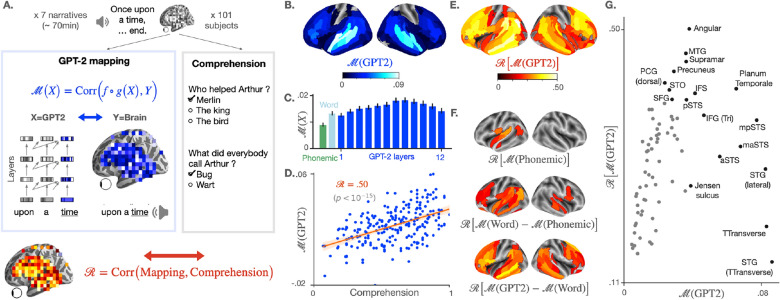
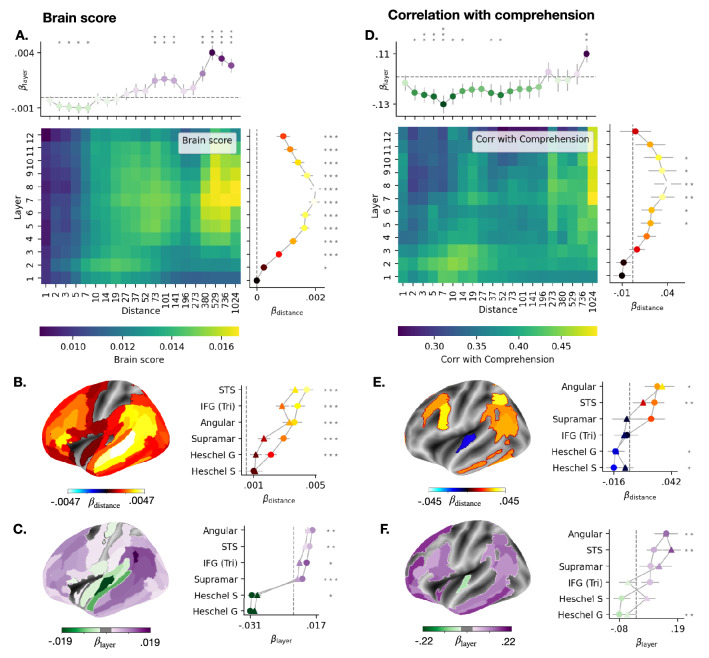
Deep language algorithms, like GPT-2, have demonstrated remarkable abilities to process text, and now constitute the backbone of automatic translation, summarization and dialogue. However, whether these models encode information that relates to human comprehension still remains controversial. Here, we show that the representations of GPT-2 not only map onto the brain responses to spoken stories, but they also predict the extent to which subjects understand the corresponding narratives. To this end, we analyze 101 subjects recorded with functional Magnetic Resonance Imaging while listening to 70 min of short stories. We then fit a linear mapping model to predict brain activity from GPT-2’s activations. Finally, we show that this mapping reliably correlates ($$\mathcal {R}=0.50, p<10^{-15}$$R=0.50,p<10-15) with subjects’ comprehension scores as assessed for each story. This effect peaks in the angular, medial temporal and supra-marginal gyri, and is best accounted for by the long-distance dependencies generated in the deep layers of GPT-2. Overall, this study shows how deep language models help clarify the brain computations underlying language comprehension.
Overview
The claims and statistics of this paper haven’t been checked yet.
Free: it reads the open-access text and checks the first 5 claims that cite a source we can check. Create a free account to check every claim.
Integrity signals
Registry
Cites
Statistics
Figures
Verification
Claims the paper makes
The claims and statistics of this paper haven’t been checked yet.
Free: it reads the open-access text and checks the first 5 claims that cite a source we can check. Create a free account to check every claim.
Claims other papers make about this one
Each is checked against this paper’s own text: does it say what the citing paper says it does?
The cited source doesn’t support the claim as written.
In the citing paper
“Previous studies in the neural encoding literature all used LLMs that were only aware of the short-term context, i.e., where the context window size was as large as several tens of words1–10.”
From Incremental accumulation of linguistic context in artificial and biological neural networks (2025) · cites this paper as [6]
Checked by a reasoning model — may be wrong.
Experimental — accuracy not yet measuredThe cited source says what the claim attributes to it.
In the citing paper
“Large Language Models (LLMs) have shown success in predicting neural signals associated with narrative processing”
From Incremental accumulation of linguistic context in artificial and biological neural networks (2025) · cites this paper as [6]
The cited source says what the claim attributes to it.
In the citing paper
“This was the case even though the participants in these studies were exposed to language stimuli that encompassed hundreds and even thousands of words.”
From Incremental accumulation of linguistic context in artificial and biological neural networks (2025) · cites this paper as [6]
Self-check
Percentages, sums and reported differences re-computed from the paper’s own numbers.
The self-check needs the paper’s full text.
Citations
Cites
BERT: Pre-training of Deep Bidirectional Transformers for Language Understanding
Devlin, J., Chang, M.-W., Lee, K., & Toutanova, K. (2018) · arXiv · doi:10.48550/arxiv.1810.04805 · Cited by 73,173
Scikit-learn: Machine Learning in Python
Pedregosa, F., Varoquaux, G., Gramfort, A., Michel, V., Thirion, B., Grisel, O., Blondel, M., Müller, A., Nothman, J., Louppe, G., et al. (2012) · arXiv · doi:10.48550/arxiv.1201.0490 · Cited by 71,016
Self-citationSciPy 1.0: fundamental algorithms for scientific computing in Python
Virtanen, P., Gommers, R., Oliphant, T. E., Haberland, M., Reddy, T., Cournapeau, D., Burovski, E., Peterson, P., Weckesser, W., Bright, J., et al. (2020) · Nature Methods · doi:10.1038/s41592-019-0686-2 · Cited by 38,430
Exploring the Limits of Transfer Learning with a Unified Text-to-Text Transformer
Raffel, C., Shazeer, N., Roberts, A., Lee, K., Narang, S., Matena, M., Zhou, Y., Li, W., & Liu, P. J. (2019) · arXiv · doi:10.48550/arxiv.1910.10683 · Cited by 31,859
Language Models are Few-Shot Learners
Brown, T. B., Mann, B., Ryder, N., Subbiah, M., Kaplan, J., Dhariwal, P., Neelakantan, A., Shyam, P., Sastry, G., Askell, A., et al. (2020) · arXiv · doi:10.48550/arxiv.2005.14165 · Cited by 23,372
Learning Transferable Visual Models From Natural Language Supervision
Radford, A., Kim, J. W., Hallacy, C., Ramesh, A., Goh, G., Agarwal, S., Sastry, G., Askell, A., Mishkin, P., Clark, J., et al. (2021) · arXiv · doi:10.48550/arxiv.2103.00020 · Cited by 15,293
SciPy 1.0: fundamental algorithms for scientific computing in Python
Virtanen, P., Gommers, R., Oliphant, T. E., Haberland, M., Reddy, T., Cournapeau, D., Burovski, E., Peterson, P., Weckesser, W., Bright, J., et al. (2019) · Apollo - University of Cambridge Repository · doi:10.17863/cam.64134 · Cited by 10,460
Transformers: State-of-the-Art Natural Language Processing
Wolf, T., Debut, L., Sanh, V., Chaumond, J., Delangue, C., Moi, A., Cistac, P., Rault, T., Louf, R., Funtowicz, M., et al. (2020) · Proceedings of the 2020 Conference on Empirical Methods in Natural Language Processing: System Demonstrations · doi:10.18653/v1/2020.emnlp-demos.6 · Cited by 8,741
XLNet: Generalized Autoregressive Pretraining for Language Understanding
Yang, Z., Dai, Z., Yang, Y., Carbonell, J., Salakhutdinov, R., & Le, Q. V. (2019) · arXiv · doi:10.48550/arxiv.1906.08237 · Cited by 6,687 · cited 4×
“Finally, by decomposing and manipulating GPT-2’s processes, we identify (1) the brain regions, (2) the levels of representations (phonological, lexical, compositional), and (3) the attentional gating that specifically relates to this prediction.”
BackgroundMethodInfluentialStatsmodels: Econometric and Statistical Modeling with Python
Seabold, S., & Perktold, J. (2010) · Proceedings of the Python in Science Conference · doi:10.25080/majora-92bf1922-011 · Cited by 6,465
The cortical organization of speech processing
Hickok, G., & Poeppel, D. (2007) · Nature Reviews Neuroscience · doi:10.1038/nrn2113 · Cited by 5,495 · cited 1×
“…effects (GPT-2 eighth layer versus word-embedding) peak in the superior-frontal, posterior superior-temporal gyrus, in the precuneus and in both the triangular and opercular parts of the inferior frontal gyrus – a network typically associated with high-level language comprehension 7,33–37 .”
BackgroundMEG and EEG data analysis with MNE-Python
Gramfort, A. (2013) · Frontiers in Neuroscience · doi:10.3389/fnins.2013.00267 · Cited by 3,784
Self-citationAutomatic parcellation of human cortical gyri and sulci using standard anatomical nomenclature
Destrieux, C., Fischl, B., Dale, A., & Halgren, E. (2010) · NeuroImage · doi:10.1016/j.neuroimage.2010.06.010 · Cited by 2,956 · cited 2×
“Scores are averaged across subjects, narratives, and voxels within brain regions (142 regions in each hemisphere, following a subdivision of Destrieux Atlas 27 , cf. Supplementary Information A).”
BackgroundMethodZero-shot text-to-image generation
Ramesh, A., Pavlov, M., Goh, G., Gray, S., Voss, C., Radford, A., Chen, M., & Sutskever, I. (2021) · arXiv · doi:10.48550/arxiv.2102.12092 · Cited by 2,417 · cited 1×
“These limits may be temporary, however: the latest models appear to be more robust to out-of-distribution sampling 58 and trained on multimodal data 59,60 .”
BackgroundThe brain basis of language processing: from structure to function.
Friederici, A. D. (2011) · Physiological Reviews · doi:10.1152/physrev.00006.2011 · Cited by 2,140
Reproducible brain-wide association studies require thousands of individuals
Marek, S., Tervo-Clemmens, B., Calabro, F. J., Montez, D. F., Kay, B. P., Hatoum, A. S., Donohue, M. R., Foran, W., Miller, R. L., Hendrickson, T. J., et al. (2022) · Nature · doi:10.1038/s41586-022-04492-9 · Cited by 1,928
Performance-optimized hierarchical models predict neural responses in higher visual cortex
Yamins, D. L. K., Hong, H., Cadieu, C. F., Solomon, E. A., Seibert, D., & DiCarlo, J. J. (2014) · Proceedings of the National Academy of Sciences · doi:10.1073/pnas.1403112111 · Cited by 1,924
Using goal-driven deep learning models to understand sensory cortex
Yamins, D. L. K., & DiCarlo, J. J. (2016) · Nature Neuroscience · doi:10.1038/nn.4244 · Cited by 1,621
Natural speech reveals the semantic maps that tile human cerebral cortex
Huth, A. G., de Heer, W. A., Griffiths, T. L., Theunissen, F. E., & Gallant, J. L. (2016) · Nature · doi:10.1038/nature17637 · Cited by 1,504
Adversarial NLI: A New Benchmark for Natural Language UnderstandingPreprint
Nie, Y., Williams, A., Dinan, E., Bansal, M., Weston, J., & Kiela, D. (2019) · Annual Meeting of the Association for Computational Linguistics · doi:10.48550/arxiv.1910.14599 · Cited by 1,334
The Curious Case of Neural Text Degeneration
Holtzman, A., Buys, J., Du, L., Forbes, M., & Choi, Y. (2019) · arXiv · doi:10.48550/arxiv.1904.09751 · Cited by 1,304
(2019) · doi:10.18653/v1/p19-1356 · Cited by 1,291
Selective cortical representation of attended speaker in multi-talker speech perception
Mesgarani, N., & Chang, E. F. (2012) · Nature · doi:10.1038/nature11020 · Cited by 1,007
A neurocognitive perspective on language: The declarative/procedural model
Ullman, M. T. (2001) · Nature Reviews Neuroscience · doi:10.1038/35094573 · Cited by 997 · cited 1×
“First, a number of qualitative theories describe how words may be combined into meaningful representations 36–43 .”
BackgroundTopographic mapping of a hierarchy of temporal receptive windows using a narrated story
Lerner, Y., Honey, C. J., Silbert, L. J., & Hasson, U. (2011) · The Journal of Neuroscience · doi:10.1523/jneurosci.3684-10.2011 · Cited by 834 · cited 3×
“…effects (GPT-2 eighth layer versus word-embedding) peak in the superior-frontal, posterior superior-temporal gyrus, in the precuneus and in both the triangular and opercular parts of the inferior frontal gyrus – a network typically associated with high-level language comprehension 7,33–37 .”
BackgroundMethodLess Is More: Expectation Sharpens Representations in the Primary Visual Cortex
Kok, P., Jehee, J. F. M., & de Lange, F. P. (2012) · Neuron · doi:10.1016/j.neuron.2012.04.034 · Cited by 798 · cited 1×
“Finally, previous analyses have investigated the role of attention in the brain 5,48,49 .”
Cortical representation of the constituent structure of sentences
Pallier, C., Devauchelle, A.-D., & Dehaene, S. (2011) · Proceedings of the National Academy of Sciences · doi:10.1073/pnas.1018711108 · Cited by 691
Adversarial NLI: A New Benchmark for Natural Language Understanding
Nie, Y., Williams, A., Dinan, E., Bansal, M., Weston, J., & Kiela, D. (2020) · Proceedings of the 58th Annual Meeting of the Association for Computational Linguistics · doi:10.18653/v1/2020.acl-main.441 · Cited by 656
Bornkessel, I., & Schlesewsky, M. (2006) · Psychological Review · doi:10.1037/0033-295x.113.4.787 · Cited by 622
Challenges in Data-to-Document Generation
Wiseman, S., Shieber, S., & Rush, A. (2017) · Proceedings of the 2017 Conference on Empirical Methods in Natural Language Processing · doi:10.18653/v1/d17-1239 · Cited by 524
The neural architecture of language: Integrative modeling converges on predictive processing
Schrimpf, M., Blank, I. A., Tuckute, G., Kauf, C., Hosseini, E. A., Kanwisher, N., Tenenbaum, J. B., & Fedorenko, E. (2021) · Proceedings of the National Academy of Sciences · doi:10.1073/pnas.2105646118 · Cited by 517
Brain-Score: Which Artificial Neural Network for Object Recognition is most Brain-Like?
Schrimpf, M., Kubilius, J., Hong, H., Majaj, N. J., Rajalingham, R., Issa, E. B., Kar, K., Bashivan, P., Prescott-Roy, J., Geiger, F., et al. (2018) · bioRxiv (Cold Spring Harbor Laboratory) · doi:10.1101/407007 · Cited by 458
MUC (Memory, Unification, Control) and beyond
Hagoort, P. (2013) · Frontiers in Psychology · doi:10.3389/fpsyg.2013.00416 · Cited by 427
Broderick, M. P., Anderson, A. J., Di Liberto, G. M., Crosse, M. J., & Lalor, E. C. (2018) · Current Biology · doi:10.1016/j.cub.2018.01.080 · Cited by 421
The Neurobiology of Language Beyond Single Words
Hagoort, P., & Indefrey, P. (2014) · Annual Review of Neuroscience · doi:10.1146/annurev-neuro-071013-013847 · Cited by 407
Emergent linguistic structure in artificial neural networks trained by self-supervision
Manning, C. D., Clark, K., Hewitt, J., Khandelwal, U., & Levy, O. (2020) · Proceedings of the National Academy of Sciences · doi:10.1073/pnas.1907367117 · Cited by 339
Reconciling time, space and function: A new dorsal–ventral stream model of sentence comprehension
Bornkessel-Schlesewsky, I., & Schlesewsky, M. (2013) · Brain and Language · doi:10.1016/j.bandl.2013.01.010 · Cited by 329
Brains and algorithms partially converge in natural language processing
Caucheteux, C., & King, J.-R. (2022) · Communications Biology · doi:10.1038/s42003-022-03036-1 · Cited by 318 · cited 6×
“1C), as previously reported 5,7,29 .”
BackgroundResultInfluentialSelf-citationThe revolution will not be controlled: natural stimuli in speech neuroscience
Hamilton, L. S., & Huth, A. G. (2020) · Language, Cognition and Neuroscience · doi:10.1080/23273798.2018.1499946 · Cited by 301
Bisk, Y., Holtzman, A., Thomason, J., Andreas, J., Bengio, Y., Chai, J., Lapata, M., Lazaridou, A., May, J., Nisnevich, A., et al. (2020) · Proceedings of the 2020 Conference on Empirical Methods in Natural Language Processing (EMNLP) · doi:10.18653/v1/2020.emnlp-main.703 · Cited by 274
Syntactic Structure from Deep Learning
Linzen, T., & Baroni, M. (2021) · Annual Review of Linguistics · doi:10.1146/annurev-linguistics-032020-051035 · Cited by 202
Neural correlate of the construction of sentence meaning
Fedorenko, E., Scott, T. L., Brunner, P., Coon, W. G., Pritchett, B., Schalk, G., & Kanwisher, N. (2016) · Proceedings of the National Academy of Sciences · doi:10.1073/pnas.1612132113 · Cited by 199 · cited 2×
“Second, several quantitative approaches have been proposed to investigate comprehension, either with “model-free” methods based on inter-subject correlation (e.g. 33,35,45 ) or “model-based” methods based on word vectors 46 .”
BackgroundMethodCompositionality Decomposed: How do Neural Networks Generalise?
Hupkes, D., Dankers, V., Mul, M., & Bruni, E. (2020) · Journal of Artificial Intelligence Research · doi:10.1613/jair.1.11674 · Cited by 194
Incorporating Context into Language Encoding Models for fMRI
Jain, S., & Huth, A. G. (2018) · doi:10.1101/327601 · Cited by 155 · cited 2×
“1C), as previously reported 5,7,29 .”
ResultWord meaning in minds and machines.
Lake, B. M., & Murphy, G. L. (2023) · Psychological Review · doi:10.1037/rev0000297 · Cited by 131
Toneva, M., & Wehbe, L. (2019) · arXiv (Cornell University) · doi:10.48550/arxiv.1905.11833 · Cited by 127
Neurocomputational Models of Language Processing
Hale, J., Campanelli, L., Li, J., Bhattasali, S., Pallier, C., & Brennan, J. (2021) · Annual Review of Linguistics · doi:10.1146/annurev-linguistics-051421-020803 · Cited by 124
Hurdles to Progress in Long-form Question Answering
Krishna, K., Roy, A., & Iyyer, M. (2021) · Proceedings of the 2021 Conference of the North American Chapter of the Association for Computational Linguistics: Human Language Technologies · doi:10.18653/v1/2021.naacl-main.393 · Cited by 114
Voxelwise encoding models with non-spherical multivariate normal priors
Núñez-Elizalde, A. O., Huth, A. G., & Gallant, J. L. (2018) · NeuroImage · doi:10.1016/j.neuroimage.2019.04.012 · Cited by 111
Attentional and linguistic interactions in speech perception
Sabri, M., Binder, J. R., Desai, R. H., Medler, D. A., Leitl, M. D., & Liebenthal, E. (2007) · NeuroImage · doi:10.1016/j.neuroimage.2007.09.052 · Cited by 107
Linguistic generalization and compositionality in modern artificial neural networks
Baroni, M. (2020) · Philosophical Transactions of the Royal Society B: Biological Sciences · doi:10.1098/rstb.2019.0307 · Cited by 102
A neural network model of when to retrieve and encode episodic memories
Lu, Q., Hasson, U., & Norman, K. A. (2022) · eLife · doi:10.7554/elife.74445 · Cited by 96
Hagoort, P., Baggio, G., & Willems, R. M. (2009) · The Cognitive Neurosciences · doi:10.7551/mitpress/8029.003.0072 · Cited by 96
McClelland, J. L., Hill, F., Rudolph, M., Baldridge, J., & Schütze, H. (2020) · Proceedings of the National Academy of Sciences · doi:10.1073/pnas.1910416117 · Cited by 91 · cited 1×
“Furthermore, GPT-2 is only trained with textual data and does not situate objects in a grounded environment that would capture their real-world interactions 18,57 .”
BackgroundDecoding the neural representation of story meanings across languages
Dehghani, M., Boghrati, R., Man, K., Hoover, J., Gimbel, S. I., Vaswani, A., Zevin, J. D., Immordino‐Yang, M. H., Gordon, A. S., Damasio, A., et al. (2017) · Human Brain Mapping · doi:10.1002/hbm.23814 · Cited by 78
Linking artificial and human neural representations of language
Gauthier, J., & Levy, R. (2019) · Proceedings of the 2019 Conference on Empirical Methods in Natural Language Processing and the 9th International Joint Conference on Natural Language Processing (EMNLP-IJCNLP) · doi:10.18653/v1/d19-1050 · Cited by 70
Anderson, A. J., Kiela, D., Binder, J. R., Fernandino, L., Humphries, C. J., Conant, L. L., Raizada, R. D. S., Grimm, S., & Lalor, E. C. (2021) · The Journal of Neuroscience · doi:10.1523/jneurosci.1152-20.2021 · Cited by 70
Neural Encoding and Decoding With Distributed Sentence Representations
Sun, J., Wang, S., Zhang, J., & Zong, C. (2020) · IEEE Transactions on Neural Networks and Learning Systems · doi:10.1109/tnnls.2020.3027595 · Cited by 61
Challenges in Data-to-Document GenerationPreprint
Wiseman, S., Shieber, S. M., & Rush, A. M. (2017) · arXiv (Cornell University) · doi:10.48550/arxiv.1707.08052 · Cited by 53
Thinking ahead: spontaneous prediction in context as a keystone of language in humans and machines
Goldstein, A., Zada, Z., Buchnik, E., Schain, M., Price, A., Aubrey, B., Nastase, S. A., Feder, A., Emanuel, D., Cohen, A., et al. (2020) · bioRxiv (Cold Spring Harbor Laboratory) · doi:10.1101/2020.12.02.403477 · Cited by 51
BEIR: A Heterogenous Benchmark for Zero-shot Evaluation of Information Retrieval Models
Thakur, N., Reimers, N., Rücklé, A., Srivastava, A., & Gurevych, I. (2021) · arXiv · doi:10.48550/arxiv.2104.08663 · Cited by 45
Broderick, M. P., Zuk, N. J., Anderson, A. J., & Lalor, E. C. (2022) · European Journal of Neuroscience · doi:10.1111/ejn.15805 · Cited by 40
Narratives: fMRI data for evaluating models of naturalistic language comprehensionPreprint
Nastase, S. A., Liu, Y., Hillman, H., Zadbood, A., Hasenfratz, L., Keshavarzian, N., Chen, J., Honey, C. J., Yeshurun, Y., Regev, M., et al. (2020) · bioRxiv (Cold Spring Harbor Laboratory) · doi:10.1101/2020.12.23.424091 · Cited by 32
Can RNNs learn Recursive Nested Subject-Verb Agreements?Preprint
Lakretz, Y., Desbordes, T., King, J.-R., Crabbé, B., Oquab, M., & Dehaene, S. (2021) · arXiv (Cornell University) · doi:10.48550/arxiv.2101.02258 · Cited by 30
Self-citationHow does inattention affect written and spoken language processing?
Cohen, L., Salondy, P., Pallier, C., & Dehaene, S. (2021) · Cortex · doi:10.1016/j.cortex.2021.02.007 · Cited by 29
Long-range and hierarchical language predictions in brains and algorithmsPreprint
Caucheteux, C., Gramfort, A., & King, J.-R. (2021) · arXiv (Cornell University) · doi:10.48550/arxiv.2111.14232 · Cited by 28
Self-citationModel-based analysis of brain activity reveals the hierarchy of language in 305 subjects
Caucheteux, C., Gramfort, A., & King, J.-R. (2021) · Findings of the Association for Computational Linguistics: EMNLP 2021 · doi:10.18653/v1/2021.findings-emnlp.308 · Cited by 21
Self-citationBroderick, M. P., Zuk, N. J., Anderson, A. J., et al. (2020) · bioRxiv (Cold Spring Harbor Laboratory) · doi:10.1101/2020.12.14.422789 · Cited by 6
Research works printed but not linked: 3
- Radford A Wu J Child R Luan D Amodei D Sutskever I Language models are unsupervised multitask learners OpenAI blog 2019 1 8 9
- Caucheteux, C., Gramfort, A., & King, J.-R. Disentangling syntax and semantics in the brain with deep networks. In International Conference on Machine Learning, 1336–1348. PMLR, (2021b).
- Reddy, A. J. & Wehbe, L. Syntactic representations in the human brain: Beyond effort-based metrics. preprint, Neuroscience (2020).
Cited by
Shared computational principles for language processing in humans and deep language models
Goldstein, A., Zada, Z., Buchnik, E., Schain, M., Price, A., Aubrey, B., Nastase, S. A., Feder, A., Emanuel, D., Cohen, A., et al. (2022) · Nature Neuroscience · doi:10.1038/s41593-022-01026-4 · Cited by 447
Brains and algorithms partially converge in natural language processing
Caucheteux, C., & King, J.-R. (2022) · Communications Biology · doi:10.1038/s42003-022-03036-1 · Cited by 318
Self-citationEvidence of a predictive coding hierarchy in the human brain listening to speech
Caucheteux, C., Gramfort, A., & King, J.-R. (2023) · Nature Human Behaviour · doi:10.1038/s41562-022-01516-2 · Cited by 308
Self-citationThe language network as a natural kind within the broader landscape of the human brain
Fedorenko, E., Ivanova, A. A., & Regev, T. I. (2024) · Nature Reviews Neuroscience · doi:10.1038/s41583-024-00802-4 · Cited by 293
Decoding speech perception from non-invasive brain recordings
Défossez, A., Caucheteux, C., Rapin, J., Kabeli, O., & King, J.-R. (2023) · Nature Machine Intelligence · doi:10.1038/s42256-023-00714-5 · Cited by 215
“Given that phrase embeddings are known to capture semantic and syntactic representations [18, 19, 38], these correlations suggest that our model decodes relatively high-level representations of speech.”
BackgroundResultSelf-citation
Metadata
- Authors
- Caucheteux, C., Gramfort, A., & King, J.-R.
- Affiliations
- Commissariat à l'Énergie Atomique et aux Énergies Alternatives (FR)
- Institut national de recherche en sciences et technologies du numérique (FR)
- Centre National de la Recherche Scientifique (FR)
- Corresponding author
- Caucheteux, Charlotte
- Venue
- Scientific Reports
- Published
- 2022-09-29
- Volume
- 12
- Issue
- 1
- Pages
- 16327-16327
- ISSN
- 2045-2322 (ISSN-L)
- PMC
- PMC9522791
- OpenAlex
- W4297995647
- Cited by
- 91
- References
- 53
- Citations by year
- 2026: 18 · 2025: 18 · 2024: 30 · 2023: 21 · 2022: 2
- FWCI
- 9.15
- Type
- journal article
- Language
- en
- Open access
- gold
- doi.org
- Licence
- cc-by
- creativecommons.org/licenses/by/4.0 (tdm)
- creativecommons.org/licenses/by/4.0 (vor)
- Locations
- Scientific Reports (publishedVersion, cc-by)
- PubMed Central (publishedVersion, cc-by)
- PubMed (publishedVersion)
- HAL (submittedVersion, other-oa)
- DOAJ (DOAJ: Directory of Open Access Journals) (submittedVersion, cc-by-sa)
- Greater South Information System
- Funders
- Agence Nationale de la Recherche (ANR-17-EURE-, ANR-17-EURE-0017, ANR-17)
- Fondation Fyssen (17-EURE-0017, ANR-17-EURE-0017)
- Topics
- Life Sciences › Neuroscience › Cognitive Neuroscience › Neurobiology of Language and Bilingualism
- Social Sciences › Psychology › Developmental and Educational Psychology › Reading and Literacy Development
- Physical Sciences › Computer Science › Artificial Intelligence › Topic Modeling
- Keywords
- GPT-2, language comprehension, semantic understanding, deep language models, oral narrative, functional MRI, long-distance dependencies, angular gyrus, medial temporal lobe, supramarginal gyrus
- MeSH terms
- Alanine Transaminase, Algorithms, Brain, Humans, Language, Semantics, Comprehension
About these checks
Registry, retraction, Cites and statistics results are computed, not judged, with one exception: a printed reference that no index lists is read once by a model before it counts as a citation error. Claims are extracted by a model and kept only when their quote appears verbatim in the text; each cited source is then checked, with a model’s help, for whether it says what the claim relies on. Those verdicts can be wrong — read the claim’s quote and the cited source before relying on one.
Statistics and arithmetic are recomputed, not judged.
Confidence bands are shown only for fields calibrated on our annotated test set. None is calibrated yet, so no band is shown.
What counts as a claim ›How we measure confidence ›How we check this ›
Are you an author, or do you see a problem with this page? Request a review
Data sources
Bibliographic data: Semantic Scholar, OpenAlex, Crossref.
Contains information from the Semantic Scholar Academic Graph Datasets, made available under the ODC Attribution License (ODC-BY 1.0).
Semantic Scholar’s data is described in: Kinney, R., et al. (2023). The Semantic Scholar Open Data Platform. arXiv:2301.10140.
