

Deep language algorithms predict semantic comprehension from brain activity
Open accessThe DOI matches its Crossref record; 68 of the 68 references it cites were found in a registry or an index.
Abstract
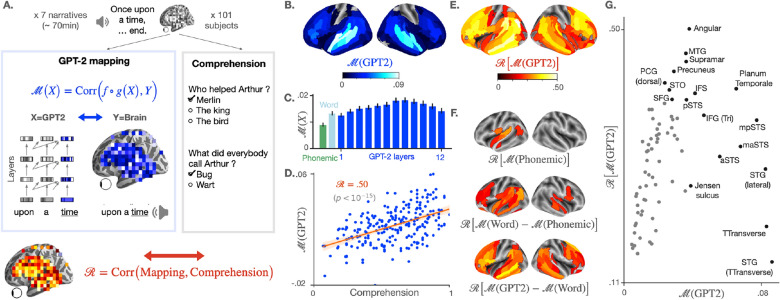
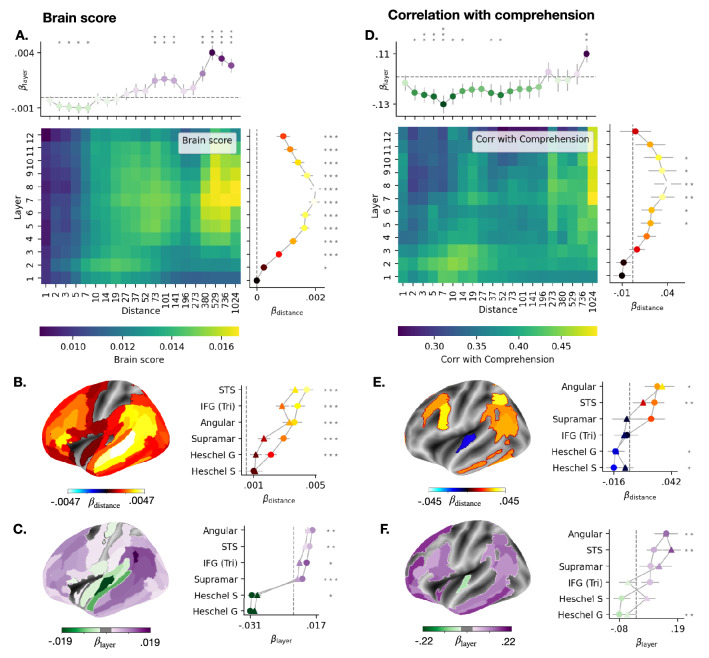
Deep language algorithms, like GPT-2, have demonstrated remarkable abilities to process text, and now constitute the backbone of automatic translation, summarization and dialogue. However, whether these models encode information that relates to human comprehension still remains controversial. Here, we show that the representations of GPT-2 not only map onto the brain responses to spoken stories, but they also predict the extent to which subjects understand the corresponding narratives. To this end, we analyze 101 subjects recorded with functional Magnetic Resonance Imaging while listening to 70 min of short stories. We then fit a linear mapping model to predict brain activity from GPT-2’s activations. Finally, we show that this mapping reliably correlates ($$\mathcal {R}=0.50, p<10^{-15}$$R=0.50,p<10-15) with subjects’ comprehension scores as assessed for each story. This effect peaks in the angular, medial temporal and supra-marginal gyri, and is best accounted for by the long-distance dependencies generated in the deep layers of GPT-2. Overall, this study shows how deep language models help clarify the brain computations underlying language comprehension.
Overview
The claims and statistics of this paper haven’t been checked yet.
Free: it reads the open-access text and checks the first 5 claims that cite a source we can check. Create a free account to check every claim.
Integrity signals
Registry
Cites
Statistics
Figures
Verification
Claims the paper makes
The claims and statistics of this paper haven’t been checked yet.
Free: it reads the open-access text and checks the first 5 claims that cite a source we can check. Create a free account to check every claim.
Claims other papers make about this one
Each is checked against this paper’s own text: does it say what the citing paper says it does?
The cited source doesn’t support the claim as written.
In the citing paper
“Previous studies in the neural encoding literature all used LLMs that were only aware of the short-term context, i.e., where the context window size was as large as several tens of words1–10.”
From Incremental accumulation of linguistic context in artificial and biological neural networks (2025) · cites this paper as [6]
Checked by a reasoning model — may be wrong.
Experimental — accuracy not yet measuredThe cited source says what the claim attributes to it.
In the citing paper
“Large Language Models (LLMs) have shown success in predicting neural signals associated with narrative processing”
From Incremental accumulation of linguistic context in artificial and biological neural networks (2025) · cites this paper as [6]
The cited source says what the claim attributes to it.
In the citing paper
“This was the case even though the participants in these studies were exposed to language stimuli that encompassed hundreds and even thousands of words.”
From Incremental accumulation of linguistic context in artificial and biological neural networks (2025) · cites this paper as [6]
Self-check
Percentages, sums and reported differences re-computed from the paper’s own numbers.
The self-check needs the paper’s full text.
Citations
Cites
BERT: Pre-training of Deep Bidirectional Transformers for Language Understanding
Devlin, J., Chang, M.-W., Lee, K., & Toutanova, K. (2018) · arXiv · doi:10.48550/arxiv.1810.04805 · Cited by 73,173
Scikit-learn: Machine Learning in Python
Pedregosa, F., Varoquaux, G., Gramfort, A., Michel, V., Thirion, B., Grisel, O., Blondel, M., Müller, A., Nothman, J., Louppe, G., et al. (2012) · arXiv · doi:10.48550/arxiv.1201.0490 · Cited by 71,016
Self-citationSciPy 1.0: fundamental algorithms for scientific computing in Python
Virtanen, P., Gommers, R., Oliphant, T. E., Haberland, M., Reddy, T., Cournapeau, D., Burovski, E., Peterson, P., Weckesser, W., Bright, J., et al. (2020) · Nature Methods · doi:10.1038/s41592-019-0686-2 · Cited by 38,430
Exploring the Limits of Transfer Learning with a Unified Text-to-Text Transformer
Raffel, C., Shazeer, N., Roberts, A., Lee, K., Narang, S., Matena, M., Zhou, Y., Li, W., & Liu, P. J. (2019) · arXiv · doi:10.48550/arxiv.1910.10683 · Cited by 31,859
Language Models are Few-Shot Learners
Brown, T. B., Mann, B., Ryder, N., Subbiah, M., Kaplan, J., Dhariwal, P., Neelakantan, A., Shyam, P., Sastry, G., Askell, A., et al. (2020) · arXiv · doi:10.48550/arxiv.2005.14165 · Cited by 23,372
Learning Transferable Visual Models From Natural Language Supervision
Radford, A., Kim, J. W., Hallacy, C., Ramesh, A., Goh, G., Agarwal, S., Sastry, G., Askell, A., Mishkin, P., Clark, J., et al. (2021) · arXiv · doi:10.48550/arxiv.2103.00020 · Cited by 15,293
SciPy 1.0: fundamental algorithms for scientific computing in Python
Virtanen, P., Gommers, R., Oliphant, T. E., Haberland, M., Reddy, T., Cournapeau, D., Burovski, E., Peterson, P., Weckesser, W., Bright, J., et al. (2019) · Apollo - University of Cambridge Repository · doi:10.17863/cam.64134 · Cited by 10,460
Transformers: State-of-the-Art Natural Language Processing
Wolf, T., Debut, L., Sanh, V., Chaumond, J., Delangue, C., Moi, A., Cistac, P., Rault, T., Louf, R., Funtowicz, M., et al. (2020) · Proceedings of the 2020 Conference on Empirical Methods in Natural Language Processing: System Demonstrations · doi:10.18653/v1/2020.emnlp-demos.6 · Cited by 8,741
XLNet: Generalized Autoregressive Pretraining for Language Understanding
Yang, Z., Dai, Z., Yang, Y., Carbonell, J., Salakhutdinov, R., & Le, Q. V. (2019) · arXiv · doi:10.48550/arxiv.1906.08237 · Cited by 6,687 · cited 4×
“Finally, by decomposing and manipulating GPT-2’s processes, we identify (1) the brain regions, (2) the levels of representations (phonological, lexical, compositional), and (3) the attentional gating that specifically relates to this prediction.”
BackgroundMethodInfluentialStatsmodels: Econometric and Statistical Modeling with Python
Seabold, S., & Perktold, J. (2010) · Proceedings of the Python in Science Conference · doi:10.25080/majora-92bf1922-011 · Cited by 6,465
Research works printed but not linked: 3
- Radford A Wu J Child R Luan D Amodei D Sutskever I Language models are unsupervised multitask learners OpenAI blog 2019 1 8 9
- Caucheteux, C., Gramfort, A., & King, J.-R. Disentangling syntax and semantics in the brain with deep networks. In International Conference on Machine Learning, 1336–1348. PMLR, (2021b).
- Reddy, A. J. & Wehbe, L. Syntactic representations in the human brain: Beyond effort-based metrics. preprint, Neuroscience (2020).
Cited by
Shared computational principles for language processing in humans and deep language models
Goldstein, A., Zada, Z., Buchnik, E., Schain, M., Price, A., Aubrey, B., Nastase, S. A., Feder, A., Emanuel, D., Cohen, A., et al. (2022) · Nature Neuroscience · doi:10.1038/s41593-022-01026-4 · Cited by 447
Brains and algorithms partially converge in natural language processing
Caucheteux, C., & King, J.-R. (2022) · Communications Biology · doi:10.1038/s42003-022-03036-1 · Cited by 318
Self-citationEvidence of a predictive coding hierarchy in the human brain listening to speech
Caucheteux, C., Gramfort, A., & King, J.-R. (2023) · Nature Human Behaviour · doi:10.1038/s41562-022-01516-2 · Cited by 308
Self-citationThe language network as a natural kind within the broader landscape of the human brain
Fedorenko, E., Ivanova, A. A., & Regev, T. I. (2024) · Nature Reviews Neuroscience · doi:10.1038/s41583-024-00802-4 · Cited by 293
Decoding speech perception from non-invasive brain recordings
Défossez, A., Caucheteux, C., Rapin, J., Kabeli, O., & King, J.-R. (2023) · Nature Machine Intelligence · doi:10.1038/s42256-023-00714-5 · Cited by 215
“Given that phrase embeddings are known to capture semantic and syntactic representations [18, 19, 38], these correlations suggest that our model decodes relatively high-level representations of speech.”
BackgroundResultSelf-citationDeep problems with neural network models of human vision
Bowers, J. S., Malhotra, G., Dujmović, M., Llera Montero, M., Tsvetkov, C., Biscione, V., Puebla, G., Adolfi, F., Hummel, J. E., Heaton, R. F., et al. (2023) · Behavioral and Brain Sciences · doi:10.1017/s0140525x22002813 · Cited by 204
Toward a Realistic Model of Speech Processing in the Brain with Self-Supervised Learning
Millet, J., Caucheteux, C., Orhan, P., Boubenec, Y., Gramfort, A., Dunbar, E., Pallier, C., & King, J.-R. (2022) · neural information processing systems · doi:10.52202/068431-2422 · Cited by 198
Self-citationAutomatic Scoring of Metaphor Creativity with Large Language Models
DiStefano, P. V., Patterson, J. D., & Beaty, R. E. (2025) · Creativity Research Journal · doi:10.1080/10400419.2024.2326343 · Cited by 52
Contextual feature extraction hierarchies converge in large language models and the brain
Mischler, G., Li, Y. A., Bickel, S., Mehta, A. D., & Mesgarani, N. (2024) · Nature Machine Intelligence · doi:10.1038/s42256-024-00925-4 · Cited by 114
Disentangling Syntax and Semantics in the Brain with Deep NetworksPreprint
Caucheteux, C., Gramfort, A., & King, J.-R. (2021) · arXiv (Cornell University) · doi:10.48550/arxiv.2103.01620 · Cited by 93
Self-citationScaling laws for language encoding models in fMRI
Antonello, R., Vaidya, A. R., & Huth, A. G. (2023) · PubMed · doi:10.48550/arxiv.2305.11863 · Cited by 88
Shared functional specialization in transformer-based language models and the human brain
Kumar, S., Sumers, T. R., Yamakoshi, T., Goldstein, A., Hasson, U., Norman, K. A., Griffiths, T. L., Hawkins, R. D., & Nastase, S. A. (2024) · Nature Communications · doi:10.1038/s41467-024-49173-5 · Cited by 86
Explaining black box text modules in natural language with language modelsPreprint
Singh, C., Hsu, A. R., Antonello, R., Jain, S., Huth, A. G., Yu, B., & Gao, J. (2023) · arXiv (Cornell University) · doi:10.48550/arxiv.2305.09863 · Cited by 84
Towards decoding individual words from non-invasive brain recordings
d’Ascoli, S., Bel, C., Rapin, J., Banville, H. J., Benchetrit, Y., Pallier, C., & King, J.-R. (2025) · Nature Communications · doi:10.1038/s41467-025-65499-0 · Cited by 77
Self-citationGoldstein, A., Ham, E., Schain, M., Nastase, S. A., Aubrey, B., Zada, Z., Grinstein-Dabush, A., Gazula, H., Feder, A., Doyle, W., et al. (2025) · Nature Communications · doi:10.1038/s41467-025-65518-0 · Cited by 76
Gwilliams, L., Flick, G., Marantz, A. P., Pylkkänen, L., Poeppel, D., & King, J.-R. (2023) · Scientific Data · doi:10.1038/s41597-023-02752-5 · Cited by 70
Self-citationGoldstein, A., Grinstein-Dabush, A., Schain, M., Wang, H., Hong, Z., Aubrey, B., Nastase, S. A., Zada, Z., Ham, E., Feder, A., et al. (2024) · Nature Communications · doi:10.1038/s41467-024-46631-y · Cited by 64
“To conclude, the alignment between brain embeddings and DLM contextual embeddings, combined with accumulated evidence across recent papers 35,37,38,40,61 suggests that the brain may rely on contextual embeddings to represent natural language.”
Large language models can segment narrative events similarly to humans
Michelmann, S., Kumar, M., Norman, K. A., & Toneva, M. (2025) · Behavior Research Methods · doi:10.3758/s13428-024-02569-z · Cited by 60
Adversarial attacks and defenses for large language models (LLMs): methods, frameworks & challenges
Kumar, P. (2024) · International Journal of Multimedia Information Retrieval · doi:10.1007/s13735-024-00334-8 · Cited by 43
Modeling naturalistic face processing in humans with deep convolutional neural networks
Jiahui, G., Feilong, M., Castello, M. V. D. O., Nastase, S. A., Haxby, J. V., & Gobbini, M. I. (2023) · Proceedings of the National Academy of Sciences · doi:10.1073/pnas.2304085120 · Cited by 55
Thinking ahead: spontaneous prediction in context as a keystone of language in humans and machines
Goldstein, A., Zada, Z., Buchnik, E., Schain, M., Price, A., Aubrey, B., Nastase, S. A., Feder, A., Emanuel, D., Cohen, A., et al. (2020) · bioRxiv (Cold Spring Harbor Laboratory) · doi:10.1101/2020.12.02.403477 · Cited by 51
The default network dominates neural responses to evolving movie stories
Yang, E., Milisav, F., Kopál, J., Holmes, A. J., Mitsis, G. D., Mišić, B., Finn, E. S., & Bzdok, D. (2023) · Nature Communications · doi:10.1038/s41467-023-39862-y · Cited by 47
Antonello, R., & Huth, A. (2023) · Neurobiology of Language · doi:10.1162/nol_a_00087 · Cited by 45
Through their eyes: Multi-subject brain decoding with simple alignment techniques
Ferrante, M., Boccato, T., Özçelik, F., VanRullen, R., & Toschi, N. (2024) · Imaging Neuroscience · doi:10.1162/imag_a_00170 · Cited by 43
Desbordes, T., Lakretz, Y., Chanoine, V., Oquab, M., Badier, J., Trébuchon, A., Carron, R., Bénar, C., Dehaene, S., & King, J.-R. (2023) · Journal of Neuroscience · doi:10.1523/jneurosci.1163-22.2023 · Cited by 40
Self-citationYu, S., Gu, C., Huang, K., & Li, P. (2024) · Science Advances · doi:10.1126/sciadv.adn7744 · Cited by 40
Generative language reconstruction from brain recordings
Ye, Z., Ai, Q., Liu, Y., de Rijke, M., Zhang, M., Lioma, C., & Ruotsalo, T. (2025) · Communications Biology · doi:10.1038/s42003-025-07731-7 · Cited by 38
Language Models Can Generate Human-Like Self-Reports of Emotion
Tavast, M., Kunnari, A., & Hämäläinen, P. (2022) · ACM International Conference on Intelligent User Interfaces (IUI) · doi:10.1145/3490100.3516464 · Cited by 34
ROSE: A Universal Neural Grammar
Murphy, E. (2025) · Cognitive Neuroscience · doi:10.1080/17588928.2025.2523875 · Cited by 33
Nakagi, Y., Matsuyama, T., Koide‐Majima, N., Yamaguchi, H. Q., Kubo, R., Nishimoto, S., & Takagi, Y. (2024) · Conference on Empirical Methods in Natural Language Processing (EMNLP) · doi:10.18653/v1/2024.emnlp-main.1133 · Cited by 28
Mapping Brains with Language Models: A Survey
Karamolegkou, A., Abdou, M., & Søgaard, A. (2023) · Findings of the Association for Computational Linguistics: ACL (Findings of ACL) · doi:10.18653/v1/2023.findings-acl.618 · Cited by 28
Semantic Brain Decoding: from fMRI to conceptually similar image reconstruction of visual stimuliPreprint
Ferrante, M., Boccato, T., & Toschi, N. (2022) · arXiv (Cornell University) · doi:10.48550/arxiv.2212.06726 · Cited by 27
The memory trace of an intrusive trauma-analog episode
Kobelt, M., Waldhauser, G. T., Rupietta, A. E., Heinen, R. M., Rau, E. M. B., Kessler, H., & Axmacher, N. (2024) · Current Biology · doi:10.1016/j.cub.2024.03.005 · Cited by 27
Long-range and hierarchical language predictions in brains and algorithmsPreprint
Caucheteux, C., Gramfort, A., & King, J.-R. (2021) · arXiv (Cornell University) · doi:10.48550/arxiv.2111.14232 · Cited by 28
Self-citationIncremental accumulation of linguistic context in artificial and biological neural networks
Tikochinski, R., Goldstein, A., Meiri, Y., Hasson, U., & Reichart, R. (2025) · Nature Communications · doi:10.1038/s41467-025-56162-9 · Cited by 24
“…is possible that the type of dataset is crucial, as, to our knowledge, the studies that demonstrated better performance in the middle layers (e.g., Caucheteux et al., 2022; Aw & Tenova, 2023; Zaid et al., 2023) focused on language production rather than comprehension, making comparison difficult.”
On the importance of severely testing deep learning models of cognition
Bowers, J. S., Malhotra, G., Adolfi, F., Dujmović, M., Montero, M. L., Biscione, V., Puebla, G., Hummel, J. H., & Heaton, R. F. (2023) · Cognitive Systems Research · doi:10.1016/j.cogsys.2023.101158 · Cited by 26
Taylor, J., & Kriegeskorte, N. (2023) · Scientific Reports · doi:10.1038/s41598-023-40807-0 · Cited by 24
Russo, A. G., Ciarlo, A., Ponticorvo, S., Salle, F. D., Tedeschi, G., & Esposito, F. (2022) · Scientific Reports · doi:10.1038/s41598-022-21782-4 · Cited by 24
Incremental Accumulation of Linguistic Context in Artificial and Biological Neural Networks
(2024) · doi:10.1101/2024.01.15.575798 · Cited by 24
Anderson, A. J., Davis, C., & Lalor, E. C. (2024) · PLoS Computational Biology · doi:10.1371/journal.pcbi.1012537 · Cited by 23
On the mechanical origins of waving, coiling and skewing in Arabidopsis thaliana roots
Porat, A., Tekinalp, A., Bhosale, Y., Gazzola, M., & Meroz, Y. (2024) · Proceedings of the National Academy of Sciences · doi:10.1073/pnas.2312761121 · Cited by 22
Deep speech-to-text models capture the neural basis of spontaneous speech in everyday conversationsPreprint
Goldstein, A., Wang, H., Niekerken, L., Zada, Z., Aubrey, B., Sheffer, T., Nastase, S. A., Gazula, H., Schain, M., Singh, A., et al. (2023) · bioRxiv (Cold Spring Harbor Laboratory) · doi:10.1101/2023.06.26.546557 · Cited by 23
Hong, Z., Wang, H., Zada, Z., Gazula, H., Turner, D. D., Aubrey, B., Niekerken, L., Doyle, W., Devore, S., Dugan, P. C., et al. (2024) · eLife · doi:10.7554/elife.101204.1 · Cited by 22
The channel capacity of multilevel linguistic features constrains speech comprehension
Giroud, J., Lerousseau, J. P., Pellegrino, F., & Morillon, B. (2021) · Cognition · doi:10.1016/j.cognition.2022.105345 · Cited by 20
Su, Y., MacGregor, L. J., Olasagasti, I., & Giraud, A. (2023) · PLoS Biology · doi:10.1371/journal.pbio.3002046 · Cited by 20
Same Cause; Different Effects in the Brain
Toneva, M., Williams, J. R., Bollu, A., Dann, C., & Wehbe, L. (2022) · PubMed · doi:10.48550/arxiv.2202.10376 · Cited by 19
Studying Psychosis Using Natural Language Generation: A Review of Emerging Opportunities
Palaniyappan, L. K., Benrimoh, D. A., Voppel, A., & Rocca, R. (2023) · Biological Psychiatry Cognitive Neuroscience and Neuroimaging · doi:10.1016/j.bpsc.2023.04.009 · Cited by 17
Liberto, G. M. D., Nidiffer, A. R., Crosse, M. J., Zuk, N. J., Haro, S., Cantisani, G., Winchester, M., Igoe, A., McCrann, R., Chandra, S., et al. (2024) · Neurons Behavior Data analysis and Theory · doi:10.51628/001c.124867 · Cited by 16
Gu, C., Nastase, S. A., Zada, Z., & Li, P. (2025) · npj Science of Learning · doi:10.1038/s41539-025-00337-y · Cited by 57
Ferrante, M., Boccato, T., Passamonti, L., & Toschi, N. (2024) · Journal of Neural Engineering · doi:10.1088/1741-2552/ad593c · Cited by 15
INSPECT: Intrinsic and Systematic Probing Evaluation for Code Transformers
Karmakar, A., & Robbes, R. (2023) · IEEE Transactions on Software Engineering · doi:10.1109/tse.2023.3341624 · Cited by 15
Çalışkan, E. B. (2023) · Journal of Design Studio · doi:10.46474/jds.1267485 · Cited by 15
Computational Architecture of Speech Comprehension in the Human Brain
Gwilliams, L., Bhaya-Grossman, I., Zhang, Y., Scott, T. L., Harper, S., & Levy, D. F. (2024) · Annual Review of Linguistics · doi:10.1146/annurev-linguistics-031120-111245 · Cited by 15
Multi-Level Knowledge Distillation for Out-of-Distribution Detection in Text
Wu, Q., Jiang, H., Yin, H., Karlsson, B. F., & Lin, C.-Y. (2023) · Proceedings of the conference - Association for Computational Linguistics. Meeting · doi:10.18653/v1/2023.acl-long.403 · Cited by 14
Finding structure during incremental speech comprehension
Lyu, B., Marslen‐Wilson, W. D., Fang, Y., & TYLER, L. K. (2024) · eLife · doi:10.7554/elife.89311 · Cited by 14
Clarifying status of DNNs as models of human vision
Bowers, J. S., Malhotra, G., Dujmović, M., Montero, M. L., Tsvetkov, C., Biscione, V., Puebla, G., Adolfi, F., Hummel, J. E., Heaton, R. F., et al. (2023) · Behavioral and Brain Sciences · doi:10.1017/s0140525x23002777 · Cited by 13
Explanations of Large Language Models Explain Language Representations in the BrainPreprint
Rahimi, M., Daliri, M. R., & Yaghoobzadeh, Y. (2025) · arXiv (Cornell University) · doi:10.48550/arxiv.2502.14671 · Cited by 13
Introduction to Artificial Consciousness: History, Current Trends and Ethical ChallengesPreprint
Elamrani, A. (2025) · arXiv (Cornell University) · doi:10.48550/arxiv.2503.05823 · Cited by 13
Roles of Scaling and Instruction Tuning in Language Perception: Model vs. Human Attention
Gao, C., Huang, S., Li, J., & Chen, J. (2023) · Findings of the Association for Computational Linguistics: EMNLP (Findings of EMNLP) · doi:10.18653/v1/2023.findings-emnlp.868 · Cited by 12
Measuring Meaning Composition in the Human Brain with Composition Scores from Large Language Models
Gao, C., Li, J., Chen, J., & Huang, S. (2024) · Proceedings of the conference - Association for Computational Linguistics. Meeting · doi:10.18653/v1/2024.acl-long.609 · Cited by 12
Computational Models to Study Language Processing in the Human Brain: A SurveyPreprint
Wang, S., Sun, J., Zhang, Y., Lin, N., Moens, M., & Zong, C. (2024) · arXiv (Cornell University) · doi:10.48550/arxiv.2403.13368 · Cited by 12
Towards Brain Passage Retrieval: An Investigation of EEG Query Representations
McGuire, N., & Moshfeghi, Y. (2025) · International ACM SIGIR Conference on Research and Development in Information Retrieval (SIGIR) · doi:10.1145/3726302.3730097 · Cited by 10
Can Transformers Smell Like Humans?
Taleb, F., Vasco, M., Ribeiro, A., Björkman, M., & Kragić, D. (2024) · neural information processing systems · doi:10.52202/079017-2300 · Cited by 10
Top-down semantic predictions align phonetic neuronal dynamics in human superior temporal gyrus
Orepić, P., Truccolo, W., Halgren, E., Cash, S. S., Giraud, A., & Proix, T. (2026) · Nature Communications · doi:10.1038/s41467-026-77942-x · Cited by 11
Scaling and context steer LLMs along the same computational path as the human brain
Raugel, J., Rapin, J., d’Ascoli, S., Wyart, V., & King, J.-R. (2025) · neural information processing systems · doi:10.52202/085713-1787 · Cited by 8
Self-citationPredicting EEG Responses to Attended Speech via Deep Neural Networks for Speech
Alickovic, E., Dorszewski, T., Christiansen, T. U., Eskelund, K., Gizzi, L., Skoglund, M. A., & Wendt, D. (2023) · Annual International Conference of the IEEE Engineering in Medicine and Biology Society (EMBC) · doi:10.1109/embc40787.2023.10340027 · Cited by 8
Are transformers truly foundational for robotics?
Marshall, J. A. R., & Barron, A. (2024) · npj Robotics · doi:10.1038/s44182-025-00025-4 · Cited by 9
Jiang, Y., Ma, X., Liu, S., Erfani, S., Liu, T., Bailey, J., Lau, J. H., & Ehinger, K. A. (2025) · arXiv (Cornell University) · doi:10.48550/arxiv.2512.10300 · Cited by 8
Hierarchical Decoding of Perceived Speech From Non-Invasive Brain Recordings
Wang, B., Xu, X., Xiao, B., Linze, Z., Wu, X., Cheng, H., & Chen, J. (2026) · IEEE Transactions on Neural Systems and Rehabilitation Engineering · doi:10.1109/tnsre.2026.3688564 · Cited by 7
Wang, Y., Gong, X., Meng, L., Wu, X., & Meng, H. M. L. (2024) · Interspeech (USB) · doi:10.21437/interspeech.2024-1616 · Cited by 7
Hidden States in LLMs Improve EEG Representation Learning and Visual Decoding
Liu, A., Jing, H., Liu, Y., Ma, Y., & Zheng, N. (2024) · Frontiers in artificial intelligence and applications · doi:10.3233/faia240732 · Cited by 7
Speech Neurophysiology in Realistic Contexts: Big Hype or Big Leap?
Liberto, G. M. D., & Ip, E. Y. J. (2026) · European Journal of Neuroscience · doi:10.1111/ejn.70496 · Cited by 7
Language Reconstruction with Brain Predictive Coding from fMRI Data
Yin, C., Ye, Z., & Li, P. (2026) · Proceedings of the conference - Association for Computational Linguistics. Meeting · doi:10.18653/v1/2026.acl-long.949 · Cited by 7
Çalışkan, E. B. (2023) · International Conference on Innovative Academic Studies (ICIAS) · doi:10.59287/icias.1581 · Cited by 7
Task-relevant representational spaces in human memory traces
Heinen, R. M., Rau, E. M. B., Herweg, N. A., & Axmacher, N. (2025) · PLoS Computational Biology · doi:10.1371/journal.pcbi.1013476 · Cited by 6
Inducing Dyslexia in Vision Language Models
Honarmand, M., Sharma, A., AlKhamissi, B., Mehrer, J., & Schrimpf, M. (2026) · International Conference on Learning Representations · doi:10.48550/arxiv.2509.24597 · Cited by 6
Brain-model neural similarity reveals abstractive summarization performance
Zhang, Z., Guo, S.-L., Zhou, W. H., Luo, Y., Zhu, Y., Zhang, L., & Li, L. (2025) · Scientific Reports · doi:10.1038/s41598-024-84530-w · Cited by 6
Morgan, A. M., Devinsky, O., Doyle, W., Dugan, P. C., Friedman, D. J., & Flinker, A. (2026) · Science Advances · doi:10.1126/sciadv.aec0518 · Cited by 6
Moreno, A., Amalric, M., Pietrantoni, M., Becuwe-Desmidt, S., Thirion, B., Pallier, C., Dehaene‐Lambertz, G., & Dehaene, S. (2025) · bioRxiv (Cold Spring Harbor Laboratory) · doi:10.64898/2025.12.19.695075 · Cited by 6
Mitra, H., Nonamaker, E., Corder, R. D., Solorio, L., & Ardekani, A. M. (2024) · Annals of Biomedical Engineering · doi:10.1007/s10439-024-03620-y · Cited by 5
Exploring possibilities and limits of ChatGPT: Usage in building design studies
Çalışkan, E. B. (2025) · Turkish Journal of Engineering · doi:10.31127/tuje.1591495 · Cited by 5
Çalışkan, E. B. (2023) · Architectus · doi:10.37190/arc230309 · Cited by 5
Divergences between Language Models and Human BrainsPreprint
Zhou, Y., Liu, E., Neubig, G., Tarr, M. J., & Wehbe, L. (2023) · PubMed Central · doi:10.48550/arxiv.2311.09308 · Cited by 5
How Many Bytes Can You Take Out Of Brain-To-Text Decoding?Preprint
Antonello, R., Sarma, N., Tang, J., Song, J., & Huth, A. G. (2024) · arXiv (Cornell University) · doi:10.48550/arxiv.2405.14055 · Cited by 5
Cognitive Mirrors: Exploring the Diverse Functional Roles of Attention Heads in LLM ReasoningPreprint
Ma, X., Wang, J., Jiang, Y., Erfani, S., Liu, T., & Bailey, J. (2025) · arXiv (Cornell University) · doi:10.48550/arxiv.2512.10978 · Cited by 5
Larger language models better align with neural representations of natural language
Hong, Z., Wang, H., Zada, Z., Gazula, H., Turner, D. D., Aubrey, B., Niekerken, L., Doyle, W., Devore, S., Dugan, P. C., et al. (2026) · eLife · doi:10.7554/elife.101204 · Cited by 4
Brain-wide representation of social knowledge
Alcalá-López, D., Mei, N., Margolles, P., & Soto, D. (2024) · Social Cognitive and Affective Neuroscience · doi:10.1093/scan/nsae032 · Cited by 4
Assessing the Alignment Between Word Representations in the Brain and Large Language Models
Kwon, E., Patterson, J. D., Beaty, R. E., & Goucher-Lambert, K. (2024) · Springer eBooks · doi:10.1007/978-3-031-71922-6_14 · Cited by 4
Murphy, E. (2024) · arXiv (Cornell University) · doi:10.48550/arxiv.2412.01276 · Cited by 4
Logo-LLM: Local and Global Modeling with Large Language Models for Time Series ForecastingPreprint
Ou, W., Zhao, Z., Chen, C., Guo, D., & Lin, Y. (2025) · arXiv (Cornell University) · doi:10.48550/arxiv.2505.11017 · Cited by 4
Zhang, S., Baber, J., Alam, E., Bianco, F., Turner, E., Chamanzar, M., & Dehghani, H. (2024) · arXiv (Cornell University) · doi:10.13140/rg.2.2.20046.88648 · Cited by 4
Neurocomputer System of Semantic Analysis of the Text in the Kazakh Language
Akanova, A., Ismailova, A., Oralbekova, Z., Kenzhebayeva, Z., & Anarbekova, G. (2024) · ACM Transactions on Asian and Low-Resource Language Information Processing · doi:10.1145/3652159 · Cited by 3
He, D., Siok, W. T., & Wang, N. (2026) · Artificial Intelligence Review · doi:10.1007/s10462-026-11728-x · Cited by 3
Reconstructing voice identity from noninvasive auditory cortex recordings
Lamothe, C., Thoret, E., Trapeau, R., Giordano, B. L., Sein, J., Takerkart, S., Ayache, S., Artières, T., & Belin, P. (2026) · eLife · doi:10.7554/elife.98047.3 · Cited by 3
Xu, T., Li, J., & Jiang, X. (2025) · NeuroImage · doi:10.1016/j.neuroimage.2025.121253 · Cited by 3
Improve Language Model and Brain Alignment via Associative Memory
Yin, C., Zhang, Y., Wen, X., & Li, P. (2025) · Findings of the Association for Computational Linguistics: ACL (Findings of ACL) · doi:10.18653/v1/2025.findings-acl.55 · Cited by 3
Russo, A. G., Martino, M. D., Elia, A., Salle, F. D., & Esposito, F. (2022) · Cortex · doi:10.1016/j.cortex.2022.07.005 · Cited by 3
Zhang, Z., Zhu, Y., Zheng, Y., Luo, Y., Shao, H., Guo, S.-L., Dong, L., Li, Z., & Li, L. (2024) · Applied Sciences · doi:10.3390/app14020875 · Cited by 3
Dominey, P. F. (2024) · International Joint Conference on Neural Networks (IJCNN) · doi:10.1109/ijcnn60899.2024.10650571 · Cited by 3
Metadata
- Authors
- Caucheteux, C., Gramfort, A., & King, J.-R.
- Affiliations
- Commissariat à l'Énergie Atomique et aux Énergies Alternatives (FR)
- Institut national de recherche en sciences et technologies du numérique (FR)
- Centre National de la Recherche Scientifique (FR)
- Corresponding author
- Caucheteux, Charlotte
- Venue
- Scientific Reports
- Published
- 2022-09-29
- Volume
- 12
- Issue
- 1
- Pages
- 16327-16327
- ISSN
- 2045-2322 (ISSN-L)
- PMC
- PMC9522791
- OpenAlex
- W4297995647
- Cited by
- 91
- References
- 53
- Citations by year
- 2026: 18 · 2025: 18 · 2024: 30 · 2023: 21 · 2022: 2
- FWCI
- 9.15
- Type
- journal article
- Language
- en
- Open access
- gold
- doi.org
- Licence
- cc-by
- creativecommons.org/licenses/by/4.0 (tdm)
- creativecommons.org/licenses/by/4.0 (vor)
- Locations
- Scientific Reports (publishedVersion, cc-by)
- PubMed Central (publishedVersion, cc-by)
- PubMed (publishedVersion)
- HAL (submittedVersion, other-oa)
- DOAJ (DOAJ: Directory of Open Access Journals) (submittedVersion, cc-by-sa)
- Greater South Information System
- Funders
- Agence Nationale de la Recherche (ANR-17-EURE-, ANR-17-EURE-0017, ANR-17)
- Fondation Fyssen (17-EURE-0017, ANR-17-EURE-0017)
- Topics
- Life Sciences › Neuroscience › Cognitive Neuroscience › Neurobiology of Language and Bilingualism
- Social Sciences › Psychology › Developmental and Educational Psychology › Reading and Literacy Development
- Physical Sciences › Computer Science › Artificial Intelligence › Topic Modeling
- Keywords
- GPT-2, language comprehension, semantic understanding, deep language models, oral narrative, functional MRI, long-distance dependencies, angular gyrus, medial temporal lobe, supramarginal gyrus
- MeSH terms
- Alanine Transaminase, Algorithms, Brain, Humans, Language, Semantics, Comprehension
About these checks
Registry, retraction, Cites and statistics results are computed, not judged, with one exception: a printed reference that no index lists is read once by a model before it counts as a citation error. Claims are extracted by a model and kept only when their quote appears verbatim in the text; each cited source is then checked, with a model’s help, for whether it says what the claim relies on. Those verdicts can be wrong — read the claim’s quote and the cited source before relying on one.
Statistics and arithmetic are recomputed, not judged.
Confidence bands are shown only for fields calibrated on our annotated test set. None is calibrated yet, so no band is shown.
What counts as a claim ›How we measure confidence ›How we check this ›
Are you an author, or do you see a problem with this page? Request a review
Data sources
Bibliographic data: Semantic Scholar, OpenAlex, Crossref.
Contains information from the Semantic Scholar Academic Graph Datasets, made available under the ODC Attribution License (ODC-BY 1.0).
Semantic Scholar’s data is described in: Kinney, R., et al. (2023). The Semantic Scholar Open Data Platform. arXiv:2301.10140.
