

Sex/gender and socioeconomic differences in modifiable risk factors for dementia
Open accessThe DOI matches its Crossref record; 58 of the 58 references it cites were found in a registry or an index.
Abstract
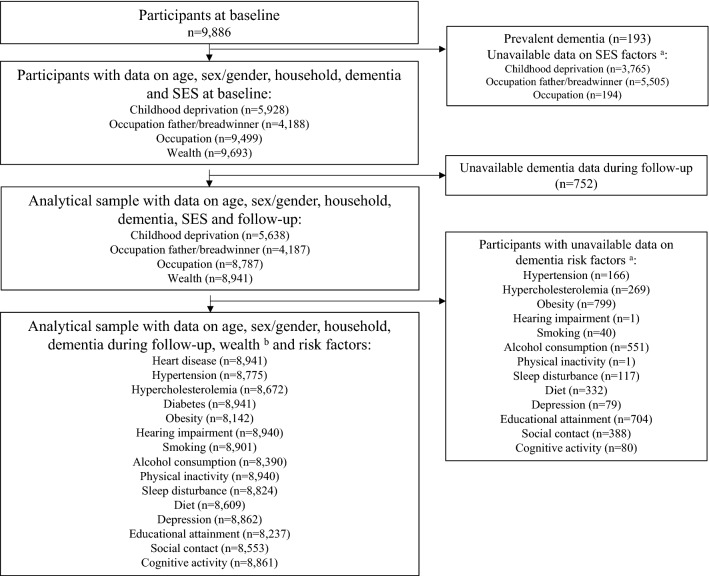
Both sex/gender and socioeconomic differences have been reported in the prevalence of modifiable risk factors for dementia. However, it remains unclear whether the associations between modifiable risk factors for dementia and incident dementia differ by sex/gender or socioeconomic status. This study aimed to investigate sex/gender and socioeconomic differences in the associations of modifiable risk factors with incident dementia using a life-course perspective. We used data from the English Longitudinal Study of Ageing (2008/2009 to 2018/2019). A total of 8,941 individuals were included [mean (standard deviation) age, 66.1 ± 9.8 years; 4,935 (55.2%) were women]. No overall sex/gender difference in dementia risk was found. Dementia risk was higher among those who experienced childhood deprivation [hazard ratio (HR) = 1.51 (1.17; 1.96)], lower occupational attainment [HR low versus high = 1.60 (1.23; 2.09) and HR medium versus high = 1.53 (1.15; 2.06)], and low wealth [HR low versus high = 1.63 (1.26; 2.12)]. Though different associations were found among the subgroups, there might be a sex/gender difference in dementia risk only for low cognitive activity, suggesting a higher risk for women [HR = 2.61 (1.89; 3.60)] compared to men [HR = 1.73 (1.20; 2.49)]. No consistent socioeconomic differences in modifiable dementia risk were found. A population-based approach that tackles inequalities in dementia risk profiles directly may be more effective than individual approaches in dementia prevention.
Overview
The claims and statistics of this paper haven’t been checked yet.
Free: it reads the open-access text and checks the first 5 claims that cite a source we can check. Create a free account to check every claim.
Integrity signals
Registry
Cites
Statistics
Figures
Verification
Claims the paper makes
The claims and statistics of this paper haven’t been checked yet.
Free: it reads the open-access text and checks the first 5 claims that cite a source we can check. Create a free account to check every claim.
Claims other papers make about this one
Each is checked against this paper’s own text: does it say what the citing paper says it does?
The source backs part of the claim, not all of it — or backs it for a different population, condition or comparison.
In the citing paper
“Findings about the effect of biological sex on risk of dementia are inconsistent.(53)”
From Dementia prevention, intervention, and care: 2024 report of the Lancet standing Commission (2024) · cites this paper as [53]
Experimental — accuracy not yet measured
Self-check
Percentages, sums and reported differences re-computed from the paper’s own numbers.
The self-check needs the paper’s full text.
Citations
Cites
1 retracted
Dementia prevention, intervention, and care: 2020 report of the Lancet Commission
Livingston, G., Huntley, J., Sommerlad, A., Ames, D., Ballard, C., Banerjee, S., Brayne, C., Burns, A., Cohen-Mansfield, J., Cooper, C., et al. (2020) · The Lancet · doi:10.1016/s0140-6736(20)30367-6 · Cited by 10,430
RetractedControlling the False Discovery Rate: A Practical and Powerful Approach to Multiple Testing
Benjamini, Y., & Hochberg, Y. (1995) · Journal of the Royal Statistical Society Series B: Statistical Methodology · doi:10.1111/j.2517-6161.1995.tb02031.x · Cited by 109,482
What is cognitive reserve? Theory and research application of the reserve concept
STERN, Y. (2002) · Journal of the International Neuropsychological Society · doi:10.1017/s1355617702813248 · Cited by 3,951
Vandenbroucke, J. P., Elm, E. V., Altman, D. G., Gøtzsche, P. C., Mulrow, C. D., Pocock, S. J., Poole, C., Schlesselman, J. J., Egger, M., & initiative, F. T. S. (2007) · Annals of Internal Medicine · doi:10.7326/0003-4819-147-8-200710160-00010-w1 · Cited by 3,543
A Note on Robust Variance Estimation for Cluster‐Correlated Data
Williams, R. L. (2000) · Biometrics · doi:10.1111/j.0006-341x.2000.00645.x · Cited by 2,501
Mixed brain pathologies account for most dementia cases in community-dwelling older persons
Schneider, J. A., Arvanitakis, Z., Bang, W., & Bennett, D. A. (2007) · Neurology · doi:10.1212/01.wnl.0000271090.28148.24 · Cited by 1,992
Cohort profile: The English longitudinal study of ageing
Steptoe, A., Breeze, E., Banks, J., & Nazroo, J. (2013) · International Journal of Epidemiology · doi:10.1093/ije/dys168 · Cited by 1,779
Sex differences in anxiety and depression clinical perspectives
Altemus, M., Sarvaiya, N., & Neill Epperson, C. (2014) · Frontiers in Neuroendocrinology · doi:10.1016/j.yfrne.2014.05.004 · Cited by 1,413
Midlife cardiovascular risk factors and risk of dementia in late life
Whitmer, R. A., Sidney, S., Selby, J., Johnston, S. C., & Yaffe, K. (2005) · Neurology · doi:10.1212/01.wnl.0000149519.47454.f2 · Cited by 1,238
Education and cognitive functioning across the life span
Lövdén, M., Fratiglioni, L., Glymour, M. M., Lindenberger, U., & Tucker-Drob, E. M. (2020) · Psychological Science in the Public Interest · doi:10.1177/1529100620920576 · Cited by 1,224
Research works printed but not linked: 3
- 1. WHO Dementia 2022 Geneva World Health Organization
- 45. WHO Global report on diabetes 2016 Geneva World Health Organization
- 55. WHO Global action plan on the public health response to dementia 2017–2025 2017 Geneva World Health Organization
Cited by
Dementia prevention, intervention, and care: 2024 report of the Lancet standing Commission
Livingston, G., Huntley, J., Liu, K. Y., Costafreda, S. G., Selbæk, G., Alladi, S., Ames, D., Banerjee, S., Burns, A., Brayne, C., et al. (2024) · The Lancet · doi:10.1016/s0140-6736(24)01296-0 · Cited by 3,860
Martin, S. S., Aday, A. W., Almarzooq, Z. I., Anderson, C. A. M., Arora, P., Avery, C. L., Baker-Smith, C. M., Barone Gibbs, B., Beaton, A. Z., Boehme, A. K., et al. (2024) · Circulation · doi:10.1161/cir.0000000000001209 · Cited by 2,800
Martin, S. S., Aday, A. W., Allen, N. B., Almarzooq, Z. I., Anderson, C. A. M., Arora, P., Avery, C. L., Baker-Smith, C. M., Bansal, N., Beaton, A. Z., et al. (2025) · Circulation · doi:10.1161/cir.0000000000001303 · Cited by 1,080
Palaniappan, L. P., Allen, N. B., Almarzooq, Z. I., Anderson, C. A. M., Arora, P., Avery, C. L., Baker-Smith, C. M., Bansal, N., Currie, M. E., Earlie, R. S., et al. (2026) · Circulation · doi:10.1161/cir.0000000000001412 · Cited by 242
Alzheimer disease seen through the lens of sex and gender
Castro‐Aldrete, L., Einsiedler, M., Martínková, J., Depypere, H. T., Ang, T. F. A., Mielke, M. M., Sindi, S., Eyre, H. A., Au, R., Dimech, A. S., et al. (2025) · Nature Reviews Neurology · doi:10.1038/s41582-025-01071-0 · Cited by 50
“Accordingly, individuals with low socioeconomic status face a considerably increased risk of developing dementia 44 .”
Bertogg, A., & Leist, A. K. (2023) · European Journal of Ageing · doi:10.1007/s10433-023-00751-4 · Cited by 33
“2021; Geraets and Leist 2023).”
BackgroundSelf-citationSocial determinants of dementia: A scoping review
Walsh, S., Klee, M., Hui, E. K., Saeed, U., Waters, S., Kuhn, I. L., Siette, J., Orgeta, V., Stafford, J., Smith, L., et al. (2025) · Alzheimer s & Dementia · doi:10.1002/alz.70524 · Cited by 37
Self-citationSayfullaeva, J., McLoughlin, J., & Kwakowsky, A. (2024) · Journal of Alzheimer s Disease · doi:10.3233/jad-240899 · Cited by 28
Chen, T. S., Mi, N., Lao, H. Y., Wang, C.-Y., Lo, W. L. A., Mao, Y., Tang, Y., Pei, Z., Yuan, J., & Huang, D. (2024) · BMC Medicine · doi:10.1186/s12916-024-03302-5 · Cited by 23
“Suggesting interventions for dementia, considering gender and serum uric acid variations, necessitates personalized strategies to accommodate diverse responses and specific factors influencing treatment efficacy [55–61].”
BackgroundHabbal, S., Mian, M., Imam, M., Tahiri, J., Amor, A., & Reddy, P. H. (2025) · Brain Organoid and Systems Neuroscience Journal · doi:10.1016/j.bosn.2025.05.001 · Cited by 19
Tsiakiri, A., Bakirtzis, C., Plakias, S., Vlotinou, P., Vadikolias, Κ., Terzoudi, A., & Christidi, F. (2024) · Biomedicines · doi:10.3390/biomedicines12061232 · Cited by 16
“Moreover, recent studies [80,81] have reported differential associations of risk factors with dementia among men and women, indicating that certain risk factors may have distinct impacts based on sex.”
BackgroundSex differences in modifiable dementia risk factors: Findings from the Rush Memory and Aging Project
Martin, J., Gordon, E. H., Reid, N., Hubbard, R. E., & Ward, D. D. (2025) · Alzheimer s & Dementia · doi:10.1002/alz.70506 · Cited by 16
Leung, C. W., Insolera, N. E., Wolfson, J. A., McEvoy, C. T., Ryan, L. H., Friedman, E. M., Langa, K. M., Heeringa, S. G., & Hao, W. (2024) · The Journals of Gerontology Series B · doi:10.1093/geronb/gbae153 · Cited by 12
López‐de‐Andrés, A., Jiménez‐García, R., Zamorano‐León, J. J., Omaña-Palanco, R., Carabantes-Alarcón, D., Hernández‐Barrera, V., de Miguel‐Díez, J., & Cuadrado‐Corrales, N. (2023) · International Journal of Environmental Research and Public Health · doi:10.3390/ijerph20064923 · Cited by 10
Elechi, K. W., Toluwalashe, S., Shekoni, M., Ede, N. S., Solomon, E. M., Iloanusi, C. A., Agbo, C. E., Idogen, O. S., Ikechukwu, C. A., Ifeanyi, O. C., et al. (2025) · Journal of Public Health Research · doi:10.1177/22799036251350957 · Cited by 9
Geraets, A. F. J., Schram, M. T., Jansen, J. F. A., Köhler, S., van Boxtel, M. P. J., Eussen, S. J. P. M., Koster, A., Stehouwer, C. D. A., Bosma, H., & Leist, A. K. (2024) · Social Science & Medicine · doi:10.1016/j.socscimed.2024.117111 · Cited by 6
Self-citationBeydoun, M. A., Georgescu, M. F., Weiss, J., Hooten, N. N., Beydoun, H. A., Tsai, J., Vieytes, C. A. M., Evans, M. K., & Zonderman, A. B. (2025) · Social Science & Medicine · doi:10.1016/j.socscimed.2025.118137 · Cited by 7
Welberry, H., Jorm, L. R., Kiely, K. M., Huque, M. H., Peters, R., & Anstey, K. J. (2025) · The Lancet Healthy Longevity · doi:10.1016/j.lanhl.2025.100711 · Cited by 8
Sex in the medical machine: How algorithms can entrench bioessentialism in precision medicine
Ichikawa, K., Boulicault, M., Thinius, A., DiMarco, M., Murchland, A. R., Maldonado, B., Higgins, A. S., & Richardson, S. S. (2025) · Big Data & Society · doi:10.1177/20539517251381674 · Cited by 7
“…differences, re-ported disparities in AD risk may also be shaped by the gender/sex patterning of known, modi fi able risk factors, as suggested by Geraets and Leist (2023) who, for example, found no sex difference in the risk of dementia but rather “ differences in the prevalence of modi fi…”
Gender Differences in the Effects of Exercise Interventions on Alzheimer’s Disease
Dong, Y., Shi, L., Ma, Y., Liu, Y., Sun, Y., & Jin, Q. (2025) · Brain Sciences · doi:10.3390/brainsci15080812 · Cited by 10
“Women are more likely to be engaged in low-wage, low-autonomy occupations with limited cognitive stimulation, which may heighten the long-term risk of AD [78].”
Three maxims for countering sex essentialism in scientific research
Boulicault, M., Gompers, A. D., Aalami, L. R., Danielsen, A. C., Dore, E. C., Homan, P., Lee, K. M. N., Miyagi, M., Niederriter, H., Sanogo, A., et al. (2025) · Biology of Sex Differences · doi:10.1186/s13293-025-00748-x · Cited by 7
“Yet this inference obscures how demographic factors such as lifespan and gendered social variables such as education, intimate partner violence, and socioeconomic status are known to play a large role in sex disparities in ADRDs [73–75].”
Fan, S., Liu, P.-C., Wang, J.-Z., Win, N. N., Lin, C., & Lin, H.-H. (2026) · Journal of the Formosan Medical Association · doi:10.1016/j.jfma.2026.03.072 · Cited by 5
Liu, F.-W., Liu, Y., Shen, X.-R., Du, J., Zhang, H., & Hou, X. (2024) · Frontiers in Molecular Neuroscience · doi:10.3389/fnmol.2024.1391082 · Cited by 8
da Silva, S. P., Castro, C. C. M., Rabelo, L. N., Engelberth, R. C. G. J., Fernández‐Calvo, B., & Fiuza, F. P. (2023) · GeroScience · doi:10.1007/s11357-023-00982-4 · Cited by 7
“Many lifestyle risk factors are also known to influence the AD aetiology, such as age, family history, sex, educational levels, environmental toxins, and head injuries [10, 11].”
Thompson, J., Yu, S., & Vasefi, M. (2025) · Journal of Clinical Neuroscience · doi:10.1016/j.jocn.2025.111712 · Cited by 4
Nabe‐Nielsen, K., Garde, A. H., Gyntelberg, F., Hansen, Å. M., Prescott, E., Laursen, P., & Holtermann, A. (2024) · Scandinavian Journal of Medicine and Science in Sports · doi:10.1111/sms.14730 · Cited by 4
“Actually, a previous study found that low cognitive activity was a stronger risk factor for dementia among women than among men [48].”
Sex Differences for Social Determinants Associated with Lewy Body Dementia Onset and Diagnosis
Bayram, E., Wyman‐Chick, K. A., Costello, R., Ghodsi, H., Rivera, C. S., Solomon, L., Kane, J. P. M., & Litvan, I. (2025) · Neurodegenerative Diseases · doi:10.1159/000544772 · Cited by 5
“Differences between LBD and control groups in our preliminary analyses identi fi ed social determinants to consider to better address the needs of people with LBD. Childhood socioeconomic status has been associated with higher dementia risk in studies from various countries [17, 18].”
Dementia Risk and Gender Equality: Global Insights Into Social Determinants
You, W. (2025) · Nursing and Health Sciences · doi:10.1111/nhs.70230 · Cited by 6
“…(Pusswald et al. 2015; Vitaliano et al. 2011), experience greater exposure to stress (Guo et al. 2024; Hasselgren et al. 2020), and historically have had lower access to education (Alty et al. 2023), all of which are associated with an increased risk of dementia (Geraets and Leist 2023; IHME 2020).”
Social patterning of cognitive impairment in Colombia: evidence from the SABE 2015 study
Barragán, A. G., Gómez, I. E., & Lucumí, D. (2024) · BMC Geriatrics · doi:10.1186/s12877-024-05432-0 · Cited by 2
Walbaum, M., Aguzzoli, E., Castro‐Aldrete, L., Cyhlarova, E., Chadha, A. S., & Knapp, M. R. J. (2025) · International Journal of Geriatric Psychiatry · doi:10.1002/gps.70067 · Cited by 2
Abzhandadze, T., Hoang, M. T., Raaschou, P., Norgren, J., Mo, M., Molnár, C., Xu, H., Kananen, L., Åkerman, M., Religa, D., et al. (2025) · Scientific Reports · doi:10.1038/s41598-025-03055-y · Cited by 3
Hajek, A., König, H., Rafnsson, S. B., & Gyasi, R. M. (2025) · BMC Public Health · doi:10.1186/s12889-025-24239-1 · Cited by 4
Sex differences in modifiable risk factors of dementia and their associations with cognition
Fitzhugh, M. C., & Pa, J. (2026) · Biology of Sex Differences · doi:10.1186/s13293-026-00908-7 · Cited by 2
“The literature consistently reports that women are more likely to experience lower levels of education, high cholesterol, physical inactivity, and depression, while more men experience diabetes, hearing loss, and substance abuse [17–21].”
The Role of Gender in Cognitive Processing of Affective Linguistic Stimuli in Bilinguals
Doqaruni, V. R. (2024) · Cognitie, Creier, Comportament · doi:10.24193/cbb.2024.29.01
Chen, T. S., Mi, N.-N., Lao, H. Y., Wang, C.-Y., Lo, W. L. A., Mao, Y.-R., Tang, Y., Zhong, P., Yuan, J.-Q., & Huang, D.-F. (2024) · Figshare · doi:10.6084/m9.figshare.25405959
Prevalence of Neurocognitive Disorders in the Elderly Quechua Population Using the Q-RUDAS
Zegarra-Valdivia, J. A., Quispe, R. D. M., Turpo, J. C., Paredes-Manrique, C., Malaga, M., Mamani-Benito, O., Montesinos, R., Custodio, N., & Tosto, G. (2025) · Brain Sciences · doi:10.3390/brainsci15121307 · Cited by 3
“…in the associations between modifiable risk factors and incident dementia were found across subgroups, a potential sex/gender difference in dementia risk related to low cognitive activity was identified, suggesting an increased risk for women compared to men with low cognitive activity [51].”
Iwai, K., Azuma, T., Yonenaga, T., Sasai, Y., Tabata, K., Sugiura, I., Nakashima, S., Nagase, Y., & Tomofuji, T. (2026) · AI · doi:10.3390/ai7020042
Ryan-Claytor, C., & Luo, L. (2026) · International Journal of Epidemiology · doi:10.1093/ije/dyag026
Riahi, R., Mansournia, M. A., Badihian, N., & Hosseini, S. M. (2026) · Journal of the American Heart Association · doi:10.1161/jaha.125.045217
Tremblay, S. A., Tulsi, J., Yang, D., Alsibai, Z., McDonald, I., Aladeeb, R., Novielli, A., Wong, T. L. H., Freitas, J. G., Miller, M., et al. (2026) · Neurobiology of Aging · doi:10.1016/j.neurobiolaging.2026.06.005
Park, S., Ko, A. J., Lim, J. H., & Park, E. (2026) · BMJ Open · doi:10.1136/bmjopen-2025-112641
Leung, C. W., Insolera, N. E., Lee, H., Wolfson, J. A., McEvoy, C. T., Friedman, E. M., Heeringa, S. G., & Hao, W. (2026) · American Journal of Clinical Nutrition · doi:10.1016/j.ajcnut.2026.101386
Selmanović, S., Vujadinovic, A., Bojic, J. V., Gajić, D., Čusto, E. B., Klebic, J., Bećarević, M., Dzambic, S. A., & Milić, B. (2026) · Cureus · doi:10.7759/cureus.115704
“These findings lend support to the hypothesis that higher educational levels in early life stimulate cognitive reserve development, providing a protective effect in later years and delaying the clinical manifestation of cognitive decline [13].”
Metadata
- Authors
- Geraets, A. F. J., & Leist, A. K.
- Affiliations
- University of Luxembourg (LU)
- Corresponding author
- Geraets, Anouk F. J.
- Venue
- Scientific Reports
- Published
- 2023-01-03
- Volume
- 13
- Issue
- 1
- Pages
- 80-80
- ISSN
- 2045-2322 (ISSN-L)
- PMC
- PMC9810648
- OpenAlex
- W4313528550
- Semantic Scholar
- ee11f82ec84661af623ec1b48b2a5675fd73d5c0
- Cited by
- 43
- References
- 58
- Citations by year
- 2026: 10 · 2025: 18 · 2024: 12 · 2023: 3
- FWCI
- 8.72
- Type
- journal article
- Language
- en
- Open access
- gold
- doi.org
- Licence
- cc-by
- creativecommons.org/licenses/by/4.0 (tdm)
- creativecommons.org/licenses/by/4.0 (vor)
- Locations
- Scientific Reports (publishedVersion, cc-by)
- PubMed Central (publishedVersion, cc-by)
- PubMed (publishedVersion)
- Open Repository and Bibliography (University of Luxembourg) (submittedVersion, cc-by-nc-sa)
- DOAJ (DOAJ: Directory of Open Access Journals) (submittedVersion, cc-by-sa)
- Funders
- H2020 European Research Council (803239)
- Topics
- Health Sciences › Medicine › Psychiatry and Mental health › Dementia and Cognitive Impairment Research
- Social Sciences › Health › Health disparities and outcomes
- Health Sciences › Medicine › Endocrinology, Diabetes and Metabolism › Menopause: Health Impacts and Treatments
- Keywords
- dementia, modifiable risk factors, sex differences, gender differences, socioeconomic status, child deprivation, occupational attainment, wealth, cognitive activity, incident dementia, life course perspective, dementia prevention, health disparities
- MeSH terms
- Aged, Aging, Child, Dementia, Female, Humans, Longitudinal Studies, Male, Middle Aged, Risk Factors, Social Class, Socioeconomic Factors
About these checks
Registry, retraction, Cites and statistics results are computed, not judged, with one exception: a printed reference that no index lists is read once by a model before it counts as a citation error. Claims are extracted by a model and kept only when their quote appears verbatim in the text; each cited source is then checked, with a model’s help, for whether it says what the claim relies on. Those verdicts can be wrong — read the claim’s quote and the cited source before relying on one.
Statistics and arithmetic are recomputed, not judged.
Confidence bands are shown only for fields calibrated on our annotated test set. None is calibrated yet, so no band is shown.
What counts as a claim ›How we measure confidence ›How we check this ›
Are you an author, or do you see a problem with this page? Request a review
Data sources
Bibliographic data: Semantic Scholar, OpenAlex, Crossref.
Contains information from the Semantic Scholar Academic Graph Datasets, made available under the ODC Attribution License (ODC-BY 1.0).
Semantic Scholar’s data is described in: Kinney, R., et al. (2023). The Semantic Scholar Open Data Platform. arXiv:2301.10140.
