

The DOI matches its Crossref record; 265 of the 271 references it cites were found in a registry or an index; none of the 238 sources its claims cite is checked for support yet.
Education and Cognitive Functioning Across the Life Span
Open accessAbstract
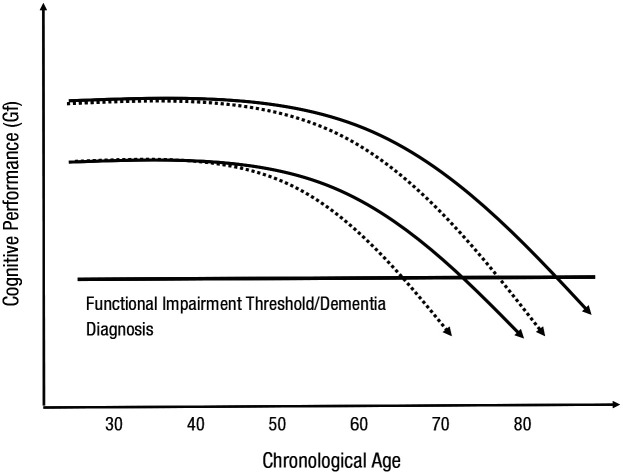
Cognitive abilities are important predictors of educational and occupational performance, socioeconomic attainment, health, and longevity. Declines in cognitive abilities are linked to impairments in older adults’ everyday functions, but people differ from one another in their rates of cognitive decline over the course of adulthood and old age. Hence, identifying factors that protect against compromised late-life cognition is of great societal interest. The number of years of formal education completed by individuals is positively correlated with their cognitive function throughout adulthood and predicts lower risk of dementia late in life. These observations have led to the propositions that prolonging education might (a) affect cognitive ability and (b) attenuate aging-associated declines in cognition. We evaluate these propositions by reviewing the literature on educational attainment and cognitive aging, including recent analyses of data harmonized across multiple longitudinal cohort studies and related meta-analyses. In line with the first proposition, the evidence indicates that educational attainment has positive effects on cognitive function. We also find evidence that cognitive abilities are associated with selection into longer durations of education and that there are common factors (e.g., parental socioeconomic resources) that affect both educational attainment and cognitive development. There is likely reciprocal interplay among these factors, and among cognitive abilities, during development. Education–cognitive ability associations are apparent across the entire adult life span and across the full range of education levels, including (to some degree) tertiary education. However, contrary to the second proposition, we find that associations between education and aging-associated cognitive declines are negligible and that a threshold model of dementia can account for the association between educational attainment and late-life dementia risk. We conclude that educational attainment exerts its influences on late-life cognitive function primarily by contributing to individual differences in cognitive skills that emerge in early adulthood but persist into older age. We also note that the widespread absence of educational influences on rates of cognitive decline puts constraints on theoretical notions of cognitive aging, such as the concepts of cognitive reserve and brain maintenance. Improving the conditions that shape development during the first decades of life carries great potential for improving cognitive ability in early adulthood and for reducing public-health burdens related to cognitive aging and dementia.
Overview
CoChat Summary
TL;DR
This review concludes that educational attainment is robustly associated with higher levels of cognitive function across adulthood and lower late-life dementia risk, but it has negligible associations with rates of aging-related cognitive decline. Education’s late-life cognitive benefits are best explained by higher peak cognitive ability in early adulthood that persists and delays threshold crossing, not by slowed decline.
Key findings
- Educational attainment is positively associated with adult cognitive-ability levels. Strenze’s meta-analysis (59 samples, total N = 84,828) found a sample-size-weighted average correlation corrected for measurement error of .56 (95% CI [0.53, 0.58]); Opdebeeck et al.’s older-adult meta-analysis (109 studies, total N = 111,684) found an average correlation of approximately .3 for general cognitive ability. Five additional years of education were associated with roughly 0.2 to 0.4 SD higher cognitive performance, or about 3 to 6 IQ points.
- Education–cognitive change associations are small and inconsistent. Seblova et al.’s meta-analysis reported point estimates of less than 0.001 SD per decade for episodic memory, 0.002 SD per decade for general intelligence, 0.002 SD per decade for processing speed, −0.004 SD per decade for verbal fluency, and less than −0.001 SD per decade for crystallized ability; none was statistically significant. A university degree versus high school diploma was estimated to yield only about 0.02 SD less decline over 20 years (upper 95% CI = 0.05 SD), compared with average episodic memory decline of about 0.4 to 0.5 SD per decade.
- Low educational attainment is associated with higher dementia risk. Meng and D’Arcy’s pooled analyses found a 2.6-fold increased risk for dementia in less educated versus more educated people in prevalence studies (95% CI [2.2, 3.1]) and a 1.9-fold increased risk in incidence studies (95% CI [1.5, 2.3]). The review argues a threshold model can account for this association without education affecting rates of cognitive decline.
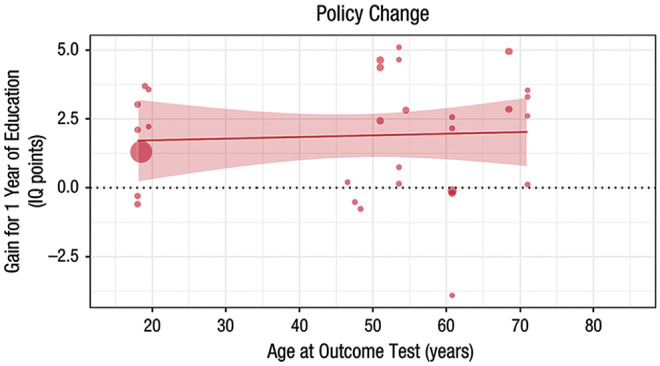
- Quasiexperimental evidence indicates education has causal effects on cognitive abilities. Ritchie and Tucker-Drob’s meta-analysis found policy-change designs yielded about 2 IQ points (0.14 SD) per year of education (95% CI [0.9, 3.1]), while school-age-cutoff designs yielded approximately 5 IQ points per year; effects appeared on fluid abilities as well as crystallized abilities.
Methods
- This is a narrative, non-systematic review synthesizing literature on educational attainment, cognitive aging, and dementia, including observational studies, harmonized longitudinal cohort analyses, and meta-analyses.
- Key evidence sources include Lipnicki et al.’s harmonized analysis of 14 longitudinal studies in 12 countries (42,170 individuals aged 54–105, 2–16 assessment waves), Seblova et al.’s meta-analysis of education and age-related cognitive change, and Ritchie and Tucker-Drob’s meta-analysis of quasiexperimental schooling effects.
- The main analysis is qualitative synthesis of effect sizes, longitudinal change models, and quasiexperimental designs; no new primary data are reported.
Limitations
- The paper states it is not a systematic review; educational attainment is indexed by qualification or years of education, which elides schooling quality, social context, and credential status, and research on those aspects is too sparse for mature conclusions.
- The paper states that cross-study heterogeneity in education–change associations remains unknown; dementia-progression studies are scarce, mixed, and subject to collider bias and ascertainment timing; effects of education after college and dose-response across all education levels remain unclear.
- Evident from the text: conclusions rely on observational and meta-analytic evidence with varying cognitive measures, reliability, ceiling effects (e.g., MMSE), and differing dementia diagnostic protocols, which limits causal and domain-specific inferences.
Model-written summary. Check it against the paper before relying on it.
Integrity signals
Registry
Cites
Statistics
Figures



Verification
Claims the paper makes
0 Valid · 2 Not valid · 150 Not checked · 143 Own results and interpretations
A result the paper reports from its own data — it cites no other source for it, so there is none to check. The quote shows it is in the paper.
In the paper
“we find that associations between education and aging-associated cognitive declines are negligible”
§ Education and Cognitive Functioning Across the Life Span > Abstract
plain- Asserted: passes — The authors put it forward as true.
- Checkable: passes — It can be checked against evidence.
- Load-bearing: passes — The paper’s conclusions depend on it.
- Based: passes — The paper gives a reason why it holds.
A result the paper states — it cites no source for it, so there is none to check. The quote shows it is in the paper.
In the paper
“We also find evidence that cognitive abilities are associated with selection into longer durations of education”
§ Education and Cognitive Functioning Across the Life Span > Abstract
plainstates an association- Asserted: passes — The authors put it forward as true.
- Checkable: passes — It can be checked against evidence.
- Load-bearing: passes — The paper’s conclusions depend on it.
- Based: passes — The paper gives a reason why it holds.
A result the paper states — it cites no source for it, so there is none to check. The quote shows it is in the paper.
In the paper
“there are common factors (e.g., parental socioeconomic resources) that affect both educational attainment and cognitive development”
§ Education and Cognitive Functioning Across the Life Span > Abstract
plainstates a cause- Asserted: passes — The authors put it forward as true.
- Checkable: passes — It can be checked against evidence.
- Load-bearing: passes — The paper’s conclusions depend on it.
- Based: passes — The paper gives a reason why it holds.
A result the paper states — it cites no source for it, so there is none to check. The quote shows it is in the paper.
In the paper
“Throughout adulthood, cognitive function in individuals with more years of schooling is, on average, better than cognitive function in those with fewer years of schooling.”
§ Education and Cognitive Functioning Across the Life Span > Evidence From Observational Studies > Summary of the evidence from observational studies in the broader context of cognitive aging and dementia
plainstates an association- Asserted: passes — The authors put it forward as true.
- Checkable: passes — It can be checked against evidence.
- Load-bearing: passes — The paper’s conclusions depend on it.
- Based: passes — The paper gives a reason why it holds.
None of the sources cited for this claim have been checked yet.
In the paper
“Two studies detected no statistically significant effect of education on cognitive change in the years before dementia diagnosis.”
§ Education and Cognitive Functioning Across the Life Span > Evidence From Observational Studies > Education and cognitive decline before and after dementia diagnosis
plain- Asserted: passes — The authors put it forward as true.
- Checkable: passes — It can be checked against evidence.
- Load-bearing: unclear — It is unclear whether the paper’s conclusions depend on it.
- Based: passes — The paper gives a reason why it holds.
186 more claims
Create a free account to see all 295 claims and to verify the 238 references still open.
- It may state two separate claims as one. 79
- Probably not a substantial claim. 31
- The quote only partly states this claim. 2
Claims other papers make about this one
Each is checked against this paper’s own text: does it say what the citing paper says it does?
The cited source says what the claim attributes to it.
In the citing paper
“overall cognitive capacities including crystallized and fluid composites, despite there being distinctions between them, have modest associations with each other, and can be summarized by a higher-order common factor (general intelligence) (Lovden, Fratiglioni, Glymour, Lindenberger, & Tucker-Drob, 2020; Lubinski, 2004; van der Maas et al., 2006).”
From Early-Initiated Childhood Reading for Pleasure: Associations with Better Cognitive Performance, Mental Well-being and Brain Structure in Young Adolescence (2024) · cites this paper as Lovden, Fratiglioni, Glymour, Lindenberger, & Tucker-Drob, 2020
The cited source says what the claim attributes to it.
In the citing paper
“Our results also suggested that early RfP showed a similar beneficial association with cognitive development as educational attainment (EA) at certain levels, since EA is positively associated with subsequent cognitive functions later-in-life (Lovden et al., 2020; Ritchie & Tucker-Drob, 2018)”
From Early-Initiated Childhood Reading for Pleasure: Associations with Better Cognitive Performance, Mental Well-being and Brain Structure in Young Adolescence (2024) · cites this paper as Lovden et al., 2020
In the citing paper
“However, educational attainment is a key driver of socioeconomic resources throughout life, such as occupation, economic outcomes, social status, and access to health care.24”
In the citing paper
“Thus, promoting continued education through early adulthood could confer benefits that contribute to lower ADRD risk directly (ie, cognitive or brain reserve, or both) and indirectly (ie, upward mobility).24”
Self-check
Percentages, sums and reported differences re-computed from the paper’s own numbers.
Each contradiction between two passages listed here was confirmed by an independent check.
Rated minor: it would not touch a result — a value no result rests on, a p-value that stays on the same side of the significance level, or a conflict that is clerical, resolved elsewhere in the paper, or outside its own findings.
In the paper
§ Education and Cognitive Functioning Across the Life Span > A Primer on Adult Cognitive Development
“Table: Table 4. Example of a Positive Association Between Educational Attainment and Cognitive Change: More Education Is Associated with Smaller Age-Related Increases in Cognitive Performance”
§ Education and Cognitive Functioning Across the Life Span > A Primer on Adult Cognitive Development
“A negative correlation between educational attainment and cognitive change can also indicate that greater educational attainment is associated with smaller increases in cognitive performance over time (e.g., in a measure of crystallized intelligence such as vocabulary). Table 4 gives an example of such a situation.”
Citations
Cites
Diagnostic and Statistical Manual of Mental Disorders
American Psychiatric Association (2013) · doi:10.1176/appi.books.9780890425596 · Cited by 116,369
Folstein, M. F., Folstein, S. E., & McHugh, P. R. (1975) · Journal of Psychiatric Research · doi:10.1016/0022-3956(75)90026-6 · Cited by 88,282
Hirono, N., Mori, E., Ikejiri, Y., Imamura, T., Shimomura, T., Hashimoto, M., Yamashita, H., & Ikeda, M. (1997) · Brain and nerve · Cited by 21,038
Kok, J. S., Berg, I. J., & Scherder, E. J. A. (2013) · Dementia and Geriatric Cognitive Disorders Extra · doi:10.1159/000353441 · Cited by 20,589
Older Adults' Reasons for Using Technology while Aging in Place
Peek, S. T. M., Luijkx, K. G., Rijnaard, M. D., Nieboer, M. E., van der Voort, C. S., Aarts, S., van Hoof, J., Vrijhoef, H. J. M., & Wouters, E. J. M. (2016) · Gerontology · doi:10.1159/000430949 · Cited by 19,690
Sensitivity and False Alarm Rate of a Fall Sensor in Long-Term Fall Detection in the Elderly
Kangas, M., Korpelainen, R., Vikman, I., Nyberg, L., & Jämsä, T. (2015) · Gerontology · doi:10.1159/000362720 · Cited by 18,909
NIA‐AA Research Framework: Toward a biological definition of Alzheimer's disease
Jack, C. R., Bennett, D. A., Blennow, K., Carrillo, M. C., Dunn, B., Haeberlein, S. B., Holtzman, D. M., Jagust, W., Jessen, F., Karlawish, J., et al. (2018) · Alzheimer's & Dementia · doi:10.1016/j.jalz.2018.02.018 · Cited by 10,537
"General Intelligence," Objectively Determined and Measured
Spearman, C. (1904) · The American Journal of Psychology · doi:10.2307/1412107 · Cited by 6,207 · cited 4×
“, 2006) is an example of an account of the positive correlations among different cognitive abilities (Spearman, 1904) that does not invoke a g factor.”
BackgroundMethodInfluentialSocioeconomic status and child development
Bradley, R. H., & Corwyn, R. F. (2002) · Annual Review of Psychology · doi:10.1146/annurev.psych.53.100901.135233 · Cited by 5,484 · cited 1×
“Individual differences in educational attainment are therefore likely to be associated with the broad constellations of environmental opportunities and advantages that come with higher parental socioeconomic status (Bradley & Corwyn, 2002; Strenze, 2007).”
BackgroundSchmidt, F. L., & Hunter, J. E. (1998) · Psychological Bulletin · doi:10.1037//0033-2909.124.2.262 · Cited by 4,180 · cited 1×
“Cognitive abilities, measured both in childhood and in adulthood, are important predictors of life achievements, health, and mortality (Batty, Deary, & Gottfredson, 2007; Gottfredson & Deary, 2004; Schmidt & Hunter, 1998; Strenze, 2007).”
Background
Research works printed but not linked: 2
- Bronfenbrenner U., McClelland P., Wethington E., Moen P., Ceci S. J. (1996). The state of Americans. New York, NY: Free Press.
- Plomin R. (1994). SAGE series on individual differences and development, Vol. 6. Genetics and experience: The interplay between nature and nurture. Thousand Oaks, CA: SAGE.
Cited by
Life course epidemiology and public health
Wagner, C., Carmeli, C., Jackisch, J., Kivimäki, M., van der Linden, B. W. A., Cullati, S., & Chiolero, A. (2024) · The Lancet Public Health · doi:10.1016/s2468-2667(24)00018-5 · Cited by 188
Wang, A.-Y., Hu, H.-Y., Ou, Y.-N., Wang, Z.-T., Ma, Y.-H., Tan, L., & Yu, J.-T. (2023) · The Journal of Prevention of Alzheimer's Disease · doi:10.14283/jpad.2022.81 · Cited by 176
“Lower education, as a key indicator of SES, has been demonstrated to be a risk factor in many previous reviews (65).”
Wilkins, C. H., Windon, C., Dilworth‐Anderson, P., Romanoff, J., Gatsonis, C. G., Hanna, L., Apgar, C., Gareen, I. F., Hill, C. V., Hillner, B. E., et al. (2022) · JAMA Neurology · doi:10.1001/jamaneurol.2022.3157 · Cited by 147
Sleep disturbances and dementia risk: a multicenter study
Sindi, S., Kåreholt, I., Johansson, L., Skoog, J., Sjöberg, L., Wang, H., Johansson, B., Fratiglioni, L., Soininen, H., Solomon, A., et al. (2018) · Alzheimer's & Dementia · doi:10.1016/j.jalz.2018.05.012 · Cited by 144
Self-citationSingh, B., Bennett, H., Miatke, A., Dumuid, D., Curtis, R., Ferguson, T., Brinsley, J., Szeto, K., Petersen, J. M., Gough, C., et al. (2025) · British Journal of Sports Medicine · doi:10.1136/bjsports-2024-108589 · Cited by 157
Metadata
- Authors
- Lövdén, M., Fratiglioni, L., Glymour, M. M., Lindenberger, U., & Tucker-Drob, E. M.
- Affiliations
- Stockholm University (SE)
- University of California, San Francisco (US)
- Max Planck Institute for Human Development (DE)
- Department of Psychology and Population Research Center, University of Texas at Austin
- Corresponding author
- Lövdén, Martin
- Venue
- Psychological Science in the Public Interest
- Publisher
- SAGE Publications
- Published
- 2020-08
- Volume
- 21
- Issue
- 1
- Pages
- 6-41
- ISSN
- 1529-1006 (ISSN-L)
- 2160-0031
- PMC
- PMC7425377
- OpenAlex
- W3047728892
- Cited by
- 1,224
- References
- 271
- Citations by year
- 2026: 203 · 2025: 281 · 2024: 294 · 2023: 229 · 2022: 153 · 2021: 60 · 2020: 4
- FWCI
- 81.33
- Type
- journal article
- Language
- en
- Open access
- hybrid
- doi.org
- Licence
- cc-by
- creativecommons.org/licenses/by/4.0/ (unspecified)
- journals.sagepub.com/page/policies/text-and-data-mining-license (tdm)
- Locations
- Psychological Science in the Public Interest (publishedVersion, cc-by)
- PubMed Central (publishedVersion, cc-by)
- PubMed (publishedVersion)
- MPG.PuRe (Max Planck Society) (submittedVersion, other-oa)
- Funders
- Eunice Kennedy Shriver National Institute of Child Health and Human Development (R01HD083613, P2CHD042849)
- Topics
- Health Sciences › Medicine › Psychiatry and Mental health › Dementia and Cognitive Impairment Research
- Social Sciences › Psychology › Experimental and Cognitive Psychology › Cognitive Abilities and Testing
- Social Sciences › Psychology › Developmental and Educational Psychology › Aging and Gerontology Research
- Keywords
- educational attainment, cognitive aging, cognitive decline, late-life cognition, dementia risk, cognitive reserve, brain maintenance, individual differences in cognitive ability, cognitive development
- MeSH terms
- Cognitive Aging, Academic Success, Cognition, Dementia, Educational Status, Humans, Risk Factors, Cognitive Reserve, Cognitive Dysfunction
About these checks
Registry, retraction, Cites and statistics results are computed, not judged, with one exception: a printed reference that no index lists is read once by a model before it counts as a citation error. Claims are extracted by a model and kept only when their quote appears verbatim in the text; each cited source is then checked, with a model’s help, for whether it says what the claim relies on. Those verdicts can be wrong — read the claim’s quote and the cited source before relying on one.
A language model drew the claims from the paper on 2026-10-04, under version 3 of the claim definition (model deepseek-v4.1-flash, prompt extract-v3).
A second model labelled each claim on 2026-10-04 (model jev-1.13-20260917, definition revision gold-guideline-v0.2).
Statistics and arithmetic are recomputed, not judged.
Confidence bands are shown only for fields calibrated on our annotated test set. None is calibrated yet, so no band is shown.
What counts as a claim ›How we measure confidence ›How we check this ›
Are you an author, or do you see a problem with this page? Request a review
How to cite
Cite CoChat for the checks on this page, and the paper for its own findings.
- This page
- CoChat. (2026). Citation check: Education and Cognitive Functioning Across the Life Span. https://app.cochat.ai/papers/10.1177/1529100620920576
- The paper
- Lövdén, M., Fratiglioni, L., Glymour, M. M., Lindenberger, U., & Tucker-Drob, E. M. (2020). Education and Cognitive Functioning Across the Life Span. Psychological Science in the Public Interest. https://doi.org/10.1177/1529100620920576
Data sources
Bibliographic data: Semantic Scholar, OpenAlex, Crossref.
Contains information from the Semantic Scholar Academic Graph Datasets, made available under the ODC Attribution License (ODC-BY 1.0).
Semantic Scholar’s data is described in: Kinney, R., et al. (2023). The Semantic Scholar Open Data Platform. arXiv:2301.10140.
