

A critical assessment of nanoparticles enhanced phase change materials (NePCMs) for latent heat energy storage applications
Open accessThe DOI matches its Crossref record; 53 of the 53 references it cites were found in a registry or an index; 3 of the 10 sources its claims cite were checked for support.
Abstract
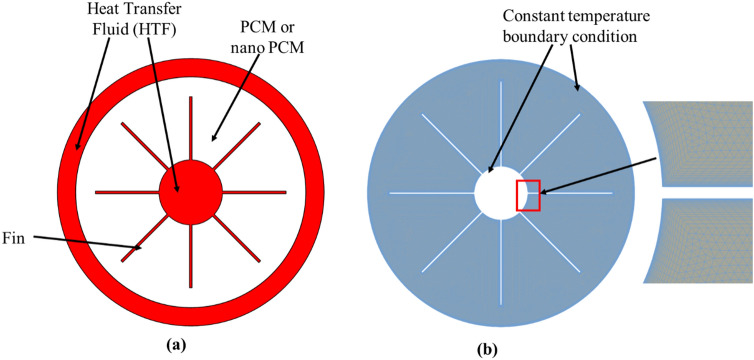
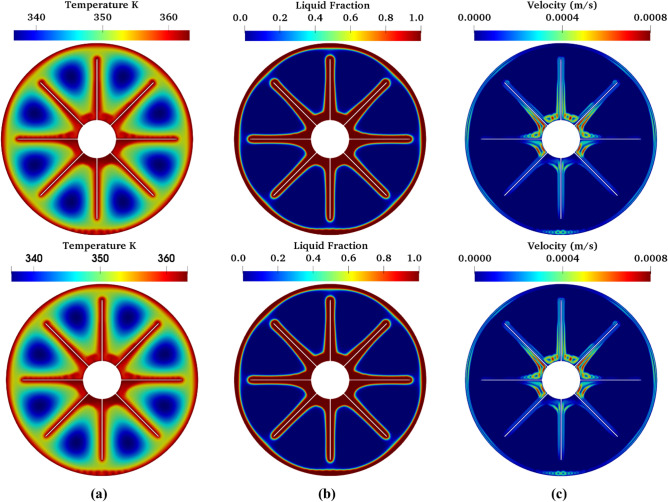
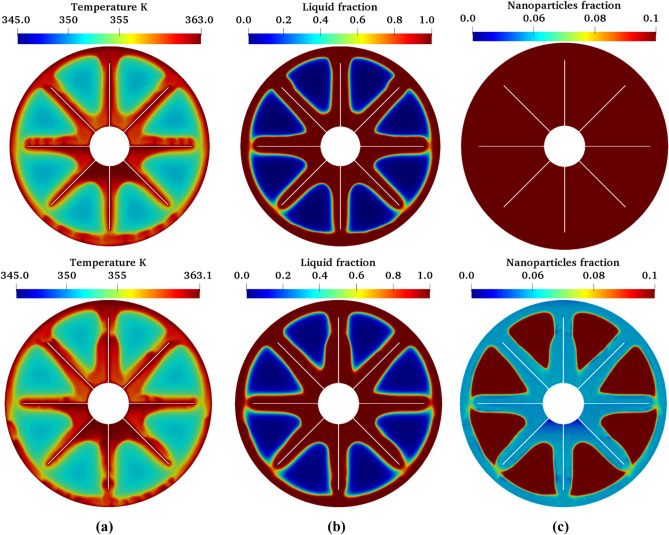
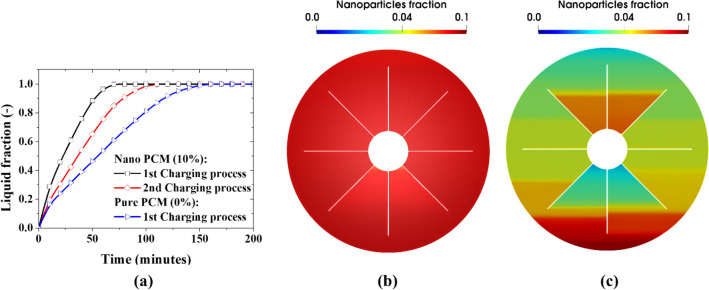
Phase change material (PCM) laden with nanoparticles has been testified as a notable contender to increase the effectiveness of latent heat thermal energy storage (TES) units during charging and discharging modes. In this study, a numerical model is developed and implemented based on the coupling between an advanced two-phase model for the nanoparticles-enhanced PCM (NePCM) and the enthalpy-porosity formulation for the transient behavior of the phase change. Therefore, a porosity source term is added to the nanoparticles transport equation to account for the particles' frozen state in regions occupied by solid PCM. This two-phase model includes three main nanoparticles' slip mechanisms: Brownian diffusion, thermophoresis diffusion, and sedimentation. A two-dimensional model of a triplex tube heat exchanger is considered and different charging and discharging configurations are analyzed. Compared to pure PCM, results show a substantial heat transfer enhancement during the charging and discharging cycle in which a homogeneous distribution of nanoparticles is considered as the initial condition. For this case, the two-phase model predictions are superior to the ones obtained with the classical single-phase model. In the case of multi-cycle charging and discharging, a significant deterioration of the heat transfer rate is observed using the two-phase model while such assessment is senseless using the single-phase mixture model due to the physical assumptions upon which this model is formulated. The two-phase model results reveal that, for a NePCM with high nanoparticles concentration (> 1%), the melting performance during the second charging cycle is reduced by 50% compared to the first one. This performance degradation is attributed to a noteworthy non-homogeneous distribution of the nanoparticles at the beginning of the second charging cycle. The dominant nanoparticles migration mechanism, in this scenario, is the one resulting from sedimentation effects.
Overview
CoChat Summary
## TL;DR
This paper argues that single-phase nanoparticle-enhanced PCM models are inadequate for multi-cycle latent heat storage because they assume a uniform nanoparticle distribution and miss migration effects. Using a two-phase model coupled with enthalpy-porosity, the authors show that nanoparticles can improve melting/solidification in the first cycle but performance can deteriorate by about 50% by the second charging cycle in a 10% NePCM case.
## Key findings
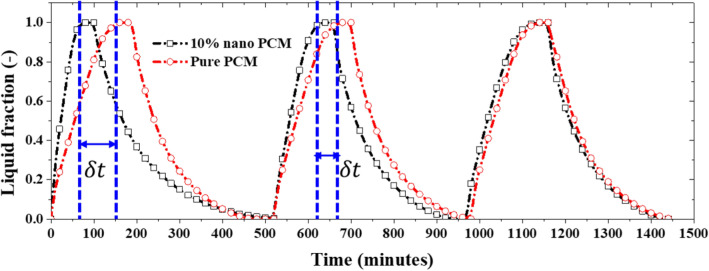
- For a 10% NePCM in a triplex tube heat exchanger, the two-phase model predicted a fully melted condition earlier than pure PCM in the first charging process, and the paper reports a 50% degradation in NePCM performance by the third charging process relative to the first.
- In the multi-cycle case, the second charging performance of the NePCM was reported to be reduced by about 50% compared with the first charging, while still being about 20% better than pure PCM.
- The degradation is attributed to non-homogeneous nanoparticle distribution caused by sedimentation, Brownian diffusion, and thermophoresis; the paper identifies sedimentation as the dominant mechanism in the high-concentration case (> 1%).
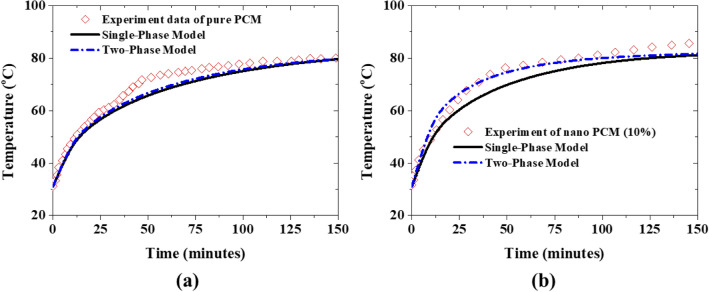
- For the 0% nanoparticle case, both single-phase and two-phase models gave the same predictions, while for the 10% case the two-phase model was reported to be more accurate than the single-phase model.
## Methods
- The study uses a numerical two-phase model for NePCM, coupled with the enthalpy-porosity method for phase change, and compares it against a single-phase mixture model.
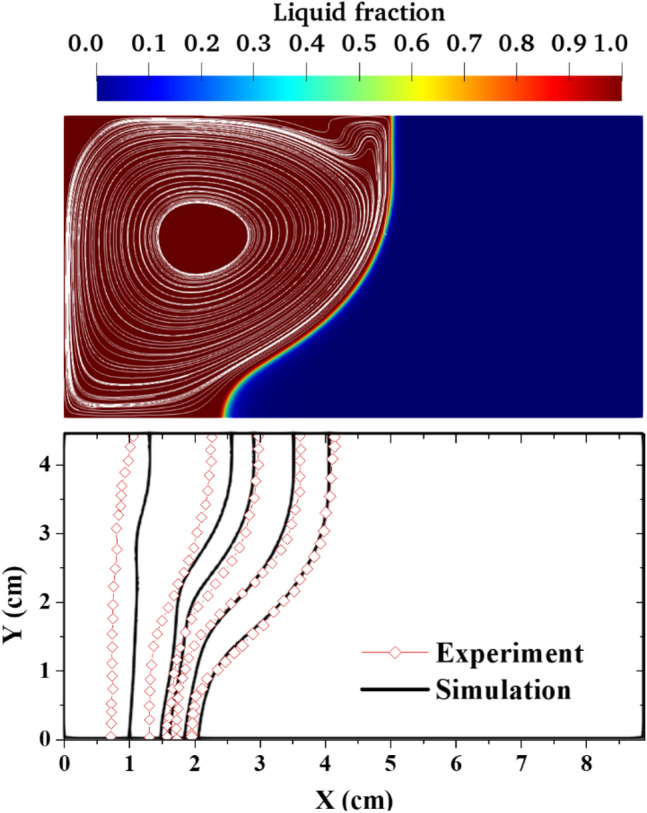
- Validation is performed in two parts: first against experimental melting of pure Gallium in a rectangular cavity, and second against an experimental triplex tube heat exchanger with RT82 paraffin and Al2O3 nanoparticles.
- Simulations were run in OpenFOAM CFD version 6; the authors performed three consecutive charging/discharging cycles for 0% and 10% nano PCM under specified constant boundary temperatures.
## Limitations
- The paper states that the single-phase model is inadequate for multi-cycle NePCM operation because it assumes homogeneous nanoparticle distribution and cannot capture slip mechanisms.
- The text makes evident that the exact quantitative results are tied to the specific geometry and conditions studied: a 2D triplex tube heat exchanger, 10% Al2O3 NePCM, and the chosen temperature cycles; this limits direct generalization from the reported simulations.
- Not stated in the paper.
Model-written summary. Check it against the paper before relying on it.
Integrity signals
Registry
Cites
Statistics
Figures
Verification
Claims the paper makes
2 Valid · 0 Not valid · 4 Not checked · 33 Own results and interpretations
The cited sources support only part of this claim — read each source’s verdict below.
In the paper
“In fact, this model (single-phase model) has been demonstrated45–47 to lack the ability to predict the correct magnitude of the heat transfer enhancement, particularly, for nanoparticle concentrations higher than 1%.”
§ A critical assessment of nanoparticles enhanced phase change materials (NePCMs) for latent heat energy storage applications > Introduction
What the sources say
- Not checked — no full text of the sourcecites [45] Buongiorno J Convective transport in nanofluids J. Heat Transf. 2006 128 240 250 10.1115/1.2150834 source
- Not checked — no full text of the sourcecites [46] Haddad Z Abu-Nada E Oztop HF Mataoui A Natural convection in nanofluids: Are the thermophoresis and Brownian motion effects significant in nanofluid heat transfer enhancement? Int. J. Therm. Sci. 2012 57 152 162 10.1016/j.ijthermalsci.2012.01.016 source
- Partly supportedcites [47] Amidu MA Addad Y Riahi MK Abu-Nada E Numerical investigation of nanoparticles slip mechanisms impact on the natural convection heat transfer characteristics of nanofluids in an enclosure Sci. Rep. 2021 11 25 10.1038/s41598-021-95269-z 34344981 PMC8333057 sourceExperimental — accuracy not yet measured
In “Validation of the models and discussion of results” (page unavailable), the paper concludes that the single-phase model is inadequate for quantitative prediction at high nanoparticle concentration, notably 3%; at 1%, it reports reasonable agreement with experiments. The reported error concerns the magnitude of heat-transfer deterioration, not enhancement, and the paper does not establish the claim for all concentrations above 1%. (LLM, conf=0.88)
boosted- Asserted: passes — The authors put it forward as true.
- Checkable: passes — It can be checked against evidence.
- Load-bearing: passes — The paper’s conclusions depend on it.
- Based: passes — The paper gives a reason why it holds.
The cited sources support only part of this claim — read each source’s verdict below.
In the paper
“On the other hand, a more advanced two-phase model taking into account the Brownian diffusion and thermophoresis diffusion slip mechanisms as originally proposed by Buongiorno45, then further improved for numerical stability by Riahi et al.48, and upgraded by Amidu et al.47 to also include nanoparticles sedimentation effects, would be more suitable for such multi-cycle simulations.”
§ A critical assessment of nanoparticles enhanced phase change materials (NePCMs) for latent heat energy storage applications > Introduction
What the sources say
- Not checked — no full text of the sourcecites [45] Buongiorno J Convective transport in nanofluids J. Heat Transf. 2006 128 240 250 10.1115/1.2150834 source
- Partly supportedcites [48] Riahi MK Ali M Addad Y Abu-Nada E Combined Newton–Raphson and streamlines-upwind Petrov–Galerkin iterations for nanoparticles transport in buoyancy-driven flow J. Eng. Math. 2022 132 22 10.1007/s10665-021-10205-4 sourceExperimental — accuracy not yet measured
Our copy supports only the stability half of the attribution: Section 4.2 (p. 9) states the advection-dominated nanoparticle equation exhibits spurious oscillations and 'we use the SUPG method, which provides numerical stability', reinforced in 5.1 (pp. 14-16, Figures 3-4) and the Conclusion (p. 21). The rest of the paraphrase is not this paper's: its two-phase Buongiorno model contains only Brownian motion and thermophoresis (Abstract, p. 1), it explicitly reports that those two terms alone cannot reproduce the heat-transfer impairment and that 'additional forces might have to be accounted for' (Conclusion, p. 21) — sedimentation is nowhere included; and the study is restricted to the steady, time-invariant state (2.1, p. 3), so it says nothing about multi-cycle simulations. Indeed Section 5.3 (p. 20) argues the opposite about suitability, noting the concentration variation is 'marginal' and would not give dramatically different outcomes from a single-phase approach. (LLM, conf=0.78)
- Partly supportedcites [47] Amidu MA Addad Y Riahi MK Abu-Nada E Numerical investigation of nanoparticles slip mechanisms impact on the natural convection heat transfer characteristics of nanofluids in an enclosure Sci. Rep. 2021 11 25 10.1038/s41598-021-95269-z 34344981 PMC8333057 sourceExperimental — accuracy not yet measured
In the section proposing the combined two-phase model (page not available), the paper says its model includes Brownian diffusion, thermophoretic diffusion, and sedimentation, and gives a more complete description of the flow physics than the models it compares. It does not assess multi-cycle simulations or state that the model is more suitable for them; its time-dependent numerical tests concern convergence toward steady-state results. (LLM, conf=0.86)
hedgedstates a cause- Asserted: passes — The authors put it forward as true.
- Checkable: passes — It can be checked against evidence.
- Load-bearing: passes — The paper’s conclusions depend on it.
- Based: passes — The paper gives a reason why it holds.
A result the paper states — it cites no source for it, so there is none to check. The quote shows it is in the paper.
In the paper
“For this case, the two-phase model predictions are superior to the ones obtained with the classical single-phase model.”
§ A critical assessment of nanoparticles enhanced phase change materials (NePCMs) for latent heat energy storage applications > Abstract Phase change material (PCM) laden with nanoparticles has been testified as a notable contender to increase the effectiveness of latent heat thermal energy storage (TES) units during charging and discharging modes. In this study, a numerical model is developed and implemented based on the coupling between an advanced two-phase model for the nanoparticles-enhanced PCM (NePCM) and the enthalpy-porosity formulation for the transient behavior of the phase change. Therefore, a porosity source term is added to the nanoparticles transport equation to account for the particles' frozen state in regions occupied by solid PCM. This two-phase model includes three main nanoparticles’ slip mechanisms: Brownian diffusion, thermophoresis diffusion, and sedimentation. A two-dimensional model of a triplex tube heat exchanger is considered and different charging and discharging configurations are analyzed. Compared to pure PCM, results show a substantial heat transfer enhancement during the charging and discharging cycle in which a homogeneous distribution of nanoparticles is considered as the initial condition. For this case, the two-phase model predictions are superior to the ones obtained with the classical single-phase model. In the case of multi-cycle charging and discharging, a significant deterioration of the heat transfer rate is observed using the two-phase model while such assessment is senseless using the single-phase mixture model due to the physical assumptions upon which this model is formulated. The two-phase model results reveal that, for a NePCM with high nanoparticles concentration (> 1%), the melting performance during the second charging cycle is reduced by 50% compared to the first one. This performance degradation is attributed to a noteworthy non-homogeneous distribution of the nanoparticles at the beginning of the second charging cycle. The dominant nanoparticles migration mechanism, in this scenario, is the one resulting from sedimentation effects.
plainstates an associationSingle case- Asserted: passes — The authors put it forward as true.
- Checkable: passes — It can be checked against evidence.
- Load-bearing: passes — The paper’s conclusions depend on it.
- Based: passes — The paper gives a reason why it holds.
- Rests on an assumption not shown here.
A result the paper reports from its own data — it cites no other source for it, so there is none to check. The quote shows it is in the paper.
In the paper
“The two-phase model results reveal that, for a NePCM with high nanoparticles concentration (> 1%), the melting performance during the second charging cycle is reduced by 50% compared to the first one.”
§ A critical assessment of nanoparticles enhanced phase change materials (NePCMs) for latent heat energy storage applications > Abstract Phase change material (PCM) laden with nanoparticles has been testified as a notable contender to increase the effectiveness of latent heat thermal energy storage (TES) units during charging and discharging modes. In this study, a numerical model is developed and implemented based on the coupling between an advanced two-phase model for the nanoparticles-enhanced PCM (NePCM) and the enthalpy-porosity formulation for the transient behavior of the phase change. Therefore, a porosity source term is added to the nanoparticles transport equation to account for the particles' frozen state in regions occupied by solid PCM. This two-phase model includes three main nanoparticles’ slip mechanisms: Brownian diffusion, thermophoresis diffusion, and sedimentation. A two-dimensional model of a triplex tube heat exchanger is considered and different charging and discharging configurations are analyzed. Compared to pure PCM, results show a substantial heat transfer enhancement during the charging and discharging cycle in which a homogeneous distribution of nanoparticles is considered as the initial condition. For this case, the two-phase model predictions are superior to the ones obtained with the classical single-phase model. In the case of multi-cycle charging and discharging, a significant deterioration of the heat transfer rate is observed using the two-phase model while such assessment is senseless using the single-phase mixture model due to the physical assumptions upon which this model is formulated. The two-phase model results reveal that, for a NePCM with high nanoparticles concentration (> 1%), the melting performance during the second charging cycle is reduced by 50% compared to the first one. This performance degradation is attributed to a noteworthy non-homogeneous distribution of the nanoparticles at the beginning of the second charging cycle. The dominant nanoparticles migration mechanism, in this scenario, is the one resulting from sedimentation effects.
plainstates a cause- Asserted: passes — The authors put it forward as true.
- Checkable: passes — It can be checked against evidence.
- Load-bearing: passes — The paper’s conclusions depend on it.
- Based: passes — The paper gives a reason why it holds.
- Rests on an assumption not shown here.
A result the paper reports from its own data — it cites no other source for it, so there is none to check. The quote shows it is in the paper.
In the paper
“The dominant nanoparticles migration mechanism, in this scenario, is the one resulting from sedimentation effects.”
§ A critical assessment of nanoparticles enhanced phase change materials (NePCMs) for latent heat energy storage applications > Abstract Phase change material (PCM) laden with nanoparticles has been testified as a notable contender to increase the effectiveness of latent heat thermal energy storage (TES) units during charging and discharging modes. In this study, a numerical model is developed and implemented based on the coupling between an advanced two-phase model for the nanoparticles-enhanced PCM (NePCM) and the enthalpy-porosity formulation for the transient behavior of the phase change. Therefore, a porosity source term is added to the nanoparticles transport equation to account for the particles' frozen state in regions occupied by solid PCM. This two-phase model includes three main nanoparticles’ slip mechanisms: Brownian diffusion, thermophoresis diffusion, and sedimentation. A two-dimensional model of a triplex tube heat exchanger is considered and different charging and discharging configurations are analyzed. Compared to pure PCM, results show a substantial heat transfer enhancement during the charging and discharging cycle in which a homogeneous distribution of nanoparticles is considered as the initial condition. For this case, the two-phase model predictions are superior to the ones obtained with the classical single-phase model. In the case of multi-cycle charging and discharging, a significant deterioration of the heat transfer rate is observed using the two-phase model while such assessment is senseless using the single-phase mixture model due to the physical assumptions upon which this model is formulated. The two-phase model results reveal that, for a NePCM with high nanoparticles concentration (> 1%), the melting performance during the second charging cycle is reduced by 50% compared to the first one. This performance degradation is attributed to a noteworthy non-homogeneous distribution of the nanoparticles at the beginning of the second charging cycle. The dominant nanoparticles migration mechanism, in this scenario, is the one resulting from sedimentation effects.
plainstates a cause- Asserted: passes — The authors put it forward as true.
- Checkable: passes — It can be checked against evidence.
- Load-bearing: passes — The paper’s conclusions depend on it.
- Based: passes — The paper gives a reason why it holds.
21 more claims
Create a free account to see all 39 claims and every source verdict.
- It may state two separate claims as one. 12
- Probably not a substantial claim. 3
Citations
Cites
Convective Transport in Nanofluids
Buongiorno, J. (2006) · Journal of Heat Transfer · doi:10.1115/1.2150834 · Cited by 7,013
Buoyancy-driven heat transfer enhancement in a two-dimensional enclosure utilizing nanofluids
Khanafer, K., Vafai, K., & Lightstone, M. (2003) · International Journal of Heat and Mass Transfer · doi:10.1016/s0017-9310(03)00156-x · Cited by 2,975
Review of convective heat transfer enhancement with nanofluids
Kakaç, S., & Pramuanjaroenkij, A. (2009) · International Journal of Heat and Mass Transfer · doi:10.1016/j.ijheatmasstransfer.2009.02.006 · Cited by 1,946
Enhanced Thermal Conductivity through the Development of Nanofluids
Eastman, J. A., Choi, U. S., Li, S., Thompson, L. J., & Lee, S. (1996) · MRS Proceedings · doi:10.1557/proc-457-3 · Cited by 1,140
A benchmark study on the thermal conductivity of nanofluids
Buongiorno, J., Venerus, D. C., Prabhat, N., McKrell, T., Townsend, J., Christianson, R., Tolmachev, Y. V., Keblinski, P., Hu, L.-W., Alvarado, J. L., et al. (2009) · Journal of Applied Physics · doi:10.1063/1.3245330 · Cited by 1,096
Vajjha, R. S., & Das, D. K. (2009) · International Journal of Heat and Mass Transfer · doi:10.1016/j.ijheatmasstransfer.2009.06.027 · Cited by 908
Ho, C. J., Liu, W. K., Chang, Y. S., & Lin, C. C. (2010) · International Journal of Thermal Sciences · doi:10.1016/j.ijthermalsci.2010.02.013 · Cited by 816
Phase change materials (PCM) for cooling applications in buildings: A review
Souayfane, F., Fardoun, F., & Biwole, P.-H. (2016) · Energy and Buildings · doi:10.1016/j.enbuild.2016.04.006 · Cited by 813
Khodadadi, J. M., & Hosseinizadeh, S. F. (2007) · International Communications in Heat and Mass Transfer · doi:10.1016/j.icheatmasstransfer.2007.02.005 · Cited by 715
Melting and Solidification of a Pure Metal on a Vertical Wall
Gau, C., & Viskanta, R. (1986) · Journal of Heat Transfer · doi:10.1115/1.3246884 · Cited by 655
Research works printed but not linked: 2
- Amidu MA Addad Y Numerical prediction of the reactor pressure vessel melting under IVR-ERVC conditions Adv. Therm. Hydraul. 2020 2020 582 590
- Vesilind PA Design of prototype thickeners from batch settling tests Water Sewage Works 1968 115 302 307
Cited by
Nano-enhanced phase change materials: Fundamentals and applications
Said, Z., Pandey, A. K., Tiwari, A. K., Kalidasan, B., Jamil, F., Thakur, A. K., Tyagi, V. V., Sarı, A., & Ali, H. M. (2024) · Progress in Energy and Combustion Science · doi:10.1016/j.pecs.2024.101162 · Cited by 386
Self-citationHussain, S., Prakash, J., Almutairi, B. N., & Ramesh, K. (2024) · Journal of Magnetism and Magnetic Materials · doi:10.1016/j.jmmm.2024.171808 · Cited by 57
Phase change materials in thermal management of Li-ion batteries: A state-of-the-art review
Talebizadehsardari, P., Hosseinzadeh, K., Mohammed, H. I., Maarof, H. A., Rashid, F. L., Togun, H., Biswas, N., Miaari, A. A., Ali, H. M., Rocca, A. L., et al. (2025) · Journal of Energy Storage · doi:10.1016/j.est.2025.119782 · Cited by 59
Ali, M. I. H., Alkaabi, A. K., & Lee, J. I. (2022) · Nuclear Engineering and Design · doi:10.1016/j.nucengdes.2022.111819 · Cited by 51
Self-citationRecent Advances in Phase Change Energy Storage Materials: Developments and Applications
Abdullah, M., Obayedullah, M., & Musfika, S. A. (2025) · International Journal of Energy Research · doi:10.1155/er/6668430 · Cited by 55
“Furthermore, choosing particular PCMs — like Mg84Cu16 — can result in higher loading rates and thermal conductivity, which makes them attractive for use in thermal storage applications [129].”
InfluentialZacharias, A., Baby, R., Maria, H. J., & Thomas, S. (2024) · Renewable and Sustainable Energy Reviews · doi:10.1016/j.rser.2024.115195 · Cited by 44
Aziz, A., Waheed, W., Mourad, A., Abderrahmane, A., Younis, O., Abu‐Nada, E., & Alazzam, A. (2023) · Journal of Energy Storage · doi:10.1016/j.est.2023.109579 · Cited by 45
Comprehensive thermal analysis of a nano-enhanced PCM in a finned latent heat storage system
Benyahia, I., Alghamdi, M., Abderrahmane, A., Younis, O., Laouedj, S., Guedri, K., & Alahmer, A. I. (2025) · International Communications in Heat and Mass Transfer · doi:10.1016/j.icheatmasstransfer.2025.109106 · Cited by 36
Selvam, D. C., Devarajan, Y., Beemkumar, N., et al. (2025) · Results in Engineering · doi:10.1016/j.rineng.2025.105729 · Cited by 31
Hussain, S., Prakash, J., Almutairi, B. N., & Ramesh, K. (2024) · Journal of Energy Storage · doi:10.1016/j.est.2024.113026 · Cited by 33
Kıyak, B., Biswas, N., Oztop, H. F., & Selımefendıgıl, F. (2025) · Journal of Energy Storage · doi:10.1016/j.est.2025.116172 · Cited by 31
Pu, J., Du, J., Zhang, B., Rong, F., Jiao, F., & Hong, Y. (2024) · Case Studies in Thermal Engineering · doi:10.1016/j.csite.2024.104991 · Cited by 26
Nanoparticles enhanced phase change materials for thermal energy storage applications: An assessment
Ismail, M., Dinçer, İ., Biçer, Y., & Saghir, M. Z. (2025) · International Journal of Thermofluids · doi:10.1016/j.ijft.2025.101207 · Cited by 31
Bharathiraja, R., Ramkumar, T., Selvakumar, M., Radhika, N., Praveenkumar, N., Mohanraj, M. P., & Shajahan, M. I. (2025) · Thermochimica Acta · doi:10.1016/j.tca.2025.180129 · Cited by 51
Beyond Conventional Cooling: Advanced Micro/Nanostructures for Managing Extreme Heat Flux
Zhang, Y., Li, H., Zhou, Y., Ma, J., Lin, K., Lin, H., Guo, C., & Jia, B. (2025) · Advanced Materials · doi:10.1002/adma.202504706 · Cited by 51
Ismail, M., Dinçer, İ., & Biçer, Y. (2023) · Journal of Energy Storage · doi:10.1016/j.est.2023.110071 · Cited by 21
Perumalsamy, J., Punniakodi, S. B. M., Selvam, C., et al. (2025) · Journal of Composites Science · doi:10.3390/jcs9030120 · Cited by 20
“Higher concentrations often cause agglomeration, sedimentation, and increased viscosity, complicating manufacturing and requiring additional steps (e.g., sonication) for proper dispersion [53–55].”
Ismail, M., Dinçer, İ., Biçer, Y., & Saghir, M. Z. (2024) · Process Safety and Environmental Protection · doi:10.1016/j.psep.2024.09.012 · Cited by 23
Kalidasan, B., Pandey, A. K., Bhutto, Y. A., Islam, A., Kareri, T., Saidur, R., Buddhi, D., & Tyagi, V. V. (2024) · Energy Technology · doi:10.1002/ente.202400248 · Cited by 23
Croitoru, C. V., Bode, F. I., Calotă, R., Berville, C., & Georgescu, M.-R. (2024) · Energies · doi:10.3390/en17051239 · Cited by 19
Alinia, A. M., & Sheikholeslami, M. (2025) · Scientific Reports · doi:10.1038/s41598-025-85161-5 · Cited by 16
Bharathiraja, R., Suresh, S., & Ramkumar, T. (2025) · International Journal of Thermophysics · doi:10.1007/s10765-025-03661-y · Cited by 20
Chavan, S., Venkateswarlu, B., Kim, S., & Joo, S. W. (2024) · Energy Technology · doi:10.1002/ente.202301398 · Cited by 16
Soliman, A. S., & Cheng, P. (2026) · Journal of Energy Storage · doi:10.1016/j.est.2026.120880 · Cited by 23
Study of thermal performance and melting behaviour of a novel paraffin wax-carbon quantum Dots PCMs
Murali, G., Janumala, E., Reddi, B. V., Vali, P. S. N. M., Elumalai, P. V., Murugan, M., Alwetaishi, M., Ramu, T., & Prabhakar, S. (2025) · Scientific Reports · doi:10.1038/s41598-025-08312-8 · Cited by 11
Prashanth, S. P., Arunachala, U. C., & Varun, K. (2024) · Journal of Energy Storage · doi:10.1016/j.est.2024.112045 · Cited by 12
Shah, N. A., Kumar, N., Yadav, H. C., & Chaurasiya, V. (2025) · International Communications in Heat and Mass Transfer · doi:10.1016/j.icheatmasstransfer.2025.108620 · Cited by 11
Mohseni, S. A., Mohseni, M. A., Babapoor, A., & Rahimi-Ahar, Z. (2025) · Journal of Energy Storage · doi:10.1016/j.est.2025.118116 · Cited by 17
Liu, J., Xiao, Y., Chen, D., Ye, C., & Nie, C. (2024) · Energies · doi:10.3390/en17081973 · Cited by 11
“These enhancers include fins [14–16], nanoparticles [17–19], metal foam [20–22], heat pipe [23,24] Energies 2024 , 17 , 1973 2 of 17 and the combination of them [25,26].”
BackgroundNoran, N. K., Pandey, A. K., Selvaraj, J. A.-L., Amin, N., & Kalidasan, B. (2025) · FlatChem · doi:10.1016/j.flatc.2025.100828 · Cited by 9
Calotă, R., Pop, O. G., Croitoru, C. V., et al. (2025) · Journal of Energy Storage · doi:10.1016/j.est.2025.115659 · Cited by 8
Xing, Z., Pan, Y., Yin, R., Yuan, X., Liang, Y., Jia, X., & Huang, Z. (2025) · Applied Energy · doi:10.1016/j.apenergy.2025.126735 · Cited by 11
Zarei, M., Vahidhosseini, S. M., Rashidi, S., Rafee, R., & Yan, W. (2025) · Journal of Energy Storage · doi:10.1016/j.est.2025.115804 · Cited by 19
Sattinova, Z., Assilbekov, B., Pal, A., Bekenov, T., & Saha, B. B. (2025) · Results in Engineering · doi:10.1016/j.rineng.2025.103957 · Cited by 7
Analysis of PV-NEPCM systems by using different nanoparticles: effects of inclination angles
Unnikrishnan, K. S., & Bandaru, R. (2025) · Journal of Thermal Analysis and Calorimetry · doi:10.1007/s10973-025-15024-8 · Cited by 6
“A critical review of PCM/nano-PCM melting–freezing processes highlights their role in energy storage applications, emphasising how nanoparticle dispersion enhances thermal conductivity but may lead to non-homogeneous distributions over multiple cycles if not modelled accurately [12, 13].”
Gupta, S. K., Kumari, S., & Singh, A. P. (2026) · Energy Storage and Saving · doi:10.1016/j.enss.2025.06.002 · Cited by 12
Adera, B., Ancha, V. R., Tadiwose, T., & Getahun, E. (2026) · Energy Reports · doi:10.1016/j.egyr.2026.109224 · Cited by 6
Cofré‐Toledo, J., Muñoz‐Cuevas, F., Jofré‐Severino, E., Segura‐Ponce, L. A., & Vasco, D. A. (2023) · Energy Storage · doi:10.1002/est2.521 · Cited by 6
“34 The modeling assumes an incompressible, laminar, and transient fluid flow.”
BackgroundAziz, A., Anwer, S., Abu‐Nada, E., & Alazzam, A. (2025) · Energy Conversion and Management · doi:10.1016/j.enconman.2025.120594 · Cited by 7
Wang, J., Wu, W., Wang, R., He, Z., & Lu, S. (2025) · Chemical Engineering Journal · doi:10.1016/j.cej.2025.169814 · Cited by 6
Gürgenç, E., Oztop, H. F., Şenocak, Ş. M., Aktemur, C., Gürgenç, T., Varol, Y., Yamaç, H. İ., & Gür, M. (2025) · Thermal Science and Engineering Progress · doi:10.1016/j.tsep.2025.104257 · Cited by 15
Asfaw, B. T., Tefera, G., & Bright, G. (2026) · Journal of Composites Science · doi:10.3390/jcs10030129 · Cited by 6
Mahboobtosi, M., Hosseinzadeh, K., Faghiri, S., Soleymanzadeh, M., & Ganji, D. D. (2026) · Journal of Energy Storage · doi:10.1016/j.est.2026.121229 · Cited by 6
A Thermal Approach for Modeling Concrete Ablation During Molten Corium–Concrete Interaction
Khurshid, I., Amidu, M. A., Hassan, M., Faizan, M., Afgan, I., & Addad, Y. (2024) · Arabian Journal for Science and Engineering · doi:10.1007/s13369-024-09377-9 · Cited by 8
“Moreover, a number of researchers have investigated the melting/solidification of phase change materials [38–42].”
Self-citationBhatt, T., Jain, N., & Ng, E. Y. K. (2025) · Fluids · doi:10.3390/fluids10020032 · Cited by 4
Kumar, A., Muthusamy, E., Kumar, R., Goyal, R. K., & Anand, Y. (2026) · Journal of Energy Storage · doi:10.1016/j.est.2026.120747 · Cited by 6
Thankaraj, T., & Kameswaran, P. K. (2025) · Results in Engineering · doi:10.1016/j.rineng.2025.104882 · Cited by 4
New and Emerging Materials for MEMS/NEMS: Properties and Characterization
Jaksic, O. M., & Jakšić, Z. (2025) · Springer tracts in electrical and electronics engineering · doi:10.1007/978-981-96-4659-3_8 · Cited by 7
Çolak, A. B. (2026) · Heat and Mass Transfer · doi:10.1007/s00231-026-03644-1 · Cited by 3
“Nanoparticles have an inherent nano scale advantage, as they experience Brownian motion, leading to their movement from areas of greater concen - tration to areas of lower concentration [ 2 ].”
Ponnusamy, C., Premnath, D., Cheralathan, M., et al. (2024) · Environmental Science and Pollution Research · doi:10.1007/s11356-024-33013-6 · Cited by 3
“However, this enhancement does not occur during the sensible cooling of the liquid due to the increased viscosity of nanofluids which suppresses the free convection effects (Amidu et al. 2023; Sharma et al. 2023).”
Optimized thermal storage in a heat exchanger with paraffin nano enhanced PCM and rectangular fins
Chabani, I., & Mebarek‐Oudina, F. (2025) · Advances in Mechanical Engineering · doi:10.1177/16878132251342091 · Cited by 2
“48,49 Hence why the relevance of the investigation of the impact of nanoparticles on the storing capacity of classical phase change materials, namely, Paraffin wax.”
Altınok, O., Kurşun, B., & Balta, M. (2025) · Journal of Energy Storage · doi:10.1016/j.est.2025.119534 · Cited by 3
A review on advancements in passive decay heat removal system of advanced nuclear reactors
Prajapati, S. K., Kapadia, R. G., & Kumar, S. (2026) · Open Nuclear Energy · doi:10.1016/j.one.2026.100001 · Cited by 3
hadoui, B. E., Bahoum, A., Kaddiri, M., et al. (2026) · Journal of Energy Storage · doi:10.1016/j.est.2026.121665 · Cited by 2
Advances in ice thermal energy storage for low-carbon and flexible cooling systems
Zhan, H., Yuan, X., Wang, Y., Sun, S., Lin, X., & Kosonen, R. (2026) · Renewable and Sustainable Energy Reviews · doi:10.1016/j.rser.2026.117124 · Cited by 6
Bhaherathi, S., Raj, J. V., Harish, R., & Gugulothu, S. K. (2026) · Energy Reports · doi:10.1016/j.egyr.2026.109438 · Cited by 2
Recognition and promotion of the great poet Abai Qunanbaiuly in China
Saishanhuli, W., Abdimanuly, O., Manafu, B. G., et al. (2024) · Scientific Herald of Uzhhorod University Series Physics · doi:10.54919/physics/55.2024.72hd1 · Cited by 1
Emlin, V., & Tide, P. S. (2025) · Nanoscale and Microscale Thermophysical Engineering · doi:10.1080/15567265.2025.2551926 · Cited by 2
“The encapsulation is performed in an emulsification process in which polymer material for the shell is dissolved in the base-fluid and is then heated to a temperature above the melting point of PCM with continuous stirring [9–11].”
Luo, S., Zhang, K., Wang, L.-B., Zhang, Q., Hu, Z., Shi, G., & Liu, Y. (2025) · Journal of Energy Storage · doi:10.1016/j.est.2025.119287 · Cited by 2
Boldoo, T., Chinnasamy, V., Kim, H.-M., & Cho, H. (2025) · Thermal Science and Engineering Progress · doi:10.1016/j.tsep.2025.104420 · Cited by 2
Nimbona, F., Akhrif, I., Jai, M. E., et al. (2026) · International Journal of Heat and Fluid Flow · doi:10.1016/j.ijheatfluidflow.2026.110330 · Cited by 1
Yadav, A., Ayah, E. I. S. A., Kalidasan, B., Said, Z., Bahman, A. M., & Pandey, A. K. (2026) · Renewable and Sustainable Energy Reviews · doi:10.1016/j.rser.2026.117076 · Cited by 3
Zinnah, M. A., Hassan, N., Rasul, M. G., & Silva, S. D. (2026) · Journal of Thermal Analysis and Calorimetry · doi:10.1007/s10973-026-15685-z · Cited by 2
“Amidu et al. [32] have formulated and implemented a numerical technique that integrates the enthalpy-porosity method with an improved two-phase model for NEPCM.”
Nasiri, M., & Hadim, H. A. (2026) · Journal of Energy Storage · doi:10.1016/j.est.2026.123133 · Cited by 1
Puka, M., Bardhi, A., Pjetri, A., & Mucka, A. (2024) · Qubahan Academic Journal · doi:10.48161/qaj.v4n1a263 · Cited by 3
Energy policy of the EU in Central Asia
Zharmakhanova, Z., Nurdavletova, S., Issayeva, A., et al. (2024) · Polityka Energetyczna – Energy Policy Journal · doi:10.33223/epj/178250 · Cited by 1
Search for innovative solutions to improve the energy system of Ukraine: World experience
Mikhailova, L., Zavytii, O., Horlachuk, M., Вільчинська, Д. В., & Кондратюк, О. С. (2024) · Naukovij žurnal «Tehnìka ta energetika» · doi:10.31548/machinery/3.2024.103 · Cited by 5
Optimisation of solar power plant parameters for use in sprinklers in Southern Ukraine
Sadovoy, O. S., Hruban, V., Fedorchuk, M., & Fedorchuk, V. (2024) · Naukovij žurnal «Tehnìka ta energetika» · doi:10.31548/machinery/3.2024.117 · Cited by 4
“The batteries ensured uninter-rupted operation of the system during periods of shade or night (Amidu et al ., 2023).”
BackgroundNoran, N. K., Rahim, N. A., Selvaraj, J. A.-L., & Buddhi, D. (2024) · E3S Web of Conferences · doi:10.1051/e3sconf/202448801001
Zou, S., & Wang, A. (2024) · Research Square · doi:10.21203/rs.3.rs-4000521/v1
Zhanybekova, B., Beisenova, Z., Khamidova, A. K., et al. (2023) · Scientific Herald of Uzhhorod University Series Physics · doi:10.54919/physics/55.2024.60le3
Karassayev, G. M., Yensenov, K., Zhumagulov, B. S., et al. (2024) · Scientific Herald of Uzhhorod University Series Physics · doi:10.54919/physics/55.2024.75ge1
Refrigerator Performance Enhancement with Nanoparticle Infused Phase Change Material
Professor of Mechanical Engineering, J., Ram, P. T. V., & Prasanthi, G. (2024) · Indian Journal of Science and Technology · doi:10.17485/ijst/v17i45.3315
Nimbona, F. (2025) · Research Square · doi:10.21203/rs.3.rs-6224584/v1
Using Phase-Change Materials in Distribution Network Transformers for Thermal Loss Reduction
Amiri, H. (2025) · doi:10.1109/icredg66184.2025.10966080
“Of course, their melting point and thermal transmission efficiency can be increased by adding nanoparticles [14].”
Shehram, M., Hamidi, M. N., Wahab, A. A. A., & Desa, M. K. M. (2025) · Science and Technology for Energy Transition · doi:10.2516/stet/2025034
Ismail, M., & Dinçer, İ. (2025) · Thermal Science and Engineering Progress · doi:10.1016/j.tsep.2025.104304
Zhu, Y., Liu, Z., Li, D., et al. (2026) · Fullerenes Nanotubes and Carbon Nanostructures · doi:10.1080/1536383x.2026.2614053
“[11] Polyethylene glycol (PEG) is an organic PCMs known for its high latent heat and environmentally friendly nature, making it a highly promising option.”
Xu, Y., Guo, J., Liu, G., et al. (2026) · SSRN Electronic Journal · doi:10.2139/ssrn.6151015
Jatav, A. K., & Reddy, K. S. (2026) · Applied Thermal Engineering · doi:10.1016/j.applthermaleng.2026.131020 · Cited by 1
Thon, H., Hojkar, D., Stropnik, R., Schümann, H., Mori, M., & Simonsen, G. (2026) · International Journal of Energy Research · doi:10.1155/er/8452989
Zacharias, A., & Baby, R. (2026) · International Journal of Thermal Sciences · doi:10.1016/j.ijthermalsci.2026.111063
Aminov, R. Z., Yurin, V. E., & Anoshin, D. (2026) · Nuclear Engineering and Design · doi:10.1016/j.nucengdes.2026.115073
Rajkumar, S., Haridass, K., Nallusamy, N., & Kumar, U. R. (2026) · International Journal of Ambient Energy · doi:10.1080/01430750.2026.2708921
Sharma, A. K., Sharma, P., Gupta, B., Kumar, A., Baredar, P., & Shalwar, P. K. (2026) · Solar Energy Materials and Solar Cells · doi:10.1016/j.solmat.2026.114610
Rashid, F. L., Hammoodi, K. A., Abdalrahem, M. K., et al. (2026) · Journal of Thermal Analysis and Calorimetry · doi:10.1007/s10973-026-15918-1
“…a progressively non-uniform particle distribution; a two-phase numerical assessment reported that, for nanoparticle loadings above about 1%, the melting performance during the second charging cycle was reduced by approximately 50% relative to the first, primarily as a result of sedimentation [78].”
Jayathunga, D., Karunathilake, H., Narayana, M., & Witharana, S. (2026) · Frontiers in Energy Research · doi:10.3389/fenrg.2026.1865512
Alromithy, F. S., Hussien, S. A., Altimania, M. R., et al. (2026) · Case Studies in Thermal Engineering · doi:10.1016/j.csite.2026.108481
Hojkar, D., Thon, H., Stropnik, R., et al. (2026) · Journal of Energy Storage · doi:10.1016/j.est.2026.124583
Kurşun, B., Balta, M., & Aydemı̇r, S. B. (2026) · Applied Thermal Engineering · doi:10.1016/j.applthermaleng.2026.133120
Nimbona, F. (2025) · Research Square · doi:10.21203/rs.3.rs-6222453/v2
Sen, R., Dev, A., Verma, V. K., Kundu, S., Tran, A.-T., Kumar, V., & Kumar, V. (2026) · Journal of Energy Storage · doi:10.1016/j.est.2026.124819
Soni, N., Nithiyanantham, U., & Reddy, K. S. (2026) · Energy · doi:10.1016/j.energy.2026.142590
Metadata
- Authors
- Amidu, M. A., Ali, M., Alkaabi, A. K., & Addad, Y.
- Affiliations
- Khalifa University of Science and Technology (AE)
- Corresponding author
- Addad, Yacine
- Venue
- Scientific Reports
- Published
- 2023-05-15
- Volume
- 13
- Issue
- 1
- Pages
- 7829-7829
- ISSN
- 2045-2322 (ISSN-L)
- PMC
- PMC10185680
- OpenAlex
- W4376642651
- Semantic Scholar
- ca66e207531e467810c08daf73d31a70e238163a
- Cited by
- 101
- References
- 50
- Citations by year
- 2026: 33 · 2025: 39 · 2024: 22 · 2023: 6
- FWCI
- 9.82
- Type
- journal article
- Language
- en
- Open access
- gold
- doi.org
- Licence
- cc-by
- creativecommons.org/licenses/by/4.0 (tdm)
- creativecommons.org/licenses/by/4.0 (vor)
- Locations
- Scientific Reports (publishedVersion, cc-by)
- SSRN Electronic Journal (acceptedVersion)
- PubMed Central (publishedVersion, cc-by)
- PubMed (publishedVersion)
- DOAJ (DOAJ: Directory of Open Access Journals) (submittedVersion, cc-by-sa)
- Funders
- Khalifa University of science and technology
- Topics
- Physical Sciences › Engineering › Mechanical Engineering › Phase Change Materials Research
- Physical Sciences › Engineering › Mechanical Engineering › Adsorption and Cooling Systems
- Physical Sciences › Chemical Engineering › Fluid Flow and Transfer Processes › Nanofluid Flow and Heat Transfer
- Keywords
- latent heat storage, two-phase model, Brownian diffusion, thermophoresis, sedimentation, nanoparticle migration, triplex tube heat exchanger, charging and discharging cycles, heat transfer enhancement
About these checks
Registry, retraction, Cites and statistics results are computed, not judged, with one exception: a printed reference that no index lists is read once by a model before it counts as a citation error. Claims are extracted by a model and kept only when their quote appears verbatim in the text; each cited source is then checked, with a model’s help, for whether it says what the claim relies on. Those verdicts can be wrong — read the claim’s quote and the cited source before relying on one.
The claim verdicts this report counts are experimental: their accuracy is not yet measured.
A language model drew the claims from the paper on 2026-10-10, under version 3 of the claim definition (model deepseek-v4.1-flash, prompt extract-v3).
A second model labelled each claim on 2026-10-10 (model jev-1.13-20260917, definition revision gold-guideline-v0.2).
Cited sources are checked with a language model’s help (gpt-6-sol and qwen3.8-omni-flash).
Statistics and arithmetic are recomputed, not judged.
Confidence bands are shown only for fields calibrated on our annotated test set. None is calibrated yet, so no band is shown.
What counts as a claim ›How we measure confidence ›How we check this ›
Are you an author, or do you see a problem with this page? Request a review
Data sources
Bibliographic data: Semantic Scholar, OpenAlex, Crossref.
Contains information from the Semantic Scholar Academic Graph Datasets, made available under the ODC Attribution License (ODC-BY 1.0).
Semantic Scholar’s data is described in: Kinney, R., et al. (2023). The Semantic Scholar Open Data Platform. arXiv:2301.10140.
