

Interdisciplinary approach to identify language markers for post-traumatic stress disorder using machine learning and deep learning
Open accessThe DOI matches its Crossref record; 68 of the 68 references it cites were found in a registry or an index.
Abstract
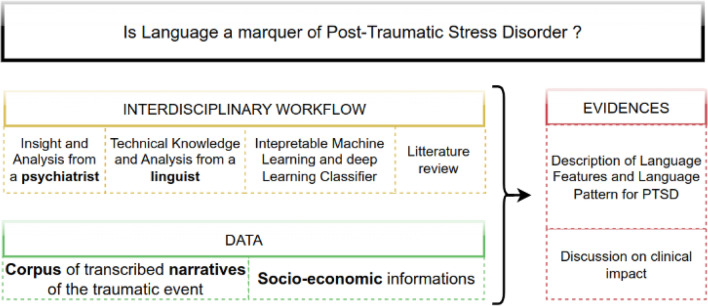
Post-traumatic stress disorder (PTSD) lacks clear biomarkers in clinical practice. Language as a potential diagnostic biomarker for PTSD is investigated in this study. We analyze an original cohort of 148 individuals exposed to the November 13, 2015, terrorist attacks in Paris. The interviews, conducted 5–11 months after the event, include individuals from similar socioeconomic backgrounds exposed to the same incident, responding to identical questions and using uniform PTSD measures. Using this dataset to collect nuanced insights that might be clinically relevant, we propose a three-step interdisciplinary methodology that integrates expertise from psychiatry, linguistics, and the Natural Language Processing (NLP) community to examine the relationship between language and PTSD. The first step assesses a clinical psychiatrist's ability to diagnose PTSD using interview transcription alone. The second step uses statistical analysis and machine learning models to create language features based on psycholinguistic hypotheses and evaluate their predictive strength. The third step is the application of a hypothesis-free deep learning approach to the classification of PTSD in our cohort. Results show that the clinical psychiatrist achieved a diagnosis of PTSD with an AUC of 0.72. This is comparable to a gold standard questionnaire (Area Under Curve (AUC) ≈ 0.80). The machine learning model achieved a diagnostic AUC of 0.69. The deep learning approach achieved an AUC of 0.64. An examination of model error informs our discussion. Importantly, the study controls for confounding factors, establishes associations between language and DSM-5 subsymptoms, and integrates automated methods with qualitative analysis. This study provides a direct and methodologically robust description of the relationship between PTSD and language. Our work lays the groundwork for advancing early and accurate diagnosis and using linguistic markers to assess the effectiveness of pharmacological treatments and psychotherapies.
Overview
The claims and statistics of this paper haven’t been checked yet.
Free: it reads the open-access text and checks the first 5 claims that cite a source we can check. Create a free account to check every claim.
Integrity signals
Registry
Cites
Statistics
Figures



Verification
Claims the paper makes
The claims and statistics of this paper haven’t been checked yet.
Free: it reads the open-access text and checks the first 5 claims that cite a source we can check. Create a free account to check every claim.
Claims other papers make about this one
Each is checked against this paper’s own text: does it say what the citing paper says it does?
The source backs part of the claim, not all of it — or backs it for a different population, condition or comparison.
In the citing paper
“Meanwhile, the future tense was less commonly analyzed, yet has been considered to reflect anticipatory anxiety or fear about potential future threats, which are significant elements of PTSD symptomatology.40,59”
From Linguistic markers for identifying post-traumatic stress disorder and associated symptoms: a systematic literature review (2025) · cites this paper as [40]
Experimental — accuracy not yet measuredThe source backs part of the claim, not all of it — or backs it for a different population, condition or comparison.
In the citing paper
“Present tense usage often suggests that the traumatic experience is being relived rather than merely remembered (related to criterion B of DSM-5), which can indicate ongoing distress and unresolved trauma.40,77”
From Linguistic markers for identifying post-traumatic stress disorder and associated symptoms: a systematic literature review (2025) · cites this paper as [40]
Experimental — accuracy not yet measuredThe source backs part of the claim, not all of it — or backs it for a different population, condition or comparison.
In the citing paper
“Some studies 40,44,62,64 suggested that longer narratives are associated with more severe PTSD symptoms”
From Linguistic markers for identifying post-traumatic stress disorder and associated symptoms: a systematic literature review (2025) · cites this paper as [40]
Experimental — accuracy not yet measuredThe source backs part of the claim, not all of it — or backs it for a different population, condition or comparison.
In the citing paper
“Studies 40,69,79,80 have found that less coherent narratives, characterized by disjointed and fragmented storytelling, are associated with more severe PTSD symptoms.”
From Linguistic markers for identifying post-traumatic stress disorder and associated symptoms: a systematic literature review (2025) · cites this paper as [40]
Experimental — accuracy not yet measuredThe cited source says what the claim attributes to it.
In the citing paper
“Not all the studies found an association between death vocabulary and PTSD symptoms or severity, but many 40,45,47,49,56,57,60,62,[64][65][66] were consistent in indicating that death vocabulary was associated with more PTSD symptoms.”
From Linguistic markers for identifying post-traumatic stress disorder and associated symptoms: a systematic literature review (2025) · cites this paper as [40]
4 more claims about this paper
Create a free account to see every claim other papers make about this one.
Self-check
Percentages, sums and reported differences re-computed from the paper’s own numbers.
The self-check needs the paper’s full text.
Citations
Cites
Breiman, L. (2001) · Machine Learning · doi:10.1023/a:1010933404324 · Cited by 133,538
SMOTE synthetic minority over-sampling technique
Chawla, N. V., Bowyer, K. W., Hall, L. O., & Kegelmeyer, W. P. (2002) · Journal of Artificial Intelligence Research · doi:10.1613/jair.953 · Cited by 32,865
Focal Loss for Dense Object Detection
Lin, T.-Y., Goyal, P., Girshick, R., He, K., & Dollar, P. (2017) · 2017 IEEE International Conference on Computer Vision (ICCV) · doi:10.1109/iccv.2017.324 · Cited by 30,581
Learning Deep Features for Discriminative Localization
Zhou, B., Khosla, A., Lapedriza, A., Oliva, A., & Torralba, A. (2016) · 2016 IEEE Conference on Computer Vision and Pattern Recognition (CVPR) · doi:10.1109/cvpr.2016.319 · Cited by 11,428
Focal Loss for Dense Object Detection
Lin, T.-Y., Goyal, P., Girshick, R., He, K., & Dollar, P. (2020) · IEEE Transactions on Pattern Analysis and Machine Intelligence · doi:10.1109/tpami.2018.2858826 · Cited by 9,556
Blevins, C. A., Weathers, F. W., Davis, M. T., Witte, T. K., & Domino, J. L. (2015) · Journal of Traumatic Stress · doi:10.1002/jts.22059 · Cited by 5,233
Disclosure of traumas and immune function: Health implications for psychotherapy.
Pennebaker, J. W., Kiecolt-Glaser, J. K., & Glaser, R. (1988) · Journal of Consulting and Clinical Psychology · doi:10.1037//0022-006x.56.2.239 · Cited by 1,236
FLAIR: An Easy-to-Use Framework for State-of-the-Art NLP
Akbik, A., Bergmann, T., Blythe, D. A. J., Rasul, K., Schweter, S., & Vollgraf, R. (2019) · Conference of the North American Chapter of the Association for Computational Linguistics: Human Language Technologies (NAACL-HLT) · doi:10.18653/v1/n19-4010 · Cited by 1,175
McKnight, P. E., & Najab, J. (2010) · The Corsini Encyclopedia of Psychology · doi:10.1002/9780470479216.corpsy0524 · Cited by 934
Temporal patterns of happiness and information in a global social network: hedonometrics and Twitter
Dodds, P. S., Harris, K. D., Kloumann, I. M., Bliss, C. A., & Danforth, C. M. (2011) · PLoS ONE · doi:10.1371/journal.pone.0026752 · Cited by 809
Shah, K., Patel, H., Sanghvi, D., & Shah, M. (2020) · Augmented Human Research · doi:10.1007/s41133-020-00032-0 · Cited by 576
Machine learning and natural language processing in mental health: systematic review
Le Glaz, A., Haralambous, Y., Kim-Dufor, D.-H., Lenca, P., Billot, R., Ryan, T. C., Marsh, J., DeVylder, J., Walter, M., Berrouiguet, S., et al. (2021) · Journal of Medical Internet Research · doi:10.2196/15708 · Cited by 576
Visualizing and Understanding Convolutional Networks
Zeiler, M. D., & Fergus, R. (2013) · arXiv · doi:10.48550/arxiv.1311.2901 · Cited by 522
Automated assessment of psychiatric disorders using speech: A systematic review
Low, D. M., Bentley, K. H., & Ghosh, S. S. (2020) · Laryngoscope Investigative Otolaryngology · doi:10.1002/lio2.354 · Cited by 509
Natural language processing applied to mental illness detection: a narrative review
Zhang, T., Schoene, A. M., Ji, S., & Ananiadou, S. (2022) · npj Digital Medicine · doi:10.1038/s41746-022-00589-7 · Cited by 476
Stanza: A Python Natural Language Processing Toolkit for Many Human Languages
Qi, P., Zhang, Y., Zhang, Y., Bolton, J., & Manning, C. D. (2020) · arXiv · doi:10.48550/arxiv.2003.07082 · Cited by 476
Posttraumatic Stress Disorder in Adults: Impact, Comorbidity, Risk Factors, and Treatment
Sareen, J. (2014) · The Canadian Journal of Psychiatry · doi:10.1177/070674371405900902 · Cited by 467
Empath: Understanding Topic Signals in Large-Scale Text
Fast, E., Chen, B., & Bernstein, M. S. (2016) · Proceedings of the 2016 CHI Conference on Human Factors in Computing Systems · doi:10.1145/2858036.2858535 · Cited by 413
Forecasting the onset and course of mental illness with Twitter data
Reece, A. G., Reagan, A. J., Lix, K. L. M., Dodds, P. S., Danforth, C. M., & Langer, E. J. (2017) · Scientific Reports · doi:10.1038/s41598-017-12961-9 · Cited by 401
Prediction of psychosis across protocols and risk cohorts using automated language analysis
Corcoran, C. M., Carrillo, F., Fernández‐Slezak, D., Bedi, G., Klim, C., Javitt, D. C., Bearden, C. E., & Cecchi, G. A. (2018) · World Psychiatry · doi:10.1002/wps.20491 · Cited by 381
Quantifying incoherence in speech: An automated methodology and novel application to schizophrenia
Elvevåg, B., Foltz, P. W., Weinberger, D. R., & Goldberg, T. E. (2007) · Schizophrenia Research · doi:10.1016/j.schres.2007.03.001 · Cited by 363
Natural language processing in mental health applications using non-clinical texts
CALVO, R. A., MILNE, D. N., HUSSAIN, M. S., & CHRISTENSEN, H. (2017) · Natural Language Engineering · doi:10.1017/s1351324916000383 · Cited by 362
Jiang, A. Q., Sablayrolles, A., Mensch, A., Bamford, C., Chaplot, D. S., Casas, D. D. L., Bressand, F., Lengyel, G., Lample, G., Saulnier, L., et al. (2023) · arXiv · doi:10.48550/arxiv.2310.06825 · Cited by 340
InterpretML: A Unified Framework for Machine Learning Interpretability
Nori, H., Jenkins, S., Koch, P., & Caruana, R. (2019) · arXiv · doi:10.48550/arxiv.1909.09223 · Cited by 322
Measuring post traumatic stress disorder in Twitter
Coppersmith, G., Harman, C., & Dredze, M. (2014) · Proceedings of the International AAAI Conference on Web and Social Media · doi:10.1609/icwsm.v8i1.14574 · Cited by 316
Pranckevičius, T., & Marcinkevičius, V. (2017) · Baltic Journal of Modern Computing · doi:10.22364/bjmc.2017.5.2.05 · Cited by 307
Does "subthreshold" posttraumatic stress disorder have any clinical relevance?
Zlotnick, C., Franklin, C. L., & Zimmerman, M. (2002) · Comprehensive Psychiatry · doi:10.1053/comp.2002.35900 · Cited by 283
Speech Graphs Provide a Quantitative Measure of Thought Disorder in Psychosis
Mota, N. B., Vasconcelos, N. A. P., Lemos, N., Pieretti, A. C., Kinouchi, O., Cecchi, G. A., Copelli, M., & Ribeiro, S. (2012) · PLoS ONE · doi:10.1371/journal.pone.0034928 · Cited by 265
Partial PTSD versus full PTSD: an empirical examination of associated impairment
BRESLAU, N., LUCIA, V. C., & DAVIS, G. C. (2004) · Psychological Medicine · doi:10.1017/s0033291704002594 · Cited by 256
Resilience after trauma: The role of memory suppression
Mary, A., Dayan, J., Leone, G., Postel, C., Fraisse, F., Malle, C., Vallée, T., Klein-Peschanski, C., Viader, F., de la Sayette, V., et al. (2020) · Science · doi:10.1126/science.aay8477 · Cited by 253
Self-citationJackson, R. G., Patel, R., Jayatilleke, N., Kolliakou, A., Ball, M., Gorrell, G., Roberts, A., Dobson, R. J., & Stewart, R. (2017) · BMJ Open · doi:10.1136/bmjopen-2016-012012 · Cited by 221
Learning Deep Features for Discriminative LocalizationPreprint
Zhou, B., Khosla, A., Lapedriza, À., et al. (2015) · arXiv (Cornell University) · doi:10.48550/arxiv.1512.04150 · Cited by 202
Memory and narrative of traumatic events: A literature review.
Crespo, M., & Fernández-Lansac, V. (2016) · Psychological Trauma: Theory, Research, Practice, and Policy · doi:10.1037/tra0000041 · Cited by 193
Anomalies in language as a biomarker for schizophrenia
de Boer, J. N., Brederoo, S., Voppel, A., & Sommer, I. E. (2020) · Current Opinion in Psychiatry · doi:10.1097/yco.0000000000000595 · Cited by 141
FEEL: a French Expanded Emotion Lexicon
Abdaoui, A., Azé, J., Bringay, S., & Poncelet, P. (2016) · Language Resources and Evaluation · doi:10.1007/s10579-016-9364-5 · Cited by 132
DLATK: Differential Language Analysis ToolKit
Schwartz, H. A., Giorgi, S., Sap, M., Crutchley, P., Ungar, L., & Eichstaedt, J. (2017) · Proceedings of the 2017 Conference on Empirical Methods in Natural Language Processing: System Demonstrations · doi:10.18653/v1/d17-2010 · Cited by 130
Jelinek, L., Stockbauer, C., Randjbar, S., Kellner, M. B., Ehring, T. W., & Moritz, S. (2010) · Behaviour Research and Therapy · doi:10.1016/j.brat.2010.03.014 · Cited by 119
Contextual Embeddings: When Are They Worth It?
Arora, S., May, A., Zhang, J., & Ré, C. (2020) · Proceedings of the conference - Association for Computational Linguistics. Meeting · doi:10.18653/v1/2020.acl-main.236 · Cited by 118
Motreff, Y., Baubet, T., Pirard, P., Rabet, G., Petitclerc, M., Stene, L. E., Vuillermoz, C., Chauvin, P., & Vandentorren, S. (2019) · Journal of Psychiatric Research · doi:10.1016/j.jpsychires.2019.11.018 · Cited by 117
Language Patterns Discriminate Mild Depression From Normal Sadness and Euthymic State
Smirnova, D. A., Cumming, P. D., Sloeva, E., Kuvshinova, N. Y., Romanov, D. V., & Nosachev, G. (2018) · Frontiers in Psychiatry · doi:10.3389/fpsyt.2018.00105 · Cited by 103
The use of machine learning techniques in trauma-related disorders: a systematic review
Ramos-Lima, L. F., Waikamp, V., Antonelli-Salgado, T., Passos, I. C., & Freitas, L. H. M. (2020) · Journal of Psychiatric Research · doi:10.1016/j.jpsychires.2019.12.001 · Cited by 98
A Window into the Intoxicated Mind? Speech as an Index of Psychoactive Drug Effects
Bedi, G., Cecchi, G., Slezak, D. F., Carrillo, F., Sigman, M., & de Wit, H. (2014) · Neuropsychopharmacology · doi:10.1038/npp.2014.80 · Cited by 96
Involuntary future projections are as frequent as involuntary memories, but more positive
Finnbogadóttir, H., & Berntsen, D. (2013) · Consciousness and Cognition · doi:10.1016/j.concog.2012.06.014 · Cited by 94
Contextual Embeddings: When Are They Worth It?
Arora, S., May, A., Zhang, J., & Ré, C. (2020) · Annual Meeting of the Association for Computational Linguistics · doi:10.48550/arxiv.2005.09117 · Cited by 80
He, Q., Veldkamp, B. P., Glas, C. A. W., & de Vries, T. (2017) · Assessment · doi:10.1177/1073191115602551 · Cited by 74
Early Linguistic Markers of Trauma-Specific Processing Predict Post-trauma Adjustment
Kleim, B., Horn, A. B., Kraehenmann, R., Mehl, M. R., & Ehlers, A. (2018) · Frontiers in Psychiatry · doi:10.3389/fpsyt.2018.00645 · Cited by 74
Bunnell, B. E., Davidson, T. M., & Ruggiero, K. J. (2018) · Journal of Anxiety Disorders · doi:10.1016/j.janxdis.2018.03.002 · Cited by 69
Römisch, S., Leban, E., Habermas, T., & Döll-Hentschker, S. (2014) · Psychological Trauma: Theory, Research, Practice, and Policy · doi:10.1037/a0035169 · Cited by 66
Are trauma narratives unique and do they predict psychological adjustment?
Beaudreau, S. A. (2007) · Journal of Traumatic Stress · doi:10.1002/jts.20206 · Cited by 63
Greenhoot, A. F., Sun, S., Bunnell, S. L., & Lindboe, K. (2013) · Memory · doi:10.1080/09658211.2012.712975 · Cited by 61
Chandler, C., Foltz, P. W., & Elvevåg, B. (2019) · Schizophrenia Bulletin · doi:10.1093/schbul/sbz105 · Cited by 61
Une base de l’émotionalité (valence, arousal, catégories) de 1286 mots français selon l’âge (EMA)
Gobin, P., Camblats, A.-M., Faurous, W., & Mathey, S. (2017) · European Review of Applied Psychology · doi:10.1016/j.erap.2016.12.001 · Cited by 55
Rabellino, D., Burin, D., Harricharan, S., Lloyd, C., Frewen, P. A., McKinnon, M. C., & Lanius, R. A. (2018) · Frontiers in Human Neuroscience · doi:10.3389/fnhum.2018.00163 · Cited by 53
Textual Deconvolution Saliency (TDS) : a deep tool box for linguistic analysis
Vanni, L., Ducoffe, M., Aguilar, C., Precioso, F., & Mayaffre, D. (2018) · Proceedings of the conference - Association for Computational Linguistics. Meeting · doi:10.18653/v1/p18-1051 · Cited by 43
Self-citationSon, Y., Clouston, S. A. P., Kotov, R., Eichstaedt, J. C., Bromet, E. J., Luft, B. J., & Schwartz, H. A. (2023) · Psychological Medicine · doi:10.1017/s0033291721002294 · Cited by 42
Automated Assessment of Psychiatric Disorders Using Speech: A Systematic ReviewPreprint
Low, D. M., Bentley, K. H., & Ghosh, S. (2019) · OSF Preprints (OSF Preprints) · doi:10.31219/osf.io/5pwze · Cited by 31
Auxéméry, Y. (2018) · L Encéphale · doi:10.1016/j.encep.2018.02.003 · Cited by 27
Self-citationLe syndrome psycholinguistique traumatique (SPLIT)
Auxéméry, Y., & Gayraud, F. (2020) · L Évolution Psychiatrique · doi:10.1016/j.evopsy.2020.05.002 · Cited by 26
Self-citationArgôlo, F. C., Magnavita, G. M., Mota, N. B., Ziebold, C., Mabunda, D., Pan, P. M., Zugman, A., Gadelha, A., Corcoran, C. M., & Bressan, R. A. (2020) · Brazilian Journal of Psychiatry · doi:10.1590/1516-4446-2019-0722 · Cited by 21
Toward new memory sciences: The Programme 13-Novembre
Eustache, F., & Peschanski, D. (2022) · Progress in brain research · doi:10.1016/bs.pbr.2022.07.003 · Cited by 20
Self-citationTrauma, Rememory and Language in Holodomor Survivors’ Narratives
Zasiekina, L. (2020) · PSYCHOLINGUISTICS · doi:10.31470/2309-1797-2020-27-1-80-94 · Cited by 16
Nedelcea, C., Ciorbea, I. D., Vasile, D. L., Ionescu, Ș., Papasteri, C., Letzner, R. D., Cosmoiu, A., & Georgescu, T. (2022) · European Journal of Psychotraumatology · doi:10.1080/20008198.2022.2066455 · Cited by 11
PassivePy: A Tool to Automatically Identify Passive Voice in Big Text DataPreprint
Sepehri, A. A., Mir, M., & Markowitz, D. M. (2022) · doi:10.31234/osf.io/bwp3t · Cited by 10
Recommendations for the use of statistics in Clinical and Health Psychology
Pol, A. L. P., & Sesé, A. (2013) · Clínica y Salud · doi:10.5093/cl2013a6 · Cited by 8
Vanni, L., Corneli, M., Mayaffre, D., & Precioso, F. (2023) · Corpus · doi:10.4000/corpus.7667 · Cited by 7
Self-citationSafeguarding against spurious AI-based predictions: The case of automated verbal memory assessment
Chandler, C., Foltz, P. W., Cohen, A. S., Holmlund, T. B., & Elvevåg, B. (2021) · Workshop on Computational Linguistics and Clinical Psychology (CLPsych) · doi:10.18653/v1/2021.clpsych-1.20 · Cited by 6
Bullock, A., Burns, A. I., Taylor, E. C., Grandner, M. A., Miller, M., Alkozei, A., & Killgore, W. D. S. (2020) · SLEEP · doi:10.1093/sleep/zsaa056.1072 · Cited by 3
Key Passages : From Statistics to Deep Learning
Vanni, L., Corneli, M., Longrée, D., Mayaffre, D., & Precioso, F. (2020) · Studies in classification, data analysis, and knowledge organization · doi:10.1007/978-3-030-52680-1_4 · Cited by 2
Self-citation
Research works printed but not linked: 6
- 1. Auxéméry Y Gayraud F Identification des marques du traumatisme psychique dans le langage parlé: définition de l’échelle diagnostique « SPLIT-10 » Ann. Méd.-Psychol. Rev. Psychiatr. 2021 179 869 888
- 7. Gayraud F Auxéméry Y Identification of the marks of psychic trauma in spoken language: Definition of the “SPLIT-10” diagnostic scale Ann. Méd.-Psychol. Rev. Psychiatr. 2022 180 195 212
- 28. Gupta A Kaur M Bajaj A Khanna A Entailment and spectral clustering based single and multiple document summarization Int. J. Intell. Syst. Appl. 2019 11 39 51
- 34. Reece AG Forecasting the onset and course of mental illness with Twitter data Sci. Rep. 2017 7 13006 10.1038/s41598-017-12961-9 29021528 PMC5636873 · DOI · Paper page
- 37. da Rocha D Programme 13-Novembre, un an après Rev. Neuropsychol. 2016 8 227 232
- 41. Piolat A Booth RJ Chung CK Davids M La Pennebaker JW version française du dictionnaire pour le LIWC: modalités de construction et exemples d’utilisation Psychol. Fr. 2011 56 145 159
Cited by
The relationship between language features and PTSD symptoms: a systematic review and meta-analysis
Yu, Z., Gu, Z., Shen, Y., & Lu, J. (2025) · Frontiers in Psychiatry · doi:10.3389/fpsyt.2025.1476978 · Cited by 12
Quillivic, R., Auxéméry, Y., Gayraud, F., Dayan, J., & Mesmoudi, S. (2025) · Journal of the American Medical Informatics Association · doi:10.1093/jamia/ocaf075 · Cited by 3
Self-citationLinguistic agentivity as a marker of traumatic discourse
Gayraud, F., & Auxéméry, Y. (2025) · European Journal of Trauma & Dissociation · doi:10.1016/j.ejtd.2025.100501 · Cited by 5
Self-citationEmotional Speech Markers of Psychiatric Disturbance in Huntington’s Disease
Chenain, L., Fabre, A., Titeux, H., Morgado, G., Youssov, K., Clavel, C., & Bachoud‐Lévi, A. (2025) · European Psychiatry · doi:10.1192/j.eurpsy.2026.12064 · Cited by 3
Stress Detection Using Natural Language Processing and Machine Learning Over Social Interaction
Rajput, G. K., Chakravarty, A., Saxena, A. K., Kumar, S., Kumar, L., & Goel, A. (2025) · doi:10.1109/cises66934.2025.11265359 · Cited by 2
Metadata
- Authors
- Quillivic, R., Gayraud, F., Auxéméry, Y., Vanni, L., Peschanski, D., Eustache, F., Dayan, J., & Mesmoudi, S.
- Affiliations
- École Pratique des Hautes Études (FR)
- Centre National de la Recherche Scientifique (FR)
- Inserm (FR)
- Corresponding author
- Quillivic, Robin
- ORCID
- Venue
- Scientific Reports
- Published
- 2024-05-30
- Volume
- 14
- Issue
- 1
- Pages
- 12468-12468
- ISSN
- 2045-2322 (ISSN-L)
- PMC
- PMC11139884
- OpenAlex
- W4399155231
- Semantic Scholar
- 0543b8c53c73c258b83fcb7887b58cf13600f77f
- Cited by
- 24
- References
- 63
- Citations by year
- 2026: 10 · 2025: 12 · 2024: 2
- FWCI
- 11.36
- Type
- journal article
- Language
- en
- Open access
- gold
- doi.org
- Licence
- cc-by
- creativecommons.org/licenses/by/4.0 (tdm)
- creativecommons.org/licenses/by/4.0 (vor)
- Locations
- Scientific Reports (publishedVersion, cc-by)
- PubMed Central (publishedVersion, cc-by)
- PubMed (publishedVersion)
- HAL (submittedVersion, cc-by)
- DOAJ (DOAJ: Directory of Open Access Journals) (submittedVersion)
- Funders
- Region île-de-France (CP2021-297)
- Centre National de la Recherche Scientifique
- French General Secretariat for Investment (ANR-10-EQPX-0021-01)
- Topics
- Social Sciences › Psychology › Social Psychology › Mental Health via Writing
- Social Sciences › Psychology › Clinical Psychology › Posttraumatic Stress Disorder Research
- Health Sciences › Health Professions › Health Information Management › Artificial Intelligence in Healthcare
- Keywords
- post-traumatic stress disorder, linguistic markers, psycholinguistics, PTSD diagnosis, natural language processing, deep learning classification, interview transcription, 2015 Paris attacks, linguistic biomarkers
- MeSH terms
- Machine Learning, Deep Learning, Adult, Female, Humans, Language, Male, Middle Aged, Natural Language Processing, Stress Disorders, Post-Traumatic, Biomarkers
About these checks
Registry, retraction, Cites and statistics results are computed, not judged, with one exception: a printed reference that no index lists is read once by a model before it counts as a citation error. Claims are extracted by a model and kept only when their quote appears verbatim in the text; each cited source is then checked, with a model’s help, for whether it says what the claim relies on. Those verdicts can be wrong — read the claim’s quote and the cited source before relying on one.
Statistics and arithmetic are recomputed, not judged.
Confidence bands are shown only for fields calibrated on our annotated test set. None is calibrated yet, so no band is shown.
What counts as a claim ›How we measure confidence ›How we check this ›
Are you an author, or do you see a problem with this page? Request a review
Data sources
Bibliographic data: Semantic Scholar, OpenAlex, Crossref.
Contains information from the Semantic Scholar Academic Graph Datasets, made available under the ODC Attribution License (ODC-BY 1.0).
Semantic Scholar’s data is described in: Kinney, R., et al. (2023). The Semantic Scholar Open Data Platform. arXiv:2301.10140.
