

Temporal discounting predicts procrastination in the real world
Open accessPublished version of a preprint
The DOI matches its Crossref record; 65 of the 69 references it cites were found in a registry or an index; 16 of the 32 sources its claims cite were checked for support.
Abstract
People procrastinate, but why? One long-standing hypothesis is that temporal discounting drives procrastination: in a task with a distant future reward, the discounted future reward fails to provide sufficient motivation to initiate work early. However, empirical evidence for this hypothesis has been lacking. Here, we used a long-term real-world task and a novel measure of procrastination to examine the association between temporal discounting and real-world procrastination. To measure procrastination, we critically measured the entire time course of the work progress instead of a single endpoint, such as task completion day. This approach allowed us to compute a fine-grained metric of procrastination. We found a positive correlation between individuals' degree of future reward discounting and their level of procrastination, suggesting that temporal discounting is a cognitive mechanism underlying procrastination. We found no evidence of a correlation when we, instead, measured procrastination by task completion day or by survey. This association between temporal discounting and procrastination offers empirical support for targeted interventions that could mitigate procrastination, such as modifying incentive systems to reduce the delay to a reward and lowering discount rates.
Overview
CoChat Summary
## TL;DR
This study found that in a real-world semester-long research participation task, higher temporal discounting was associated with greater behavioral procrastination when procrastination was measured using a fine-grained metric of the full work-progress time course. The association was not observed when procrastination was measured by task completion day or by survey-based procrastination scales.
## Key findings
- The final sample for the main temporal-discounting analysis was 84 participants; the sample for the risk-attitude analysis was 91 participants.
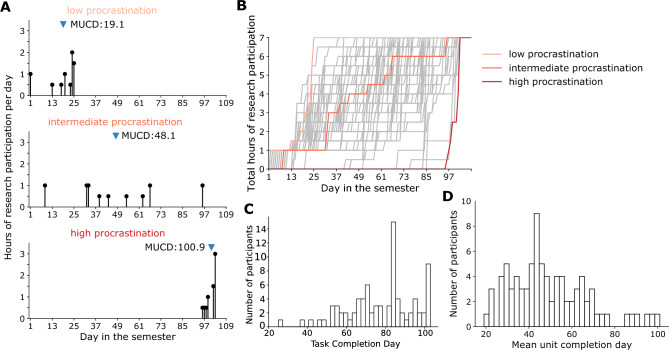
- The new procrastination metric, Mean Unit Completion Day (MUCD), ranged from 19.1 to 100.9, and task completion day ranged from 25 to 103 days, showing substantial individual variability.
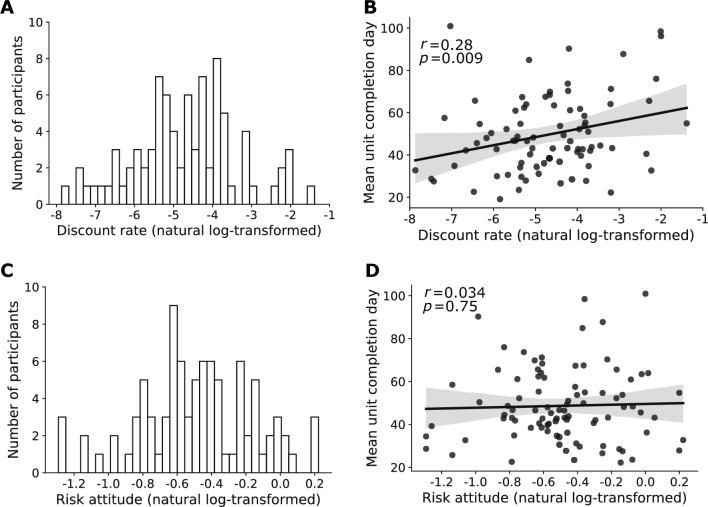
- Temporal discount rate showed a positive correlation with MUCD; this relationship remained after controlling for age and gender.
- The discount rate showed no correlation with procrastination measured by task completion day or the PASS survey score.
- Risk attitude showed no evidence of correlation with behavioral procrastination across the measures tested, including the DOSPERT scale and custom risk questions.
## Methods
- The study used a real-world, self-paced research participation requirement in an NYU Introduction to Psychology course: students had to complete 7 hours of research participation over a 109-day semester, with no early-completion incentive.
- Participants were recruited from the course after the semester ended; the online study initially had 194 respondents, with inclusion/exclusion rules yielding 84 participants for delay discounting analyses and 91 for risk analyses.
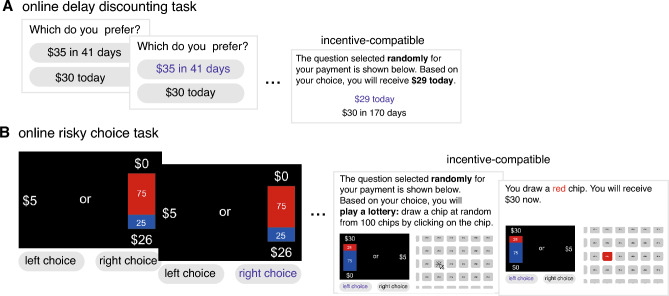
- Temporal discounting was measured with a 51-trial incentive-compatible delay discounting task and fit with a hyperbolic choice model using maximum-likelihood estimation; procrastination was quantified mainly with MUCD, alongside other metrics and the PASS scale for convergent validity.
## Limitations
- The authors explicitly note a WEIRD sample of NYU undergraduates and a non-academic task as limitations; they say future work should generalize to more diverse samples and other tasks.
- They also note that the task may have been framed as avoiding losses rather than seeking gains, and suggest future work should test whether discounted future losses relate to procrastination.
- Evident from the text: the paper’s main evidence is correlational, so the text does not establish causality between temporal discounting and procrastination.
Model-written summary. Check it against the paper before relying on it.
Integrity signals
Registry
Cites
Statistics
Figures
Verification
Claims the paper makes
9 Valid · 0 Not valid · 4 Not checked · 62 Own results and interpretations
The cited sources support only part of this claim — read each source’s verdict below.
In the paper
“However, individuals who complete a task at the same time can exhibit very different temporal patterns of work progress28–30.”
§ Temporal discounting predicts procrastination in the real world > Introduction
What the sources say
- Not checked — no full text of the sourcecites [28] Konradt U Ellwart T Gevers J Wasting effort or wasting time? A longitudinal study of pacing styles as a predictor of academic performance Learn. Individ. Differ. 2021 88 102003 10.1016/j.lindif.2021.102003 source
- Not checked — no full text of the sourcecites [29] Vangsness L Young ME Turtle, task ninja, or time waster? Who cares? Traditional task-completion strategies are overrated Psychol. Sci. 2020 31 306 315 10.1177/0956797619901267 32101097 source
- Partly supportedcites [30] Steel P Svartdal F Thundiyil T Brothen T Examining procrastination across multiple goal stages: A longitudinal study of temporal motivation theory Front. Psychol. 2018 9 327 10.3389/fpsyg.2018.00327 29666590 PMC5891720 sourceExperimental — accuracy not yet measured
The Pacing Style section says people differ in when they do the bulk of their work, and the Goal choice and goal pursuit results report different work patterns over the course. The paper does not establish the claim’s more specific condition that those individuals complete the task at the same time. No page numbers are available in our copy. (LLM, conf=0.82)
plain- Asserted: passes — The authors put it forward as true.
- Checkable: passes — It can be checked against evidence.
- Load-bearing: passes — The paper’s conclusions depend on it.
- Based: passes — The paper gives a reason why it holds.
The cited sources support only part of this claim — read each source’s verdict below.
In the paper
“The other two studies17,19 measured behavioral procrastination but limited their metrics to the task completion day, as they did not measure the entire time course of work progress.”
§ Temporal discounting predicts procrastination in the real world > Discussion
What the sources say
- Partly supportedcites [17] Le Bouc R Pessiglione M A neuro-computational account of procrastination behavior Nat. Commun. 2022 13 5639 10.1038/s41467-022-33119-w 36163352 PMC9513091 sourceExperimental — accuracy not yet measured
The Results (‘Procrastination behavior’; page not specified) measure at-home procrastination by the delay until participants completed and returned the forms, with no measure of work progress along the way. But the paper also measures procrastination through a lab ‘now/tomorrow’ choice task, so its metrics were not limited to the task-completion day. (LLM, conf=0.85)
- Not checked — no full text of the sourcecites [19] Reuben E Sapienza P Zingales L Procrastination and impatience J. Behav. Exp. Econ. 2015 58 63 76 10.1016/j.socec.2015.07.005 source
plain- Asserted: passes — The authors put it forward as true.
- Checkable: passes — It can be checked against evidence.
- Load-bearing: passes — The paper’s conclusions depend on it.
- Based: passes — The paper gives a reason why it holds.
- Partly supported
The sources with a verdict support this claim; the rest weren’t checked yet, have no full text we could read, or their verdicts aren’t rated yet.
In the paper
“Mindfulness-based training has been shown to be effective in reducing procrastination50–53, but no studies have tested the effect of episodic future thinking on procrastination.”
§ Temporal discounting predicts procrastination in the real world > Discussion
What the sources say
- Not checked — no full text of the sourcecites [50] Rad HS Samadi S Sirois FM Goodarzi H Mindfulness intervention for academic procrastination: A randomized control trial Learn. Individ. Differ. 2023 101 102244 10.1016/j.lindif.2022.102244 source
- Not checked — no full text of the sourcecites [51] Schutte NS del Pozo de Bolger A Greater mindfulness is linked to less procrastination Int. J. Appl. Posit. Psychol. 2020 5 1 12 10.1007/s41042-019-00025-4 source
- Supportedcites [52] Li L Mu L Effects of mindfulness training on psychological capital, depression, and procrastination of the youth demographic Iran. J. Public Health 2020 49 1692 33643944 PMC7898108 source
The Discussions section reports that procrastination scores in the experimental group fell significantly after the intervention and concludes that mindfulness training can relieve procrastination. The cited claim is consistent with that finding; the study concerns a youth demographic. (LLM, conf=0.92)
- Not matchedcites [53] Dionne F Using acceptance and mindfulness to reduce procrastination among university students: Results from a pilot study Rev. Prâksis 2016 1 8 20
Its entry has no title and year that we can search by.
boostedstates a cause- Asserted: passes — The authors put it forward as true.
- Checkable: passes — It can be checked against evidence.
- Load-bearing: unclear — It is unclear whether the paper’s conclusions depend on it.
- Based: passes — The paper gives a reason why it holds.
Every source the paper cites for this claim was checked and supports it.
In the paper
“To ensure that participants were not responding randomly, we conducted a quality control procedure69. We verified that participants’responses were influenced by task-relevant variables.”
§ Temporal discounting predicts procrastination in the real world > Methods > Participant inclusion
What the sources say
- Supportedcites [69] Pehlivanova M Diminished cortical thickness is associated with impulsive choice in adolescence J. Neurosci. 2018 38 2471 2481 10.1523/JNEUROSCI.2200-17.2018 29440536 PMC5858592 source
The Delay discounting task section (page unavailable) explicitly says the authors performed quality control to rule out random responding and verified that responses depended on task-relevant variables. It describes fitting participants’ choices with predictors including reward amounts and delay. (LLM, conf=0.95)
plainstates a causen = 84- Asserted: passes — The authors put it forward as true.
- Checkable: passes — It can be checked against evidence.
- Load-bearing: passes — The paper’s conclusions depend on it.
- Based: passes — The paper gives a reason why it holds.
- Supported
A result the paper reports from its own data — it cites no other source for it, so there is none to check. The quote shows it is in the paper.
In the paper
“MUCD had a wide distribution, ranging from 19.1 to 100.9 (, ), further demonstrating the high level of individual variability in procrastination (Fig. 2D).”
§ Temporal discounting predicts procrastination in the real world > Results > Characterizing individual variability in procrastination
plain- Asserted: passes — The authors put it forward as true.
- Checkable: passes — It can be checked against evidence.
- Load-bearing: unclear — It is unclear whether the paper’s conclusions depend on it.
- Based: passes — The paper gives a reason why it holds.
29 more claims
Create a free account to see all 75 claims and every source verdict.
- Probably not a substantial claim. 34
- It may state two separate claims as one. 13
- The quote only partly states this claim. 2
Citations
Cites
The weirdest people in the world?
Henrich, J., Heine, S. J., & Norenzayan, A. (2010) · Behavioral and Brain Sciences · doi:10.1017/s0140525x0999152x · Cited by 12,641
High self-control predicts good adjustment, less pathology, better grades, and interpersonal success
Tangney, J. P., Baumeister, R. F., & Boone, A. L. (2004) · Journal of Personality · doi:10.1111/j.0022-3506.2004.00263.x · Cited by 6,557 · cited 1×
“We included the Barratt Impulsivity Scale 63 , the Brief Self-Control Scale 64 , and perfectionism scales 65,66 to test their association with behavioral procrastination and whether they mediate the correlation between temporal discounting and procrastination.”
MethodRisk Aversion and Incentive Effects
Holt, C. A., & Laury, S. K. (2002) · American Economic Review · doi:10.1257/000282802762024700 · Cited by 5,939
The dimensions of perfectionism
Frost, R. O., Marten, P., Lahart, C., & Rosenblate, R. (1990) · Cognitive Therapy and Research · doi:10.1007/bf01172967 · Cited by 4,279 · cited 1×
“We included the Barratt Impulsivity Scale 63 , the Brief Self-Control Scale 64 , and perfectionism scales 65,66 to test their association with behavioral procrastination and whether they mediate the correlation between temporal discounting and procrastination.”
MethodSteel, P. (2007) · Psychological bulletin · doi:10.1037/0033-2909.133.1.65 · Cited by 3,417
Hewitt, P. L., & Flett, G. L. (1991) · Journal of Personality and Social Psychology · doi:10.1037/0022-3514.60.3.456 · Cited by 3,378 · cited 1×
“We included the Barratt Impulsivity Scale 63 , the Brief Self-Control Scale 64 , and perfectionism scales 65,66 to test their association with behavioral procrastination and whether they mediate the correlation between temporal discounting and procrastination.”
MethodO'Donoghue, T., & Rabin, M. (1999) · American Economic Review · doi:10.1257/aer.89.1.103 · Cited by 3,121
Some empirical evidence on dynamic inconsistency
Thaler, R. (1981) · Economics Letters · doi:10.1016/0165-1765(81)90067-7 · Cited by 2,243
Heroin addicts have higher discount rates for delayed rewards than non-drug-using controls.
Kirby, K. N., Petry, N. M., & Bickel, W. K. (1999) · Journal of Experimental Psychology: General · doi:10.1037/0096-3445.128.1.78 · Cited by 2,171 · cited 2×
“It was adapted from Kirby’s choice set 31 and has been widely used in the temporal discounting literature 31–37 .”
MethodAcademic procrastination: Frequency and cognitive-behavioral correlates.
Solomon, L. J., & Rothblum, E. D. (1984) · Journal of Counseling Psychology · doi:10.1037/0022-0167.31.4.503 · Cited by 1,788 · cited 8×
“We found no correlation between the discount rate and the PASS score ( r = 0.21 , p = 0.056 ; after we controlled for age and gender: β = 0.088 , SE = 0.053 , t ( 78 ) = 1.65 , p = 0.10 ), highlighting the advantage of behavioral measures of procrastination over survey-based measures. www.nature.com/scientificreports/…”
BackgroundMethodInfluential
Research works printed but not linked: 3
- Kachgal MM Hansen LS Nutter KJ Academic procrastination prevention/intervention: Strategies and recommendations J. Dev. Educ. 2001 25 14
- Dionne F Using acceptance and mindfulness to reduce procrastination among university students: Results from a pilot study Rev. Prâksis 2016 1 8 20
- Gollwitzer PM The Volitional Benefits of Planning. The Psychology of Action: Linking Cognition and Motivation to Behavior 1996 New York Guilford Press
Cited by
Zhao, H., Wei, Z., Feng, T., & Feng, P. (2025) · Brain Structure and Function · doi:10.1007/s00429-025-03028-x · Cited by 4
“…struggle with long-term academic and career goals (Acuff et al. 2017; Xu and Yin 2020 ), showing increased procrastination (Sutcliffe et al. 2019; Zhang and Ma 2024), poor time management (König and Kleinmann 2007), and a preference for short-term gratification over delayed achievement (Kirby et…”
Hu, Y., Tang, Y., Li, W., Zheng, D., Jin, Y., Fan, Q., Buitelaar, J. K., Zhou, Y., & Chen, Z. (2026) · Molecular Psychiatry · doi:10.1038/s41380-025-03423-0 · Cited by 4
Wang, Y., Chong, Y., Men, R., Li, F., Pan, H., & Xu, X. (2026) · Frontiers in Psychiatry · doi:10.3389/fpsyt.2025.1653871 · Cited by 2
Temporal dynamics of effort discounting: The roles of cognitive load and depression
Yang, Y., & Holroyd, C. (2026) · Cognitive Affective & Behavioral Neuroscience · doi:10.3758/s13415-026-01410-8 · Cited by 3
“These findings suggest that procrastination may not only reflect delay discounting of rewards, as traditionally framed (Zentall, 2021; Zhang & Ma, 2024), but may also stem from dynamic inconsistency in effort-related decisions.”
McClure, J. H. C., Sayan, S., & Anderson, R. J. (2026) · Psychological Reports · doi:10.1177/00332941251415315 · Cited by 1
Optimal and sub-optimal temporal decisions can explain procrastination in a real-world taskPreprint
Chebolu, S., & Dayan, P. (2024) · PsyArXiv (OSF Preprints) · doi:10.31234/osf.io/69zhd · Cited by 3
The Timing of Suboptimality: How Temporal Uncertainty Drives Procrastination BehaviorPreprint
Sokratous, K., Hintze, A., Fitch, A. K., & Kvam, P. D. (2024) · OSF Preprints (OSF Preprints) · doi:10.31219/osf.io/trkv9
Hu, Y., Tang, Y., Li, W. H., Zheng, D., Jin, Y., Fan, Q., Buitelaar, J. K., Zhou, Y., & Chen, Z. (2025) · bioRxiv (Cold Spring Harbor Laboratory) · doi:10.1101/2025.06.06.658269
Brozzo, C., & Shepherd, J. (2026) · Synthese · doi:10.1007/s11229-026-05481-5
余, 诗. (2026) · Advances in Social Sciences · doi:10.12677/ass.2026.155383
Mortality, Meaning, and the End of Philosophy
Papademas, M. (2026) · Philosophies · doi:10.3390/philosophies11030080
“Empirical studies support the point that people tend to delay action when rewards are distant, and limited time increases their focus on the present, patterns that an unlimited lifespan would likely weaken [26,27].”
Zhang, X., Yan, B., Chen, B., Wu, L., & Liu, Y. (2026) · Public Administration · doi:10.1111/padm.70073 · Cited by 1
Time-Based Cognition and Working Memory Explain Changes in Delay Discounting Through Adolescence
Phaneuf-Hadd, C. V., & Somerville, L. H. (2026) · Journal of Cognition and Development · doi:10.1080/15248372.2026.2705196
Metadata
- Authors
- Zhang, P. Y., & Ma, W. J.
- Affiliations
- New York University (US)
- Corresponding author
- Zhang, Pei Yuan
- Venue
- Scientific Reports
- Published
- 2024-06-25
- Volume
- 14
- Issue
- 1
- Pages
- 14642-14642
- ISSN
- 2045-2322 (ISSN-L)
- PMC
- PMC11199680
- OpenAlex
- W4400002709
- Cited by
- 13
- References
- 69
- Citations by year
- 2026: 9 · 2025: 2 · 2024: 2
- FWCI
- 6.48
- Type
- journal article
- Language
- en
- Open access
- gold
- doi.org
- Licence
- cc-by
- creativecommons.org/licenses/by/4.0 (tdm)
- creativecommons.org/licenses/by/4.0 (vor)
- Locations
- Scientific Reports (publishedVersion, cc-by)
- PubMed Central (publishedVersion, cc-by)
- PubMed (publishedVersion)
- DOAJ (DOAJ: Directory of Open Access Journals) (submittedVersion, cc-by-sa)
- PsyArXiv (OSF Preprints) (submittedVersion, cc-by)
- PsyArXiv (OSF Preprints) (submittedVersion)
- Funders
- York University
- Topics
- Social Sciences › Psychology › Clinical Psychology › Perfectionism, Procrastination, Anxiety Studies
- Social Sciences › Decision Sciences › General Decision Sciences › Decision-Making and Behavioral Economics
- Social Sciences › Psychology › Social Psychology › Grit, Self-Efficacy, and Motivation
- Keywords
- procrastination, delay discounting, incentive mechanisms, procrastination interventions
- MeSH terms
- Procrastination, Adult, Female, Humans, Male, Motivation, Reward, Young Adult, Delay Discounting
About these checks
Registry, retraction, Cites and statistics results are computed, not judged, with one exception: a printed reference that no index lists is read once by a model before it counts as a citation error. Claims are extracted by a model and kept only when their quote appears verbatim in the text; each cited source is then checked, with a model’s help, for whether it says what the claim relies on. Those verdicts can be wrong — read the claim’s quote and the cited source before relying on one.
The claim verdicts this report counts are experimental: their accuracy is not yet measured.
A language model drew the claims from the paper on 2026-10-09, under version 3 of the claim definition (model deepseek-v4.1-flash, prompt extract-v3).
A second model labelled each claim on 2026-10-09 (model jev-1.13-20260917, definition revision gold-guideline-v0.2).
Cited sources are checked with a language model’s help (gpt-6-sol).
Statistics and arithmetic are recomputed, not judged.
Confidence bands are shown only for fields calibrated on our annotated test set. None is calibrated yet, so no band is shown.
What counts as a claim ›How we measure confidence ›How we check this ›
Are you an author, or do you see a problem with this page? Request a review
Data sources
Bibliographic data: Semantic Scholar, OpenAlex, Crossref.
Contains information from the Semantic Scholar Academic Graph Datasets, made available under the ODC Attribution License (ODC-BY 1.0).
Semantic Scholar’s data is described in: Kinney, R., et al. (2023). The Semantic Scholar Open Data Platform. arXiv:2301.10140.
