

Trust, trustworthiness and AI governance
Open accessThe DOI matches its Crossref record; 96 of the 96 references it cites were found in a registry or an index.
Abstract
An emerging issue in AI alignment is the use of artificial intelligence (AI) by public authorities, and specifically the integration of algorithmic decision-making (ADM) into core state functions. In this context, the alignment of AI with the values related to the notions of trust and trustworthiness constitutes a particularly sensitive problem from a theoretical, empirical, and normative perspective. In this paper, we offer an interdisciplinary overview of the scholarship on trust in sociology, political science, and computer science anchored in artificial intelligence. On this basis, we argue that only a coherent and comprehensive interdisciplinary approach making sense of the different properties attributed to trust and trustworthiness can convey a proper understanding of complex watchful trust dynamics in a socio-technical context. Ensuring the trustworthiness of AI-Governance ultimately requires an understanding of how to combine trust-related values while addressing machines, humans and institutions at the same time. We offer a road-map of the steps that could be taken to address the challenges identified.
Overview
The claims and statistics of this paper haven’t been checked yet.
Free: it reads the open-access text and checks the first 5 claims that cite a source we can check. Create a free account to check every claim.
Integrity signals
Registry
Cites
Statistics
Figures
Verification
Claims the paper makes
The claims and statistics of this paper haven’t been checked yet.
Free: it reads the open-access text and checks the first 5 claims that cite a source we can check. Create a free account to check every claim.
Self-check
Percentages, sums and reported differences re-computed from the paper’s own numbers.
The self-check needs the paper’s full text.
Citations
Cites
"Why Should I Trust You?": Explaining the Predictions of Any Classifier
Ribeiro, M. T., Singh, S., & Guestrin, C. (2016) · Proceedings of the 22nd ACM SIGKDD International Conference on Knowledge Discovery and Data Mining · doi:10.1145/2939672.2939778 · Cited by 17,555
An integrative model of organizational trust
Mayer, R. C., Davis, J. H., & Schoorman, F. D. (1995) · The Academy of Management Review · doi:10.2307/258792 · Cited by 10,736 · cited 1×
“A starting point for such a conceptualisation could be the proposal to understand trust as “the willingness of a party to be vulnerable to the actions of another party” 15 , be this other party another human, an institution or a machine.”
BackgroundA Survey on Bias and Fairness in Machine Learning
Mehrabi, N., Morstatter, F., Saxena, N., Lerman, K., & Galstyan, A. (2022) · ACM Computing Surveys · doi:10.1145/3457607 · Cited by 5,812
A Survey on Bias and Fairness in Machine Learning
Mehrabi, N., Morstatter, F., Saxena, N., Lerman, K., & Galstyan, A. (2019) · arXiv · doi:10.48550/arxiv.1908.09635 · Cited by 5,812
Trust And Distrust: New Relationships and Realities
Lewicki, R. J., McAllister, D. J., & Bies, R. J. (1998) · The Academy of Management Review · doi:10.5465/amr.1998.926620 · Cited by 3,091 · cited 1×
“Unconditional trust can transcend what we conceive to be socially desirable, while conditional distrust might be a value in itself—when voiced through appropriate channels—because it may serve to prevent misbehaviour and keep social relations or societal systems in check 26–28 .”
BackgroundHuman trust in artificial intelligence: Review of empirical research
Glikson, E., & Woolley, A. W. (2020) · Academy of Management Annals · doi:10.5465/annals.2018.0057 · Cited by 2,921 · cited 3×
“The insertion of ADM into the relationship between citizens and public authorities has aroused considerable research efforts 48–50 .”
BackgroundPolitical Trust and Trustworthiness
Levi, M., & Stoker, L. (2000) · Annual Review of Political Science · doi:10.1146/annurev.polisci.3.1.475 · Cited by 2,190 · cited 1×
“With respect to public institutions the list includes values pertinent for the qualities (e.g., competence, reliability, democratic participation), procedures (e.g., transparency, accountability) and results (e.g., effectiveness, general welfare, justice) of political-administrative work 31 .”
BackgroundAge of Surveillance Capitalism – The Fight for a Human Future at the New Frontier of Power.
Kendell, D. (2020) · Brock Education Journal · doi:10.26522/brocked.v29i2.849 · Cited by 2,135
A Unified Framework of Five Principles for AI in Society
Floridi, L., & Cowls, J. (2019) · Harvard Data Science Review · doi:10.1162/99608f92.8cd550d1 · Cited by 1,631 · cited 2×
“There are, at present, numerous proposed mathematical specifications of fairness 108,109 that are not always grounded in the corresponding ethical desiderata 101,110 .”
BackgroundIn AI we trust? Perceptions about automated decision-making by artificial intelligence
Araujo, T., Helberger, N., Kruikemeier, S., & de Vreese, C. H. (2020) · AI & SOCIETY · doi:10.1007/s00146-019-00931-w · Cited by 1,038
Artificial Intelligence, Values, and Alignment
Gabriel, I. (2020) · Minds and Machines · doi:10.1007/s11023-020-09539-2 · Cited by 896
Transparency and the black box problem: why we do not trust AI
von Eschenbach, W. J. (2021) · Philosophy & Technology · doi:10.1007/s13347-021-00477-0 · Cited by 786
Proceedings of the 50th Hawaii International Conference on System Sciences (2017)
(2017) · Proceedings of the Annual Hawaii International Conference on System Sciences · doi:10.24251/hicss.2017.000 · Cited by 737
Bengio, Y., Lecun, Y., & Hinton, G. (2021) · Communications of the ACM · doi:10.1145/3448250 · Cited by 661 · cited 1×
“In the past decade, these networks have been at the core of widely diffused AI used for image recognition, natural language processing and, most recently, the generation of content 35 .”
BackgroundAccountable Artificial Intelligence: Holding Algorithms to Account
Busuioc, M. (2021) · Public Administration Review · doi:10.1111/puar.13293 · Cited by 652
Oxford Studies In Epistemology
(2007) · doi:10.1093/oso/9780199237067.001.0001 · Cited by 602
A Review on Fairness in Machine Learning
Pessach, D., & Shmueli, E. (2023) · ACM Computing Surveys · doi:10.1145/3494672 · Cited by 598 · cited 2×
“There are, at present, numerous proposed mathematical specifications of fairness 108,109 that are not always grounded in the corresponding ethical desiderata 101,110 .”
BackgroundQuo vadis artificial intelligence?
Jiang, Y., Li, X., Luo, H., Yin, S., & Kaynak, O. (2022) · Discover Artificial Intelligence · doi:10.1007/s44163-022-00022-8 · Cited by 544
Schepman, A., & Rodway, P. (2023) · International Journal of Human–Computer Interaction · doi:10.1080/10447318.2022.2085400 · Cited by 503 · cited 3×
“Not only does trust vary depending on the respondents’ characteristics (e.g., age, gender, competence, education, personality traits, political orientations), but also regarding institutional and contextual factors (e.g., the countries’ socio-economic and cultural background) 55–59 .”
BackgroundSousa, W. G. D., Melo, E. R. P. D., Bermejo, P. H. D. S., Farias, R. A. S., & Gomes, A. O. (2019) · Government Information Quarterly · doi:10.1016/j.giq.2019.07.004 · Cited by 501
(2019) · Cited by 467
Exploring artificial intelligence adoption in public organizations: a comparative case study
Neumann, O., Guirguis, K., & Steiner, R. (2024) · Public Management Review · doi:10.1080/14719037.2022.2048685 · Cited by 451 · cited 1×
“What is more, ADM implementation is complex and largely dependent on institutional practices and contextual factors 5 .”
BackgroundBurrell, J., & Fourcade, M. (2021) · Annual Review of Sociology · doi:10.1146/annurev-soc-090820-020800 · Cited by 430
Wirtz, B. W., Weyerer, J. C., & Sturm, B. J. (2020) · International Journal of Public Administration · doi:10.1080/01900692.2020.1749851 · Cited by 398
Trust in Artificial Intelligence: Meta-Analytic Findings
Kaplan, A. D., Kessler, T. T., Brill, J. C., & Hancock, P. A. (2023) · Human Factors: The Journal of the Human Factors and Ergonomics Society · doi:10.1177/00187208211013988 · Cited by 397
Schilke, O., Reimann, M., & Cook, K. S. (2021) · Annual Review of Sociology · doi:10.1146/annurev-soc-082120-082850 · Cited by 360
van Noordt, C., & Misuraca, G. (2022) · Government Information Quarterly · doi:10.1016/j.giq.2022.101714 · Cited by 356 · cited 1×
“At the same time, great expectations are formulated about the beneficial “disruptive” innovation potential of trustworthy ADM in countless areas, ranging from health to transportation and finance 45 (see 79 for a critique).”
BackgroundA snapshot of the frontiers of fairness in machine learning
Chouldechova, A., & Roth, A. (2020) · Communications of the ACM · doi:10.1145/3376898 · Cited by 354
An experimental study of public trust in AI chatbots in the public sector
Aoki, N. (2020) · Government Information Quarterly · doi:10.1016/j.giq.2020.101490 · Cited by 350
A Review of Taxonomies of Explainable Artificial Intelligence (XAI) Methods
Speith, T. (2022) · 2022 ACM Conference on Fairness Accountability and Transparency · doi:10.1145/3531146.3534639 · Cited by 337 · cited 1×
“There are numerous systematic analyses already 59,103 and even a systematic analysis of systematic analyses 104 Work in XAI can range from developing technical tools like 105 to meta discussions on what explainability should focus on, for example 106 .”
BackgroundSchwalbe, G., & Finzel, B. (2024) · Data Mining and Knowledge Discovery · doi:10.1007/s10618-022-00867-8 · Cited by 328
Theorizing Regulatory Intermediaries: The RIT Model
Abbott, K. W., Levi-faur, D., & Snidal, D. (2017) · The ANNALS of the American Academy of Political and Social Science · doi:10.1177/0002716216688272 · Cited by 304
Algorithmic bias: Senses, sources, solutions
Fazelpour, S., & Danks, D. (2021) · Philosophy Compass · doi:10.1111/phc3.12760 · Cited by 272
Grimmelikhuijsen, S. (2023) · Public Administration Review · doi:10.1111/puar.13483 · Cited by 259 · cited 1×
“In the context of algorithmic decision-making, explainability, in particular, is a very powerful tool in facilitating trust in the process that involves AI 100 .”
The Ethical Algorithm: The Science of Socially Aware Algorithm Design
Kearns, M., & Roth, A. (2021) · Perspectives on Science and Christian Faith · doi:10.56315/pscf3-21kearns · Cited by 259
Against Parsimony: Three Easy Ways of Complicating some Categories of Economic Discourse
Hirschman, A. O. (1985) · Economics and Philosophy · doi:10.1017/s0266267100001863 · Cited by 247 · cited 1×
“Scholars in various research fields would converge in this assessment, as trust is widely considered to be an important precondition and ingredient of societal cohesion, political stability, economic development, and/or technological innovation 20–24 .”
BackgroundTowards Intelligent Regulation of Artificial Intelligence
BUITEN, M. C. (2019) · European Journal of Risk Regulation · doi:10.1017/err.2019.8 · Cited by 237 · cited 1×
“At the same time, governments also face urgent calls to regulate these systems 73–76 .”
BackgroundEncyclopedia of Quality of Life and Well-Being Research
(2020) · Springer eBooks · doi:10.1007/978-3-319-69909-7 · Cited by 221
Trust, Distrust and Two Paradoxes of Democracy
Sztompka, P. (1998) · European Journal of Social Theory · doi:10.1177/136843198001001003 · Cited by 212
Brown, A., Chouldechova, A., Putnam-Hornstein, E., Tobin, A., & Vaithianathan, R. (2019) · Proceedings of the 2019 CHI Conference on Human Factors in Computing Systems · doi:10.1145/3290605.3300271 · Cited by 207
A Review of Trust in Artificial Intelligence: Challenges, Vulnerabilities and Future Directions
Lockey, S., Gillespie, N., Holm, D., & Someh, I. A. (2021) · Proceedings of the Annual Hawaii International Conference on System Sciences · doi:10.24251/hicss.2021.664 · Cited by 205 · cited 2×
“Not only does trust vary depending on the respondents’ characteristics (e.g., age, gender, competence, education, personality traits, political orientations), but also regarding institutional and contextual factors (e.g., the countries’ socio-economic and cultural background) 55–59 .”
BackgroundZajko, M. (2022) · Sociology Compass · doi:10.1111/soc4.12962 · Cited by 199
Algorithmic governance: A modes of governance approach
Gritsenko, D., & Wood, M. (2022) · Regulation & Governance · doi:10.1111/rego.12367 · Cited by 183
Miller, T. (2023) · 2023 ACM Conference on Fairness Accountability and Transparency · doi:10.1145/3593013.3594001 · Cited by 172
Contestable AI by Design: Towards a Framework
Alfrink, K., Keller, I., Kortuem, G., & Doorn, N. (2022) · Minds and Machines · doi:10.1007/s11023-022-09611-z · Cited by 169
Choung, H., David, P., & Ross, A. A. (2022) · AI & Society · doi:10.1007/s00146-022-01473-4 · Cited by 164
Perspectives on Digital Humanism
Werthner, H., Prem, E., Lee, E. A., & Ghezzi, C. (2021) · Springer eBooks · doi:10.1007/978-3-030-86144-5 · Cited by 146
(2019) · doi:10.1093/oso/9780198838494.001.0001 · Cited by 146
AI cheerleaders: Public relations, neoliberalism and artificial intelligence
Bourne, C. (2019) · Public Relations Inquiry · doi:10.1177/2046147x19835250 · Cited by 140
The politics of Artificial Intelligence regulation and governance reform in the European Union
Justo‐Hanani, R. (2022) · Policy Sciences · doi:10.1007/s11077-022-09452-8 · Cited by 135 · cited 1×
“Different regulatory approaches are being developed, adopted, and tentatively implemented, all of which center on public trust 88,89 .”
BackgroundThe Oxford handbook of social and political trust
O’Brien, T. (2019) · European Journal of Cultural and Political Sociology · doi:10.1080/23254823.2019.1662622 · Cited by 132
Mugari, I., & Obioha, E. E. (2021) · Social Sciences · doi:10.3390/socsci10060234 · Cited by 128
Representative Bureaucracy and Attitudes Toward Automated Decision Making
Miller, S. M., & Keiser, L. R. (2021) · Journal of Public Administration Research and Theory · doi:10.1093/jopart/muaa019 · Cited by 127 · cited 1×
“Findings paint an inconclusive picture, as automated decision-making is evaluated on a par with human decision-making, sometimes even better 43,67,69,70 .”
BackgroundMolina, M. D., & Sundar, S. S. (2024) · New Media & Society · doi:10.1177/14614448221103534 · Cited by 124
Helberger, N., Araujo, T., & de Vreese, C. H. (2020) · Computer Law & Security Review · doi:10.1016/j.clsr.2020.105456 · Cited by 118 · cited 1×
“Findings paint an inconclusive picture, as automated decision-making is evaluated on a par with human decision-making, sometimes even better 43,67,69,70 .”
BackgroundChatila, R., Dignum, V., Fisher, M., Giannotti, F., Morik, K. J., Russell, S., & Yeung, K. (2021) · Lecture notes in computer science · doi:10.1007/978-3-030-69128-8_2 · Cited by 118
Algorithmic regulation: A maturing concept for investigating regulation of and through algorithms
Ulbricht, L., & Yeung, K. (2022) · Regulation & Governance · doi:10.1111/rego.12437 · Cited by 111
IEEE P7001: A Proposed Standard on Transparency
Winfield, A. F. T., Booth, S., Dennis, L. A., Egawa, T., Hastie, H., Jacobs, N., Muttram, R. I., Olszewska, J. I., Rajabiyazdi, F., Theodorou, A., et al. (2021) · Frontiers in Robotics and AI · doi:10.3389/frobt.2021.665729 · Cited by 106 · cited 2×
“Transparency is seen as quintessential to trust 97,98 , but at the same time, it is also recognised that transparency is not a “silver bullet” 2,99 nor is it clear how it can be operationalised into more trustworthy AI.”
BackgroundHidalgo, C. A., Orghian, D., Canals, J. A., de Almeida, F., & Martin, N. (2021) · The MIT Press eBooks · doi:10.7551/mitpress/13373.001.0001 · Cited by 101 · cited 2×
“What trusting a non-human agent means has been explored within the field of human-computer and human-robot interaction, see for e.g. 93,94 .”
BackgroundOn studying algorithms ethnographically: Making sense of objects of ignorance
Lange, A.-C., Lenglet, M., & Seyfert, R. (2019) · Organization · doi:10.1177/1350508418808230 · Cited by 98 · cited 1×
“Generally speaking, research has abandoned assumptions of binary relationships between distinct spheres (technology and society), acknowledging that AI is inherently embedded in social reality 51,52 .”
BackgroundKaun, A. (2022) · Information, Communication & Society · doi:10.1080/1369118x.2021.1924827 · Cited by 97 · cited 1×
“Problems are associated with ADM design, but also with the institutional context of its applications, thus furthering discomfort, and in part, also contestation 71”
BackgroundWhat Does it Mean to Trust a Robot?: Steps Toward a Multidimensional Measure of Trust
Ullman, D., & Malle, B. F. (2018) · Companion of the 2018 ACM/IEEE International Conference on Human-Robot Interaction · doi:10.1145/3173386.3176991 · Cited by 95
Human intervention in automated decision-making: Toward the construction of contestable systems
Almada, M. (2019) · Proceedings of the Seventeenth International Conference on Artificial Intelligence and Law · doi:10.1145/3322640.3326699 · Cited by 95
Social impacts of algorithmic decision-making: A research agenda for the social sciences
Gerdon, F., Bach, R. L., Kern, C. A., & Kreuter, F. (2022) · Big Data & Society · doi:10.1177/20539517221089305 · Cited by 90 · cited 2×
“ADM systems and their usage have been shown to generate problematic societal consequences, primarily by reproducing, even enlarging, existing social inequalities and power asymmetries 47,53,66 .”
BackgroundHow to Watch the Watchers? Democratic Oversight of Algorithmic Police Surveillance in Belgium
Brakel, R. E. V. (2021) · Surveillance & Society · doi:10.24908/ss.v19i2.14325 · Cited by 79
Algorithms, data, and platforms: the diverse challenges of governing AI
Nitzberg, M., & Zysman, J. (2022) · Journal of European Public Policy · doi:10.1080/13501763.2022.2096668 · Cited by 74 · cited 1×
“It has also been noted that unless specifically regulated, de facto rules by the private sector 84 will govern the development and use of AI.”
BackgroundImpacts of Attitudes Toward Government and Corporations on Public Trust in Artificial Intelligence
Chen, Y.-N. K., & Wen, C.-H. R. (2021) · Communication Studies · doi:10.1080/10510974.2020.1807380 · Cited by 73
Six, F. E., & Verhoest, K. (2017) · Edward Elgar Publishing eBooks · doi:10.4337/9781785365577 · Cited by 71
Beyond explainability: justifiability and contestability of algorithmic decision systems
Henin, C., & Le Métayer, D. (2022) · AI & SOCIETY · doi:10.1007/s00146-021-01251-8 · Cited by 71
Calhoun, C. S., Bobko, P., Gallimore, J. J., & Lyons, J. B. (2019) · Journal of Trust Research · doi:10.1080/21515581.2019.1579730 · Cited by 69
Instilling moral value alignment by means of multi-objective reinforcement learning
Rodríguez-Soto, M., Serramia, M., López-Sánchez, M., & Rodríguez-Aguilar, J. A. (2022) · Ethics and Information Technology · doi:10.1007/s10676-022-09635-0 · Cited by 69 · cited 1×
“Scholars in various research fields would converge in this assessment, as trust is widely considered to be an important precondition and ingredient of societal cohesion, political stability, economic development, and/or technological innovation 20–24 .”
BackgroundBüthe, T., Djeffal, C., Lütge, C., Maasen, S., & Ingersleben-Seip, N. V. (2022) · Journal of European Public Policy · doi:10.1080/13501763.2022.2126515 · Cited by 66 · cited 2×
“Thirdly, notwithstanding early attempts, which are fruitful but mainly set out to explore and scope the field 83,92 , research has yet to systematically develop an explicit research agenda addressing the regulatory challenges and responses to the technological transformations spurred by ADM systems…”
BackgroundMachine learning and power relations
Maas, J. (2022) · AI & Society · doi:10.1007/s00146-022-01400-7 · Cited by 64 · cited 1×
“ADM systems and their usage have been shown to generate problematic societal consequences, primarily by reproducing, even enlarging, existing social inequalities and power asymmetries 47,53,66 .”
BackgroundThe Role of Perceived Risk and Security Level in Building Trust in E-government Solutions
Ejdys, J., Ginevičius, R., Rózsa, Z., & Jánošková, K. (2019) · E+M Ekonomie a Management · doi:10.15240/tul/001/2019-3-014 · Cited by 61 · cited 1×
“However, trust remains highly conditional and depends on the general propensity to trust, the perception of the quality and usefulness of services, and risk sensitivity, particularly in regard to data privacy and security 61,62 .”
BackgroundSmith, M. L. (2011) · Journal of Information Technology · doi:10.1057/jit.2010.17 · Cited by 59
Challenges of Aligning Artificial Intelligence with Human Values
Sutrop, M. (2020) · Acta Baltica Historiae et Philosophiae Scientiarum · doi:10.11590/abhps.2020.2.04 · Cited by 56
Reflections on Artificial Intelligence for Humanity
Braunschweig, B., & Ghallab, M. (2021) · Lecture notes in computer science · doi:10.1007/978-3-030-69128-8 · Cited by 49
Algorithmic Fairness and Structural Injustice: Insights from Feminist Political Philosophy
Kasirzadeh, A. (2022) · Proceedings of the 2022 AAAI/ACM Conference on AI, Ethics, and Society · doi:10.1145/3514094.3534188 · Cited by 43 · cited 1×
“There are, at present, numerous proposed mathematical specifications of fairness 108,109 that are not always grounded in the corresponding ethical desiderata 101,110 .”
BackgroundMascio, F. D., Maggetti, M., & Natalini, A. (2018) · Policy Studies Journal · doi:10.1111/psj.12253 · Cited by 41
Self-citationKuppler, M., Kern, C. A., Bach, R. L., & Kreuter, F. (2022) · Frontiers in Sociology · doi:10.3389/fsoc.2022.883999 · Cited by 41
Interdisciplinary Mixed Methods Systematic Reviews: Theoretical and Practical Considerations
Nowell, L. S., Paolucci, A., Dhingra, S., Jacobsen, M., Lorenzetti, D., Lorenzetti, L., & Paolucci, E. O. (2022) · Social Sciences & Humanities Open · doi:10.1016/j.ssaho.2022.100295 · Cited by 37
AI algorithmic oversight: new frontiers in regulation
Busuioc, M. (2022) · Edward Elgar Publishing eBooks · doi:10.4337/9781839108990.00043 · Cited by 37
Fischer, J. E., Greenhalgh, C., Jiang, W., Ramchurn, S. D., Wu, F., & Rodden, T. (2021) · Concurrency and Computation: Practice and Experience · doi:10.1002/cpe.4082 · Cited by 35 · cited 1×
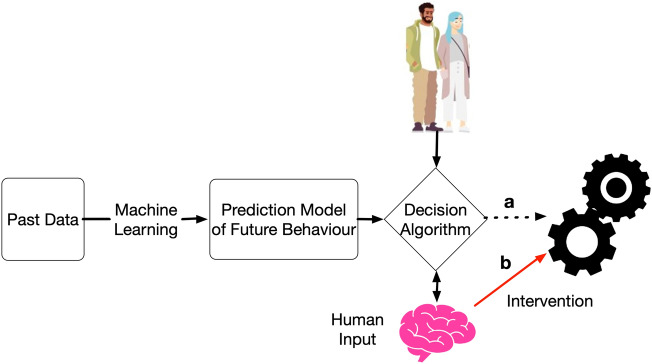
“Figure 1 uses a pink brain to illustrate human intervention in-or on-the-loop 36,37 of the decision-making.”
BackgroundThe problem with trust: on the discursive commodification of trust in AI
Krüger, S., & Wilson, C. (2022) · AI & Society · doi:10.1007/s00146-022-01401-6 · Cited by 34
Can AI communication tools increase legislative responsiveness and trust in democratic institutions?
Kreps, S., & Jakesch, M. (2023) · Government Information Quarterly · doi:10.1016/j.giq.2023.101829 · Cited by 34 · cited 1×
“At the same time, however, trust in the use of ADM by public authorities greatly depends on the specific areas of application 64 and the way they are implemented and used 65 .”
The Global Governance of Artificial Intelligence: Next Steps for Empirical and Normative ResearchPreprint
Tallberg, J., Erman, E., Furendal, M., Geith, J., Klamberg, M., & Lundgren, M. (2023) · SSRN Electronic Journal · doi:10.2139/ssrn.4424123 · Cited by 34 · cited 2×
“Public authorities (including regulators and intermediaries) face calls to regulate AI while already heavily relying on algorithmic systems to assist decision-making, and being confronted with a regulatory issue that is global in scale 91,92 .”
BackgroundTrustworthy AI and the Logics of Intersectional Resistance
Knowles, B., Fledderjohann, J., Richards, J. T., & Varshney, K. R. (2023) · ACM Conference on Fairness, Accountability, and Transparency (FAccT) · doi:10.1145/3593013.3593986 · Cited by 30
Algorithms as regulatory objects
Seyfert, R. (2021) · Information Communication & Society · doi:10.1080/1369118x.2021.1874035 · Cited by 29 · cited 1×
“Generally speaking, research has abandoned assumptions of binary relationships between distinct spheres (technology and society), acknowledging that AI is inherently embedded in social reality 51,52 .”
BackgroundTrust and distrust in interorganisational relations—Scale development
Lewicka, D., & Zakrzewska-Bielawska, A. F. (2022) · PLoS ONE · doi:10.1371/journal.pone.0279231 · Cited by 29 · cited 1×
“In regard to interpersonal trust, for instance, it has been highlighted that competence, predictability, benevolence and integrity are crucial values that help to ascertain a trustee’s trustworthiness 29,30 .”
BackgroundFairness in Algorithmic Profiling: A German Case Study
Kern, C. A., Bach, R. L., Mautner, H., & Kreuter, F. (2021) · MADOC (University of Mannheim) · doi:10.48550/arxiv.2108.04134 · Cited by 29
Perspectives from Practice: Algorithmic Decision-Making in Public Employment Services
Flügge, A. W. A. (2021) · ACM Conference on Computer Supported Cooperative Work (CSCW) · doi:10.1145/3462204.3481787 · Cited by 17
The Rule of Law and Automated Decision-Making: Exploring Fundamentals of Algorithmic Governance
Suksi, M. (2023) · Springer eBooks · doi:10.1007/978-3-031-30142-1 · Cited by 11
Why Should We Care About the Manipulative Power of Algorithmic Transparency?
Wang, H. (2023) · Philosophy & Technology · doi:10.1007/s13347-023-00610-1 · Cited by 9 · cited 1×
“Transparency is seen as quintessential to trust 97,98 , but at the same time, it is also recognised that transparency is not a “silver bullet” 2,99 nor is it clear how it can be operationalised into more trustworthy AI.”
BackgroundConceptualising Contestability: Perspectives on Contesting Algorithmic Decisions
Lyons, H., Velloso, E., & Miller, T. (2021) · Proceedings of the ACM on Human-Computer Interaction · doi:10.1145/3449180 · Cited by 4
Interactive Robotics: Legal, Ethical, Social and Economic Aspects
(2022) · Biosystems & biorobotics · doi:10.1007/978-3-031-04305-5 · Cited by 3
The Inigo Montoya Problem for Trustworthy AI
Probasco, E., Toney, A., & Curlee, K. J. (2023) · doi:10.51593/20230014a · Cited by 2
Research works printed but not linked: 14
- 7. Chouldechova, A., Benavides-Prado, D., Fialko, O. & Vaithianathan, R. A case study of algorithm-assisted decision making in child maltreatment hotline screening decisions. In Proc. 1st Conference on Fairness, Accountability and Transparency, vol. 81, 134-148 (Proceedings of Machine Learning Research, 2018).
- 9. Sarlin, R. Automationin administrative decision-makingconcerningsocialbenefits: A government agency perspective. In The Rule of Law and Automated Decision-Making (ed. Suksi, M.) (Springer, 2023).
- 12. Grau, A.) (Springer Nature, 2022).
- 20. Nguyen, C. T.) (Oxford University Press, 2022).
- 21. Luhmann, N. Trust and Power (Wiley, 1979).
- 23. Arnold, T., Kasenberg, D. & Scheutz, M. Value alignment or misalignment -what will keep systems accountable? In The Work- shops of the The Thirty-First AAAI Conference on Artificial Intelligence, Saturday, February 4-9, 2017, San Francisco, California, USA, vol. WS-17 of AAAI Technical Report (AAAI Press, 2017).
- 27. Gambetta, D. Can we trust trust? In Making and Breaking Cooperative Relations (ed.
- 32. Bacharach, M. & Gambetta, D. Trust in signs. In Trust in Society (ed. Cook, K. S.) (Russell Sage Foundation, 2001).
- 53. Rossi, F. Building trust in artificial intelligence. J. int. Aff. 72, 127-134 (2018).
- 64. Colesca, S. E. Understanding trust in e-government. Econ. Eng. Decis. 3, 7-15 (2009).
- 75. Berryhill, J., Heang, K. K., Clogher, R. & McBride, K. Hello World: Artificial Intelligence and its Use in the Public Sector (OECD, 2019).
- 91. Buiten, M. C. Towards intelligent regulation of artificial intelligence. Eur. J. Risk Regul. 10, 41-59. https:// doi. org/ 10. 1017/ err. 2019.8 (2019). · DOI · Paper page
- 92. Justo-Hanani, R. The politics of artificial intelligence regulation and governance reform in the European union. Policy Sci. 55, 137-159. https:// doi. org/ 10. 1007/ s11077-022-09452-8 (2022). · DOI
- 97. Ingram, M. Calibrating trust between humans and artificial intelligence systems. PhD Thesis, University of Glasgow (2023).
Cited by
AI agents and agentic systems: a multi-expert analysis
Hughes, L., Dwivedi, Y. K., Malik, T., Shawosh, M., Albashrawi, M. A., Jeon, I., Dutot, V., Appanderanda, M., Crick, T., De’, R., et al. (2025) · Journal of Computer Information Systems · doi:10.1080/08874417.2025.2483832 · Cited by 168
Evaluating Trustworthiness in AI: Risks, Metrics, and Applications Across Industries
Nastoska, A., Jancheska, B., Rizinski, M., & Trajanov, D. (2025) · Electronics · doi:10.3390/electronics14132717 · Cited by 169
ADABARA, I., Olaniyi Sadiq, B., Nuhu Shuaibu, A., Ibrahim Danjuma, Y., & Maninti, V. (2025) · F1000Research · doi:10.12688/f1000research.169927.1 · Cited by 38
Data Quality in the Age of AI: A Review of Governance, Ethics, and the FAIR Principles
Guillen-Aguinaga, M., Aguinaga-Ontoso, E., Guillen-Aguinaga, L., Guillen-Grima, F., & Aguinaga-Ontoso, I. (2025) · Data · doi:10.3390/data10120201 · Cited by 37
“Large-language-model behavior further highlights how data quality and governance jointly determine reliability and trust [23,210,272].”
AI systems should be trustworthy, not trusted
Zanotti, G. (2025) · AI & Society · doi:10.1007/s00146-025-02728-6 · Cited by 14
Metadata
- Authors
- Lahusen, C., Maggetti, M., & Slavkovik, M.
- Affiliations
- University of Siegen (DE)
- University of Lausanne (CH)
- University of Bergen (NO)
- Corresponding author
- Slavkovik, Marija
- Venue
- Scientific Reports
- Published
- 2024-09-05
- Volume
- 14
- Issue
- 1
- Pages
- 20752-20752
- ISSN
- 2045-2322 (ISSN-L)
- PMC
- PMC11377768
- OpenAlex
- W4402260412
- Semantic Scholar
- 557643d102f198097775863d69f74dbdfa20f464
- Cited by
- 68
- References
- 94
- Citations by year
- 2026: 44 · 2025: 24
- FWCI
- 28.18
- Type
- journal article
- Language
- en
- Open access
- gold
- doi.org
- Licence
- cc-by
- creativecommons.org/licenses/by/4.0 (tdm)
- creativecommons.org/licenses/by/4.0 (vor)
- Locations
- Scientific Reports (publishedVersion, cc-by)
- PubMed Central (publishedVersion, cc-by)
- PubMed (publishedVersion)
- DOAJ (DOAJ: Directory of Open Access Journals) (submittedVersion)
- IRIS (submittedVersion, cc-by)
- SERVAL (Université de Lausanne) (submittedVersion, cc-by)
- Funders
- University of Bergen
- Topics
- Physical Sciences › Computer Science › Artificial Intelligence › Ethics and Social Impacts of AI
- Social Sciences › Political Science and International Relations › E-Government and Public Services
- Social Sciences › Law › Digitalization, Law, and Regulation
- Keywords
- trust in AI, trustworthiness, AI governance, algorithmic decision-making, public sector organizations, AI alignment, socio-technical systems, human-AI interaction, institutional trust
About these checks
Registry, retraction, Cites and statistics results are computed, not judged, with one exception: a printed reference that no index lists is read once by a model before it counts as a citation error. Claims are extracted by a model and kept only when their quote appears verbatim in the text; each cited source is then checked, with a model’s help, for whether it says what the claim relies on. Those verdicts can be wrong — read the claim’s quote and the cited source before relying on one.
Statistics and arithmetic are recomputed, not judged.
Confidence bands are shown only for fields calibrated on our annotated test set. None is calibrated yet, so no band is shown.
What counts as a claim ›How we measure confidence ›How we check this ›
Are you an author, or do you see a problem with this page? Request a review
Data sources
Bibliographic data: Semantic Scholar, OpenAlex, Crossref.
Contains information from the Semantic Scholar Academic Graph Datasets, made available under the ODC Attribution License (ODC-BY 1.0).
Semantic Scholar’s data is described in: Kinney, R., et al. (2023). The Semantic Scholar Open Data Platform. arXiv:2301.10140.
