

Exploring the impact of probiotics on adult ADHD management through a double-blind RCT
Open accessThe DOI matches its Crossref record; 65 of the 67 references it cites were found in a registry or an index; 11 of the 36 sources its claims cite were checked for support.
Abstract
Attention deficit hyperactivity disorder (ADHD) is a common neuropsychiatric condition often persisting into adulthood, characterized by inattention, impulsivity, and hyperactivity. Emerging research suggests a connection between ADHD and gut microbiota, highlighting probiotics as potential therapeutic agents. This study involved a double-blind, randomized controlled trial where college students with ADHD received either a multi-strain probiotic supplement or a placebo daily for three months. ADHD symptoms were evaluated using a computerized performance test (MOXO) and the MATAL questionnaire. Academic records provided performance data. Additionally, eating and sleeping habits, gastrointestinal symptoms, and anthropometrics were assessed through questionnaires before and after the intervention. Fingernail cortisol concentrations (FCC) measured the long-term activity of the hypothalamic-pituitary-adrenal axis. The findings indicated that the probiotic significantly decreased hyperactivity, improved gastrointestinal symptoms, and enhanced academic performance. A multivariate analysis identified age as a significant predictor, with younger participants experiencing greater overall benefits from the intervention. There was also a negative correlation between FCC and symptoms of attention and impulsivity. Furthermore, higher academic grades were associated with lower levels of hyperactivity and impulsivity. These results suggest a beneficial impact of probiotics on ADHD symptoms and lay the groundwork for further studies to evaluate the effects of various probiotic strains on clinical outcomes in ADHD.
Overview
CoChat Summary
TL;DR
In a three-month double-blind RCT of 60 college students with ADHD, a multi-strain probiotic significantly reduced hyperactivity and GI symptoms and improved within-group academic grades, but between-group academic improvement was not significant. Age was the only significant multivariate predictor of overall benefit, with younger participants benefiting more.
Key findings
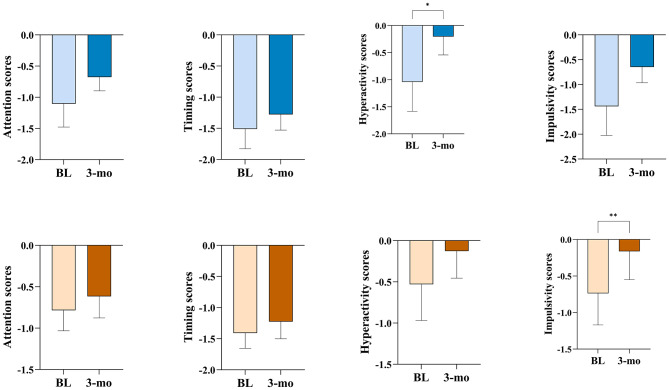
- Probiotic treatment significantly decreased MOXO-measured hyperactivity after three months (p = 0.012), while attention, timing, and impulsivity did not change significantly (p > 0.05); placebo showed a significant reduction in impulsivity (p = 0.0036).
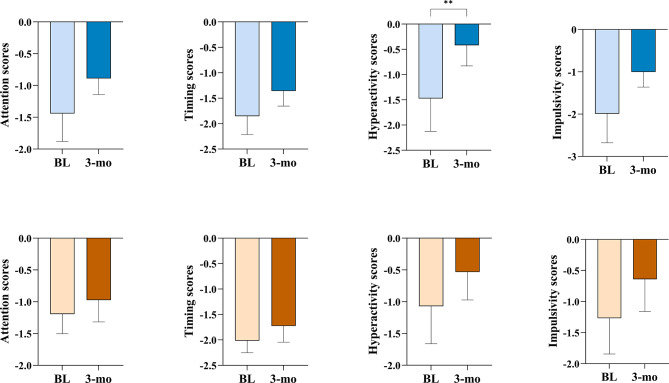
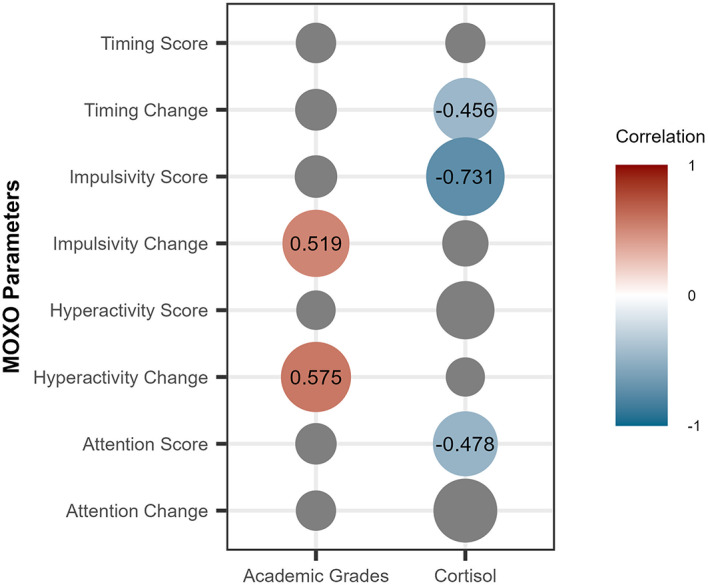
- In the “low-functioning” baseline subgroup, probiotic users showed significant hyperactivity improvement (p = 0.0074), and post-intervention fingernail cortisol negatively correlated with attention (rs = −0.478, p = 0.038) and impulsivity (rs = −0.731, p < 0.001).
- GI symptoms significantly decreased in the probiotic group (p = 0.007), and academic grades increased within the probiotic group from 81.61 ± 7.67 to 84.87 ± 6.03 (p = 0.0041), but the between-group grade difference was not significant (p = 0.4181, Cohen’s d = −0.307).
- Multivariate analysis explained ~28.5% of variance in a composite benefit score; age was significantly associated with greater benefit (p = 0.013), while baseline cortisol was marginal (p = 0.095).
Methods
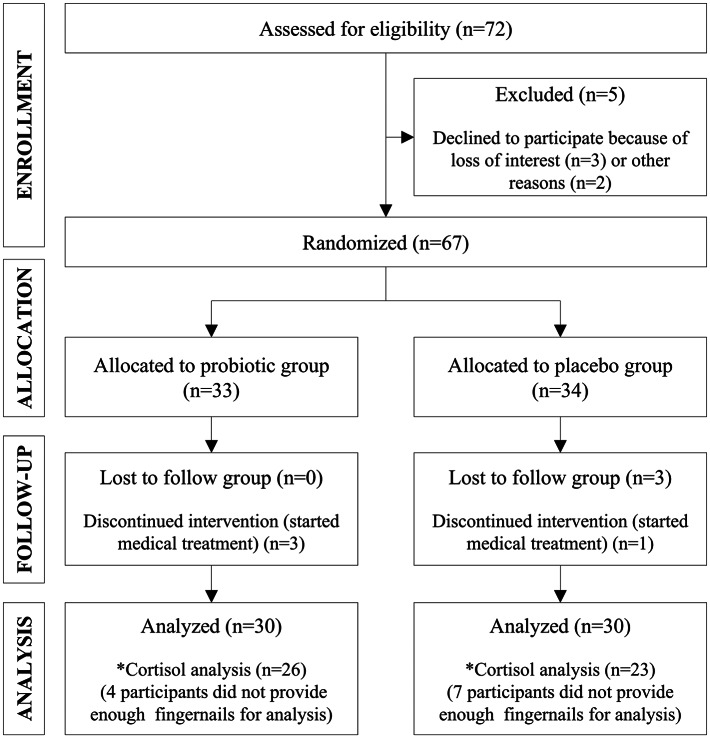
- Double-blind, randomized controlled trial in 67 recruited college students aged 19–30 with ADHD diagnosis and not on ADHD medication; 60 completed (30 probiotic, 30 placebo).
- Participants took two capsules daily for three months containing 8 × 10⁹ CFU each of *L. helveticus*, *B. animalis* ssp. *lactis*, *Enterococcus faecium*, *B. longum*, and *Bacillus subtilis*, or placebo.
- Outcomes included MOXO-CPT, MATAL questionnaire, academic records, dietary/sleep/GI questionnaires, anthropometrics, and fingernail cortisol; analyses used non-parametric tests, Spearman correlations, and multiple regression on a composite benefit score.
Limitations
- Stated: single-center RCT with modest sample size (60), mean age 26, and skewed gender distribution (two-thirds female), limiting generalizability; causality remains challenging; no clinician-rated symptom scales; no formal blinding check; 12 participants withdrawn for non-adherence (5 started drug treatment, 7 consumed <80% capsules); no inflammatory biomarkers or gut microbiome profiles.
- Stated: multiple testing may increase Type I error risk, especially for secondary outcomes.
- Evident from the text: the probiotic group’s academic improvement was significant within-group but not significantly different from placebo, and placebo also reduced impulsivity, so between-group specificity for several outcomes is limited.
Model-written summary. Check it against the paper before relying on it.
Integrity signals
Registry
Cites
Statistics
Figures
Verification
Claims the paper makes
4 Valid · 1 Not valid · 17 Not checked · 56 Own results and interpretations
The sources with a verdict support this claim; the rest weren’t checked yet, have no full text we could read, or their verdicts aren’t rated yet.
In the paper
“HCC has proven to validly capture the accumulated, integrated long-term activity of the HPA axis43–45.”
§ Exploring the impact of probiotics on adult ADHD management through a double-blind RCT > Measurements > Long-term cortisol levels
What the sources say
- Not checked yetcites [43] Izawa, S. et al. Cortisol level measurements in fingernails as a retrospective index of hormone production. Psychoneuroendocrinology 54, 24–30. 10.1016/j.psyneuen.2015.01.015 (2015). 25662340 source
- Supportedcites [44] Izawa, S., Sugaya, N., Ogawa, N., Shirotsuki, K. & Nomura, S. A validation study on fingernail cortisol: Correlations with one-month cortisol levels estimated by hair and saliva samples. Stress 24, 734–741. 10.1080/10253890.2021.1895113 (2021). 33792492 source
The Introduction (p. 1) of Izawa et al. (2021) states plainly that 'Cortisol levels measured in hair samples are an index of cumulative hormone levels', that 1 cm of scalp hair reflects one month of hormone levels, and that 'hair samples provide an index of cumulative hormone exposure over a longer period, which informs the investigation of cortisol levels and chronic stress'. It also records that hair cortisol is associated with saliva cortisol (Short et al., 2016; Sugaya et al., 2020) and elevated in chronically stressed people, i.e. it treats HCC as a validated integrative marker of HPA-axis output rather than questioning it. The strictly 'HPA axis' wording is applied in the same paragraph to acute stress responses, but the cumulative-integration content the citing sentence attributes here is stated by this source; the claim is a broad background statement carried by a citation cluster (43-45), so no exact sentence is required. (LLM, conf=0.82)
- Not checked yetcites [45] Herane-Vives, A. et al. Elevated fingernail cortisol levels in major depressive episodes. Psychoneuroendocrinology 88, 17–23. 10.1016/j.psyneuen.2017.10.026 (2018). 29153629 source
boostedstates a cause- Asserted: passes — The authors put it forward as true.
- Checkable: passes — It can be checked against evidence.
- Load-bearing: passes — The paper’s conclusions depend on it.
- Based: passes — The paper gives a reason why it holds.
Every source the paper cites for this claim was checked and supports it.
In the paper
“A recent report found an increased rate of comorbid functional GI disorders (FGID), such as irritable bowel syndrome (IBS), in a large cohort of adults with ADHD60.”
§ Exploring the impact of probiotics on adult ADHD management through a double-blind RCT > Discussion
What the sources say
- Supportedcites [60] Kedem, S. et al. Attention deficit hyperactivity disorder and gastrointestinal morbidity in a large cohort of young adults. World J Gastroenterol 26, 6626–6637. 10.3748/wjg.v26.i42.6626 (2020). 33268951 PMC7673962 source
The Discussion states that this large cohort of young adults with ADHD had an increased rate of comorbid functional GI disorders, including IBS. The citing sentence accurately paraphrases that finding. (LLM, conf=0.95)
plainstates an association- Asserted: passes — The authors put it forward as true.
- Checkable: passes — It can be checked against evidence.
- Load-bearing: unclear — It is unclear whether the paper’s conclusions depend on it.
- Based: passes — The paper gives a reason why it holds.
- Supported
A result the paper reports from its own data — it cites no other source for it, so there is none to check. The quote shows it is in the paper.
In the paper
“The findings indicated that the probiotic significantly decreased hyperactivity”
- Also stated in: § ADHD symptoms after intervention · plain
“A significant decrease in hyperactivity was documented after three months of the probiotic intervention (p = 0.012)”
§ Exploring the impact of probiotics on adult ADHD management through a double-blind RCT > Abstract
plainstates a causen = 30 ·- Asserted: passes — The authors put it forward as true.
- Checkable: passes — It can be checked against evidence.
- Load-bearing: passes — The paper’s conclusions depend on it.
- Based: passes — The paper gives a reason why it holds.
- Rests on 4 assumptions not shown here.
- Also stated in: § ADHD symptoms after intervention · plain
A result the paper reports from its own data — it cites no other source for it, so there is none to check. The quote shows it is in the paper.
In the paper
“Among the “low-functioning” subjects, those who consumed probiotics showed a significant improvement in hyperactivity (p = 0.0074)”
§ Exploring the impact of probiotics on adult ADHD management through a double-blind RCT > Results > ADHD symptoms after intervention
plainstates a cause- Asserted: passes — The authors put it forward as true.
- Checkable: passes — It can be checked against evidence.
- Load-bearing: passes — The paper’s conclusions depend on it.
- Based: passes — The paper gives a reason why it holds.
- Rests on 4 assumptions not shown here.
A result the paper reports from its own data — it cites no other source for it, so there is none to check. The quote shows it is in the paper.
In the paper
“Among “low-functioning” participants, a significant negative correlation between cortisol levels after the three-month intervention and attention and impulsivity was noted for those who received probiotics (rs=-0.478, p = 0.038, and rs = -0.731, p < 0.001, respectively).”
§ Exploring the impact of probiotics on adult ADHD management through a double-blind RCT > Results > Correlations between ADHD performance indices, cortisol levels and academic outcomes
plainstates an association- Asserted: passes — The authors put it forward as true.
- Checkable: passes — It can be checked against evidence.
- Load-bearing: unclear — It is unclear whether the paper’s conclusions depend on it.
- Based: passes — The paper gives a reason why it holds.
- Rests on 3 assumptions not shown here.
30 more claims
Create a free account to see all 78 claims and to verify the 25 references still open.
- Probably not a substantial claim. 21
- It may state two separate claims as one. 26
- The quote only partly states this claim. 3
Claims other papers make about this one
Each is checked against this paper’s own text: does it say what the citing paper says it does?
The source backs part of the claim, not all of it — or backs it for a different population, condition or comparison.
In the citing paper
“Levy Schwartz et al. (2024) observed improvements in ADHD-related hyperactivity and academic performance alongside reduced cortisol”
From Psychobiotics in mental health: insights from human clinical trials via the gut-brain axis (2026) · cites this paper as Levy Schwartz et al. (2024)
Experimental — accuracy not yet measured
Self-check
Percentages, sums and reported differences re-computed from the paper’s own numbers.
Each contradiction between two passages listed here was confirmed by an independent check.
Rated major: it would touch a result — a value a result rests on, reported and recomputed p-values on opposite sides of the significance level, two passages that conflict with no sign which is right, or a cited work retracted before this paper was published.
In the paper
§ Exploring the impact of probiotics on adult ADHD management through a double-blind RCT > Discussion
“In the current work, significant improvements in academic grades were achieved by the end of the intervention among students taking probiotics compared to both their baseline performance and the placebo group.”
§ Exploring the impact of probiotics on adult ADHD management through a double-blind RCT > Results > Academic achievement
“| Delta | 2.70 ± 5.65 | 3.25 ± 6.11 | 0.7092 |”
Rated major: it would touch a result — a value a result rests on, reported and recomputed p-values on opposite sides of the significance level, two passages that conflict with no sign which is right, or a cited work retracted before this paper was published.
In the paper
§ Exploring the impact of probiotics on adult ADHD management through a double-blind RCT > Measurements > ADHD symptoms and severity
“For the change scores used in the analysis, a negative value represents an improvement in symptoms (i.e., a decrease in the MOXO score from baseline), whereas a positive value indicates a worsening of symptoms (i.e., an increase in the MOXO score from baseline).”
§ Exploring the impact of probiotics on adult ADHD management through a double-blind RCT > Measurements > ADHD symptoms and severity
“Changes (delta) in performance indices were calculated by subtracting the scores after the intervention from those obtained at baseline.”
Rated major: it would touch a result — a value a result rests on, reported and recomputed p-values on opposite sides of the significance level, two passages that conflict with no sign which is right, or a cited work retracted before this paper was published.
In the paper
§ Exploring the impact of probiotics on adult ADHD management through a double-blind RCT > Measurements > ADHD symptoms and severity
“In this test, lower scores indicate better performance, meaning fewer symptoms of hyperactivity, impulsivity, and inattention, while higher scores indicate greater symptom severity.”
§ Exploring the impact of probiotics on adult ADHD management through a double-blind RCT > Results > ADHD symptoms after intervention
“Participants in the ‘normal-functioning’ group had a baseline score higher than − 1 in all four tested performance indices, where more positive scores represent better outcomes.”
Rated major: it would touch a result — a value a result rests on, reported and recomputed p-values on opposite sides of the significance level, two passages that conflict with no sign which is right, or a cited work retracted before this paper was published.
In the paper
§ Exploring the impact of probiotics on adult ADHD management through a double-blind RCT > Discussion
“Furthermore, 12 participants were withdrawn from the study due to non-adherence, with 5 participants starting drug treatment and 7 failing to consume at least 80% of the supplements.”
§ Exploring the impact of probiotics on adult ADHD management through a double-blind RCT > Results > Demographics and baseline characteristics of the study group
“Three participants from the placebo group were lost to follow-up and were excluded from the analysis. Additionally, three individuals randomly assigned to the probiotic group and one from the placebo group were removed due to the initiation of pharmacotherapy, which was in violation of an exclusion criteria. In total, 60 students completed the trial, 30 in each arm (Fig. 1).”
Rated minor: it would not touch a result — a value no result rests on, a p-value that stays on the same side of the significance level, or a conflict that is clerical, resolved elsewhere in the paper, or outside its own findings.
In the paper
§ Exploring the impact of probiotics on adult ADHD management through a double-blind RCT > Results > ADHD symptoms after intervention
“the ‘low-functioning’ group including participants who had lower baseline scores across the majority of indices”
§ Exploring the impact of probiotics on adult ADHD management through a double-blind RCT > Results > ADHD symptoms after intervention
“Participants with a baseline score of -1 or lower in at least one of the MOXO indices were included in the “low-functioning” group.”
4 more findings
Create a free account to see every finding of this check.
Citations
Cites
Sontrop, J. M., Dixon, S. N., Garg, A. X., Buendia-Jimenez, I., Dohein, O., Huang, S.-H. S., & Clark, W. F. (2013) · American Journal of Nephrology · doi:10.1159/000350377 · Cited by 5,871
Mind-altering microorganisms: the impact of the gut microbiota on brain and behaviour
Cryan, J. F., & Dinan, T. G. (2012) · Nature Reviews Neuroscience · doi:10.1038/nrn3346 · Cited by 4,572 · cited 1×
“The bidirectional communication of the gut-brain axis could play a role in this relationship, potentially contributing to the modulation of both GI symptoms and ADHD 50,61 , although further research is needed to fully understand these mechanisms.”
BackgroundKessler, R. C., Adler, L., Barkley, R., Biederman, J., Conners, C. K., Demler, O., Faraone, S. V., Greenhill, L. L., Howes, M. J., Secnik, K., et al. (2006) · American Journal of Psychiatry · doi:10.1176/ajp.2006.163.4.716 · Cited by 3,886
Moshfegh, A. J., Rhodes, D. G., Baer, D. J., Murayi, T., Clemens, J. C., Rumpler, W. V., Paul, D. R., Sebastian, R. S., Kuczynski, K. J., Ingwersen, L. A., et al. (2008) · The American Journal of Clinical Nutrition · doi:10.1093/ajcn/88.2.324 · Cited by 1,982 · cited 1×
“All participants had a monthly session with a dietitian and were asked to fill out a 24-recall questionnaire 37 .”
BackgroundMessaoudi, M., Lalonde, R., Violle, N., Javelot, H., Desor, D., Nejdi, A., Bisson, J.-F., Rougeot, C., Pichelin, M., Cazaubiel, M., et al. (2011) · British Journal of Nutrition · doi:10.1017/s0007114510004319 · Cited by 1,324
Psychobiotics: A novel class of psychotropic
Dinan, T. G., Stanton, C., & Cryan, J. F. (2013) · Biological Psychiatry · doi:10.1016/j.biopsych.2013.05.001 · Cited by 1,287
From gut dysbiosis to altered brain function and mental illness: mechanisms and pathways
Rogers, G. B., Keating, D. J., Young, R. L., Wong, M.-L., Licinio, J., & Wesselingh, S. (2016) · Molecular Psychiatry · doi:10.1038/mp.2016.50 · Cited by 969
Song, P., Zha, M., Yang, Q., Zhang, Y., Li, X., & Rudan, I. (2021) · Journal of Global Health · doi:10.7189/jogh.11.04009 · Cited by 896
WINPEPI updated: computer programs for epidemiologists, and their teaching potential
Abramson, J. H. (2011) · Epidemiologic Perspectives & Innovations · doi:10.1186/1742-5573-8-1 · Cited by 844 · cited 1×
“We determined the sample size using the WinPepi software 34 applying a randomized clinical trial sample size formula considering type I (α) and type II errors (β) of 0.05 and 0.20 (power = 80%), respectively.”
MethodInfluentialAkkasheh, G., Kashani-Poor, Z., Tajabadi-Ebrahimi, M., Jafari, P., Akbari, H., Taghizadeh, M., Memarzadeh, M. R., Asemi, Z., & Esmaillzadeh, A. (2016) · Nutrition · doi:10.1016/j.nut.2015.09.003 · Cited by 767 · cited 1×
“Based on a previous study 35 , we used a standard deviation of 6.4 and 4.8 (intervention and placebo, respectively) and a difference in mean of 4.2, considering the decrease in the Beck Depression Inventory score as the key variable.”
MethodInfluentialFrazier, T. W., Youngstrom, E. A., Glutting, J. J., & Watkins, M. W. (2007) · Journal of Learning Disabilities · doi:10.1177/00222194070400010401 · Cited by 700
Evidence for the validity of a sleep habits survey for adolescents
Wolfson, A. R., Carskadon, M. A., Acebo, C., Seifer, R., Fallone, G., Labyak, S. E., & Martin, J. L. (2003) · Sleep · doi:10.1093/sleep/26.2.213 · Cited by 682 · cited 1×
“Participants completed the Family Eating and Activity Habits Questionnaire (FEAQ) 38 , the School Sleep Habits Survey (SSHS) questionnaire 39 and a self-assessment GI symptoms questionnaire 40 before and after the three-month intervention.”
MethodBytzer, P., Talley, N. J., Leemon, M., Young, L. J., Jones, M. P., & Horowitz, M. (2001) · Archives of Internal Medicine · doi:10.1001/archinte.161.16.1989 · Cited by 632
The Role of Cortisol in Chronic Stress, Neurodegenerative Diseases, and Psychological Disorders
Knezevic, E., Nenic, K., Milanovic, V., & Knezevic, N. N. (2023) · Cells · doi:10.3390/cells12232726 · Cited by 564
Diet and the development of the human intestinal microbiome
Voreades, N., Kozil, A., & Weir, T. L. (2014) · Frontiers in Microbiology · doi:10.3389/fmicb.2014.00494 · Cited by 498 · cited 1×
“This hypothesis suggests that personalized probiotic interventions, tailored to an individual’s microbiome composition, could potentially yield more consistent improvements across all ADHD symptom domains 50,51 .”
BackgroundSlykerman, R. F., Hood, F., Wickens, K., Thompson, J. M. D., Barthow, C., Murphy, R., Kang, J., Rowden, J., Stone, P., Crane, J., et al. (2017) · EBioMedicine · doi:10.1016/j.ebiom.2017.09.013 · Cited by 422
Young Adult Educational and Vocational Outcomes of Children Diagnosed with ADHD
Kuriyan, A. B., Pelham, W. E., Molina, B. S. G., Waschbusch, D. A., Gnagy, E. M., Sibley, M. H., Babinski, D. E., Walther, C., Cheong, J., Yu, J., et al. (2013) · Journal of Abnormal Child Psychology · doi:10.1007/s10802-012-9658-z · Cited by 406 · cited 1×
“Lower levels of academic achievement have been previously shown in college students with ADHD compared to their non-ADHD counterparts 52 , leading to increased dropout and lower occupational status 53 .”
BackgroundPärtty, A., Kalliomäki, M., Wacklin, P., Salminen, S., & Isolauri, E. (2015) · Pediatric Research · doi:10.1038/pr.2015.51 · Cited by 397
BAUER, A. M., QUAS, J. A., & BOYCE, W. T. (2002) · Journal of Developmental & Behavioral Pediatrics · doi:10.1097/00004703-200204000-00007 · Cited by 371
The Impact of Microbiota on Brain and Behavior: Mechanisms & Therapeutic Potential
Borre, Y. E., Moloney, R. D., Clarke, G., Dinan, T. G., & Cryan, J. F. (2014) · Advances in Experimental Medicine and Biology · doi:10.1007/978-1-4939-0897-4_17 · Cited by 329 · cited 2×
“The bidirectional communication of the gut-brain axis could play a role in this relationship, potentially contributing to the modulation of both GI symptoms and ADHD 50,61 , although further research is needed to fully understand these mechanisms.”
BackgroundWang, Y., Li, N., Yang, J.-J., Zhao, D.-M., Chen, B., Zhang, G.-Q., Chen, S., Cao, R.-F., Yu, H., Zhao, C.-Y., et al. (2020) · Pharmacological Research · doi:10.1016/j.phrs.2020.104784 · Cited by 324
Kato-Kataoka, A., Nishida, K., Takada, M., Kawai, M., Kikuchi-Hayakawa, H., Suda, K., Ishikawa, H., Gondo, Y., Shimizu, K., Matsuki, T., et al. (2016) · Applied and Environmental Microbiology · doi:10.1128/aem.04134-15 · Cited by 288
Fang, Z., Pan, T., Li, L., Wang, H., Zhu, J., Zhang, H., Zhao, J., Chen, W., & Lu, W. (2022) · Gut Microbes · doi:10.1080/19490976.2022.2044723 · Cited by 273
Takada, M., Nishida, K., Kataoka‐Kato, A., Gondo, Y., Ishikawa, H., Suda, K., Kawai, M., Hoshi, R., Watanabe, O., Igarashi, T., et al. (2016) · Neurogastroenterology & Motility · doi:10.1111/nmo.12804 · Cited by 243
Nimgampalle, M. (2017) · JOURNAL OF CLINICAL AND DIAGNOSTIC RESEARCH · doi:10.7860/jcdr/2017/26106.10428 · Cited by 241
ADHD in college students: Developmental findings
Weyandt, L. L., & DuPaul, G. J. (2008) · Developmental Disabilities Research Reviews · doi:10.1002/ddrr.38 · Cited by 185
Checa-Ros, A., Jeréz-Calero, A., Molina-Carballo, A., Campoy, C., & Muñoz-Hoyos, A. (2021) · Nutrients · doi:10.3390/nu13010249 · Cited by 164
Nelson, J. M., & Gregg, N. (2012) · Journal of Attention Disorders · doi:10.1177/1087054710385783 · Cited by 162 · cited 1×
“Further, college students with ADHD are more likely to experience depression and anxiety 54 , which may delay their academic achievement.”
BackgroundAyano, G., Tsegay, L., Gizachew, Y., Necho, M., Yohannes, K., Abraha, M., Demelash, S., Anbesaw, T., & Alati, R. (2023) · Psychiatry Research · doi:10.1016/j.psychres.2023.115449 · Cited by 160
Wang, W. C., Yan, F. F., Hu, J. Y., Amen, O. A., & Cheng, H. W. (2018) · Journal of Animal Science · doi:10.1093/jas/sky092 · Cited by 157
Blomqvist, M., Holmberg, K., Lindblad, F., Fernell, E., Ek, U., & Dahllöf, G. (2007) · European Journal of Oral Sciences · doi:10.1111/j.1600-0722.2007.00423.x · Cited by 139
Reliability and validity of the Family Eating and Activity Habits Questionnaire
Golan, M., & Weizman, A. (1998) · European Journal of Clinical Nutrition · doi:10.1038/sj.ejcn.1600647 · Cited by 135
Association of Constipation and Fecal Incontinence With Attention-Deficit/Hyperactivity Disorder
McKeown, C., Hisle-Gorman, E., Eide, M., Gorman, G. H., & Nylund, C. M. (2013) · Pediatrics · doi:10.1542/peds.2013-1580 · Cited by 134
Production of Indole-3-Lactic Acid by Bifidobacterium Strains Isolated fromHuman Infants
Sakurai, T., Odamaki, T., & Xiao, J.-Z. (2019) · Microorganisms · doi:10.3390/microorganisms7090340 · Cited by 129
Preliminary data suggesting the efficacy of attention training for school-aged children with ADHD
Tamm, L., Epstein, J. N., Peugh, J. L., Nakonezny, P. A., & Hughes, C. W. (2013) · Developmental Cognitive Neuroscience · doi:10.1016/j.dcn.2012.11.004 · Cited by 125
Reis, D. J., Ilardi, S. S., & Punt, S. E. W. (2018) · PLOS ONE · doi:10.1371/journal.pone.0199041 · Cited by 123
Takahashi, K., Nakagawasai, O., Nemoto, W., Odaira, T., Sakuma, W., Onogi, H., Nishijima, H., Furihata, R., Nemoto, Y., Iwasa, H., et al. (2019) · Journal of Neuroinflammation · doi:10.1186/s12974-019-1580-7 · Cited by 98
Shahar, D., Fraser, D., Shai, I., & Vardi, H. (2003) · The Journal of Nutrition · doi:10.1093/jn/133.11.3625 · Cited by 80 · cited 1×
“Dietary profiling was performed using the validated 127-item FFQ developed for the Israeli population 36 .”
MethodMeasuring cortisol and DHEA in fingernails: A pilot study
Seo (2009) · Neuropsychiatric Disease and Treatment · doi:10.2147/ndt.s8307 · Cited by 80
Sustained attention and heart rate variability in children and adolescents with ADHD
Griffiths, K. R., Quintana, D. S., Hermens, D. F., Spooner, C., Tsang, T. W., Clarke, S., & Kohn, M. R. (2017) · Biological Psychology · doi:10.1016/j.biopsycho.2017.01.004 · Cited by 79
Venkataraman, R., Madempudi, R. S., Neelamraju, J., Ahire, J. J., Vinay, H. R., Lal, A., Thomas, G., & Stephen, S. (2020) · Probiotics and Antimicrobial Proteins · doi:10.1007/s12602-020-09681-4 · Cited by 74
Skott, E., Yang, L. L., Stiernborg, M., Söderström, Å., Rȕegg, J., Schalling, M., Forsell, Y., Giacobini, M., & Lavebratt, C. (2020) · Brain, Behavior, and Immunity · doi:10.1016/j.bbi.2020.05.056 · Cited by 73 · cited 1×
“In the MOXO test, lower scores represent better performance, with fewer symptoms of hyperactivity and impulsivity 55 .”
BackgroundCortisol level measurements in fingernails as a retrospective index of hormone production
Izawa, S., Miki, K., Tsuchiya, M., Mitani, T., Midorikawa, T., Fuchu, T., Komatsu, T., & Togo, F. (2015) · Psychoneuroendocrinology · doi:10.1016/j.psyneuen.2015.01.015 · Cited by 66
Ming, X., Chen, N., Ray, C., Brewer, G., Kornitzer, J., & Steer, R. A. (2018) · Child Neurology Open · doi:10.1177/2329048x18786799 · Cited by 64
Medical Comorbidity of Attention-Deficit/Hyperactivity Disorder in US Adolescents
Jameson, N. D., Sheppard, B. K., Lateef, T. M., Vande Voort, J. L., He, J.-P., & Merikangas, K. R. (2016) · Journal of Child Neurology · doi:10.1177/0883073816653782 · Cited by 60
Wang, L.-J., Yang, C.-Y., Kuo, H.-C., Chou, W.-J., Tsai, C.-S., & Lee, S.-Y. (2022) · Journal of Personalized Medicine · doi:10.3390/jpm12020227 · Cited by 58
Hypothalamic-Pituitary-Adrenal Reactivity in Boys with Attention Deficit Hyperactivity Disorder
Hong, H. J., Shin, D. W., Lee, E. H., Oh, Y. H., & Noh, K. S. (2003) · Yonsei Medical Journal · doi:10.3349/ymj.2003.44.4.608 · Cited by 56
Langkamp-Henken, B., Rowe, C. C., Ford, A. L., Christman, M. C., Nieves, C., Khouri, L., Specht, G. J., Girard, S.-A., Spaiser, S. J., & Dahl, W. J. (2015) · British Journal of Nutrition · doi:10.1017/s0007114514003997 · Cited by 54
Objective measures of attention-deficit/hyperactivity disorder: a pilot study.
Berger, I., & Goldzweig, G. (2010) · PubMed · Cited by 49
Elevated fingernail cortisol levels in major depressive episodes
Herane-Vives, A., Fischer, S., de Angel, V., Wise, T., Cheung, E., Chua, K.-C., Arnone, D., Young, A. H., & Cleare, A. J. (2018) · Psychoneuroendocrinology · doi:10.1016/j.psyneuen.2017.10.026 · Cited by 46 · cited 1×
“HCC has proven to validly capture the accumulated, integrated long-term activity of the HPA axis 43–45 .”
BackgroundKedem, S., Yust-Katz, S., Carter, D., Levi, Z., Kedem, R., Dickstein, A., Daher, S., & Katz, L. H. (2020) · World Journal of Gastroenterology · doi:10.3748/wjg.v26.i42.6626 · Cited by 44 · cited 1×
“A recent report found an increased rate of comorbid functional GI disorders (FGID), such as irritable bowel syndrome (IBS), in a large cohort of adults with ADHD 60 .”
BackgroundVasiliu, O. (2023) · Frontiers in Psychiatry · doi:10.3389/fpsyt.2023.1074736 · Cited by 42
Heat-killed Lactobacillus casei subsp. casei 327 promotes colonic serotonin synthesis in mice
Hara, T., Mihara, T., Ishibashi, M., Kumagai, T., & Joh, T. (2018) · Journal of Functional Foods · doi:10.1016/j.jff.2018.05.050 · Cited by 42
Fingernail cortisol – State of research and future directions
Fischer, S., Schumacher, S., Skoluda, N., & Strahler, J. (2020) · Frontiers in Neuroendocrinology · doi:10.1016/j.yfrne.2020.100855 · Cited by 40 · cited 1×
“Fingernail cortisol, unlike blood or salivary cortisol, is unaffected by state-like confounders and may serve as a primary indicator of HPA axis activity 62 .”
BackgroundZaghari, M., Zahroojian, N., Riahi, M., & Parhizkar, S. (2015) · Italian Journal of Animal Science · doi:10.4081/ijas.2015.3555 · Cited by 33
Izawa, S., Sugaya, N., Ogawa, N., Shirotsuki, K., & Nomura, S. (2021) · Stress · doi:10.1080/10253890.2021.1895113 · Cited by 29
Siegel, M. P., & Conklin, S. M. (2020) · Brain Behavior & Immunity - Health · doi:10.1016/j.bbih.2019.100029 · Cited by 27
Kamradt, J. M., Momany, A. M., & Nikolas, M. A. (2018) · ADHD Attention Deficit and Hyperactivity Disorders · doi:10.1007/s12402-017-0238-5 · Cited by 26
Adult ADHD: it is old and new at the same time – what is it?
Custodio, R. J. P., Hengstler, J. G., Cheong, J. H., Kim, H. J., Wascher, E., & Getzmann, S. (2023) · Reviews in the Neurosciences · doi:10.1515/revneuro-2023-0071 · Cited by 25
Cheng, H.-W., Jiang, S., & Hu, J. (2019) · Oral Health by Using Probiotic Products · doi:10.5772/intechopen.86775 · Cited by 17
Development of Bacillus subtilis mutants to produce tryptophan in pigs
Bjerre, K., Cantor, M. D., Nørgaard, J. V., Poulsen, H. D., Blaabjerg, K., Canibe, N., Jensen, B. B., Stuer-Lauridsen, B., Nielsen, B., & Derkx, P. M. F. (2017) · Biotechnology Letters · doi:10.1007/s10529-016-2245-6 · Cited by 13 · cited 1×
“All statistical analyses were performed using SPSS software, version 23.”
MethodHussain, S., Andrews, D., & Hill, B. C. (2017) · Biochemistry · doi:10.1021/acs.biochem.7b00833 · Cited by 6
(2010) · PubMed · Cited by 5
Attention-Deficit/Hyperactivity Disorder
DuPaul, G. J., Pollack, B., & Pinho, T. D. (2017) · Springer eBooks · doi:10.1007/978-3-319-57196-6_20 · Cited by 5
Wang, Z., Zhu, H., Chen, L., Gan, C., Min, W., Xiao, J., Zou, Z., & He, Y. (2024) · Journal of Attention Disorders · doi:10.1177/10870547241264660 · Cited by 4
Cited by
Unraveling the gut microbiota-brain axis: Mechanisms, pathophysiology, and therapeutic opportunities
Jiang, C., Nageeb, W. M., Batool, S., Hashish, A., Alkhawagah, S. M., Ibrahim, H. A. A., Zhu, W., Che, C., Li, X., Jin, M., et al. (2026) · iScience · doi:10.1016/j.isci.2026.116224 · Cited by 14
Zou, P., Huang, Z., Zong, X., & Zhang, Q. (2025) · Neuroscience & Biobehavioral Reviews · doi:10.1016/j.neubiorev.2025.106436 · Cited by 5
The Effectiveness of the Gut Microbiota Modulation on ADHD in Adults: A Systematic Review
Gomes, A., Siopa, C., Pestana, P. C., & Novais, F. (2025) · Current Treatment Options in Psychiatry · doi:10.1007/s40501-025-00358-9 · Cited by 6
“Consequently, the impact on both populations remains unclear and needs more investigation [49].”
InfluentialPsychobiotics in mental health: insights from human clinical trials via the gut-brain axis
Sisubalan, N., Kesika, P., Sivamaruthi, B. S., & Chaiyasut, C. (2026) · Frontiers in microbiology · doi:10.3389/fmicb.2026.1804560 · Cited by 4
Rodrigues, B., Miranda, I. M., & de Oliveira, S. C. (2026) · Microorganisms · doi:10.3390/microorganisms14061301 · Cited by 5
Metadata
- Authors
- Levy Schwartz, M., Magzal, F., Yehuda, I., & Tamir, S.
- Affiliations
- Migal - Galilee Technology Center (IL)
- Tel Hai Academic College (IL)
- Corresponding author
- Magzal, Faiga
- Tamir, Snait
- Venue
- Scientific Reports
- Published
- 2024-11-05
- Volume
- 14
- Issue
- 1
- Pages
- 26830-26830
- ISSN
- 2045-2322 (ISSN-L)
- PMC
- PMC11538393
- OpenAlex
- W4404061103
- Cited by
- 15
- References
- 67
- Citations by year
- 2026: 11 · 2025: 4
- FWCI
- 3.22
- Type
- journal article
- Language
- en
- Open access
- gold
- doi.org
- Licence
- cc-by-nc-nd
- creativecommons.org/licenses/by-nc-nd/4.0 (tdm)
- creativecommons.org/licenses/by-nc-nd/4.0 (vor)
- Locations
- Scientific Reports (publishedVersion, cc-by-nc-nd)
- PubMed Central (publishedVersion, cc-by-nc-nd)
- PubMed (publishedVersion)
- DOAJ (DOAJ: Directory of Open Access Journals) (submittedVersion, cc-by-sa)
- Topics
- Life Sciences › Agricultural and Biological Sciences › Food Science › Probiotics and Fermented Foods
- Health Sciences › Medicine › Psychiatry and Mental health › Attention Deficit Hyperactivity Disorder
- Life Sciences › Biochemistry, Genetics and Molecular Biology › Molecular Biology › Gut microbiota and health
- Keywords
- probiotics, adult ADHD, gut microbiota, hyperactivity, impulsivity, academic performance, hypothalamic-pituitary-adrenal axis, gastrointestinal symptoms, university students, age as predictor
- MeSH terms
- Gastrointestinal Microbiome, Adolescent, Adult, Attention Deficit Disorder with Hyperactivity, Double-Blind Method, Female, Humans, Hydrocortisone, Male, Surveys and Questionnaires, Probiotics, Young Adult
About these checks
Registry, retraction, Cites and statistics results are computed, not judged, with one exception: a printed reference that no index lists is read once by a model before it counts as a citation error. Claims are extracted by a model and kept only when their quote appears verbatim in the text; each cited source is then checked, with a model’s help, for whether it says what the claim relies on. Those verdicts can be wrong — read the claim’s quote and the cited source before relying on one.
The claim verdicts this report counts are experimental: their accuracy is not yet measured.
A language model drew the claims from the paper on 2026-10-04, under version 3 of the claim definition (model deepseek-v4.1-flash, prompt extract-v3).
A second model labelled each claim on 2026-10-04 (model jev-1.13-20260917, definition revision gold-guideline-v0.2).
Cited sources are checked with a language model’s help (qwen3.8-omni-flash and gpt-6-sol).
Statistics and arithmetic are recomputed, not judged.
Confidence bands are shown only for fields calibrated on our annotated test set. None is calibrated yet, so no band is shown.
What counts as a claim ›How we measure confidence ›How we check this ›
Are you an author, or do you see a problem with this page? Request a review
Data sources
Bibliographic data: Semantic Scholar, OpenAlex, Crossref.
Contains information from the Semantic Scholar Academic Graph Datasets, made available under the ODC Attribution License (ODC-BY 1.0).
Semantic Scholar’s data is described in: Kinney, R., et al. (2023). The Semantic Scholar Open Data Platform. arXiv:2301.10140.
