

The ecosystem traits index is proposed as a composite index of ecosystem robustness for use in marine resource management
Open accessThe DOI matches its Crossref record; 73 of the 73 references it cites were found in a registry or an index; none of the 105 sources its claims cite is checked for support yet.
Abstract
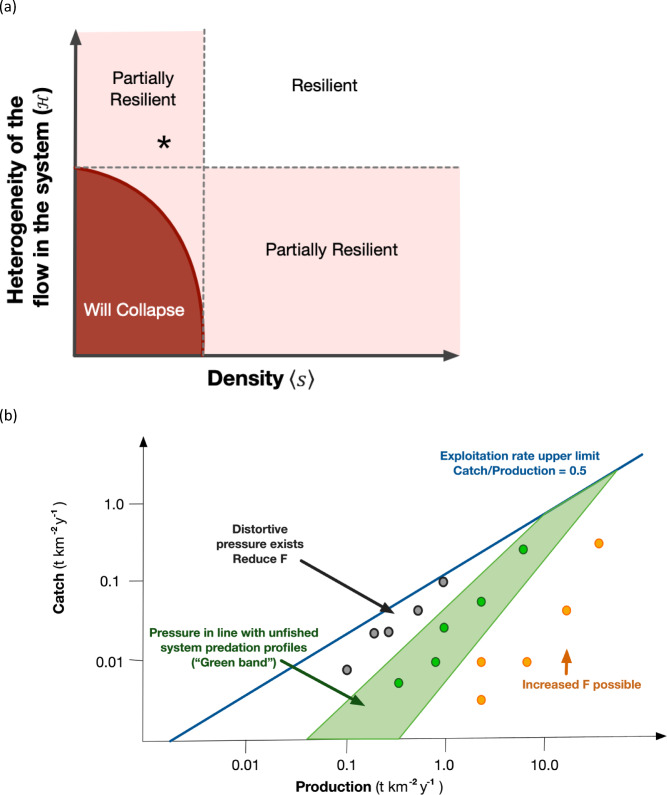
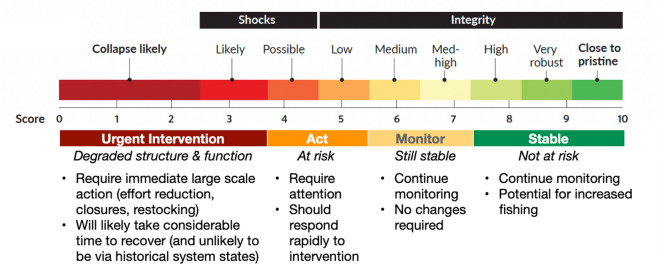
Abstract Ecosystem structure and function are seldom represented in ecological indicators used for resource management and conservation, despite their central position in stated objectives of international agreements and national policy on maintaining and conserving global ecosystems. Network theory provides capacity to change this situation. Inspired by the use of composite indicators in emergency warning, planning systems and in network analyses in many other applications, we show that a small suite of network-based indicators can provide a practical basis for measuring ecosystem structure in fisheries management. We suggest an Ecosystem Traits Index (ETI) that provides a rating of the combined ecosystem state and structural integrity. This index combines information captured by: the Hub index, which identifies species critical to system function; Gao’s resilience score, which provides a measure of system resilience due to the density of connections and flow patterns in the ecosystem’s food web; and the “Green Band” index (which measures pressure on ecosystem structure due to the mortality from human activities such as harvesting). Applying these indices to marine ecosystems of very different types showed that the combination of indicators is informative in each case and that each ecosystem’s unique state results from fishing pressure, environmental change, and inherent ecosystem structural robustness. Simulation-based tests demonstrated the indicators rapidly respond to, and consistently reflect, ecosystem state changes across marine ecosystem types, though they cannot distinguish the effects of individual stressors such as fishing mortality, habitat modification, climate or other environmental changes. We have focused on fisheries because fishery indicators should, in principle, have utility across any form of marine ecosystem pressure.
Overview
CoChat Summary
TL;DR
The paper proposes an Ecosystem Traits Index (ETI) that combines the Hub index, Gao’s resilience score, and the Green Band into a composite rating of marine ecosystem structure and integrity for resource management. Model-based tests across contrasting marine ecosystems show the ETI responds to fishing and climate pressures, but it cannot distinguish among individual stressors.
Key findings
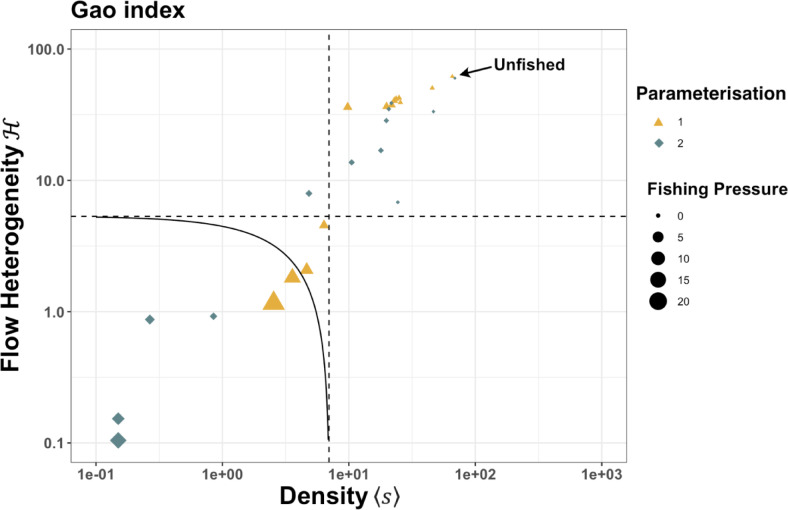
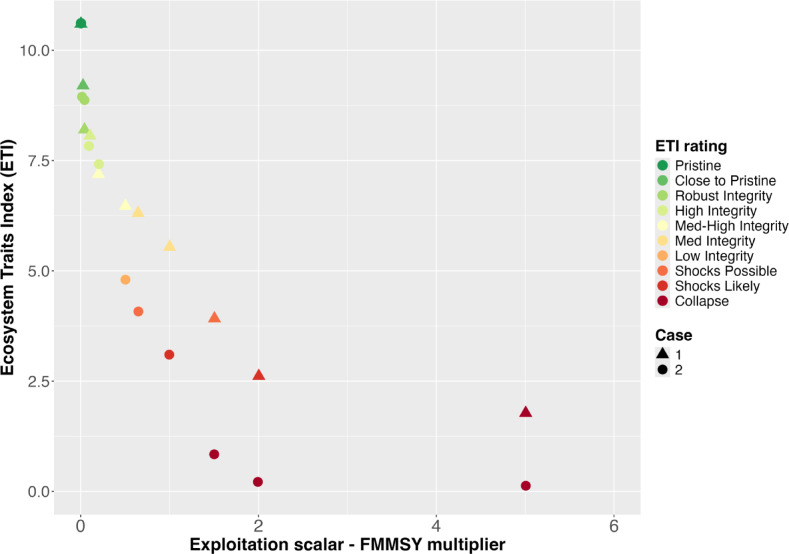
- The ETI and its components were sensitive and responsive to ecosystem state changes across marine ecosystem types, with the southeast Australian system rated resilient below 1.5×FMMSY and moving toward collapse past 2–5×FMMSY; parameterisation 2 reached degraded ETI values faster, dropping to low integrity at half FMMSY while parameterisation 1 retained medium or higher integrity until fishing pressure exceeded FMMSY.
- Historical ETI results differed by system: southeast Australia dropped from high integrity in the 1980s to medium and low integrity before 2020; Kerala varied from medium to low integrity before 2001 then suddenly dropped to “shocks possible”; eastern Bering Sea almost always had medium–high integrity; Chile started at “shocks possible” and dropped to “shocks likely” post-2013.
- Under future climate and marine heatwave scenarios, every region showed a 5–350% increase in the number of species above the Green Band, and ETI declined through time under climate change, decreasing further with marine heatwaves; reducing fishing pressure raised ETI slowly and steadily as systems rebuilt.
- The eastern Bering Sea had the highest proportion of groups below the Green Band at 50%, compared with 26–40% in the other three systems, yet non-trivial numbers of species groups remained above the Green Band, over half of them target species.
Methods
- The ETI combines three network-based indicators: the Hub index for topology and critical species, Gao’s resilience score for structural resilience, and the Green Band for distortive fishing mortality pressure; the final ETI is calculated from species classifications by Green Band–relative biomass combinations, class weightings, and Gao’s resilience score, with 10 possible qualitative ratings.
- The index was tested using model-generated data from Ecopath with Ecosim models: Test 1 varied fishing pressure in two parameterisations of a southeast Australia model; Test 2 used historical time series for Kerala, eastern Bering Sea, southeast Australia, and north-central Chile through 2017–2018; Test 3 applied CMIP6 SSP3-7.0 climate projections, marine heatwave scenarios, and a 50% reduction in commercial fishing pressure.
- Analyses assessed responsiveness, sensitivity, and specificity by comparing indicator magnitude and patterns across simulations and ecosystems, including whether indicators responded to degradation and recovery under fishing and climate drivers.
Limitations
- The paper states the indicators cannot distinguish the effects of individual stressors such as fishing mortality, habitat modification, climate, or other environmental changes, and that indicators alone do not allow attribution of specific changes to specific drivers in most cases.
- The ETI was developed and applied using model-derived data; calculating it typically relies on ecosystem model output to generate the unfished profile for the Green Band, because for most ecosystems there is no data on the unfished ecosystem, though observational data could in principle be used if suitably long time series were available.
- The paper notes the exact resilience scores used in the ETI are somewhat arbitrary and could be more or less precautionary, and that the indicators are neither lagging nor leading indicators—they reflect change but cannot anticipate it.
Model-written summary. Check it against the paper before relying on it.
Integrity signals
Registry
Cites
Statistics
Figures
Verification
Claims the paper makes
0 Valid · 3 Not valid · 45 Not checked · 124 Own results and interpretations
A result the paper states — it cites no source for it, so there is none to check. The quote shows it is in the paper.
In the paper
“though they cannot distinguish the effects of individual stressors such as fishing mortality, habitat modification, climate or other environmental changes.”
§ The ecosystem traits index is proposed as a composite index of ecosystem robustness for use in marine resource management > Abstract
plain- Asserted: passes — The authors put it forward as true.
- Checkable: passes — It can be checked against evidence.
- Load-bearing: passes — The paper’s conclusions depend on it.
- Based: passes — The paper gives a reason why it holds.
A result the paper reports from its own data — it cites no other source for it, so there is none to check. The quote shows it is in the paper.
In the paper
“Applying these indices to marine ecosystems of very different types showed that the combination of indicators is informative in each case”
§ The ecosystem traits index is proposed as a composite index of ecosystem robustness for use in marine resource management > Abstract
plainstates an association- Asserted: passes — The authors put it forward as true.
- Checkable: passes — It can be checked against evidence.
- Load-bearing: passes — The paper’s conclusions depend on it.
- Based: passes — The paper gives a reason why it holds.
A result the paper reports from its own data — it cites no other source for it, so there is none to check. The quote shows it is in the paper.
In the paper
“The Chilean result was not as positive, starting with “shocks possible” initially and dropping to “shocks likely” post 2013 (Figure S3, Table S11).”
§ The ecosystem traits index is proposed as a composite index of ecosystem robustness for use in marine resource management > Results > Test 2: Historical time series of ecosystem state
plainSingle case- Asserted: passes — The authors put it forward as true.
- Checkable: passes — It can be checked against evidence.
- Load-bearing: unclear — It is unclear whether the paper’s conclusions depend on it.
- Based: passes — The paper gives a reason why it holds.
A result the paper reports from its own data — it cites no other source for it, so there is none to check. The quote shows it is in the paper.
In the paper
“For both parameterisations of the model, once pressure exceeds 1.5xFMMSY the value for system density is more likely to be below the threshold for a partially resilient state (Fig. 3).”
§ The ecosystem traits index is proposed as a composite index of ecosystem robustness for use in marine resource management > Results > Test 1: Varying fishing pressure
hedgedstates an association- Asserted: passes — The authors put it forward as true.
- Checkable: passes — It can be checked against evidence.
- Load-bearing: passes — The paper’s conclusions depend on it.
- Based: passes — The paper gives a reason why it holds.
A result the paper reports from its own data — it cites no other source for it, so there is none to check. The quote shows it is in the paper.
In the paper
“Squid, sharks and predatory fish (such as arrowtooth flounder for the East Bering Sea, or Hake in the Chilean model) are identified as hub species across the various modelled systems.”
§ The ecosystem traits index is proposed as a composite index of ecosystem robustness for use in marine resource management > Results > Test 2: Historical time series of ecosystem state
plain- Asserted: passes — The authors put it forward as true.
- Checkable: passes — It can be checked against evidence.
- Load-bearing: unclear — It is unclear whether the paper’s conclusions depend on it.
- Based: passes — The paper gives a reason why it holds.
70 more claims
Create a free account to see all 172 claims and to verify the 105 references still open.
- It may state two separate claims as one. 65
- Probably not a substantial claim. 45
Self-check
Percentages, sums and reported differences re-computed from the paper’s own numbers.
Each contradiction between two passages listed here was confirmed by an independent check.
Rated minor: it would not touch a result — a value no result rests on, a p-value that stays on the same side of the significance level, or a conflict that is clerical, resolved elsewhere in the paper, or outside its own findings.
In the paper
§ The ecosystem traits index is proposed as a composite index of ecosystem robustness for use in marine resource management > Discussion
“This investment is likely why so many species groups in that system are rated as “light” or “acceptable” in the Green Band analyses (Table S9).”
§ The ecosystem traits index is proposed as a composite index of ecosystem robustness for use in marine resource management > Results > Test 2: Historical time series of ecosystem state
“The Hub species for each case study (Table S9) highlight the importance of omnivorous predators.”
Rated minor: it would not touch a result — a value no result rests on, a p-value that stays on the same side of the significance level, or a conflict that is clerical, resolved elsewhere in the paper, or outside its own findings.
In the paper
§ The ecosystem traits index is proposed as a composite index of ecosystem robustness for use in marine resource management > Methods > Composite Index—ETI
“κj is the combination score (a scalar of how healthy that combination of distortive pressure and relative biomass is, provided for reference in Table S3)”
§ The ecosystem traits index is proposed as a composite index of ecosystem robustness for use in marine resource management > Methods > Composite Index—ETI
“ETI=R\left(\sum_{j}{W}_{j}\left[\sum_{i}\frac{{\kappa }_{i}{N}_{i,j}}{{N}_{j}}\right]\right)”
Rated minor: it would not touch a result — a value no result rests on, a p-value that stays on the same side of the significance level, or a conflict that is clerical, resolved elsewhere in the paper, or outside its own findings.
In the paper
§ The ecosystem traits index is proposed as a composite index of ecosystem robustness for use in marine resource management > Methods > Distortive pressure—the green band
“Testing described in Fulton et al.40 indicates that method is reasonably robust to taxonomic resolution”
§ The ecosystem traits index is proposed as a composite index of ecosystem robustness for use in marine resource management > References
“40. Dunne, J. A., Williams, R. J. & Martinez, N. D. Network structure and robustness of marine food webs.”
Citations
Cites
The renormalization group: Critical phenomena and the Kondo problem
Wilson, K. G. (1975) · Reviews of Modern Physics · doi:10.1103/revmodphys.47.773 · Cited by 4,522
Ecosystem-Based Fishery Management
Pikitch, E. K., Santora, C., Babcock, E. A., Bakun, A., Bonfil, R., Conover, D. O., Dayton, P., Doukakis, P., Fluharty, D., Heneman, B., et al. (2004) · Science · doi:10.1126/science.1098222 · Cited by 2,312
Self-citationUniversal resilience patterns in complex networks
Gao, J., Barzel, B., & Barabási, A.-L. (2016) · Nature · doi:10.1038/nature16948 · Cited by 1,217
Ecopath, Ecosim, and Ecospace as tools for evaluating ecosystem impact of fisheries
Pauly, D. (2000) · ICES Journal of Marine Science · doi:10.1006/jmsc.2000.0726 · Cited by 1,016
The importance of structural complexity in coral reef ecosystems
Graham, N. A. J., & Nash, K. L. (2013) · Coral Reefs · doi:10.1007/s00338-012-0984-y · Cited by 957
Categorizing and Naming Marine Heatwaves
CSIRO, Hobday, A., Oliver, E., Sen Gupta, A., Benthuysen, J., Burrows, M., Donat, M., Holbrook, N., Moore, P., Thomsen, M., et al. (2018) · Oceanography · doi:10.5670/oceanog.2018.205 · Cited by 809
A global assessment of marine heatwaves and their drivers
Holbrook, N. J., Scannell, H. A., Sen Gupta, A., Benthuysen, J. A., Feng, M., Oliver, E. C. J., Alexander, L. V., Burrows, M. T., Donat, M. G., Hobday, A. J., et al. (2019) · Nature Communications · doi:10.1038/s41467-019-10206-z · Cited by 772
Oliver, E. C. J., Benthuysen, J. A., Darmaraki, S., Donat, M. G., Hobday, A. J., Holbrook, N. J., Schlegel, R. W., & Sen Gupta, A. (2021) · Annual Review of Marine Science · doi:10.1146/annurev-marine-032720-095144 · Cited by 706
Projected Marine Heatwaves in the 21st Century and the Potential for Ecological Impact
Oliver, E. C. J., Burrows, M. T., Donat, M. G., Sen Gupta, A., Alexander, L. V., Perkins-Kirkpatrick, S. E., Benthuysen, J. A., Hobday, A. J., Holbrook, N. J., Moore, P. J., et al. (2019) · Frontiers in Marine Science · doi:10.3389/fmars.2019.00734 · Cited by 679
Ulanowicz, R. E. (1986) · Springer eBooks · doi:10.1007/978-1-4612-4916-0 · Cited by 659
Abundance of common species, not species richness, drives delivery of a real‐world ecosystem service
Winfree, R., W. Fox, J., Williams, N. M., Reilly, J. R., & Cariveau, D. P. (2015) · Ecology Letters · doi:10.1111/ele.12424 · Cited by 654
Identification of global marine hotspots: sentinels for change and vanguards for adaptation action
Hobday, A. J., & Pecl, G. T. (2014) · Reviews in Fish Biology and Fisheries · doi:10.1007/s11160-013-9326-6 · Cited by 648
Best practice in Ecopath with Ecosim food-web models for ecosystem-based management
Heymans, J. J., Coll, M., Link, J. S., Mackinson, S., Steenbeek, J., Walters, C., & Christensen, V. (2016) · Ecological Modelling · doi:10.1016/j.ecolmodel.2015.12.007 · Cited by 529
Integrating food web diversity, structure and stability
Rooney, N., & McCann, K. S. (2012) · Trends in Ecology & Evolution · doi:10.1016/j.tree.2011.09.001 · Cited by 505
Ecological network analysis: network construction
Fath, B. D., Scharler, U. M., Ulanowicz, R. E., & Hannon, B. (2007) · Ecological Modelling · doi:10.1016/j.ecolmodel.2007.04.029 · Cited by 442
A framework for selecting a suite of indicators for fisheries management
Rice, J. C., & Rochet, M.-J. (2005) · ICES Journal of Marine Science · doi:10.1016/j.icesjms.2005.01.003 · Cited by 441
Network structure and robustness of marine food webs
Dunne, J., Williams, R., & Martinez, N. (2004) · Marine Ecology Progress Series · doi:10.3354/meps273291 · Cited by 421
Which ecological indicators can robustly detect effects of fishing?
FULTON, E., SMITH, A., & PUNT, A. (2005) · ICES Journal of Marine Science · doi:10.1016/j.icesjms.2004.12.012 · Cited by 407
Self-citationEffect of complexity on marine ecosystem models
Fulton, E., Smith, A., & Johnson, C. (2003) · Marine Ecology Progress Series · doi:10.3354/meps253001 · Cited by 339
Self-citationPossible ecosystem impacts of applying MSY policies from single-species assessment
Walters, C. J., Christensen, V., Martell, S. J., & Kitchell, J. F. (2005) · ICES Journal of Marine Science · doi:10.1016/j.icesjms.2004.12.005 · Cited by 335
Pratchett, M. S., Hoey, A. S., Wilson, S. K., Messmer, V., & Graham, N. A. J. (2011) · Diversity · doi:10.3390/d3030424 · Cited by 314
Link, J. S. (2010) · Ecological Modelling · doi:10.1016/j.ecolmodel.2010.03.012 · Cited by 303
Translating ecosystem indicators into decision criteria
Link, J. S. (2005) · ICES Journal of Marine Science · doi:10.1016/j.icesjms.2004.12.015 · Cited by 270
Cowley, P. D. (2001) · African Zoology · doi:10.1080/15627020.2001.11657143 · Cited by 264
Characteristic Sizes of Life in the Oceans, from Bacteria to Whales*
Andersen, K. H., Berge, T., Gonçalves, R. J., Hartvig, M., Heuschele, J., Hylander, S., Jacobsen, N. S., Lindemann, C., Martens, E. A., Neuheimer, A. B., et al. (2016) · Annual Review of Marine Science · doi:10.1146/annurev-marine-122414-034144 · Cited by 254
Ecosystem Traits Linking Functional Traits to Macroecology
He, N., Liu, C., Piao, S., Sack, L., Xu, L., Luo, Y., He, J., Han, X., Zhou, G., Zhou, X., et al. (2019) · Trends in Ecology & Evolution · doi:10.1016/j.tree.2018.11.004 · Cited by 231
Biodiversity and ecosystem functioning in dynamic landscapes
Brose, U., & Hillebrand, H. (2016) · Philosophical Transactions of the Royal Society B: Biological Sciences · doi:10.1098/rstb.2015.0267 · Cited by 215
Do climate and fishing influence size-based indicators of Celtic Sea fish community structure?
Blanchard, J. L., Dulvy, N. K., Jennings, S., Ellis, J. R., Pinnegar, J. K., Tidd, A., & Kell, L. T. (2005) · ICES Journal of Marine Science · doi:10.1016/j.icesjms.2005.01.006 · Cited by 210
Plausible 2005–2050 emissions scenarios project between 2 °C and 3 °C of warming by 2100
Pielke Jr, R., Burgess, M. G., & Ritchie, J. (2022) · Environmental Research Letters · doi:10.1088/1748-9326/ac4ebf · Cited by 197
Myths that Continue to Impede Progress in Ecosystem-Based Fisheries Management
Patrick, W. S., & Link, J. S. (2015) · Fisheries · doi:10.1080/03632415.2015.1024308 · Cited by 183
Fath, B. D., Asmus, H., Asmus, R., Baird, D., Borrett, S. R., de Jonge, V. N., Ludovisi, A., Niquil, N., Scharler, U. M., Schückel, U., et al. (2019) · Ocean & Coastal Management · doi:10.1016/j.ocecoaman.2019.03.007 · Cited by 176
Fisheries productivity under progressive coral reef degradation
Rogers, A., Blanchard, J. L., & Mumby, P. J. (2018) · Journal of Applied Ecology · doi:10.1111/1365-2664.13051 · Cited by 175
Tam, J. C., Link, J. S., Rossberg, A. G., Rogers, S. I., Levin, P. S., Rochet, M.-J., Bundy, A., Belgrano, A., Libralato, S., Tomczak, M., et al. (2017) · ICES Journal of Marine Science · doi:10.1093/icesjms/fsw230 · Cited by 116
Ecological network metrics: opportunities for synthesis
Lau, M. K., Borrett, S. R., Baiser, B., Gotelli, N. J., & Ellison, A. M. (2017) · Ecosphere · doi:10.1002/ecs2.1900 · Cited by 111
Shin, Y.-J., & Shannon, L. J. (2010) · ICES Journal of Marine Science · doi:10.1093/icesjms/fsp273 · Cited by 111
Link, J. S., Yemane, D., Shannon, L. J., Coll, M., Shin, Y.-J., Hill, L., & Borges, M. D. F. (2010) · ICES Journal of Marine Science · doi:10.1093/icesjms/fsp258 · Cited by 107
Shin, Y.-J., Bundy, A., Shannon, L. J., Simier, M., Coll, M., Fulton, E. A., Link, J. S., Jouffre, D., Ojaveer, H., Mackinson, S., et al. (2010) · ICES Journal of Marine Science · doi:10.1093/icesjms/fsp287 · Cited by 107
Self-citationIPSL IPSL-CM6A-LR model output prepared for CMIP6 CMIP
Boucher, O., Denvil, S., Levavasseur, G., Cozic, A., Caubel, A., Foujols, M., Meurdesoif, Y., Cadule, P., Devilliers, M., Ghattas, J., et al. (2018) · Earth System Grid Federation · doi:10.22033/esgf/cmip6.1534 · Cited by 100
Parsing human and biophysical drivers of coral reef regimes
Jouffray, J.-B., Wedding, L. M., Norström, A. V., Donovan, M. K., Williams, G. J., Crowder, L. B., Erickson, A. L., Friedlander, A. M., Graham, N. A. J., Gove, J. M., et al. (2019) · Proceedings of the Royal Society B: Biological Sciences · doi:10.1098/rspb.2018.2544 · Cited by 86
Newman, S. J., Brown, J. I., Fairclough, D. V., Wise, B. S., Bellchambers, L. M., Molony, B. W., Lenanton, R. C. J., Jackson, G., Smith, K. A., Gaughan, D. J., et al. (2018) · Marine Policy · doi:10.1016/j.marpol.2017.10.028 · Cited by 76
Punt, A. E., MacCall, A. D., Essington, T. E., Francis, T. B., Hurtado-Ferro, F., Johnson, K. F., Kaplan, I. C., Koehn, L. E., Levin, P. S., & Sydeman, W. J. (2016) · Ecological Modelling · doi:10.1016/j.ecolmodel.2016.06.004 · Cited by 74
Ramírez-Monsalve, P., Raakjær, J., Nielsen, K. N., Santiago, J. L., Ballesteros, M., Laksá, U., & Degnbol, P. (2016) · Marine Policy · doi:10.1016/j.marpol.2015.12.030 · Cited by 72
Assessing marine ecosystem condition: A review to support indicator choice and framework development
Smit, K. P., Bernard, A. T. F., Lombard, A. T., & Sink, K. J. (2021) · Ecological Indicators · doi:10.1016/j.ecolind.2020.107148 · Cited by 65
Shin, Y.-J., Houle, J. E., Akoglu, E., Blanchard, J. L., Bundy, A., Coll, M., Demarcq, H., Fu, C., Fulton, E. A., Heymans, J. J., et al. (2018) · Ecological Indicators · doi:10.1016/j.ecolind.2018.01.010 · Cited by 64
Self-citationThe good(ish), the bad, and the ugly: a tripartite classification of ecosystem trends
Bundy, A., Shannon, L. J., Rochet, M.-J., Neira, S., Shin, Y.-J., Hill, L., & Aydin, K. (2010) · ICES Journal of Marine Science · doi:10.1093/icesjms/fsp283 · Cited by 62
Quantifying Patterns of Change in Marine Ecosystem Response to Multiple Pressures
Large, S. I., Fay, G., Friedland, K. D., & Link, J. S. (2015) · PLOS ONE · doi:10.1371/journal.pone.0119922 · Cited by 58
State-of-the-art and challenges in global grassland degradation studies
Zhang, M., Sun, J., Wang, Y., Li, Y., & Duo, J. (2024) · Geography and sustainability · doi:10.1016/j.geosus.2024.08.008 · Cited by 54
New trophic indicators and target values for an ecosystem-based management of fisheries
Bourdaud, P., Gascuel, D., Bentorcha, A., & Brind’Amour, A. (2016) · Ecological Indicators · doi:10.1016/j.ecolind.2015.10.010 · Cited by 53
Regime shifts in marine communities: a complex systems perspective on food web dynamics
Yletyinen, J., Bodin, Ö., Weigel, B., Nordström, M. C., Bonsdorff, E., & Blenckner, T. (2016) · Proceedings of the Royal Society B: Biological Sciences · doi:10.1098/rspb.2015.2569 · Cited by 52
McArthur Forest Fire Danger Index and the Canadian Forest Fire Weather Index
Dowdy, A. J., Mills, G. A., Finkele, K., & de Groot, W. J. (n.d.) · Cited by 52
Shannon, L. J., Coll, M., Yemane, D., Jouffre, D., Neira, S., Bertrand, A., Diaz, E., & Shin, Y.-J. (2010) · ICES Journal of Marine Science · doi:10.1093/icesjms/fsp270 · Cited by 51
NOAA-GFDL GFDL-ESM4 model output prepared for CMIP6 ScenarioMIP
John, J. G., Blanton, C., McHugh, C. E., Radhakrishnan, A., Rand, K., Vahlenkamp, H., Wilson, C., Zadeh, N., Dunne, J. P. P., Dussin, R., et al. (2018) · Earth System Grid Federation · doi:10.22033/esgf/cmip6.1414 · Cited by 48
Emergent Properties Delineate Marine Ecosystem Perturbation and Recovery
Link, J. S., Pranovi, F., Libralato, S., Coll, M., Christensen, V., Solidoro, C., & Fulton, E. A. (2015) · Trends in Ecology & Evolution · doi:10.1016/j.tree.2015.08.011 · Cited by 47
Self-citationMaureaud, A., Andersen, K. H., Zhang, L., & Lindegren, M. (2020) · Journal of Animal Ecology · doi:10.1111/1365-2656.13207 · Cited by 42
Sustainable reference points for multispecies coral reef fisheries
Zamborain‐Mason, J., Cinner, J. E., MacNeil, M. A., Graham, N. A. J., Hoey, A. S., Beger, M., Brooks, A. J., Booth, D. J., Edgar, G. J., Feary, D. A., et al. (2023) · Nature Communications · doi:10.1038/s41467-023-41040-z · Cited by 41
Evaluating link criticality of road network based on the concept of macroscopic fundamental diagram
Kim, S., & Yeo, H. (2017) · Transportmetrica A: Transport Science · doi:10.1080/23249935.2016.1231231 · Cited by 41
Shifting baselines and deciding on the desirable form of multispecies maximum sustainable yield
Fulton, E. A., Sainsbury, K., Noranarttragoon, P., Leadbitter, D., Staples, D. J., Porobic, J., Ye, Y., Phoonsawat, R., & Kulanujaree, N. (2022) · ICES Journal of Marine Science · doi:10.1093/icesjms/fsac150 · Cited by 40
Self-citationGaichas, S. K., Seagraves, R. J., Coakley, J. M., DePiper, G. S., Guida, V. G., Hare, J. A., Rago, P. J., & Wilberg, M. J. (2016) · Frontiers in Marine Science · doi:10.3389/fmars.2016.00105 · Cited by 39
Role of trophic models and indicators in current marine fisheries management
Longo, C., Hornborg, S., Bartolino, V, Tomczak, M., Ciannelli, L., Libralato, S., & Belgrano, A. (2015) · Marine Ecology Progress Series · doi:10.3354/meps11502 · Cited by 35
de Jonge, V. N., & Schückel, U. (2021) · Ocean & Coastal Management · doi:10.1016/j.ocecoaman.2021.105582 · Cited by 32
Was overfishing of predatory fish responsible for a lobster-induced regime shift in the Benguela?
Blamey, L. K., Plagányi, É. E., & Branch, G. M. (2014) · Ecological Modelling · doi:10.1016/j.ecolmodel.2013.11.004 · Cited by 31
Rocchi, M., Scotti, M., Micheli, F., & Bodini, A. (2017) · Journal of Marine Systems · doi:10.1016/j.jmarsys.2016.10.003 · Cited by 30
Fu, C., Xu, Y., Grüss, A., Bundy, A., Shannon, L., Heymans, J. J., Halouani, G., Akoglu, E., Lynam, C. P., Coll, M., et al. (2020) · ICES Journal of Marine Science · doi:10.1093/icesjms/fsz182 · Cited by 28
Self-citationAn indicator-based approach for assessing marine ecosystem resilience
Flensborg, L. C., Maureaud, A. A., Bravo, D. N., & Lindegren, M. (2023) · ICES Journal of Marine Science · doi:10.1093/icesjms/fsad077 · Cited by 27
Criticality analysis of Internet infrastructure
Yan, G., Eidenbenz, S., Thulasidasan, S., Datta, P., & Ramaswamy, V. (2010) · Computer Networks · doi:10.1016/j.comnet.2009.11.002 · Cited by 22
A Criticality-based Approach for the Analysis of Smart Grids
Katina, P. F., Keating, C. B., Zio, E., & Gheorghe, A. V. (2016) · Technology and Economics of Smart Grids and Sustainable Energy · doi:10.1007/s40866-016-0013-2 · Cited by 20
Detection of fishing pressure using ecological network indicators derived from ecosystem models
Ito, M., Halouani, G., Cresson, P., Giraldo, C., & Girardin, R. (2023) · Ecological Indicators · doi:10.1016/j.ecolind.2023.110011 · Cited by 15
Status and potential of ecosystem approach to fisheries management (EAFM) in Bangladesh
Islam, M. M., Nahiduzzaman, M., Acosta, R., Mome, M. A., & Wahab, M. A. (2022) · Ocean & Coastal Management · doi:10.1016/j.ocecoaman.2022.106068 · Cited by 12
Food web structure, the hub index and identifying species of ecological significance
Fulton, E. A., & Sainsbury, K. (2024) · Ecological Indicators · doi:10.1016/j.ecolind.2024.112378 · Cited by 10
Self-citationRelating food web structure to resilience, keystone status and uncertainty in ecological responses
Condie, S. A., Johnson, P., Fulton, E. A., & Bulman, C. M. (2014) · Ecosphere · doi:10.1890/es14-00068.1 · Cited by 6
Self-citation“The Green Band”: Using Production and Catch to Judge Distortive Pressure on an Ecosystem
Fulton, E. A., Sainsbury, K., Bulman, C., Novaglio, C., Porobic, J., Hayes, D., van Putten, E. I., Dutra, L. X. C., Thomas, L., Norris, W., et al. (2025) · doi:10.1101/2025.06.09.658403 · Cited by 3
Self-citation(2017) · Research Repository (Delft University of Technology)
Network Criticality Analysis for Finite Sized Wireless Sensor Networks
Dhuli, S., & Singh, Y. N. (2014) · arXiv · doi:10.48550/arxiv.1412.2934
Research works printed but not linked: 4
- García, S. M., Zerbi, A., Aliaume, C., et al. The ecosystem approach to fisheries: issues, terminology, principles, institutional foundations, implementation and outlook. (FAO, Ed.). (Food and Agriculture Organization of the United Nations: Rome, 2003)
- Newman, M. E. J. et al. (eds) The Structure and Dynamics of Networks (Princeton, 2006).
- Heath, M., Law, R. & Searle, K. Scoping the background information for an ecosystem approach to fisheries in Scottish waters: Review of predator-prey interactions with fisheries, and balanced harvesting. A study commissioned by Fisheries Innovation Scotland (FIS) (2017). http://www.fiscot.org/
- Fulton, E. A. et al. Benchmarks for Ecosystem Assessment: Indicators and Guidelines for Practical Ecosystem Based Fishery Management (EBFM) (CSIRO, 2021).
Cited by
Stress and resilience in northern European marine ecosystems
Llope, M., Blenckner, T., Vasilakopoulos, P., McGinty, N., Lynam, C. P., Hélaouët, P., Möllmann, C., Frelat, R., Durant, J. M., Stige, L. C., et al. (2026) · Proceedings of the National Academy of Sciences · doi:10.1073/pnas.2527939123 · Cited by 4
Indikator Komposit Potensi Wilayah Untuk Investasi Sektor Perikanan
Wilianto, A., Mulatsih, S., & Wisudo, S. H. (2025) · Jurnal Kebijakan Sosial Ekonomi Kelautan dan Perikanan · doi:10.15578/jksekp.v15i2.15953 · Cited by 1
Grüss, A., Datta, S., McGregor, V., Holmes, S. J., Davis, J. P., Fulton, E. A., Plagányi, É. E., Sainsbury, K. J., Dolder, P. J., Parsa, M., et al. (2026) · Fisheries Research · doi:10.1016/j.fishres.2026.107841
Self-citationDay, S., & Wentworth, J. (2026) · doi:10.58248/pn767
Metadata
- Authors
- Fulton, E. A., & Sainsbury, K.
- Affiliations
- Commonwealth Scientific and Industrial Research Organisation (AU)
- University of Tasmania (AU)
- Corresponding author
- Fulton, E. A.
- Venue
- Scientific Reports
- Published
- 2025-09-02
- Volume
- 15
- Issue
- 1
- Pages
- 32281-32281
- ISSN
- 2045-2322 (ISSN-L)
- PMC
- PMC12402227
- OpenAlex
- W4413899540
- Cited by
- 4
- References
- 71
- Citations by year
- 2026: 3 · 2025: 1
- FWCI
- 1.87
- Type
- journal article
- Language
- en
- Open access
- gold
- doi.org
- Licence
- cc-by
- creativecommons.org/licenses/by/4.0 (tdm)
- creativecommons.org/licenses/by/4.0 (vor)
- Locations
- Scientific Reports (publishedVersion, cc-by)
- Europe PMC (PubMed Central) (publishedVersion, cc-by)
- PubMed Central (publishedVersion, cc-by)
- PubMed (publishedVersion)
- DOAJ (DOAJ: Directory of Open Access Journals) (submittedVersion)
- Funders
- Lenfest Ocean Program (00030061)
- Commonwealth Scientific and Industrial Research Organisation
- Topics
- Life Sciences › Agricultural and Biological Sciences › Aquatic Science › Marine and fisheries research
- Physical Sciences › Environmental Science › Global and Planetary Change › Ecosystem dynamics and resilience
- Physical Sciences › Environmental Science › Environmental Engineering › Sustainability and Ecological Systems Analysis
- Keywords
- ecosystem robustness, food web structure, hub species, resilience, fishing pressure, fishing mortality, marine ecosystem management, fisheries management
- MeSH terms
- Animals, Conservation of Natural Resources, Fisheries, Ecosystem, Aquatic Organisms
About these checks
Registry, retraction, Cites and statistics results are computed, not judged, with one exception: a printed reference that no index lists is read once by a model before it counts as a citation error. Claims are extracted by a model and kept only when their quote appears verbatim in the text; each cited source is then checked, with a model’s help, for whether it says what the claim relies on. Those verdicts can be wrong — read the claim’s quote and the cited source before relying on one.
A language model drew the claims from the paper on 2026-11-24, under version 3 of the claim definition (model deepseek-v4.1-flash, prompt extract-v3).
A second model labelled each claim on 2026-11-24 (model jev-1.13-20260917, definition revision gold-guideline-v0.2).
Statistics and arithmetic are recomputed, not judged.
Confidence bands are shown only for fields calibrated on our annotated test set. None is calibrated yet, so no band is shown.
What counts as a claim ›How we measure confidence ›How we check this ›
Are you an author, or do you see a problem with this page? Request a review
Data sources
Bibliographic data: Semantic Scholar, OpenAlex, Crossref.
Contains information from the Semantic Scholar Academic Graph Datasets, made available under the ODC Attribution License (ODC-BY 1.0).
Semantic Scholar’s data is described in: Kinney, R., et al. (2023). The Semantic Scholar Open Data Platform. arXiv:2301.10140.
