

Gender, knowledge, and trust in artificial intelligence: A classroom-based randomized experiment.
Open accessThe DOI matches its Crossref record; 33 of the 33 references it cites were found in a registry or an index.
Abstract
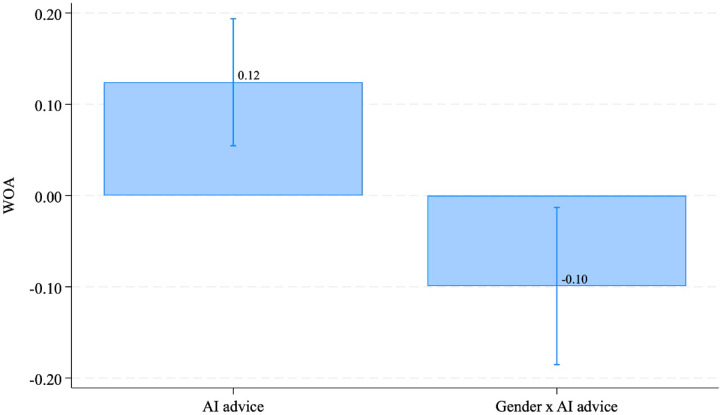
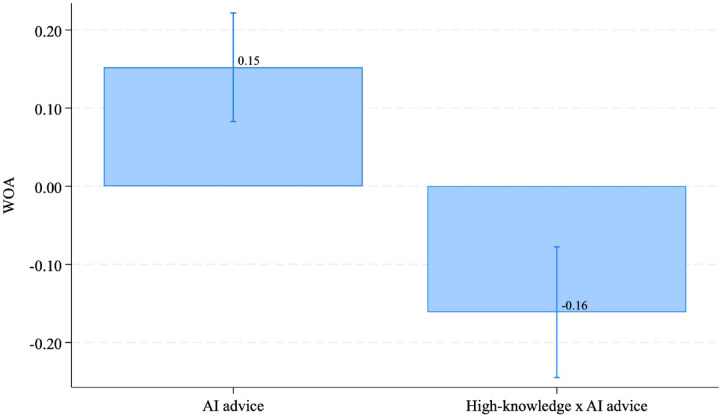
Artificial intelligence (AI) is increasingly utilized to provide real-time assistance and recommendations across a wide range of tasks in both education and workplace settings, especially since the emergence of Generative AI. However, it is unclear how users perceive the trustworthiness of these tools, particularly given the publicized "hallucinations" that they may experience. We conduct a randomized field experiment in an undergraduate course setting where students perform periodic tests using a digital platform. We analyze how subject characteristics affect trust in AI versus peers' advice. Students are randomly assigned to either a treatment group receiving advice labeled as coming from an AI system or a control group receiving advice labeled as coming from human peers. Our results are in line with recent laboratory experiments documenting algorithm appreciation. However, this effect is moderated by subject characteristics: male and high-knowledge participants place significantly less weight on AI advice compared to peer advice. Notably, these trust patterns persist regardless of advice quality (correct or incorrect). Moreover, our results remain consistent over a four-week period, including after providing performance feedback during the second week, allowing subjects to make more informed trust decisions.
Overview
The claims and statistics of this paper haven’t been checked yet.
Free: it reads the open-access text and checks the first 5 claims that cite a source we can check. Create a free account to check every claim.
Integrity signals
Registry
Cites
Statistics
Figures
Verification
Claims the paper makes
The claims and statistics of this paper haven’t been checked yet.
Free: it reads the open-access text and checks the first 5 claims that cite a source we can check. Create a free account to check every claim.
Claims other papers make about this one
Each is checked against this paper’s own text: does it say what the citing paper says it does?
The source backs part of the claim, not all of it — or backs it for a different population, condition or comparison.
In the citing paper
“Dávila et al. (2025) used advice that was correct on 50% of items and found that advice weighting varied with prior knowledge and gender, identifying both as boundary conditions in an adjacent AI-advice setting.”
From Beyond checking: verification quality, reliance calibration, and learning in generative AI-assisted higher education (2026) · cites this paper as Dávila et al., 2025
Experimental — accuracy not yet measuredThe cited source says what the claim attributes to it.
In the citing paper
“Prior/domain knowledge can shape epistemic evaluation, verification success, and, later, reliance calibration; Dávila et al. (2025) also identified gender as a moderator of advice weighting, while Chen and Lou (2026) and Hu et al. (2026) showed that proficiency, unfamiliarity, and uncertainty altered evaluation or verification demands.”
From Beyond checking: verification quality, reliance calibration, and learning in generative AI-assisted higher education (2026) · cites this paper as Dávila et al., 2025
Self-check
Percentages, sums and reported differences re-computed from the paper’s own numbers.
The self-check needs the paper’s full text.
Citations
Cites
Estimating Standard Errors in Finance Panel Data Sets: Comparing Approaches
Petersen, M. A. (2009) · Review of Financial Studies · doi:10.1093/rfs/hhn053 · Cited by 10,746
Gender Differences in Preferences
Croson, R., & Gneezy, U. (2009) · Journal of Economic Literature · doi:10.1257/jel.47.2.448 · Cited by 5,694
A Practitioner’s Guide to Cluster-Robust Inference
Colin Cameron, A., & Miller, D. L. (2015) · Journal of Human Resources · doi:10.3368/jhr.50.2.317 · Cited by 5,037 · cited 2×
“We cluster standard errors by subject and question in the multiple period analysis and use robust standard errors within the one-shot experiment 29,32 .”
Algorithm aversion: People erroneously avoid algorithms after seeing them err.
Dietvorst, B. J., Simmons, J. P., & Massey, C. (2015) · Journal of Experimental Psychology: General · doi:10.1037/xge0000033 · Cited by 3,232
Trust in Automation: Integrating Empirical Evidence on Factors That Influence Trust
Hoff, K. A., & Bashir, M. (2015) · Human Factors: The Journal of the Human Factors and Ergonomics Society · doi:10.1177/0018720814547570 · Cited by 2,817
What Do Laboratory Experiments Measuring Social Preferences Reveal About the Real World?
Levitt, S. D., & List, J. A. (2007) · Journal of Economic Perspectives · doi:10.1257/jep.21.2.153 · Cited by 2,668
“Clinical versus Actuarial Judgment.”
Dawes, R. M., Faust, D., & Meehl, P. E. (1989) · Science · doi:10.1126/science.2648573 · Cited by 2,298
Harrison, G. W., & List, J. A. (2004) · Journal of Economic Literature · doi:10.1257/0022051043004577 · Cited by 2,099
Algorithm appreciation: People prefer algorithmic to human judgment
Logg, J. M., Minson, J. A., & Moore, D. A. (2019) · Organizational Behavior and Human Decision Processes · doi:10.1016/j.obhdp.2018.12.005 · Cited by 2,061 · cited 9×
“While our study has fewer subjects than many laboratory studies (e.g., Logg et al., 2019), we have a high number of within-subject observations (3,667 across four weeks, averaging 44 per subject).”
InfluentialThe robust beauty of improper linear models in decision making.
Dawes, R. M. (1979) · American Psychologist · doi:10.1037/0003-066x.34.7.571 · Cited by 1,966
Task-Dependent Algorithm Aversion
Castelo, N., Bos, M. W., & Lehmann, D. R. (2019) · Journal of Marketing Research · doi:10.1177/0022243719851788 · Cited by 1,500
When Should You Adjust Standard Errors for Clustering?
Abadie, A., Athey, S., Imbens, G. W., & Wooldridge, J. M. (2022) · The Quarterly Journal of Economics · doi:10.1093/qje/qjac038 · Cited by 1,460
Task-Dependent Algorithm Aversion
Castelo, N., Bos, M. W., Bos, M. W., Lehmann, D. R., & Lehmann, D. R. (2019) · Springer eBooks · doi:10.1007/978-3-031-88067-4_21 · Cited by 1,441
In AI we trust? Perceptions about automated decision-making by artificial intelligence
Araujo, T., Helberger, N., Kruikemeier, S., & de Vreese, C. H. (2020) · AI & SOCIETY · doi:10.1007/s00146-019-00931-w · Cited by 1,038
A systematic review of algorithm aversion in augmented decision making
Burton, J. W., Stein, M., & Jensen, T. B. (2020) · Journal of Behavioral Decision Making · doi:10.1002/bdm.2155 · Cited by 814
Gender and Culture: International Experimental Evidence from Trust Games
Croson, R., & Buchan, N. (1999) · American Economic Review · doi:10.1257/aer.89.2.386 · Cited by 624
What influences algorithmic decision-making? A systematic literature review on algorithm aversion
Mahmud, H., Islam, A. K. M. N., Ahmed, S. I., & Smolander, K. (2022) · Technological Forecasting and Social Change · doi:10.1016/j.techfore.2021.121390 · Cited by 601
Trust and gender: An examination of behavior and beliefs in the Investment Game
Buchan, N. R., Croson, R. T. A., & Solnick, S. (2008) · Journal of Economic Behavior & Organization · doi:10.1016/j.jebo.2007.10.006 · Cited by 563
Trust, Confidence, and Expertise in a Judge-Advisor System
Sniezek, J. A., & Van Swol, L. M. (2001) · Organizational Behavior and Human Decision Processes · doi:10.1006/obhd.2000.2926 · Cited by 469
Understanding algorithm aversion: When is advice from automation discounted?
Prahl, A., & Van Swol, L. (2017) · Journal of Forecasting · doi:10.1002/for.2464 · Cited by 308 · cited 1×
“To explore trust differences between AI and peer advice, we focus on advice utilization, a consistently used measure of trust in behavioral studies 9,26–28 .”
My Friends, Editors, Algorithms, and I: Examining audience attitudes to news selection
Thurman, N., Moeller, J., Helberger, N., & Trilling, D. (2019) · Digital Journalism · doi:10.1080/21670811.2018.1493936 · Cited by 277
Dietvorst, B. J., & Bharti, S. (2020) · Psychological Science · doi:10.1177/0956797620948841 · Cited by 273
Factors affecting the acceptance of expert advice
van Swol, L. M., & Sniezek, J. A. (2005) · British Journal of Social Psychology · doi:10.1348/014466604x17092 · Cited by 224
Appropriate Reliance on AI Advice: Conceptualization and the Effect of Explanations
Schemmer, M., Kuehl, N., Benz, C., Bartos, A., & Satzger, G. (2023) · Proceedings of the 28th International Conference on Intelligent User Interfaces · doi:10.1145/3581641.3584066 · Cited by 208
The role of trust in information science and technology
Marsh, S., & Dibben, M. R. (2003) · Annual Review of Information Science and Technology · doi:10.1002/aris.1440370111 · Cited by 202 · cited 2×
“This suggests that advice source influences both dispositional trust (initial inclinations) and learned trust (evolved through experience), which we capture over our four-week experiment 24,25 .”
Accepting Error to Make Less Error
Einhorn, H. J. (1986) · Journal of Personality Assessment · doi:10.1207/s15327752jpa5003_8 · Cited by 179
Algorithm-Augmented Work and Domain Experience: The Countervailing Forces of Ability and Aversion
Allen, R., & Choudhury, P. (. (2022) · Organization Science · doi:10.1287/orsc.2021.1554 · Cited by 177
Humans rely more on algorithms than social influence as a task becomes more difficult
Bogert, E., Schecter, A., & Watson, R. T. (2021) · Scientific Reports · doi:10.1038/s41598-021-87480-9 · Cited by 144 · cited 6×
“We control for question easiness and question type as prior literature indicates that the nature of the task moderates trust in AI, with individuals potentially relying more on advice in tasks of higher difficulty 8 or lower subjectivity 2 .”
InfluentialExpert decision support system use, disuse, and misuse: a study using the theory of planned behavior
Workman, M. (2004) · Computers in Human Behavior · doi:10.1016/j.chb.2004.03.011 · Cited by 106
Does Aggregated Returns Disclosure Increase Portfolio Risk Taking?
Beshears, J. L., Choi, J. J., Laibson, D., & Madrian, B. C. (2016) · Review of Financial Studies · doi:10.1093/rfs/hhw086 · Cited by 87 · cited 1×
“However, previous research highlights the external validity limitations of such environments, noting that many effects documented in laboratories do not extend to real-world settings 21–23 .”
Dittrich, M. (2015) · Applied Economics · doi:10.1080/00036846.2015.1019036 · Cited by 63
Human preferences toward algorithmic advice in a word association task
Bogert, E., Lauharatanahirun, N., & Schecter, A. (2022) · Scientific Reports · doi:10.1038/s41598-022-18638-2 · Cited by 35
Quantifying machine influence over human forecasters
Abeliuk, A., Benjamin, D. M., Morstatter, F., & Galstyan, A. (2020) · Scientific Reports · doi:10.1038/s41598-020-72690-4 · Cited by 18
Cited by
Wei, J., & Shang, Y. (2026) · Frontiers in Psychology · doi:10.3389/fpsyg.2026.1965371 · Cited by 1
“Dávila et al. (2025) used advice that was correct on 50% of items and found that advice weighting varied with prior knowledge and gender, identifying both as boundary conditions in an adjacent AI-advice setting.”
Pillai, P., Saadat, S., Ward, I., Hajibandeh, S., & Hajibandeh, S. (2026) · Postgraduate Medical Journal · doi:10.1093/postmj/qgag077 · Cited by 1
Laupichler, M. C., & Rother, J. F. (2026) · SSRN Electronic Journal · doi:10.2139/ssrn.7552578
Ding, H., Shen, Y., Bo, Y., Wang, P., & Zhai, S. (2026) · Aslib Journal of Information Management · doi:10.1108/ajim-01-2026-0073
Metadata
- Authors
- Dávila, A., El Fassi, I., Oyon, D., & Rudolf, N.
- Affiliations
- University of Lausanne (CH)
- Venue
- Scientific Reports
- Published
- 2025-11-20
- Volume
- 15
- Issue
- 1
- Pages
- 41066-41066
- ISSN
- 2045-2322 (ISSN-L)
- PMC
- PMC12635179
- OpenAlex
- W4416410027
- Cited by
- 3
- References
- 32
- Citations by year
- 2026: 3
- FWCI
- 3.10
- Type
- journal article
- Language
- en
- Open access
- gold
- doi.org
- Licence
- cc-by-nc-nd
- creativecommons.org/licenses/by-nc-nd/4.0 (tdm)
- creativecommons.org/licenses/by-nc-nd/4.0 (vor)
- Locations
- Scientific Reports (publishedVersion, cc-by-nc-nd)
- Europe PMC (PubMed Central) (publishedVersion, cc-by-nc-nd)
- PubMed (publishedVersion)
- Alexandria (UniSG) (University of St.Gallen) (submittedVersion)
- DOAJ (DOAJ: Directory of Open Access Journals) (submittedVersion, cc-by-sa)
- Funders
- National Science Foundation
- Schweizerischer Nationalfonds zur Förderung der Wissenschaftlichen Forschung (220038)
- Topics
- Social Sciences › Economics, Econometrics and Finance › Economics and Econometrics › Experimental Behavioral Economics Studies
- Physical Sciences › Computer Science › Artificial Intelligence › Ethics and Social Impacts of AI
- Social Sciences › Education › Artificial Intelligence in Education
- Keywords
- trust in AI, generative AI, algorithm appreciation, gender differences, knowledge effects, peer advice, AI hallucination, algorithmic decision-making, artificial intelligence in education
- MeSH terms
- Adult, Artificial Intelligence, Female, Humans, Male, Sex Factors, Students, Knowledge, Trust, Young Adult
About these checks
Registry, retraction, Cites and statistics results are computed, not judged, with one exception: a printed reference that no index lists is read once by a model before it counts as a citation error. Claims are extracted by a model and kept only when their quote appears verbatim in the text; each cited source is then checked, with a model’s help, for whether it says what the claim relies on. Those verdicts can be wrong — read the claim’s quote and the cited source before relying on one.
Statistics and arithmetic are recomputed, not judged.
Confidence bands are shown only for fields calibrated on our annotated test set. None is calibrated yet, so no band is shown.
What counts as a claim ›How we measure confidence ›How we check this ›
Are you an author, or do you see a problem with this page? Request a review
Data sources
Bibliographic data: Semantic Scholar, OpenAlex, Crossref.
Contains information from the Semantic Scholar Academic Graph Datasets, made available under the ODC Attribution License (ODC-BY 1.0).
Semantic Scholar’s data is described in: Kinney, R., et al. (2023). The Semantic Scholar Open Data Platform. arXiv:2301.10140.
