

The DOI matches its Crossref record; 56 of the 57 references it cites were found in a registry or an index; 5 of the 19 sources its claims cite were checked for support.
Image adaptive encryption using EfficientNet B3 feature guided multi scroll chaotic map with modulo controlled pseudo parallel processing
Open accessAbstract
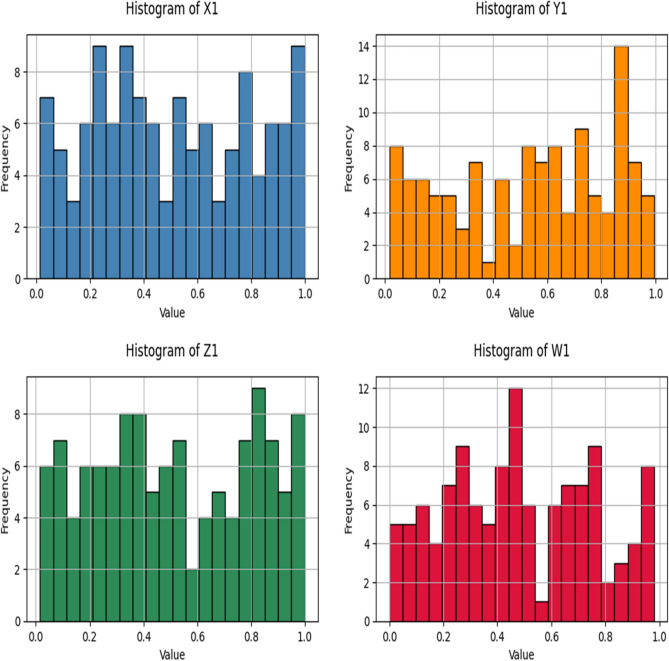
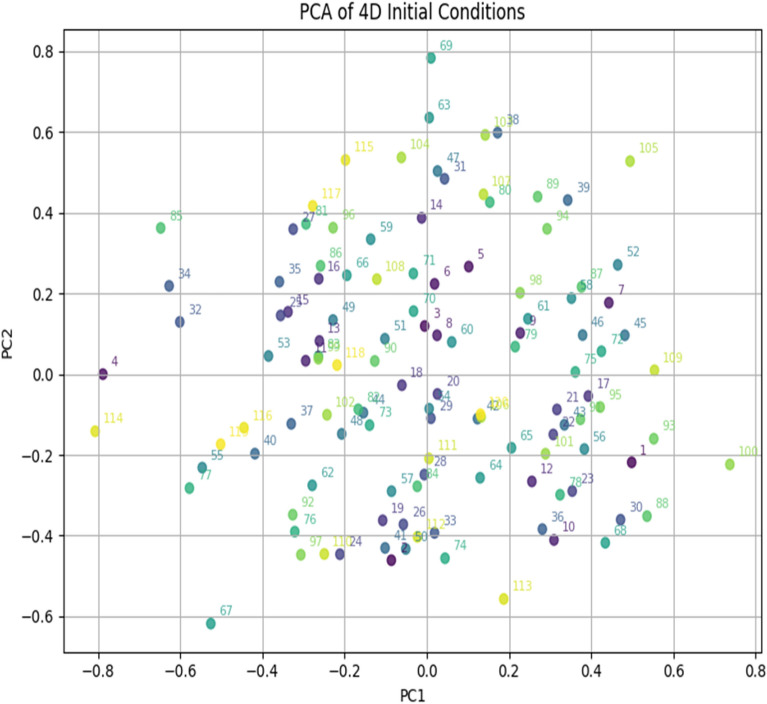
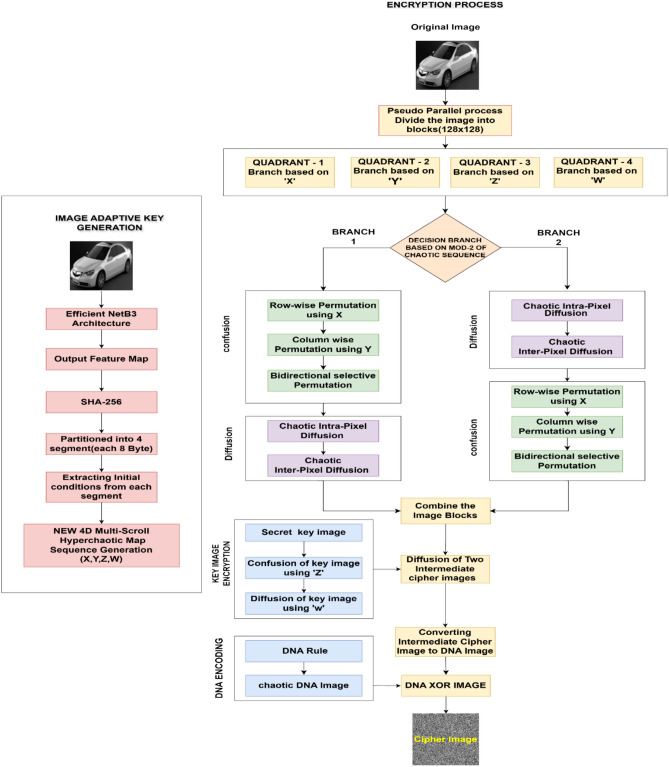
A new multistage encryption algorithm is proposed by integrating the deep neural network with a new 4D multi-scroll chaotic map to enhance the efficiency and improve the security of image transmission in the open channel. This combined network expands the key space and maintains the secrecy of the key with the multistage encryption algorithm. Initially, the image adaptive key generation process is implemented by the EfficientNet-B3 network to extract the features from the source image, which are then converted into hash values using SHA 256. The hash values are partitioned into four sections, and each section is normalized to give one distinct initial value for the generation of a multi-scroll chaotic sequence. The pseudo-parallel process routes the split source sub-image blocks (128⨯128) of plain text to branch 1 or branch 2, decided by the seed value of the chaotic sequence, increasing the high robustness against the differential and statistical attacks. Each branch contains row and column-wise permutations, bidirectional selective shuffling, and chaotic intra/inter-pixel diffusion in varying orders. The key image diffusion and dynamic DNA diffusion to the intermediate cypher image exhibit a strong avalanche effect. The simulation evaluation on the natural data set images demonstrates the large key space of 2 to the power of 674, high key sensitivity, uniform histogram with entropy value attains the critical values of 7.9, high NPCR value of 99.9%, UACI values with 33.46%,…
Overview
CoChat Summary
TL;DR
This paper proposes a multistage image encryption scheme that combines EfficientNet-B3 feature extraction with a new 4D multi-scroll chaotic map and pseudo-parallel processing. The authors report strong encryption metrics on natural images, including key space about \(2^{674}\), entropy near 7.9–8, NPCR 99.9%, and UACI 33.46%.
Key findings
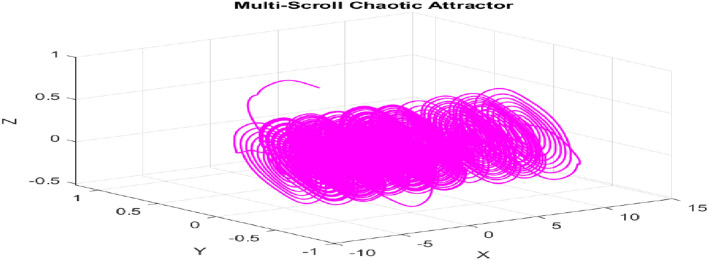
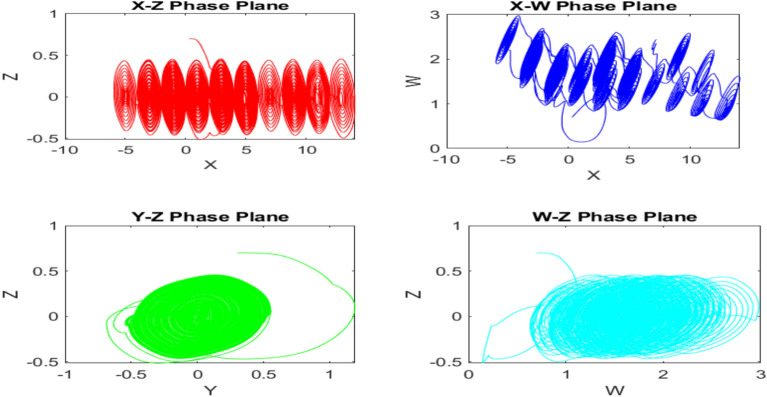
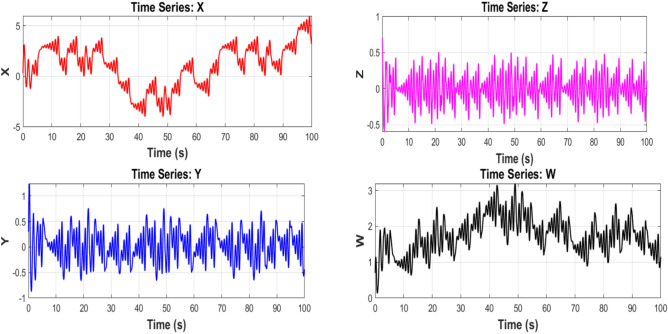
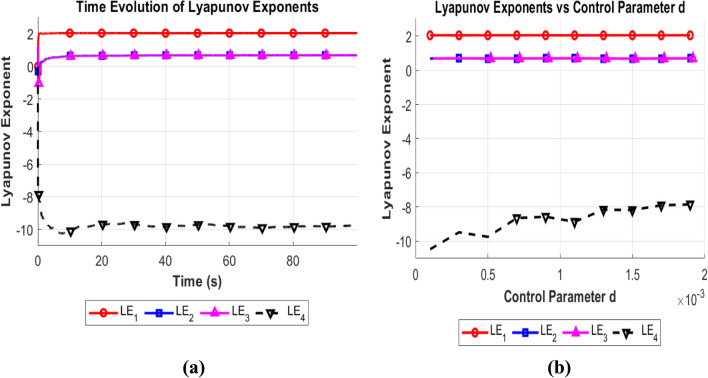
- The proposed 4D multi-scroll chaotic map is reported to have positive Lyapunov exponents, with \(LE_1=2.0440\), \(LE_2=0.6940\), \(LE_3=0.6933\), and \(LE_4=-7.8454\), and Kaplan-Yorke dimension \(D_{KY}=3.4374\), which the paper interprets as hyperchaotic.
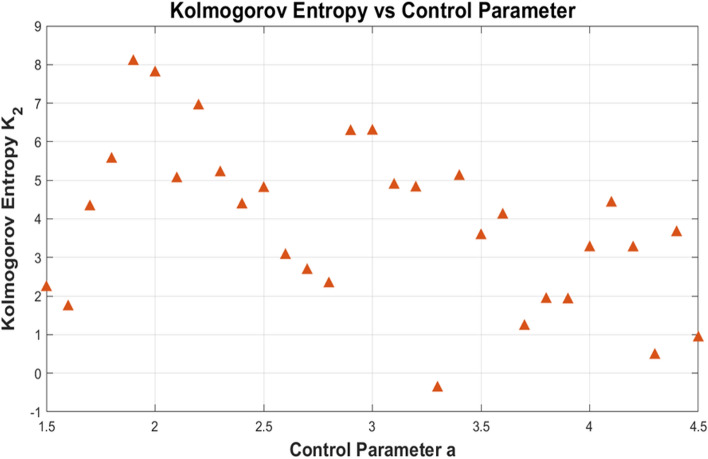
- The paper reports an average Kolmogorov entropy of 3.5403 for the chaotic map, and NIST SP 800-22 tests were passed with all sequence p-values greater than 0.01.
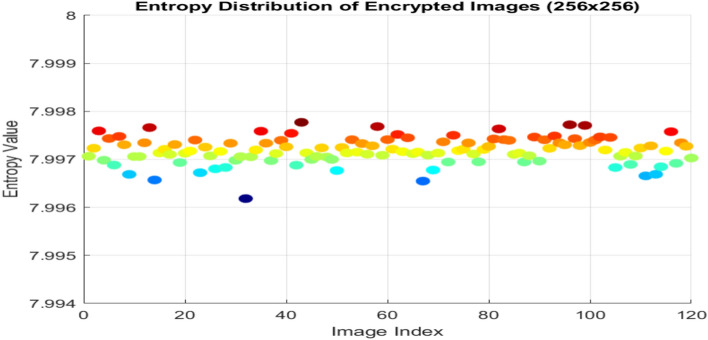
- For image security, the authors report entropy values near the critical value of 8; specifically, the abstract says entropy attains 7.9, and the text reports initial-condition entropies of 7.970, 7.975, 7.971, and 7.974 bits.
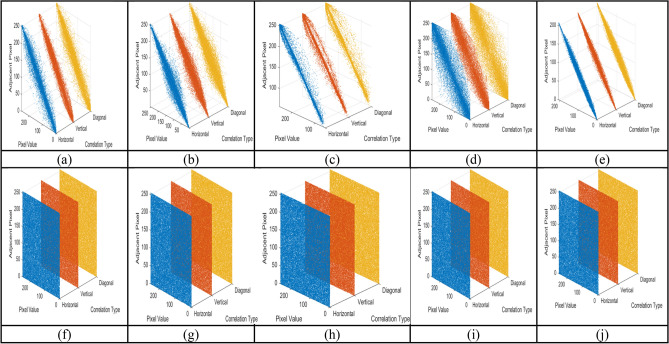
- The conclusion reports NPCR of 99.9% and UACI of 33.46%, plus near-zero horizontal, vertical, and diagonal correlation; the results section also states NPCR values were greater than 99.6% and UACI values were close to 33%.
Methods
- Design: a multistage image encryption framework with EfficientNet-B3-based adaptive key generation, SHA-256 hashing of extracted features, a new 4D multi-scroll chaotic map, pseudo-parallel branch selection, confusion-diffusion blocks, key-image diffusion, and dynamic DNA encoding.
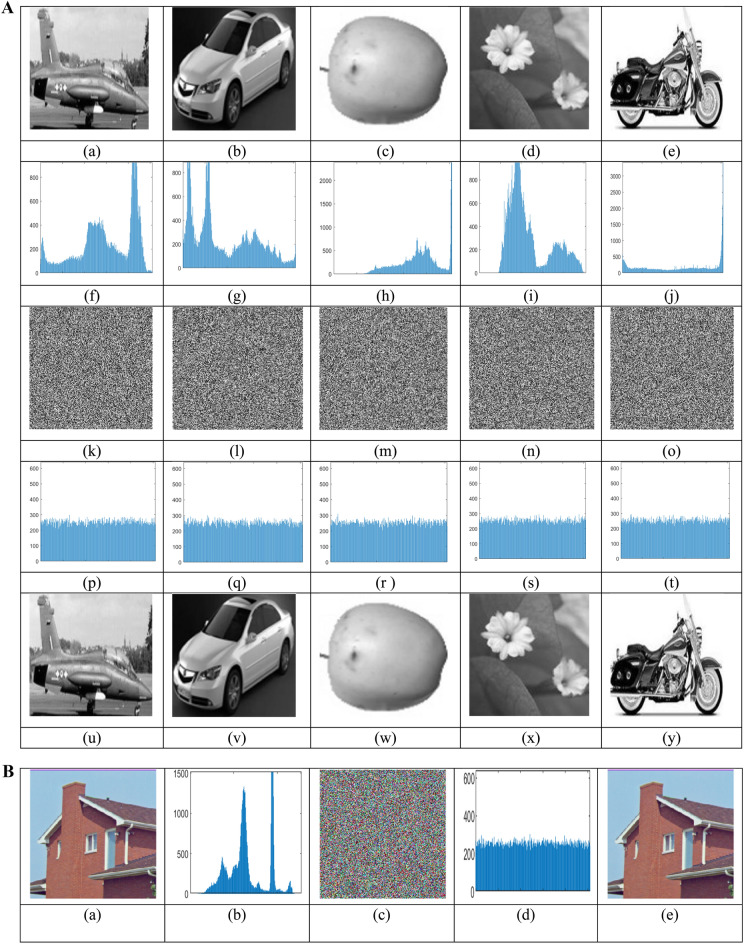
- Data/sample: experiments were run on the Natural Image dataset (6,899 images from 8 classes), with 120 sample images used for result and performance analysis; an additional tree color image from the USC-SIPI database is mentioned.
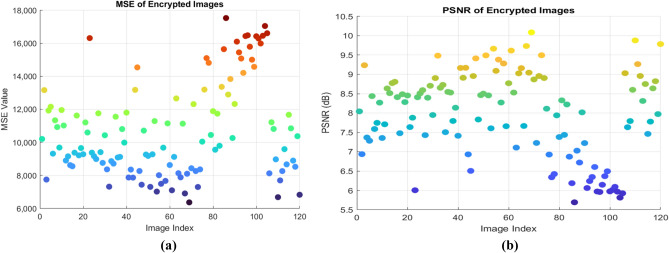
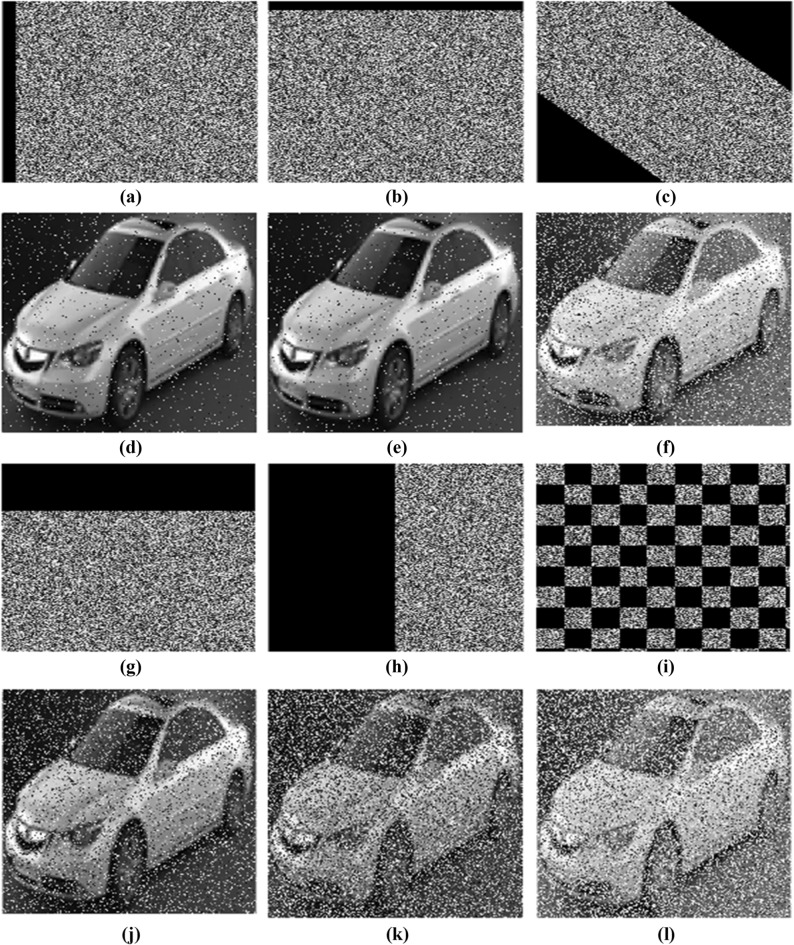
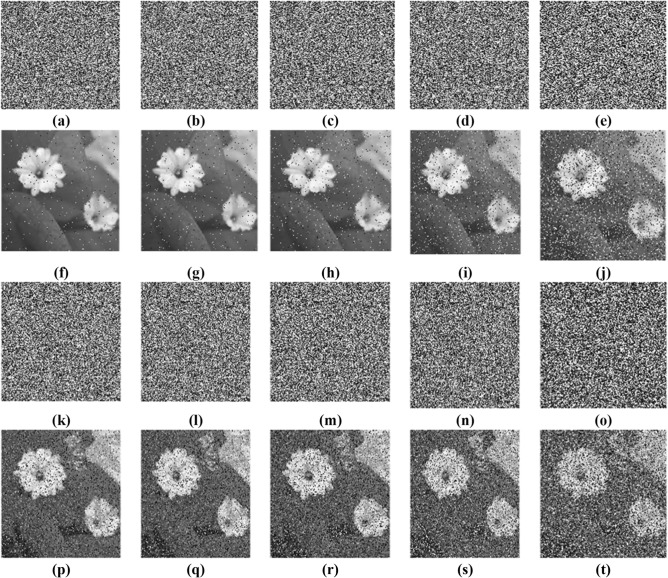
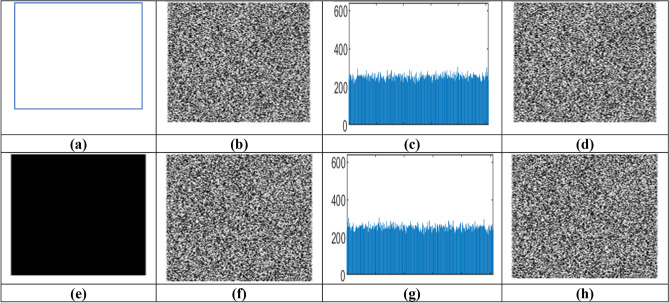
- Analysis: the paper evaluates chaotic properties (Lyapunov exponents, Kaplan-Yorke dimension, Kolmogorov entropy, NIST tests), and encryption quality using entropy, histograms, correlation coefficients, chi-square, deviation from ideality, key space, key sensitivity, MSE/PSNR, and robustness to cropping, noise, chosen-plaintext, and chosen-ciphertext attacks.
Limitations
- The paper states that some existing methods suffer from small key space or efficiency limitations, but it does not clearly state a limitation of the proposed method itself.
- Evident from the text: some reported parameter values are inconsistent across sections (for example, \(d\) is given as 0.0019, 0.0001, and 0.0011 in different places), and the exposition is fragmented with repeated or inconsistent algorithm notation; this is evident in the provided text.
- Evident from the text: the main evaluation is on 120 sampled images from a natural-image dataset, so generalization beyond those samples is not demonstrated here.
Model-written summary. Check it against the paper before relying on it.
Integrity signals
Registry
Cites
Statistics
Figures
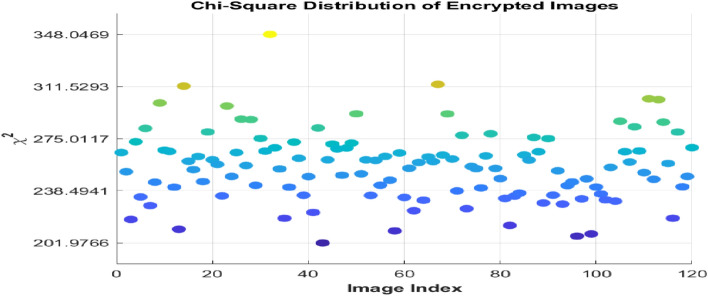
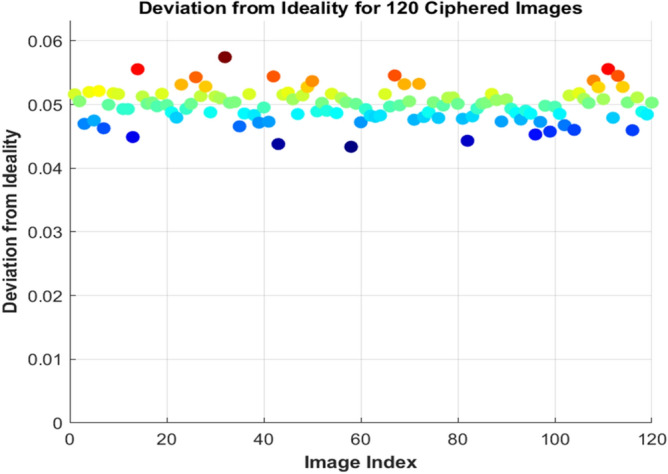
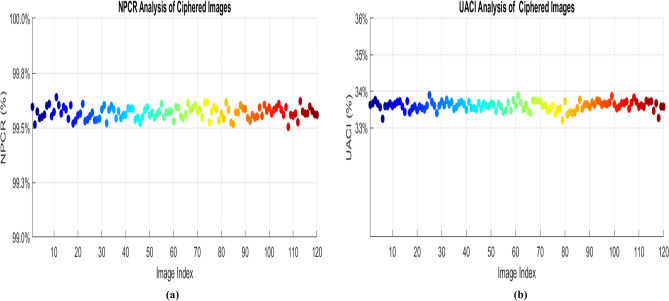
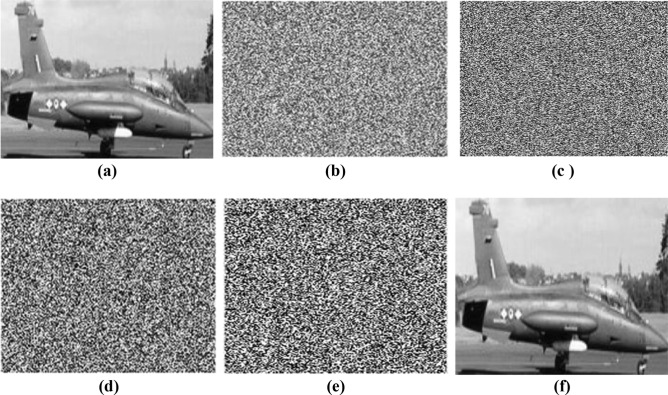
Verification
Claims the paper makes
5 Valid · 1 Not valid · 9 Not checked · 93 Own results and interpretations
A result the paper reports from its own data — it cites no other source for it, so there is none to check. The quote shows it is in the paper.
In the paper
“The resultant entropy values for initial conditions are 7.970, 7.975, 7.971, and 7.974 bits.”
§ Image adaptive encryption using EfficientNet B3 feature guided multi scroll chaotic map with modulo controlled pseudo parallel processing > Results and performance analysis > Statistical analysis
plain- Asserted: passes — The authors put it forward as true.
- Checkable: passes — It can be checked against evidence.
- Load-bearing: passes — The paper’s conclusions depend on it.
- Based: passes — The paper gives a reason why it holds.
A result the paper reports from its own data — it cites no other source for it, so there is none to check. The quote shows it is in the paper.
In the paper
“The Table 7 shows entropy values for 5 sample test images and a high degree of unpredictability for the encrypted images that are ideally near 8”
§ Image adaptive encryption using EfficientNet B3 feature guided multi scroll chaotic map with modulo controlled pseudo parallel processing > Results and performance analysis > Statistical analysis
plainn = 5- Asserted: passes — The authors put it forward as true.
- Checkable: passes — It can be checked against evidence.
- Load-bearing: passes — The paper’s conclusions depend on it.
- Based: passes — The paper gives a reason why it holds.
A result the paper reports from its own data — it cites no other source for it, so there is none to check. The quote shows it is in the paper.
In the paper
“almost zero-pixel correlation”
§ Image adaptive encryption using EfficientNet B3 feature guided multi scroll chaotic map with modulo controlled pseudo parallel processing > Abstract A new multistage encryption algorithm is proposed by integrating the deep neural network with a new 4D multi-scroll chaotic map to enhance the efficiency and improve the security of image transmission in the open channel. This combined network expands the key space and maintains the secrecy of the key with the multistage encryption algorithm. Initially, the image adaptive key generation process is implemented by the EfficientNet-B3 network to extract the features from the source image, which are then converted into hash values using SHA 256. The hash values are partitioned into four sections, and each section is normalized to give one distinct initial value for the generation of a multi-scroll chaotic sequence. The pseudo-parallel process routes the split source sub-image blocks (128⨯128) of plain text to branch 1 or branch 2, decided by the seed value of the chaotic sequence, increasing the high robustness against the differential and statistical attacks. Each branch contains row and column-wise permutations, bidirectional selective shuffling, and chaotic intra/inter-pixel diffusion in varying orders. The key image diffusion and dynamic DNA diffusion to the intermediate cypher image exhibit a strong avalanche effect. The simulation evaluation on the natural data set images demonstrates the large key space of 2 to the power of 674, high key sensitivity, uniform histogram with entropy value attains the critical values of 7.9, high NPCR value of 99.9%, UACI values with 33.46%, almost zero-pixel correlation and strong robustness to the cropping and noise attacks.
plain- Asserted: passes — The authors put it forward as true.
- Checkable: passes — It can be checked against evidence.
- Load-bearing: passes — The paper’s conclusions depend on it.
- Based: passes — The paper gives a reason why it holds.
A result the paper reports from its own data — it cites no other source for it, so there is none to check. The quote shows it is in the paper.
In the paper
“strong robustness to the cropping and noise attacks.”
§ Image adaptive encryption using EfficientNet B3 feature guided multi scroll chaotic map with modulo controlled pseudo parallel processing > Abstract A new multistage encryption algorithm is proposed by integrating the deep neural network with a new 4D multi-scroll chaotic map to enhance the efficiency and improve the security of image transmission in the open channel. This combined network expands the key space and maintains the secrecy of the key with the multistage encryption algorithm. Initially, the image adaptive key generation process is implemented by the EfficientNet-B3 network to extract the features from the source image, which are then converted into hash values using SHA 256. The hash values are partitioned into four sections, and each section is normalized to give one distinct initial value for the generation of a multi-scroll chaotic sequence. The pseudo-parallel process routes the split source sub-image blocks (128⨯128) of plain text to branch 1 or branch 2, decided by the seed value of the chaotic sequence, increasing the high robustness against the differential and statistical attacks. Each branch contains row and column-wise permutations, bidirectional selective shuffling, and chaotic intra/inter-pixel diffusion in varying orders. The key image diffusion and dynamic DNA diffusion to the intermediate cypher image exhibit a strong avalanche effect. The simulation evaluation on the natural data set images demonstrates the large key space of 2 to the power of 674, high key sensitivity, uniform histogram with entropy value attains the critical values of 7.9, high NPCR value of 99.9%, UACI values with 33.46%, almost zero-pixel correlation and strong robustness to the cropping and noise attacks.
boosted- Asserted: passes — The authors put it forward as true.
- Checkable: passes — It can be checked against evidence.
- Load-bearing: passes — The paper’s conclusions depend on it.
- Based: passes — The paper gives a reason why it holds.
A result the paper states — it cites no source for it, so there is none to check. The quote shows it is in the paper.
In the paper
“The key image diffusion and dynamic DNA diffusion to the intermediate cypher image exhibit a strong avalanche effect.”
§ Image adaptive encryption using EfficientNet B3 feature guided multi scroll chaotic map with modulo controlled pseudo parallel processing > Abstract A new multistage encryption algorithm is proposed by integrating the deep neural network with a new 4D multi-scroll chaotic map to enhance the efficiency and improve the security of image transmission in the open channel. This combined network expands the key space and maintains the secrecy of the key with the multistage encryption algorithm. Initially, the image adaptive key generation process is implemented by the EfficientNet-B3 network to extract the features from the source image, which are then converted into hash values using SHA 256. The hash values are partitioned into four sections, and each section is normalized to give one distinct initial value for the generation of a multi-scroll chaotic sequence. The pseudo-parallel process routes the split source sub-image blocks (128⨯128) of plain text to branch 1 or branch 2, decided by the seed value of the chaotic sequence, increasing the high robustness against the differential and statistical attacks. Each branch contains row and column-wise permutations, bidirectional selective shuffling, and chaotic intra/inter-pixel diffusion in varying orders. The key image diffusion and dynamic DNA diffusion to the intermediate cypher image exhibit a strong avalanche effect. The simulation evaluation on the natural data set images demonstrates the large key space of 2 to the power of 674, high key sensitivity, uniform histogram with entropy value attains the critical values of 7.9, high NPCR value of 99.9%, UACI values with 33.46%, almost zero-pixel correlation and strong robustness to the cropping and noise attacks.
boostedstates an association- Asserted: passes — The authors put it forward as true.
- Checkable: passes — It can be checked against evidence.
- Load-bearing: passes — The paper’s conclusions depend on it.
- Based: passes — The paper gives a reason why it holds.
56 more claims
Create a free account to see all 108 claims and every source verdict.
- Probably not a substantial claim. 11
- It may state two separate claims as one. 35
- The quote only partly states this claim. 6
Self-check
Percentages, sums and reported differences re-computed from the paper’s own numbers.
Each contradiction between two passages listed here was confirmed by an independent check.
Rated major: it would touch a result — a value a result rests on, reported and recomputed p-values on opposite sides of the significance level, two passages that conflict with no sign which is right, or a cited work retracted before this paper was published.
In the paper
“Two unique values (12 and 23), each with probability = 0.5\documentclass[12pt]{minimal} \usepackage{amsmath} \usepackage{wasysym} \usepackage{amsfonts} \usepackage{amssymb} \usepackage{amsbsy} \usepackage{mathrsfs} \usepackage{upgreek} \setlength{\oddsidemargin}{-69pt} \begin{document}$$H=[0.5 {log}_{2}\left(0.5\right)+ 0.5 {log}_{2}\left(0.5\right)] =1.0$$\end{document}”
§ Image adaptive encryption using EfficientNet B3 feature guided multi scroll chaotic map with modulo controlled pseudo parallel processing > Proposed algorithm > Encryption algorithm
Reported 1 · recomputed -1
Rated major: it would touch a result — a value a result rests on, reported and recomputed p-values on opposite sides of the significance level, two passages that conflict with no sign which is right, or a cited work retracted before this paper was published.
In the paper
§ Image adaptive encryption using EfficientNet B3 feature guided multi scroll chaotic map with modulo controlled pseudo parallel processing > Preliminaries > Multi-scroll chaotic map
“For the control parameter, a = 2.5; b = 8.5; c = 3; d = 0.0019; e = 1.75, Fig. 4a and b shows the positive LE of the multi-scroll chaotic system.”
§ Image adaptive encryption using EfficientNet B3 feature guided multi scroll chaotic map with modulo controlled pseudo parallel processing > Preliminaries > Multi-scroll chaotic map
“At the same time, the key parameters are fixed at a = 2.5, b = 8.5, c = 3, d = 0.0001, and e = 1.75, based on a control parameter sweep over a ∈ [1.5,4.5].”
Rated major: it would touch a result — a value a result rests on, reported and recomputed p-values on opposite sides of the significance level, two passages that conflict with no sign which is right, or a cited work retracted before this paper was published.
In the paper
§ Image adaptive encryption using EfficientNet B3 feature guided multi scroll chaotic map with modulo controlled pseudo parallel processing > Preliminaries > Multi-scroll chaotic map
“With (a, b, c, d, e) = (2.5, 8.5, 3, 0.0011, 1.75), dt = 0.005, and T= 256⨯256 steps (discarding the first 10%”
§ Image adaptive encryption using EfficientNet B3 feature guided multi scroll chaotic map with modulo controlled pseudo parallel processing > Preliminaries > Multi-scroll chaotic map
“For the control parameter, a = 2.5; b = 8.5; c = 3; d = 0.0019; e = 1.75, Fig. 4a and b shows the positive LE of the multi-scroll chaotic system.”
Citations
Cites
EfficientNet: Rethinking Model Scaling for Convolutional Neural Networks
Tan, M., & Le, Q. V. (2019) · arXiv · doi:10.48550/arxiv.1905.11946 · Cited by 17,072
Classification of Remote Sensing Images Using EfficientNet-B3 CNN Model With Attention
Alhichri, H., Alswayed, A. S., Bazi, Y., Ammour, N., & Alajlan, N. A. (2021) · IEEE Access · doi:10.1109/access.2021.3051085 · Cited by 357 · cited 1×
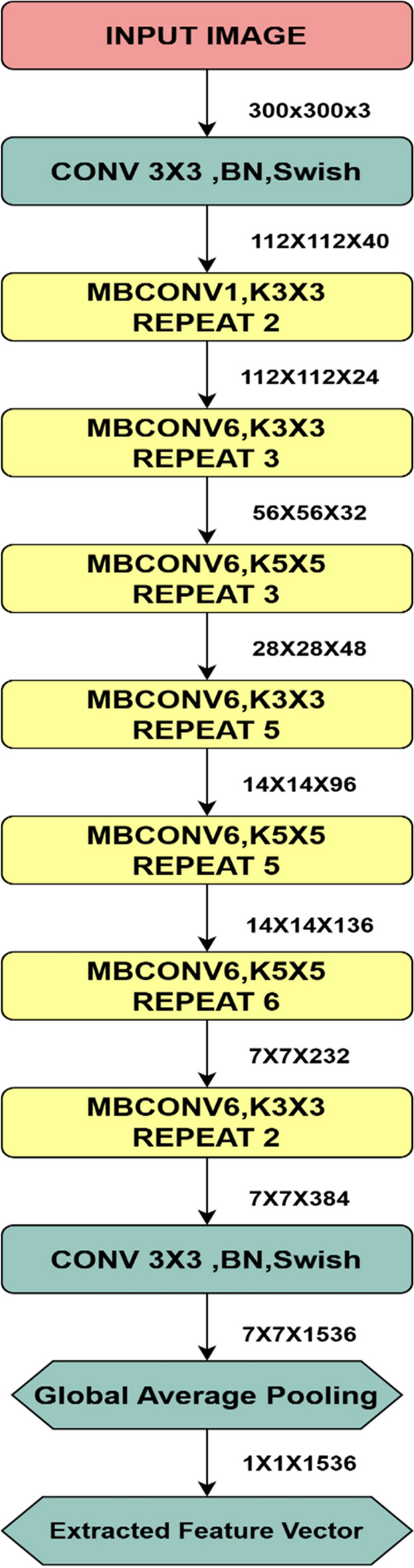
“For the extraction of features, the network uses the Mobile inverted bottleneck convolution (MB Conv) block that uses inverted residual connections 28 .”
Farah, M. A. B., Guesmi, R., Kachouri, A., & Samet, M. (2020) · Optics & Laser Technology · doi:10.1016/j.optlastec.2019.105777 · Cited by 290
A novel pixel-split image encryption scheme based on 2D Salomon map
Lai, Q., Hu, G., Erkan, U., & Toktas, A. (2023) · Expert Systems with Applications · doi:10.1016/j.eswa.2022.118845 · Cited by 250
Double image encryption algorithm based on neural network and chaos
Man, Z., Li, J., Di, X., Sheng, Y., & Liu, Z. (2021) · Chaos, Solitons & Fractals · doi:10.1016/j.chaos.2021.111318 · Cited by 241
A new one-dimensional chaotic map for image encryption scheme based on random DNA coding
Liang, Q., & Zhu, C. (2023) · Optics & Laser Technology · doi:10.1016/j.optlastec.2022.109033 · Cited by 222 · cited 1×
“The Table 7 shows entropy values for 5 sample test images and a high degree of unpredictability for the encrypted images that are ideally near 8 31 .”
Effects of Degradations on Deep Neural Network ArchitecturesPreprint
Roy, P., Ghosh, S., Bhattacharya, S., & Pal, U. (2018) · arXiv (Cornell University) · doi:10.48550/arxiv.1807.10108 · Cited by 201
A robust medical image encryption in dual domain: chaos-DNA-IWT combined approach
Banu S, A., & Amirtharajan, R. (2020) · Medical & Biological Engineering & Computing · doi:10.1007/s11517-020-02178-w · Cited by 147
An efficient medical image encryption using hybrid DNA computing and chaos in transform domain
Ravichandran, D., Aashiq Banu, S., Murthy, B. K., Balasubramanian, V., Fathima, S., & Amirtharajan, R. (2021) · Medical & Biological Engineering & Computing · doi:10.1007/s11517-021-02328-8 · Cited by 135 · cited 1×
“Deviation from the ideal value in the encrypted image is used to evaluate the divergence from the ideal encrypted histogram 35 .”
Secure medical image encryption scheme for Healthcare IoT using novel hyperchaotic map and DNA cubes
Lai, Q., & Hua, H. (2024) · Expert Systems with Applications · doi:10.1016/j.eswa.2024.125854 · Cited by 134
Cited by
Man, Z., Zhou, J., Wang, W., et al. (2026) · Chaos Solitons & Fractals · doi:10.1016/j.chaos.2026.118038 · Cited by 6
Machine Learning-Optimized Hybrid Chaotic Map for Secure Image and Multimedia Encryption in IoTPreprint
Hashmi, S. A. A., & Tiwari, P. (2026) · Research Square · doi:10.21203/rs.3.rs-9456970/v1 · Cited by 1
Aldwoah, K., Abdalgadir, L. M., Touati, A., et al. (2026) · The European Physical Journal Plus · doi:10.1140/epjp/s13360-026-07860-w
“Table 1 shows that recent studies have successfully improved chaos-based image encryption by using multiscroll attractors, improved four-dimensional chaotic systems, cellular automata, deep-feature-based key generation, DNA operations, and advanced scrambling-diffusion strategies [27–30].”
MI-DCC: A Content-Aware Dynamic Cipher Composition Framework for Adaptive Multi-Image Encryption
Drissi, S., Gmira, F., & Chergui, M. (2026) · Technologies · doi:10.3390/technologies14080461
Metadata
- Authors
- Subathra, S., & Thanikaiselvan, V.
- Affiliations
- Vellore Institute of Technology University (IN)
- Corresponding author
- Thanikaiselvan, V.
- ORCID
- Thanikaiselvan, V.
- Venue
- Scientific Reports
- Published
- 2025-12-06
- Volume
- 15
- Issue
- 1
- Pages
- 43435-43435
- ISSN
- 2045-2322 (ISSN-L)
- PMC
- PMC12690142
- OpenAlex
- W4417078067
- Cited by
- 4
- References
- 54
- Citations by year
- 2026: 4
- FWCI
- 1.40
- Type
- journal article
- Language
- en
- Open access
- gold
- doi.org
- Licence
- cc-by
- creativecommons.org/licenses/by/4.0 (tdm)
- creativecommons.org/licenses/by/4.0 (vor, 3 d)
- Locations
- Scientific Reports (publishedVersion, cc-by)
- PubMed (publishedVersion)
- PubMed Central (publishedVersion, cc-by)
- DOAJ (DOAJ: Directory of Open Access Journals) (submittedVersion, cc-by-sa)
- Funders
- Vellore Institute of Technology, Vellore
- Topics
- Physical Sciences › Computer Science › Computer Vision and Pattern Recognition › Chaos-based Image/Signal Encryption
- Physical Sciences › Computer Science › Artificial Intelligence › Computer Science and Engineering
- Physical Sciences › Computer Science › Computer Vision and Pattern Recognition › Advanced Steganography and Watermarking Techniques
- Keywords
- image encryption, EfficientNetB3, SHA-256, row and column permutations, DNA diffusion, avalanche effect, key space
About these checks
Registry, retraction, Cites and statistics results are computed, not judged, with one exception: a printed reference that no index lists is read once by a model before it counts as a citation error. Claims are extracted by a model and kept only when their quote appears verbatim in the text; each cited source is then checked, with a model’s help, for whether it says what the claim relies on. Those verdicts can be wrong — read the claim’s quote and the cited source before relying on one.
The claim verdicts this report counts are experimental: their accuracy is not yet measured.
A language model drew the claims from the paper on 2026-09-30, under version 3 of the claim definition (model deepseek-v4.1-flash, prompt extract-v3).
A second model labelled each claim on 2026-09-30 (model jev-1.13-20260917, definition revision gold-guideline-v0.2).
Statistics and arithmetic are recomputed, not judged.
Confidence bands are shown only for fields calibrated on our annotated test set. None is calibrated yet, so no band is shown.
What counts as a claim ›How we measure confidence ›How we check this ›
Are you an author, or do you see a problem with this page? Request a review
How to cite
Cite CoChat for the checks on this page, and the paper for its own findings.
- This page
- CoChat. (2026). Citation check: Image adaptive encryption using EfficientNet B3 feature guided multi scroll chaotic map with modulo controlled pseudo parallel processing. https://app.cochat.ai/papers/10.1038/s41598-025-27080-z
- The paper
- Subathra, S., & Thanikaiselvan, V. (2025). Image adaptive encryption using EfficientNet B3 feature guided multi scroll chaotic map with modulo controlled pseudo parallel processing. Scientific Reports. https://doi.org/10.1038/s41598-025-27080-z
Data sources
Bibliographic data: Semantic Scholar, OpenAlex, Crossref.
Contains information from the Semantic Scholar Academic Graph Datasets, made available under the ODC Attribution License (ODC-BY 1.0).
Semantic Scholar’s data is described in: Kinney, R., et al. (2023). The Semantic Scholar Open Data Platform. arXiv:2301.10140.
