

Image adaptive encryption using EfficientNet B3 feature guided multi scroll chaotic map with modulo controlled pseudo parallel processing
Open accessThe DOI matches its Crossref record; 56 of the 57 references it cites were found in a registry or an index; 5 of the 19 sources its claims cite were checked for support.
Abstract
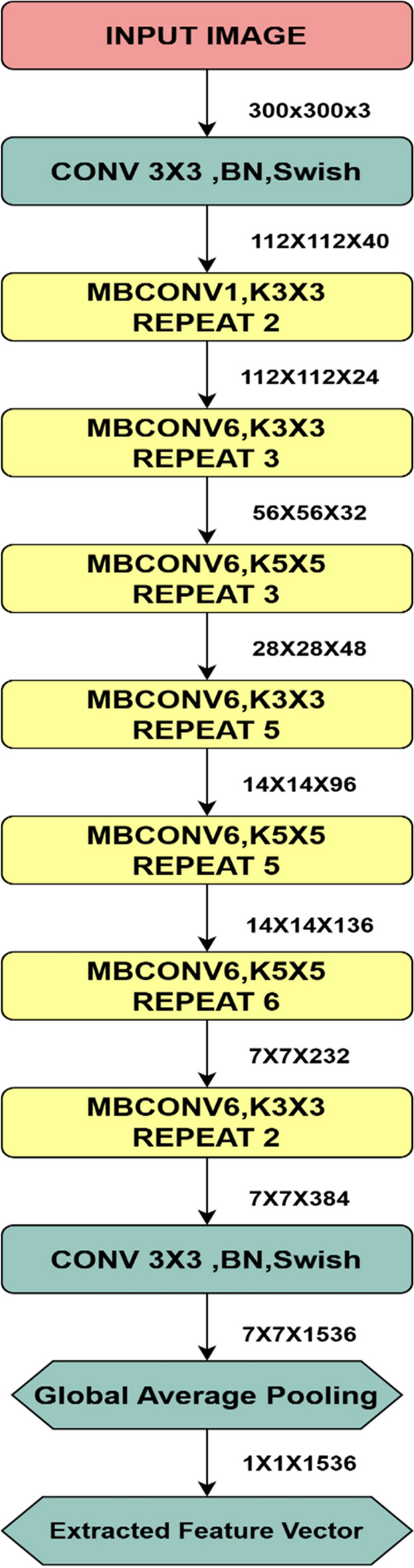
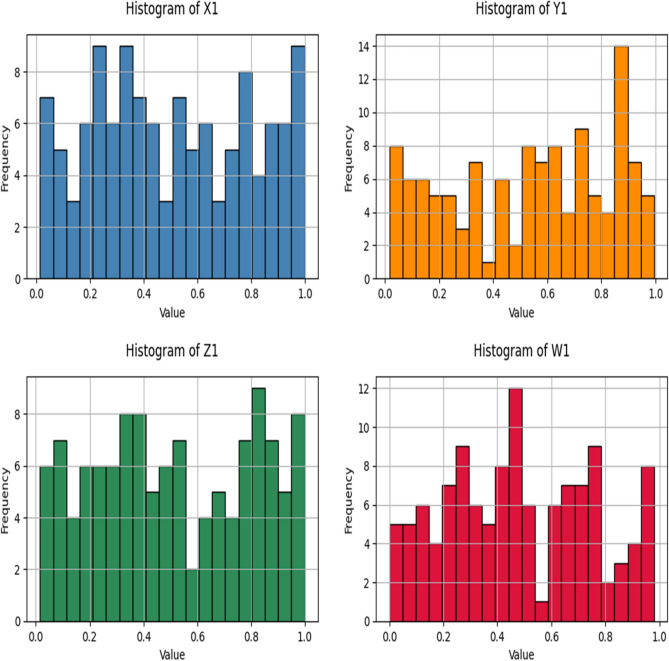
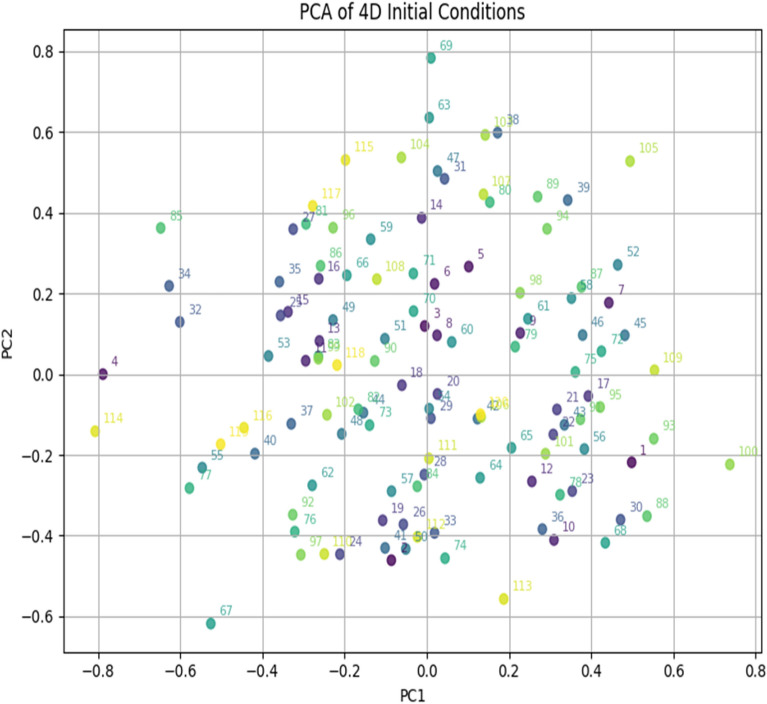
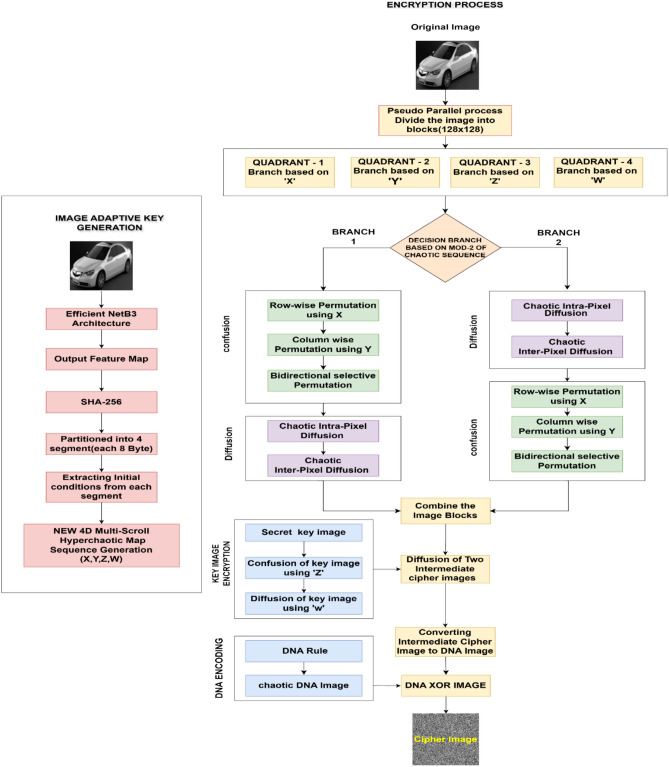
A new multistage encryption algorithm is proposed by integrating the deep neural network with a new 4D multi-scroll chaotic map to enhance the efficiency and improve the security of image transmission in the open channel. This combined network expands the key space and maintains the secrecy of the key with the multistage encryption algorithm. Initially, the image adaptive key generation process is implemented by the EfficientNet-B3 network to extract the features from the source image, which are then converted into hash values using SHA 256. The hash values are partitioned into four sections, and each section is normalized to give one distinct initial value for the generation of a multi-scroll chaotic sequence. The pseudo-parallel process routes the split source sub-image blocks (128⨯128) of plain text to branch 1 or branch 2, decided by the seed value of the chaotic sequence, increasing the high robustness against the differential and statistical attacks. Each branch contains row and column-wise permutations, bidirectional selective shuffling, and chaotic intra/inter-pixel diffusion in varying orders. The key image diffusion and dynamic DNA diffusion to the intermediate cypher image exhibit a strong avalanche effect. The simulation evaluation on the natural data set images demonstrates the large key space of 2 to the power of 674, high key sensitivity, uniform histogram with entropy value attains the critical values of 7.9, high NPCR value of 99.9%, UACI values with 33.46%,…
Overview
CoChat Summary
TL;DR
This paper proposes a multistage image encryption scheme that combines EfficientNet-B3 feature extraction with a new 4D multi-scroll chaotic map and pseudo-parallel processing. The authors report strong encryption metrics on natural images, including key space about \(2^{674}\), entropy near 7.9–8, NPCR 99.9%, and UACI 33.46%.
Key findings
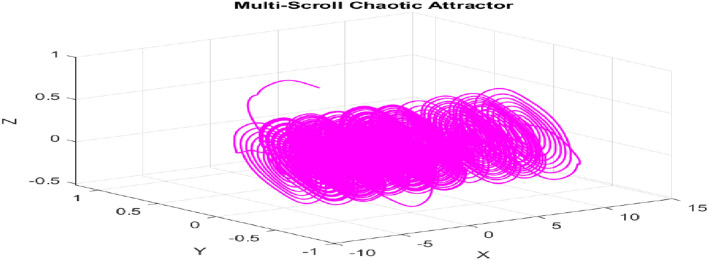
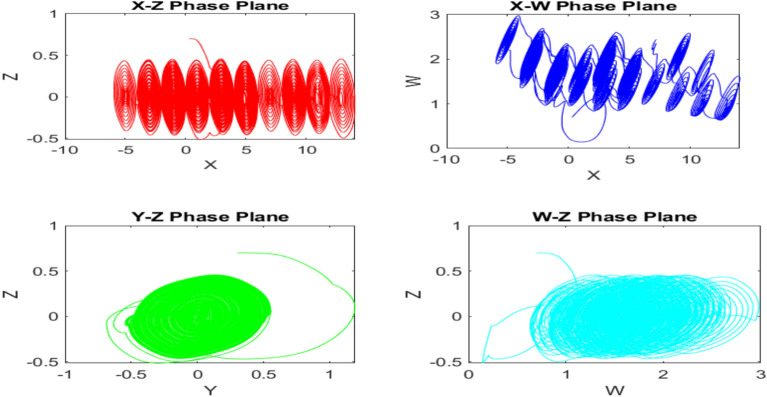
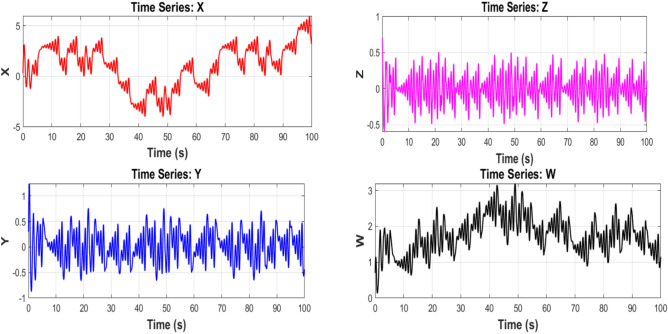
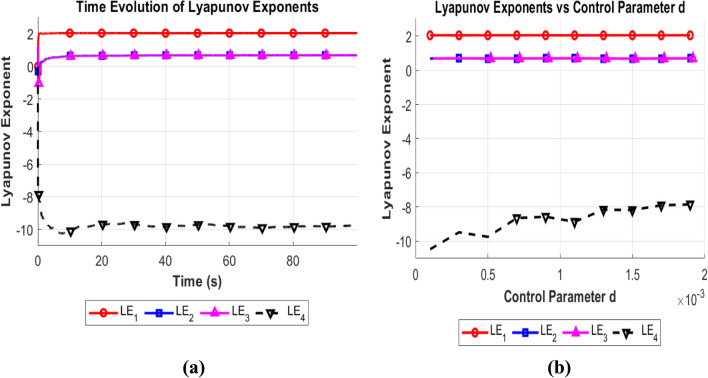
- The proposed 4D multi-scroll chaotic map is reported to have positive Lyapunov exponents, with \(LE_1=2.0440\), \(LE_2=0.6940\), \(LE_3=0.6933\), and \(LE_4=-7.8454\), and Kaplan-Yorke dimension \(D_{KY}=3.4374\), which the paper interprets as hyperchaotic.
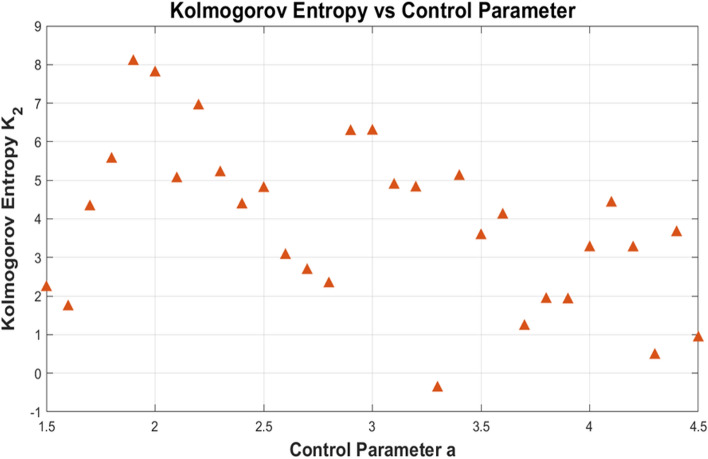
- The paper reports an average Kolmogorov entropy of 3.5403 for the chaotic map, and NIST SP 800-22 tests were passed with all sequence p-values greater than 0.01.
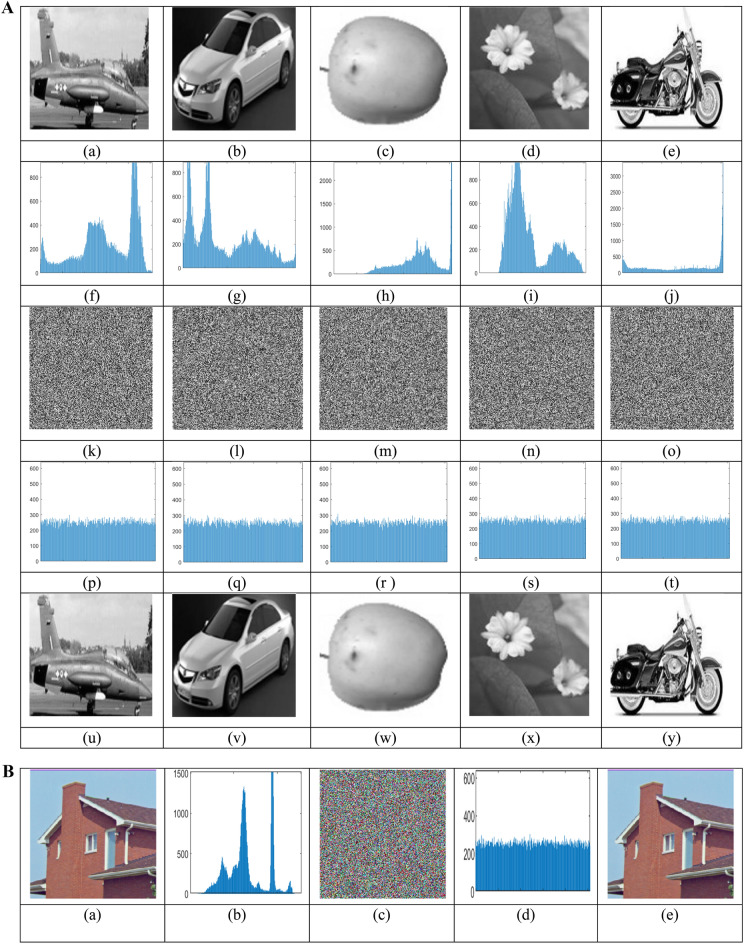
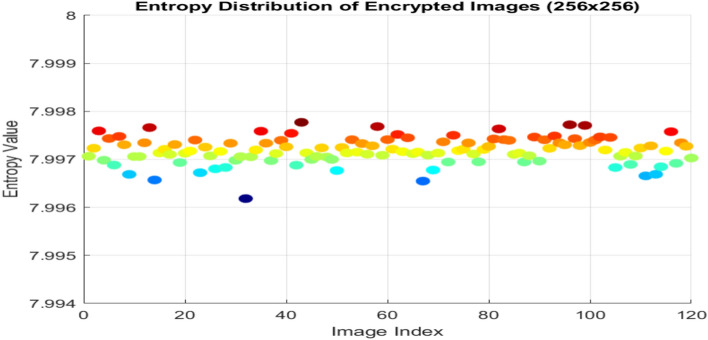
- For image security, the authors report entropy values near the critical value of 8; specifically, the abstract says entropy attains 7.9, and the text reports initial-condition entropies of 7.970, 7.975, 7.971, and 7.974 bits.
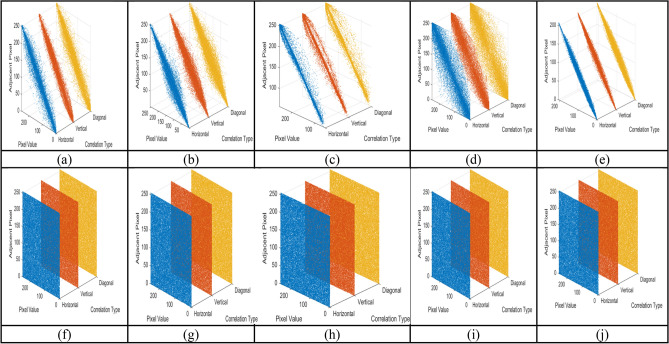
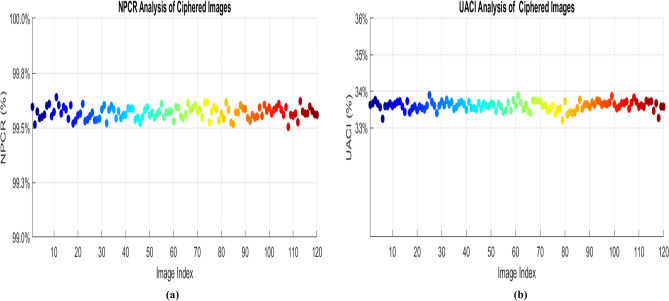
- The conclusion reports NPCR of 99.9% and UACI of 33.46%, plus near-zero horizontal, vertical, and diagonal correlation; the results section also states NPCR values were greater than 99.6% and UACI values were close to 33%.
Methods
- Design: a multistage image encryption framework with EfficientNet-B3-based adaptive key generation, SHA-256 hashing of extracted features, a new 4D multi-scroll chaotic map, pseudo-parallel branch selection, confusion-diffusion blocks, key-image diffusion, and dynamic DNA encoding.
- Data/sample: experiments were run on the Natural Image dataset (6,899 images from 8 classes), with 120 sample images used for result and performance analysis; an additional tree color image from the USC-SIPI database is mentioned.
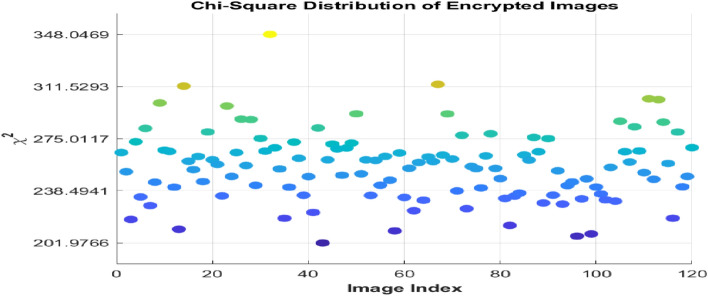
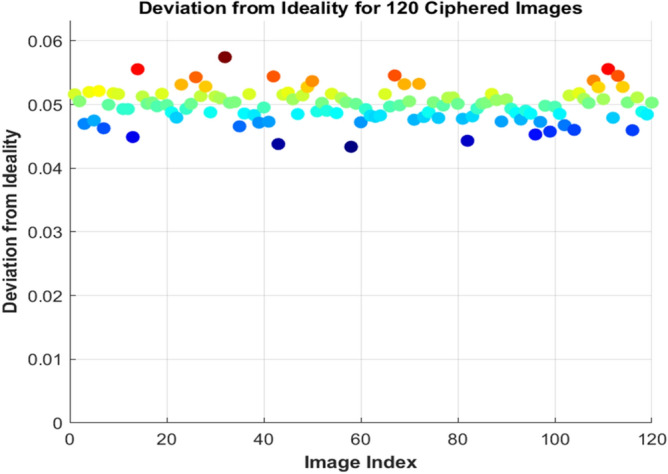
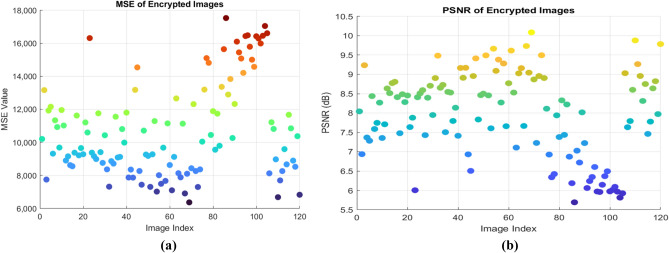
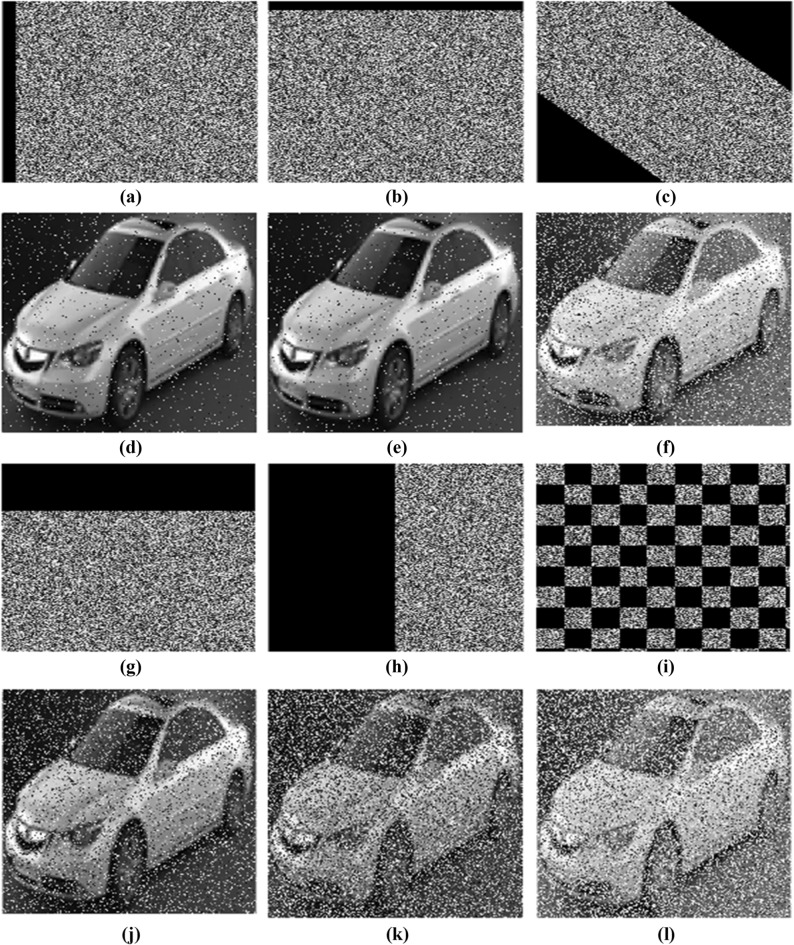
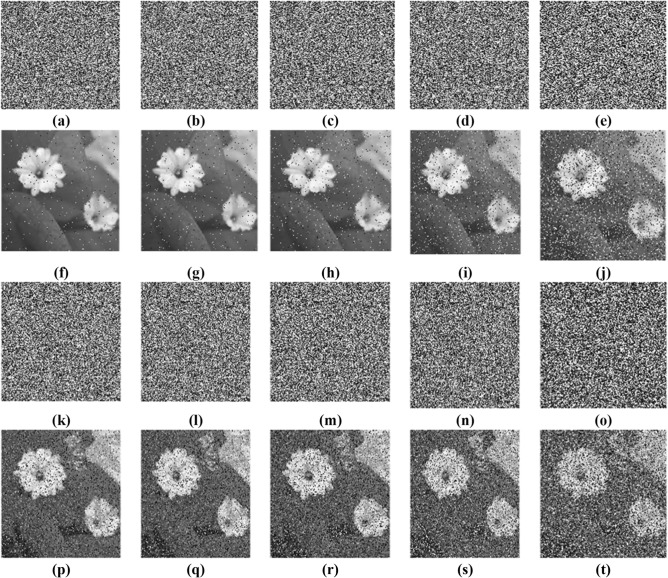
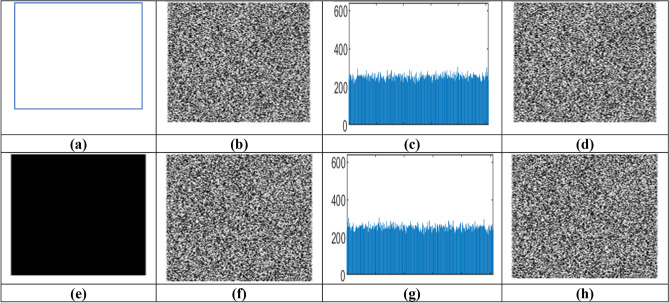
- Analysis: the paper evaluates chaotic properties (Lyapunov exponents, Kaplan-Yorke dimension, Kolmogorov entropy, NIST tests), and encryption quality using entropy, histograms, correlation coefficients, chi-square, deviation from ideality, key space, key sensitivity, MSE/PSNR, and robustness to cropping, noise, chosen-plaintext, and chosen-ciphertext attacks.
Limitations
- The paper states that some existing methods suffer from small key space or efficiency limitations, but it does not clearly state a limitation of the proposed method itself.
- Evident from the text: some reported parameter values are inconsistent across sections (for example, \(d\) is given as 0.0019, 0.0001, and 0.0011 in different places), and the exposition is fragmented with repeated or inconsistent algorithm notation; this is evident in the provided text.
- Evident from the text: the main evaluation is on 120 sampled images from a natural-image dataset, so generalization beyond those samples is not demonstrated here.
Model-written summary. Check it against the paper before relying on it.
Integrity signals
Registry
Cites
Statistics
Figures
Verification
Claims the paper makes
5 Valid · 1 Not valid · 9 Not checked · 93 Own results and interpretations
A result the paper reports from its own data — it cites no other source for it, so there is none to check. The quote shows it is in the paper.
In the paper
“The resultant entropy values for initial conditions are 7.970, 7.975, 7.971, and 7.974 bits.”
§ Image adaptive encryption using EfficientNet B3 feature guided multi scroll chaotic map with modulo controlled pseudo parallel processing > Results and performance analysis > Statistical analysis
plain- Asserted: passes — The authors put it forward as true.
- Checkable: passes — It can be checked against evidence.
- Load-bearing: passes — The paper’s conclusions depend on it.
- Based: passes — The paper gives a reason why it holds.
A result the paper reports from its own data — it cites no other source for it, so there is none to check. The quote shows it is in the paper.
In the paper
“The Table 7 shows entropy values for 5 sample test images and a high degree of unpredictability for the encrypted images that are ideally near 8”
§ Image adaptive encryption using EfficientNet B3 feature guided multi scroll chaotic map with modulo controlled pseudo parallel processing > Results and performance analysis > Statistical analysis
plainn = 5- Asserted: passes — The authors put it forward as true.
- Checkable: passes — It can be checked against evidence.
- Load-bearing: passes — The paper’s conclusions depend on it.
- Based: passes — The paper gives a reason why it holds.
A result the paper reports from its own data — it cites no other source for it, so there is none to check. The quote shows it is in the paper.
In the paper
“almost zero-pixel correlation”
§ Image adaptive encryption using EfficientNet B3 feature guided multi scroll chaotic map with modulo controlled pseudo parallel processing > Abstract A new multistage encryption algorithm is proposed by integrating the deep neural network with a new 4D multi-scroll chaotic map to enhance the efficiency and improve the security of image transmission in the open channel. This combined network expands the key space and maintains the secrecy of the key with the multistage encryption algorithm. Initially, the image adaptive key generation process is implemented by the EfficientNet-B3 network to extract the features from the source image, which are then converted into hash values using SHA 256. The hash values are partitioned into four sections, and each section is normalized to give one distinct initial value for the generation of a multi-scroll chaotic sequence. The pseudo-parallel process routes the split source sub-image blocks (128⨯128) of plain text to branch 1 or branch 2, decided by the seed value of the chaotic sequence, increasing the high robustness against the differential and statistical attacks. Each branch contains row and column-wise permutations, bidirectional selective shuffling, and chaotic intra/inter-pixel diffusion in varying orders. The key image diffusion and dynamic DNA diffusion to the intermediate cypher image exhibit a strong avalanche effect. The simulation evaluation on the natural data set images demonstrates the large key space of 2 to the power of 674, high key sensitivity, uniform histogram with entropy value attains the critical values of 7.9, high NPCR value of 99.9%, UACI values with 33.46%, almost zero-pixel correlation and strong robustness to the cropping and noise attacks.
plain- Asserted: passes — The authors put it forward as true.
- Checkable: passes — It can be checked against evidence.
- Load-bearing: passes — The paper’s conclusions depend on it.
- Based: passes — The paper gives a reason why it holds.
A result the paper reports from its own data — it cites no other source for it, so there is none to check. The quote shows it is in the paper.
In the paper
“strong robustness to the cropping and noise attacks.”
§ Image adaptive encryption using EfficientNet B3 feature guided multi scroll chaotic map with modulo controlled pseudo parallel processing > Abstract A new multistage encryption algorithm is proposed by integrating the deep neural network with a new 4D multi-scroll chaotic map to enhance the efficiency and improve the security of image transmission in the open channel. This combined network expands the key space and maintains the secrecy of the key with the multistage encryption algorithm. Initially, the image adaptive key generation process is implemented by the EfficientNet-B3 network to extract the features from the source image, which are then converted into hash values using SHA 256. The hash values are partitioned into four sections, and each section is normalized to give one distinct initial value for the generation of a multi-scroll chaotic sequence. The pseudo-parallel process routes the split source sub-image blocks (128⨯128) of plain text to branch 1 or branch 2, decided by the seed value of the chaotic sequence, increasing the high robustness against the differential and statistical attacks. Each branch contains row and column-wise permutations, bidirectional selective shuffling, and chaotic intra/inter-pixel diffusion in varying orders. The key image diffusion and dynamic DNA diffusion to the intermediate cypher image exhibit a strong avalanche effect. The simulation evaluation on the natural data set images demonstrates the large key space of 2 to the power of 674, high key sensitivity, uniform histogram with entropy value attains the critical values of 7.9, high NPCR value of 99.9%, UACI values with 33.46%, almost zero-pixel correlation and strong robustness to the cropping and noise attacks.
boosted- Asserted: passes — The authors put it forward as true.
- Checkable: passes — It can be checked against evidence.
- Load-bearing: passes — The paper’s conclusions depend on it.
- Based: passes — The paper gives a reason why it holds.
A result the paper states — it cites no source for it, so there is none to check. The quote shows it is in the paper.
In the paper
“The key image diffusion and dynamic DNA diffusion to the intermediate cypher image exhibit a strong avalanche effect.”
§ Image adaptive encryption using EfficientNet B3 feature guided multi scroll chaotic map with modulo controlled pseudo parallel processing > Abstract A new multistage encryption algorithm is proposed by integrating the deep neural network with a new 4D multi-scroll chaotic map to enhance the efficiency and improve the security of image transmission in the open channel. This combined network expands the key space and maintains the secrecy of the key with the multistage encryption algorithm. Initially, the image adaptive key generation process is implemented by the EfficientNet-B3 network to extract the features from the source image, which are then converted into hash values using SHA 256. The hash values are partitioned into four sections, and each section is normalized to give one distinct initial value for the generation of a multi-scroll chaotic sequence. The pseudo-parallel process routes the split source sub-image blocks (128⨯128) of plain text to branch 1 or branch 2, decided by the seed value of the chaotic sequence, increasing the high robustness against the differential and statistical attacks. Each branch contains row and column-wise permutations, bidirectional selective shuffling, and chaotic intra/inter-pixel diffusion in varying orders. The key image diffusion and dynamic DNA diffusion to the intermediate cypher image exhibit a strong avalanche effect. The simulation evaluation on the natural data set images demonstrates the large key space of 2 to the power of 674, high key sensitivity, uniform histogram with entropy value attains the critical values of 7.9, high NPCR value of 99.9%, UACI values with 33.46%, almost zero-pixel correlation and strong robustness to the cropping and noise attacks.
boostedstates an association- Asserted: passes — The authors put it forward as true.
- Checkable: passes — It can be checked against evidence.
- Load-bearing: passes — The paper’s conclusions depend on it.
- Based: passes — The paper gives a reason why it holds.
56 more claims
Create a free account to see all 108 claims and every source verdict.
- Probably not a substantial claim. 11
- It may state two separate claims as one. 35
- The quote only partly states this claim. 6
Self-check
Percentages, sums and reported differences re-computed from the paper’s own numbers.
Each contradiction between two passages listed here was confirmed by an independent check.
Rated major: it would touch a result — a value a result rests on, reported and recomputed p-values on opposite sides of the significance level, two passages that conflict with no sign which is right, or a cited work retracted before this paper was published.
In the paper
“Two unique values (12 and 23), each with probability = 0.5\documentclass[12pt]{minimal} \usepackage{amsmath} \usepackage{wasysym} \usepackage{amsfonts} \usepackage{amssymb} \usepackage{amsbsy} \usepackage{mathrsfs} \usepackage{upgreek} \setlength{\oddsidemargin}{-69pt} \begin{document}$$H=[0.5 {log}_{2}\left(0.5\right)+ 0.5 {log}_{2}\left(0.5\right)] =1.0$$\end{document}”
§ Image adaptive encryption using EfficientNet B3 feature guided multi scroll chaotic map with modulo controlled pseudo parallel processing > Proposed algorithm > Encryption algorithm
Reported 1 · recomputed -1
Rated major: it would touch a result — a value a result rests on, reported and recomputed p-values on opposite sides of the significance level, two passages that conflict with no sign which is right, or a cited work retracted before this paper was published.
In the paper
§ Image adaptive encryption using EfficientNet B3 feature guided multi scroll chaotic map with modulo controlled pseudo parallel processing > Preliminaries > Multi-scroll chaotic map
“For the control parameter, a = 2.5; b = 8.5; c = 3; d = 0.0019; e = 1.75, Fig. 4a and b shows the positive LE of the multi-scroll chaotic system.”
§ Image adaptive encryption using EfficientNet B3 feature guided multi scroll chaotic map with modulo controlled pseudo parallel processing > Preliminaries > Multi-scroll chaotic map
“At the same time, the key parameters are fixed at a = 2.5, b = 8.5, c = 3, d = 0.0001, and e = 1.75, based on a control parameter sweep over a ∈ [1.5,4.5].”
Rated major: it would touch a result — a value a result rests on, reported and recomputed p-values on opposite sides of the significance level, two passages that conflict with no sign which is right, or a cited work retracted before this paper was published.
In the paper
§ Image adaptive encryption using EfficientNet B3 feature guided multi scroll chaotic map with modulo controlled pseudo parallel processing > Preliminaries > Multi-scroll chaotic map
“With (a, b, c, d, e) = (2.5, 8.5, 3, 0.0011, 1.75), dt = 0.005, and T= 256⨯256 steps (discarding the first 10%”
§ Image adaptive encryption using EfficientNet B3 feature guided multi scroll chaotic map with modulo controlled pseudo parallel processing > Preliminaries > Multi-scroll chaotic map
“For the control parameter, a = 2.5; b = 8.5; c = 3; d = 0.0019; e = 1.75, Fig. 4a and b shows the positive LE of the multi-scroll chaotic system.”
Citations
Cites
EfficientNet: Rethinking Model Scaling for Convolutional Neural Networks
Tan, M., & Le, Q. V. (2019) · arXiv · doi:10.48550/arxiv.1905.11946 · Cited by 17,072 · cited 2×
“The compound scaling method is the core innovation in the EfficientNet architecture using single scalar factor ϕ to uniformly scale all three dimensions such as depth, width and resolution given in the Equation is analysed in the paper 27 .”
Classification of Remote Sensing Images Using EfficientNet-B3 CNN Model With Attention
Alhichri, H., Alswayed, A. S., Bazi, Y., Ammour, N., & Alajlan, N. A. (2021) · IEEE Access · doi:10.1109/access.2021.3051085 · Cited by 357 · cited 1×
“For the extraction of features, the network uses the Mobile inverted bottleneck convolution (MB Conv) block that uses inverted residual connections 28 .”
Farah, M. A. B., Guesmi, R., Kachouri, A., & Samet, M. (2020) · Optics & Laser Technology · doi:10.1016/j.optlastec.2019.105777 · Cited by 290
A novel pixel-split image encryption scheme based on 2D Salomon map
Lai, Q., Hu, G., Erkan, U., & Toktas, A. (2023) · Expert Systems with Applications · doi:10.1016/j.eswa.2022.118845 · Cited by 250
Double image encryption algorithm based on neural network and chaos
Man, Z., Li, J., Di, X., Sheng, Y., & Liu, Z. (2021) · Chaos, Solitons & Fractals · doi:10.1016/j.chaos.2021.111318 · Cited by 241
A new one-dimensional chaotic map for image encryption scheme based on random DNA coding
Liang, Q., & Zhu, C. (2023) · Optics & Laser Technology · doi:10.1016/j.optlastec.2022.109033 · Cited by 222 · cited 1×
“The Table 7 shows entropy values for 5 sample test images and a high degree of unpredictability for the encrypted images that are ideally near 8 31 .”
Effects of Degradations on Deep Neural Network ArchitecturesPreprint
Roy, P., Ghosh, S., Bhattacharya, S., & Pal, U. (2018) · arXiv (Cornell University) · doi:10.48550/arxiv.1807.10108 · Cited by 202
A robust medical image encryption in dual domain: chaos-DNA-IWT combined approach
Banu S, A., & Amirtharajan, R. (2020) · Medical & Biological Engineering & Computing · doi:10.1007/s11517-020-02178-w · Cited by 147
An efficient medical image encryption using hybrid DNA computing and chaos in transform domain
Ravichandran, D., Aashiq Banu, S., Murthy, B. K., Balasubramanian, V., Fathima, S., & Amirtharajan, R. (2021) · Medical & Biological Engineering & Computing · doi:10.1007/s11517-021-02328-8 · Cited by 144 · cited 1×
“Deviation from the ideal value in the encrypted image is used to evaluate the divergence from the ideal encrypted histogram 35 .”
Secure medical image encryption scheme for Healthcare IoT using novel hyperchaotic map and DNA cubes
Lai, Q., & Hua, H. (2024) · Expert Systems with Applications · doi:10.1016/j.eswa.2024.125854 · Cited by 134
An efficient image encryption using deep neural network and chaotic map
Maniyath, S. R., & V, T. (2020) · Microprocessors and Microsystems · doi:10.1016/j.micpro.2020.103134 · Cited by 105 · cited 1×
“To test the sequence, we generate 5000 sequences with length of 2 20 .”
Wang, M., Fu, X., Teng, L., Yan, X., Xia, Z., & Liu, P. (2024) · Chaos, Solitons & Fractals · doi:10.1016/j.chaos.2024.114959 · Cited by 87 · cited 2×
“It indicates that the map behaves in a hyperchaotic manner when there are two or more positive Lyapunov exponents 25 .”
Optical color image encryption scheme with a novel DNA encoding algorithm based on a chaotic circuit
Yıldırım, M. (2021) · Chaos Solitons & Fractals · doi:10.1016/j.chaos.2021.111631 · Cited by 86 · cited 1×
“The prominent Lyapunov exponents of the suggested system and several benchmark chaotic systems from recent research 23,24,54–57 are shown in Table 1.”
A new image encryption based on bit replacing, chaos and DNA coding techniques
Yousif, S. F., Abboud, A. J., & Alhumaima, R. S. (2022) · Multimedia Tools and Applications · doi:10.1007/s11042-022-12762-x · Cited by 86
An image encryption algorithm based on 6-dimensional hyper chaotic system and DNA encoding
Li, Q., & Chen, L. (2024) · Multimedia Tools and Applications · doi:10.1007/s11042-023-15550-3 · Cited by 86
A new parallel image cryptosystem based on 5D hyper-chaotic system
Yuan, H.-M., Liu, Y., Lin, T., Hu, T., & Gong, L.-H. (2017) · Signal Processing Image Communication · doi:10.1016/j.image.2017.01.002 · Cited by 81
Kaur, G., Agarwal, R., & Patidar, V. (2022) · The Visual Computer · doi:10.1007/s00371-021-02066-w · Cited by 78
Image encryption scheme based on improved four-dimensional chaotic system and evolutionary operators
Niu, Y., Zhou, H., & Zhang, X. (2024) · Scientific Reports · doi:10.1038/s41598-024-57756-x · Cited by 70 · cited 1×
“It is used in information theory to measure the degree of uncertainty in predicting a random variable 30 .”
Chaotic Quantum Encryption to Secure Image Data in Post Quantum Consumer Technology
Shahbaz Khan, M., Ahmad, J., Al-Dubai, A., Pitropakis, N., Ghaleb, B., Ullah, A., Attique Khan, M., & Buchanan, W. J. (2024) · IEEE Transactions on Consumer Electronics · doi:10.1109/tce.2024.3415411 · Cited by 63 · cited 1×
“The ideal value of the NPCR is 100%, and the UACI value is 33.46%, given in the reference 37 .”
InfluentialHyperchaotic encryption based on multi-scroll piecewise linear systems
García-Martínez, M., Ontañón-García, L. J., Campos-Cantón, E., & Čelikovský, S. (2015) · Applied Mathematics and Computation · doi:10.1016/j.amc.2015.08.037 · Cited by 59 · cited 2×
“The prominent Lyapunov exponents of the suggested system and several benchmark chaotic systems from recent research 23,24,54–57 are shown in Table 1.”
4D Hyperchaotic map and DNA encoding combined image encryption for secure communication
Arthi, G., Thanikaiselvan, V., & Amirtharajan, R. (2022) · Multimedia Tools and Applications · doi:10.1007/s11042-022-12598-5 · Cited by 54
Self-citationDesign of hyperchaotic system based on multi-scroll and its encryption algorithm in color image
Yan, S., Li, L., Gu, B., Cui, Y., Wang, J., & Song, J. (2023) · Integration · doi:10.1016/j.vlsi.2022.10.002 · Cited by 49 · cited 3×
“Consequently, it is difficult to predict the next state 24 .”
Dynamic rotation medical image encryption scheme based on improved Lorenz chaos
Man, Z., Gao, C., Dai, Y., & Meng, X. (2024) · Nonlinear Dynamics · doi:10.1007/s11071-024-09732-3 · Cited by 48 · cited 1×
“The attacker has access to all encryption systems except the encryption key, which is crucial from the security perspective to protect the key 38 .”
Singh, O. P., Singh, K. N., Singh, A. K., & Agrawal, A. K. (2024) · Neurocomputing · doi:10.1016/j.neucom.2024.128714 · Cited by 48
Color image encryption based on novel kolam scrambling and modified 2D logistic cascade map (2D LCM)
Mathivanan, P., & Ponnambalam, M. (2023) · The Journal of Supercomputing · doi:10.1007/s11227-023-05539-y · Cited by 43
A Faster and Robust Artificial Neural Network Based Image Encryption Technique With Improved SSIM
Panigrahy, A. K., Maniyath, S. R., Sathiyanarayanan, M., Dholvan, M., Ramaswamy, T., Hanumanthakari, S., Vignesh, N. A., Kanithan, S., & Swain, R. (2024) · IEEE Access · doi:10.1109/access.2024.3353294 · Cited by 42 · cited 1×
“The National Institute of Standards and Technology (NIST) SP 800-22, the most popular cryptography-focused randomness testing suite, consists of 16 tests that can identify numerous typical errors in non-random sequences.”
Mansouri, A., Sun, P., Lv, C., Zhu, Y., Zhao, X., Ge, H., & Sun, C. (2025) · Expert Systems with Applications · doi:10.1016/j.eswa.2025.126521 · Cited by 38
A self-reversible image encryption algorithm utilizing a novel chaotic map
Li, L. (2025) · Nonlinear Dynamics · doi:10.1007/s11071-024-10726-4 · Cited by 37 · cited 1×
“The entropy of the image is analysed for 120 sample images and all the ciphered image entropy values are distributed near to the critical value 8, shown in the Fig.”
An effective chaotic maps image encryption based on metaheuristic optimizers
Sameh, S., Moustafa, H. E.-D., Abdelhay, E. H., & Ata, M. M. (2023) · The Journal of Supercomputing · doi:10.1007/s11227-023-05413-x · Cited by 36
Lai, Q., & Ji, L. (2025) · IEEE Transactions on Circuits and Systems for Video Technology · doi:10.1109/tcsvt.2025.3545788 · Cited by 36
Security analysis of a color image encryption based on bit-level and chaotic map
Wen, H., Chen, R., Yang, J., Zheng, T., Wu, J., Lin, W., Jian, H., Lin, Y., Ma, L., Liu, Z., et al. (2024) · Multimedia Tools and Applications · doi:10.1007/s11042-023-14921-0 · Cited by 32
Miao, M.-K., Gong, L.-H., Zhang, Y., & Zhou, N. (2024) · Optics and Lasers in Engineering · doi:10.1016/j.optlaseng.2024.108560 · Cited by 31
Improved fractal coding and hyperchaotic system for lossless image compression and encryption
Long, B., Chen, Z., Liu, T., Wu, X., He, C., Wang, L., & Cao, C. (2024) · Nonlinear Dynamics · doi:10.1007/s11071-024-10671-2 · Cited by 31
New 2D hyperchaotic Cubic-Tent map and improved 3D Hilbert diffusion for image encryption
Xu, X., Song, X.-G., Liu, S.-H., Zhou, N., & Wang, M.-M. (2025) · Applied Intelligence · doi:10.1007/s10489-025-06414-4 · Cited by 28 · cited 1×
“This research confirms that the encryption algorithm is resilient to a single-bit change in the plain picture 36 .”
Further analysis of the statistical independence of the NIST SP 800-22 randomness tests
Luengo, E. A., Olivares, B. A., Villalba, L. J. G., & Hernandez-Castro, J. (2023) · Applied Mathematics and Computation · doi:10.1016/j.amc.2023.128222 · Cited by 26 · cited 1×
“These tests search for patterns to determine the likelihood that a particular sequence originated from a random source of patterns 26 .”
Nonequal-length image encryption based on bitplane chaotic mapping
Zhang, R., Zhou, R., & Luo, J. (2024) · Scientific Reports · doi:10.1038/s41598-024-58612-8 · Cited by 25
Li, Z., Zhang, S., Tan, W., & Wu, X. (2025) · Nonlinear Dynamics · doi:10.1007/s11071-025-11110-6 · Cited by 25
Üstün, D., & Şahinkaya, S. (2025) · Mathematics and Computers in Simulation · doi:10.1016/j.matcom.2025.03.019 · Cited by 22
Image encryption based on 5D hyperchaotic system using hybrid random matrix transform
Sheela, S. J., Sanjay, A., Suresh, K. V., Tandur, D., & Shubha, G. (2022) · Multidimensional Systems and Signal Processing · doi:10.1007/s11045-021-00814-8 · Cited by 21 · cited 1×
“The peak signal-to-noise ratio (PSNR) is derived from the MSE and used to evaluate mathematically how the original image deviates from the encrypted image 41 .”
Survey on medical image encryption: From classical to deep learning-based approaches
Prasad, S., & Singh, A. K. (2025) · Computers and Electrical Engineering · doi:10.1016/j.compeleceng.2024.110011 · Cited by 21
Image encryption using combination of 4D discrete hyperchaotic map and DNA encoding
Gera, U. K., & Agrawal, S. (2023) · Multimedia Tools and Applications · doi:10.1007/s11042-023-17150-7 · Cited by 20
Multiple-image encryption algorithm based on S-boxes and DNA sequences
Safdar, M. U., Shah, T., & Ali, A. (2025) · Signal Processing Image Communication · doi:10.1016/j.image.2025.117353 · Cited by 20
Secure gray image sharing framework with adaptive key generation using image digest
Chidambaram, N., Lakshmi, C., Thenmozhi, K., Harshavardhan, M., Kumaran, R., Meikandan, P. V., Mahalingam, H., & Amirtharajan, R. (2025) · Scientific Reports · doi:10.1038/s41598-025-92752-9 · Cited by 19
Hyperchaotic image encryption using DNA coding and discrete cosine transform
Lone, P. N., Mir, U. H., & Gaffar, A. (2023) · Journal of the Franklin Institute · doi:10.1016/j.jfranklin.2023.10.010 · Cited by 18
Lightweight medical-image encryption technique for IoMT based healthcare applications
Islam, M. O. U., Parah, S. A., Malik, B. A., & Malik, S. A. (2024) · Multimedia Tools and Applications · doi:10.1007/s11042-024-19281-x · Cited by 18
Image encryption scheme based on double permutation and DNA
Zhang, X., Di, J., & Niu, Y. (2023) · Multimedia Tools and Applications · doi:10.1007/s11042-023-17392-5 · Cited by 16
RISE: Rubik’s cube and image segmentation based secure medical images encryption
Demla, K., & Anand, A. (2024) · Multimedia Tools and Applications · doi:10.1007/s11042-024-18351-4 · Cited by 15 · cited 1×
“The proposed technique has a high key sensitivity factor; even a slight change in the key value results in a different decryption result, which is not equal to the original image 39 .”
Dou, Y., Yue, S., Zhang, X., Fan, H., Li, M., & Zhang, M. (2025) · Nonlinear Dynamics · doi:10.1007/s11071-024-10638-3 · Cited by 15
Zhang, Y., Chai, X., Lu, Y., Xie, X., Sun, J., & Wang, B. (2025) · Physica Scripta · doi:10.1088/1402-4896/ada58f · Cited by 15
Medical Image Encryption using Biometric Image Texture Fusion
Liu, Z., & Xue, R. (2023) · Journal of Medical Systems · doi:10.1007/s10916-023-02003-5 · Cited by 13
Index-based simultaneous permutation-diffusion in image encryption using two-dimensional price map
Lai, Q., Zhang, H., Üstün, D., Erkan, U., & Toktaş, A. (2023) · Multimedia Tools and Applications · doi:10.1007/s11042-023-16663-5 · Cited by 12
Alsubaei, F. S., Eltoukhy, M. M., Ahmed, A. A., & Diab, H. (2024) · Alexandria Engineering Journal · doi:10.1016/j.aej.2024.11.040 · Cited by 11
Naeem, E. A., Joshi, A. B., Kumar, D., & El‐Samie, F. E. A. (2024) · Soft Computing · doi:10.1007/s00500-023-09333-z · Cited by 10
A hybrid scheme using hyper-chaotic system and elliptic curve cryptography for image encryption
Chaouch, I., Naanaa, A., & Asmi, S. E. (2024) · Multimedia Tools and Applications · doi:10.1007/s11042-024-19173-0 · Cited by 10
Yan, W., & Ding, Q. (2025) · Nonlinear Dynamics · doi:10.1007/s11071-024-10526-w · Cited by 10 · cited 1×
“Where: O i = Observed frequency of pixel intensities E i = Expected frequency (assuming a uniform distribution) The chi square value is analysed with significance level of 5% and 1% and the P value must be higher than 0.05 to accepts the null hypothesis 34 which shown in the Table 9.”
InfluentialPal, S., Mukhopadhyay, J., Pathak, A., Mondal, H., & Mandal, M. K. (2024) · Evolutionary Intelligence · doi:10.1007/s12065-024-00927-6 · Cited by 9
A data hiding scheme in encrypted images using non-degenerate chaotic system and hybrid coding
Ye, C., Tong, X., Zhang, M., & Wang, Z. (2025) · Nonlinear Dynamics · doi:10.1007/s11071-025-11079-2 · Cited by 6 · cited 1×
“In this article, MSE is employed to calculate the mean squared difference between the original and encrypted images 40 .”
Cited by
Man, Z., Zhou, J., Wang, W., et al. (2026) · Chaos Solitons & Fractals · doi:10.1016/j.chaos.2026.118038 · Cited by 6
Machine Learning-Optimized Hybrid Chaotic Map for Secure Image and Multimedia Encryption in IoTPreprint
Hashmi, S. A. A., & Tiwari, P. (2026) · Research Square · doi:10.21203/rs.3.rs-9456970/v1 · Cited by 1
Aldwoah, K., Abdalgadir, L. M., Touati, A., et al. (2026) · The European Physical Journal Plus · doi:10.1140/epjp/s13360-026-07860-w
“Table 1 shows that recent studies have successfully improved chaos-based image encryption by using multiscroll attractors, improved four-dimensional chaotic systems, cellular automata, deep-feature-based key generation, DNA operations, and advanced scrambling-diffusion strategies [27–30].”
MI-DCC: A Content-Aware Dynamic Cipher Composition Framework for Adaptive Multi-Image Encryption
Drissi, S., Gmira, F., & Chergui, M. (2026) · Technologies · doi:10.3390/technologies14080461
Metadata
- Authors
- Subathra, S., & Thanikaiselvan, V.
- Affiliations
- Vellore Institute of Technology University (IN)
- Corresponding author
- Thanikaiselvan, V.
- ORCID
- Thanikaiselvan, V.
- Venue
- Scientific Reports
- Published
- 2025-12-06
- Volume
- 15
- Issue
- 1
- Pages
- 43435-43435
- ISSN
- 2045-2322 (ISSN-L)
- PMC
- PMC12690142
- OpenAlex
- W4417078067
- Semantic Scholar
- 0d076c200215d35733fc1b66a2c9e80b65cda4aa
- Cited by
- 4
- References
- 54
- Citations by year
- 2026: 4
- FWCI
- 1.40
- Type
- journal article
- Language
- en
- Open access
- gold
- doi.org
- Licence
- cc-by
- creativecommons.org/licenses/by/4.0 (tdm)
- creativecommons.org/licenses/by/4.0 (vor, 3 d)
- Locations
- Scientific Reports (publishedVersion, cc-by)
- PubMed (publishedVersion)
- PubMed Central (publishedVersion, cc-by)
- DOAJ (DOAJ: Directory of Open Access Journals) (submittedVersion, cc-by-sa)
- Funders
- Vellore Institute of Technology, Vellore
- Topics
- Physical Sciences › Computer Science › Computer Vision and Pattern Recognition › Chaos-based Image/Signal Encryption
- Physical Sciences › Computer Science › Artificial Intelligence › Computer Science and Engineering
- Physical Sciences › Computer Science › Computer Vision and Pattern Recognition › Advanced Steganography and Watermarking Techniques
- Keywords
- image encryption, EfficientNetB3, SHA-256, row and column permutations, DNA diffusion, avalanche effect, key space
About these checks
Registry, retraction, Cites and statistics results are computed, not judged, with one exception: a printed reference that no index lists is read once by a model before it counts as a citation error. Claims are extracted by a model and kept only when their quote appears verbatim in the text; each cited source is then checked, with a model’s help, for whether it says what the claim relies on. Those verdicts can be wrong — read the claim’s quote and the cited source before relying on one.
The claim verdicts this report counts are experimental: their accuracy is not yet measured.
A language model drew the claims from the paper on 2026-09-30, under version 3 of the claim definition (model deepseek-v4.1-flash, prompt extract-v3).
A second model labelled each claim on 2026-09-30 (model jev-1.13-20260917, definition revision gold-guideline-v0.2).
Statistics and arithmetic are recomputed, not judged.
Confidence bands are shown only for fields calibrated on our annotated test set. None is calibrated yet, so no band is shown.
What counts as a claim ›How we measure confidence ›How we check this ›
Are you an author, or do you see a problem with this page? Request a review
Data sources
Bibliographic data: Semantic Scholar, OpenAlex, Crossref.
Contains information from the Semantic Scholar Academic Graph Datasets, made available under the ODC Attribution License (ODC-BY 1.0).
Semantic Scholar’s data is described in: Kinney, R., et al. (2023). The Semantic Scholar Open Data Platform. arXiv:2301.10140.
