

The DOI matches its Crossref record; 89 of the 89 references it cites were found in a registry or an index.
Classification of Remote Sensing Images Using EfficientNet-B3 CNN Model With Attention
Open accessAbstract
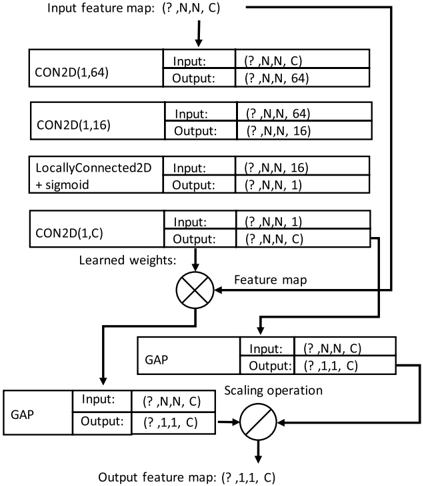
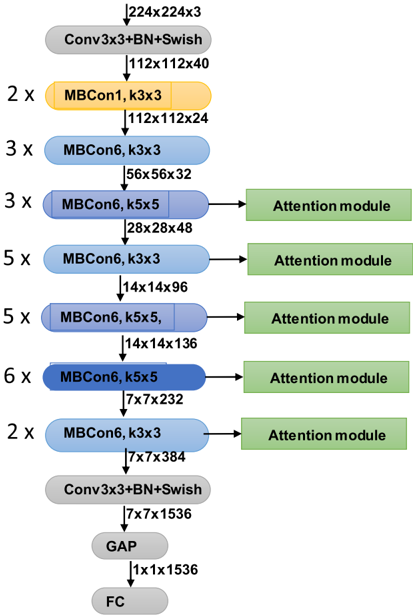
Scene classification is a highly useful task in Remote Sensing (RS) applications. Many efforts have been made to improve the accuracy of RS scene classification. Scene classification is a challenging problem, especially for large datasets with tens of thousands of images with a large number of classes and taken under different circumstances. One problem that is observed in scene classification is the fact that for a given scene, only one part of it indicates which class it belongs to, whereas the other parts are either irrelevant or they actually tend to belong to another class. To address this issue, this paper proposes a deep attention Convolutional Neural Network (CNN) for scene classification in remote sensing. CNN models use successive convolutional layers to learn feature maps from larger and larger regions (or receptive fields) of the scene. The attention mechanism computes a new feature map as a weighted average of these original feature maps. In particular, we propose a solution, named EfficientNet-B3-Attn-2, based on the pre-trained EfficientNet-B3 CNN enhanced with an attention mechanism. A dedicated branch is added to layer 262 of the network, to compute the required weights. These weights are learned automatically by training the whole CNN model end-to-end using the backpropagation algorithm. In this way, the network learns to emphasize important regions of the scene and suppress the regions that are irrelevant to the classification. We tested the proposed EfficientNet-B3-Attn-2 on six popular remote sensing datasets, namely UC Merced, KSA, OPTIMAL-31, RSSCN7, WHU-RS19, and AID datasets, showing its strong capabilities in classifying RS scenes.
Overview
The claims and statistics of this paper haven’t been checked yet.
Free: it reads the open-access text and checks the first 5 claims that cite a source we can check. Create a free account to check every claim.
Integrity signals
Registry
Cites
Statistics
Figures











Verification
Claims the paper makes
The claims and statistics of this paper haven’t been checked yet.
Free: it reads the open-access text and checks the first 5 claims that cite a source we can check. Create a free account to check every claim.
Claims other papers make about this one
Each is checked against this paper’s own text: does it say what the citing paper says it does?
The cited source says what the claim attributes to it.
In the citing paper
“For the extraction of features, the network uses the Mobile inverted bottleneck convolution (MB Conv) block that uses inverted residual connections28.”
From Image adaptive encryption using EfficientNet B3 feature guided multi scroll chaotic map with modulo controlled pseudo parallel processing (2025) · cites this paper as [28]
Experimental — accuracy not yet measured
Self-check
Percentages, sums and reported differences re-computed from the paper’s own numbers.
The self-check needs the paper’s full text.
Citations
Cites
1 retracted
Zhu, R., Li, Y., Mo, N., & Liu, Y. (2019) · Remote Sensing · doi:10.3390/rs11171996 · Cited by 45
RetractedDeep Residual Learning for Image Recognition
He, K., Zhang, X., Ren, S., & Sun, J. (2016) · 2016 IEEE Conference on Computer Vision and Pattern Recognition (CVPR) · doi:10.1109/cvpr.2016.90 · Cited by 235,474 · cited 1×
“In the original residual blocks defined ResidualNets [53], the skip connections exist between layers with wide number of channels (64 in Fig.”
BackgroundVaswani, A., Shazeer, N., Parmar, N., Uszkoreit, J., Jones, L., Gomez, A. N., Kaiser, L., & Polosukhin, I. (2017) · arXiv · doi:10.48550/arxiv.1706.03762 · Cited by 120,404 · cited 1×
“The attention mechanism (the idea of focusing on spe-cific parts of the input) has been applied in deep learning for speech recognition [30], Natural Language processing [31], multimodal reasoning and matching [32], object detection [33], and image recognition [34]–[36].”
BackgroundImageNet classification with deep convolutional neural networks
Krizhevsky, A., Sutskever, I., & Hinton, G. E. (2017) · Communications of the ACM · doi:10.1145/3065386 · Cited by 112,155 · cited 1×
“Tan and Le [50] show that the EfficientNet CNN models outperform all previous models both in term of the number of parameters and Top-1 accuracy when applied to the ImageNet dataset [51].”
MethodExploiting Generative AI to Scale up Intelligent Tutoring Systems
Jakubův, J., Chvalovský, K., Goertzel, Z., Kaliszyk, C., Olšák, M., Piotrowski, B., Schulz, S., Suda, M., & Urban, J. (2023) · DROPS (Schloss Dagstuhl – Leibniz Center for Informatics) · doi:10.4230/lipics.itp.2023.19 · Cited by 76,658
Squeeze-and-Excitation Networks
Hu, J., Shen, L., & Sun, G. (2018) · 2018 IEEE/CVF Conference on Computer Vision and Pattern Recognition · doi:10.1109/cvpr.2018.00745 · Cited by 35,667
MobileNetV2: Inverted Residuals and Linear Bottlenecks
Sandler, M., Howard, A., Zhu, M., Zhmoginov, A., & Chen, L.-C. (2018) · 2018 IEEE/CVF Conference on Computer Vision and Pattern Recognition · doi:10.1109/cvpr.2018.00474 · Cited by 28,755 · cited 1×
“MBConv is based on concepts borrowed from the MobileNet models [52].”
MethodEfficientNet: Rethinking Model Scaling for Convolutional Neural Networks
Tan, M., & Le, Q. V. (2019) · arXiv · doi:10.48550/arxiv.1905.11946 · Cited by 17,072 · cited 3×
“Recently, Tan and Le [50] studied the relationship between width and depth of CNNmodels and came upwith an efficient way to design CNN models that have less parameters, yet they provide better classification accuracy.”
BackgroundMethodSqueeze-and-Excitation Networks
Hu, J., Shen, L., Albanie, S., Sun, G., & Wu, E. (2020) · IEEE Transactions on Pattern Analysis and Machine Intelligence · doi:10.1109/tpami.2019.2913372 · Cited by 12,157
Review Article Digital change detection techniques using remotely-sensed data
SINGH, A. (1989) · International Journal of Remote Sensing · doi:10.1080/01431168908903939 · Cited by 3,849 · cited 1×
“Recent years have witnessed a rapid development in remote sensing (RS) technologies [1]–[3].”
Background
Research works printed but not linked: 4
- alhichri, 2020, KSA Remote Sensing Datasets
- k?zrak, 2020, Comparison of activation functions for deep neural networks
- chen, 2018, Recurrent transformer networks for remote sensing scene categorisation, Proc Brit Mach Vis Conf
- castelluccio, 2015, Land use classification in remote sensing images by convolutional neural networks, arXiv 1508 00092
Cited by
Adegun, A. A., Viriri, S., & Tapamo, J.-R. (2023) · Journal of Big Data · doi:10.1186/s40537-023-00772-x · Cited by 219
“[24] proposed a Deep Convolutional Neural Network (CNN) with an attention mechanism for scene classification in remote sensing.”
BackgroundResearch on object detection and recognition in remote sensing images based on YOLOv11
He, L.-H., Zhou, Y.-Z., Liu, L., Cao, W., & Ma, J.-H. (2025) · Scientific Reports · doi:10.1038/s41598-025-96314-x · Cited by 208
Deep Transfer Learning for Land Use and Land Cover Classification: A Comparative Study
Naushad, R., Kaur, T., & Ghaderpour, E. (2021) · Sensors · doi:10.3390/s21238083 · Cited by 189
Deep Learning-Based Glaucoma Detection With Cropped Optic Cup and Disc and Blood Vessel Segmentation
Islam, M. T., Mashfu, S. T., Faisal, A., Siam, S. C., Naheen, I. T., & Khan, R. (2021) · IEEE Access · doi:10.1109/access.2021.3139160 · Cited by 134
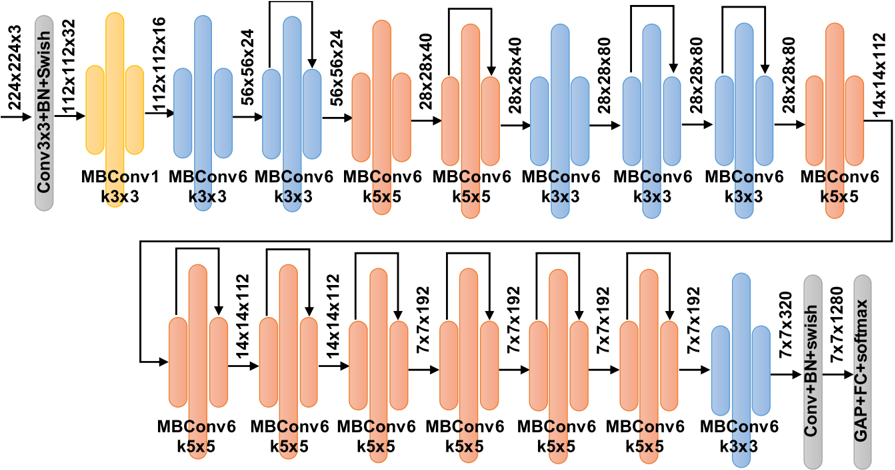
“It has a complicated architecture with a stack of convolutional layers and inverted bottleneck MBConv layers [37].”
BackgroundLand Use and Land Cover Classification Meets Deep Learning: A Review
Zhao, S., Tu, K., Ye, S., Tang, H., Hu, Y., & Xie, C. (2023) · Sensors · doi:10.3390/s23218966 · Cited by 171
Metadata
- Authors
- Alhichri, H., Alswayed, A. S., Bazi, Y., Ammour, N., & Alajlan, N. A.
- Affiliations
- King Saud University (SA)
- Venue
- IEEE Access
- Published
- 2021
- Volume
- 9
- Pages
- 14078-14094
- ISSN
- 2169-3536 (ISSN-L)
- OpenAlex
- W3118660027
- Cited by
- 357
- References
- 86
- Citations by year
- 2026: 40 · 2025: 81 · 2024: 83 · 2023: 68 · 2022: 60 · 2021: 25
- FWCI
- 26.48
- Type
- journal article
- Language
- en
- Open access
- gold
- doi.org
- Locations
- IEEE Access (publishedVersion, cc-by)
- DOAJ (DOAJ: Directory of Open Access Journals) (submittedVersion, cc-by-sa)
- Funders
- Researchers Supporting Project through the King Saud University, Riyadh, Saudi Arabia (RSP-2020/69)
- Topics
- Physical Sciences › Computer Science › Computer Vision and Pattern Recognition › Remote-Sensing Image Classification
- Physical Sciences › Computer Science › Computer Vision and Pattern Recognition › Advanced Neural Network Applications
- Social Sciences › Geography, Planning and Development › Remote Sensing and Land Use
- Keywords
- remote sensing scene classification, EfficientNetB3, attention mechanism, pre-trained CNN fine-tuning, feature map weighting
About these checks
Registry, retraction, Cites and statistics results are computed, not judged, with one exception: a printed reference that no index lists is read once by a model before it counts as a citation error. Claims are extracted by a model and kept only when their quote appears verbatim in the text; each cited source is then checked, with a model’s help, for whether it says what the claim relies on. Those verdicts can be wrong — read the claim’s quote and the cited source before relying on one.
Statistics and arithmetic are recomputed, not judged.
Confidence bands are shown only for fields calibrated on our annotated test set. None is calibrated yet, so no band is shown.
What counts as a claim ›How we measure confidence ›How we check this ›
Are you an author, or do you see a problem with this page? Request a review
How to cite
Cite CoChat for the checks on this page, and the paper for its own findings.
- This page
- CoChat. (2026). Citation check: Classification of Remote Sensing Images Using EfficientNet-B3 CNN Model With Attention. https://app.cochat.ai/papers/10.1109/access.2021.3051085
- The paper
- Alhichri, H., Alswayed, A. S., Bazi, Y., Ammour, N., & Alajlan, N. A. (2021). Classification of Remote Sensing Images Using EfficientNet-B3 CNN Model With Attention. IEEE Access. https://doi.org/10.1109/access.2021.3051085
Data sources
Bibliographic data: Semantic Scholar, OpenAlex, Crossref.
Contains information from the Semantic Scholar Academic Graph Datasets, made available under the ODC Attribution License (ODC-BY 1.0).
Semantic Scholar’s data is described in: Kinney, R., et al. (2023). The Semantic Scholar Open Data Platform. arXiv:2301.10140.
