

Exploring the relationship between AI literacy, AI trust, AI dependency, and 21st century skills in preservice mathematics teachers
Open accessThe DOI matches its Crossref record; 53 of the 54 references it cites were found in a registry or an index.
Abstract
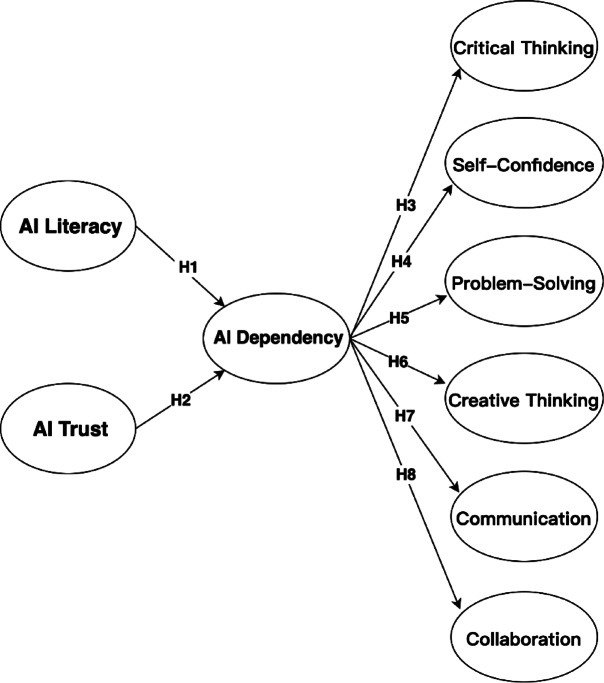
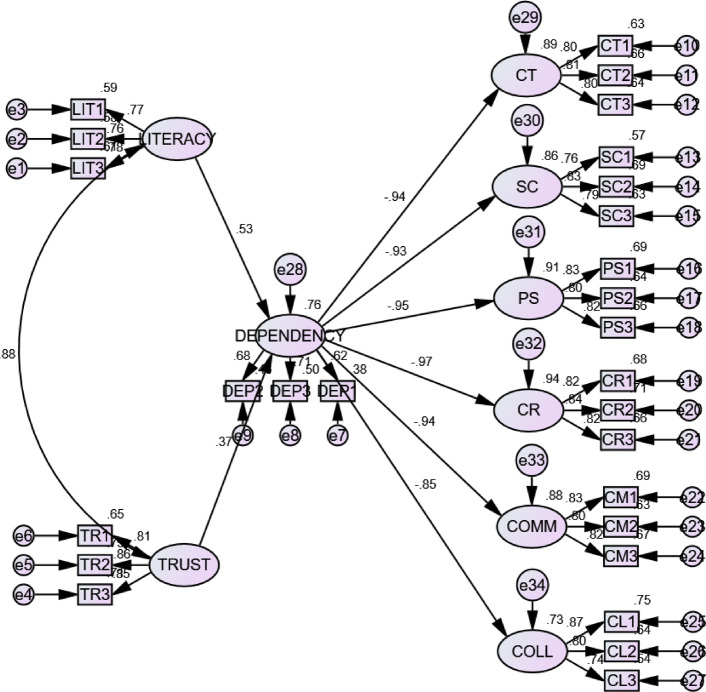
Generation-Artificial Intelligence (Gen-AI) is widely used in education and has been shown to improve students' mathematical abilities. However, dependency on Gen-AI may negatively impact these abilities and should be approached with caution. This study uses Structural Equation Modeling (SEM) to determine the relationship between AI literacy, AI trust, AI dependency, and 21st-century skills in preservice mathematics teachers. This research utilizes a self-designed questionnaire with 469 preservice mathematics teachers as respondents. SPSS and AMOS software were used for data analysis. The findings reveal that both AI trust and AI literacy significantly influence preservice mathematics teachers' dependency on Gen-AI. Furthermore, this dependency on Gen-AI among preservice mathematics teachers has a significant negative effect on their problem-solving ability, critical thinking, creative thinking, collaboration skills, communication skills, and self-confidence. This research provides new information to governments, schools, and teachers that caution should be exercised when attempting to enhance AI literacy and trust in AI among preservice mathematics teachers.
Overview
The claims and statistics of this paper haven’t been checked yet.
Free: it reads the open-access text and checks the first 5 claims that cite a source we can check. Create a free account to check every claim.
Integrity signals
Registry
Cites
Statistics
Figures
Verification
Claims the paper makes
The claims and statistics of this paper haven’t been checked yet.
Free: it reads the open-access text and checks the first 5 claims that cite a source we can check. Create a free account to check every claim.
Claims other papers make about this one
Each is checked against this paper’s own text: does it say what the citing paper says it does?
The source backs part of the claim, not all of it — or backs it for a different population, condition or comparison.
In the citing paper
“Their structural equation modeling revealed that dependency mediates the literacy-skill relationship, such that AI literacy’s direct effect on critical thinking is positive only when accompanied by critical engagement; otherwise, its indirect effect through dependency is negative [14, 50].”
From The impact of generative artificial intelligence tools on assessment equity for non-native English-speaking medical students: a systematic review (2026) · cites this paper as [50]
Experimental — accuracy not yet measured
Self-check
Percentages, sums and reported differences re-computed from the paper’s own numbers.
The self-check needs the paper’s full text.
Citations
Cites
Evaluating structural equation models with unobservable variables and measurement error
Fornell, C., & Larcker, D. F. (1981) · Journal of Marketing Research · doi:10.1177/002224378101800104 · Cited by 109,190 · cited 1×
“Secondly, the Fornell-Larcker criterion 45 , the correlations between constructs should not exceed the square root of their respective AVEs ( discriminant validity, there are instances where the correlations approach the upper limits, suggesting a need for careful interpretation of these…”
The commitment-trust theory of relationship marketing
Morgan, R. M., & Hunt, S. D. (1994) · Journal of Marketing · doi:10.1177/002224299405800302 · Cited by 22,355
Social Cognitive Theory: An Agentic Perspective
Bandura, A. (2001) · Annual Review of Psychology · doi:10.1146/annurev.psych.52.1.1 · Cited by 15,510
Dwivedi, Y. K., Kshetri, N., Hughes, L., Slade, E. L., Jeyaraj, A., Kar, A. K., Baabdullah, A. M., Koohang, A., Raghavan, V., Ahuja, M., et al. (2023) · International Journal of Information Management · doi:10.1016/j.ijinfomgt.2023.102642 · Cited by 4,584
Walter, Y. (2024) · International Journal of Educational Technology in Higher Education · doi:10.1186/s41239-024-00448-3 · Cited by 1,113 · cited 2×
“However, while previous studies highlights the transformative potential of AI in education emphasizing the need for AI literacy, prompt engineering proficiency, and enhanced critical thinking 28,41 , our findings introduce a cautionary perspective on the dependency on AI.”
New Era of Artificial Intelligence in Education: Towards a Sustainable Multifaceted Revolution
Kamalov, F., Santandreu Calonge, D., & Gurrib, I. (2023) · Sustainability · doi:10.3390/su151612451 · Cited by 1,089 · cited 1×
“AI tools offer substantial advantages in the classroom, including personalized learning experiences that can adapt to individual student needs, increased efficiency in handling administrative tasks, and the ability to provide immediate feedback to learners 2,18,49–51 .”
Role of AI chatbots in education: systematic literature review
Labadze, L., Grigolia, M., & Machaidze, L. (2023) · International Journal of Educational Technology in Higher Education · doi:10.1186/s41239-023-00426-1 · Cited by 1,043
Teachers’ AI digital competencies and twenty-first century skills in the post-pandemic world
(2023) · doi:10.1007/s11423-023-10203-6 · Cited by 734 · cited 1×
“However, while previous studies highlights the transformative potential of AI in education emphasizing the need for AI literacy, prompt engineering proficiency, and enhanced critical thinking 28,41 , our findings introduce a cautionary perspective on the dependency on AI.”
Partial Least Squares Path Modeling
(2017) · Springer eBooks · doi:10.1007/978-3-319-64069-3 · Cited by 411
Zhang, S., Zhao, X., Zhou, T., & Kim, J. H. (2024) · International Journal of Educational Technology in Higher Education · doi:10.1186/s41239-024-00467-0 · Cited by 409
Research works printed but not linked: 2
- Hair, J. F., Anderson, R. E., Tatham, R. L. & Black, W. C. Multivariate Data Analysis. Vol. 87, no. 4 (Annabel Ainscow, 2019).
- Kamalov, F., Calonge, D. S. & Gurrib, I. New era of artificial intelligence in education: towards a sustainable multifaceted revolution. Sustainability. 1–27 (2023). · DOI · Paper page
Cited by
Zhao, Y., Yuan, Y., Wen, Z., Leng, L., Shi, L., Hu, X., Xiaoman, W., Zuo, M., Mou, J., Luo, Q., et al. (2025) · Frontiers in Public Health · doi:10.3389/fpubh.2025.1648416 · Cited by 46
Cognitive Risks of AI: Literacy, Trust, and Critical Thinking
Kulal, A. (2025) · Journal of Computer Information Systems · doi:10.1080/08874417.2025.2582050 · Cited by 46
Fock, A., & Siller, H.-S. (2025) · International Journal of STEM Education · doi:10.1186/s40594-025-00589-5 · Cited by 30
“…concerning perceptions, attitudes & acceptance , three examine teachers’ intentions to use AI (Beege et al., 2024; Ramnarain et al., 2024; Wijaya et al., 2025) based on different variables (e.g., perceived AI literacy or competence, perceived benefits and risks, perceived behavioral…”
InfluentialQian, P., & Xie, X.-Z. (2025) · International Journal of Human-Computer Interaction · doi:10.1080/10447318.2025.2526580 · Cited by 26
“In relevant research, AI dependence is consistently conceptualized as psychological dependence on AI technology (Zhang et al., 2024, 2025).”
Kul, Ü., Beşaltı, M., Çelik, S., & Korkmaz, S. (2026) · Discover Education · doi:10.1007/s44217-026-01111-x · Cited by 13
“Key facets consistently include technical understanding, ethics, and critical appraisal [63, 70].”
AI misuse and passiveness of students in medical education
Hosseini, S. M. (2025) · AJP Advances in Physiology Education · doi:10.1152/advan.00164.2025 · Cited by 9
Ge, H., & Jae-Wook, S. (2025) · Acta Psychologica · doi:10.1016/j.actpsy.2025.106041 · Cited by 12
Hsieh, C.-C., Bali, S., & Li, H. (2025) · BMC Psychology · doi:10.1186/s40359-025-03792-9 · Cited by 15
“Prior research suggests that integrating AI in K–12 education offers reciprocal benefits by enhancing teachers’ capacity for innovative instruction [43, 44] and enriching students’ learning experiences, particularly through active learning and increased engagement [45].”
Artificial Intelligence and Youth: Cognitive, Educational, and Behavioral Impacts
Giansanti, D., & Cosenza, C. (2026) · AI · doi:10.3390/ai7040121 · Cited by 15
Kurdal, C., & Kaplan, A. (2026) · Kastamonu Eğitim Dergisi · doi:10.24106/kefdergi.1877948 · Cited by 7
Wang, Z., Wang, K., Park, S., & Yan, J. (2026) · Current Psychology · doi:10.1007/s12144-025-08966-7 · Cited by 5
Huiqing, Z., & Junjie, P. (2026) · Acta Psychologica · doi:10.1016/j.actpsy.2026.106480 · Cited by 7
Dagnino, F. M., Fante, C., Guerrieri, V., & Passarelli, M. (2026) · Frontiers in Psychology · doi:10.3389/fpsyg.2026.1900953 · Cited by 8
“In the current wave of generative AI models, which is leading to widespread diffusion for educational and professional practices, users who initially adopt AI for instrumental purposes may gradually develop emotional engagement patterns without explicit awareness (Zhang Y. et al., 2025).”
Alenezi, F. (2025) · Education for Information · doi:10.1177/01678329251397294 · Cited by 8
“Students lacking either competence risk over-reliance on system-generated outputs or super fi cial engagement with sources (Zhang et al., 2025).”
Modeling Trust Recalibration in AI Dialogue: Conversational Repair Strategies in ChatGPT
Troussas, C., Krouska, A., Mylonas, P., & Sgouropoulou, C. (2025) · International Workshop on Semantic and Social Media Adaptation and Personalization (SMAP) · doi:10.1109/smap66932.2025.00030 · Cited by 2
Ndacyayisenga, J. C. Y., Kidega, C., & Aciro Can, L. (2026) · BMC Medical Education · doi:10.1186/s12909-026-09303-7 · Cited by 1
“Their structural equation modeling revealed that dependency mediates the literacy-skill relationship, such that AI literacy’s direct effect on critical thinking is positive only when accompanied by critical engagement; otherwise, its indirect effect through dependency is negative [14, 50].”
Rahayu, S. T., Nurhanurawati, N., Rohman, F., & Adha, M. M. (2025) · Al-Jabar Jurnal Pendidikan Matematika · doi:10.24042/ajpm.v16i1.27378 · Cited by 1
Guha, P., Chen, S., Georges, A., & Mitchell, A. (2025) · AI & Society · doi:10.1007/s00146-025-02459-8 · Cited by 1
“Zhang et al. (2025) identify that increased confidence and the use of Generative AI can lead to a greater reliance on and use of AI platforms by educators; the same holds true for parents.”
Wen, J., Lei, Y., & Liu, Q. (2025) · Behavioral Sciences · doi:10.3390/bs16010044 · Cited by 1
“Overreliance on AI in academic settings can negatively impact students’ development of essential competencies such as communication skills, collaboration abilities, problem-solving, and self-regulation (Zhai et al., 2024; D. Zhang et al., 2025).”
Identity in Transition: How Teachers Learn, Adapt, and Evolve with AI
Bennett, V. A., & Royce, C. A. (2025) · Journal of Research in Science Mathematics and Technology Education · doi:10.31756/jrsmte.914 · Cited by 1
“Developing prompt engineering skills is crucial for effectively communicating with and fine-tuning AI chatbots to maximize their potential as teaching aids (Zhang et al., 2025).”
Ceylan, G. (2025) · Anemon Muş Alparslan Üniversitesi Sosyal Bilimler Dergisi · doi:10.18506/anemon.1774773 · Cited by 1
Su, M., Wijaya, T. T., Maričić, M., Anđić, B., & Lavicza, Z. (2025) · Interactive Learning Environments · doi:10.1080/10494820.2025.2604648 · Cited by 1
“…to improve learning outcomes and encourage a deeper understanding of learning concepts) (Hwang & Tu, 2021; Farazouli et al., 2024; Wardat et al., 2023; Zhang et al., 2025); o Intelligent assessment and management platforms – supporting educators in creating intelligent student support systems…”
InfluentialSelf-citationHow Critical Thinking Shapes Student Engagement with AI Tools to Foster Self-Directed Learning
Singhachotsukpat, R., Thiangtham, K., Wilepana, C., Yaemsawat, N., Sisaeng, P., Songkram, N., & Khlaisang, J. (2025) · International Conference on Educational Communications and Technology (ICTAECT) · doi:10.1109/ictaect67351.2025.11391283 · Cited by 3
“…reliance or uncritical use, reducing the risks of high AI trust and revealing that literacy alone is insufficient without CT. Zhang et al. [23] warn that although AI literacy encourage students to use AI more, they can also lead to dependency that weakens critical thinking,…”
AI detectors, student anxiety, and authorial alienation: a qualitative study of affective control
Ardana, S. G., & Christiana, M. (2026) · Teaching in Higher Education · doi:10.1080/13562517.2026.2643825 · Cited by 3
“Studies show that these technologies create risk-averse, distrustful environments in schools and universities, making it difficult for genuine teaching relationships to form (Ross & Macleod 2018; Seo et al. 2021; Zhang et al. 2025).”
Undergraduate mathematics faculty attitudes and experiences with generative AI integration
Joung, E., Brinkerhoff, R., Lee, I., Wong, A., & Ioane, O. (2026) · Eurasia Journal of Mathematics Science and Technology Education · doi:10.29333/ejmste/18126 · Cited by 1
“However, significant concerns have emerged, including content accuracy issues with error rates ranging from 15% to 40% in complex mathematical solutions, promotion of surface-level engagement over deep mathematical reasoning, and academic integrity challenges (Luo, 2024; Zhang et al., 2025).”
Turan, M. E., KARDUZ, F. F. A., & Montag, C. (2026) · Interactive Learning Environments · doi:10.1080/10494820.2026.2679722 · Cited by 1
Kim, J., Lee, C., & Lim, J. S. (2026) · Telematics and Informatics · doi:10.1016/j.tele.2026.102436 · Cited by 4
AI use and student perceptions of reliability and academic integrity
Zohourian, M., Pamidimukkala, A., & Kermanshachi, S. (2026) · Discover Education · doi:10.1007/s44217-026-01921-z · Cited by 1
“…can further increase familiarity with these tools and improve students’ understanding of their capabilities; however, some studies suggest that stronger AI literacy may raise the risk of students relying too heavily on AI instead of using their reasoning and problem-solving skills [36, 42].”
Charles, K., Lucy, A. C., Irene, E. C., & Fobi, S. (2026) · Educational Point · doi:10.71176/edup/19172 · Cited by 2
“Most of the explored AI research focused on the potential of AI technology to improve student engagement and develop 21st-century skills (Cukurova et al., 2020; Jiménez-García et al., 2025; Wu et al., 2022; Zhang et al., 2025).”
Reimagining Decent Work in AI-Driven Workplaces: The Role of Literacy, Trust and SupportPreprint
Thakur, S., & Tiwari, D. V. (2025) · SSRN Electronic Journal · doi:10.2139/ssrn.5434807
Ethical and Empathetic Requirements for Trustworthy ChatBots
Jit, S. S., & Dvornik, N. (2025) · IEEE International Requirements Engineering Conference Workshops (REW) · doi:10.1109/rew66121.2025.00077
Maqbool, S., Zafeer, M. U., & Al-Masaeid, M. (2025) · Advances in computational intelligence and robotics book series · doi:10.4018/979-8-3373-4217-7.ch008 · Cited by 1
Qi, F., Tsaur, T.-S., Sun, K.-S., Li, T. Y.-C., Qiu, Y., & Tsao, Y.-C. (2025) · International Conference on Educational Technology Management (ICETM) · doi:10.1109/icetm67477.2025.11413434
“Meanwhile, the application of artificial intelligence in education has been proven to enhance students' mathematical abilities[20].”
Advanced utilization of motion decomposition and visualization technology in gymnastics education
Yang, H.-L., Cheng, G., & Cheng, S. (2026) · Frontiers in Psychology · doi:10.3389/fpsyg.2026.1794257 · Cited by 8
AI Literacy and Trust in AI Among Higher Education Lecturers
Archan, D. A., & Krsmanovic, I. M. (2026) · Lecture notes on data engineering and communications technologies · doi:10.1007/978-981-95-4423-3_49 · Cited by 1
How 21st Century Skills Have Evolved in the 21st Century and How AI Is Shaping Their Next Evolution
Frydenberg, M., & Mentzer, K. (2026) · Information Systems Education Journal · doi:10.62273/pebu6919
Lamanauskas, V. (2026) · Natural Science Education in a Comprehensive School (NSECS) · doi:10.48127/gu/26.32.42
Yuan, L., Xie, X., & Wen, Y. (2026) · BMC Medical Education · doi:10.1186/s12909-026-09343-z
“Moreover, the potential risks of AI education, including overreliance, reduced critical thinking, algorithmic bias, and ethical issues, have rarely been addressed in prior reviews [9–11].”
AI in Psychotherapy: Opportunities and Risks
Neacşu, V. (2026) · Behavioral Sciences · doi:10.3390/bs16050676 · Cited by 1
Liu, J., & Lu, L. (2026) · Behavioral Sciences · doi:10.3390/bs16060957 · Cited by 1
Preservice Teachers' Artificial Intelligence Competence: A Network and Latent Profile Analyses
Acquah, B. Y. S., Arthur, F., Gyedu, F. O., Quayson, E., Boateng, E., Quaye, S. A., & Nortey, S. A. (2026) · European Journal of Education · doi:10.1111/ejed.70735 · Cited by 5
Al-Dulaimi, S. (2026) · CyberSystem journal. · doi:10.57238/csj.2026.1025
Exploring Teachers’ Perspectives on AI-Assisted Authoring Tool: A TAM-Based Study
Almasri, M. J., Imran, A. S., Pireva, K., Mavroudi, A., & Soylu, A. (2026) · IEEE Global Engineering Education Conference (EDUCON) · doi:10.1109/educon67543.2026.11574185
Demographic Factor of Artificial Intelligence Perception
Викторовна, М. Е., & Dovgyallo, Y. P. (2026) · City Healthcare · doi:10.47619/2713-2617.zm.2026.v.7i2;155-161
Kuo, L.-Y., & Lin, C.-J. (2026) · Lecture notes in computer science · doi:10.1007/978-3-032-29178-3_20
Filiz, A., Moralı, H. S., & Güzeller, C. O. (2026) · Eurasia Journal of Mathematics Science and Technology Education · doi:10.29333/ejmste/18955
“Zhang et al. (2025) conducted a study that proved the negative impacts of the dependency of preservice mathematics teachers on generative AI on essential 21 st century skills, including problem-solving skills, critical thinking skills, creative thinking skills, collaboration skills, communication…”
InfluentialAkalp, G., Özkılıçcı, G., Arlı, N. B., & Aytaç, S. (2026) · Theoretical Issues in Ergonomics Science · doi:10.1080/1463922x.2026.2706462
“CB-SEM was considered appropriate because the study adopted a confirmatory, theory-testing approach and examined theoretically derived relationships among latent variables (Hair et al. 2006; 2019; Zhang et al. 2025).”
Han, Z., Zhang, Y., Zhu, Y., & Liu, J. J. (2026) · Behavioral Sciences · doi:10.3390/bs16081274 · Cited by 1
“AI trust denotes positive attitudes and confidence stemming from the belief that AI possesses the capability to assist individuals in achieving specific objectives (Glikson & Woolley, 2020; D. Zhang et al., 2025).”
Reis, L. K., & Schütz, P. (2026) · MedienPädagogik Zeitschrift für Theorie und Praxis der Medienbildung · doi:10.21240/mpaed/71/2026.08.05.x
How Does University Students' Perception of GenAI Affect Their Learning Engagement?
Pu, B., Zhuang, P., & Zhuang, K.-J. (2026) · International Conference on Computer Science and Technologies in Education (CSTE) · doi:10.1109/cste69562.2026.11649657
Role of AI dependency in shaping 21st century skills in higher education with AI trust as a mediator
Akter, M. S., Sultana, F., Alam, S., Rupa, R. A., & Sultana, N. (2026) · Discover Artificial Intelligence · doi:10.1007/s44163-026-02056-8
“The findings show that AID increases SC and PS, contradicting the outcome of Zhang et al. [133].”
InfluentialWójcik, S., Rulkiewicz, A., & Domienik‐Karłowicz, J. (2026) · doi:10.2196/preprints.110249
Hamza, M. A., & Rehman, S. (2026) · Journal of Entrepreneurship and Public Policy · doi:10.1108/jepp-09-2024-0172
Giansanti, D. (2026) · AI · doi:10.3390/ai7090355 · Cited by 1
“…behavioral engagement, problematic use, attentional processes, self-regulation, and related psychological outcomes [1–10], whereas research on GenAI has increasingly focused on adoption, cognitive delegation, trust, dependency, AI literacy, and emerging forms of human–AI interaction [11–20].”
InfluentialHuang, Q., Tu, S., Lin, J., Lu, L., & Lv, C. (2026) · Frontiers in Psychology · doi:10.3389/fpsyg.2026.1889053
“…studies have further revealed that excessive dependency on AI may weaken students’ critical thinking ability, reduce active learning participation, and hinder the development of independent learning competence (Montag et al., 2020; Wijaya et al., 2024; Carobene et al., 2024; Tian and Zhang, 2025).”
Mulyono, H., Suryoputro, G., Azizah, U. S. A., & Falah, Z. A. (2026) · SN Social Sciences · doi:10.1007/s43545-026-01716-x
“This dynamic can deeper cognitive engagement and critical thinking, essential elements for academic success (Zhang et al. 2025 ).”
InfluentialTurcotte, N., SanFilippo, V., Özfidan, B., & Santamaria, S. (2026) · Journal of Formative Design in Learning · doi:10.1007/s41686-026-00117-w
Yin, C., Chen, G., & Sheng, C. (2026) · Education and Information Technologies · doi:10.1007/s10639-026-14158-y
“…positive experience or performance (Acosta-Enriquez et al., 2025 ; Long et al., 2025; Ye et al., 2025 ), anxiety (Hu, Mao et al., 2023b ), loneliness (Liao et al., 2025 ), trust in GenAI (Zhang et al., 2025 ), negative academic emotions (Zhong et al., 2024 ), and personality traits (Athar, 2025 ).”
Why Educators Use But Do Not Endorse Artificial Intelligence in Higher Education
Yu, J. H., Romero, P., Dunlap, M., & Warren, S. (2026) · Innovative Higher Education · doi:10.1007/s10755-026-09957-7
A Cognitive-Ethical Model for Responsible Generative AI Use in Primary Education
Wangsanata, V. C., Sasmoko, Binsar, F., & Hermanus, D. R. (2026) · International Conference on ICT for Smart Society (ICISS) · doi:10.1109/iciss71466.2026.11715024
“Additionally, reliance on AI without critical evaluation not only jeopardizes the quality of academic task, but also deprives opportunities to improve critical thinking skills [5].”
Yin, J., Jin, Y., & Yang, Y. (2026) · Behavioral Sciences · doi:10.3390/bs16101949
“Since ChatGPT’s rise, student over-reliance on AI has sparked concerns about declining creativity and critical thinking (D. Zhang et al., 2025).”
Chai, S.-M., Zhu, G.-X., He, Z.-H., Zhou, F.-Y., Wu, H., & Jiang, T.-W. (2026) · Asia Pacific Journal of Education · doi:10.1080/02188791.2026.2751966
Metadata
- Authors
- Zhang, D., Wijaya, T. T., Wang, Y., Su, M., Li, X., & Damayanti, N. W.
- Affiliations
- Qinghai Normal University (CN)
- Beijing Normal University (CN)
- Northwest Normal University (CN)
- Universitas Negeri Surabaya (ID)
- Corresponding author
- Wijaya, Tommy Tanu
- Wang, Ying
- Venue
- Scientific Reports
- Published
- 2025-04-24
- Volume
- 15
- Issue
- 1
- Pages
- 14281-14281
- ISSN
- 2045-2322 (ISSN-L)
- PMC
- PMC12022015
- OpenAlex
- W4409771305
- Semantic Scholar
- 651a83bdbf8864527d1664dd222a998d0793130d
- Cited by
- 63
- References
- 52
- Citations by year
- 2026: 42 · 2025: 21
- FWCI
- 65.51
- Type
- journal article
- Language
- en
- Open access
- gold
- doi.org
- Licence
- cc-by-nc-nd
- creativecommons.org/licenses/by-nc-nd/4.0 (tdm)
- creativecommons.org/licenses/by-nc-nd/4.0 (vor)
- Locations
- Scientific Reports (publishedVersion, cc-by-nc-nd)
- Europe PMC (PubMed Central) (publishedVersion, cc-by-nc-nd)
- PubMed Central (publishedVersion, cc-by-nc-nd)
- PubMed (publishedVersion)
- DOAJ (DOAJ: Directory of Open Access Journals) (submittedVersion, cc-by-sa)
- Funders
- Qinghai Normal University Teaching Research Project (qhnujy202226)
- Topics
- Social Sciences › Education › Artificial Intelligence in Education
- Social Sciences › Education › Digital literacy in education
- Social Sciences › Education › Education and Technology Integration
- Keywords
- AI literacy, trust in AI, AI dependency, 21st century skills, pre-service mathematics teachers, generative AI, problem-solving skills, critical thinking, creative thinking, collaboration skills, communication skills, self-confidence
About these checks
Registry, retraction, Cites and statistics results are computed, not judged, with one exception: a printed reference that no index lists is read once by a model before it counts as a citation error. Claims are extracted by a model and kept only when their quote appears verbatim in the text; each cited source is then checked, with a model’s help, for whether it says what the claim relies on. Those verdicts can be wrong — read the claim’s quote and the cited source before relying on one.
Statistics and arithmetic are recomputed, not judged.
Confidence bands are shown only for fields calibrated on our annotated test set. None is calibrated yet, so no band is shown.
What counts as a claim ›How we measure confidence ›How we check this ›
Are you an author, or do you see a problem with this page? Request a review
Data sources
Bibliographic data: Semantic Scholar, OpenAlex, Crossref.
Contains information from the Semantic Scholar Academic Graph Datasets, made available under the ODC Attribution License (ODC-BY 1.0).
Semantic Scholar’s data is described in: Kinney, R., et al. (2023). The Semantic Scholar Open Data Platform. arXiv:2301.10140.
