

Exploring the relationship between AI literacy, AI trust, AI dependency, and 21st century skills in preservice mathematics teachers
Open accessThe DOI matches its Crossref record; 53 of the 54 references it cites were found in a registry or an index.
Abstract
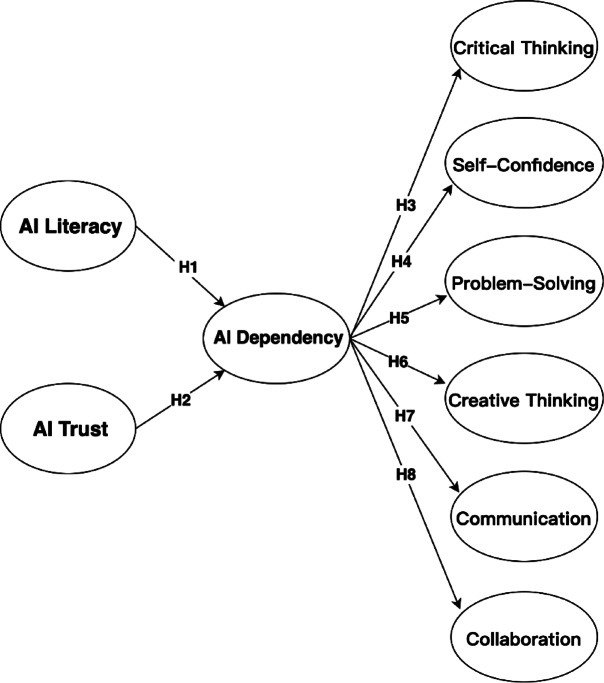
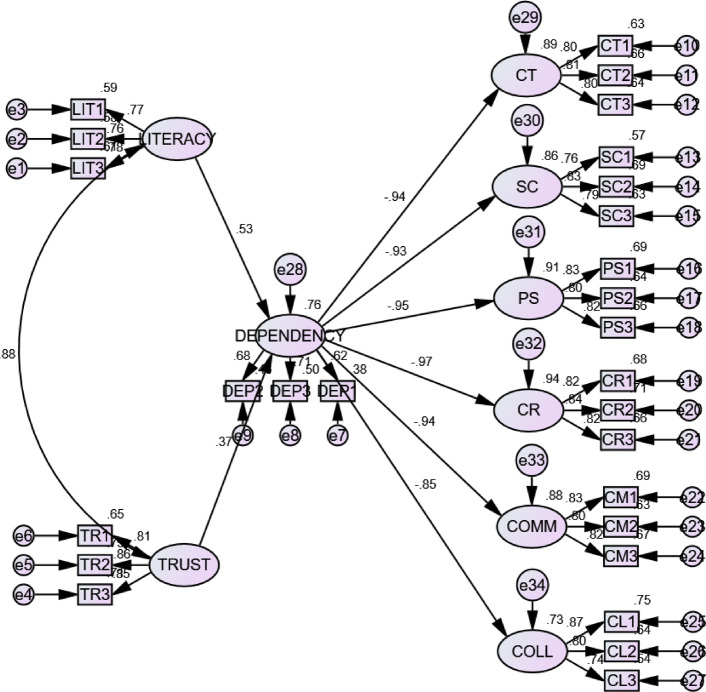
Generation-Artificial Intelligence (Gen-AI) is widely used in education and has been shown to improve students' mathematical abilities. However, dependency on Gen-AI may negatively impact these abilities and should be approached with caution. This study uses Structural Equation Modeling (SEM) to determine the relationship between AI literacy, AI trust, AI dependency, and 21st-century skills in preservice mathematics teachers. This research utilizes a self-designed questionnaire with 469 preservice mathematics teachers as respondents. SPSS and AMOS software were used for data analysis. The findings reveal that both AI trust and AI literacy significantly influence preservice mathematics teachers' dependency on Gen-AI. Furthermore, this dependency on Gen-AI among preservice mathematics teachers has a significant negative effect on their problem-solving ability, critical thinking, creative thinking, collaboration skills, communication skills, and self-confidence. This research provides new information to governments, schools, and teachers that caution should be exercised when attempting to enhance AI literacy and trust in AI among preservice mathematics teachers.
Overview
The claims and statistics of this paper haven’t been checked yet.
Free: it reads the open-access text and checks the first 5 claims that cite a source we can check. Create a free account to check every claim.
Integrity signals
Registry
Cites
Statistics
Figures
Verification
Claims the paper makes
The claims and statistics of this paper haven’t been checked yet.
Free: it reads the open-access text and checks the first 5 claims that cite a source we can check. Create a free account to check every claim.
Claims other papers make about this one
Each is checked against this paper’s own text: does it say what the citing paper says it does?
The source backs part of the claim, not all of it — or backs it for a different population, condition or comparison.
In the citing paper
“Their structural equation modeling revealed that dependency mediates the literacy-skill relationship, such that AI literacy’s direct effect on critical thinking is positive only when accompanied by critical engagement; otherwise, its indirect effect through dependency is negative [14, 50].”
From The impact of generative artificial intelligence tools on assessment equity for non-native English-speaking medical students: a systematic review (2026) · cites this paper as [50]
Experimental — accuracy not yet measured
Self-check
Percentages, sums and reported differences re-computed from the paper’s own numbers.
The self-check needs the paper’s full text.
Citations
Cites
Evaluating structural equation models with unobservable variables and measurement error
Fornell, C., & Larcker, D. F. (1981) · Journal of Marketing Research · doi:10.1177/002224378101800104 · Cited by 109,190 · cited 1×
“Secondly, the Fornell-Larcker criterion 45 , the correlations between constructs should not exceed the square root of their respective AVEs ( discriminant validity, there are instances where the correlations approach the upper limits, suggesting a need for careful interpretation of these…”
The commitment-trust theory of relationship marketing
Morgan, R. M., & Hunt, S. D. (1994) · Journal of Marketing · doi:10.1177/002224299405800302 · Cited by 22,355
Social Cognitive Theory: An Agentic Perspective
Bandura, A. (2001) · Annual Review of Psychology · doi:10.1146/annurev.psych.52.1.1 · Cited by 15,510
Dwivedi, Y. K., Kshetri, N., Hughes, L., Slade, E. L., Jeyaraj, A., Kar, A. K., Baabdullah, A. M., Koohang, A., Raghavan, V., Ahuja, M., et al. (2023) · International Journal of Information Management · doi:10.1016/j.ijinfomgt.2023.102642 · Cited by 4,584
Walter, Y. (2024) · International Journal of Educational Technology in Higher Education · doi:10.1186/s41239-024-00448-3 · Cited by 1,113 · cited 2×
“However, while previous studies highlights the transformative potential of AI in education emphasizing the need for AI literacy, prompt engineering proficiency, and enhanced critical thinking 28,41 , our findings introduce a cautionary perspective on the dependency on AI.”
New Era of Artificial Intelligence in Education: Towards a Sustainable Multifaceted Revolution
Kamalov, F., Santandreu Calonge, D., & Gurrib, I. (2023) · Sustainability · doi:10.3390/su151612451 · Cited by 1,089 · cited 1×
“AI tools offer substantial advantages in the classroom, including personalized learning experiences that can adapt to individual student needs, increased efficiency in handling administrative tasks, and the ability to provide immediate feedback to learners 2,18,49–51 .”
Role of AI chatbots in education: systematic literature review
Labadze, L., Grigolia, M., & Machaidze, L. (2023) · International Journal of Educational Technology in Higher Education · doi:10.1186/s41239-023-00426-1 · Cited by 1,043
Teachers’ AI digital competencies and twenty-first century skills in the post-pandemic world
(2023) · doi:10.1007/s11423-023-10203-6 · Cited by 734 · cited 1×
“However, while previous studies highlights the transformative potential of AI in education emphasizing the need for AI literacy, prompt engineering proficiency, and enhanced critical thinking 28,41 , our findings introduce a cautionary perspective on the dependency on AI.”
Partial Least Squares Path Modeling
(2017) · Springer eBooks · doi:10.1007/978-3-319-64069-3 · Cited by 411
Zhang, S., Zhao, X., Zhou, T., & Kim, J. H. (2024) · International Journal of Educational Technology in Higher Education · doi:10.1186/s41239-024-00467-0 · Cited by 409
Will generative AI replace teachers in higher education? A study of teacher and student perceptions
Chan, C. K. Y., & Tsi, L. H. Y. (2024) · Studies in Educational Evaluation · doi:10.1016/j.stueduc.2024.101395 · Cited by 387
The AI Revolution in Education: Will AI Replace or Assist Teachers in Higher Education?
Chan, C. K. Y., & Tsi, L. H. Y. (2023) · arXiv · doi:10.48550/arxiv.2305.01185 · Cited by 387
Higher education students’ perceptions of ChatGPT: A global study of early reactions
Ravšelj, D., Keržič, D., Tomaževič, N., Umek, L., Brezovar, N., A. Iahad, N., Abdulla, A. A., Akopyan, A., Aldana Segura, M. W., AlHumaid, J., et al. (2025) · PLOS ONE · doi:10.1371/journal.pone.0315011 · Cited by 376
How does generative artificial intelligence impact student creativity?
Habib, S., Vogel, T., Anli, X., & Thorne, E. (2024) · Journal of Creativity · doi:10.1016/j.yjoc.2023.100072 · Cited by 364
A systematic review of AI literacy scales
Lintner, T. (2024) · npj Science of Learning · doi:10.1038/s41539-024-00264-4 · Cited by 292
Ruiz-Rojas, L. I., Salvador-Ullauri, L., & Acosta-Vargas, P. (2024) · Sustainability · doi:10.3390/su16135367 · Cited by 263
Chai, C. S., Wang, X., & Xu, C. (2020) · Mathematics · doi:10.3390/math8112089 · Cited by 226
Farazouli, A., Cerratto-Pargman, T., Bolander-Laksov, K., & McGrath, C. (2024) · Assessment & Evaluation in Higher Education · doi:10.1080/02602938.2023.2241676 · Cited by 219
Developing an AI-based chatbot for practicing responsive teaching in mathematics
Lee, D., & Yeo, S. (2022) · Computers & Education · doi:10.1016/j.compedu.2022.104646 · Cited by 210
La inteligencia artificial como recurso docente: usos y posibilidades para el profesorado
Vera, M. D. M. S. (2023) · Educar · doi:10.5565/rev/educar.1810 · Cited by 203
Effects of Generative Chatbots in Higher Education
Ilieva, G., Yankova, T., Klisarova-Belcheva, S., Dimitrov, A., Bratkov, M., & Angelov, D. (2023) · Information · doi:10.3390/info14090492 · Cited by 194
Teaching CS50 with AI: Leveraging Generative Artificial Intelligence in Computer Science Education
Liu, R., Zenke, C., Liu, C., Holmes, A., Thornton, P., & Malan, D. J. (2024) · Proceedings of the 55th ACM Technical Symposium on Computer Science Education V. 1 · doi:10.1145/3626252.3630938 · Cited by 185 · cited 1×
“This suggests that while AI tools can provide immediate solutions and assist with content delivery 52,53 , their overuse may inhibit preservice mathematics teachers’ ability to think independently and devise innovative solutions to pedagogical challenges.”
Khlaif, Z. N., Ayyoub, A., Hamamra, B., Bensalem, E., Mitwally, M. A. A., Ayyoub, A., Hattab, M. K., & Shadid, F. (2024) · Education Sciences · doi:10.3390/educsci14101090 · Cited by 177
Students' adoption of AI-based teacher-bots (T-bots) for learning in higher education
Pillai, R., Sivathanu, B., Metri, B., & Kaushik, N. (2024) · Information Technology & People · doi:10.1108/itp-02-2021-0152 · Cited by 176
Valtonen, T., Hoang, N., Sointu, E., Näykki, P., Virtanen, A., Pöysä-Tarhonen, J., Häkkinen, P., Järvelä, S., Mäkitalo, K., & Kukkonen, J. (2021) · Computers in Human Behavior · doi:10.1016/j.chb.2020.106643 · Cited by 173
Exploring the effects of AI literacy in teacher learning: an empirical study
Du, H., Sun, Y., Jiang, H., Islam, A. Y. M. A., & Gu, X. (2024) · Humanities and Social Sciences Communications · doi:10.1057/s41599-024-03101-6 · Cited by 167
An Instrument for Measuring Teachers’ Trust in AI-Based Educational Technology
Nazaretsky, T., Cukurova, M., & Alexandron, G. (2022) · LAK22: 12th International Learning Analytics and Knowledge Conference · doi:10.1145/3506860.3506866 · Cited by 158
Stevens, A., & Stetson, P. D. (2023) · Journal of Biomedical Informatics · doi:10.1016/j.jbi.2023.104550 · Cited by 149
Lu, J., Zheng, R., Gong, Z., & Xu, H. (2024) · IEEE Transactions on Learning Technologies · doi:10.1109/tlt.2024.3369690 · Cited by 144
Dahri, N. A., Yahaya, N., Al-Rahmi, W. M., Vighio, M. S., Alblehai, F., Soomro, R. B., & Shutaleva, A. (2024) · Education and Information Technologies · doi:10.1007/s10639-024-12599-x · Cited by 144
Akpan, I. J., Kobara, Y. M., Owolabi, J., Akpan, A. A., & Offodile, O. F. (2025) · International Transactions in Operational Research · doi:10.1111/itor.13522 · Cited by 137
Li, M. (2024) · International Journal of Science and Mathematics Education · doi:10.1007/s10763-024-10515-w · Cited by 126 · cited 1×
“AI tools offer substantial advantages in the classroom, including personalized learning experiences that can adapt to individual student needs, increased efficiency in handling administrative tasks, and the ability to provide immediate feedback to learners 2,18,49–51 .”
Wijaya, T. T., Yu, Q., Cao, Y., He, Y., & Leung, F. K. S. (2024) · Behavioral Sciences · doi:10.3390/bs14111008 · Cited by 103
Self-citationSarfraz, M., Khawaja, K. F., & Ivaşcu, L. (2022) · The International Journal of Management Education · doi:10.1016/j.ijme.2022.100630 · Cited by 94
The relationship between inert thinking and ChatGPT dependence: An I-PACE model perspective
Ye, J., Zhang, M., Nong, W., Wang, L., & Yang, X. (2024) · Education and Information Technologies · doi:10.1007/s10639-024-12966-8 · Cited by 94
Pre-service chemistry teachers’ attitudes and attributes toward the twenty-first century skills
Shidiq, A. S., & Yamtinah, S. (2019) · Journal of Physics Conference Series · doi:10.1088/1742-6596/1157/4/042014 · Cited by 90
Wijaya, T. T., Su, M., Cao, Y., Weinhandl, R., & Houghton, T. (2025) · Education and Information Technologies · doi:10.1007/s10639-024-12837-2 · Cited by 80
Self-citationWijaya, T. T., & Weinhandl, R. (2022) · Electronics · doi:10.3390/electronics11131924 · Cited by 74
Self-citationCabero-Almenara, J., Palacios-Rodríguez, A., Loaiza-Aguirre, M. I., & Andrade-Abarca, P. S. (2024) · Frontiers in Artificial Intelligence · doi:10.3389/frai.2024.1497705 · Cited by 71
Using AI to Support Special Education Teacher Workload
Goldman, S. R., Taylor, J., Carreon, A., & Smith, S. J. (2024) · Journal of Special Education Technology · doi:10.1177/01626434241257240 · Cited by 66
Revolutionizing learning − A journey into educational games with immersive and AI technologies
Rapaka, A., Dharmadhikari, S. C., Kasat, K., Mohan, C. R., Chouhan, K. S., & Gupta, M. (2024) · Entertainment Computing · doi:10.1016/j.entcom.2024.100809 · Cited by 61
Dunder, N., Lundborg, S., Wong, J., & Viberg, O. (2024) · Proceedings of the 14th Learning Analytics and Knowledge Conference · doi:10.1145/3636555.3636882 · Cited by 42 · cited 1×
“This suggests that while AI tools can provide immediate solutions and assist with content delivery 52,53 , their overuse may inhibit preservice mathematics teachers’ ability to think independently and devise innovative solutions to pedagogical challenges.”
The Future of Education: Generative Artificial Intelligence’s Collaborative Role With Teachers
Kshetri, N. (2023) · IT Professional · doi:10.1109/mitp.2023.3333070 · Cited by 36
Cheng, R. C. H. (2024) · Online Learning · doi:10.24059/olj.v28i3.4632 · Cited by 35
Balancing: The Effects of AI Tools in Educational Context
Liang, Y. (2023) · Frontiers in Humanities and Social Sciences · doi:10.54691/fhss.v3i8.5531 · Cited by 27
Assessing Pre-Service Teachers Perception on 21stcentury Skills in Indonesia
Haviz, M., Maris, I. M., Anwar, A., Bakar, L., Aziz, D., & Fudholi, A. (2020) · Journal of Turkish Science Education · doi:10.36681/tused.2020.32 · Cited by 22
Synergizing language learning: SmallTalk AI In industry 4.0 and Education 4.0
Zhang, C., Zhiyan, L., Aravind, B. R., & Hariharasudan, A. (2024) · PeerJ Computer Science · doi:10.7717/peerj-cs.1843 · Cited by 19 · cited 1×
“As AI tools provide ready-made solutions, there is a concern that teachers might engage less in the analytical and reflective processes that underpin critical thinking 13,41 .”
Classroom Design and Application of Art Design Education Based on Artificial Intelligence
Zhao, Y., & Gao, L. (2023) · International Journal of Information Technology and Web Engineering · doi:10.4018/ijitwe.334008 · Cited by 16
Development and validation of Adaptability to Return-to-Work Scale (ARTWS) for cancer patients
Guo, Y., Xue, P., Gu, W.-W., Xiaoqin, S., Li, J., Kuai, B.-X., Xu, J., Xie, H.-W., & Han, P.-P. (2024) · Frontiers in Psychology · doi:10.3389/fpsyg.2023.1275331 · Cited by 14
Fiedot, M., Junka, A., Brożyna, M., Cybulska, J., Zdunek, A., Kočková, O., Lis, K., Chomiak, K., Czajkowski, M., Jędrzejewski, R., et al. (2024) · Carbohydrate Polymers · doi:10.1016/j.carbpol.2024.122463 · Cited by 13
Xu, Y., Li, F., Yin, Z., Sun, M., Guo, Z., & Лю, Б. (2023) · Frontiers in Psychology · doi:10.3389/fpsyg.2023.1179814 · Cited by 8 · cited 1×
“The Chi-square to degrees of freedom ratio (CMIN/df) is 2.786, which is comfortably within the acceptable range of 1 to 3, as specified by previous studies 46–48 .”
InfluentialGómez, S. C., García-Pernía, M.-R., Callejo, L. C., & Sánchez, R. E. (2024) · Digital Education Review · doi:10.1344/der.2025.46.158-167 · Cited by 7
Abdollahi, A., Azadfar, Z., Boyle, C., & Allen, K. (2021) · Journal of Religion and Health · doi:10.1007/s10943-021-01362-y · Cited by 6
Ethically Utilizing GenAI Tools to Alleviate Challenges in Conventional Feedback Provision
Zainurrahman, Z., Purnawarman, P., & Muslim, A. B. (2024) · Journal of Academic Ethics · doi:10.1007/s10805-024-09578-9 · Cited by 4
Research works printed but not linked: 2
- Hair, J. F., Anderson, R. E., Tatham, R. L. & Black, W. C. Multivariate Data Analysis. Vol. 87, no. 4 (Annabel Ainscow, 2019).
- Kamalov, F., Calonge, D. S. & Gurrib, I. New era of artificial intelligence in education: towards a sustainable multifaceted revolution. Sustainability. 1–27 (2023). · DOI · Paper page
Cited by
Zhao, Y., Yuan, Y., Wen, Z., Leng, L., Shi, L., Hu, X., Xiaoman, W., Zuo, M., Mou, J., Luo, Q., et al. (2025) · Frontiers in Public Health · doi:10.3389/fpubh.2025.1648416 · Cited by 46
Cognitive Risks of AI: Literacy, Trust, and Critical Thinking
Kulal, A. (2025) · Journal of Computer Information Systems · doi:10.1080/08874417.2025.2582050 · Cited by 46
Fock, A., & Siller, H.-S. (2025) · International Journal of STEM Education · doi:10.1186/s40594-025-00589-5 · Cited by 30
“…concerning perceptions, attitudes & acceptance , three examine teachers’ intentions to use AI (Beege et al., 2024; Ramnarain et al., 2024; Wijaya et al., 2025) based on different variables (e.g., perceived AI literacy or competence, perceived benefits and risks, perceived behavioral…”
InfluentialQian, P., & Xie, X.-Z. (2025) · International Journal of Human-Computer Interaction · doi:10.1080/10447318.2025.2526580 · Cited by 26
“In relevant research, AI dependence is consistently conceptualized as psychological dependence on AI technology (Zhang et al., 2024, 2025).”
Kul, Ü., Beşaltı, M., Çelik, S., & Korkmaz, S. (2026) · Discover Education · doi:10.1007/s44217-026-01111-x · Cited by 13
“Key facets consistently include technical understanding, ethics, and critical appraisal [63, 70].”
Metadata
- Authors
- Zhang, D., Wijaya, T. T., Wang, Y., Su, M., Li, X., & Damayanti, N. W.
- Affiliations
- Qinghai Normal University (CN)
- Beijing Normal University (CN)
- Northwest Normal University (CN)
- Universitas Negeri Surabaya (ID)
- Corresponding author
- Wijaya, Tommy Tanu
- Wang, Ying
- Venue
- Scientific Reports
- Published
- 2025-04-24
- Volume
- 15
- Issue
- 1
- Pages
- 14281-14281
- ISSN
- 2045-2322 (ISSN-L)
- PMC
- PMC12022015
- OpenAlex
- W4409771305
- Cited by
- 63
- References
- 52
- Citations by year
- 2026: 42 · 2025: 21
- FWCI
- 65.51
- Type
- journal article
- Language
- en
- Open access
- gold
- doi.org
- Licence
- cc-by-nc-nd
- creativecommons.org/licenses/by-nc-nd/4.0 (tdm)
- creativecommons.org/licenses/by-nc-nd/4.0 (vor)
- Locations
- Scientific Reports (publishedVersion, cc-by-nc-nd)
- Europe PMC (PubMed Central) (publishedVersion, cc-by-nc-nd)
- PubMed Central (publishedVersion, cc-by-nc-nd)
- PubMed (publishedVersion)
- DOAJ (DOAJ: Directory of Open Access Journals) (submittedVersion, cc-by-sa)
- Funders
- Qinghai Normal University Teaching Research Project (qhnujy202226)
- Topics
- Social Sciences › Education › Artificial Intelligence in Education
- Social Sciences › Education › Digital literacy in education
- Social Sciences › Education › Education and Technology Integration
- Keywords
- AI literacy, trust in AI, AI dependency, 21st century skills, pre-service mathematics teachers, generative AI, problem-solving skills, critical thinking, creative thinking, collaboration skills, communication skills, self-confidence
About these checks
Registry, retraction, Cites and statistics results are computed, not judged, with one exception: a printed reference that no index lists is read once by a model before it counts as a citation error. Claims are extracted by a model and kept only when their quote appears verbatim in the text; each cited source is then checked, with a model’s help, for whether it says what the claim relies on. Those verdicts can be wrong — read the claim’s quote and the cited source before relying on one.
Statistics and arithmetic are recomputed, not judged.
Confidence bands are shown only for fields calibrated on our annotated test set. None is calibrated yet, so no band is shown.
What counts as a claim ›How we measure confidence ›How we check this ›
Are you an author, or do you see a problem with this page? Request a review
Data sources
Bibliographic data: Semantic Scholar, OpenAlex, Crossref.
Contains information from the Semantic Scholar Academic Graph Datasets, made available under the ODC Attribution License (ODC-BY 1.0).
Semantic Scholar’s data is described in: Kinney, R., et al. (2023). The Semantic Scholar Open Data Platform. arXiv:2301.10140.
