

The DOI matches its Crossref record; 71 of the 73 references it cites were found in a registry or an index; 7 of the 18 sources its claims cite were checked for support.
Parameterized quantum random number generators for superconducting quantum hardware: novel architectures and NIST SP 800-22 evaluation under IBM noisy simulators
Open accessAbstract
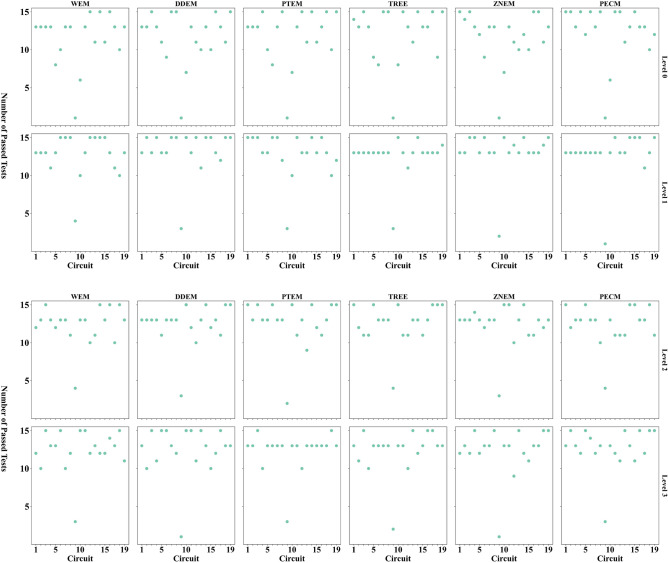
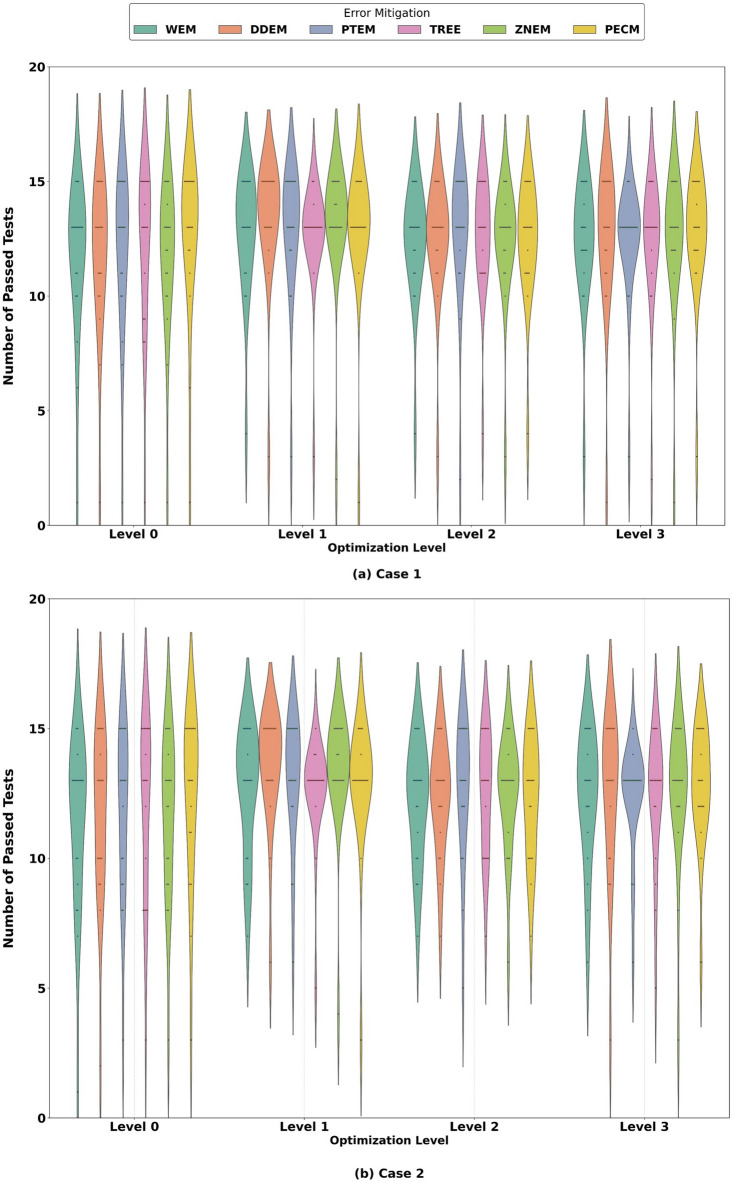
Quantum Random Number Generators (QRNGs) exploit intrinsic quantum mechanical randomness and are promising candidates for higher-quality randomness than classical RNGs. However, QRNGs on Noisy Intermediate-Scale Quantum (NISQ) platforms are constrained by decoherence, gate and measurement errors, and limited circuit depth, and the resulting impact on statistical randomness is not yet systematically characterized. This work introduces parameterized quantum random number generator (PQRNG) architectures built from parameterized quantum circuits (PQCs) to improve tunability and expressive power under realistic noise. We study three architectures, PQC-H-CH, H-PQC-CH, and H-CH-PQC, and evaluate their randomness under Transpiler optimization and circuit-level error mitigation as preprocessing steps, using NIST SP 800-22 for statistical validation. Utilizing default NIST settings, PQC-H-CH attains the largest number of fully passing preprocessing configurations (126 combinations passing all 15 tests), compared with 110 for H-PQC-CH and 69 for H-CH-PQC, indicating strong robustness across Transpiler optimization and mitigation settings, and we find that preprocessing choices influence randomness quality more strongly than adjusting NIST test parameters.
Overview
CoChat Summary
## TL;DR
The paper proposes three parameterized quantum random number generator (PQRNG) architectures for superconducting quantum hardware and benchmarks them under IBM noisy simulators with Transpiler optimization, error mitigation, and NIST SP 800-22 testing. Across the tested configurations, PQC-H-CH performs best, and the paper concludes that preprocessing choices affect randomness more than moderate changes to NIST test parameters.
## Key findings
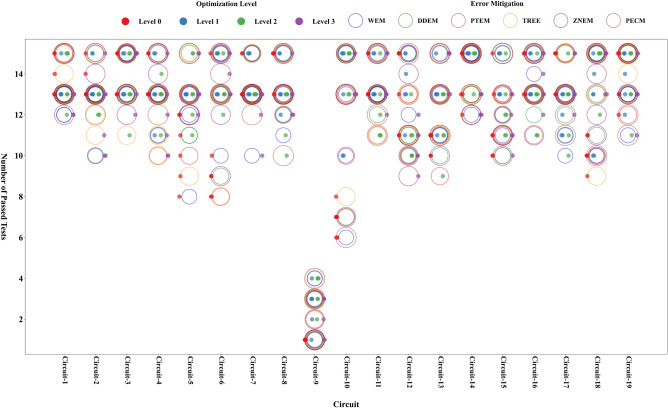
- The study analyzes 1,368 distinct bit sequences from three architectures (19 circuits per architecture; 57 circuits total), evaluated under 6 error-mitigation strategies and 4 Transpiler optimization levels, with 4 NIST parameter sets, yielding 5,472 total data points.
- Under the default NIST settings, PQC-H-CH achieved 126 fully passing preprocessing combinations (passing all 15 NIST tests), compared with 110 for H-PQC-CH and 69 for H-CH-PQC.
- In the results section, the architectures are ranked by randomness quality as PQC-H-CH strongest, H-PQC-CH next, and H-CH-PQC weakest.
- The paper reports that preprocessing parameters (Transpiler optimization and error mitigation) have a stronger impact on randomness quality than moderate calibration of NIST test parameters.
## Methods
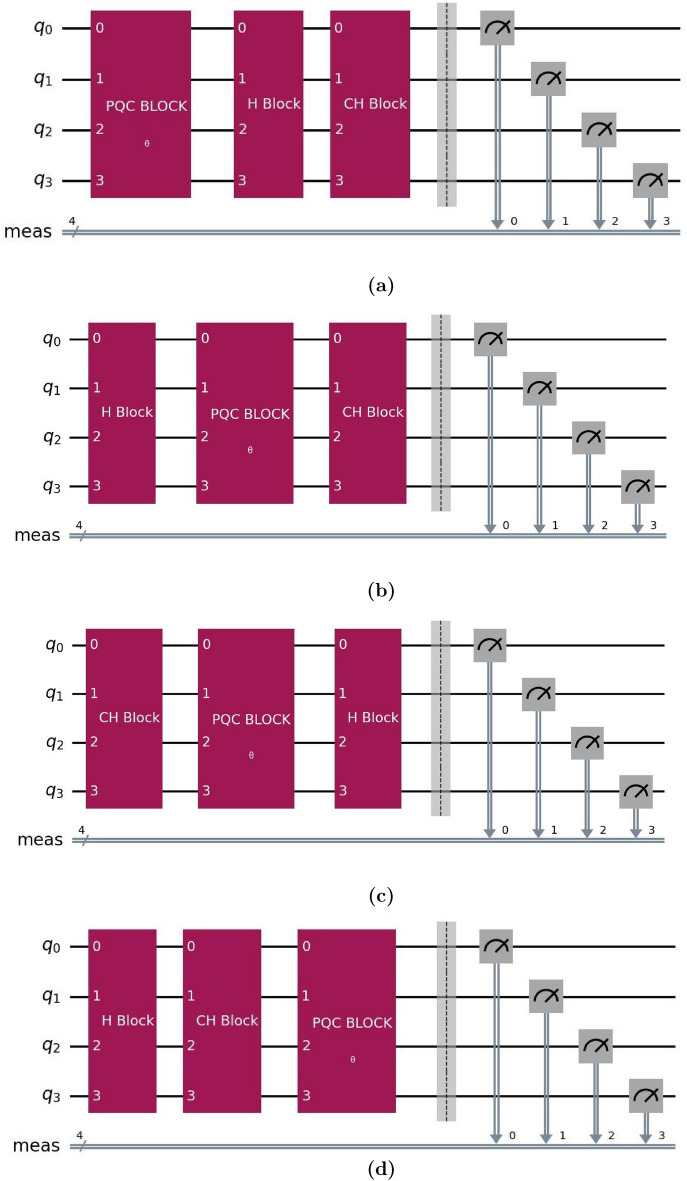
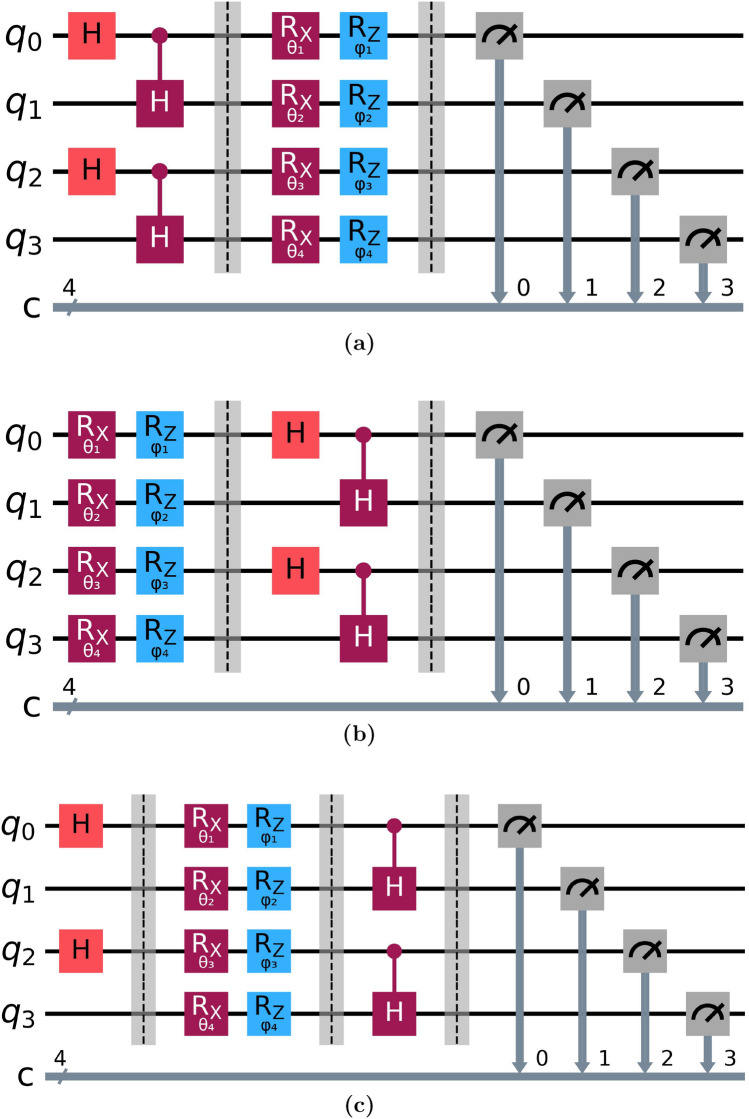
- The paper designs and benchmarks three PQRNG architectures: PQC-H-CH, H-PQC-CH, and H-CH-PQC, built from combinations of Hadamard (H), parameterized quantum circuit (PQC), and controlled-Hadamard (CH) blocks.
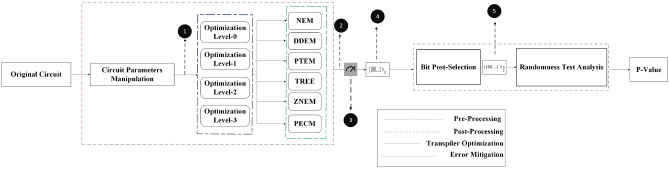
- Circuits are evaluated on an IBM noisy simulator/backend context with Transpiler optimization levels 0–3 and error mitigation techniques as preprocessing, plus post-selection and NIST SP 800-22 randomness testing as postprocessing.
- The sample consists of 19 different PQC circuits in each architecture; the paper reports evaluating 1,368 bit sequences and using four NIST parameter sets, including the default case (128, 9, 9, 10, 16, 500) for the six listed NIST tests.
## Limitations
- The paper explicitly states that the benchmarking was conducted on an IBM noisy simulator backend rather than real superconducting quantum hardware, so the results should be treated as simulator-based trends requiring validation on physical devices.
- The paper notes that the impact of circuit depth is not explored thoroughly in this study because it is intended as a baseline/benchmark for future work.
- Evident from the text: the circuit parameters are fixed to a discrete set {0, π/2, π} rather than optimized, so the study does not test fully optimized parameter settings.
Model-written summary. Check it against the paper before relying on it.
Integrity signals
Registry
Cites
Statistics
Figures
Verification
Claims the paper makes
6 Valid · 2 Not valid · 7 Not checked · 28 Own results and interpretations
The cited sources support only part of this claim — read each source’s verdict below.
In the paper
“Moreover, as mentioned, the limited circuit expressibility affects the current QRNGs’ ability to fully utilize the circuit-based randomness potential by exploring the Hilbert space21.”
§ Parameterized quantum random number generators for superconducting quantum hardware: novel architectures and NIST SP 800-22 evaluation under IBM noisy simulators > Introduction > Problem statement
What the sources say
- Partly supportedcites [21] Hubregtsen, T., Pichlmeier, J., Stecher, P. & Bertels, K. Evaluation of parameterized quantum circuits: On the relation between classification accuracy, expressibility, and entangling capability. Quantum Mach. Intell. 3(1), 9. https://doi.org/10.1007/s42484-021-00038-w (2021). sourceExperimental — accuracy not yet measured
Section 6 (Conclusion; page not provided) defines circuit expressibility in terms of a parameterized circuit’s ability to uniformly address the Hilbert space. The paper studies quantum classification, however, and does not establish that limited expressibility prevents current QRNGs from fully using circuit-based randomness potential. (LLM, conf=0.82)
plainstates a cause- Asserted: passes — The authors put it forward as true.
- Checkable: passes — It can be checked against evidence.
- Load-bearing: passes — The paper’s conclusions depend on it.
- Based: passes — The paper gives a reason why it holds.
- Partly supported
The cited sources support only part of this claim — read each source’s verdict below.
In the paper
“This is accompanied by higher levels of accumulated noise and error in the circuits77.”
§ Parameterized quantum random number generators for superconducting quantum hardware: novel architectures and NIST SP 800-22 evaluation under IBM noisy simulators > Methods > Applying preprocessing and postprocessing on PQRNGs
What the sources say
- Partly supportedcites [77] Ahsan, M., Naqvi, S. A. Z. & Anwer, H. Quantum circuit engineering for correcting coherent noise. Phys. Rev. A 105(2), 022428. https://doi.org/10.1103/PhysRevA.105.022428 (2022). sourceExperimental — accuracy not yet measured
The Introduction (p. 1) says sequences of CNOT gates add context-dependent noise, and Previous Work (p. 9) says many entangling gates can accumulate enough errors to impair later operations. These passages support a link between more entangling gates and accumulated error, but do not establish that higher levels of entanglement itself are accompanied by higher noise and error. (LLM, conf=0.84)
plainstates an association- Asserted: passes — The authors put it forward as true.
- Checkable: passes — It can be checked against evidence.
- Load-bearing: passes — The paper’s conclusions depend on it.
- Based: passes — The paper gives a reason why it holds.
- Partly supported
A result the paper reports from its own data — it cites no other source for it, so there is none to check. The quote shows it is in the paper.
In the paper
“we find that preprocessing choices influence randomness quality more strongly than adjusting NIST test parameters”
§ Parameterized quantum random number generators for superconducting quantum hardware: novel architectures and NIST SP 800-22 evaluation under IBM noisy simulators > Abstract
boostedstates a cause- Asserted: passes — The authors put it forward as true.
- Checkable: passes — It can be checked against evidence.
- Load-bearing: passes — The paper’s conclusions depend on it.
- Based: passes — The paper gives a reason why it holds.
A result the paper reports from its own data — it cites no other source for it, so there is none to check. The quote shows it is in the paper.
In the paper
“Utilizing default NIST settings, PQC-H-CH attains the largest number of fully passing preprocessing configurations (126 combinations passing all 15 tests), compared with 110 for H-PQC-CH and 69 for H-CH-PQC”
§ Parameterized quantum random number generators for superconducting quantum hardware: novel architectures and NIST SP 800-22 evaluation under IBM noisy simulators > Abstract
plainstates an association- Asserted: passes — The authors put it forward as true.
- Checkable: passes — It can be checked against evidence.
- Load-bearing: passes — The paper’s conclusions depend on it.
- Based: passes — The paper gives a reason why it holds.
A result the paper reports from its own data — it cites no other source for it, so there is none to check. The quote shows it is in the paper.
In the paper
“Across all architectures, the next most frequent outcome is passing 13/15 tests, with 17, 17, and 11 circuits achieving this level for PQC-H-CH, H-PQC-CH, and H-CH-PQC, respectively, still indicating considerable randomness.”
§ Parameterized quantum random number generators for superconducting quantum hardware: novel architectures and NIST SP 800-22 evaluation under IBM noisy simulators > Results
plain- Asserted: passes — The authors put it forward as true.
- Checkable: passes — It can be checked against evidence.
- Load-bearing: unclear — It is unclear whether the paper’s conclusions depend on it.
- Based: passes — The paper gives a reason why it holds.
13 more claims
Create a free account to see all 43 claims and to verify the 1 reference still open.
- It may state two separate claims as one. 12
- Probably not a substantial claim. 15
Citations
Cites
Bardeen, J., Cooper, L. N., & Schrieffer, J. R. (1957) · Physical Review · doi:10.1103/physrev.108.1175 · Cited by 13,213
Quantum Computation and Quantum Information: 10th Anniversary Edition
Nielsen, M. A., & Chuang, I. L. (2012) · doi:10.1017/cbo9780511976667 · Cited by 8,436
Bassham, L. E., Rukhin, A. L., Soto, J., Nechvatal, J. R., Smid, M. E., Barker, E. B., Leigh, S. D., Levenson, M., Vangel, M., Banks, D. L., et al. (2010) · NIST Special Publication 800-22 Revision 1a · doi:10.6028/nist.sp.800-22r1a · Cited by 3,617 · cited 3×
“01 suggests that the sequence is considered nonrandom with 99% confidence 75 .”
InfluentialProbabilistic machine learning and artificial intelligence
Ghahramani, Z. (2015) · Nature · doi:10.1038/nature14541 · Cited by 1,995
Superconducting Qubits: Current State of Play
Kjaergaard, M., Schwartz, M. E., Braumüller, J., Krantz, P., Wang, J. I.-J., Gustavsson, S., & Oliver, W. D. (2020) · Annual Review of Condensed Matter Physics · doi:10.1146/annurev-conmatphys-031119-050605 · Cited by 1,544 · cited 1×
“For example, in superconducting circuits, any imperfection in the pulse shaping of microwave pulses or interference from control line circuits can introduce error to the system in such a way that the final quantum state can be different from the expected one 68 .”
Trapped-ion quantum computing: Progress and challenges
Bruzewicz, C. D., Chiaverini, J., McConnell, R., & Sage, J. M. (2019) · Applied Physics Reviews · doi:10.1063/1.5088164 · Cited by 1,483 · cited 1×
“According to the literature, Quantum Processing Units (QPUs) exhibit diverse physical implementations, including photonic systems 40 , superconducting circuits 41 , and ion-trapped devices 42 .”
Classical and Quantum Computation
Kitaev, A., Shen, A., & Vyalyi, M. (2002) · Graduate Studies in Mathematics · doi:10.1090/gsm/047 · Cited by 1,387
Parameterized quantum circuits as machine learning models
Benedetti, M., Lloyd, E., Sack, S., & Fiorentini, M. (2019) · Quantum Science and Technology · doi:10.1088/2058-9565/ab4eb5 · Cited by 1,144 · cited 1×
“Moreover, PQCs are used in hybrid quantum-classical machine learning methods 58–60 as one of the promising areas of quantum computing.”
Quantum computational advantage with a programmable photonic processor
Madsen, L. S., Laudenbach, F., Askarani, M. F., Rortais, F., Vincent, T., Bulmer, J. F. F., Miatto, F. M., Neuhaus, L., Helt, L. G., Collins, M. J., et al. (2022) · Nature · doi:10.1038/s41586-022-04725-x · Cited by 1,101 · cited 1×
“According to the literature, Quantum Processing Units (QPUs) exhibit diverse physical implementations, including photonic systems 40 , superconducting circuits 41 , and ion-trapped devices 42 .”
Sim, S., Johnson, P. D., & Aspuru‐Guzik, A. (2019) · Advanced Quantum Technologies · doi:10.1002/qute.201900070 · Cited by 972 · cited 3×
“Different research groups have investigated this family using multiple layers of parameterized circuits to increase their expressibility and entangling capabilities, for example, see 55 .”
Influential
Research works printed but not linked: 2
- Tinkham, M. Introduction to Superconductivity 2nd edn. (Dover Publications, 2004).
- Von Neumann, J. Various techniques used in connection with random digits. In Monte Carlo Method, Applied Mathematics Series Vol. 12 (eds Householder, A. S. et al.) 36–38 (U.S. Government Printing Office, Washington, D.C., 1951).
Metadata
- Authors
- Salehi, R., Malik, A. W., Novotny, M. A., & Khan, S. U.
- Affiliations
- Kansas State University (US)
- Mississippi State University (US)
- Corresponding author
- Salehi, Ramin
- Venue
- Scientific Reports
- Published
- 2026-05-17
- Volume
- 16
- Issue
- 1
- ISSN
- 2045-2322 (ISSN-L)
- PMC
- PMC13385743
- OpenAlex
- W7161478311
- Semantic Scholar
- a5447cb5becaa3b3c6d57b4c78fcb72fee71eef1
- Cited by
- 1
- References
- 71
- Citations by year
- 2026: 1
- FWCI
- 1.31
- Type
- journal article
- Language
- en
- Open access
- gold
- doi.org
- Licence
- cc-by-nc-nd
- creativecommons.org/licenses/by-nc-nd/4.0 (tdm)
- creativecommons.org/licenses/by-nc-nd/4.0 (vor, 65 d)
- Locations
- Scientific Reports (publishedVersion, cc-by-nc-nd)
- PubMed (publishedVersion)
- PubMed Central (publishedVersion, cc-by-nc-nd)
- DOAJ (DOAJ: Directory of Open Access Journals) (submittedVersion)
- Topics
- Physical Sciences › Physics and Astronomy › Atomic and Molecular Physics, and Optics › Quantum Information and Cryptography
- Physical Sciences › Computer Science › Artificial Intelligence › Quantum Computing Algorithms and Architecture
- Physical Sciences › Physics and Astronomy › Atomic and Molecular Physics, and Optics › Quantum Mechanics and Applications
- Keywords
- quantum random number generators, variational quantum circuits, NISQ devices, superconducting quantum hardware, NIST SP 800-22 randomness tests, quantum randomness
About these checks
Registry, retraction, Cites and statistics results are computed, not judged, with one exception: a printed reference that no index lists is read once by a model before it counts as a citation error. Claims are extracted by a model and kept only when their quote appears verbatim in the text; each cited source is then checked, with a model’s help, for whether it says what the claim relies on. Those verdicts can be wrong — read the claim’s quote and the cited source before relying on one.
The claim verdicts this report counts are experimental: their accuracy is not yet measured.
A language model drew the claims from the paper on 2026-10-09, under version 3 of the claim definition (model deepseek-v4.1-flash, prompt extract-v3).
A second model labelled each claim on 2026-10-09 (model jev-1.13-20260917, definition revision gold-guideline-v0.2).
Cited sources are checked with a language model’s help (gpt-6-sol).
Statistics and arithmetic are recomputed, not judged.
Confidence bands are shown only for fields calibrated on our annotated test set. None is calibrated yet, so no band is shown.
What counts as a claim ›How we measure confidence ›How we check this ›
Are you an author, or do you see a problem with this page? Request a review
How to cite
Cite CoChat for the checks on this page, and the paper for its own findings.
- This page
- CoChat. (2026). Citation check: Parameterized quantum random number generators for superconducting quantum hardware: novel architectures and NIST SP 800-22 evaluation under IBM noisy simulators. https://app.cochat.ai/papers/10.1038/s41598-026-51033-9
- The paper
- Salehi, R., Malik, A. W., Novotny, M. A., & Khan, S. U. (2026). Parameterized quantum random number generators for superconducting quantum hardware: novel architectures and NIST SP 800-22 evaluation under IBM noisy simulators. Scientific Reports. https://doi.org/10.1038/s41598-026-51033-9
Data sources
Bibliographic data: Semantic Scholar, OpenAlex, Crossref.
Contains information from the Semantic Scholar Academic Graph Datasets, made available under the ODC Attribution License (ODC-BY 1.0).
Semantic Scholar’s data is described in: Kinney, R., et al. (2023). The Semantic Scholar Open Data Platform. arXiv:2301.10140.
