

Parameterized quantum random number generators for superconducting quantum hardware: novel architectures and NIST SP 800-22 evaluation under IBM noisy simulators
Open accessThe DOI matches its Crossref record; 72 of the 74 references it cites were found in a registry or an index; 7 of the 18 sources its claims cite were checked for support.
Abstract
Quantum Random Number Generators (QRNGs) exploit intrinsic quantum mechanical randomness and are promising candidates for higher-quality randomness than classical RNGs. However, QRNGs on Noisy Intermediate-Scale Quantum (NISQ) platforms are constrained by decoherence, gate and measurement errors, and limited circuit depth, and the resulting impact on statistical randomness is not yet systematically characterized. This work introduces parameterized quantum random number generator (PQRNG) architectures built from parameterized quantum circuits (PQCs) to improve tunability and expressive power under realistic noise. We study three architectures, PQC-H-CH, H-PQC-CH, and H-CH-PQC, and evaluate their randomness under Transpiler optimization and circuit-level error mitigation as preprocessing steps, using NIST SP 800-22 for statistical validation. Utilizing default NIST settings, PQC-H-CH attains the largest number of fully passing preprocessing configurations (126 combinations passing all 15 tests), compared with 110 for H-PQC-CH and 69 for H-CH-PQC, indicating strong robustness across Transpiler optimization and mitigation settings, and we find that preprocessing choices influence randomness quality more strongly than adjusting NIST test parameters.
Overview
CoChat Summary
## TL;DR
The paper proposes three parameterized quantum random number generator (PQRNG) architectures for superconducting quantum hardware and benchmarks them under IBM noisy simulators with Transpiler optimization, error mitigation, and NIST SP 800-22 testing. Across the tested configurations, PQC-H-CH performs best, and the paper concludes that preprocessing choices affect randomness more than moderate changes to NIST test parameters.
## Key findings
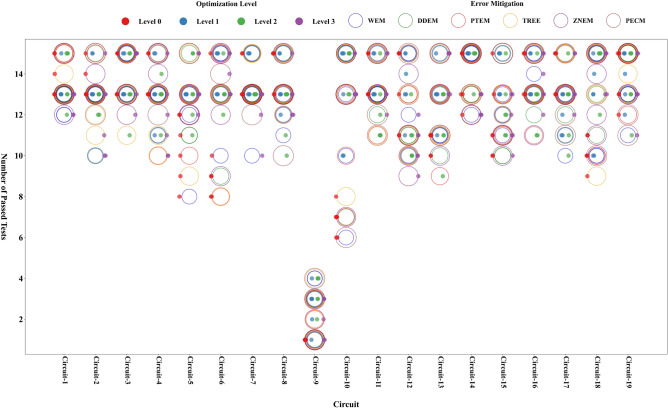
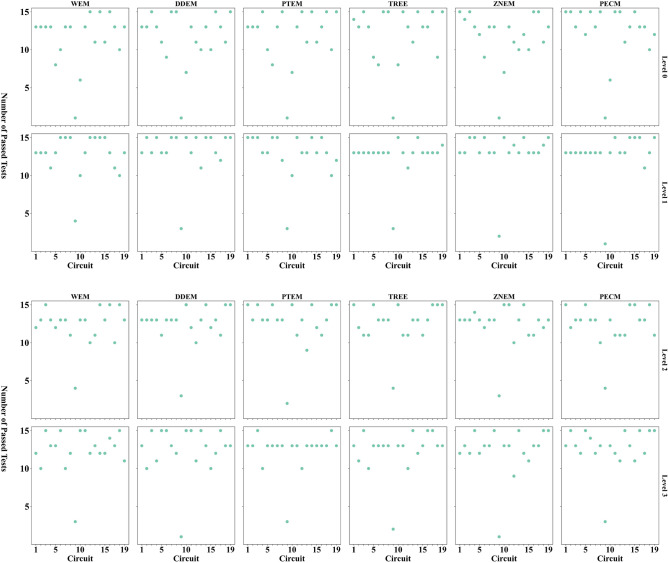
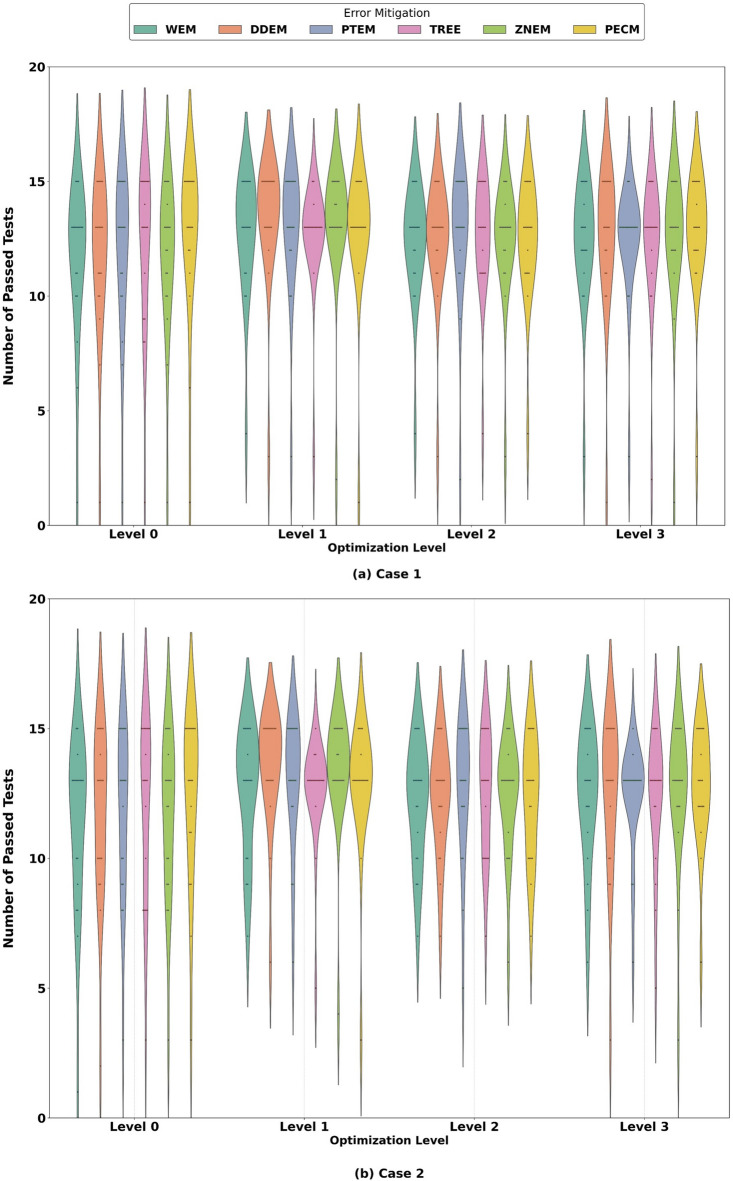
- The study analyzes 1,368 distinct bit sequences from three architectures (19 circuits per architecture; 57 circuits total), evaluated under 6 error-mitigation strategies and 4 Transpiler optimization levels, with 4 NIST parameter sets, yielding 5,472 total data points.
- Under the default NIST settings, PQC-H-CH achieved 126 fully passing preprocessing combinations (passing all 15 NIST tests), compared with 110 for H-PQC-CH and 69 for H-CH-PQC.
- In the results section, the architectures are ranked by randomness quality as PQC-H-CH strongest, H-PQC-CH next, and H-CH-PQC weakest.
- The paper reports that preprocessing parameters (Transpiler optimization and error mitigation) have a stronger impact on randomness quality than moderate calibration of NIST test parameters.
## Methods
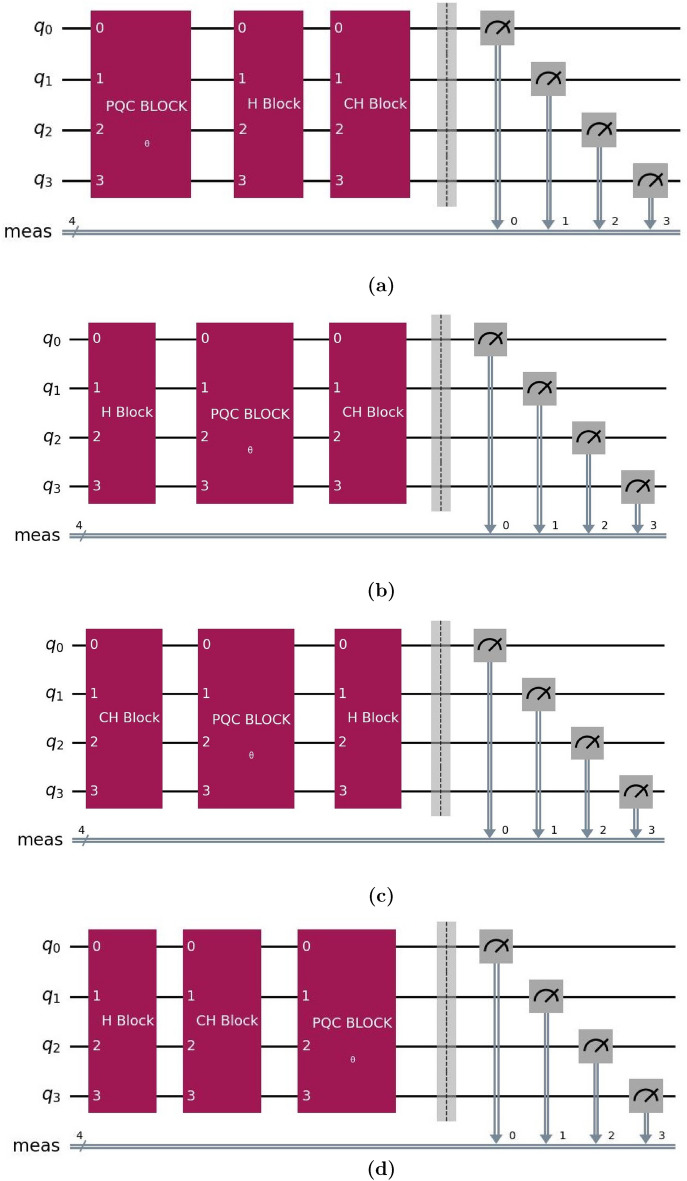
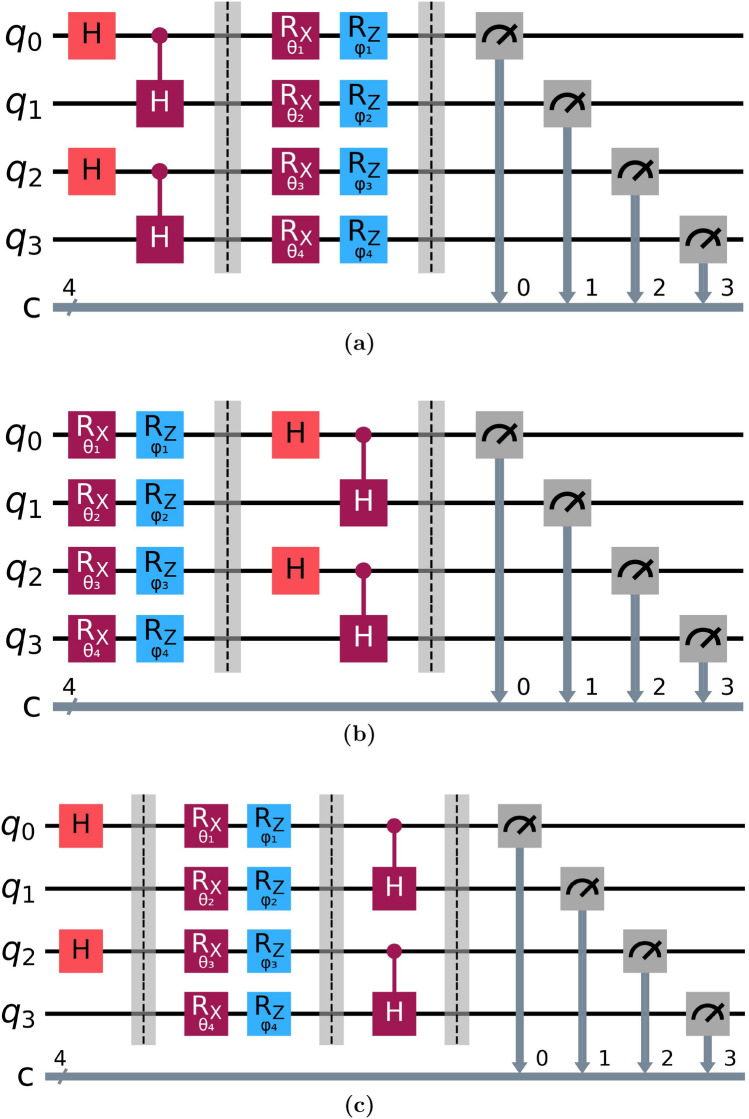
- The paper designs and benchmarks three PQRNG architectures: PQC-H-CH, H-PQC-CH, and H-CH-PQC, built from combinations of Hadamard (H), parameterized quantum circuit (PQC), and controlled-Hadamard (CH) blocks.
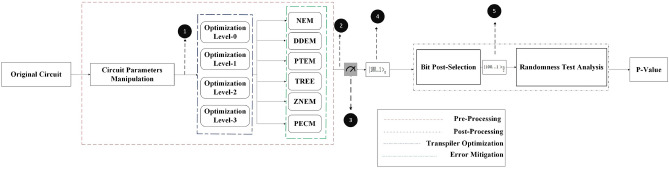
- Circuits are evaluated on an IBM noisy simulator/backend context with Transpiler optimization levels 0–3 and error mitigation techniques as preprocessing, plus post-selection and NIST SP 800-22 randomness testing as postprocessing.
- The sample consists of 19 different PQC circuits in each architecture; the paper reports evaluating 1,368 bit sequences and using four NIST parameter sets, including the default case (128, 9, 9, 10, 16, 500) for the six listed NIST tests.
## Limitations
- The paper explicitly states that the benchmarking was conducted on an IBM noisy simulator backend rather than real superconducting quantum hardware, so the results should be treated as simulator-based trends requiring validation on physical devices.
- The paper notes that the impact of circuit depth is not explored thoroughly in this study because it is intended as a baseline/benchmark for future work.
- Evident from the text: the circuit parameters are fixed to a discrete set {0, π/2, π} rather than optimized, so the study does not test fully optimized parameter settings.
Model-written summary. Check it against the paper before relying on it.
Integrity signals
Registry
Cites
Statistics
Figures
Verification
Claims the paper makes
6 Valid · 2 Not valid · 7 Not checked · 28 Own results and interpretations
The cited sources support only part of this claim — read each source’s verdict below.
In the paper
“Moreover, as mentioned, the limited circuit expressibility affects the current QRNGs’ ability to fully utilize the circuit-based randomness potential by exploring the Hilbert space21.”
§ Parameterized quantum random number generators for superconducting quantum hardware: novel architectures and NIST SP 800-22 evaluation under IBM noisy simulators > Introduction > Problem statement
What the sources say
- Partly supportedcites [21] Hubregtsen, T., Pichlmeier, J., Stecher, P. & Bertels, K. Evaluation of parameterized quantum circuits: On the relation between classification accuracy, expressibility, and entangling capability. Quantum Mach. Intell. 3 (1), 9. 10.1007/s42484-021-00038-w (2021). sourceExperimental — accuracy not yet measured
Section 6 (Conclusion; page not provided) defines circuit expressibility in terms of a parameterized circuit’s ability to uniformly address the Hilbert space. The paper studies quantum classification, however, and does not establish that limited expressibility prevents current QRNGs from fully using circuit-based randomness potential. (LLM, conf=0.82)
plainstates a cause- Asserted: passes — The authors put it forward as true.
- Checkable: passes — It can be checked against evidence.
- Load-bearing: passes — The paper’s conclusions depend on it.
- Based: passes — The paper gives a reason why it holds.
- Partly supported
The cited sources support only part of this claim — read each source’s verdict below.
In the paper
“This is accompanied by higher levels of accumulated noise and error in the circuits77.”
§ Parameterized quantum random number generators for superconducting quantum hardware: novel architectures and NIST SP 800-22 evaluation under IBM noisy simulators > Methods > Applying preprocessing and postprocessing on PQRNGs
What the sources say
- Partly supportedcites [77] Ahsan, M., Naqvi, S. A. Z. & Anwer, H. Quantum circuit engineering for correcting coherent noise. Phys. Rev. A 105 (2), 022428. 10.1103/PhysRevA.105.022428 (2022). sourceExperimental — accuracy not yet measured
The Introduction (p. 1) says sequences of CNOT gates add context-dependent noise, and Previous Work (p. 9) says many entangling gates can accumulate enough errors to impair later operations. These passages support a link between more entangling gates and accumulated error, but do not establish that higher levels of entanglement itself are accompanied by higher noise and error. (LLM, conf=0.84)
plainstates an association- Asserted: passes — The authors put it forward as true.
- Checkable: passes — It can be checked against evidence.
- Load-bearing: passes — The paper’s conclusions depend on it.
- Based: passes — The paper gives a reason why it holds.
- Partly supported
A result the paper reports from its own data — it cites no other source for it, so there is none to check. The quote shows it is in the paper.
In the paper
“we find that preprocessing choices influence randomness quality more strongly than adjusting NIST test parameters”
§ Parameterized quantum random number generators for superconducting quantum hardware: novel architectures and NIST SP 800-22 evaluation under IBM noisy simulators > Abstract
boostedstates a cause- Asserted: passes — The authors put it forward as true.
- Checkable: passes — It can be checked against evidence.
- Load-bearing: passes — The paper’s conclusions depend on it.
- Based: passes — The paper gives a reason why it holds.
A result the paper reports from its own data — it cites no other source for it, so there is none to check. The quote shows it is in the paper.
In the paper
“Utilizing default NIST settings, PQC-H-CH attains the largest number of fully passing preprocessing configurations (126 combinations passing all 15 tests), compared with 110 for H-PQC-CH and 69 for H-CH-PQC”
§ Parameterized quantum random number generators for superconducting quantum hardware: novel architectures and NIST SP 800-22 evaluation under IBM noisy simulators > Abstract
plainstates an association- Asserted: passes — The authors put it forward as true.
- Checkable: passes — It can be checked against evidence.
- Load-bearing: passes — The paper’s conclusions depend on it.
- Based: passes — The paper gives a reason why it holds.
A result the paper reports from its own data — it cites no other source for it, so there is none to check. The quote shows it is in the paper.
In the paper
“Across all architectures, the next most frequent outcome is passing 13/15 tests, with 17, 17, and 11 circuits achieving this level for PQC-H-CH, H-PQC-CH, and H-CH-PQC, respectively, still indicating considerable randomness.”
§ Parameterized quantum random number generators for superconducting quantum hardware: novel architectures and NIST SP 800-22 evaluation under IBM noisy simulators > Results
plain- Asserted: passes — The authors put it forward as true.
- Checkable: passes — It can be checked against evidence.
- Load-bearing: unclear — It is unclear whether the paper’s conclusions depend on it.
- Based: passes — The paper gives a reason why it holds.
13 more claims
Create a free account to see all 43 claims and to verify the 1 reference still open.
- It may state two separate claims as one. 12
- Probably not a substantial claim. 15
Citations
Cites
Bardeen, J., Cooper, L. N., & Schrieffer, J. R. (1957) · Physical Review · doi:10.1103/physrev.108.1175 · Cited by 13,213
Quantum Computation and Quantum Information: 10th Anniversary Edition
Nielsen, M. A., & Chuang, I. L. (2012) · doi:10.1017/cbo9780511976667 · Cited by 8,436
Bassham, L. E., Rukhin, A. L., Soto, J., Nechvatal, J. R., Smid, M. E., Barker, E. B., Leigh, S. D., Levenson, M., Vangel, M., Banks, D. L., et al. (2010) · NIST Special Publication 800-22 Revision 1a · doi:10.6028/nist.sp.800-22r1a · Cited by 3,617 · cited 3×
“01 suggests that the sequence is considered nonrandom with 99% confidence 75 .”
InfluentialProbabilistic machine learning and artificial intelligence
Ghahramani, Z. (2015) · Nature · doi:10.1038/nature14541 · Cited by 1,995
Superconducting Qubits: Current State of Play
Kjaergaard, M., Schwartz, M. E., Braumüller, J., Krantz, P., Wang, J. I.-J., Gustavsson, S., & Oliver, W. D. (2020) · Annual Review of Condensed Matter Physics · doi:10.1146/annurev-conmatphys-031119-050605 · Cited by 1,544 · cited 1×
“For example, in superconducting circuits, any imperfection in the pulse shaping of microwave pulses or interference from control line circuits can introduce error to the system in such a way that the final quantum state can be different from the expected one 68 .”
Trapped-ion quantum computing: Progress and challenges
Bruzewicz, C. D., Chiaverini, J., McConnell, R., & Sage, J. M. (2019) · Applied Physics Reviews · doi:10.1063/1.5088164 · Cited by 1,483 · cited 1×
“According to the literature, Quantum Processing Units (QPUs) exhibit diverse physical implementations, including photonic systems 40 , superconducting circuits 41 , and ion-trapped devices 42 .”
Classical and Quantum Computation
Kitaev, A., Shen, A., & Vyalyi, M. (2002) · Graduate Studies in Mathematics · doi:10.1090/gsm/047 · Cited by 1,387
Parameterized quantum circuits as machine learning models
Benedetti, M., Lloyd, E., Sack, S., & Fiorentini, M. (2019) · Quantum Science and Technology · doi:10.1088/2058-9565/ab4eb5 · Cited by 1,144 · cited 1×
“Moreover, PQCs are used in hybrid quantum-classical machine learning methods 58–60 as one of the promising areas of quantum computing.”
Quantum computational advantage with a programmable photonic processor
Madsen, L. S., Laudenbach, F., Askarani, M. F., Rortais, F., Vincent, T., Bulmer, J. F. F., Miatto, F. M., Neuhaus, L., Helt, L. G., Collins, M. J., et al. (2022) · Nature · doi:10.1038/s41586-022-04725-x · Cited by 1,101 · cited 1×
“According to the literature, Quantum Processing Units (QPUs) exhibit diverse physical implementations, including photonic systems 40 , superconducting circuits 41 , and ion-trapped devices 42 .”
Sim, S., Johnson, P. D., & Aspuru‐Guzik, A. (2019) · Advanced Quantum Technologies · doi:10.1002/qute.201900070 · Cited by 972 · cited 3×
“Different research groups have investigated this family using multiple layers of parameterized circuits to increase their expressibility and entangling capabilities, for example, see 55 .”
InfluentialQuantum Algorithms for Quantum Chemistry and Quantum Materials Science
Bauer, B., Bravyi, S., Motta, M., & Chan, G. K.-L. (2020) · Chemical Reviews · doi:10.1021/acs.chemrev.9b00829 · Cited by 848 · cited 1×
“Based on this capability, parameterized quantum circuits have been widely used in variational quantum algorithms 56 , which play a vital role in Quantum Chemistry 57 .”
Quantum random number generators
Herrero-Collantes, M., & Garcia-Escartin, J. C. (2017) · Reviews of Modern Physics · doi:10.1103/revmodphys.89.015004 · Cited by 791
Noise-Induced Barren Plateaus in Variational Quantum Algorithms
Wang, S., Fontana, E., Cerezo, M., Sharma, K., Sone, A., Cincio, L., & Coles, P. J. (2020) · arXiv · doi:10.48550/arxiv.2007.14384 · Cited by 791
Noise-induced barren plateaus in variational quantum algorithms
Wang, S., Fontana, E., Cerezo, M., Sharma, K., Sone, A., Cincio, L., & Coles, P. J. (2021) · Nature Communications · doi:10.1038/s41467-021-27045-6 · Cited by 773 · cited 1×
“Based on this capability, parameterized quantum circuits have been widely used in variational quantum algorithms 56 , which play a vital role in Quantum Chemistry 57 .”
Noise tailoring for scalable quantum computation via randomized compiling
Wallman, J. J., & Emerson, J. (2016) · Physical Review A · doi:10.1103/physreva.94.052325 · Cited by 535 · cited 2×
“Some of these error mitigation techniques are Dynamical Decoupling 65 , Pauli Twirling 66 , Twirled Readout Error Extinction (TREE) 67 , Zero Noise Extrapolation (ZNE) 70 , Probabilistic Error Amplification (PEA) 71 and Probabilistic Error Cancellation (PEC) 72 .”
A noise-based IC random number generator for applications in cryptography
Petrie, C. S., & Connelly, J. A. (2000) · IEEE Transactions on Circuits and Systems I: Fundamental Theory and Applications · doi:10.1109/81.847868 · Cited by 487 · cited 1×
“Nonoptical QRNGs exploit other quantum phenomena, such as quantum tunneling 31 , radioactive decay 28 , or noise in electronic and CMOS circuits, to generate randomness 32 .”
Monte Carlo simulations: Hidden errors from ‘‘good’’ random number generators
Ferrenberg, A. M., Landau, D. P., & Wong, Y. J. (1992) · Physical Review Letters · doi:10.1103/physrevlett.69.3382 · Cited by 437
Noise-Adaptive Compiler Mappings for Noisy Intermediate-Scale Quantum Computers
Murali, P., Baker, J. M., Javadi-Abhari, A., Chong, F. T., & Martonosi, M. (2019) · Proceedings of the Twenty-Fourth International Conference on Architectural Support for Programming Languages and Operating Systems · doi:10.1145/3297858.3304075 · Cited by 411 · cited 1×
“To solve this issue, several techniques, such as use of SWAP gates, are introduced 76 , which are beyond the scope of the current research.”
Superconducting quantum computing: a review
Huang, H.-L., Wu, D., Fan, D., & Zhu, X. (2020) · Science China Information Sciences · doi:10.1007/s11432-020-2881-9 · Cited by 378 · cited 7×
“The corresponding figures for H-PQC-CH and H-CH-PQC are provided in Supplementary Figures 28, and 29.”
InfluentialAn Efficient Methodology for Mapping Quantum Circuits to the IBM QX Architectures
Zulehner, A., Paler, A., & Wille, R. (2019) · IEEE Transactions on Computer-Aided Design of Integrated Circuits and Systems · doi:10.1109/tcad.2018.2846658 · Cited by 372 · cited 1×
“Accordingly, IBM, a leader in NISQ superconducting quantum computers, which has provided public access to its quantum computers since 2017 43 utilizes this model of quantum computing.”
A brief survey of Cryptocurrency systems
Mukhopadhyay, U., Skjellum, A., Hambolu, O., Oakley, J., Yu, L., & Brooks, R. (2016) · 2016 14th Annual Conference on Privacy, Security and Trust (PST) · doi:10.1109/pst.2016.7906988 · Cited by 321
Probabilistic error cancellation with sparse Pauli–Lindblad models on noisy quantum processors
van den Berg, E., Minev, Z. K., Kandala, A., & Temme, K. (2023) · Nature Physics · doi:10.1038/s41567-023-02042-2 · Cited by 305 · cited 2×
“Some of these error mitigation techniques are Dynamical Decoupling 65 , Pauli Twirling 66 , Twirled Readout Error Extinction (TREE) 67 , Zero Noise Extrapolation (ZNE) 70 , Probabilistic Error Amplification (PEA) 71 and Probabilistic Error Cancellation (PEC) 72 .”
Certified randomness in quantum physics
Acín, A., & Masanes, L. (2016) · Nature · doi:10.1038/nature20119 · Cited by 298
Dynamical decoupling for superconducting qubits: A performance survey
Ezzell, N., Pokharel, B., Tewala, L., Quiroz, G., & Lidar, D. A. (2023) · Physical Review Applied · doi:10.1103/physrevapplied.20.064027 · Cited by 292 · cited 2×
“Some of these error mitigation techniques are Dynamical Decoupling 65 , Pauli Twirling 66 , Twirled Readout Error Extinction (TREE) 67 , Zero Noise Extrapolation (ZNE) 70 , Probabilistic Error Amplification (PEA) 71 and Probabilistic Error Cancellation (PEC) 72 .”
Chaos-based random number generators. Part II: practical realization
Stojanovski, T., Pihl, J., & Kocarev, L. (2001) · IEEE Transactions on Circuits and Systems I: Fundamental Theory and Applications · doi:10.1109/81.915396 · Cited by 279 · cited 1×
“Stojanovski et al. mentioned that chaotic systems exhibit deterministic behavior on the microscopic scale, while they appear random on the macroscopic scale 18 .”
Quasi-Monte Carlo Methods in Numerical Finance
Joy, C., Boyle, P. P., & Tan, K. S. (1996) · Management Science · doi:10.1287/mnsc.42.6.926 · Cited by 243 · cited 2×
“Here, Case 1 is used as the reference NIST setting, with parameters (128, 9, 9, 10, 16, 500) for the Block Frequency, Non-overlapping Template, Overlapping Template, Approximate Entropy, Serial, and Linear Complexity block lengths.”
Digital zero noise extrapolation for quantum error mitigation
Giurgica-Tiron, T., Hindy, Y., LaRose, R., Mari, A., & Zeng, W. J. (2020) · 2020 IEEE International Conference on Quantum Computing and Engineering (QCE) · doi:10.1109/qce49297.2020.00045 · Cited by 241
Digital zero noise extrapolation for quantum error mitigation
Giurgica-Tiron, T., Hindy, Y., LaRose, R., Mari, A., & Zeng, W. J. (2020) · arXiv · doi:10.48550/arxiv.2005.10921 · Cited by 241
Javadi-Abhari, A., Treinish, M., Krsulich, K., Wood, C. J., Lishman, J., Gacon, J., Martiel, S., Nation, P. D., Bishop, L. S., Cross, A. W., et al. (2024) · arXiv (Cornell University) · doi:10.48550/arxiv.2405.08810 · Cited by 208 · cited 3×
“” Consequently, based on the optimization level, various techniques, such as using swapping gates, resynthesizing two-qubit blocks, and Unitarity-breaking passes are utilized in the literature 64 to modify circuit layouts and routings.”
Challenges and opportunities in quantum optimization
Abbas, A., Ambainis, A., Augustino, B., Bärtschi, A., Buhrman, H., Coffrin, C., Cortiana, G., Dunjko, V., Egger, D. J., Elmegreen, B. G., et al. (2024) · Nature Reviews Physics · doi:10.1038/s42254-024-00770-9 · Cited by 201 · cited 1×
“Further, as mentioned earlier, this group of circuits is also a necessary component of many well-known quantum algorithms, including those for optimization 61,62 .”
Scalable error mitigation for noisy quantum circuits produces competitive expectation values
Kim, Y., Wood, C. J., Yoder, T. J., Merkel, S. T., Gambetta, J. M., Temme, K., & Kandala, A. (2023) · Nature Physics · doi:10.1038/s41567-022-01914-3 · Cited by 191 · cited 1×
“Some of these error mitigation techniques are Dynamical Decoupling 65 , Pauli Twirling 66 , Twirled Readout Error Extinction (TREE) 67 , Zero Noise Extrapolation (ZNE) 70 , Probabilistic Error Amplification (PEA) 71 and Probabilistic Error Cancellation (PEC) 72 .”
The generation of 68 Gbps quantum random number by measuring laser phase fluctuations
Nie, Y.-Q., Huang, L., Liu, Y., Payne, F., Zhang, J., & Pan, J.-W. (2015) · Review of Scientific Instruments · doi:10.1063/1.4922417 · Cited by 167 · cited 1×
“Figure 6 evaluates the calibration of NIST parameter for Case 1 (128, 9, 9, 10, 16, 500), while the figures for 4 (128, 15, 18, 20, 32, 500) are presented in the supplementary information, noting that other values may also be tested 75 .”
Model-free readout-error mitigation for quantum expectation values
van den Berg, E., Minev, Z. K., & Temme, K. (2022) · Physical Review A · doi:10.1103/physreva.105.032620 · Cited by 162 · cited 7×
“Three major parts of any quantum circuit are susceptible to errors, including the operation of the gates, implementation of the qubits (decoherence), and the measurement procedure 64–67 .”
InfluentialMaximization of Extractable Randomness in a Quantum Random-Number Generator
Haw, J. Y., Assad, S. M., Lance, A. M., Ng, N. H. Y., Sharma, V., Lam, P. K., & Symul, T. (2015) · Physical Review Applied · doi:10.1103/physrevapplied.3.054004 · Cited by 138
Hubregtsen, T., Pichlmeier, J., Stecher, P., & Bertels, K. (2021) · Quantum Machine Intelligence · doi:10.1007/s42484-021-00038-w · Cited by 135 · cited 3×
“Moreover, as mentioned, the limited circuit expressibility affects the current QRNGs’ ability to fully utilize the circuit-based randomness potential by exploring the Hilbert space 21 .”
Probabilistic Smart Contracts: Secure Randomness on the Blockchain
Chatterjee, K., Goharshady, A. K., & Pourdamghani, A. (2019) · IEEE International Conference on Blockchain and Cryptocurrency (ICBC) · doi:10.1109/bloc.2019.8751326 · Cited by 128
Mannalath, V., Mishra, S., & Pathak, A. (2023) · Quantum Information Processing · doi:10.1007/s11128-023-04175-y · Cited by 125
18.8 Gbps real-time quantum random number generator with a photonic integrated chip
Bai, B., Huang, J., Qiao, G.-R., Nie, Y.-Q., Tang, W., Chu, T., Zhang, J., & Pan, J.-W. (2021) · Applied Physics Letters · doi:10.1063/5.0056027 · Cited by 121 · cited 1×
“PRNGs are algorithmic-based and depend on initial seeds to produce random-like sequences 4 , whereas TRNGs harness randomness based on physical phenomena, such as thermal noise 26 , vacuum fluctuations 27 , and radioactive decay 28 .”
Performance comparison of optimization methods on variational quantum algorithms
Bonet-Monroig, X., Wang, H., Vermetten, D., Senjean, B., Moussa, C., Bäck, T., Dunjko, V., & O'Brien, T. E. (2023) · Physical Review A · doi:10.1103/physreva.107.032407 · Cited by 107 · cited 1×
“Further, as mentioned earlier, this group of circuits is also a necessary component of many well-known quantum algorithms, including those for optimization 61,62 .”
Error Propagation in NISQ Devices for Solving Classical Optimization Problems
González-García, G., Trivedi, R., & Cirac, J. I. (2022) · PRX Quantum · doi:10.1103/prxquantum.3.040326 · Cited by 76 · cited 2×
“Previously, the noise and error effects on various quantum algorithms were investigated in the field 19,20 .”
Lee, K., Lee, S., Seo, C., & Yim, K. (2018) · IEEE Access · doi:10.1109/access.2018.2799682 · Cited by 73
Probabilistic error cancellation for dynamic quantum circuits
Gupta, R. S., van den Berg, E., Takita, M., Ristè, D., Temme, K., & Kandala, A. (2024) · Physical Review A · doi:10.1103/physreva.109.062617 · Cited by 70
Quantum random number cloud platform
Huang, L., Zhou, H., Feng, K., & Xie, C. (2021) · npj Quantum Information · doi:10.1038/s41534-021-00442-x · Cited by 57
Open Problems in Mathematics and Computational Science
(2014) · doi:10.1007/978-3-319-10683-0 · Cited by 50
Quantum true random number generation on IBM’s cloud platform
Kumar, V., Rayappan, J. B. B., Amirtharajan, R., & Praveenkumar, P. (2022) · Journal of King Saud University - Computer and Information Sciences · doi:10.1016/j.jksuci.2022.01.015 · Cited by 49 · cited 1×
“Whilst Kumar et al. 52 apply odd numbers of Hadamard gates consecutively to generate randomness.”
Demonstration of 30 Gbit/s Generation of Superconductive True Random Number Generator
Sugiura, T., Yamanashi, Y., & Yoshikawa, N. (2010) · IEEE Transactions on Applied Superconductivity · doi:10.1109/tasc.2010.2092401 · Cited by 47 · cited 1×
“Across all architectures, the next most frequent outcome is passing 13/15 tests, with 17, 17, and 11 circuits achieving this level for PQC-H-CH, H-PQC-CH, and H-CH-PQC, respectively, still indicating considerable randomness.”
Random Number Generators—Principles and Practices
Johnston, D. (2018) · De Gruyter eBooks · doi:10.1515/9781501506062 · Cited by 45
Li, Y., Fei, Y., Wang, W., Meng, X., Wang, H., Duan, Q., & Ma, Z. (2021) · Scientific Reports · doi:10.1038/s41598-021-03286-9 · Cited by 44 · cited 2×
“For example, in 53 , the authors use R y ( π/ 2) , z -basis measurement, and x -basis measurement for randomness generation, and then they utilize a Toeplitz-matrix hashing randomness extractor to improve the randomness of the generated bit strings.”
Quantum random number generators with entanglement for public randomness testing
Jacak, J. E., Jacak, W. A., Donderowicz, W. A., & Jacak, L. (2020) · Scientific Reports · doi:10.1038/s41598-019-56706-2 · Cited by 43
Extracting random numbers from quantum tunnelling through a single diode
Bernardo-Gavito, R., Bagci, I. E., Roberts, J., Sexton, J., Astbury, B., Shokeir, H., McGrath, T., Noori, Y. J., Woodhead, C. S., Missous, M., et al. (2017) · Scientific Reports · doi:10.1038/s41598-017-18161-9 · Cited by 42
Combined Pseudo-Random Sequence Generator for Cybersecurity
Maksymovych, V., Shabatura, M., Гарасимчук, О. І., Shevchuk, R., Sawicki, P., & Zając, T. (2022) · Sensors · doi:10.3390/s22249700 · Cited by 36
Quantum encryption of superposition states with quantum permutation pad in IBM quantum computers
Perepechaenko, M., & Kuang, R. (2023) · EPJ Quantum Technology · doi:10.1140/epjqt/s40507-023-00164-3 · Cited by 34
A truly random number generator based on thermal noise
Zhun, H., & Hongyi, C. (2002) · IEEE International Conference on ASIC (ASICON) · doi:10.1109/icasic.2001.982700 · Cited by 32 · cited 1×
“PRNGs are algorithmic-based and depend on initial seeds to produce random-like sequences 4 , whereas TRNGs harness randomness based on physical phenomena, such as thermal noise 26 , vacuum fluctuations 27 , and radioactive decay 28 .”
Quantum visual feature encoding revisited
Nguyen, X.-B., Nguyen, H.-Q., Churchill, H., Khan, S. U., & Luu, K. (2024) · Quantum Machine Intelligence · doi:10.1007/s42484-024-00192-x · Cited by 32
Self-citationFurther analysis of the statistical independence of the NIST SP 800-22 randomness tests
Luengo, E. A., Olivares, B. A., Villalba, L. J. G., & Hernandez-Castro, J. (2023) · Applied Mathematics and Computation · doi:10.1016/j.amc.2023.128222 · Cited by 26 · cited 1×
“Several studies have examined the NIST test to evaluate its quality and assess statistical errors, for example, the reader can refer to 22–24 .”
Diffusion-inspired quantum noise mitigation in parameterized quantum circuits
Nguyen, H.-Q., Nguyen, X.-B., Chen, S. Y.-C., Churchill, H., Borys, N. J., Khan, S. U., & Luu, K. (2025) · Quantum Machine Intelligence · doi:10.1007/s42484-025-00276-2 · Cited by 23
Self-citationQuantum circuit engineering for correcting coherent noise
Ahsan, M., Naqvi, S. A. Z., & Anwer, H. (2022) · Physical Review A · doi:10.1103/physreva.105.022428 · Cited by 22
The effect of quantum noise on algorithmic perfect quantum state transfer on NISQ processors
Валерьевич, Б. Д., & Pogosov, W. V. (2021) · Quantum Information Processing · doi:10.1007/s11128-021-03346-z · Cited by 20 · cited 1×
“Previously, the noise and error effects on various quantum algorithms were investigated in the field 19,20 .”
Robust Qubit Mapping Algorithm via Double-Source Optimal Routing on Large Quantum Circuits
Cheng, C.-Y., Yang, C.-Y., Kuo, Y.-H., Wang, R.-C., Cheng, H.-C., & Huang, C.-Y. (. (2024) · ACM Transactions on Quantum Computing · doi:10.1145/3680291 · Cited by 19 · cited 1×
“That is, the QRNG circuits must be mapped to each quantum processor, which has its own predefined set of available quantum gates and qubits 36 .”
Hybrid Hadamard and controlled-Hadamard based quantum random number generators in IBM QX
Salehi, R., Razaghi, M., & Fotouhi, B. (2022) · Physica Scripta · doi:10.1088/1402-4896/ac698b · Cited by 15 · cited 15×
“Whereas the authors in 49 introduced a Hybrid Hadamard CNOT gate using an XOR bit mask postprocessing scheme as part of an NISQRNG architecture.”
InfluentialSelf-citationError Analysis of NIST SP 800-22 Test Suite
Chen, D., Chen, H., Fan, L., & Luo, K. (2023) · IEEE Transactions on Information Forensics and Security · doi:10.1109/tifs.2023.3287391 · Cited by 14
Azeez, M., Ugiagbe, U. O., Albert-Sogules, I., et al. (2024) · World Journal of Advanced Research and Reviews · doi:10.30574/wjarr.2024.23.1.2242 · Cited by 13
A programmable true random number generator using commercial quantum computers
Sinha, A., Henderson, E. R., Henderson, J. M., Larson, E. C., & Thornton, M. A. (2023) · doi:10.1117/12.2663497 · Cited by 12 · cited 1×
“Accordingly, based on this model, several circuit variations have been introduced in recent year 38,47–53 .”
Barthe, A., Grossi, M., Vallecorsa, S., Tura, J., & Dunjko, V. (2025) · npj Quantum Information · doi:10.1038/s41534-025-01064-3 · Cited by 11 · cited 2×
“Further, the authors in 54 implemented the QRNG with a well-known Bell States circuit for extracting the quantum randomness, which contains Hadamard and CNOT gates.”
Stochastic performance analysis of a time‐of‐arrival quantum random number generator
Schranz, Á., Solymos, B., & Telek, M. (2023) · IET Quantum Communication · doi:10.1049/qtc2.12080 · Cited by 9 · cited 2×
“Although previous optical QRNGs heavily depend on photon detection (e.g., photon arrival time 29 or photon counting numbers 30 ), they primarily rely on specialized optical setups, such as lasers and photodetectors.”
Yadav, A., Mishra, S., & Pathak, A. (2024) · Physica Scripta · doi:10.1088/1402-4896/ad7c02 · Cited by 8 · cited 1×
“Correspondingly, this emerging branch of QRNGs, based on their physical implementation of qubits and quantum gates, can be categorized as optical-NISQRNG 37 or non-optical NISQRNG 38,39 .”
Secure random number generation from parity symmetric radiations
Tsurumaru, T., Sasaki, T., & Tsutsui, I. (2022) · Communications Physics · doi:10.1038/s42005-022-00915-1 · Cited by 6 · cited 7×
“The corresponding figures for H-PQC-CH and H-CH-PQC are provided in Supplementary Figures 28, and 29.”
InfluentialRandom Numbers for Machine Learning: A Comparative Study of Reproducibility and Energy Consumption
Antunes, B. A., & Hill, D. R. C. (2024) · Journal of Data Science and Intelligent Systems · doi:10.47852/bonviewjdsis42024012 · Cited by 6
Sensitivity and uniformity in statistical randomness tests
Almaraz Luengo, E., Leiva Cerna, M., García Villalba, L. J., Hurley-Smith, D., & Hernandez-Castro, J. (2022) · Journal of Information Security and Applications · doi:10.1016/j.jisa.2022.103322 · Cited by 5 · cited 1×
“Several studies have examined the NIST test to evaluate its quality and assess statistical errors, for example, the reader can refer to 22–24 .”
Quantum random number generation using Quandela photonic quantum computer
de Souza, M. A., Agostini, F. P., & Tarelho, L. V. G. (2024) · Quantum Information Processing · doi:10.1007/s11128-024-04593-6 · Cited by 5 · cited 3×
“Moreover, de Souza et al. utilized a photonic QPU for implementing a cloud-based QRNG 37 .”
Quantum random number generation using a solid state single photon source
White, S., Klauck, F., Schmitt, N., Tran, T. T., Kianinia, M., Steinfurth, A., Aharonovich, I., Szameit, A., & Solntsev, A. S. (2019) · doi:10.1117/12.2541286 · Cited by 3 · cited 1×
“Although previous optical QRNGs heavily depend on photon detection (e.g., photon arrival time 29 or photon counting numbers 30 ), they primarily rely on specialized optical setups, such as lasers and photodetectors.”
Mar’Ah, L., Mulyawan, R., & Suksmono, A. B. (2024) · IEEE International Conference on Advanced Telecommunication and Networking Technologies (ATNT) · doi:10.1109/atnt61688.2024.10719212 · Cited by 3 · cited 1×
“Whereas the authors in 49 introduced a Hybrid Hadamard CNOT gate using an XOR bit mask postprocessing scheme as part of an NISQRNG architecture.”
Automated Quantum Circuit Generation for Computing Inverse Hash FunctionsPreprint
Henderson, E. R., Henderson, J. M., Oxford, W. V., et al. (2024) · arXiv (Cornell University) · doi:10.48550/arxiv.2404.17142 · Cited by 1 · cited 3×
“Here, Case 1 is used as the reference NIST setting, with parameters (128, 9, 9, 10, 16, 500) for the Block Frequency, Non-overlapping Template, Overlapping Template, Approximate Entropy, Serial, and Linear Complexity block lengths.”
Automated quantum circuit generation for computing inverse hash functions
Henderson, E. R., Henderson, J. M., Oxford, W. V., et al. (2024) · doi:10.1117/12.3012744
Research works printed but not linked: 2
- Tinkham, M. Introduction to Superconductivity 2nd edn. (Dover Publications, 2004).
- Von Neumann, J. Various techniques used in connection with random digits. In Monte Carlo Method, Applied Mathematics Series Vol. 12 (eds Householder, A. S. et al.) 36–38 (U.S. Government Printing Office, Washington, D.C., 1951).
Metadata
- Authors
- Salehi, R., Malik, A. W., Novotny, M. A., & Khan, S. U.
- Affiliations
- Kansas State University (US)
- Mississippi State University (US)
- Corresponding author
- Salehi, Ramin
- Venue
- Scientific Reports
- Published
- 2026-05-17
- Volume
- 16
- Issue
- 1
- ISSN
- 2045-2322 (ISSN-L)
- PMC
- PMC13385743
- OpenAlex
- W7161478311
- Semantic Scholar
- a5447cb5becaa3b3c6d57b4c78fcb72fee71eef1
- Cited by
- 1
- References
- 71
- Citations by year
- 2026: 1
- FWCI
- 1.31
- Type
- journal article
- Language
- en
- Open access
- gold
- doi.org
- Licence
- cc-by-nc-nd
- creativecommons.org/licenses/by-nc-nd/4.0 (tdm)
- creativecommons.org/licenses/by-nc-nd/4.0 (vor, 65 d)
- Locations
- Scientific Reports (publishedVersion, cc-by-nc-nd)
- PubMed (publishedVersion)
- PubMed Central (publishedVersion, cc-by-nc-nd)
- DOAJ (DOAJ: Directory of Open Access Journals) (submittedVersion)
- Topics
- Physical Sciences › Physics and Astronomy › Atomic and Molecular Physics, and Optics › Quantum Information and Cryptography
- Physical Sciences › Computer Science › Artificial Intelligence › Quantum Computing Algorithms and Architecture
- Physical Sciences › Physics and Astronomy › Atomic and Molecular Physics, and Optics › Quantum Mechanics and Applications
- Keywords
- quantum random number generators, variational quantum circuits, NISQ devices, superconducting quantum hardware, NIST SP 800-22 randomness tests, quantum randomness
About these checks
Registry, retraction, Cites and statistics results are computed, not judged, with one exception: a printed reference that no index lists is read once by a model before it counts as a citation error. Claims are extracted by a model and kept only when their quote appears verbatim in the text; each cited source is then checked, with a model’s help, for whether it says what the claim relies on. Those verdicts can be wrong — read the claim’s quote and the cited source before relying on one.
The claim verdicts this report counts are experimental: their accuracy is not yet measured.
A language model drew the claims from the paper on 2026-10-09, under version 3 of the claim definition (model deepseek-v4.1-flash, prompt extract-v3).
A second model labelled each claim on 2026-10-09 (model jev-1.13-20260917, definition revision gold-guideline-v0.2).
Cited sources are checked with a language model’s help (gpt-6-sol).
Statistics and arithmetic are recomputed, not judged.
Confidence bands are shown only for fields calibrated on our annotated test set. None is calibrated yet, so no band is shown.
What counts as a claim ›How we measure confidence ›How we check this ›
Are you an author, or do you see a problem with this page? Request a review
Data sources
Bibliographic data: Semantic Scholar, OpenAlex, Crossref.
Contains information from the Semantic Scholar Academic Graph Datasets, made available under the ODC Attribution License (ODC-BY 1.0).
Semantic Scholar’s data is described in: Kinney, R., et al. (2023). The Semantic Scholar Open Data Platform. arXiv:2301.10140.
