

Decentralised health record management with blockchain: privacy and security in cloud-based systems
Open accessThe DOI matches its Crossref record; 63 of the 64 references it cites were found in a registry or an index; none of the 8 sources its claims cite is checked for support yet.
Abstract
The rise of Electronic Health Records (EHRs) has created a new challenge for healthcare organisations: how to manage, share and secure the growing amounts of health data. Conventional cloud-based EHR systems remain susceptible to centralised trust, limited auditability, and inflexible access-control mechanisms, and most existing blockchain-based systems don’t collectively support adaptive policy enforcement, privacy-preserving authentication, and anomaly-aware access validation. To address these limitations, this paper introduces the decentralised EHR management framework HealthBlockSecure, which combines permissioned blockchain infrastructure, encrypted off-chain storage, authentication with zero-knowledge proofs (ZKPs), decentralised identities, smart-contract-based policy enforcement, and the PrivAccessNet deep learning model. PrivAccessNet can provide context-aware access validation and anomaly detection based on request and policy attributes, and the external ZKP verification service can provide minimal-disclosure authentication without revealing sensitive identity information. Experimental evaluation with SyntheticMass and MIMIC-IV showed a mean access-violation prevention rate of 96.3% for five re-experiments and an audit-verification accuracy of 99.2%. It also identified all simulated tampering attempts using SHA-256 integrity verification. In general, HealthBlockSecure delivers an integrated solution for privacy-sensitive, auditable, and adaptive management of access to EHRs, with secure-access validation latency measured in the near-real-time range. The complete HealthBlockSecure implementation is publicly available at https://github.com/Sripada-RamaSree/HealthBlockSecure .
Overview
CoChat Summary
TL;DR
The paper introduces HealthBlockSecure, a decentralised EHR management framework combining permissioned blockchain, encrypted off-chain storage, ZKP authentication, DIDs, smart-contract policy enforcement, and the PrivAccessNet deep learning model. In controlled experiments on SyntheticMass and MIMIC-IV, it reports high access-violation prevention, audit-verification accuracy, and tamper detection, with added latency versus centralised OAuth.
Key findings
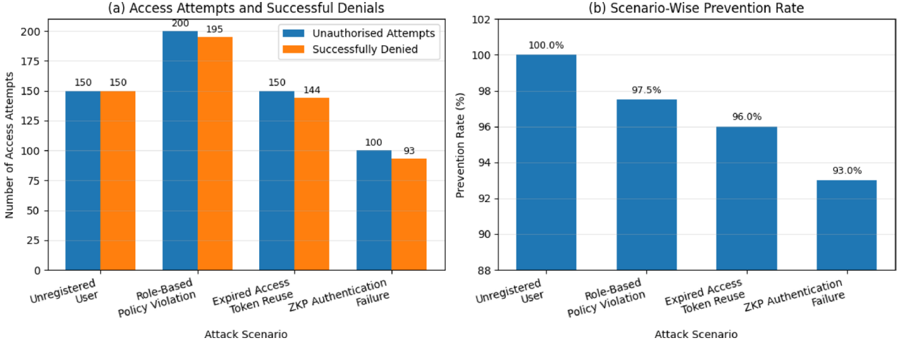
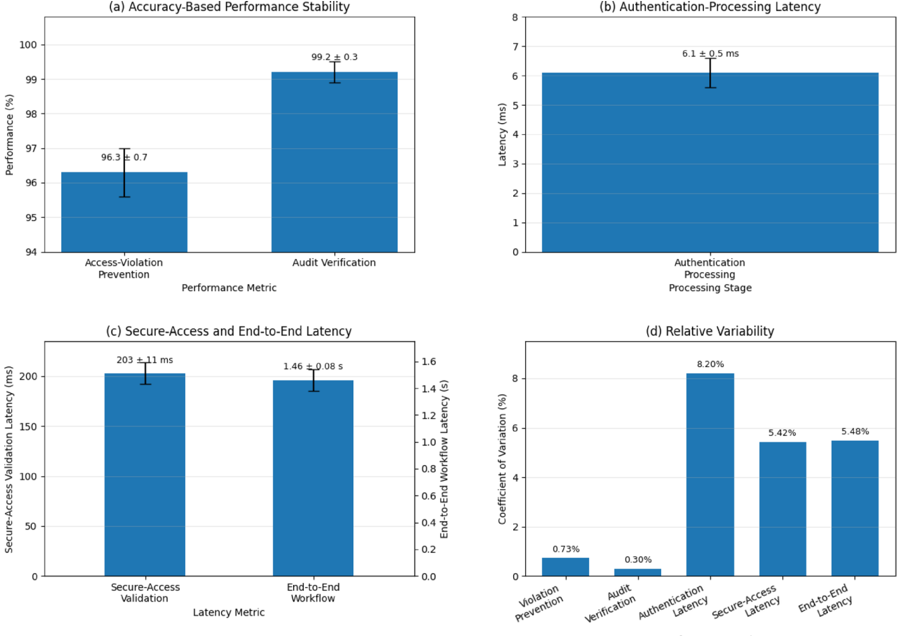
- Across five repeated runs, HealthBlockSecure achieved a mean access-violation prevention rate of 96.3 ± 0.7% and audit-verification accuracy of 99.2 ± 0.3%; a representative 600-attempt run prevented 582/600 (97.0%), including 150/150 unregistered-user attempts, 195/200 role-based policy violations, 144/150 expired-token reuses, and 93/100 invalid ZKP authentication attempts.
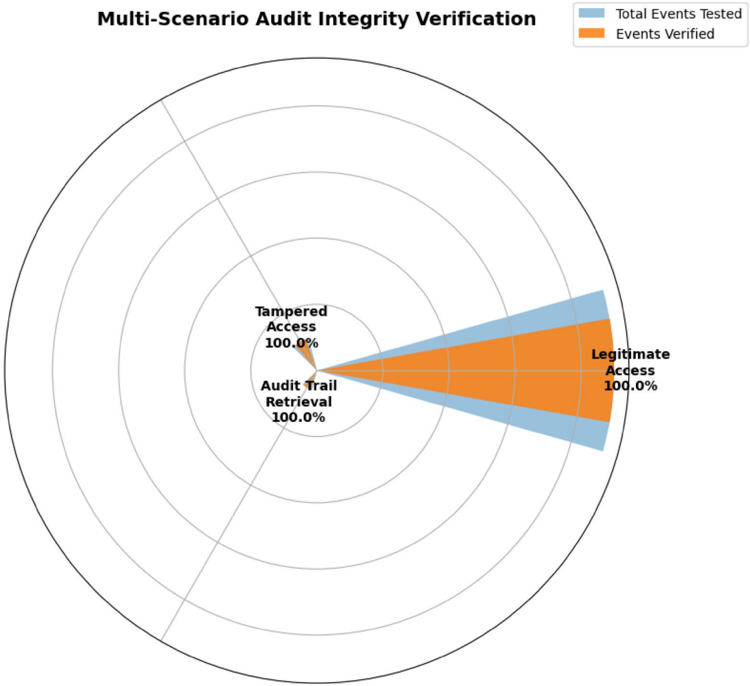
- SHA-256 integrity verification detected all 50 tampered records among 500 access events, and complete audit-trail retrieval was achieved for 30 patients (100%).
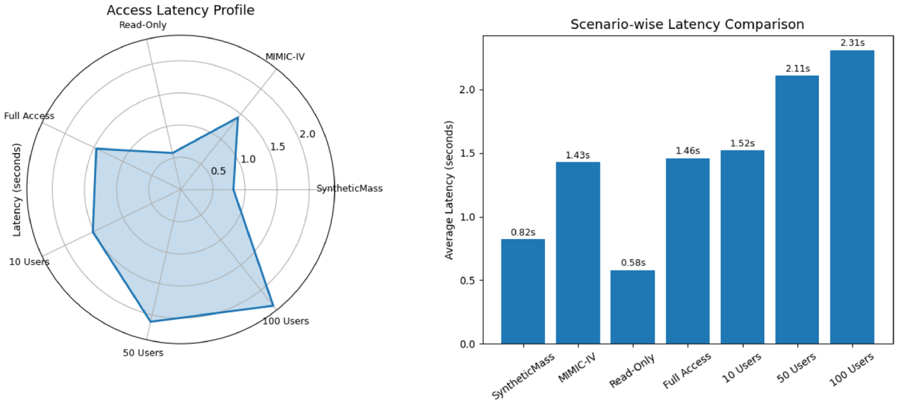
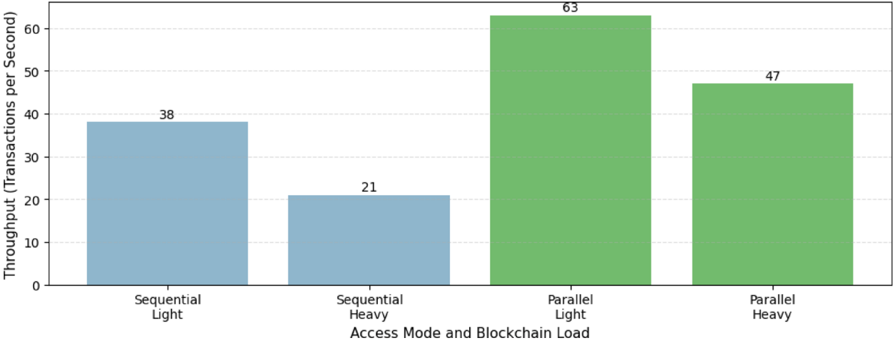
- End-to-end access latency was 1.43 s for MIMIC-IV and 0.82 s for SyntheticMass; read-only access averaged 0.58 s and full access 1.46 s; latency rose to 1.52 s, 2.11 s, and 2.31 s at 10, 50, and 100 concurrent users, respectively. Throughput was 38/21 transactions per second for sequential light/heavy load and 63/47 for parallel light/heavy load.
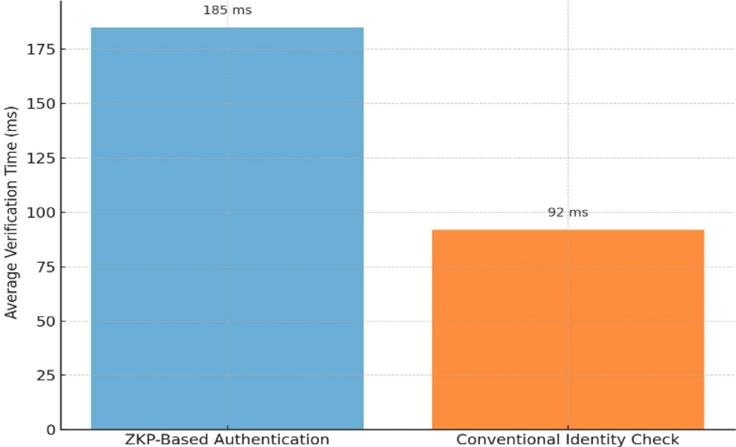
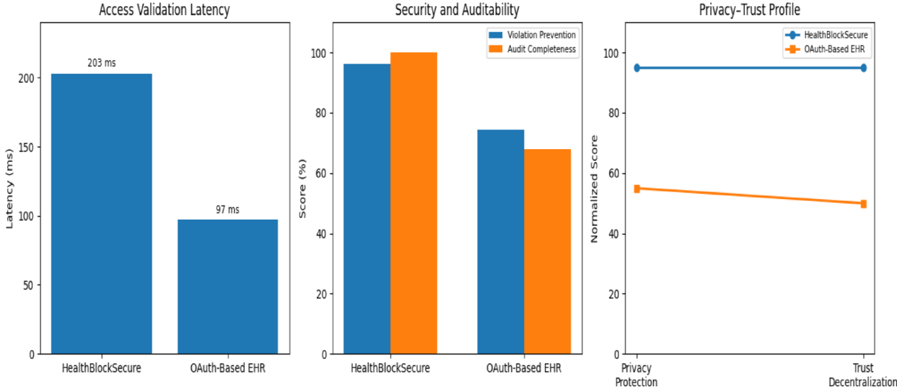
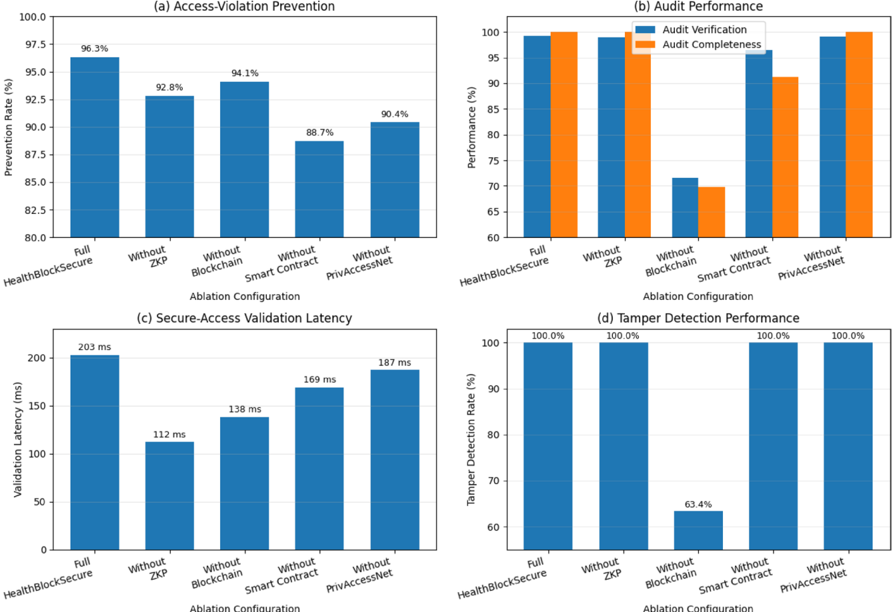
- ZKP authentication took 185 ms versus 92 ms for conventional identity checks; secure-access validation latency was 203 ms versus 97 ms for centralised OAuth, while violation prevention was 96.3% versus 74.5% and audit completeness 100% versus 68%. Ablation showed prevention dropped to 92.8% without ZKP, 88.7% without smart contracts, and 90.4% without PrivAccessNet; audit verification dropped to 71.6% without blockchain.
Methods
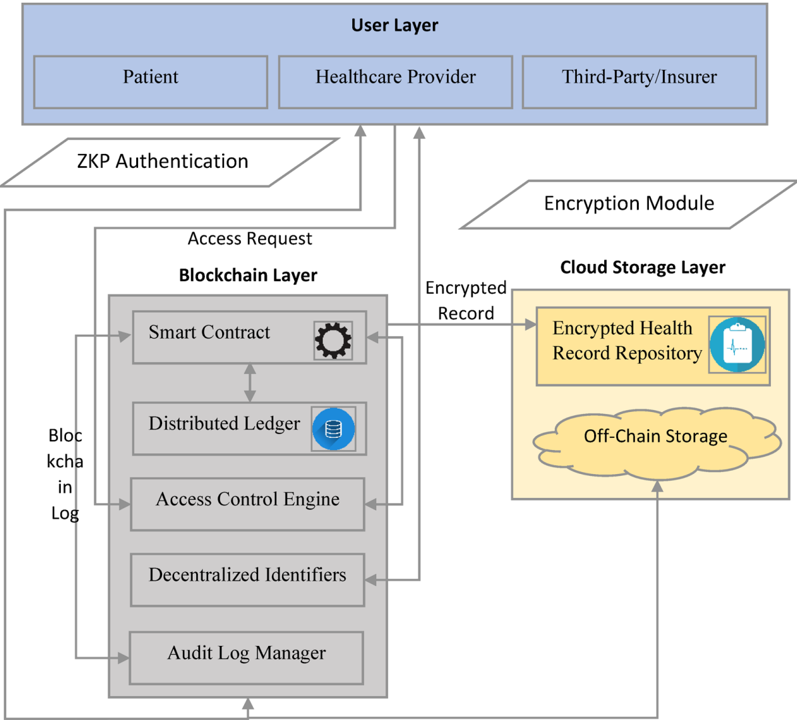
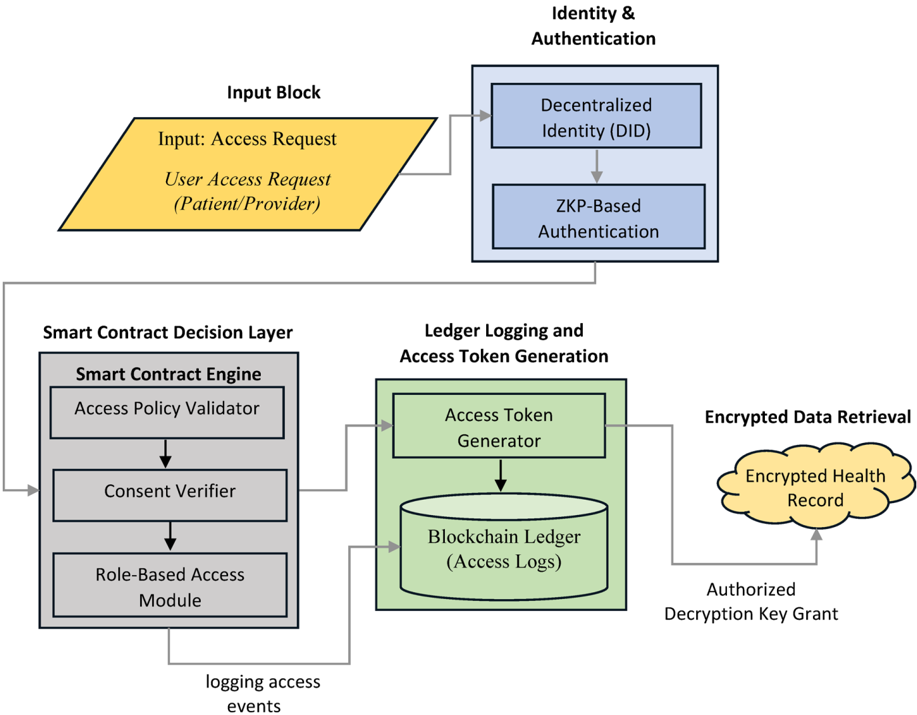
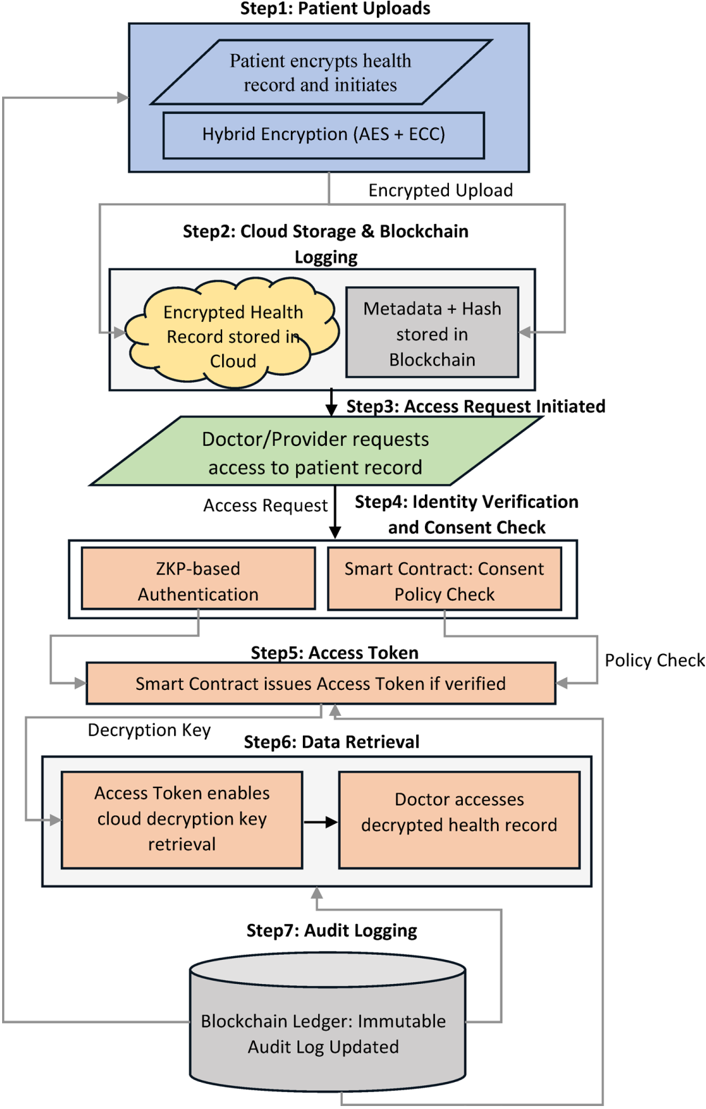
- Design: HealthBlockSecure uses a layered architecture (user, blockchain, cloud storage) with Hyperledger Fabric 2.x, Go smart contracts, AES-encrypted off-chain storage (AWS S3 and IPFS-compatible references), ECC-protected session keys, DIDs, external Python zk-SNARK verification via REST API, SHA-256 integrity hashes, and PrivAccessNet for context-aware access validation.
- Data/sample: SyntheticMass (10,000 patient records) and MIMIC-IV (~5,000 records) were used; 1,000 access requests per dataset were simulated from doctors, nurses, and researchers, with 30% unauthorised or expired-token cases and 70% compliant cases in a Docker/Docker Compose prototype.
- Analysis: PrivAccessNet is a three-hidden-layer dense network (64/32/16 neurons) with ReLU, batch normalisation, dropout 0.30, sigmoid output, Adam optimiser (learning rate 0.001), binary cross-entropy loss, batch size 32, maximum 50 epochs, early stopping, and a 20% validation subset; evaluation covered latency, throughput, violation prevention, audit verification, ZKP latency, ablation, controlled baselines, and five repeated runs with confidence intervals.
Limitations
- Stated: the evaluation was a controlled simulation using public datasets and synthetic access requests, not real healthcare networks, institutional policies, infrastructure, or user behaviour; PrivAccessNet was trained on simulated access events and would need adaptation using real access logs under privacy, ethical, and governance constraints.
- Stated: computational and operational overhead arises from blockchain endorsement, ordering, commitment, ZKP proof transmission and external verification, serialisation, communication, PrivAccessNet inference, encrypted cloud retrieval, key handling, and local decryption; this may worsen under higher concurrency or resource-constrained settings, and long-term deployment raises concerns about replicated blockchain storage, synchronisation, infrastructure maintenance, off-chain storage management, ledger growth, certificate management, policy representation, interoperability, and identity-management integration.
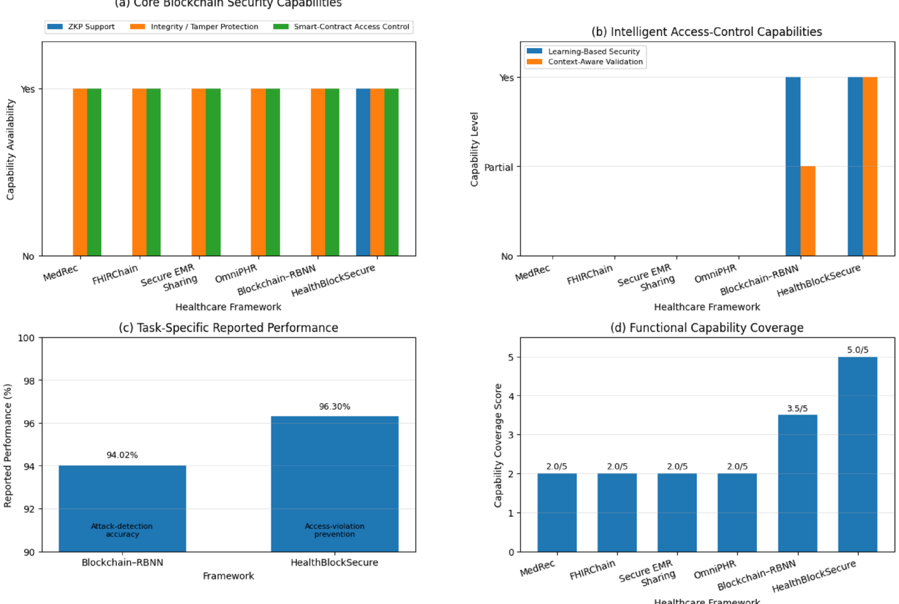
- Evident from the text: comparisons with existing blockchain healthcare frameworks are literature-based contextual benchmarks rather than direct experiments; the reported experiments did not automate online retraining; and results are for a containerised prototype, not production-scale healthcare deployment.
Model-written summary. Check it against the paper before relying on it.
Integrity signals
Registry
Cites
Statistics
Figures
Verification
Claims the paper makes
0 Valid · 6 Not valid · 4 Not checked · 133 Own results and interpretations
A result the paper reports from its own data — it cites no other source for it, so there is none to check. The quote shows it is in the paper.
In the paper
“It also identified all simulated tampering attempts using SHA-256 integrity verification.”
§ Decentralised health record management with blockchain: privacy and security in cloud-based systems > Abstract
plainstates a cause- Asserted: passes — The authors put it forward as true.
- Checkable: passes — It can be checked against evidence.
- Load-bearing: passes — The paper’s conclusions depend on it.
- Based: passes — The paper gives a reason why it holds.
- Rests on an assumption not shown here.
A result the paper reports from its own data — it cites no other source for it, so there is none to check. The quote shows it is in the paper.
In the paper
“Read-only operations like metadata access or audit log access required, on average, 0.58 s, while full record access, including secure key retrieval, encrypted data transfer, and local decryption, required 1.46 s on average.”
- Also stated in: § Throughput evaluation · plain
“Read-Only 0.58 Full Access 1.46”
§ Decentralised health record management with blockchain: privacy and security in cloud-based systems > Access latency analysis
plain- Asserted: passes — The authors put it forward as true.
- Checkable: passes — It can be checked against evidence.
- Load-bearing: unclear — It is unclear whether the paper’s conclusions depend on it.
- Based: passes — The paper gives a reason why it holds.
- Also stated in: § Throughput evaluation · plain
A result the paper reports from its own data — it cites no other source for it, so there is none to check. The quote shows it is in the paper.
In the paper
“Experimental evaluation with SyntheticMass and MIMIC-IV showed a mean access-violation prevention rate of 96.3% for five re-experiments and an audit-verification accuracy of 99.2%.”
§ Decentralised health record management with blockchain: privacy and security in cloud-based systems > Abstract
plain- Asserted: passes — The authors put it forward as true.
- Checkable: passes — It can be checked against evidence.
- Load-bearing: passes — The paper’s conclusions depend on it.
- Based: passes — The paper gives a reason why it holds.
- Rests on an assumption not shown here.
A result the paper reports from its own data — it cites no other source for it, so there is none to check. The quote shows it is in the paper.
In the paper
“Read-only operations like metadata access or audit log access required, on average, 0.58 s, while full record access, including secure key retrieval, encrypted data transfer, and local decryption, required 1.46 s on average.”
- Also stated in: § Throughput evaluation · plain
“Read-Only 0.58 Full Access 1.46”
§ Decentralised health record management with blockchain: privacy and security in cloud-based systems > Access latency analysis
plain- Asserted: passes — The authors put it forward as true.
- Checkable: passes — It can be checked against evidence.
- Load-bearing: passes — The paper’s conclusions depend on it.
- Based: passes — The paper gives a reason why it holds.
- Also stated in: § Throughput evaluation · plain
A result the paper reports from its own data — it cites no other source for it, so there is none to check. The quote shows it is in the paper.
In the paper
“Experimental evaluation with SyntheticMass and MIMIC-IV showed a mean access-violation prevention rate of 96.3% for five re-experiments and an audit-verification accuracy of 99.2%.”
§ Decentralised health record management with blockchain: privacy and security in cloud-based systems > Abstract
plain- Asserted: passes — The authors put it forward as true.
- Checkable: passes — It can be checked against evidence.
- Load-bearing: passes — The paper’s conclusions depend on it.
- Based: passes — The paper gives a reason why it holds.
- Rests on an assumption not shown here.
56 more claims
Create a free account to see all 143 claims and every source verdict.
- It may state two separate claims as one. 52
- Probably not a substantial claim. 45
Self-check
Percentages, sums and reported differences re-computed from the paper’s own numbers.
Each contradiction between two passages listed here was confirmed by an independent check.
Rated minor: it would not touch a result — a value no result rests on, a p-value that stays on the same side of the significance level, or a conflict that is clerical, resolved elsewhere in the paper, or outside its own findings.
In the paper
§ Decentralised health record management with blockchain: privacy and security in cloud-based systems > Controlled baseline evaluation under matched experimental conditions
“An anomaly-aware access assessment is possible without PrivAccessNet”
§ Decentralised health record management with blockchain: privacy and security in cloud-based systems > Ablation study of HealthBlockSecure components
“Last but not least, the PrivAccessNet-disabled configuration relied on fixed access-policy rules and lacked learned contextual anomaly detection.”
Rated minor: it would not touch a result — a value no result rests on, a p-value that stays on the same side of the significance level, or a conflict that is clerical, resolved elsewhere in the paper, or outside its own findings.
In the paper
§ Decentralised health record management with blockchain: privacy and security in cloud-based systems > Controlled baseline evaluation under matched experimental conditions
“minimal-disclosure verification of the requester is possible without ZKP authentication.”
§ Decentralised health record management with blockchain: privacy and security in cloud-based systems > Ablation study of HealthBlockSecure components
“The alternative configuration, however, lacked privacypreserving credential validation, which caused access-violation prevention to drop from 96.3% to 92.8%.”
Rated minor: it would not touch a result — a value no result rests on, a p-value that stays on the same side of the significance level, or a conflict that is clerical, resolved elsewhere in the paper, or outside its own findings.
In the paper
§ Decentralised health record management with blockchain: privacy and security in cloud-based systems > Ablation study of HealthBlockSecure components
“Access-violation prevention dropped from 99.9% to 90.4% without PrivAccessNet”
§ Decentralised health record management with blockchain: privacy and security in cloud-based systems > Ablation study of HealthBlockSecure components
“The smart-contract ablation caused the largest drop in access-violation prevention, from 96.3% to 88.7%.”
Rated minor: it would not touch a result — a value no result rests on, a p-value that stays on the same side of the significance level, or a conflict that is clerical, resolved elsewhere in the paper, or outside its own findings.
In the paper
§ Decentralised health record management with blockchain: privacy and security in cloud-based systems > Comparison with existing methods
“The latter, HealthBlockSecure, on the other hand, obviates the need for permissioned blockchain infrastructure”
§ Decentralised health record management with blockchain: privacy and security in cloud-based systems > Conclusion and future scope
“This study introduces a blockchain-based EHR management framework, HealthBlockSecure, which combines the following components: permissioned ledger infrastructure, encrypted off-chain storage, ZKP-assisted authentication, smart-contract-based access control, PrivAccessNet-based contextual validation, and cryptographic integrity verification.”
Citations
Cites
MedRec: Using Blockchain for Medical Data Access and Permission Management
Azaria, A., Ekblaw, A., Vieira, T., & Lippman, A. (2016) · 2016 2nd International Conference on Open and Big Data (OBD) · doi:10.1109/obd.2016.11 · Cited by 2,526
Fhirchain: applying blockchain to securely and scalably share clinical data
Zhang, P., White, J., Schmidt, D. C., Lenz, G., & Rosenbloom, S. T. (2018) · Computational and Structural Biotechnology Journal · doi:10.1016/j.csbj.2018.07.004 · Cited by 796
Secure and Trustable Electronic Medical Records Sharing using Blockchain
Dubovitskaya, A., Xu, Z., Ryu, S., Schumacher, M., & Wang, F. (2017) · PubMed · doi:10.48550/arxiv.1709.06528 · Cited by 422
BlockMedCare: A healthcare system based on IoT, Blockchain and IPFS for data management security
Azbeg, K., Ouchetto, O., & Jai Andaloussi, S. (2022) · Egyptian Informatics Journal · doi:10.1016/j.eij.2022.02.004 · Cited by 268
Kumar, R., Kumar, P., Tripathi, R., Gupta, G. P., Islam, A. K. M. N., & Shorfuzzaman, M. (2022) · IEEE Transactions on Industrial Informatics · doi:10.1109/tii.2022.3161631 · Cited by 204
MedShare: A Privacy-Preserving Medical Data Sharing System by Using Blockchain
Wang, M., Guo, Y., Zhang, C., Wang, C., Huang, H., & Jia, X. (2021) · IEEE Transactions on Services Computing · doi:10.1109/tsc.2021.3114719 · Cited by 203
Mamun, A. A., Azam, S., & Gritti, C. (2022) · IEEE Access · doi:10.1109/access.2022.3141079 · Cited by 185
BEdgeHealth: A Decentralized Architecture for Edge-Based IoMT Networks Using Blockchain
Nguyen, D. C., Pathirana, P. N., Ding, M., & Seneviratne, A. (2021) · IEEE Internet of Things Journal · doi:10.1109/jiot.2021.3058953 · Cited by 184
Saidi, H., Labraoui, N., Ari, A. A. A., Maglaras, L. A., & Emati, J. H. M. (2022) · IEEE Access · doi:10.1109/access.2022.3207803 · Cited by 175
Reegu, F. A., Abas, H., Gulzar, Y., Xin, Q., Alwan, A. A., Jabbari, A., Sonkamble, R. G., & Dziyauddin, R. A. (2023) · Sustainability · doi:10.3390/su15086337 · Cited by 167
Privacy Preservation of Electronic Health Records in the Modern Era: A Systematic Survey
Nowrozy, R., Ahmed, K. E. U., Kayes, A. S. M., Wang, H., & McIntosh, T. R. (2024) · ACM Computing Surveys · doi:10.1145/3653297 · Cited by 153
Gohar, A. N., AbdelMawgoud, S. A., & Farhan, M. S. (2022) · IEEE Access · doi:10.1109/access.2022.3202902 · Cited by 148
Wu, G., Wang, S., Ning, Z., & Zhu, B. (2021) · IEEE Journal of Biomedical and Health Informatics · doi:10.1109/jbhi.2021.3123643 · Cited by 136
Security, Privacy, and Reliability in Digital Healthcare Systems Using Blockchain
Ali, A., Rahim, H. A., Pasha, M. F., Dowsley, R., Masud, M., Ali, J., & Baz, M. (2021) · Electronics · doi:10.3390/electronics10162034 · Cited by 130
Systematic Review on AI-Blockchain Based E-Healthcare Records Management Systems
Haddad, A., Habaebi, M. H., Islam, M. R., Hasbullah, N. F., & Zabidi, S. A. (2022) · IEEE Access · doi:10.1109/access.2022.3201878 · Cited by 129
Blockchain Technology for Electronic Health Records
Han, Y., Zhang, Y., & Vermund, S. H. (2022) · International Journal of Environmental Research and Public Health · doi:10.3390/ijerph192315577 · Cited by 121
Secure Data Transmission of Electronic Health Records Using Blockchain Technology
Sonkamble, R. G., Bongale, A. M., Phansalkar, S., Sharma, A., & Rajput, S. S. (2023) · Electronics · doi:10.3390/electronics12041015 · Cited by 110
A Review of Blockchain-Based Secure Sharing of Healthcare Data
Peng, X., Zhang, X., Wang, L. Y., Liu, W., & Peng, S. (2022) · Applied Sciences · doi:10.3390/app12157912 · Cited by 107
A Privacy-Preserving Medical Data Sharing Scheme Based on Blockchain
Xu, G., Chen, Q., Dong, W., Gong, L., Liu, S., Chen, S., Liu, J., & Zheng, X. (2022) · IEEE Journal of Biomedical and Health Informatics · doi:10.1109/jbhi.2022.3203577 · Cited by 103
Blockchain and cloud computing-based secure electronic healthcare records storage and sharing
Amanat, A., Rizwan, M., Maple, C. R., Zikria, Y. B., Almadhor, A. S., & Kim, S. W. (2022) · Frontiers in Public Health · doi:10.3389/fpubh.2022.938707 · Cited by 99
Blockchain-based privacy preservation framework for healthcare data in cloud environment
Verma, G. (2022) · Journal of Experimental & Theoretical Artificial Intelligence · doi:10.1080/0952813x.2022.2135611 · Cited by 99
A Blockchain-Based Secret-Data Sharing Framework for Personal Health Records in Emergency Condition
Rajput, A. R., Li, Q., & Ahvanooey, M. T. (2021) · Healthcare · doi:10.3390/healthcare9020206 · Cited by 98
Ismail, L., Materwala, H., & Hennebelle, A. (2021) · Sensors · doi:10.3390/s21113753 · Cited by 88
A blockchain-based secure data-sharing framework for Software Defined Wireless Body Area Networks
Hasan, K., Chowdhury, M. J. M., Biswas, K., Ahmed, K. E. U., Islam, M. S., & Usman, M. (2022) · Computer Networks · doi:10.1016/j.comnet.2022.109004 · Cited by 88
Security-Aware and Privacy-Preserving Personal Health Record Sharing Using Consortium Blockchain
Wang, Y., Zhang, A., Zhang, P., Qu, Y., & Yu, S. (2021) · IEEE Internet of Things Journal · doi:10.1109/jiot.2021.3132780 · Cited by 85
Fugkeaw, S., Wirz, L., & Hak, L. (2023) · IEEE Access · doi:10.1109/access.2023.3288332 · Cited by 77
A blockchain-based system for patient data privacy and security
Masood, I., Daud, A. Y., Wang, Y., Banjar, A., & Alharbey, R. (2024) · Multimedia Tools and Applications · doi:10.1007/s11042-023-17941-y · Cited by 77
Secure data sharing with blockchain for remote health monitoring applications: a review
Upadrista, V., Nazir, S., & Tianfield, H. (2023) · Journal of Reliable Intelligent Environments · doi:10.1007/s40860-023-00204-w · Cited by 70
Jakhar, A. K., Singh, M., Sharma, R., Viriyasitavat, W., Dhiman, G., & Goel, S. (2024) · Multimedia Tools and Applications · doi:10.1007/s11042-024-18827-3 · Cited by 67
Centralized vs. Decentralized Cloud Computing in Healthcare
Abughazalah, M., Alsaggaf, W., Saifuddin, S., & Sarhan, S. S. (2024) · Applied Sciences · doi:10.3390/app14177765 · Cited by 67
Synergy of AI and Blockchain to Secure Electronic Healthcare Records
Rathore, N., Kumari, A., Patel, M., Chudasama, A. S., Bhalani, D., Tanwar, S., & Alabdulatif, A. (2024) · Security and Privacy · doi:10.1002/spy2.463 · Cited by 67
Blockchain-Based Decentralized Cloud Solutions for Data Transfer
Nair, R., Nasrullah, S., Vinayasree, P., Singh, P., Zahra, M. M. A., Sharma, T., & Ahmadi, F. (2022) · Computational Intelligence and Neuroscience · doi:10.1155/2022/8209854 · Cited by 66
Secure Healthcare Record Sharing Mechanism with Blockchain
Butt, G. Q., Syed, T. A., Riaz, R., Rizvi, S. S., & Paul, A. (2022) · Applied Sciences · doi:10.3390/app12052307 · Cited by 60
Combining Blockchain and IoT for Decentralized Healthcare Data Management
Meisami, S., Meisami, S., Yousefi, M., & Aref, M. R. (2023) · International Journal on Cryptography and Information Security · doi:10.5121/ijcis.2023.13102 · Cited by 60
A Framework of the Critical Factors for Healthcare Providers to Share Data Securely Using Blockchain
Alzahrani, A. G., Alhomoud, A., & Wills, G. B. (2022) · IEEE Access · doi:10.1109/access.2022.3162218 · Cited by 58
The Role of Blockchain in Medical Data Sharing
Taherdoost, H. (2023) · Cryptography · doi:10.3390/cryptography7030036 · Cited by 54
Boumezbeur, I., & Zarour, K. (2022) · Acta Informatica Pragensia · doi:10.18267/j.aip.176 · Cited by 53
Raju, K., Ramshankar, N., Shathik, J. A., & Lavanya, R. (2023) · Journal of Grid Computing · doi:10.1007/s10723-023-09678-7 · Cited by 50
López, L. J. R., Mayorga, D. F. M., Poveda, L. H. M., Carbonell, A., & Reales, W. M. R. (2024) · Computers · doi:10.3390/computers13060152 · Cited by 50
Islam, M. S., Ameedeen, M. A., Rahman, M. A., Ajra, H., & Ismail, Z. B. (2023) · Computers · doi:10.3390/computers12020046 · Cited by 48
BEHeDaS: A Blockchain Electronic Health Data System for Secure Medical Records Exchange
Oladele, J. K., Ojugo, A. A., Odiakaose, C. C., Emordi, F. U., Abere, R. A., Nwozor, B. U., Ejeh, P. O., & Geteloma, V. O. (2024) · Journal of Computing Theories and Applications · doi:10.62411/jcta.9509 · Cited by 45
Digital and Decentralized Management of Patient Data in Healthcare Using Blockchain Implementations
Westphal, E., & Seitz, H. (2021) · Frontiers in Blockchain · doi:10.3389/fbloc.2021.732112 · Cited by 41
Proposed Model for Secured Data Storage in Decentralized Cloud by Blockchain Ethereum
Khan, N., Aljoaey, H., Tabassum, M., Farzamnia, A., Sharma, T., & Tung, Y. H. (2022) · Electronics · doi:10.3390/electronics11223686 · Cited by 41
Secure Health Information System with Blockchain Technology
Ibor, A. E., Edim, E. B., & Ojugo, A. A. (2023) · Journal of the Nigerian Society of Physical Sciences · doi:10.46481/jnsps.2023.992 · Cited by 39
Measurement Device for Stress Level and Vital Sign Based on Sensor Fusion
Basjaruddin, N. C., Syahbarudin, F., & Sutjiredjeki, E. (2021) · Healthcare Informatics Research · doi:10.4258/hir.2021.27.1.11 · Cited by 38
Blockchain‐Based Electronic Health Record: Systematic Literature Review
Ettaloui, N., Arezki, S., & Gadi, T. (2024) · Human Behavior and Emerging Technologies · doi:10.1155/hbe2/4734288 · Cited by 38
Secure healthcare data sharing and attack detection framework using radial basis neural network
Kumar, A., Batta, P., Rathore, P. S., & Ahuja, S. (2025) · Scientific Reports · doi:10.1038/s41598-025-99676-4 · Cited by 38
A decentralized and privacy-preserving framework for electronic health records using blockchain
Alahmari, S., Alshardan, A., Al‐Wesabi, F. N., Sorour, S. E., Alghushairy, O., Alsini, R. A. I., Khadidos, A. O., & Duhayyim, M. A. (2025) · Alexandria Engineering Journal · doi:10.1016/j.aej.2025.04.069 · Cited by 33
Lakshmanan, M., & Mala, G. S. A. (2023) · Knowledge and Information Systems · doi:10.1007/s10115-023-01937-z · Cited by 32
A blockchain-enabled sharing platform for personal health records
Dong, Y., Mun, S. K., & Wang, Y. (2023) · Heliyon · doi:10.1016/j.heliyon.2023.e18061 · Cited by 31
Hu, F., Qiu, S., Yang, X., Wu, C., Nunes, M. B., & Chen, H. (2024) · Computers, materials & continua/Computers, materials & continua (Print) · doi:10.32604/cmc.2024.052570 · Cited by 30
A robust algorithm for authenticated health data access via blockchain and cloud computing
Ali, S., Chen, W., Shaheen, M., Zhang⋆, Y., & Ahmad, F. (2024) · PLoS ONE · doi:10.1371/journal.pone.0307039 · Cited by 28
A Framework for Secure Healthcare Data Management using Blockchain Technology
Taloba, A. I., Rayan, A., Elhadad, A., Abozeid, A., Shahin, O. R., & El-Aziz, R. M. A. (2021) · International Journal of Advanced Computer Science and Applications · doi:10.14569/ijacsa.2021.0121280 · Cited by 23
Security in Electronic Health Records System: Blockchain-Based Framework to Protect Data Integrity
Faruk, M. J. H., Shahriar, H., Saha, B., & Barek, A. (2022) · Advances in information security · doi:10.1007/978-3-031-25506-9_7 · Cited by 16
Machine learning for effective EHR management in blockchain-cloud integration
Saraswat, B. K., Saxena, A. K., & Vashist, P. C. (2024) · Journal of Autonomous Intelligence · doi:10.32629/jai.v7i4.1274 · Cited by 15
Towards Privacy-Preserving Cloud Storage: A Blockchain Approach
Zhang, J., Xu, G., Chen, X., Ahmad, H., Liu, X., & Liu, W. (2021) · Computers, materials & continua/Computers, materials & continua (Print) · doi:10.32604/cmc.2021.017227 · Cited by 13
Patil, S. M., Dakhare, B. S., Satre, S. M., & Pawar, S. D. (2024) · Multimedia Tools and Applications · doi:10.1007/s11042-024-20109-x · Cited by 13
Sanober, A., & Anwar, S. (2024) · International Journal of Computers and Applications · doi:10.1080/1206212x.2024.2422427 · Cited by 10
Advanced Cryptography & Block Chain Based Cloud Environment for Secured E-Health RecordPreprint
Sonya, A., & Kavitha, G. (2021) · Research Square · doi:10.21203/rs.3.rs-633622/v1 · Cited by 6
Kumaran, K. S., Khekare, G. S., Athitya, M. T., Aakash, A. M., Pranav, M., & Chidambaram, N. H. (2025) · Lecture notes in networks and systems · doi:10.1007/978-981-96-2694-6_1 · Cited by 6
An Extensive Survey on Blockchain-Based Electronic Health Record Systems
Bharimalla, P. K., Dash, S. R., & Choudhury, H. S. (2022) · International Journal of Reliable and Quality E-Healthcare · doi:10.4018/ijrqeh.299960 · Cited by 5
Securing Large Healthcare Files in Cloud-Blockchain Integration: A Comprehensive ReviewPreprint
López, L. J. R., Mayorga, D. F. M., Martinez, L. H., Carbonell, A., & Reales, W. M. R. (2024) · Preprints.org · doi:10.20944/preprints202402.0453.v1
Combining Blockchain and IOT for Decentralized Healthcare Data Management
Meisami, S., Meisami, S., Yousefi, M., & Aref, M. R. (2023) · arXiv · doi:10.48550/arxiv.2304.00127
Review on Blockchain-Enabled Techniques for Secure Storage and Sharing of Patient Healthcare Records
Mahmood, R., & George, V. (2024) · 2024 Second International Conference on Emerging Trends in Information Technology and Engineering (ICETITE) · doi:10.1109/ic-etite58242.2024.10493543
Research works printed but not linked: 2
- Reegu, F. A. et al. Blockchain-based framework for interoperable electronic health record. Ann. Romanian Soc. Cell Biol. 25(3), 6486-6495 (2021).
- Tatineni, S. Integrating AI, blockchain and cloud technologies for data management in healthcare. J. Comput. Eng. Technol. (JCET) 5(1), 7-20 (2022).
Cited by
Still being checked.
Metadata
- Authors
- Sree, S. R., Radhika, D., Veerabhadram, V., Sirisha, S. M., Jyoshna, B., & Raghavender, E.
- Affiliations
- Aditya University (IN)
- CR Rao Advanced Institute of Mathematics, Statistics and Computer Science (IN)
- SRKR Engineering College (IN)
- Corresponding author
- Sree, S. Rama
- ORCID
- Sree, S. Rama
- Venue
- Scientific Reports
- Published
- 2026-11-11
- ISSN
- 2045-2322 (ISSN-L)
- OpenAlex
- W7225783750
- Semantic Scholar
- 05de0a7cb205ffa9cb57d181dc5fe9fff5ddfc1e
- Cited by
- 0
- References
- 60
- FWCI
- 0.00
- Type
- journal article
- Language
- en
- Open access
- gold
- doi.org
- Licence
- cc-by-nc-nd
- creativecommons.org/licenses/by-nc-nd/4.0 (tdm)
- creativecommons.org/licenses/by-nc-nd/4.0 (am)
- Locations
- Scientific Reports (publishedVersion, cc-by-nc-nd)
- Topics
- Physical Sciences › Computer Science › Information Systems › Blockchain Technology Applications and Security
- Health Sciences › Health Professions › Health Information Management › Electronic Health Records Systems
- Physical Sciences › Computer Science › Information Systems › Cloud Data Security Solutions
- Keywords
- electronic health records, blockchain, access control, zero-knowledge proofs, decentralized identity, smart contracts, anomaly detection, data integrity verification, health data privacy
About these checks
Registry, retraction, Cites and statistics results are computed, not judged, with one exception: a printed reference that no index lists is read once by a model before it counts as a citation error. Claims are extracted by a model and kept only when their quote appears verbatim in the text; each cited source is then checked, with a model’s help, for whether it says what the claim relies on. Those verdicts can be wrong — read the claim’s quote and the cited source before relying on one.
A language model drew the claims from the paper on 2026-11-20, under version 3 of the claim definition (model deepseek-v4.1-flash, prompt extract-v3).
A second model labelled each claim on 2026-11-20 (model jev-1.13-20260917, definition revision gold-guideline-v0.2).
Statistics and arithmetic are recomputed, not judged.
Confidence bands are shown only for fields calibrated on our annotated test set. None is calibrated yet, so no band is shown.
What counts as a claim ›How we measure confidence ›How we check this ›
Are you an author, or do you see a problem with this page? Request a review
Data sources
Bibliographic data: Semantic Scholar, OpenAlex, Crossref.
Contains information from the Semantic Scholar Academic Graph Datasets, made available under the ODC Attribution License (ODC-BY 1.0).
Semantic Scholar’s data is described in: Kinney, R., et al. (2023). The Semantic Scholar Open Data Platform. arXiv:2301.10140.
