

Hybrid physics-AI outperforms numerical weather prediction for extreme precipitation nowcasting
Open accessThe DOI matches its Crossref record; 55 of the 55 references it cites were found in a registry or an index.
Abstract
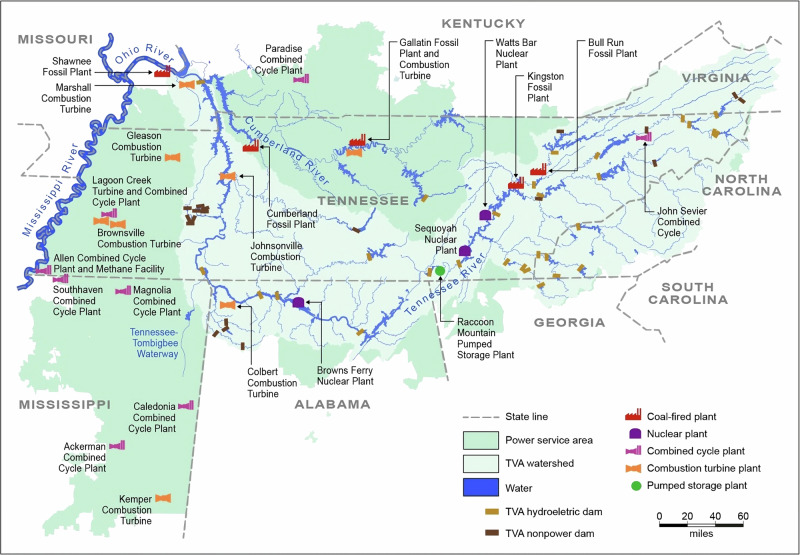
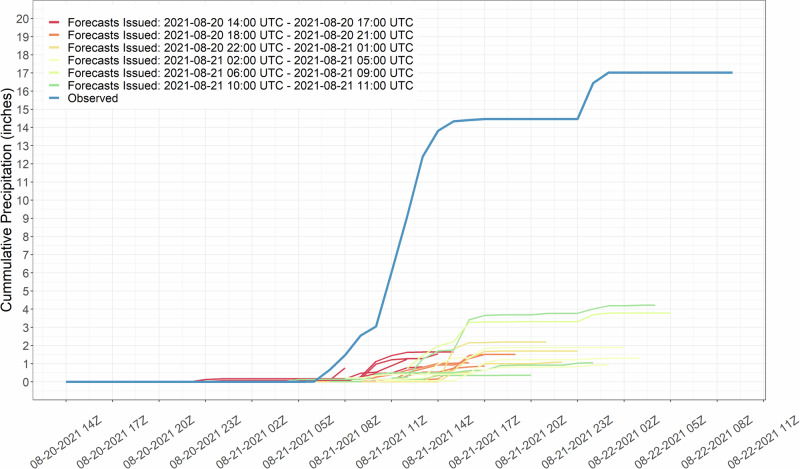
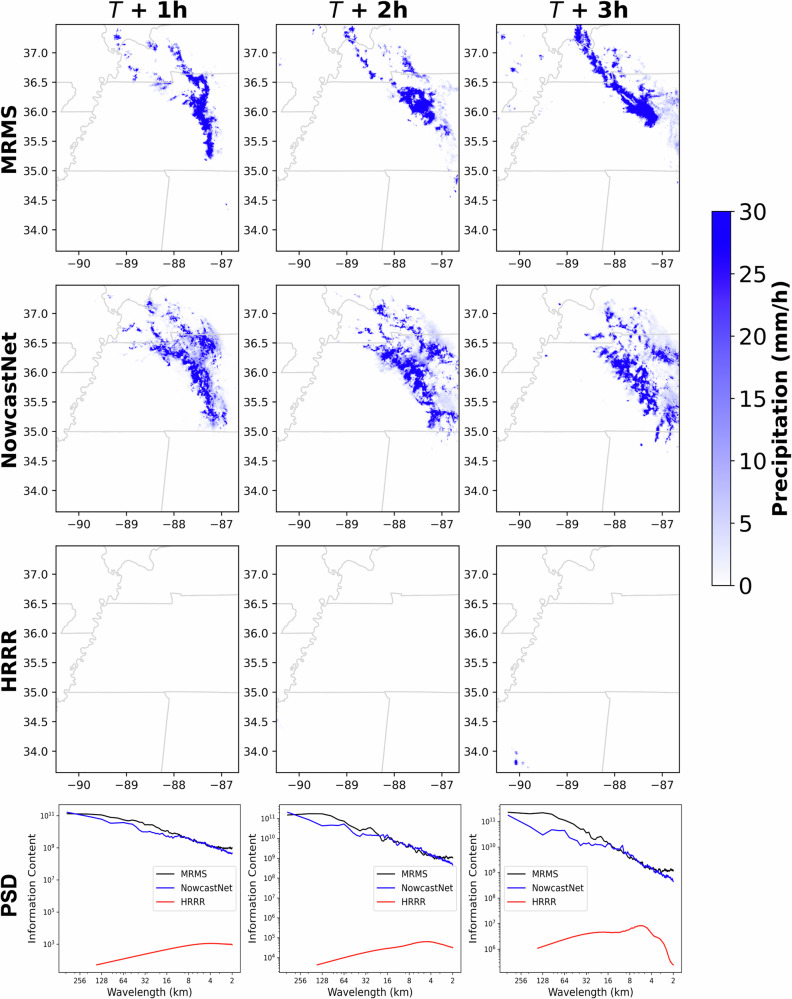
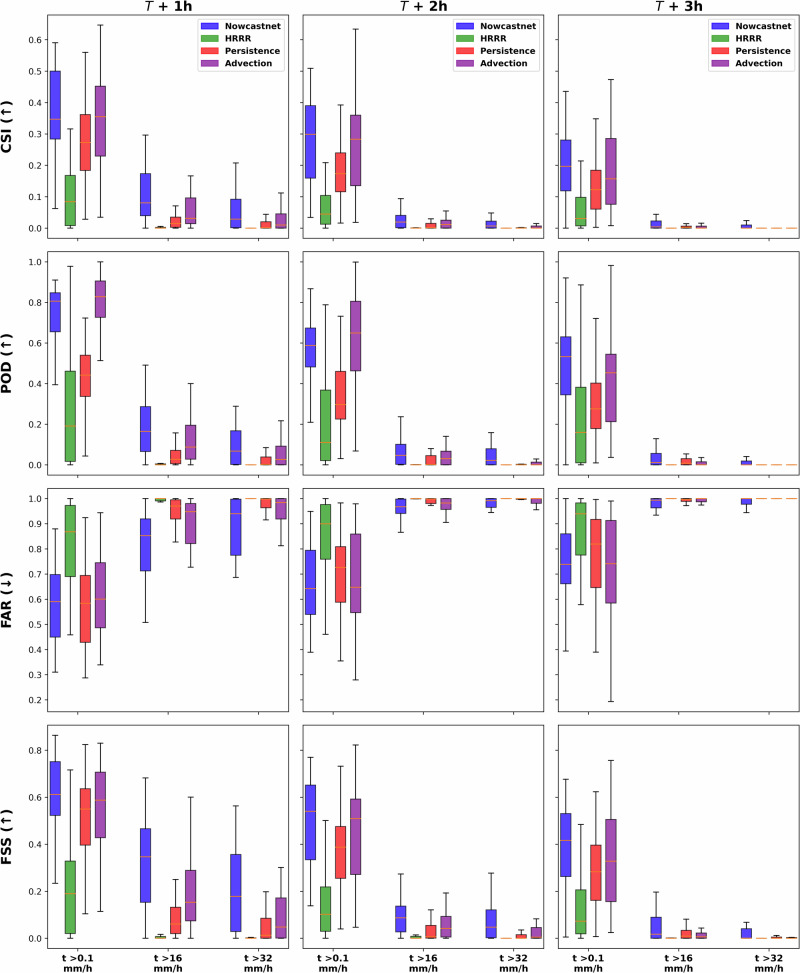
Precipitation nowcasting, which is critical for flood emergency and river management, has remained challenging for decades, although recent developments in deep generative modeling (DGM) suggest the possibility of improvements. River management centers, such as the Tennessee Valley Authority, have been using Numerical Weather Prediction (NWP) models for nowcasting, but they have been struggling with missed detections even from best-in-class NWP models. While decades of prior research achieved limited improvements beyond advection and localized evolution, recent attempts have shown progress from so-called physics-free machine learning (ML) methods, and even greater improvements from physics-embedded ML approaches. Developers of DGM for nowcasting have compared their approaches with optical flow (a variant of advection) and meteorologists' judgment, but not with NWP models. Further, they have not conducted independent co-evaluations with water resources and river managers. Here we show that the state-of-the-art physics-embedded deep generative model, specifically NowcastNet, outperforms the High Resolution Rapid Refresh (HRRR) model, which is the latest generation of NWP, along with advection and persistence, especially for heavy precipitation events. Thus, for grid-cell extremes over 16 mm/h, NowcastNet demonstrated a median critical success index (CSI) of 0.30, compared with median CSI of 0.04 for HRRR. However, despite hydrologically-relevant improvements in point-by-point forecasts from NowcastNet, caveats include overestimation of spatially aggregate precipitation over longer lead times. Our co-evaluation with ML developers, hydrologists and river managers suggest the possibility of improved flood emergency response and hydropower management.
Overview
The claims and statistics of this paper haven’t been checked yet.
Free: it reads the open-access text and checks the first 5 claims that cite a source we can check. Create a free account to check every claim.
Integrity signals
Registry
Cites
Statistics
Figures
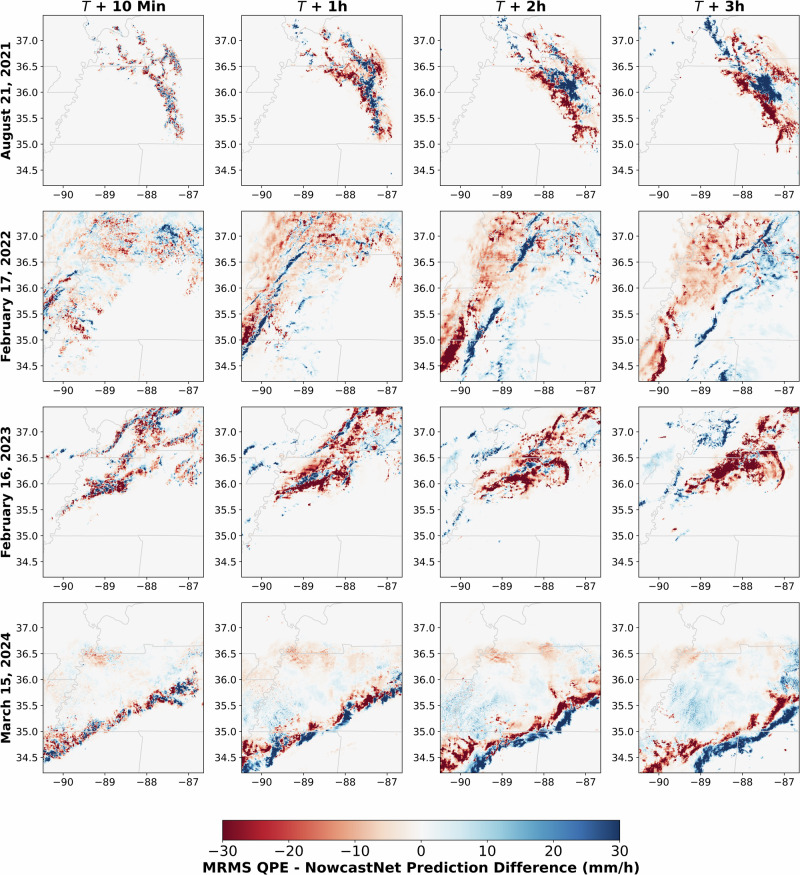
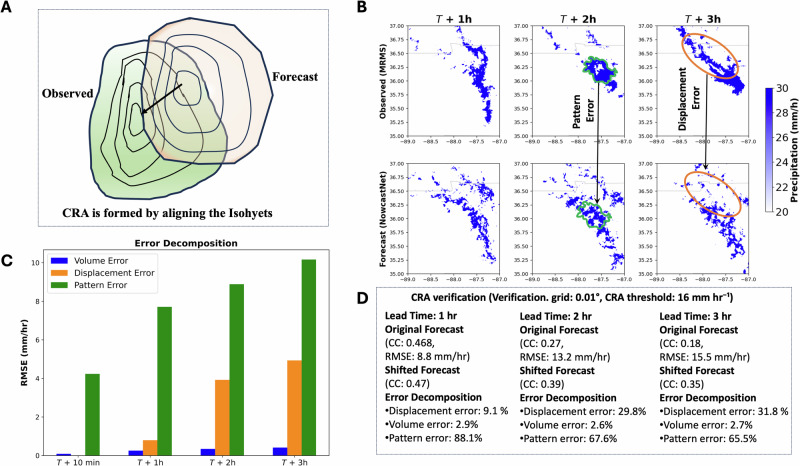
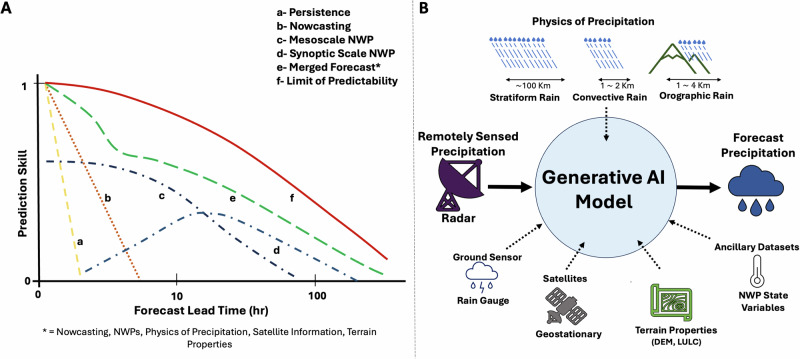
Verification
Claims the paper makes
The claims and statistics of this paper haven’t been checked yet.
Free: it reads the open-access text and checks the first 5 claims that cite a source we can check. Create a free account to check every claim.
Self-check
Percentages, sums and reported differences re-computed from the paper’s own numbers.
The self-check needs the paper’s full text.
Citations
Cites
Roberts, N. M., & Lean, H. W. (2008) · Monthly Weather Review · doi:10.1175/2007mwr2123.1 · Cited by 1,361 · cited 1×
“…Where, Recall ¼ POD ¼ aa þ c and Precision ¼ aa þ b ¼ 1 (cid:2) FAR The fractions skill score (FSS) is a commonly used neighborhood veri fi cation method designed tomitigate displacement errors by comparing neighborhood fractions for both forecast and observed fi elds at various spatial scales 57 .”
Forecast Verification: A Practitioner's Guide in Atmospheric Science
(2011) · Wiley eBooks · doi:10.1002/9781119960003 · Cited by 1,267
A North American Hourly Assimilation and Model Forecast Cycle: The Rapid Refresh
Benjamin, S. G., Weygandt, S. S., Brown, J. M., Hu, M., Alexander, C. R., Smirnova, T. G., Olson, J. B., James, E. P., Dowell, D. C., Grell, G. A., et al. (2016) · Monthly Weather Review · doi:10.1175/mwr-d-15-0242.1 · Cited by 1,164
Skilful precipitation nowcasting using deep generative models of radar
Ravuri, S., Lenc, K., Willson, M., Kangin, D., Lam, R., Mirowski, P., Fitzsimons, M., Athanassiadou, M., Kashem, S., Madge, S., et al. (2021) · Nature · doi:10.1038/s41586-021-03854-z · Cited by 1,024
An Overview of the Global Historical Climatology Network Temperature Database
Peterson, T. C., & Vose, R. S. (1997) · Bulletin of the American Meteorological Society · doi:10.1175/1520-0477(1997)078<2837:aootgh>2.0.co;2 · Cited by 910
The Critical Success Index as an Indicator of Warning Skill
Schaefer, J. T. (1990) · Weather and Forecasting · doi:10.1175/1520-0434(1990)005<0570:tcsiaa>2.0.co;2 · Cited by 867 · cited 8×
“TheCSImeasurestheratioofcorrectlypredictedeventstothetotal numberofobservedandforecastedevents(Eq.”
InfluentialZhang, J., Howard, K., Langston, C., Kaney, B., Qi, Y., Tang, L., Grams, H., Wang, Y., Cocks, S., Martinaitis, S., et al. (2016) · Bulletin of the American Meteorological Society · doi:10.1175/bams-d-14-00174.1 · Cited by 657 · cited 1×
“Multi Radar Multi Sensor (MRMS) data are used as reference observations which is developed by NOAA ’ s National Severe Storms Laboratory (NSSL) and it incorporates data from approximately180operational US WSR-88D weatherradarsand model analyses to producegriddedprecipitation 32 .”
Braud, I., Haverkamp, R., Arrúe, J. L., & López, M. V. (2003) · Journal of Hydrometeorology · doi:10.1175/1525-7541(2003)004<0878:amrchf>2.0.co;2 · Cited by 599
Self-citationDeep Learning for Precipitation Nowcasting: A Benchmark and A New Model
Shi, X., Gao, Z., Lausen, L., Wang, H., Yeung, D., Wong, W. K., & Woo, W. (2017) · arXiv (Cornell University) · doi:10.48550/arxiv.1706.03458 · Cited by 596 · cited 1×
“Machine learning offers potential solutions by capturing complex spatio-temporal patterns, integrating diverse data sources, and introducing approaches like spatiotemporal convolution 16,20,22 , adversarial training 23,24,48 , and latent random variables 49 to enhance nowcasting capabilities.”
Skilful nowcasting of extreme precipitation with NowcastNet
Zhang, Y., Long, M., Chen, K., Xing, L., Jin, R., Jordan, M. I., & Wang, J. (2023) · Nature · doi:10.1038/s41586-023-06184-4 · Cited by 465 · cited 10×
“So, inthisstudy, we focus on the state-of-the-art physics conditioned deep generative model NowcastNet 24 .”
Influential
Research works printed but not linked: 12
- Genevois, R. & Tecca, P. R. The vajont landslide: state-of-the-art. Ital. J. Eng. Geol. Environ. 6, 15-39 (2013).
- Marchuk, G. Numerical Methods in Weather Prediction (Elsevier, 2012).
- Ganguly, A. R. & Bras, R. L. Distributed quantitative precipitation forecasting using information from radar and numerical weather prediction models. J. Hydrometeorol. 4, 1168-1180 (2003). · doi:10.1175/1525-7541(2003)004 · Paper page
- Germann, U. & Zawadzki, I. Scale-dependence of the predictability of precipitation from continental radar images. Mon. Weather Rev. 130, 2859-2873 (2002). · doi:10.1175/1520-0493(2002)130
- Alexander, C., Carley, J. & Pyle, M. The rapid refresh forecast system: looking beyond the first operational version. In 28th Conference on Numerical Weather Prediction (2023).
- Goodfellow, I et al. Generative Adversarial Nets (Advances in Neural Information Processing Systems) 2672-2680 (Curran, 2014).
- Murphy, A. H. What is a good forecast? An essay on the nature of goodness in weather forecasting. Weather Forecast. 8, 281-293 (1993). · doi:10.1175/1520-0434(1993)008
- Doswell, C. H. A. R. L., Davies-Jones, R. & Keller, D. L. On summary measures of skill in rare event forecasting based on contingency tables. Weather Forecast. 5, 576-585 (1990). · doi:10.1175/1520-0434(1990)005
- Heidke, P. Calculation of the success and quality of wind force forecasts in the storm warning service. Geogr. Ann. 8, 301-349 (1926).
- Harris, D., Foufoula-Georgiou, E., Droegemeier, K. K. & Levit, J. J. Multiscale statistical properties of a high-resolution precipitation forecast. J. Hydrometeorol. 2, 406-418 (2001). · doi:10.1175/1525-7541(2001)002
- Zipser, E. Rainfall predictability: when will extrapolation-based algorithms fail. In 8th Conference on Hydrometeorology, American Meteorological Society (1990).
- Houze Jr, R. A. Stratiform precipitation in regions of convection: a meteorological paradox? Bull. Am. Meteorol. Soc. 78, 2179-2196 (1997). · doi:10.1175/1520-0477(1997)078
Cited by
Tiggeloven, T., Pfeiffer, S., Matanó, A., van den Homberg, M., Thalheimer, L., Reichstein, M., & Torresan, S. (2025) · iScience · doi:10.1016/j.isci.2025.113689 · Cited by 49
Urban morphology impacts on urban microclimate using artificial intelligence – a review
Marey, A., Zou, J., Goubran, S., Wang, L. L., & Gaur, A. (2025) · City and Environment Interactions · doi:10.1016/j.cacint.2025.100221 · Cited by 39
Jiang, P., Ma, Z., & Mei, G. (2026) · Natural hazards and earth system sciences · doi:10.5194/nhess-26-487-2026 · Cited by 44
Nitha, V., Pramada, S. K., Praseed, N. S., & Sridhar, V. (2025) · Atmosphere · doi:10.3390/atmos16040372 · Cited by 19
Sakib, N., Hosen, M. A., Khan, B., Gunn, B., & Johnstone, M. (2025) · IEEE Access · doi:10.1109/access.2025.3625924 · Cited by 22
“Hybrid physics–ML frameworks [105] have shown remarkable success across domains, such as manufacturing force prediction [106], and similar strategies are being adapted for renewable energy.”
A hybrid deep learning framework for improving short-term precipitation forecasts
Salehi, S., & Neyshabouri, S. A. A. S. (2025) · Environmental Modelling & Software · doi:10.1016/j.envsoft.2025.106635 · Cited by 11
Jumadi, J., Danardono, D., Roziaty, E., Ulinuha, A., Supari, S., Choy, L. K., Sattar, F., & Nawaz, M. (2025) · Sustainability · doi:10.3390/su17209281 · Cited by 16
Utility of Graph Neural Networks in Short-to Medium-Range Weather Forecasting
Sun, X., Li, J., Zhao, Z., Jing, G., Chen, B., Hu, J., Wang, F., & Zhang, Y. (2025) · Computers, materials & continua/Computers, materials & continua (Print) · doi:10.32604/cmc.2025.063373 · Cited by 15
Artificial Intelligence in Climate Science: A State-of-the-Art Review (2020–2025)Preprint
Ramachandra, V. (2025) · doi:10.31223/x5m73j · Cited by 15
Snow or rain? hybrid AI deciphers surface precipitation phase from satellite observations
Yang, C., Li, H., Zhu, R., Wang, Y., Zhang, F., Gu, M., Jiang, G., ZHANG, R., & Tang, X. (2026) · Nature Communications · doi:10.1038/s41467-026-69487-w · Cited by 12
“Meanwhile, meteorological forecast models (e.g., FuXi) generate physically consistent 3D atmospheric fi elds via Transformer architecture 29,30 , outperforming traditional numerical models in synoptic-scale circulation forecasting 31 – 33 .”
AI needs physics more than physics needs AI
Coveney, P. V., & Highfield, R. (2026) · Frontiers in Physics · doi:10.3389/fphy.2025.1731777 · Cited by 7
AI and 6E evaluation on solar cooking system for sustainable development growth in solar industry
Kumar, A., Muthusamy, E., Kumar, R., Kumar, I., & Kapoor, G. (2025) · Journal of Renewable and Sustainable Energy · doi:10.1063/5.0292806 · Cited by 6
Precipitation Spatio-Temporal Forecasting in China via DC-CNN-BiLSTM
Shu, P., Duan, X., Shao, C., Liu, J., Tian, Y., & Li, S. (2025) · Water · doi:10.3390/w17091381 · Cited by 5
Panja, M., Das, D., Chakraborty, T., Ray, A., Athulya, R., Hens, C., Dana, S. K., Murukesh, N., & Ghosh, D. (2025) · Chaos An Interdisciplinary Journal of Nonlinear Science · doi:10.1063/5.0297336 · Cited by 7
AI for science: Progress, challenges, and perspectives
Xu, Y., Shao, Z., Liu, X., Li, Y., An, Z., Fu, C., Huang, C., Zhang, L., Gao, F., Li, J., et al. (2026) · The Innovation · doi:10.1016/j.xinn.2026.101530 · Cited by 15
Pappa, A., Kalogiros, J. A., Tombrou, M., Spyrou, C., Anagnostou, M. N., Varlas, G., Kalogeri, C., & Katsafados, P. (2025) · Hydrology · doi:10.3390/hydrology12080198 · Cited by 4
“This approach demonstrates the effectiveness of the advection equation for nowcasting applications [36–39].”
RainCast: A Hybrid Precipitation Nowcasting Algorithm Using the Himawari-8/9 Satellite Measurements
Andreev, A. I., Олегович, К. М., Malkovsky, S. I., & Filei, A. A. (2025) · Informatics and Automation · doi:10.15622/ia.24.4.4 · Cited by 2
A neural network model for cyclone landfall prediction in the Bay of Bengal
Dhayanand, J., & Neelakantan, T. R. (2025) · Natural Hazards · doi:10.1007/s11069-025-07697-z · Cited by 2
“NWP models struggle to predict convective storms while the machine learning algorithms can identify patterns using the trained data (Das et al. 2024).”
Hao, M., Shao, W., Jia, Y., & Jiang, X. (2026) · International Journal of Remote Sensing · doi:10.1080/01431161.2026.2621181 · Cited by 3
“Recent years have witnessed the integration of artificial intelligence (AI) into numerical modelling, particularly through hybrid physics-AI approaches (Das et al. 2024; Y. Ma et al. 2025).”
Efthimiou, G. C. (2025) · Sensors · doi:10.3390/s25216523 · Cited by 1
“Extending maxima prediction to pressure/temperature broad-ens validation opportunities (reanalysis, surface networks) and invites transfer-learning between domains—benefiting air-quality and wind applications when co-trained on extremes [21].”
InfluentialPCEED-Net: A Physics-Constrained Enhanced Encoder–Decoder Network for Precipitation Nowcasting
Chi, H., Gu, L., Yuan, J., Liu, Y., Zhao, Y., & Wu, K. (2026) · IEEE Transactions on Geoscience and Remote Sensing · doi:10.1109/tgrs.2026.3660822 · Cited by 2
“NowcastNet [41] adopts a physics-constrained deep generative model that incorporates physical principles, such as the continuity equation, into its neural network design, thereby improving the modeling of precipitation motion and the overall accuracy of nowcasting.”
Bisht, D. S., Hazra, V., & Piyush, D. N. (2026) · Natural Hazards · doi:10.1007/s11069-025-07919-4 · Cited by 2
“Recent studies have shown that embedding physical constraints or using DL as a post-processing tool for NWP outputs can substantially reduce regional biases and enhance the detection of HPE (Rojas-Campos et al. 2023; Chen et al. 2024; Das et al. 2024).”
Wang, C., Sang, B., He, Q., & Han, S. (2026) · IEEE Transactions on Geoscience and Remote Sensing · doi:10.1109/tgrs.2026.3667511 · Cited by 2
“First, the absence of physical constraints during multisource data fusion leads to insu ffi cient mechanistic modeling of mete-orological parameters, particularly in capturing the dynamic evolution of precipitating cloud systems [17].”
Hybrid and Physics-Informed AI Models in Earth System Analysis
Kaif, M., Halder, P., Mittu, S., Sarangi, A., & Pandey, N. K. (2026) · Advances in computational intelligence and robotics book series · doi:10.4018/979-8-2600-0778-5.ch003 · Cited by 1
Is it safe to deploy AI in safety-critical systems?
Kolda, T. G. (2026) · Philosophical Transactions of the Royal Society A Mathematical Physical and Engineering Sciences · doi:10.1098/rsta.2025.0123 · Cited by 2
Attention mechanism-based multi-scale spatiotemporal fusion for precipitation nowcasting
Zheng, X., Qin, H., Yin, C., Wang, W., Shi, P., Zhu, Y., & Hu, F. (2025) · Theoretical and Applied Climatology · doi:10.1007/s00704-025-05816-1 · Cited by 1
“As a deep learning model based on the self-attention mechanism, Transformer has demonstrated outstanding performance in addressing the challenges of spatiotemporal prediction tasks (Deihim et al. 2023; Fan et al. 2022, 2025; Cao et al. 2023; Das et al. 2024).”
Bassford, J., Parker, D. J., Marsham, J. H., & Warner, J. (2025) · Quarterly Journal of the Royal Meteorological Society · doi:10.1002/qj.70041 · Cited by 2
“There are also developments in hybrid approaches that combine machine learning with physical models (Das et al. , 2024; Kashinath et al. , 2021).”
K, S. K., & Suganthi, G. (2026) · Journal of Computer Science · doi:10.3844/jcssp.2026.1231.1253 · Cited by 1
Mimi, M. A., Khan, M. M. H., Ahmed, A. B., & Rois, R. (2026) · Complexity · doi:10.1155/cplx/9285052 · Cited by 1
Deep learning-based precipitation nowcasting integrating radar echoes and rain gauge data
Li, L., Li, J., Wang, Y., Chongju, S., Li, Z., & Liu, J. (2026) · Journal of Hydrology · doi:10.1016/j.jhydrol.2026.136210 · Cited by 1
bai, H. (2025) · SSRN Electronic Journal · doi:10.2139/ssrn.5120383
Pandey, S., Afzal, T., Anjum, M., Anwar, W., Khanam, T., & din, M. (2025) · International Journal of Innovative Research in Computer Science & Technology · doi:10.55524/ijircst.2025.13.3.16 · Cited by 1
A Hybrid TCN-BiLSTM Model for Enhanced Precipita.tion Nowcasting
Kumar, B. S., Jyothsna, P., Nambari, P., Bheesetti, R., Satya, P. V., & Krishna, M. (2025) · International Conference on Computer, Computation and Communication (IC3C) · doi:10.13052/rp-9788743808268a039
HybridFlow: A Hybrid Velocity Generation Framework for Precipitation Nowcasting
Ling, X., Duan, G., Li, C., Huang, T., & He, T. (2025) · IEEE Transactions on Geoscience and Remote Sensing · doi:10.1109/tgrs.2025.3646177 · Cited by 2
“Das et al. [22] demonstrated that hybrid physics–AI approaches significantly outperform traditional NWP for extreme pre-Authorized licensed use limited to the terms of the applicable license agreement with IEEE.”
AI for Weather Nowcasting: Opportunities and Challenges
Abuhuweidi, Z. F. S. (2026) · International Journal for Research in Applied Science and Engineering Technology · doi:10.22214/ijraset.2026.76920
Bahamazava, K., & Reznik, S. (2026) · Natural Hazards Research · doi:10.1016/j.nhres.2026.01.003
Zheng, Y., Yang, B., Sheng, J., Zhou, K., Tian, F., Zhang, X., Zhang, X. Y., Lan, Y., Cao, Y., Liu, X., et al. (2026) · Advances in Atmospheric Sciences · doi:10.1007/s00376-025-5487-1
Rainfall Forecasting: A Review of Current Practice
Shuvo, S., Afrin, N., Pan, X., Yildirim, G., & Rahman, A. (2026) · Lecture notes in civil engineering · doi:10.1007/978-3-032-18708-6_22
Wen, Z., Xia, Y., Zhao, Y., Cai, J., Zhu, B., Feng, H., Gadekallu, T. R., & Fang, K. (2025) · International Conference on Robotics, Intelligent Control and Artificial Intelligence (RICAI) · doi:10.1109/ricai68060.2025.11385043
“Most models are optimized using Mean Squared Error (MSE) or similar pixel-wise regression losses, a strategy that tends to produce visually over-smoothed prediction results [18].”
Exemplar-Based Adaptation for Extreme Temperature Event Prediction
Zhou, Z., Yeung, D., Wong, K.-H., & Wong, W.-K. (2025) · International Conference on Intelligent Digitization of Systems and Services (IDSS) · doi:10.1109/idss67199.2025.11398218
“For instance, Reference [20] proposed a hybrid deep learning system, NowcastNet, for extreme rainfall nowcasting that augments a generative radar-based CNN with physics-informed inputs.”
Kuang, Z., Zheng, X., & Song, Z. (2026) · Atmospheric Research · doi:10.1016/j.atmosres.2026.108939
Mallat, M., Kechiche, O. B. H. B., Oudira, H., Seghiour, A., Chouder, A., Hamouda, M., Silvestre, S., & Motahhir, S. (2026) · Unconventional Resources · doi:10.1016/j.uncres.2026.100386
Emerging energy signals advance early warnings of extreme precipitation
Zhang, T., Chen, J., Deng, Y., Yang, S., Chen, D., Zhu, J., & Cai, F. (2026) · Nature Communications · doi:10.1038/s41467-026-71214-4
Pure and physics-guided deep learning approaches for spatio-temporal groundwater level prediction
Salis, M., Sartor, G., Meo, R., Ferraris, S., & Atto, A. M. (2026) · Machine Learning Science and Technology · doi:10.1088/2632-2153/ae9af0
Enhancing Weather Forecasting Accuracy Using Machine Learning Algorithms: A Data-Driven Approach
Dubey, S., & Yadav, P. (2026) · Lecture notes in networks and systems · doi:10.1007/978-3-032-19672-9_40
Forecasting threshold exceedance of atmospheric variables at a specific locationPreprint
Baggio, R., & Muzy, J. (2026) · doi:10.5194/egusphere-2026-3111
Piamsa-nga, P., Phisanbut, N., & Piamsa-nga, N. (2026) · doi:10.5194/egusphere-2026-1314
Sadeghi, B., Alesheikh, A. A., Jafari, A., & Rezaie, F. (2026) · Physics and Chemistry of the Earth Parts A/B/C · doi:10.1016/j.pce.2026.104610
Ahmed, S. M. S., & Güneyli, H. (2026) · Intelligent Climate and Eco-Environment · doi:10.1016/j.icee.2026.100009
MvReNowcast: Disentangling radar product features for improved nowcasting of raincloud evolution
Zhu, H., Chen, J., Chen, X., Wong, W. K., Tan, C., Yao, H., & Jiang, X. S. (2026) · Journal of Hydrology · doi:10.1016/j.jhydrol.2026.135938
Suribabu, C. R., Sakthi, L., & Balaji, S. (2026) · Journal of Hydrologic Engineering · doi:10.1061/jhyeff.heeng-7002
Wei, D. O. N. G., Qi-Feng, Q. I. A. N., Jia, X.-J., & Ruo-Wen, Y. A. N. G. (2026) · Advances in Climate Change Research · doi:10.1016/j.accre.2026.08.010
Miller, Z. (2026) · American Journal of Capstone Research · doi:10.70251/ye5wj337
“(Das et al., 2024).”
InfluentialLin, X., & Li, Y. (2026) · Remote Sensing · doi:10.3390/rs18193440
Oubouisk, M., Bari, D., Mordane, S., Sayrou, I., & messari, A. E. (2026) · Atmospheric Research · doi:10.1016/j.atmosres.2026.109388
Asare, E. A. (2026) · Physics and Chemistry of the Earth Parts A/B/C · doi:10.1016/j.pce.2026.104936
Zikri, M. A., Pangalo, G. N. A., Alghazali, M. F., Youwe, A. S. G. N., Kurniawan, F. I., & Norman, Y. (2026) · Jurnal Borneo Saintek · doi:10.35334/zwrdgs75
Zhu, X., Cai, Y., Wang, G., Zhu, D., Liu, K., Zhang, X., Quan, L., & Yin, Z. (2026) · Remote Sensing · doi:10.3390/rs18213762
Metadata
- Authors
- Das, P., Posch, A., Barber, N., Hicks, M., Duffy, K., Vandal, T., Singh, D., Werkhoven, K. V., & Ganguly, A. R.
- Affiliations
- Northeastern University (US)
- Tennessee Valley Authority (US)
- Oak Ridge National Laboratory (US)
- RTI International (US)
- Corresponding author
- Ganguly, Auroop R.
- Venue
- npj Climate and Atmospheric Science
- Published
- 2024-11-18
- Volume
- 7
- Issue
- 1
- Pages
- 282-282
- ISSN
- 2397-3722 (ISSN-L)
- PMC
- PMC11573709
- OpenAlex
- W4404482519
- Cited by
- 58
- References
- 55
- Citations by year
- 2026: 35 · 2025: 23
- FWCI
- 9.37
- Type
- journal article
- Language
- en
- Open access
- gold
- doi.org
- Licence
- cc-by-nc-nd
- creativecommons.org/licenses/by-nc-nd/4.0 (tdm)
- creativecommons.org/licenses/by-nc-nd/4.0 (vor)
- Locations
- npj Climate and Atmospheric Science (publishedVersion, cc-by-nc-nd)
- PubMed Central (publishedVersion, cc-by-nc-nd)
- PubMed (publishedVersion)
- arXiv (Cornell University) (submittedVersion, cc-by)
- DOAJ (DOAJ: Directory of Open Access Journals) (submittedVersion, cc-by-sa)
- arXiv (Cornell University) (cc-by)
- Funders
- National Aeronautics and Space Administration (80NSSC22K1138)
- Nuclear Safety and Security Commission
- Topics
- Physical Sciences › Earth and Planetary Sciences › Atmospheric Science › Meteorological Phenomena and Simulations
- Physical Sciences › Environmental Science › Environmental Engineering › Hydrological Forecasting Using AI
- Physical Sciences › Earth and Planetary Sciences › Atmospheric Science › Precipitation Measurement and Analysis
- Keywords
- precipitation nowcasting, heavy rainfall, deep generative models, numerical weather prediction, HRRR model, flood disaster response, river management, critical success index, hydropower management, advection
About these checks
Registry, retraction, Cites and statistics results are computed, not judged, with one exception: a printed reference that no index lists is read once by a model before it counts as a citation error. Claims are extracted by a model and kept only when their quote appears verbatim in the text; each cited source is then checked, with a model’s help, for whether it says what the claim relies on. Those verdicts can be wrong — read the claim’s quote and the cited source before relying on one.
Statistics and arithmetic are recomputed, not judged.
Confidence bands are shown only for fields calibrated on our annotated test set. None is calibrated yet, so no band is shown.
What counts as a claim ›How we measure confidence ›How we check this ›
Are you an author, or do you see a problem with this page? Request a review
Data sources
Bibliographic data: Semantic Scholar, OpenAlex, Crossref.
Contains information from the Semantic Scholar Academic Graph Datasets, made available under the ODC Attribution License (ODC-BY 1.0).
Semantic Scholar’s data is described in: Kinney, R., et al. (2023). The Semantic Scholar Open Data Platform. arXiv:2301.10140.
