

Hybrid physics-AI outperforms numerical weather prediction for extreme precipitation nowcasting
Open accessThe DOI matches its Crossref record; 55 of the 55 references it cites were found in a registry or an index.
Abstract
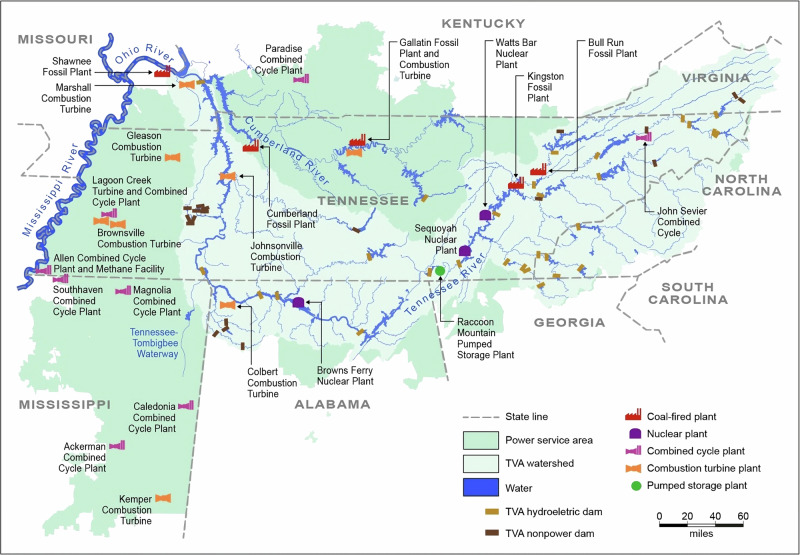
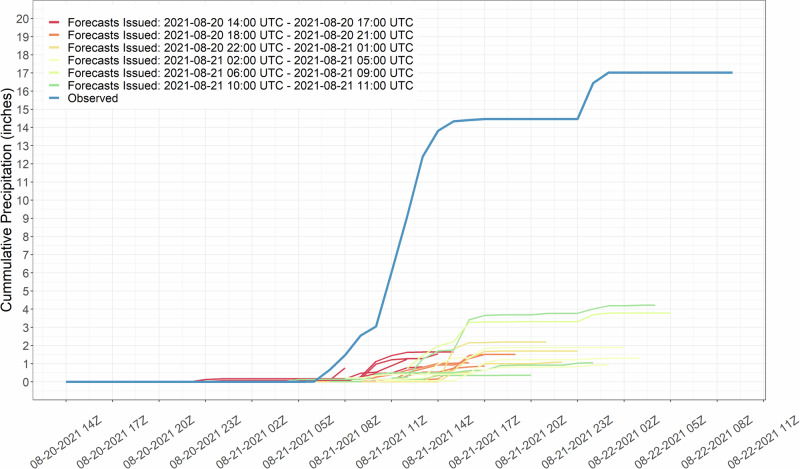
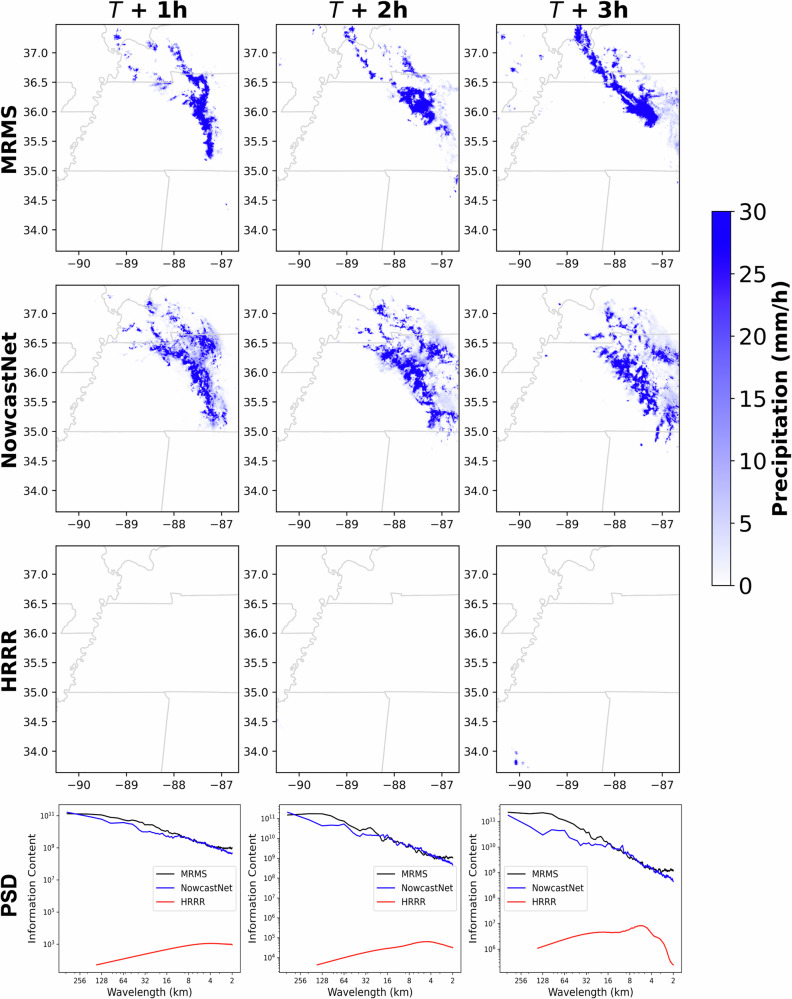
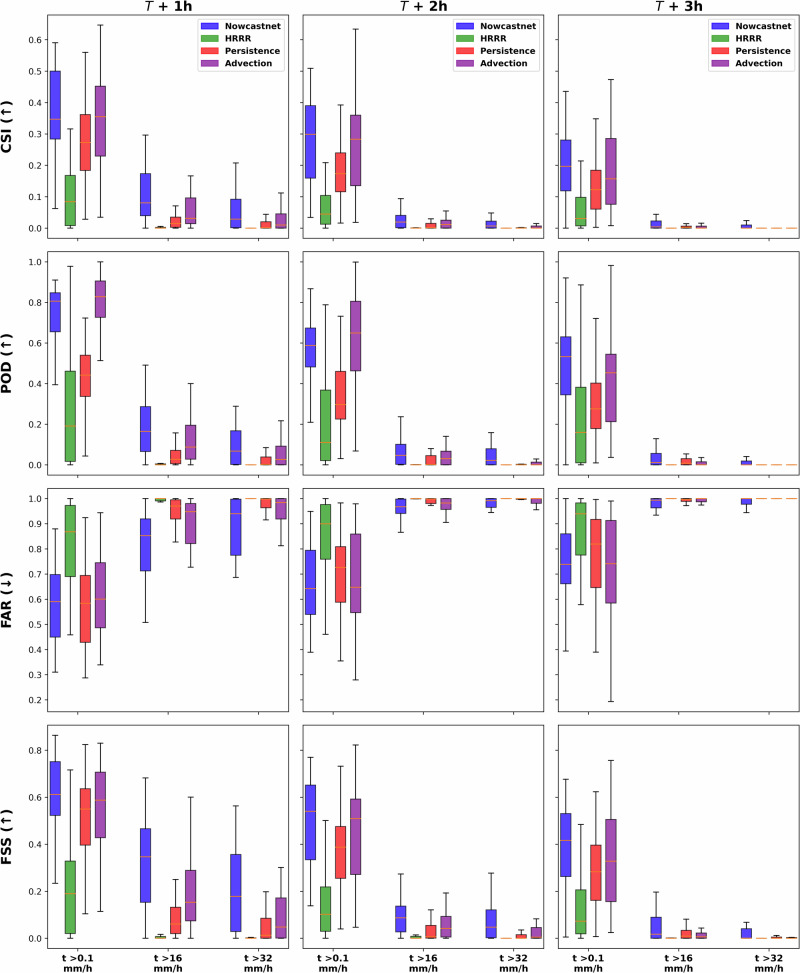
Precipitation nowcasting, which is critical for flood emergency and river management, has remained challenging for decades, although recent developments in deep generative modeling (DGM) suggest the possibility of improvements. River management centers, such as the Tennessee Valley Authority, have been using Numerical Weather Prediction (NWP) models for nowcasting, but they have been struggling with missed detections even from best-in-class NWP models. While decades of prior research achieved limited improvements beyond advection and localized evolution, recent attempts have shown progress from so-called physics-free machine learning (ML) methods, and even greater improvements from physics-embedded ML approaches. Developers of DGM for nowcasting have compared their approaches with optical flow (a variant of advection) and meteorologists' judgment, but not with NWP models. Further, they have not conducted independent co-evaluations with water resources and river managers. Here we show that the state-of-the-art physics-embedded deep generative model, specifically NowcastNet, outperforms the High Resolution Rapid Refresh (HRRR) model, which is the latest generation of NWP, along with advection and persistence, especially for heavy precipitation events. Thus, for grid-cell extremes over 16 mm/h, NowcastNet demonstrated a median critical success index (CSI) of 0.30, compared with median CSI of 0.04 for HRRR. However, despite hydrologically-relevant improvements in point-by-point forecasts from NowcastNet, caveats include overestimation of spatially aggregate precipitation over longer lead times. Our co-evaluation with ML developers, hydrologists and river managers suggest the possibility of improved flood emergency response and hydropower management.
Overview
The claims and statistics of this paper haven’t been checked yet.
Free: it reads the open-access text and checks the first 5 claims that cite a source we can check. Create a free account to check every claim.
Integrity signals
Registry
Cites
Statistics
Figures
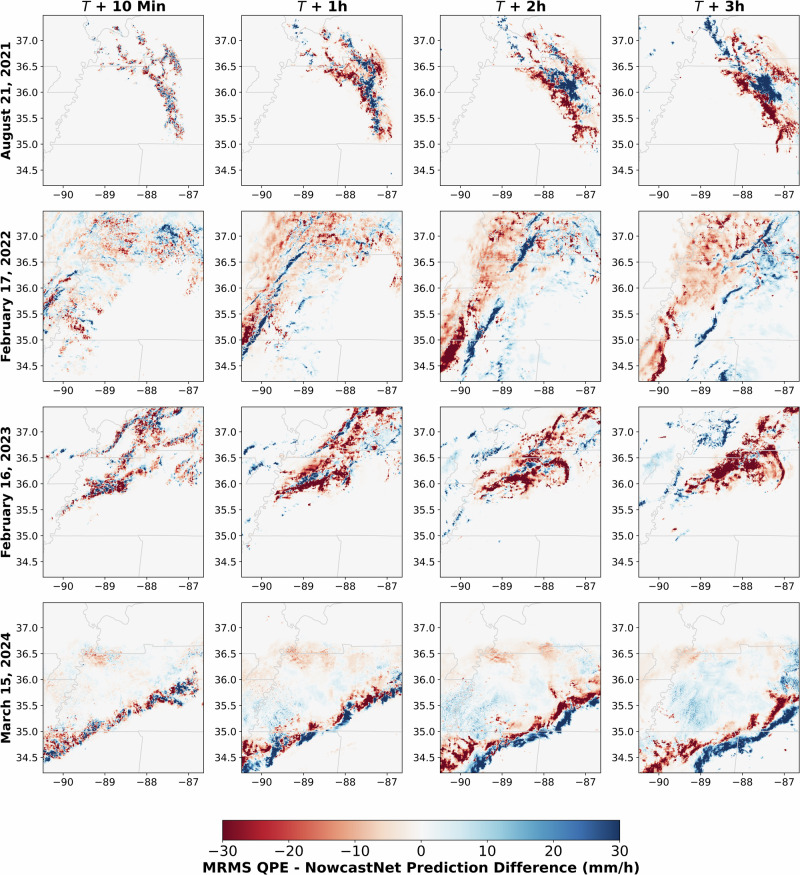
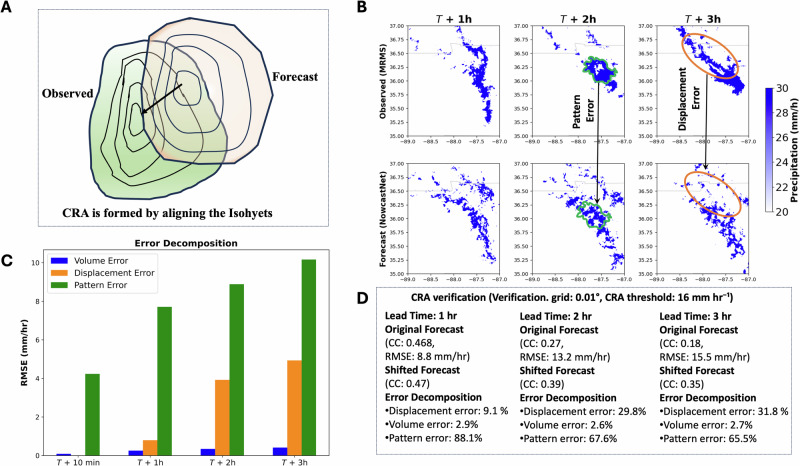
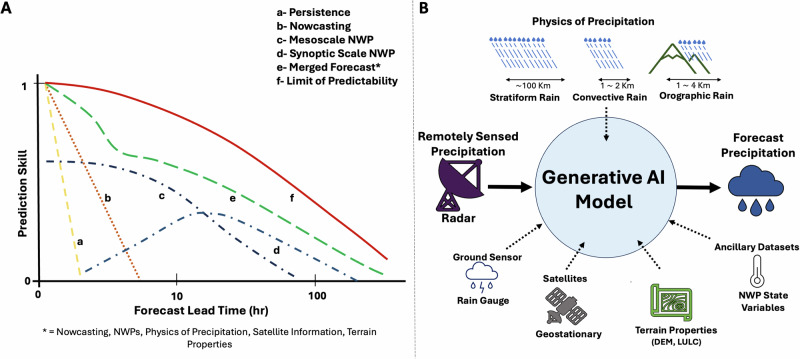
Verification
Claims the paper makes
The claims and statistics of this paper haven’t been checked yet.
Free: it reads the open-access text and checks the first 5 claims that cite a source we can check. Create a free account to check every claim.
Self-check
Percentages, sums and reported differences re-computed from the paper’s own numbers.
The self-check needs the paper’s full text.
Citations
Cites
Roberts, N. M., & Lean, H. W. (2008) · Monthly Weather Review · doi:10.1175/2007mwr2123.1 · Cited by 1,361 · cited 1×
“…Where, Recall ¼ POD ¼ aa þ c and Precision ¼ aa þ b ¼ 1 (cid:2) FAR The fractions skill score (FSS) is a commonly used neighborhood veri fi cation method designed tomitigate displacement errors by comparing neighborhood fractions for both forecast and observed fi elds at various spatial scales 57 .”
Forecast Verification: A Practitioner's Guide in Atmospheric Science
(2011) · Wiley eBooks · doi:10.1002/9781119960003 · Cited by 1,267
A North American Hourly Assimilation and Model Forecast Cycle: The Rapid Refresh
Benjamin, S. G., Weygandt, S. S., Brown, J. M., Hu, M., Alexander, C. R., Smirnova, T. G., Olson, J. B., James, E. P., Dowell, D. C., Grell, G. A., et al. (2016) · Monthly Weather Review · doi:10.1175/mwr-d-15-0242.1 · Cited by 1,164
Skilful precipitation nowcasting using deep generative models of radar
Ravuri, S., Lenc, K., Willson, M., Kangin, D., Lam, R., Mirowski, P., Fitzsimons, M., Athanassiadou, M., Kashem, S., Madge, S., et al. (2021) · Nature · doi:10.1038/s41586-021-03854-z · Cited by 1,024
An Overview of the Global Historical Climatology Network Temperature Database
Peterson, T. C., & Vose, R. S. (1997) · Bulletin of the American Meteorological Society · doi:10.1175/1520-0477(1997)078<2837:aootgh>2.0.co;2 · Cited by 910
The Critical Success Index as an Indicator of Warning Skill
Schaefer, J. T. (1990) · Weather and Forecasting · doi:10.1175/1520-0434(1990)005<0570:tcsiaa>2.0.co;2 · Cited by 867 · cited 8×
“TheCSImeasurestheratioofcorrectlypredictedeventstothetotal numberofobservedandforecastedevents(Eq.”
InfluentialZhang, J., Howard, K., Langston, C., Kaney, B., Qi, Y., Tang, L., Grams, H., Wang, Y., Cocks, S., Martinaitis, S., et al. (2016) · Bulletin of the American Meteorological Society · doi:10.1175/bams-d-14-00174.1 · Cited by 657 · cited 1×
“Multi Radar Multi Sensor (MRMS) data are used as reference observations which is developed by NOAA ’ s National Severe Storms Laboratory (NSSL) and it incorporates data from approximately180operational US WSR-88D weatherradarsand model analyses to producegriddedprecipitation 32 .”
Braud, I., Haverkamp, R., Arrúe, J. L., & López, M. V. (2003) · Journal of Hydrometeorology · doi:10.1175/1525-7541(2003)004<0878:amrchf>2.0.co;2 · Cited by 599
Self-citationDeep Learning for Precipitation Nowcasting: A Benchmark and A New Model
Shi, X., Gao, Z., Lausen, L., Wang, H., Yeung, D., Wong, W. K., & Woo, W. (2017) · arXiv (Cornell University) · doi:10.48550/arxiv.1706.03458 · Cited by 596 · cited 1×
“Machine learning offers potential solutions by capturing complex spatio-temporal patterns, integrating diverse data sources, and introducing approaches like spatiotemporal convolution 16,20,22 , adversarial training 23,24,48 , and latent random variables 49 to enhance nowcasting capabilities.”
Skilful nowcasting of extreme precipitation with NowcastNet
Zhang, Y., Long, M., Chen, K., Xing, L., Jin, R., Jordan, M. I., & Wang, J. (2023) · Nature · doi:10.1038/s41586-023-06184-4 · Cited by 465 · cited 10×
“So, inthisstudy, we focus on the state-of-the-art physics conditioned deep generative model NowcastNet 24 .”
InfluentialVerification of precipitation in weather systems: determination of systematic errors
Ebert, E. E., & McBride, J. L. (2000) · Journal of Hydrology · doi:10.1016/s0022-1694(00)00343-7 · Cited by 462
Germann, U., & Zawadzki, I. (2002) · Monthly Weather Review · doi:10.1175/1520-0493(2002)130<2859:sdotpo>2.0.co;2 · Cited by 413
Dowell, D. C., Alexander, C. R., James, E. P., Weygandt, S. S., Benjamin, S. G., Manikin, G. S., Blake, B. T., Brown, J. M., Olson, J. B., Hu, M., et al. (2022) · Weather and Forecasting · doi:10.1175/waf-d-21-0151.1 · Cited by 399
Nimrod: a system for generating automated very short range forecasts
Golding, B. W. (1998) · Meteorological Applications · doi:10.1017/s1350482798000577 · Cited by 369
RainNet v1.0: a convolutional neural network for radar-based precipitation nowcasting
Ayzel, G., Scheffer, T., & Heistermann, M. (2020) · Geoscientific Model Development · doi:10.5194/gmd-13-2631-2020 · Cited by 360
Operational Ensemble Prediction at the National Meteorological Center: Practical Aspects
Tracton, M. S., & Kalnay, E. (1993) · Weather and Forecasting · doi:10.1175/1520-0434(1993)008<0379:oepatn>2.0.co;2 · Cited by 327
Pysteps: an open-source Python library for probabilistic precipitation nowcasting (v1.0)
Pulkkinen, S., Nerini, D., Pérez Hortal, A. A., Velasco-Forero, C., Seed, A., Germann, U., & Foresti, L. (2019) · Geoscientific Model Development · doi:10.5194/gmd-12-4185-2019 · Cited by 304 · cited 3×
“In this study, neighborhood sizes of 1 to 27 are used.”
Deep learning for twelve hour precipitation forecasts
Espeholt, L., Agrawal, S., Sønderby, C., Kumar, M., Heek, J., Bromberg, C., Gazen, C., Carver, R., Andrychowicz, M., Hickey, J., et al. (2022) · Nature Communications · doi:10.1038/s41467-022-32483-x · Cited by 253 · cited 3×
“Even leadingNWPmodelssuchasHighResolutionRapidRefresh(HRRR),often struggletoaccuratelypredictextremeprecipitationevents 17,18 , prompting organizations like the TVA to opt for alternative forecasts with coarser spatial and temporal resolution.”
Operational Application of Optical Flow Techniques to Radar-Based Rainfall Nowcasting
Woo, W.-C., & Wong, W.-K. (2017) · Atmosphere · doi:10.3390/atmos8030048 · Cited by 248 · cited 1×
“These methods operate at both local and global scales, utilizing optical fl ow constraints (OFCs) to delineate motion in speci fi c areas or across entire images 41 – 43 .”
Machine Learning for Precipitation Nowcasting from Radar Images
Agrawal, S., Barrington, L., Bromberg, C., Burge, J., Gazen, C., & Hickey, J. J. (2019) · arXiv (Cornell University) · doi:10.48550/arxiv.1912.12132 · Cited by 226 · cited 3×
“Current machine learning methods treat forecasting as an image-to-image translation problem, employing computer vision tools to generate nowcasts 22 .”
Development of a precipitation nowcasting algorithm based upon optical flow techniques
Bowler, N. E. H., Pierce, C. E., & Seed, A. (2004) · Journal of Hydrology · doi:10.1016/j.jhydrol.2003.11.011 · Cited by 220 · cited 5×
“Advection is represented by the PySTEPS 27 algorithm (Supplementary Information Section D).”
InfluentialOptical flow models as an open benchmark for radar-based precipitation nowcasting (rainymotion v0.1)
Ayzel, G., Heistermann, M., & Winterrath, T. (2019) · Geoscientific Model Development · doi:10.5194/gmd-12-1387-2019 · Cited by 204
The future of Earth system prediction: Advances in model-data fusion
Gettelman, A., Geer, A., FORBES, R. M., Carmichael, G. R., Feingold, G., Posselt, D. J., Stephens, G. L., van den Heever, S. C., Varble, A. C., & Zuidema, P. (2022) · Science Advances · doi:10.1126/sciadv.abn3488 · Cited by 182 · cited 1×
“Earth system prediction problems vary depending on these scales, and challenges in weather and hydrological forecasting cannot be directly comparedacross different space-time scales 30 .”
The Kerala flood of 2018: combined impact of extreme rainfall and reservoir storagePreprint
Mishra, V. K., Aadhar, S., Shah, H. L., Kumar, R., Pattanaik, D. R., & Tiwari, A. D. (2018) · doi:10.5194/hess-2018-480 · Cited by 172
Stieglitz, M., Ducharne, A., Koster, R. D., & Suárez, M. J. (2001) · Journal of Hydrometeorology · doi:10.1175/1525-7541(2001)002<0228:tiodsp>2.0.co;2 · Cited by 158
Precipitation forecast skill of numerical weather prediction models and radar nowcasts
Lin, C. A., Vasić, S., Kilambi, A., Turner, B., & Zawadzki, I. (2005) · Geophysical Research Letters · doi:10.1029/2005gl023451 · Cited by 143 · cited 1×
“Traditional forecasting methodshaveemployedpersistence,advectionofradarechoes 13 ,Numerical Weather Prediction (NWP) models 14 , and data-driven extrapolation-based methods 15 , either individually or in combination 16 .”
Ebert, E. E., & Gallus, W. A. (2009) · Weather and Forecasting · doi:10.1175/2009waf2222252.1 · Cited by 139
A review of radar-based nowcasting of precipitation and applicable machine learning techniquesPreprint
Prudden, R., Adams, S. V., Kangin, D., Robinson, N., Ravuri, S. V., Mohamed, S., & Arribas, A. (2020) · arXiv (Cornell University) · doi:10.48550/arxiv.2005.04988 · Cited by 138
Nowcasting of precipitation systems
Browning, K. A., & Collier, C. G. (1989) · Reviews of Geophysics · doi:10.1029/rg027i003p00345 · Cited by 115 · cited 2×
“So, they are most effective for generating general forecasts 12 h ahead and beyond 44 .”
Assessing flash flood hazard and damages in the southeast United States
Alipour, A., Ahmadalipour, A., & Moradkhani, H. (2020) · Journal of Flood Risk Management · doi:10.1111/jfr3.12605 · Cited by 85
Sinclair, S., & Pegram, G. G. S. (2005) · Hydrology and Earth System Sciences · doi:10.5194/hess-9-127-2005 · Cited by 80
A Framework for Mechanistic Flood Inundation Forecasting at the Metropolitan Scale
Schubert, J. E., Luke, A., AghaKouchak, A., & Sanders, B. F. (2022) · Water Resources Research · doi:10.1029/2021wr031279 · Cited by 72
A Probabilistic Derivation of Heidke Skill Score
Hyvärinen, O. (2013) · Weather and Forecasting · doi:10.1175/waf-d-13-00103.1 · Cited by 64
Liu, Y., Xi, D.-G., Li, Z.-L., & Hong, Y. E. (2015) · Journal of Hydrology · doi:10.1016/j.jhydrol.2015.07.042 · Cited by 62 · cited 2×
“These methods operate at both local and global scales, utilizing optical fl ow constraints (OFCs) to delineate motion in speci fi c areas or across entire images 41 – 43 .”
Pierce, C. E., Seed, A. W., Ballard, S. P., Simonin, D., & Li, Z. (2012) · InTech eBooks · doi:10.5772/39054 · Cited by 59
Catastrophic flooding from an orographic thunderstorm in the central Appalachians
Hicks, N. S., Smith, J. A., Miller, A. J., & Nelson, P. A. (2005) · Water Resources Research · doi:10.1029/2005wr004129 · Cited by 45
New climate model metrics based on object-orientated pattern matching of rainfall
Moise, A. F., & Delage, F. P. D. (2011) · Journal of Geophysical Research Atmospheres · doi:10.1029/2010jd015318 · Cited by 41 · cited 1×
“In the CRA method, a rain entity is de fi ned using an isohyet (rain rate contour), and the forecast entity is translated and rotated over the observed entity until the best fi t is achieved based on criteria like minimum squared error, maximum correlation, or maximum overlap 60,61 .”
The fractions skill score for ensemble forecast verification
Necker, T., Wolfgruber, L., Kugler, L., Weißmann, M., Dorninger, M., & Serafin, S. (2024) · Quarterly Journal of the Royal Meteorological Society · doi:10.1002/qj.4824 · Cited by 41 · cited 2×
“…23,24 , and FSS with 9 km × 9 km neighborhood is included to provide insight into neighborhood-based skill, as using only grid-point veri fi cationcanyieldmisleadingresultsduetodouble-penaltyerrors,where forecasts are penalizedtwice for deviations caused by displacement errors 33 .”
Visual Dynamics: Stochastic Future Generation via Layered Cross Convolutional Networks
Xue, T.-F., Wu, J., Bouman, K., & Freeman, W. (2018) · IEEE Transactions on Pattern Analysis and Machine Intelligence · doi:10.1109/tpami.2018.2854726 · Cited by 37
Al-Fugara, A., Mabdeh, A. N., AlAyyash, S., & Khasawneh, A. (2023) · Sustainability · doi:10.3390/su15031758 · Cited by 30 · cited 1×
“The impacts of fl oods and especially fl ash fl oods extend beyond immediate human and infra-structural losses to encompass critical infrastructure such as hydropower operations and dam management 2 .”
Assimilation of radar-based nowcast into a HIRLAM NWP model
Jensen, D. G., Petersen, C., & Rasmussen, M. R. (2014) · Meteorological Applications · doi:10.1002/met.1479 · Cited by 27 · cited 1×
“Traditional forecasting methodshaveemployedpersistence,advectionofradarechoes 13 ,Numerical Weather Prediction (NWP) models 14 , and data-driven extrapolation-based methods 15 , either individually or in combination 16 .”
Li, X., Rankin, C., Gangrade, S., Zhao, G., Lander, K., Voisin, N., Shao, M., Morales‐Hernández, M., Kao, S., & Gao, H. (2021) · Journal of Hydrology · doi:10.1016/j.jhydrol.2021.127126 · Cited by 25 · cited 1×
“Toaddressthechallengesposedbyemergency fl ash fl ood management, short-term Quantitative Precipitation Forecasts (QPF) serve as vital tools by driving the hydrologic and hydraulic models which predict runoff and fl ooding downstream 11,12 .”
Pichugina, Y. L., Banta, R. M., Brewer, A. W., Bianco, L., Draxl, C., Kenyon, J. S., Lundquist, J. K., Olson, J. B., Turner, D. D., Wharton, S., et al. (2020) · Journal of Renewable and Sustainable Energy · doi:10.1063/5.0009138 · Cited by 24
Application of Contiguous Rain Area (CRA) Methods to Tropical Cyclone Rainfall Forecast Verification
Chen, Y., Ebert, E. E., Davidson, N. E., & Walsh, K. J. E. (2018) · Earth and Space Science · doi:10.1029/2018ea000412 · Cited by 23 · cited 2×
“In the CRA method, a rain entity is de fi ned using an isohyet (rain rate contour), and the forecast entity is translated and rotated over the observed entity until the best fi t is achieved based on criteria like minimum squared error, maximum correlation, or maximum overlap 60,61 .”
Gangrade, S., Ghimire, G. R., Kao, S., Morales‐Hernández, M., Tavakoly, A. A., Gutenson, J. L., Sparrow, K. H., Darkwah, G. K., Kalyanapu, A., & Follum, M. L. (2023) · Journal of Hydrology · doi:10.1016/j.jhydrol.2023.130157 · Cited by 21
McGovern, A., Demuth, J. L., Bostrom, A., Wirz, C. D., Tissot, P. E., Cains, M. G., & Musgrave, K. D. (2024) · npj natural hazards. · doi:10.1038/s44304-024-00014-x · Cited by 21 · cited 1×
“Our approach directly addresses this need by building trustworthiness in precipitation forecasts using physics-embedded DGM for river managers, which is a critical component for effective hazard management 37 .”
Evaluation of high-resolution rapid refresh (HRRR) forecasts for extreme precipitation
Yue, H., & Gebremichael, M. (2020) · Environmental Research Communications · doi:10.1088/2515-7620/ab9002 · Cited by 18
Assessing cognitive screeners with the critical success index
Larner, A. J. (2021) · Progress in Neurology and Psychiatry · doi:10.1002/pnp.719 · Cited by 18 · cited 1×
“(9)): CSI is prone to bias because it tends to yield lower scores for rare events 52,53 .”
A Deep Learning Approach to Short-Term Quantitative Precipitation Forecasting
Yadav, N., & Ganguly, A. R. (2020) · International Workshop Climate Informatics · doi:10.1145/3429309.3429311 · Cited by 15 · cited 3×
“Traditional forecasting methodshaveemployedpersistence,advectionofradarechoes 13 ,Numerical Weather Prediction (NWP) models 14 , and data-driven extrapolation-based methods 15 , either individually or in combination 16 .”
Self-citationCarley, J. R., Alexander, C. R., Wicker, L. J., Jablonowski, C., Clark, A. J., Nelson, J. A., Jirak, I. L., & Viner, K. C. (2024) · NOAA Institutional Repository · doi:10.25923/ccgj-7140 · Cited by 10
Sheet, S., Banerjee, M., Mandal, D., & Ghosh, D. (2024) · Environmental Monitoring and Assessment · doi:10.1007/s10661-024-12563-9 · Cited by 6
Assessing RRFS versus HRRR in Predicting Widespread Convective Systems over the Eastern CONUS
Grim, J. A., Pinto, J. O., & Dowell, D. C. (2023) · Weather and Forecasting · doi:10.1175/waf-d-23-0112.1 · Cited by 5
Chaudhuri, D. (2000) · Journal of Hydraulic Engineering · doi:10.1061/(asce)0733-9429(2000)126:6(395 · Cited by 4
The fractions skill score for ensemble forecast verificationPreprint
Necker, T., Wolfgruber, L., Kugler, L., et al. (2024) · doi:10.22541/au.169169008.89657659/v2 · Cited by 1
Real-Time Flood Forecasting for River Crossings
Krajewski, W. F., & Mantilla, R. I. (2018) · Cited by 1
Research works printed but not linked: 12
- Genevois, R. & Tecca, P. R. The vajont landslide: state-of-the-art. Ital. J. Eng. Geol. Environ. 6, 15-39 (2013).
- Marchuk, G. Numerical Methods in Weather Prediction (Elsevier, 2012).
- Ganguly, A. R. & Bras, R. L. Distributed quantitative precipitation forecasting using information from radar and numerical weather prediction models. J. Hydrometeorol. 4, 1168-1180 (2003). · doi:10.1175/1525-7541(2003)004 · Paper page
- Germann, U. & Zawadzki, I. Scale-dependence of the predictability of precipitation from continental radar images. Mon. Weather Rev. 130, 2859-2873 (2002). · doi:10.1175/1520-0493(2002)130
- Alexander, C., Carley, J. & Pyle, M. The rapid refresh forecast system: looking beyond the first operational version. In 28th Conference on Numerical Weather Prediction (2023).
- Goodfellow, I et al. Generative Adversarial Nets (Advances in Neural Information Processing Systems) 2672-2680 (Curran, 2014).
- Murphy, A. H. What is a good forecast? An essay on the nature of goodness in weather forecasting. Weather Forecast. 8, 281-293 (1993). · doi:10.1175/1520-0434(1993)008
- Doswell, C. H. A. R. L., Davies-Jones, R. & Keller, D. L. On summary measures of skill in rare event forecasting based on contingency tables. Weather Forecast. 5, 576-585 (1990). · doi:10.1175/1520-0434(1990)005
- Heidke, P. Calculation of the success and quality of wind force forecasts in the storm warning service. Geogr. Ann. 8, 301-349 (1926).
- Harris, D., Foufoula-Georgiou, E., Droegemeier, K. K. & Levit, J. J. Multiscale statistical properties of a high-resolution precipitation forecast. J. Hydrometeorol. 2, 406-418 (2001). · doi:10.1175/1525-7541(2001)002
- Zipser, E. Rainfall predictability: when will extrapolation-based algorithms fail. In 8th Conference on Hydrometeorology, American Meteorological Society (1990).
- Houze Jr, R. A. Stratiform precipitation in regions of convection: a meteorological paradox? Bull. Am. Meteorol. Soc. 78, 2179-2196 (1997). · doi:10.1175/1520-0477(1997)078
Cited by
Tiggeloven, T., Pfeiffer, S., Matanó, A., den Homberg, M. J. C. V., Thalheimer, L., Reichstein, M., & Torresan, S. (2025) · iScience · doi:10.1016/j.isci.2025.113689 · Cited by 72
Urban morphology impacts on urban microclimate using artificial intelligence – a review
Marey, A., Zou, J., Goubran, S., Wang, L. L., & Gaur, A. (2025) · City and Environment Interactions · doi:10.1016/j.cacint.2025.100221 · Cited by 39
Jiang, P., Ma, Z., & Mei, G. (2026) · Natural hazards and earth system sciences · doi:10.5194/nhess-26-487-2026 · Cited by 44
Nitha, V., Pramada, S. K., Praseed, N. S., & Sridhar, V. (2025) · Atmosphere · doi:10.3390/atmos16040372 · Cited by 19
Sakib, N., Hosen, M. A., Khan, B., Gunn, B., & Johnstone, M. (2025) · IEEE Access · doi:10.1109/access.2025.3625924 · Cited by 22
“Hybrid physics–ML frameworks [105] have shown remarkable success across domains, such as manufacturing force prediction [106], and similar strategies are being adapted for renewable energy.”
Metadata
- Authors
- Das, P., Posch, A., Barber, N., Hicks, M., Duffy, K., Vandal, T., Singh, D., Werkhoven, K. V., & Ganguly, A. R.
- Affiliations
- Northeastern University (US)
- Tennessee Valley Authority (US)
- Oak Ridge National Laboratory (US)
- RTI International (US)
- Corresponding author
- Ganguly, Auroop R.
- Venue
- npj Climate and Atmospheric Science
- Published
- 2024-11-18
- Volume
- 7
- Issue
- 1
- Pages
- 282-282
- ISSN
- 2397-3722 (ISSN-L)
- PMC
- PMC11573709
- OpenAlex
- W4404482519
- Cited by
- 58
- References
- 55
- Citations by year
- 2026: 35 · 2025: 23
- FWCI
- 9.37
- Type
- journal article
- Language
- en
- Open access
- gold
- doi.org
- Licence
- cc-by-nc-nd
- creativecommons.org/licenses/by-nc-nd/4.0 (tdm)
- creativecommons.org/licenses/by-nc-nd/4.0 (vor)
- Locations
- npj Climate and Atmospheric Science (publishedVersion, cc-by-nc-nd)
- PubMed Central (publishedVersion, cc-by-nc-nd)
- PubMed (publishedVersion)
- arXiv (Cornell University) (submittedVersion, cc-by)
- DOAJ (DOAJ: Directory of Open Access Journals) (submittedVersion, cc-by-sa)
- arXiv (Cornell University) (cc-by)
- Funders
- National Aeronautics and Space Administration (80NSSC22K1138)
- Nuclear Safety and Security Commission
- Topics
- Physical Sciences › Earth and Planetary Sciences › Atmospheric Science › Meteorological Phenomena and Simulations
- Physical Sciences › Environmental Science › Environmental Engineering › Hydrological Forecasting Using AI
- Physical Sciences › Earth and Planetary Sciences › Atmospheric Science › Precipitation Measurement and Analysis
- Keywords
- precipitation nowcasting, heavy rainfall, deep generative models, numerical weather prediction, HRRR model, flood disaster response, river management, critical success index, hydropower management, advection
About these checks
Registry, retraction, Cites and statistics results are computed, not judged, with one exception: a printed reference that no index lists is read once by a model before it counts as a citation error. Claims are extracted by a model and kept only when their quote appears verbatim in the text; each cited source is then checked, with a model’s help, for whether it says what the claim relies on. Those verdicts can be wrong — read the claim’s quote and the cited source before relying on one.
Statistics and arithmetic are recomputed, not judged.
Confidence bands are shown only for fields calibrated on our annotated test set. None is calibrated yet, so no band is shown.
What counts as a claim ›How we measure confidence ›How we check this ›
Are you an author, or do you see a problem with this page? Request a review
Data sources
Bibliographic data: Semantic Scholar, OpenAlex, Crossref.
Contains information from the Semantic Scholar Academic Graph Datasets, made available under the ODC Attribution License (ODC-BY 1.0).
Semantic Scholar’s data is described in: Kinney, R., et al. (2023). The Semantic Scholar Open Data Platform. arXiv:2301.10140.
