

Prescribable mHealth apps identified from an overview of systematic reviews
Open accessThe DOI matches its Crossref record; 62 of the 63 references it cites were found in a registry or an index.
Abstract
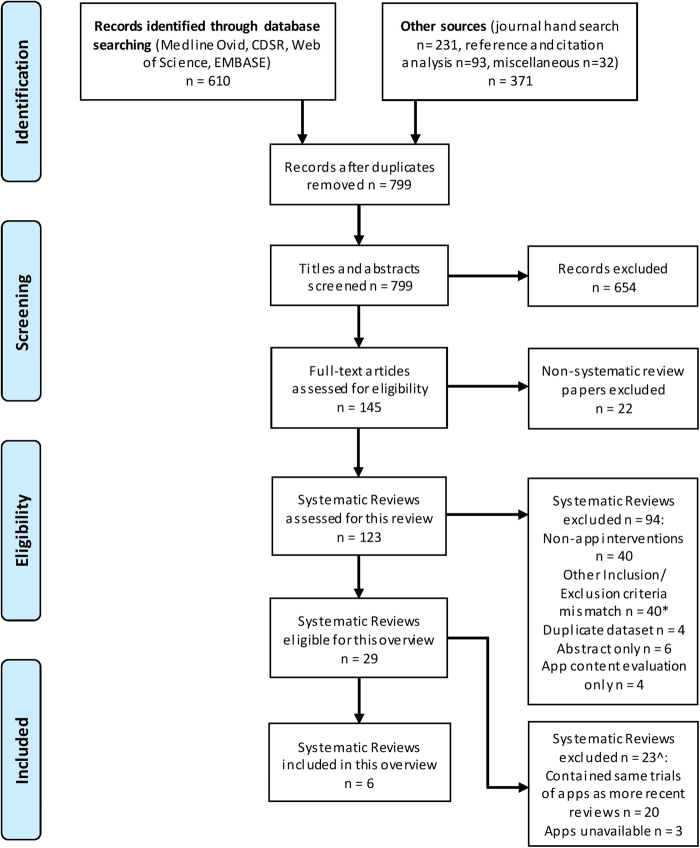
Mobile health apps aimed towards patients are an emerging field of mHealth. Their potential for improving self-management of chronic conditions is significant. Here, we propose a concept of “prescribable” mHealth apps, defined as apps that are currently available, proven effective, and preferably stand-alone, i.e., that do not require dedicated central servers and continuous monitoring by medical professionals. Our objectives were to conduct an overview of systematic reviews to identify such apps, assess the evidence of their effectiveness, and to determine the gaps and limitations in mHealth app research. We searched four databases from 2008 onwards and the Journal of Medical Internet Research for systematic reviews of randomized controlled trials (RCTs) of stand-alone health apps. We identified 6 systematic reviews including 23 RCTs evaluating 22 available apps that mostly addressed diabetes, mental health and obesity. Most trials were pilots with small sample size and of short duration. Risk of bias of the included reviews and trials was high. Eleven of the 23 trials showed a meaningful effect on health or surrogate outcomes attributable to apps. In conclusion, we identified only a small number of currently available stand-alone apps that have been evaluated in RCTs. The overall low quality of the evidence of effectiveness greatly limits the prescribability of health apps. mHealth apps need to be evaluated by more robust RCTs that report between-group differences before becoming prescribable. Systematic reviews should incorporate sensitivity analysis of trials with high risk of bias to better summarize the evidence, and should adhere to the relevant reporting guideline.
Overview
The claims and statistics of this paper haven’t been checked yet.
Free: it reads the open-access text and checks the first 5 claims that cite a source we can check. Create a free account to check every claim.
Integrity signals
Registry
Cites
Statistics
Figures
Verification
Claims the paper makes
The claims and statistics of this paper haven’t been checked yet.
Free: it reads the open-access text and checks the first 5 claims that cite a source we can check. Create a free account to check every claim.
Claims other papers make about this one
Each is checked against this paper’s own text: does it say what the citing paper says it does?
The source backs part of the claim, not all of it — or backs it for a different population, condition or comparison.
In the citing paper
“therefore, there is a small evidence base to provide guidance assessing their effectiveness [21, 22].”
From Patient Engagement with Conversational Agents in Health Applications 2016–2022: A Systematic Review and Meta-Analysis (2024) · cites this paper as [22]
Experimental — accuracy not yet measuredThe cited source says what the claim attributes to it.
In the citing paper
“There is mixed evidence to support current ambitions for mobile health (mHealth) apps to improve chronic health and well-being.”
From A Library of Analytic Indicators to Evaluate Effective Engagement with Consumer mHealth Apps for Chronic Conditions: Scoping Review (2019) · cites this paper as [1]
In the citing paper
“There are thousands of health-related apps available for download from the app store but only a tiny fraction are appropriate for clinical use.”
From What is the clinical value of mHealth for patients? (2020) · cites this paper as [37]
Self-check
Percentages, sums and reported differences re-computed from the paper’s own numbers.
The self-check needs the paper’s full text.
Citations
Cites
Preferred reporting items for systematic reviews and meta-analyses: The PRISMA statement
Moher, D., Liberati, A., Tetzlaff, J., & Altman, D. G. (2010) · International Journal of Surgery · doi:10.1016/j.ijsu.2010.02.007 · Cited by 12,156
Hoffmann, T. C., Glasziou, P. P., Boutron, I., Milne, R., Perera, R., Moher, D., Altman, D. G., Barbour, V., Macdonald, H., Johnston, M., et al. (2014) · BMJ · doi:10.1136/bmj.g1687 · Cited by 10,548
Self-citationMoher, D., Hopewell, S., Schulz, K. F., Montori, V., Gotzsche, P. C., Devereaux, P. J., Elbourne, D., Egger, M., & Altman, D. G. (2010) · BMJ · doi:10.1136/bmj.c869 · Cited by 8,883
GRADE guidelines: 3. Rating the quality of evidence
Balshem, H., Helfand, M., Schünemann, H. J., Oxman, A. D., Kunz, R., Brozek, J., Vist, G. E., Falck-Ytter, Y., Meerpohl, J., & Norris, S. (2011) · Journal of Clinical Epidemiology · doi:10.1016/j.jclinepi.2010.07.015 · Cited by 8,285
Development of AMSTAR: A measurement tool to assess the methodological quality of systematic reviews
Shea, B. J., Grimshaw, J. M., Wells, G. A., Boers, M., Andersson, N., Hamel, C., Porter, A. C., Tugwell, P., Moher, D., & Bouter, L. M. (2007) · BMC Medical Research Methodology · doi:10.1186/1471-2288-7-10 · Cited by 4,374
ROBIS: A new tool to assess risk of bias in systematic reviews was developed
Whiting, P., Savović, J., Higgins, J. P. T., Caldwell, D. M., Reeves, B. C., Shea, B., Davies, P., Kleijnen, J., & Churchill, R. (2016) · Journal of Clinical Epidemiology · doi:10.1016/j.jclinepi.2015.06.005 · Cited by 2,272
The impact of mHealth interventions: systematic review of systematic reviews
Marcolino, M. S., Oliveira, J. A. Q., D'Agostino, M., Ribeiro, A. L., Alkmim, M. B. M., & Novillo-Ortiz, D. (2018) · JMIR mHealth and uHealth · doi:10.2196/mhealth.8873 · Cited by 1,163
Schoeppe, S., Alley, S., Van Lippevelde, W., Bray, N. A., Williams, S. L., Duncan, M. J., & Vandelanotte, C. (2016) · International Journal of Behavioral Nutrition and Physical Activity · doi:10.1186/s12966-016-0454-y · Cited by 949
Evaluating Digital Health Interventions
Murray, E., Hekler, E. B., Andersson, G., Collins, L. M., Doherty, A., Hollis, C., Rivera, D. E., West, R., & Wyatt, J. C. (2016) · American Journal of Preventive Medicine · doi:10.1016/j.amepre.2016.06.008 · Cited by 847 · cited 1×
“…RCTs should remain the gold standard, but should be employed strategically, and only used when the intervention is stable, can be implemented with high-fi delity, and has a high likelihood of clinically meaningful bene fi t. 63 We also emphasize the value of traditional systematic and other reviews.”
BackgroundHollis, C., Falconer, C. J., Martin, J. L., Whittington, C., Stockton, S., Glazebrook, C., & Davies, E. B. (2017) · Journal of Child Psychology and Psychiatry · doi:10.1111/jcpp.12663 · Cited by 846 · cited 1×
“…of mHealth apps aimed at particular health conditions that examined different aspects of the apps such as the contents, quality and usability, 5 – 8 no overview of systematic reviews has been done yet to summarize the effectiveness of stand-alone mHealth apps speci fi cally, and across different…”
Background
Cited by
Items 201–290 of 290
Livet, M., & Easter, J. C. (2019) · Journal of the American Pharmacists Association · doi:10.1016/j.japh.2018.12.013 · Cited by 4
Technological Advances in Clinical Assessment
Heinz, M. V., Thomas, N. X., Nguyen, N. D., Griffin, T. Z., & Jacobson, N. (2019) · The Cambridge Handbook of Clinical Assessment and Diagnosis · doi:10.1017/9781108235433.007 · Cited by 7
Laitinen, J. H., Korkiakangas, E. E., Mäkiniemi, J. P., Tiitinen, S., Tikka, P., B, H. O.-K. A., Simunaniemi, A., Ahola, S., Jaako, J., Kekkonen, M., et al. (2020) · BMC Public Health · doi:10.1186/s12889-020-8449-7 · Cited by 7
“However, a recent review identified only a small number of currently available stand-alone apps that have been evaluated in RCTs, and concluded that overall, the evidence of effectiveness is of relatively low quality [38].”
BackgroundGerbutavicius, R., Merle, D. A., Wolf, A., Dimopoulos, S., Kortuem, K., & Kortuem, C. (2024) · JMIR Formative Research · doi:10.2196/55742 · Cited by 3
“However, most health apps in ophthalmology and other disciplines still lack evidence of clinical effectiveness and thus lack the rational basis to qualify for reimbursement [8,9].”
BackgroundOlszar, A., Książek, E., & Konikowska, K. (2024) · Engineering Sciences And Technologies · doi:10.15611/nit.2024.40.08 · Cited by 2
Health apps: a cross-sectional study exploring patient motivations and usage implications
Oudbier, S. J., Perillo, M., Smeulers, M., Nurmohamed, A. S., Meij, H. J., & Smets, E. M. A. (2025) · BMC Public Health · doi:10.1186/s12889-025-24227-5 · Cited by 4
“Additionally, the evidence base for health apps is often unclear, even for those prescribed by HCPs, because current studies lack concrete evaluation [11, 40].”
Assessment of mHealth Solutions Applied to Fall Detection for the Elderly
de Oliveira, F. S., da Silva, C. C., Pinheiro, T. S., Yokoi, L. M., dos Santos, P. D., Tanaka, H., & Simões, P. W. T. D. A. (2021) · Studies in health technology and informatics · doi:10.3233/shti210606 · Cited by 2
“Therefore, there are gaps to be clarified for a broader adoption in clinical practice and based on scientific evidence[1].”
BackgroundKodama, K., Kurata, K., & Cao, J. (2022) · Future of business and finance · doi:10.1007/978-981-19-4230-3_1 · Cited by 3
Gabizon, I., Bhagirath, V. C., Lokker, C., Bhavnani, S. P., & Lonn, E. (2019) · Personalized Medicine · doi:10.2217/pme-2019-0015 · Cited by 2
How prescribers can use technology to improve patient care
Shah, S., & Coughlan, J. (2019) · Journal of Prescribing Practice · doi:10.12968/jprp.2019.1.4.198 · Cited by 2
Amawi, H. A., Al-Azzam, S. I., Al-Zanati, T., Altamimi, N., Hammad, A. M., Alzoubi, K. H., Ashby, C. R., & Tiwari, A. K. (2021) · Recent Patents on Anti-Cancer Drug Discovery · doi:10.2174/1574892816666210728122304 · Cited by 2
Kernebeck, S., Busse, T. S., & Vollmar, H. C. (2022) · Springer eBooks · doi:10.1007/978-3-658-35691-0_4 · Cited by 2
del Castillo, J. M. B., Alejandre‐Alba, N., Henares, I., Ferraris, M. P., & Águila, M. (2023) · Archivos de la Sociedad Española de Oftalmología (English Edition) · doi:10.1016/j.oftale.2023.03.004 · Cited by 2
Introducing the Chronic Disease mHealth App Quality Evaluation Framework (CHRONIQ)
Charlie, C., & Cilliers, L. (2024) · Conference on Information Communications Technology and Society (ICTAS) · doi:10.1109/ictas59620.2024.10507109 · Cited by 2
“…Hare : Department of Information Systems University of Fort Hare, East London, South Africa lcilliers@ufh.ac.za The potential of health apps to enhance healthcare outcomes is exemplified by studies such as [4], demonstrating their ability to empower patients to monitor and manage health conditions.”
BackgroundRijcken, C. A. W. (2019) · Elsevier eBooks · doi:10.1016/b978-0-12-817638-2.00009-2 · Cited by 3
Mobile phone applications used to monitor age-related macular degeneration
Rogalska, A., & Kurzak, E. (2025) · Annales Academiae Medicae Silesiensis · doi:10.18794/aams/195983 · Cited by 1
“Byambasuren et al. [33] suggest that independent and trustworthy sources should evaluate mHealth applications and recommend a set of trustworthy applications for healthcare professionals to refer patients to.”
Trustworthiness Features of Commercially Available Mobile Health (mHealth) Applications
Tejera, J., Gokhale, S. S., & Gromisch, E. S. (2025) · IEEE Annual International Computer Software and Applications Conference (COMPSAC) · doi:10.1109/compsac65507.2025.00266 · Cited by 2
“Proven effective mHealth apps can be “prescribed,” or recommended as standalone aids by medical practitioners to help patients manage their condition [26, 27].”
Osei, E., Asante, L. S., Ampon-Wireko, S., & Abdulai, P. M. (2025) · Digital Health · doi:10.1177/20552076251379770 · Cited by 1
The future of addiction psychiatry
Arruda, F. S., & Castaldelli-Maia, J. M. (2025) · International Review of Psychiatry · doi:10.1080/09540261.2025.2566211 · Cited by 2
“Also, the proliferation of mental health apps, exceeding hundreds of thousands, reveals a market dynamic often driven more by commercial than clinical priorities (Byambasuren et al., 2018).”
di Bona, K., Ijaz, K., & Ahmadpour, N. (2025) · Australian Conference on Human-Computer Interaction (OzCHI) · doi:10.1145/3764687.3764704 · Cited by 2
Horwitz, A. G., Mills, E. D., Nanwani, R., Bohnert, A. S. B., & Sen, S. (2026) · Journal of Affective Disorders · doi:10.1016/j.jad.2026.121237 · Cited by 1
Vasiloglou, M. F., Kotzakioulafi, E., Mainardi, F., Ahmed, M., Staiano, A. E., Dimidi, E., Salathé, M., Maher, C., Vandelanotte, C., & Mantzoros, C. S. (2026) · The Lancet Digital Health · doi:10.1016/j.landig.2026.101009 · Cited by 1
Potier, R. (2022) · L Évolution Psychiatrique · doi:10.1016/j.evopsy.2022.09.001 · Cited by 1
Yokomitsu, K., Takashina, H. N., Takebayashi, Y., & Muranaka, S. (2023) · JMIR Research Protocols · doi:10.2196/44469 · Cited by 1
“The use of mobile devices, which are now owned by a majority of people, has made it possible for individuals to access care in their daily lives without being restricted by place and time [4-6].”
A Mobile Health Design Process to Improve User Engagement
Ikwunne, T. A. (2024) · ACM SIGACCESS Accessibility and Computing · doi:10.1145/3703599.3703603 · Cited by 1
Sarbaz, M., Baigi, S. F. M., Salehzade, Z., Aval, R. N., Esmaeili, M., & Kimiafar, K. (2024) · Journal of Health Administration · doi:10.61186/jha.27.3.1 · Cited by 1
Technology-enabled care in practice: from apps to Skype
Johnson, K., Chambers, C., & Corden-LePetit, D. (2019) · Practice Nursing · doi:10.12968/pnur.2019.30.9.444 · Cited by 1
COVID-19 in 2021: Is it the major disrupter that eHealth needs?
Saltman, D. C. (2021) · Australian Journal of General Practice · doi:10.31128/ajgp-covid-47 · Cited by 1
There's an App for That, But Does It Work?
Wu, A. C. (2019) · The Journal of Allergy and Clinical Immunology In Practice · doi:10.1016/j.jaip.2019.05.023 · Cited by 2
Chen, E. S. (2019) · Carolina Digital Repository (University of North Carolina at Chapel Hill) · doi:10.17615/p8d8-s681 · Cited by 2
Incentive Spirometry and Smart Phones: Performance validation and user impressions
Baxter, C. A. (2018) · Queensland University of Technology · doi:10.5204/thesis.eprints.125165 · Cited by 2
Yokomitsu, K., Oimatsu, R., Toh, S. H. Y., & Sündermann, O. (2024) · doi:10.2196/preprints.60871 · Cited by 1
Adolescents' perspectives on chronic medication use: opportunities for mHealth
Kosse, R. C. (2019) · Utrecht University Repository (Utrecht University) · Cited by 2
Engagement With Digital Health Technologies
Nicholas, R. (2019) · Queensland University of Technology · doi:10.5204/thesis.eprints.134483 · Cited by 1
Stein, M. D., & Galea, S. (2020) · Oxford University Press eBooks · doi:10.1093/oso/9780197510384.003.0053
Missing People in Spain: An App for Trauma Recovery – A Digital Health Intervention for Survivors
Escudero, C. (2020) · Advances in human services and public health (AHSPH) book series · doi:10.4018/978-1-7998-6705-0.ch005
McGrowder, D. A., Miller, F. G., Brown, J. G., Wilson-Clarke, C. F., & Anderson-Jackson, L. (2020) · Advances in medical technologies and clinical practice book series · doi:10.4018/978-1-7998-6527-8.ch007
de Almeida, R. S. (2020) · Advances in medical technologies and clinical practice book series · doi:10.4018/978-1-7998-7472-0.ch011
Tracking via Volunteered Geographic Information
Hardy, A. (2020) · Goodfellow Publishers Ltd eBooks · doi:10.23912/9781911635383-4574
Letter to the editor regarding: ‘Smartphone apps on burns first aid: A review of the advice’
Patel, B., Schrire, T., & Sen, S. K. (2021) · Burns · doi:10.1016/j.burns.2021.04.009
Pragmatic randomized trials for behavioral health or educational interventions
Troxel, A. B. (2021) · Elsevier eBooks · doi:10.1016/b978-0-12-817663-4.00005-2
Applied Design Research of Self-Health Technologies in Sports
Chamorro‐Koc, M., Nicholas, R., & Wang, K. (2021) · QUT ePrints (Queensland University of Technology)
AIM in Wearable and Implantable Computing
Baronetto, A., & Amft, O. (2021) · Springer eBooks · doi:10.1007/978-3-030-58080-3_299-1
Loohuis, A. M. M. (2021) · University of Groningen research database (University of Groningen / Centre for Information Technology) · doi:10.33612/diss.182829039
Lee, D., Frey, G., Cothran, D., Harezlak, J., & Shih, P. C. (2021) · JMIR Formative Research · doi:10.2196/preprints.35701
On maintaining successful treatment outcomes in interdisciplinary multimodal pain treatment
Elbers, S. (2021) · Research Publications (Maastricht University) · doi:10.26481/dis.20211117se
The Role of mHealth in Improving Health and Medication Management
(2020) · Advances in medical technologies and clinical practice book series · doi:10.4018/978-1-7998-3832-6.ch002
(2021) · Elsevier eBooks · doi:10.1016/b978-3-437-22851-3.50032-3
AIM in Wearable and Implantable Computing
Baronetto, A., & Amft, O. (2022) · Springer eBooks · doi:10.1007/978-3-030-64573-1_299
(2019) · Elsevier eBooks · doi:10.1016/b978-0-12-817638-2.09988-0
del Castillo, J. M. B., Alba, N. A., Henares, I., Ferraris, M. P., & Águila, M. (2023) · Archivos de la Sociedad Española de Oftalmología · doi:10.1016/j.oftal.2023.01.004 · Cited by 2
Baxter, C. A. (2023) · Queensland University of Technology · doi:10.5204/thesis.eprints.238364
Let's Get Physical: Exploring Gamification in Fitness Apps to Sustain User Engagement
Khan, A. (2023) · doi:10.32920/23159873.v1 · Cited by 1
Yu, F., Li, S., & Yu, W. M. (2023) · Soft Computing · doi:10.1007/s00500-023-08841-2
RetractedPak, J., & Kim, H. S. (2023) · Research Square · doi:10.21203/rs.3.rs-3325534/v1
XXI Congreso Internacional Interacción Persona-Ordenador
Lecuona, A. R., & Gallego, B. M. (2021) · UMA Editorial eBooks · doi:10.24310/mumaedmumaed.63
Bonotis, P., Angelidis, P., & Natsiavas, P. (2024) · doi:10.2196/preprints.57342
MHealth application for cancer care delivery
Üğüdücü, K., Cerit, T., Toprak, A. G., & Alankuş, G. (2024) · AIP conference proceedings · doi:10.1063/5.0194462 · Cited by 1
Bröcker, E., Scheffler, F., Suliman, S., et al. (2024) · Cambridge Prisms Global Mental Health · doi:10.1017/gmh.2024.34.pr9
Bröcker, E., Scheffler, F., Suliman, S., et al. (2024) · Cambridge Prisms Global Mental Health · doi:10.1017/gmh.2024.34.pr8
Bröcker, E. (2024) · Cambridge Prisms Global Mental Health · doi:10.1017/gmh.2024.34.pr7
Bröcker, E., Scheffler, F., Suliman, S., et al. (2024) · Cambridge Prisms Global Mental Health · doi:10.1017/gmh.2024.34.pr5
Bröcker, E., Scheffler, F., Suliman, S., et al. (2024) · Cambridge Prisms Global Mental Health · doi:10.1017/gmh.2024.34.pr6
Bröcker, E. (2024) · Cambridge Prisms Global Mental Health · doi:10.1017/gmh.2024.34.pr4
Bröcker, E., Scheffler, F., Suliman, S., et al. (2024) · Cambridge Prisms Global Mental Health · doi:10.1017/gmh.2024.34.pr2
Bröcker, E., Scheffler, F., Suliman, S., et al. (2024) · Cambridge Prisms Global Mental Health · doi:10.1017/gmh.2024.34.pr3
Bröcker, E. (2023) · Cambridge Prisms Global Mental Health · doi:10.1017/gmh.2024.34.pr1
di Bona, K., Ijaz, K., & Ahmadpour, N. (2024) · doi:10.2196/preprints.69833
Health technology for all: examining health apps and wearables use through the lens of (in)equality
Bao, H. (2025) · DR-NTU (Nanyang Technological University) · doi:10.32657/10356/183350
Xiong, Y., & Cai, Y. (2025) · International Conference on Artificial Intelligence and Machine Learning Research (CAIMLR) · doi:10.1117/12.3058103 · Cited by 1
“Mhealth is the collection of user health data through Internet of Things (IoT) devices such as sensors and sending it to the cloud for analysis, feedback and treatment [1, 13, 16].”
Mobile health apps for QT interval measurement: A systematic review
Chavez-Ecos, F. A., Uribe-Cavero, L. J., Chavez-Ecos, R., Arias-Arias, S., Chavez-Gutarra, M. A., Montesinos‐Segura, R., & Camacho-Caballero, K. (2025) · Journal of Electrocardiology · doi:10.1016/j.jelectrocard.2025.154041
Dietel, F. A., Pletzer-Zelgert, E., Portenhauser, A. A., Baumeister, H., Reininghaus, U., Pryss, R. C., Stach, M., Vocks, S., & Terhorst, Y. (2025) · doi:10.2196/preprints.82765
Orellano-Colón, E. M., Colón-Peña, F. E., Fernández-Morales, K., Jesús, Y. M. V.-D., Hugger-Olavarrieta, J. J., Palleja-Valentín, E. M., & Roche-Lima, A. (2025) · Physical & Occupational Therapy In Geriatrics · doi:10.1080/02703181.2025.2581271
Pelle, T., van der Palen, J., de Graaf, F., van den Hoogen, F. H. J., Bevers, K., & van den Ende, C. H. (2021) · Figshare · doi:10.6084/m9.figshare.14570252
Demsash, A. W., Kalayou, M. H., & Walle, A. D. (2024) · Figshare · doi:10.6084/m9.figshare.26103713
Demsash, A. W., Kalayou, M. H., & Walle, A. D. (2024) · Figshare · doi:10.6084/m9.figshare.26103849
Gu, J., Miller, C. B., Henry, A. L., Espie, C. A., Davis, M. L., Stott, R., Emsley, R., Smits, J. A. J., Craske, M., Saunders, K. E. A., et al. (2020) · Figshare · doi:10.6084/m9.figshare.12186165
Bucci, S., Varese, F., Quayle, E., Cartwright, K., Larkin, A., Chan, C., Chitsabesan, P., Green, V., Hewins, W., Machin, M., et al. (2025) · medRxiv · doi:10.1111/camh.70060 · Cited by 2
Precision Approaches for Scalable Digital and Clinic-Based Interventions in Mental Health
Bohnert, A. S. B., Fritsche, L., & Sen, S. (2026) · Biological Psychiatry Cognitive Neuroscience and Neuroimaging · doi:10.1016/j.bpsc.2026.01.004 · Cited by 1
A scoping review on using real-world data to evaluate the effectiveness of mHealth applications
Gehder, S., Brückner, S., Gilbert, S., & Goeldner, M. (2026) · npj Digital Medicine · doi:10.1038/s41746-026-02562-0 · Cited by 3
Hoang, V. L., Nguyen, N. T., Bui, H. T., Hoang, T. H., & Liamputtong, P. (2025) · Springer eBooks · doi:10.1007/978-981-97-0821-5_133-1
Wang, J., Li, C., Yang, Y., Bhandari, B., & Coleman, D. C. (2026) · The Science of Diabetes Self-Management and Care · doi:10.1177/26350106261438832
“33 Because this was a short-term feasibility study with a small sample size, clinical outcome estimates are preliminary and primarily intended to inform measurement procedures for future trials.”
A Repeated Block Perturbation Subsampling for Large-Scale Longitudinal Data
Yao, Y., Lee, J. H., & Jin, Z. (2026) · Journal of Statistical Theory and Practice · doi:10.1007/s42519-026-00591-2 · Cited by 1
Hacia un Dispositivo Wearable Electrónico Inteligente de Corrección Postural Asociado a la Espalda
González, A. B. G., Márquez-Sánchez, S., Robles-García, M., Corchado, J. M., & Reboredo, A. D. L. (2021) · Revista de la Asociación Interacción Persona Ordenador (AIPO) · doi:10.65234/interaccion.47 · Cited by 1
“Este nuevo paradigma, incluye aplicaciones (apps) sobre el estilo de vida y bienestar que conectan a las personas con dispositivos de todo tipo (Byambasuren et al., 2018) y ecosistemas de sensores con el fin de mejorar la calidad de vida con la supervisión de los profesionales que a través de…”
Tran, V.-T., Ravaud, P., Kunneman, M., Montori, V. M., & Phi, N. T. T. (2026) · Digital Health · doi:10.1177/20552076261458023
Hoang, V. L., Nguyen, N. T., Bui, H. T., Hoang, T. H., & Liamputtong, P. (2026) · Springer eBooks · doi:10.1007/978-981-92-1288-0_133
Temesgen, W. A., Lai, Y. Y., Suen, H. N., Chan, W. Y., Yau, P. T., Chien, W. T., & Chong, Y. Y. (2026) · Nursing Reports · doi:10.3390/nursrep16090303 · Cited by 1
“Non-pharmacological interventions, including mHealth, are generally perceived as safer than pharmacotherapy or invasive treatments [59].”
Dietel, F. A., Pletzer-Zelgert, E., Portenhauser, A. A., Baumeister, H., Reininghaus, U., Pryss, R. C., Stach, M., Vocks, S., & Terhorst, Y. (2025) · JMIR mhealth and uhealth · doi:10.2196/82765
MOBILE HEALTH AND PEER SUPPORT NETWORKS IN PCOS SELF-MANAGEMENT: A NARRATIVE REVIEW
Kępa, W., Kadłuczka, J., Papuga, A., Grzymek, M., Pawlucka, A., Pawłucka, K., Bury, J., Kraska, K., Potoniec, J., Sobek, A., et al. (2026) · International Journal of Innovative Technologies in Social Science · doi:10.31435/ijitss.3(51).2026.6217
Mechael, P., Chaney, S. C., Aboelwaffa, Y., Lim, S. S., Liu, S., Teixeira, A. R., Kalema, N. L., & Arora, P. (2026) · The Lancet Digital Health · doi:10.1016/j.landig.2026.101078
Metadata
- Authors
- Byambasuren, O., Sanders, S., Beller, E., & Glasziou, P.
- Affiliations
- Bond University (AU)
- Corresponding author
- Byambasuren, Oyungerel
- Venue
- npj Digital Medicine
- Published
- 2018-05-09
- Volume
- 1
- Issue
- 1
- Pages
- 12-12
- ISSN
- 2398-6352 (ISSN-L)
- PMC
- PMC6550270
- OpenAlex
- W2800465629
- Cited by
- 291
- References
- 63
- Citations by year
- 2026: 14 · 2025: 25 · 2024: 35 · 2023: 28 · 2022: 35 · 2021: 52 · 2020: 51 · 2019: 43 · 2018: 8
- FWCI
- 6.97
- Type
- journal article
- Language
- en
- Open access
- gold
- doi.org
- Licence
- cc-by
- creativecommons.org/licenses/by/4.0 (tdm)
- creativecommons.org/licenses/by/4.0 (vor)
- Locations
- npj Digital Medicine (publishedVersion, cc-by)
- Europe PMC (PubMed Central) (publishedVersion, cc-by)
- PubMed Central (publishedVersion, cc-by)
- PubMed (publishedVersion)
- Bond University Research Portal (Bond University) (submittedVersion, cc-by)
- DOAJ (DOAJ: Directory of Open Access Journals) (submittedVersion, cc-by-sa)
- Funders
- Australian Government
- National Health and Medical Research Council (1080042, 1044904)
- Topics
- Health Sciences › Health Professions › General Health Professions › Mobile Health and mHealth Applications
- Social Sciences › Psychology › Applied Psychology › Digital Mental Health Interventions
- Physical Sciences › Computer Science › Information Systems › Mobile Learning in Education
- Keywords
- mobile health apps, patient self-management, chronic disease, diabetes mellitus, mental health, obesity, evidence of effectiveness, risk of bias, randomized controlled trials
About these checks
Registry, retraction, Cites and statistics results are computed, not judged, with one exception: a printed reference that no index lists is read once by a model before it counts as a citation error. Claims are extracted by a model and kept only when their quote appears verbatim in the text; each cited source is then checked, with a model’s help, for whether it says what the claim relies on. Those verdicts can be wrong — read the claim’s quote and the cited source before relying on one.
Statistics and arithmetic are recomputed, not judged.
Confidence bands are shown only for fields calibrated on our annotated test set. None is calibrated yet, so no band is shown.
What counts as a claim ›How we measure confidence ›How we check this ›
Are you an author, or do you see a problem with this page? Request a review
Data sources
Bibliographic data: Semantic Scholar, OpenAlex, Crossref.
Contains information from the Semantic Scholar Academic Graph Datasets, made available under the ODC Attribution License (ODC-BY 1.0).
Semantic Scholar’s data is described in: Kinney, R., et al. (2023). The Semantic Scholar Open Data Platform. arXiv:2301.10140.
