

Prescribable mHealth apps identified from an overview of systematic reviews
Open accessThe DOI matches its Crossref record; 62 of the 63 references it cites were found in a registry or an index.
Abstract
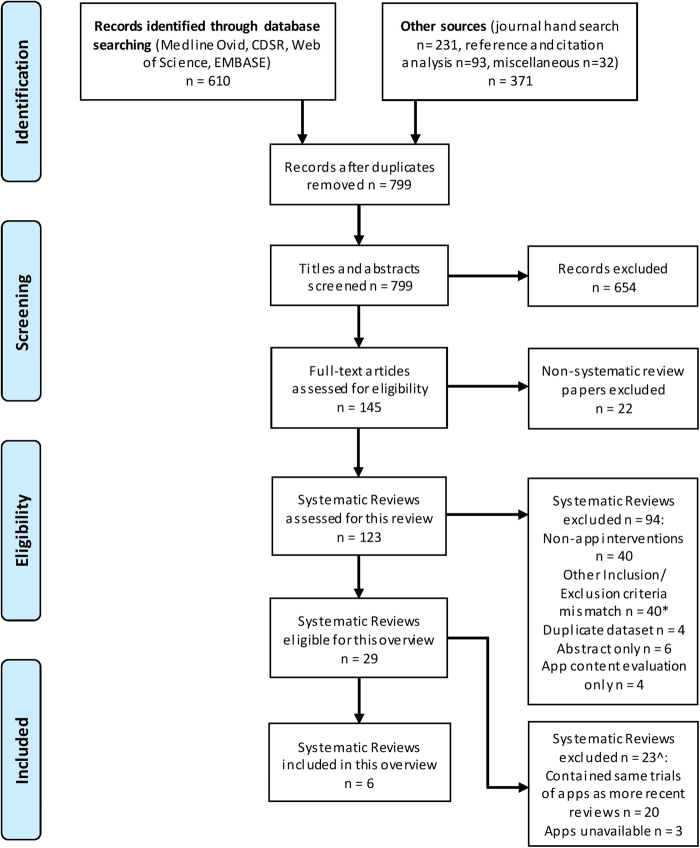
Mobile health apps aimed towards patients are an emerging field of mHealth. Their potential for improving self-management of chronic conditions is significant. Here, we propose a concept of “prescribable” mHealth apps, defined as apps that are currently available, proven effective, and preferably stand-alone, i.e., that do not require dedicated central servers and continuous monitoring by medical professionals. Our objectives were to conduct an overview of systematic reviews to identify such apps, assess the evidence of their effectiveness, and to determine the gaps and limitations in mHealth app research. We searched four databases from 2008 onwards and the Journal of Medical Internet Research for systematic reviews of randomized controlled trials (RCTs) of stand-alone health apps. We identified 6 systematic reviews including 23 RCTs evaluating 22 available apps that mostly addressed diabetes, mental health and obesity. Most trials were pilots with small sample size and of short duration. Risk of bias of the included reviews and trials was high. Eleven of the 23 trials showed a meaningful effect on health or surrogate outcomes attributable to apps. In conclusion, we identified only a small number of currently available stand-alone apps that have been evaluated in RCTs. The overall low quality of the evidence of effectiveness greatly limits the prescribability of health apps. mHealth apps need to be evaluated by more robust RCTs that report between-group differences before becoming prescribable. Systematic reviews should incorporate sensitivity analysis of trials with high risk of bias to better summarize the evidence, and should adhere to the relevant reporting guideline.
Overview
The claims and statistics of this paper haven’t been checked yet.
Free: it reads the open-access text and checks the first 5 claims that cite a source we can check. Create a free account to check every claim.
Integrity signals
Registry
Cites
Statistics
Figures
Verification
Claims the paper makes
The claims and statistics of this paper haven’t been checked yet.
Free: it reads the open-access text and checks the first 5 claims that cite a source we can check. Create a free account to check every claim.
Claims other papers make about this one
Each is checked against this paper’s own text: does it say what the citing paper says it does?
The source backs part of the claim, not all of it — or backs it for a different population, condition or comparison.
In the citing paper
“therefore, there is a small evidence base to provide guidance assessing their effectiveness [21, 22].”
From Patient Engagement with Conversational Agents in Health Applications 2016–2022: A Systematic Review and Meta-Analysis (2024) · cites this paper as [22]
Experimental — accuracy not yet measuredThe cited source says what the claim attributes to it.
In the citing paper
“There is mixed evidence to support current ambitions for mobile health (mHealth) apps to improve chronic health and well-being.”
From A Library of Analytic Indicators to Evaluate Effective Engagement with Consumer mHealth Apps for Chronic Conditions: Scoping Review (2019) · cites this paper as [1]
In the citing paper
“There are thousands of health-related apps available for download from the app store but only a tiny fraction are appropriate for clinical use.”
From What is the clinical value of mHealth for patients? (2020) · cites this paper as [37]
Self-check
Percentages, sums and reported differences re-computed from the paper’s own numbers.
The self-check needs the paper’s full text.
Citations
Cites
Preferred reporting items for systematic reviews and meta-analyses: The PRISMA statement
Moher, D., Liberati, A., Tetzlaff, J., & Altman, D. G. (2010) · International Journal of Surgery · doi:10.1016/j.ijsu.2010.02.007 · Cited by 12,156
Hoffmann, T. C., Glasziou, P. P., Boutron, I., Milne, R., Perera, R., Moher, D., Altman, D. G., Barbour, V., Macdonald, H., Johnston, M., et al. (2014) · BMJ · doi:10.1136/bmj.g1687 · Cited by 10,548
Self-citationMoher, D., Hopewell, S., Schulz, K. F., Montori, V., Gotzsche, P. C., Devereaux, P. J., Elbourne, D., Egger, M., & Altman, D. G. (2010) · BMJ · doi:10.1136/bmj.c869 · Cited by 8,883
GRADE guidelines: 3. Rating the quality of evidence
Balshem, H., Helfand, M., Schünemann, H. J., Oxman, A. D., Kunz, R., Brozek, J., Vist, G. E., Falck-Ytter, Y., Meerpohl, J., & Norris, S. (2011) · Journal of Clinical Epidemiology · doi:10.1016/j.jclinepi.2010.07.015 · Cited by 8,285
Development of AMSTAR: A measurement tool to assess the methodological quality of systematic reviews
Shea, B. J., Grimshaw, J. M., Wells, G. A., Boers, M., Andersson, N., Hamel, C., Porter, A. C., Tugwell, P., Moher, D., & Bouter, L. M. (2007) · BMC Medical Research Methodology · doi:10.1186/1471-2288-7-10 · Cited by 4,374
ROBIS: A new tool to assess risk of bias in systematic reviews was developed
Whiting, P., Savović, J., Higgins, J. P. T., Caldwell, D. M., Reeves, B. C., Shea, B., Davies, P., Kleijnen, J., & Churchill, R. (2016) · Journal of Clinical Epidemiology · doi:10.1016/j.jclinepi.2015.06.005 · Cited by 2,272
The impact of mHealth interventions: systematic review of systematic reviews
Marcolino, M. S., Oliveira, J. A. Q., D'Agostino, M., Ribeiro, A. L., Alkmim, M. B. M., & Novillo-Ortiz, D. (2018) · JMIR mHealth and uHealth · doi:10.2196/mhealth.8873 · Cited by 1,163
Schoeppe, S., Alley, S., Van Lippevelde, W., Bray, N. A., Williams, S. L., Duncan, M. J., & Vandelanotte, C. (2016) · International Journal of Behavioral Nutrition and Physical Activity · doi:10.1186/s12966-016-0454-y · Cited by 949
Evaluating Digital Health Interventions
Murray, E., Hekler, E. B., Andersson, G., Collins, L. M., Doherty, A., Hollis, C., Rivera, D. E., West, R., & Wyatt, J. C. (2016) · American Journal of Preventive Medicine · doi:10.1016/j.amepre.2016.06.008 · Cited by 847 · cited 1×
“…RCTs should remain the gold standard, but should be employed strategically, and only used when the intervention is stable, can be implemented with high-fi delity, and has a high likelihood of clinically meaningful bene fi t. 63 We also emphasize the value of traditional systematic and other reviews.”
BackgroundHollis, C., Falconer, C. J., Martin, J. L., Whittington, C., Stockton, S., Glazebrook, C., & Davies, E. B. (2017) · Journal of Child Psychology and Psychiatry · doi:10.1111/jcpp.12663 · Cited by 846 · cited 1×
“…of mHealth apps aimed at particular health conditions that examined different aspects of the apps such as the contents, quality and usability, 5 – 8 no overview of systematic reviews has been done yet to summarize the effectiveness of stand-alone mHealth apps speci fi cally, and across different…”
BackgroundMobile Text Messaging for Health: A Systematic Review of Reviews
Hall, A. K., Cole-Lewis, H., & Bernhardt, J. M. (2015) · Annual Review of Public Health · doi:10.1146/annurev-publhealth-031914-122855 · Cited by 815
Validation of an index of the quality of review articles
Oxman, A. D., & Guyatt, G. H. (1991) · Journal of Clinical Epidemiology · doi:10.1016/0895-4356(91)90160-b · Cited by 786
A Smartphone Application to Support Recovery From Alcoholism: A Randomized Clinical Trial
Gustafson, D. H., McTavish, F. M., Chih, M.-Y., Atwood, A. K., Johnson, R. A., Boyle, M. G., Levy, M. S., Driscoll, H., Chisholm, S. M., Dillenburg, L., et al. (2014) · JAMA Psychiatry · doi:10.1001/jamapsychiatry.2013.4642 · Cited by 692 · cited 2×
“02).(25) These apps are available in Sweden and the USA respectively.”
BackgroundFirth, J., Torous, J., Nicholas, J., Carney, R., Rosenbaum, S., & Sarris, J. (2017) · Journal of Affective Disorders · doi:10.1016/j.jad.2017.04.046 · Cited by 675 · cited 2×
“One of the systematic reviews addressed diabetes, 10 two addressed mental health, 11,15 another two addressed physical activity and weight loss related issues, 12,14 and one addressed all of these areas by addressing the behavior change aspect of apps.”
BackgroundCarter, M. C., Burley, V. J., Nykjaer, C., & Cade, J. E. (2013) · Journal of Medical Internet Research · doi:10.2196/jmir.2283 · Cited by 666 · cited 1×
“28 The MyMealMate app includes calorie information of 23,000 UK-speci fi c brands of food items in the database, and goal-setting, physical activity monitoring and automated text-messages functions.”
Living systematic review: 1. Introduction-the why, what, when, and how
Elliott, J. H., Synnot, A., Turner, T., Simmonds, M., Akl, E. A., McDonald, S., Salanti, G., Meerpohl, J., MacLehose, H., Hilton, J., et al. (2017) · Journal of Clinical Epidemiology · doi:10.1016/j.jclinepi.2017.08.010 · Cited by 655 · cited 1×
“64,65 This will be invaluable in digital health research and evidence base building.”
BackgroundSelf-citationAgarwal, S., LeFevre, A. E., Lee, J., L’Engle, K., Mehl, G., Sinha, C., & Labrique, A. (2016) · BMJ · doi:10.1136/bmj.i1174 · Cited by 639 · cited 1×
“This emphasizes the importance of providing complete and transparent reporting of app interventions, 51 as is true of other interventions in health care.”
BackgroundLiving Systematic Reviews: An Emerging Opportunity to Narrow the Evidence-Practice Gap
Elliott, J. H., Turner, T., Clavisi, O., Thomas, J., Higgins, J. P. T., Mavergames, C., & Gruen, R. L. (2014) · PLoS Medicine · doi:10.1371/journal.pmed.1001603 · Cited by 596 · cited 1×
“64,65 This will be invaluable in digital health research and evidence base building.”
BackgroundFlores Mateo, G., Granado-Font, E., Ferré-Grau, C., & Montaña-Carreras, X. (2015) · Journal of Medical Internet Research · doi:10.2196/jmir.4836 · Cited by 540 · cited 1×
“Mateo 2015 systematic review assessed studies aimed at increasing weight loss and physical activity for overweight and obese people of all ages.(12) It included nine RCTs and two case control studies of which five RCTs were relevant to this overview.”
BackgroundPayne, H. E., Lister, C., West, J. H., & Bernhardt, J. M. (2015) · JMIR mHealth and uHealth · doi:10.2196/mhealth.3335 · Cited by 524
Almirall, D., Nahum-Shani, I., Sherwood, N. E., & Murphy, S. A. (2014) · Translational Behavioral Medicine · doi:10.1007/s13142-014-0265-0 · Cited by 453 · cited 1×
“62 As our overview showed, the effect of apps as health interventions might be marginal, and such small bene fi ts can only be reliably detected by rigorous testing.”
BackgroundHuckvale, K., Prieto, J. T., Tilney, M., Benghozi, P.-J., & Car, J. (2015) · BMC Medicine · doi:10.1186/s12916-015-0444-y · Cited by 376 · cited 1×
“54 They now employ a US-based app called AppScript , which contains all the apps in the NHS App library, to make app prescribing even easier for doctors.”
MethodHoffmann, T. C., Erueti, C., & Glasziou, P. P. (2013) · BMJ · doi:10.1136/bmj.f3755 · Cited by 375 · cited 1×
“We believe that sharing information amongst researchers working in app development is vital to reduce research waste and prevent re-invention of wheels.(53) We also found several cases where, despite the initial trials failing to demonstrate any positive benefit, the apps were still released (Table 2), adding to the ‘…”
ResultSelf-citationTurner-McGrievy, G. M., Beets, M. W., Moore, J. B., Kaczynski, A. T., Barr-Anderson, D. J., & Tate, D. F. (2013) · Journal of the American Medical Informatics Association · doi:10.1136/amiajnl-2012-001510 · Cited by 373 · cited 1×
“Several studies also noted that the control groups were susceptible to contamination with apps using the same or similar interventions to the tested app, since there are thousands of apps freely available to them outside of the research setting.(29,58) A solution to this issue would be to increase the sample size to a…”
MethodLiving systematic reviews: 2. Combining human and machine effort
Thomas, J., Noel-Storr, A., Marshall, I., Wallace, B., McDonald, S., Mavergames, C., Glasziou, P., Shemilt, I., Synnot, A., Turner, T., et al. (2017) · Journal of Clinical Epidemiology · doi:10.1016/j.jclinepi.2017.08.011 · Cited by 355 · cited 1×
“66 CONCLUSION Smartphone popularity and mHealth apps provide a huge potential to improve health outcomes for millions of patients.”
BackgroundSelf-citationLaing, B. Y., Mangione, C. M., Tseng, C.-H., Leng, M., Vaisberg, E., Mahida, M., Bholat, M., Glazier, E., Morisky, D. E., & Bell, D. S. (2014) · Annals of Internal Medicine · doi:10.7326/m13-3005 · Cited by 353
Kirwan, M., Vandelanotte, C., Fenning, A., & Duncan, M. J. (2013) · Journal of Medical Internet Research · doi:10.2196/jmir.2588 · Cited by 343
CBT for depression: a pilot RCT comparing mobile phone vs. computer
Watts, S., Mackenzie, A., Thomas, C., Griskaitis, A., Mewton, L., Williams, A., & Andrews, G. (2013) · BMC Psychiatry · doi:10.1186/1471-244x-13-49 · Cited by 329 · cited 1×
“Only one of the RCTs tested an app for depression against a previously validated web-based CBT program.(23) Both groups had equally significant improvements.”
BackgroundHolmen, H., Torbjørnsen, A., Wahl, A. K., Jenum, A. K., Småstuen, M. C., Årsand, E., & Ribu, L. (2014) · JMIR mHealth and uHealth · doi:10.2196/mhealth.3882 · Cited by 294 · cited 1×
“19 All the diabetes apps include functions to log blood glucose levels, insulin dose, diet and physical activity, and to set push noti fi cations and reminders.”
BackgroundBonoto, B. C., de Araújo, V. E., Godói, I. P., de Lemos, L. L. P., Godman, B., Bennie, M., Diniz, L. M., & Junior, A. A. G. (2017) · JMIR mhealth and uhealth · doi:10.2196/mhealth.6309 · Cited by 294
Charpentier, G., Benhamou, P.-Y., Dardari, D., Clergeot, A., Franc, S., Schaepelynck-Belicar, P., Catargi, B., Melki, V., Chaillous, L., Farret, A., et al. (2011) · Diabetes Care · doi:10.2337/dc10-1259 · Cited by 292 · cited 2×
“Four trials tested apps for type 1 diabetes patients, of which two demonstrated a significant between group reduction in HbA1c levels.(17,20) One trial that tested an app for type 2 diabetes patients did not show any between group differences in HbA1c levels at one year.”
Glynn, L. G., Hayes, P. S., Casey, M., Glynn, F., Alvarez-Iglesias, A., Newell, J., ÓLaighin, G., Heaney, D., O’Donnell, M., & Murphy, A. W. (2014) · British Journal of General Practice · doi:10.3399/bjgp14x680461 · Cited by 280
Roepke, A. M., Jaffee, S. R., Riffle, O. M., McGonigal, J., Broome, R., & Maxwell, B. (2015) · Games for Health Journal · doi:10.1089/g4h.2014.0046 · Cited by 265 · cited 1×
“The basic version of SuperBetter app was tested against its “fortified” version, which contains more cognitive behavioral therapy (CBT) and positive psychotherapy content, and a waitlist control group.(22) Depression scores were equally reduced in both app groups compared to the control group, but the attrition rate w…”
MethodTurner-McGrievy, G., & Tate, D. (2011) · Journal of Medical Internet Research · doi:10.2196/jmir.1841 · Cited by 263 · cited 2×
“30 The Schoeppe 2016 systematic review assessed studies aimed at improving diet, physical activity and sedentary behavior.”
BackgroundRandomized Controlled Pilot Study Testing Use of Smartphone Technology for Obesity Treatment
Allen, J. K., Stephens, J., Dennison Himmelfarb, C. R., Stewart, K. J., & Hauck, S. (2013) · Journal of Obesity · doi:10.1155/2013/151597 · Cited by 217
Smartphone interventions for long-term health management of chronic diseases: an integrative review
Wang, J., Wang, Y., Wei, C., Yao, N. (., Yuan, A., Shan, Y., & Yuan, C. (2014) · Telemedicine and e-Health · doi:10.1089/tmj.2013.0243 · Cited by 215
The digital placebo effect: mobile mental health meets clinical psychiatry
Torous, J., & Firth, J. (2016) · The Lancet Psychiatry · doi:10.1016/s2215-0366(15)00565-9 · Cited by 200
Direito, A., Jiang, Y., Whittaker, R., & Maddison, R. (2015) · Journal of Medical Internet Research · doi:10.2196/jmir.4568 · Cited by 192
Miner, A., Kuhn, E., Hoffman, J. E., Owen, J. E., Ruzek, J. I., & Taylor, C. B. (2016) · Psychological Trauma: Theory, Research, Practice, and Policy · doi:10.1037/tra0000092 · Cited by 185 · cited 1×
“Only one of the RCTs tested an app called PTSD Coach against waitlist control for 1 month; however, there were no significant between group differences in the PTSD Checklist–Civilian questionnaire result.(26) Weight loss and physical activity.”
BackgroundWharton, C. M., Johnston, C. S., Cunningham, B. K., & Sterner, D. (2014) · Journal of Nutrition Education and Behavior · doi:10.1016/j.jneb.2014.04.291 · Cited by 181
Gajecki, M., Berman, A. H., Sinadinovic, K., Rosendahl, I., & Andersson, C. (2014) · Addiction Science & Clinical Practice · doi:10.1186/1940-0640-9-11 · Cited by 179 · cited 2×
“Two other trials included in Payne 2015 systematic review explored use of mobile apps to curb alcohol use among university students 24 and patients leaving residential treatment for alcohol use disorder.”
BackgroundMethodInfluentialContinuous Evaluation of Evolving Behavioral Intervention Technologies
Mohr, D. C., Cheung, K., Schueller, S. M., Hendricks Brown, C., & Duan, N. (2013) · American Journal of Preventive Medicine · doi:10.1016/j.amepre.2013.06.006 · Cited by 168
van het Reve, E., Silveira, P., Daniel, F., Casati, F., & de Bruin, E. D. (2014) · Journal of Medical Internet Research · doi:10.2196/jmir.3055 · Cited by 167
Beyond the Randomized Controlled Trial: A Review of Alternatives in mHealth Clinical Trial Methods
Pham, Q., Wiljer, D., & Cafazzo, J. A. (2016) · JMIR mHealth and uHealth · doi:10.2196/mhealth.5720 · Cited by 162
Silveira, P., van de Langenberg, R., van het Reve, E., Daniel, F., Casati, F., & de Bruin, E. D. (2013) · Journal of Medical Internet Research · doi:10.2196/jmir.2579 · Cited by 140
Overviews of systematic reviews: great promise, greater challenge
McKenzie, J. E., & Brennan, S. E. (2017) · Systematic Reviews · doi:10.1186/s13643-017-0582-8 · Cited by 134 · cited 1×
“9 Hence, our objectives were to: (1) conduct an overview of systematic reviews of randomized controlled trials (RCTs) to identify and evaluate the effectiveness of prescribable mHealth apps; and (2) determine the gaps and limitations in mHealth app research.”
BackgroundWorswick, J., Wayne, S. C., Bennett, R., Fiander, M., Mayhew, A., Weir, M. C., Sullivan, K. J., & Grimshaw, J. M. (2013) · Systematic Reviews · doi:10.1186/2046-4053-2-26 · Cited by 130
Current Issues and Future Directions for Research Into Digital Behavior Change Interventions
Yardley, L., Choudhury, T., Patrick, K., & Michie, S. (2016) · American Journal of Preventive Medicine · doi:10.1016/j.amepre.2016.07.019 · Cited by 112 · cited 1×
“4 Here, we propose a concept of “ prescribable ” mHealth apps, de fi ned as health apps that are currently available, proven effective, and preferably stand-alone.”
BackgroundPham, Q., Khatib, Y., Stansfeld, S., Fox, S., & Green, T. (2016) · Games for Health Journal · doi:10.1089/g4h.2015.0033 · Cited by 104
Walsh, J. C., Corbett, T., Hogan, M., Duggan, J., & McNamara, A. (2016) · JMIR mHealth and uHealth · doi:10.2196/mhealth.5227 · Cited by 101
Self-Directed Interventions to Promote Weight Loss: A Systematic Review of Reviews
Tang, J., Abraham, C., Greaves, C., & Yates, T. (2014) · Journal of Medical Internet Research · doi:10.2196/jmir.2857 · Cited by 78
Mobile Phone and Web 2.0 Technologies for Weight Management: A Systematic Scoping Review
Bardus, M., Smith, J. R., Samaha, L., & Abraham, C. (2015) · Journal of Medical Internet Research · doi:10.2196/jmir.5129 · Cited by 75
Drion, I., Pameijer, L. R., van Dijk, P. R., Groenier, K. H., Kleefstra, N., & Bilo, H. J. G. (2015) · Journal of Diabetes Science and Technology · doi:10.1177/1932296815585871 · Cited by 74 · cited 1×
“Two of the apps also offer versions for doctors to enrol and monitor multiple patients.(16,18) At this stage, only two of these diabetes apps are available free of charge worldwide,(18,20) and the other three apps are available either in Germany, France, or Norway (Table 2).”
BackgroundSimblett, S., Birch, J., Matcham, F., Yaguez, L., & Morris, R. (2017) · JMIR Mental Health · doi:10.2196/mental.5558 · Cited by 72
Berndt, R.-D., Takenga, C., Preik, P., Kuehn, S., Berndt, L., Mayer, H., Kaps, A., & Schiel, R. (2014) · Journal of Personalized Medicine · doi:10.3390/jpm4020200 · Cited by 61
Comparisons within randomised groups can be very misleading
Bland, M., & Altman, D. G. (2011) · BMJ · doi:10.1136/bmj.d561 · Cited by 58
Perry, R., Leach, V., Davies, P., Penfold, C., Ness, A., & Churchill, R. (2017) · Systematic Reviews · doi:10.1186/s13643-017-0487-6 · Cited by 57
Mummah, S. A., Mathur, M., King, A. C., Gardner, C. D., & Sutton, S. (2016) · JMIR mhealth and uhealth · doi:10.2196/mhealth.5146 · Cited by 52
Smartphone App Use for Diabetes Management: Evaluating Patient Perspectives
Lithgow, K., Edwards, A., & Rabi, D. (2017) · JMIR Diabetes · doi:10.2196/diabetes.6643 · Cited by 40
Exergame Apps and Physical Activity: The Results of the ZOMBIE Trial
Cowdery, J., Majeske, P., Frank, R., & Brown, D. (2015) · American Journal of Health Education · doi:10.1080/19325037.2015.1043063 · Cited by 39
Bardus, M., Smith, J. R., Samaha, L., & Abraham, C. (2016) · European Journal of Public Health · doi:10.1093/eurpub/ckw090 · Cited by 18
Torous, J. B., Powell, A. C., & Knable, M. B. (2016) · Psychiatric Annals · doi:10.3928/00485713-20160908-02 · Cited by 10
Cited by
What is the clinical value of mHealth for patients?
Rowland, S. P., Fitzgerald, J. E., Holme, T., Powell, J., & McGregor, A. (2020) · npj Digital Medicine · doi:10.1038/s41746-019-0206-x · Cited by 454
Mobile phone text messaging and app-based interventions for smoking cessation
Whittaker, R., McRobbie, H., Bullen, C., Rodgers, A., Gu, Y., & Dobson, R. (2019) · Cochrane Database of Systematic Reviews · doi:10.1002/14651858.cd006611.pub5 · Cited by 452
“Byambasuren 2018 Byambasuren O, Sanders S, Beller E, Glasziou P. Prescribable mHealth apps identified from an overview of systematic reviews. npj Digital Medicine 2018;1(1):12.”
BackgroundResultBeyond validation: getting health apps into clinical practice
Gordon, W. J., Landman, A., Zhang, H., & Bates, D. W. (2020) · npj Digital Medicine · doi:10.1038/s41746-019-0212-z · Cited by 326
Akbar, S., Coiera, & Magrabi, F. (2020) · Journal of the American Medical Informatics Association · doi:10.1093/jamia/ocz175 · Cited by 245
Digital Interventions on Healthy Lifestyle Management: Systematic Review
Chatterjee, A., Prinz, A., Gerdes, M., & Martinez, S. (2021) · Journal of Medical Internet Research · doi:10.2196/26931 · Cited by 194
“Smartphone-based interventions [39-59] (such as apps, SMS text messages, sports, multicomponent interventions, emails, and social media) are readily available, inexpensive, and use tools already used by most teenagers.”
BackgroundMethod
Metadata
- Authors
- Byambasuren, O., Sanders, S., Beller, E., & Glasziou, P.
- Affiliations
- Bond University (AU)
- Corresponding author
- Byambasuren, Oyungerel
- Venue
- npj Digital Medicine
- Published
- 2018-05-09
- Volume
- 1
- Issue
- 1
- Pages
- 12-12
- ISSN
- 2398-6352 (ISSN-L)
- PMC
- PMC6550270
- OpenAlex
- W2800465629
- Cited by
- 291
- References
- 63
- Citations by year
- 2026: 14 · 2025: 25 · 2024: 35 · 2023: 28 · 2022: 35 · 2021: 52 · 2020: 51 · 2019: 43 · 2018: 8
- FWCI
- 6.97
- Type
- journal article
- Language
- en
- Open access
- gold
- doi.org
- Licence
- cc-by
- creativecommons.org/licenses/by/4.0 (tdm)
- creativecommons.org/licenses/by/4.0 (vor)
- Locations
- npj Digital Medicine (publishedVersion, cc-by)
- Europe PMC (PubMed Central) (publishedVersion, cc-by)
- PubMed Central (publishedVersion, cc-by)
- PubMed (publishedVersion)
- Bond University Research Portal (Bond University) (submittedVersion, cc-by)
- DOAJ (DOAJ: Directory of Open Access Journals) (submittedVersion, cc-by-sa)
- Funders
- Australian Government
- National Health and Medical Research Council (1080042, 1044904)
- Topics
- Health Sciences › Health Professions › General Health Professions › Mobile Health and mHealth Applications
- Social Sciences › Psychology › Applied Psychology › Digital Mental Health Interventions
- Physical Sciences › Computer Science › Information Systems › Mobile Learning in Education
- Keywords
- mobile health apps, patient self-management, chronic disease, diabetes mellitus, mental health, obesity, evidence of effectiveness, risk of bias, randomized controlled trials
About these checks
Registry, retraction, Cites and statistics results are computed, not judged, with one exception: a printed reference that no index lists is read once by a model before it counts as a citation error. Claims are extracted by a model and kept only when their quote appears verbatim in the text; each cited source is then checked, with a model’s help, for whether it says what the claim relies on. Those verdicts can be wrong — read the claim’s quote and the cited source before relying on one.
Statistics and arithmetic are recomputed, not judged.
Confidence bands are shown only for fields calibrated on our annotated test set. None is calibrated yet, so no band is shown.
What counts as a claim ›How we measure confidence ›How we check this ›
Are you an author, or do you see a problem with this page? Request a review
Data sources
Bibliographic data: Semantic Scholar, OpenAlex, Crossref.
Contains information from the Semantic Scholar Academic Graph Datasets, made available under the ODC Attribution License (ODC-BY 1.0).
Semantic Scholar’s data is described in: Kinney, R., et al. (2023). The Semantic Scholar Open Data Platform. arXiv:2301.10140.
