

Randomized controlled trial of a 12-week digital care program in improving low back pain
Open accessThe DOI matches its Crossref record; 38 of the 38 references it cites were found in a registry or an index.
Abstract
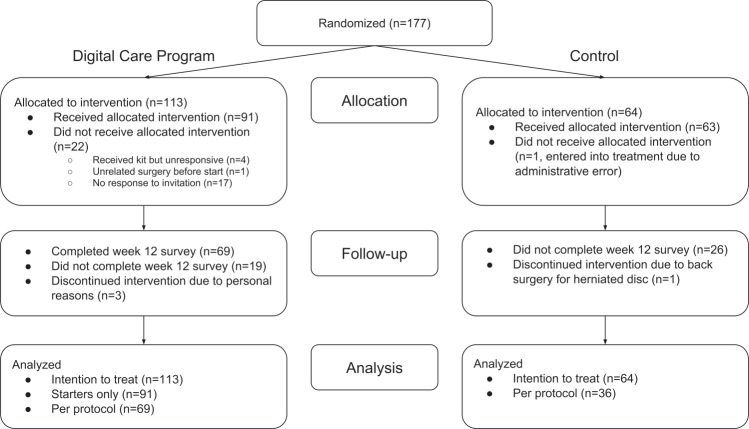
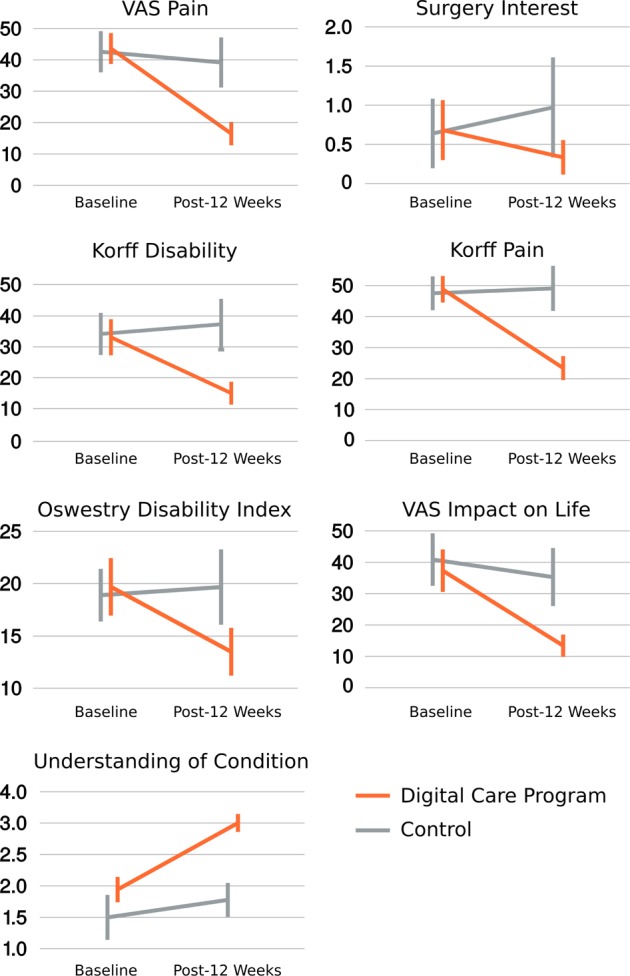
Low back pain (LBP) is the leading cause of disability throughout the world and is economically burdensome. The recommended first line treatment for non-specific LBP is non-invasive care. A digital care program (DCP) delivering evidence-based non-invasive treatment for LBP can aid self-management by engaging patients and scales personalized therapy for patient-specific needs. We assessed the efficacy of a 12-week DCP for LBP in a two-armed, pre-registered, randomized, controlled trial (RCT). Participants were included based on self-reported duration of LBP, but those with surgery or injury to the lower back in the previous three months were excluded. The treatment group (DCP) received the 12-week DCP, consisting of sensor-guided exercise therapy, education, cognitive behavioral therapy, team and individual behavioral coaching, activity tracking, and symptom tracking – all administered remotely via an app. The control group received three digital education articles only. All participants maintained access to treatment-as-usual. At 12 weeks, an intention-to-treat analysis showed each primary outcome—Oswestry Disability Index ( p < 0.001), Korff Pain ( p < 0.001) and Korff Disability ( p < 0.001)—as well as each secondary outcome improved more for participants in the DCP group compared to control group. For participants who completed the DCP (per protocol), average improvement in pain outcomes ranged 52-64% (Korff: 48.8–23.4, VAS: 43.6–16.5, VAS impact on daily life: 37.3–13.4; p < 0.01 for all) and average improvement in disability outcomes ranged 31–55% (Korff: 33.1–15, ODI: 19.7–13.5; p < 0.01 for both). Surgical interest significantly reduced in the DCP group. Participants that completed the DCP had an average engagement, each week, of 90%. Future studies will further explore the effectiveness of the DCP for long-term outcomes beyond 12 weeks and for a LBP patient population with possibly greater baseline pain and disability. In conclusion, the DCP resulted in improved LBP outcomes compared to treatment-as-usual and has potential to scale personalized evidence-based non-invasive treatment for LBP patients.
Overview
The claims and statistics of this paper haven’t been checked yet.
Free: it reads the open-access text and checks the first 5 claims that cite a source we can check. Create a free account to check every claim.
Integrity signals
Registry
Cites
Statistics
Figures
Verification
Claims the paper makes
The claims and statistics of this paper haven’t been checked yet.
Free: it reads the open-access text and checks the first 5 claims that cite a source we can check. Create a free account to check every claim.
Claims other papers make about this one
Each is checked against this paper’s own text: does it say what the citing paper says it does?
The check wasn’t confident either way, so it gives no verdict — never disputed.
In the citing paper
“In fact, DL has the ability to enhance human lives by providing additional accuracy in diagnosis, including estimating natural disasters [40], the discovery of new drugs [41], and cancer diagnosis [42–44].”
From Review of deep learning: concepts, CNN architectures, challenges, applications, future directions (2021) · cites this paper as [44]
Experimental — accuracy not yet measuredThe check wasn’t confident either way, so it gives no verdict — never disputed.
In the citing paper
“Furthermore, in grading prostate cancer, US board-certified general pathologists achieved an average accuracy of 61%, while the Google AI [44] outperformed these specialists by achieving an average accuracy of 70%.”
From Review of deep learning: concepts, CNN architectures, challenges, applications, future directions (2021) · cites this paper as [44]
Experimental — accuracy not yet measuredThe check wasn’t confident either way, so it gives no verdict — never disputed.
In the citing paper
“Finally, the application of DHT sensor-outcomes to monitor RA during daily life remains yet to be validated against standard in-clinic administered assessments of RA impact24.”
From Digital health technologies and machine learning augment patient reported outcomes to remotely characterise rheumatoid arthritis (2024) · cites this paper as [24]
Experimental — accuracy not yet measuredThe check wasn’t confident either way, so it gives no verdict — never disputed.
In the citing paper
“Particular issues are presented by the use of published data, which can be unvalidated or incomplete due to selective reporting26,27.”
From Machine intelligence in healthcare—perspectives on trustworthiness, explainability, usability, and transparency (2020) · cites this paper as [26]
Experimental — accuracy not yet measured
Self-check
Percentages, sums and reported differences re-computed from the paper’s own numbers.
The self-check needs the paper’s full text.
Citations
Cites
Fitting Linear Mixed-Effects Models Using lme4
Bates, D., Mächler, M., Bolker, B., & Walker, S. (2015) · Journal of Statistical Software · doi:10.18637/jss.v067.i01 · Cited by 86,835
Vos, T., Abajobir, A. A., Abate, K. H., Abbafati, C., Abbas, K. M., Abd-Allah, F., Abdulkader, R. S., Abdulle, A. M., Abebo, T. A., Abera, S. F., et al. (2017) · The Lancet · doi:10.1016/s0140-6736(17)32154-2 · Cited by 13,220
‘Small Changes' to Diet and Physical Activity Behaviors for Weight Management
Hills, A. P., Byrne, N. M., Lindstrom, R., & Hill, J. O. (2013) · Obesity Facts · doi:10.1159/000345030 · Cited by 9,493
Fairbank, J. C. T., & Pynsent, P. B. (2000) · Spine · doi:10.1097/00007632-200011150-00017 · Cited by 5,851
Qaseem, A., Wilt, T. J., McLean, R. M., Forciea, M. A., & for the Clinical Guidelines Committee of the American College of Physicians* (2017) · Annals of Internal Medicine · doi:10.7326/m16-2367 · Cited by 3,234
Epidemiological features of chronic low-back pain
Andersson, G. B. (1999) · The Lancet · doi:10.1016/s0140-6736(99)01312-4 · Cited by 3,181
Prevention and treatment of low back pain: evidence, challenges, and promising directions
Foster, N. E., Anema, J. R., Cherkin, D., Chou, R., Cohen, S. P., Gross, D. P., Ferreira, P. H., Fritz, J. M., Koes, B. W., Peul, W., et al. (2018) · The Lancet · doi:10.1016/s0140-6736(18)30489-6 · Cited by 2,398
Ostelo, R. W. J. G., Deyo, R. A., Stratford, P., Waddell, G., Croft, P., Von Korff, M., Bouter, L. M., & de Vet, H. C. (2008) · Spine · doi:10.1097/brs.0b013e31815e3a10 · Cited by 2,009
Lumbar Disc Disorders and Low-Back Pain: Socioeconomic Factors and Consequences
Katz, J. N. (2006) · Journal of Bone and Joint Surgery · doi:10.2106/jbjs.e.01273 · Cited by 1,645
A primary care back pain screening tool: identifying patient subgroups for initial treatment
Hill, J. C., Dunn, K. M., Lewis, M., Mullis, R., Main, C. J., Foster, N. E., & Hay, E. M. (2008) · Arthritis Care & Research · doi:10.1002/art.23563 · Cited by 1,052
Cited by
Items 301–341 of 341
Sandhu, M. M., Khalifa, S., Portmann, M., & Jurdak, R. (2023) · Green energy and technology · doi:10.1007/978-3-031-27685-9_1
The Effects of Online-Based Interventions for Chronic Low Back Pain Patients: A Clinical Trial
Heo, D. J., Kim, J.-W., & Kim, J. M. (2023) · Clinical Pain · doi:10.35827/cp.2023.22.1.38
Ayensa, J. S., Schifferdecker-Hoch, F., & Hollmann, M. (2023) · B&G Bewegungstherapie und Gesundheitssport · doi:10.1055/a-2107-7402
Shi, W., Zhang, Y., Bian, Y., Chen, L., Yuan, W., Zhang, H., Feng, Q., Zhang, H., Liu, D., & Lin, Y. (2024) · doi:10.2196/preprints.56580
Jafari, B., Amiri, M. R., Łabęcka, M. K., & Rajabi, R. (2024) · Research Square · doi:10.21203/rs.3.rs-4241768/v1
Devorski, L., Suppiah, A., Fukuda, D. H., Stout, J. R., Ingersoll, C. D., & Mangum, L. C. (2024) · International Journal of Athletic Therapy & Training · doi:10.1123/ijatt.2023-0140
Lee, S.-J., Kim, J., Lee, D.-Y., Hong, J.-H., Yu, J.-H., Kim, J.-S., Kim, S.-G., & Nam, Y.-G. (2024) · Applied Sciences · doi:10.3390/app14114825
Halimah, N., Kasimbara, R. P., Widyaningtyas, E., & Sartoyo, S. (2024) · Jurnal Ilmiah Keperawatan (Scientific Journal of Nursing) · doi:10.33023/jikep.v10i1.1889
Kaminski, C. (2024) · MSK – Muskuloskelettale Physiotherapie · doi:10.1055/a-2361-3449
Artificial Intelligence (AI) in Oncology in the UAE
Shaikh, K., & Bekal, S. V. (2024) · Springer eBooks · doi:10.1007/978-981-99-6794-0_18 · Cited by 1
Integrating predictors of host condition into spatiotemporal multi-scale models of virus sheddingPreprint
Kramer, A. M., Faust, C. L., Castellanos, A. A., Fischhoff, I. R., Peel, A. J., Eby, P., Ruiz‐Aravena, M., Borremans, B., Plowright, R. K., & Han, B. A. (2024) · bioRxiv (Cold Spring Harbor Laboratory) · doi:10.1101/2024.10.24.616488
Didyk, C., Lewis, L. K., & Lange, B. S. (2025) · Disability and Rehabilitation · doi:10.1080/09638288.2025.2459895
“Limited homogeneous high-quality research exists [8], however, LBP self-management apps have shown improvements in health-related outcomes [9] such as pain [10] and disability [11].”
Dementia Care: A Test Case for the Humanity of AI in Health and Nursing Care
Boddington, P. (2025) · SpringerBriefs in philosophy · doi:10.1007/978-3-031-85478-1_11
Lechauve, J.-B., Dobija, L., Pereira, B., Grolier, M., Pelletier-Visa, M., Lanhers, C., & Coudeyre, E. (2026) · JMIR mhealth and uhealth · doi:10.2196/77736 · Cited by 1
“The use of smartphone apps could reduce pain and disability [27,28] and improve quality of life [29] in the short term, but these effects have not been studied in the long term.”
Tokuoka, Y., Endo, T., Morikura, T., Hiradate, Y., Ikawa, M., & Funahashi, A. (2025) · Scientific Reports · doi:10.1038/s41598-025-06727-x
Rhon, D. I., McDevitt, A. W., Magel, J. S., & Donaldson, M. B. (2025) · Sports Health A Multidisciplinary Approach · doi:10.1177/19417381251372980
Cui, M.-M., Tan, S., Liu, Y. S., Wang, X., Chen, M., Tang, Y., & Ding, L. (2025) · Journal of Pain Research · doi:10.2147/jpr.s559658
Rössler, B., & Steeves, V. (2025) · Cambridge University Press eBooks · doi:10.1017/9781009383851.007
Мидхатович, З. А., Yusupova, A. R., Khalfieva, D. M., Khuzina, V. R., Kalmurzina, D. F., Shavalieva, Z. I., Gascarova, E. R., Galiullina, G. S., Saphina, R. M., Tutaeva, A. A., et al. (2025) · Medical and Social Expert Evaluation and Rehabilitation · doi:10.17816/mser690503
Lun, Q., Gong, M., & Qin, Q. (2025) · Psycho-Oncologie · doi:10.18282/po5611
Lijing Lin, A., Sperrin, M., Jenkins, D. A., Martin, G. P., & Peek, N. B. (2021) · Figshare · doi:10.6084/m9.figshare.13710814
Wang, G., Yang, M., Hong, M. R., Krauss, J., & Bailey, J. F. (2022) · Figshare · doi:10.6084/m9.figshare.19350002
Self-citationMarins, E. F., Caputo, E. L., KRUGER, V., Junior, D. M., Scaglioni, F., Del Vecchio, F. B., Primo, T. T., & Alberton, C. L. (2024) · Figshare · doi:10.6084/m9.figshare.26648409
Marins, E. F., Caputo, E. L., KRUGER, V., Junior, D. M., Scaglioni, F., Del Vecchio, F. B., Primo, T. T., & Alberton, C. L. (2024) · Figshare · doi:10.6084/m9.figshare.26648415
Major, V. J., & Aphinyanaphongs, Y. (2020) · Figshare · doi:10.6084/m9.figshare.12926564
Marins, E. F., Caputo, E. L., KRUGER, V., Junior, D. M., Scaglioni, F., Del Vecchio, F. B., Primo, T. T., & Alberton, C. L. (2024) · Figshare · doi:10.6084/m9.figshare.26648400
Keogh, A., Argent, R., Anderson, A., Caulfield, B., & Johnston, W. (2021) · Figshare · doi:10.6084/m9.figshare.16625327
Marins, E. F., Caputo, E. L., KRUGER, V., Junior, D. M., Scaglioni, F., Del Vecchio, F. B., Primo, T. T., & Alberton, C. L. (2024) · Figshare · doi:10.6084/m9.figshare.26648406
Yadav, S., Gold, L. S., Zaidi, Q. H., Hwang, R., Lu, L., & Wang, G. (2024) · Figshare · doi:10.6084/m9.figshare.26195738
Wang, G., Yang, M., Hong, M. R., Krauss, J., & Bailey, J. F. (2022) · Figshare · doi:10.6084/m9.figshare.19349999
Self-citationMarins, E. F., Caputo, E. L., KRUGER, V., Junior, D. M., Scaglioni, F., Del Vecchio, F. B., Primo, T. T., & Alberton, C. L. (2024) · Figshare · doi:10.6084/m9.figshare.26648412
Marins, E. F., Caputo, E. L., KRUGER, V., Junior, D. M., Scaglioni, F., Del Vecchio, F. B., Primo, T. T., & Alberton, C. L. (2024) · Figshare · doi:10.6084/m9.figshare.26648403
Escobar-Grisales, D., Ríos-Urrego, C. D., & Orozco‐Arroyave, J. R. (2025) · Springer eBooks · doi:10.1007/978-3-031-95878-6_1
Sehath connect revolutionizing e-healthcare with artificial intelligence and machine learning
Hemalatha, D., Ali, M. M., Baskaran, N., David, A., Ravikumar, & Begum, A. (2026) · AIP conference proceedings · doi:10.1063/5.0298345
Marchesi, G., Rapelli, G., Roselli, G., Spina, G., Semonella, M., Andersson, G., Simpson, S., & Pietrabissa, G. (2026) · doi:10.2196/preprints.95227
Wang, P., Yuan, J., Gu, Q., Dai, G., Zhu, X., Liu, Z., Yu, Y., & Jin, X. (2026) · Frontiers in Digital Health · doi:10.3389/fdgth.2026.1902063
Mohapatra, A., Bhattacharya, S., & Misra, S. (2026) · Technological Forecasting and Social Change · doi:10.1016/j.techfore.2026.124849
Fedkov, D., Koliadenko, D. I., Petelytska, L., Peine, C., Lang, F., Khalil, A., & Iaremenko, O. B. (2026) · Clinical Rheumatology · doi:10.1007/s10067-026-08126-7
“…on digital rehabilitation supports that applications offering personalised exercise videos, digitally delivered exercise programmes, and customised physical activity guidance may enhance pain and functional outcomes, particularly when they include adaptive or individualised support [26, 27].”
Wang, X., Jing, W., Li, Y., Li, H., Li, J., Liu, Y., & Yuan, S. (2026) · Journal of Medical Internet Research · doi:10.2196/95903
“,105-110, 112-114 112-114, Compared with control, motor function virtual reality, telehealth-based exercise, and app-based exercise yielded SMD estimates ranging from −0.45 to −0.33, with 95% CrIs excluding zero (Figure 6).”
InfluentialJingyi, L. I. U., Law, S. W., Cheung, W., Wong, R. M. Y., & Liu, C. (2026) · Science Progress · doi:10.1177/00368504261490504
Teepe, G. W., Klöppel, S., Mühlenfeld, N., & Siegel, M. (2026) · doi:10.2196/preprints.115226
Metadata
- Authors
- Shebib, R., Bailey, J. F., Smittenaar, P., Perez, D. A., Mecklenburg, G., & Hunter, S.
- Affiliations
- Kaiser Permanente (US)
- University of California, San Francisco (US)
- Hinge Health (US)
- Corresponding author
- Shebib, Raad
- Venue
- npj Digital Medicine
- Published
- 2019-01-07
- Volume
- 2
- Issue
- 1
- Pages
- 1-1
- ISSN
- 2398-6352 (ISSN-L)
- PMC
- PMC6550254
- OpenAlex
- W2907378463
- Cited by
- 341
- References
- 38
- Citations by year
- 2026: 14 · 2025: 32 · 2024: 52 · 2023: 63 · 2022: 67 · 2021: 61 · 2020: 44 · 2019: 7
- FWCI
- 18.07
- Type
- journal article
- Language
- en
- Open access
- gold
- doi.org
- Licence
- cc-by
- creativecommons.org/licenses/by/4.0 (tdm)
- creativecommons.org/licenses/by/4.0 (vor)
- Locations
- npj Digital Medicine (publishedVersion, cc-by)
- Europe PMC (PubMed Central) (publishedVersion, cc-by)
- PubMed Central (publishedVersion, cc-by)
- PubMed (publishedVersion)
- DOAJ (DOAJ: Directory of Open Access Journals) (submittedVersion)
- eScholarship (California Digital Library) (submittedVersion, cc-by)
- Topics
- Health Sciences › Health Professions › Physical Therapy, Sports Therapy and Rehabilitation › Musculoskeletal pain and rehabilitation
- Health Sciences › Health Professions › General Health Professions › Mobile Health and mHealth Applications
- Social Sciences › Psychology › Applied Psychology › Digital Mental Health Interventions
- Keywords
- low back pain, non-specific low back pain, mobile health apps, cognitive behavioral therapy, behavioral coaching, self-management, Oswestry Disability Index, disability, patient engagement, non-invasive treatment
About these checks
Registry, retraction, Cites and statistics results are computed, not judged, with one exception: a printed reference that no index lists is read once by a model before it counts as a citation error. Claims are extracted by a model and kept only when their quote appears verbatim in the text; each cited source is then checked, with a model’s help, for whether it says what the claim relies on. Those verdicts can be wrong — read the claim’s quote and the cited source before relying on one.
Statistics and arithmetic are recomputed, not judged.
Confidence bands are shown only for fields calibrated on our annotated test set. None is calibrated yet, so no band is shown.
What counts as a claim ›How we measure confidence ›How we check this ›
Are you an author, or do you see a problem with this page? Request a review
Data sources
Bibliographic data: Semantic Scholar, OpenAlex, Crossref.
Contains information from the Semantic Scholar Academic Graph Datasets, made available under the ODC Attribution License (ODC-BY 1.0).
Semantic Scholar’s data is described in: Kinney, R., et al. (2023). The Semantic Scholar Open Data Platform. arXiv:2301.10140.
