

Why digital medicine depends on interoperability
Open accessThe DOI matches its Crossref record; 33 of the 33 references it cites were found in a registry or an index.
Abstract
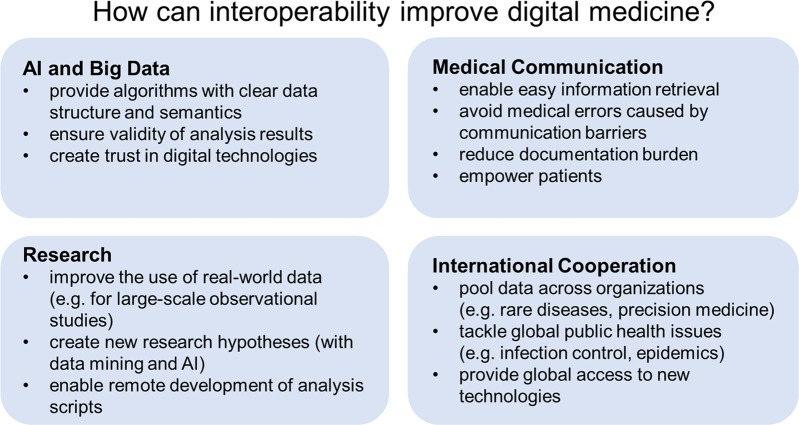
Digital data are anticipated to transform medicine. However, most of today’s medical data lack interoperability: hidden in isolated databases, incompatible systems and proprietary software, the data are difficult to exchange, analyze, and interpret. This slows down medical progress, as technologies that rely on these data – artificial intelligence, big data or mobile applications – cannot be used to their full potential. In this article, we argue that interoperability is a prerequisite for the digital innovations envisioned for future medicine. We focus on four areas where interoperable data and IT systems are particularly important: (1) artificial intelligence and big data; (2) medical communication; (3) research; and (4) international cooperation. We discuss how interoperability can facilitate digital transformation in these areas to improve the health and well-being of patients worldwide.
Overview
The claims and statistics of this paper haven’t been checked yet.
Free: it reads the open-access text and checks the first 5 claims that cite a source we can check. Create a free account to check every claim.
Integrity signals
Registry
Cites
Statistics
Figures
Verification
Claims the paper makes
The claims and statistics of this paper haven’t been checked yet.
Free: it reads the open-access text and checks the first 5 claims that cite a source we can check. Create a free account to check every claim.
Claims other papers make about this one
Each is checked against this paper’s own text: does it say what the citing paper says it does?
The source backs part of the claim, not all of it — or backs it for a different population, condition or comparison.
In the citing paper
“However, it has been shown that interoperability can be implemented successfully for large data-dependent systems, such as with the World Wide Web, and there is increasing awareness of the importance of interoperability within digital health15–17.”
From Machine intelligence in healthcare—perspectives on trustworthiness, explainability, usability, and transparency (2020) · cites this paper as [17]
Experimental — accuracy not yet measuredThe cited source says what the claim attributes to it.
In the citing paper
“However, it has been shown that interoperability can be implemented successfully for large data-dependent systems, such as with the World Wide Web, and there is increasing awareness of the importance of interoperability within digital health15–17.”
From Machine intelligence in healthcare—perspectives on trustworthiness, explainability, usability, and transparency (2020) · cites this paper as [17]
Self-check
Percentages, sums and reported differences re-computed from the paper’s own numbers.
The self-check needs the paper’s full text.
Citations
Cites
Dermatologist-level classification of skin cancer with deep neural networks
Esteva, A., Kuprel, B., Novoa, R. A., Ko, J., Swetter, S. M., Blau, H. M., & Thrun, S. (2017) · Nature · doi:10.1038/nature21056 · Cited by 14,362
Gulshan, V., Peng, L., Coram, M., Stumpe, M. C., Wu, D., Narayanaswamy, A., Venugopalan, S., Widner, K., Madams, T., Cuadros, J., et al. (2016) · JAMA · doi:10.1001/jama.2016.17216 · Cited by 7,697
Artificial intelligence in healthcare: past, present and future
Jiang, F., Jiang, Y., Zhi, H., Dong, Y., Li, H., Ma, S., Wang, Y., Dong, Q., Shen, H., & Wang, Y. (2017) · Stroke and Vascular Neurology · doi:10.1136/svn-2017-000101 · Cited by 4,837
Rajkomar, A., Dean, J., & Kohane, I. (2019) · New England Journal of Medicine · doi:10.1056/nejmra1814259 · Cited by 4,579
Predicting the future - big data, machine learning, and clinical medicine
Obermeyer, Z., & Emanuel, E. J. (2016) · New England Journal of Medicine · doi:10.1056/nejmp1606181 · Cited by 3,652
Updating the accounts: global mortality of the 1918–1920 "Spanish" influenza pandemic.
Johnson, N. P. A. S., & Mueller, J. (2002) · Bulletin of the History of Medicine · doi:10.1353/bhm.2002.0022 · Cited by 1,980
Mining electronic health records: towards better research applications and clinical care
Jensen, P. B., Jensen, L. J., & Brunak, S. (2012) · Nature Reviews Genetics · doi:10.1038/nrg3208 · Cited by 1,680
The Inevitable Application of Big Data to Health Care
Murdoch, T. B., & Detsky, A. S. (2013) · JAMA · doi:10.1001/jama.2013.393 · Cited by 1,664
A Systematic Review of Healthcare Applications for Smartphones
Mosa, A. S. M., Yoo, I., & Sheets, L. (2012) · BMC Medical Informatics and Decision Making · doi:10.1186/1472-6947-12-67 · Cited by 1,184
The human phenotype ontology: a tool for annotating and analyzing human hereditary disease
Robinson, P. N., Köhler, S., Bauer, S., Seelow, D., Horn, D., & Mundlos, S. (2008) · The American Journal of Human Genetics · doi:10.1016/j.ajhg.2008.09.017 · Cited by 1,034 · cited 1×
“It can be complemented by more domain-specific terminologies such as, for example, Logical Observation Identifiers Names and Codes (LOINC) for laboratory observations,(22) the Identification of Medicinal Products (IDMP) for medicines,(23) the nomenclature of the HUGO Gene Nomenclature Committee (HGNC) for genes(24) or…”
BackgroundDigital Phenotyping: Technology for a New Science of Behavior
Insel, T. R. (2017) · JAMA · doi:10.1001/jama.2017.11295 · Cited by 833
SMART on FHIR: a standards-based, interoperable apps platform for electronic health records
Mandel, J. C., Kreda, D. A., Mandl, K. D., Kohane, I. S., & Ramoni, R. B. (2016) · Journal of the American Medical Informatics Association · doi:10.1093/jamia/ocv189 · Cited by 829
Evaluation and accurate diagnoses of pediatric diseases using artificial intelligence
Liang, H., Tsui, B. Y., Ni, H., Valentim, C. C. S., Baxter, S. L., Liu, G., Cai, W., Kermany, D. S., Sun, X., Chen, J., et al. (2019) · Nature Medicine · doi:10.1038/s41591-018-0335-9 · Cited by 659
LOINC, a Universal Standard for Identifying Laboratory Observations: A 5-Year Update
McDonald, C. J., Huff, S. M., Suico, J. G., Hill, G., Leavelle, D., Aller, R., Forrey, A., Mercer, K., DeMoor, G., Hook, J., et al. (2003) · Clinical Chemistry · doi:10.1373/49.4.624 · Cited by 579
HL7 FHIR: An Agile and RESTful approach to healthcare information exchange
Bender, D., & Sartipi, K. (2013) · Proceedings of the 26th IEEE International Symposium on Computer-Based Medical Systems · doi:10.1109/cbms.2013.6627810 · Cited by 540 · cited 1×
“An emerging standard for the communication of health data is, for example, HL7’s Fast Healthcare Interoperability Resources (FHIR), which defines around 140 common healthcare concepts, so-called resources, which can be accessed and exchanged using modern web technologies.(18) FHIR is increasingly adopted by the health…”
BackgroundArtificial intelligence powers digital medicine
Fogel, A. L., & Kvedar, J. C. (2018) · npj Digital Medicine · doi:10.1038/s41746-017-0012-2 · Cited by 456
Rath, A., Olry, A., Dhombres, F., Brandt, M. M., Urbero, B., & Ayme, S. (2012) · Human Mutation · doi:10.1002/humu.22078 · Cited by 382
Mobile phones democratize and cultivate next-generation imaging, diagnostics and measurement tools
Ozcan, A. (2014) · Lab Chip · doi:10.1039/c4lc00010b · Cited by 364
Genenames.org: the HGNC and VGNC resources in 2017
Yates, B., Braschi, B., Gray, K. A., Seal, R. L., Tweedie, S., & Bruford, E. A. (2017) · Nucleic Acids Research · doi:10.1093/nar/gkw1033 · Cited by 328
The Next Epidemic — Lessons from Ebola
Gates, B. (2015) · New England Journal of Medicine · doi:10.1056/nejmp1502918 · Cited by 288
The Undiagnosed Diseases Network: Accelerating Discovery about Health and Disease
Ramoni, R. B., Mulvihill, J. J., Adams, D. R., Allard, P., Ashley, E. A., Bernstein, J. A., Gahl, W. A., Hamid, R., Loscalzo, J., McCray, A. T., et al. (2017) · The American Journal of Human Genetics · doi:10.1016/j.ajhg.2017.01.006 · Cited by 179
Principles of Health Interoperability: SNOMED CT, HL7 and FHIR
Benson, T., & Grieve, G. (2016) · Health Information Technology Standards · doi:10.1007/978-3-319-30370-3 · Cited by 170 · cited 1×
“Most definitions further distinguish between different components, layers or levels of interoperability.(15,16) Although these components can slightly differ across definitions, they generally follow a distinction between lower-level technical components and higher-level organizational components.”
BackgroundDigital Medical Tools and Sensors
Topol, E. J., Steinhubl, S. R., & Torkamani, A. (2015) · JAMA · doi:10.1001/jama.2014.17125 · Cited by 142
Progress In Interoperability: Measuring US Hospitals’ Engagement In Sharing Patient Data
Holmgren, A. J., Patel, V., & Adler-Milstein, J. (2017) · Health Affairs · doi:10.1377/hlthaff.2017.0546 · Cited by 114 · cited 1×
“Accordingly, progress in health interoperability is slow.(14) Here, we argue that interoperability is indispensable for advances in digital health and that it is, in fact, a prerequisite for most of the innovations envisioned for future medicine.”
BackgroundGates, B. (2018) · New England Journal of Medicine · doi:10.1056/nejmp1806283 · Cited by 95
Glicksberg, B. S., Johnson, K. W., & Dudley, J. T. (2018) · Human Molecular Genetics · doi:10.1093/hmg/ddy114 · Cited by 83
Virtual care for improved global health
Steinhubl, S. R., Kim, K., Ajayi, T. A., & Topol, E. J. (2018) · The Lancet · doi:10.1016/s0140-6736(18)30109-0 · Cited by 68
Healthcare Interoperability Standards Compliance Handbook
Oemig, F., & Snelick, R. (2016) · Springer eBooks · doi:10.1007/978-3-319-44839-8 · Cited by 51
Health Information Technology Interoperability and Use for Better Care and Evidence
Perlin, J. B. (2016) · JAMA · doi:10.1001/jama.2016.12337 · Cited by 50
Quantitative analysis of manual annotation of clinical text samples
Miñarro-Giménez, J. A., Cornet, R., Jaulent, M., Dewenter, H., Thun, S., Gøeg, K. R., Karlsson, D., & Schulz, S. (2018) · International Journal of Medical Informatics · doi:10.1016/j.ijmedinf.2018.12.011 · Cited by 25
Self-citationMaking sense of our digital medicine Babel
Lancet, T. (2018) · The Lancet · doi:10.1016/s0140-6736(18)32545-5 · Cited by 12
Oemig, F., & Snelick, R. (2016) · Cited by 4
Research works printed but not linked: 1
- Beale, T. Archetypes: constraint-based domain models for future-proof information systems. in Eleventh OOPSLA Workshop on Behavioral Semantics. (2002).
Cited by
The Role of AI in Hospitals and Clinics: Transforming Healthcare in the 21st Century
Maleki Varnosfaderani, S., & Forouzanfar, M. (2024) · Bioengineering · doi:10.3390/bioengineering11040337 · Cited by 931
“Interoperability between systems: Another major challenge in integrating AI into healthcare is the issue of interoperability—the ability of different healthcare IT systems and software applications to communicate, exchange data, and use the information that has been exchanged [168].”
BackgroundSurgical data science – from concepts toward clinical translation
Maier‐Hein, L., Eisenmann, M., Sarıkaya, D., März, K., Collins, T., Malpani, A., Fallert, J., Feußner, H., Giannarou, S., Mascagni, P., et al. (2021) · Medical Image Analysis · doi:10.1016/j.media.2021.102306 · Cited by 512
“However, a strict semantic annotation is a prerequisite for guaranteeing retrievability and interoperability (Lehne et al., 2019).”
BackgroundExploring students' perspectives on generative AI-assisted academic writing
Kim, J., Yu, S., Detrick, R., & Li, N. (2025) · Education and Information Technologies · doi:10.1007/s10639-024-12878-7 · Cited by 438
“Eighth, a lack of interoperability was perceived as another challenge as identified by previous studies (Kim & Cho, 2023; Lehne et al., 2019).”
Cutillo, C. M., Sharma, K. R., Foschini, L., Kundu, S., Mackintosh, M., Mandl, K. D., MI in Healthcare Workshop Working Group, Beck, T., Collier, E., Colvis, C., et al. (2020) · npj Digital Medicine · doi:10.1038/s41746-020-0254-2 · Cited by 337
Singh, R. P., Hom, G. L., Abramoff, M. D., Campbell, J. P., Chiang, M. F., & on behalf of the AAO Task Force on Artificial Intelligence (2020) · Translational Vision Science & Technology · doi:10.1167/tvst.9.2.45 · Cited by 259
Metadata
- Authors
- Lehne, M., Sass, J., Essenwanger, A., Schepers, J., & Thun, S.
- Affiliations
- Berlin Institute of Health at Charité - Universitätsmedizin Berlin (DE)
- Hochschule Niederrhein (DE)
- Corresponding author
- Lehne, Moritz
- Venue
- npj Digital Medicine
- Published
- 2019-08-20
- Volume
- 2
- Issue
- 1
- Pages
- 79-79
- ISSN
- 2398-6352 (ISSN-L)
- PMC
- PMC6702215
- OpenAlex
- W2969628488
- Cited by
- 501
- References
- 33
- Citations by year
- 2026: 89 · 2025: 91 · 2024: 115 · 2023: 62 · 2022: 57 · 2021: 59 · 2020: 26 · 2019: 1
- FWCI
- 6.76
- Type
- journal article
- Language
- en
- Open access
- gold
- doi.org
- Licence
- cc-by
- creativecommons.org/licenses/by/4.0 (tdm)
- creativecommons.org/licenses/by/4.0 (vor)
- Locations
- npj Digital Medicine (publishedVersion, cc-by)
- PubMed Central (publishedVersion, cc-by)
- PubMed (publishedVersion)
- DOAJ (DOAJ: Directory of Open Access Journals) (submittedVersion)
- Refubium (Universitätsbibliothek der Freien Universität Berlin) (submittedVersion, cc-by)
- Universitätsbibliothek der FU Berlin Hochschulschriftenstelle u. Dokumentenserver (cc-by)
- Funders
- Deutsche Forschungsgemeinschaft
- Charité – Universitätsmedizin Berlin
- Topics
- Health Sciences › Health Professions › Health Information Management › Electronic Health Records Systems
- Health Sciences › Medicine › Health Informatics › Artificial Intelligence in Healthcare and Education
- Health Sciences › Medicine › Public Health, Environmental and Occupational Health › Technology and Human Factors in Education and Health
- Keywords
- interoperability, health data sharing, digital health, artificial intelligence, big data, medical communication, health research, international health cooperation, digital transformation of medicine, health information systems
About these checks
Registry, retraction, Cites and statistics results are computed, not judged, with one exception: a printed reference that no index lists is read once by a model before it counts as a citation error. Claims are extracted by a model and kept only when their quote appears verbatim in the text; each cited source is then checked, with a model’s help, for whether it says what the claim relies on. Those verdicts can be wrong — read the claim’s quote and the cited source before relying on one.
Statistics and arithmetic are recomputed, not judged.
Confidence bands are shown only for fields calibrated on our annotated test set. None is calibrated yet, so no band is shown.
What counts as a claim ›How we measure confidence ›How we check this ›
Are you an author, or do you see a problem with this page? Request a review
Data sources
Bibliographic data: Semantic Scholar, OpenAlex, Crossref.
Contains information from the Semantic Scholar Academic Graph Datasets, made available under the ODC Attribution License (ODC-BY 1.0).
Semantic Scholar’s data is described in: Kinney, R., et al. (2023). The Semantic Scholar Open Data Platform. arXiv:2301.10140.
