

Why digital medicine depends on interoperability
Open accessThe DOI matches its Crossref record; 33 of the 33 references it cites were found in a registry or an index.
Abstract
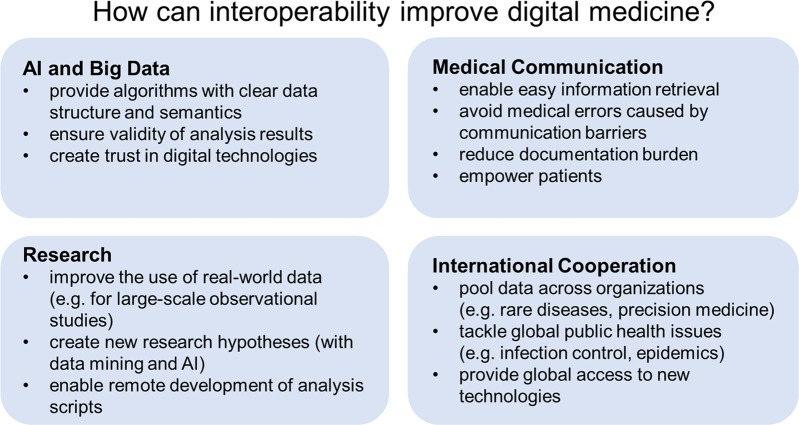
Digital data are anticipated to transform medicine. However, most of today’s medical data lack interoperability: hidden in isolated databases, incompatible systems and proprietary software, the data are difficult to exchange, analyze, and interpret. This slows down medical progress, as technologies that rely on these data – artificial intelligence, big data or mobile applications – cannot be used to their full potential. In this article, we argue that interoperability is a prerequisite for the digital innovations envisioned for future medicine. We focus on four areas where interoperable data and IT systems are particularly important: (1) artificial intelligence and big data; (2) medical communication; (3) research; and (4) international cooperation. We discuss how interoperability can facilitate digital transformation in these areas to improve the health and well-being of patients worldwide.
Overview
The claims and statistics of this paper haven’t been checked yet.
Free: it reads the open-access text and checks the first 5 claims that cite a source we can check. Create a free account to check every claim.
Integrity signals
Registry
Cites
Statistics
Figures
Verification
Claims the paper makes
The claims and statistics of this paper haven’t been checked yet.
Free: it reads the open-access text and checks the first 5 claims that cite a source we can check. Create a free account to check every claim.
Claims other papers make about this one
Each is checked against this paper’s own text: does it say what the citing paper says it does?
The source backs part of the claim, not all of it — or backs it for a different population, condition or comparison.
In the citing paper
“However, it has been shown that interoperability can be implemented successfully for large data-dependent systems, such as with the World Wide Web, and there is increasing awareness of the importance of interoperability within digital health15–17.”
From Machine intelligence in healthcare—perspectives on trustworthiness, explainability, usability, and transparency (2020) · cites this paper as [17]
Experimental — accuracy not yet measuredThe cited source says what the claim attributes to it.
In the citing paper
“However, it has been shown that interoperability can be implemented successfully for large data-dependent systems, such as with the World Wide Web, and there is increasing awareness of the importance of interoperability within digital health15–17.”
From Machine intelligence in healthcare—perspectives on trustworthiness, explainability, usability, and transparency (2020) · cites this paper as [17]
Self-check
Percentages, sums and reported differences re-computed from the paper’s own numbers.
The self-check needs the paper’s full text.
Citations
Cites
Dermatologist-level classification of skin cancer with deep neural networks
Esteva, A., Kuprel, B., Novoa, R. A., Ko, J., Swetter, S. M., Blau, H. M., & Thrun, S. (2017) · Nature · doi:10.1038/nature21056 · Cited by 14,362
Gulshan, V., Peng, L., Coram, M., Stumpe, M. C., Wu, D., Narayanaswamy, A., Venugopalan, S., Widner, K., Madams, T., Cuadros, J., et al. (2016) · JAMA · doi:10.1001/jama.2016.17216 · Cited by 7,697
Artificial intelligence in healthcare: past, present and future
Jiang, F., Jiang, Y., Zhi, H., Dong, Y., Li, H., Ma, S., Wang, Y., Dong, Q., Shen, H., & Wang, Y. (2017) · Stroke and Vascular Neurology · doi:10.1136/svn-2017-000101 · Cited by 4,837
Rajkomar, A., Dean, J., & Kohane, I. (2019) · New England Journal of Medicine · doi:10.1056/nejmra1814259 · Cited by 4,579
Predicting the future - big data, machine learning, and clinical medicine
Obermeyer, Z., & Emanuel, E. J. (2016) · New England Journal of Medicine · doi:10.1056/nejmp1606181 · Cited by 3,652
Updating the accounts: global mortality of the 1918–1920 "Spanish" influenza pandemic.
Johnson, N. P. A. S., & Mueller, J. (2002) · Bulletin of the History of Medicine · doi:10.1353/bhm.2002.0022 · Cited by 1,980
Mining electronic health records: towards better research applications and clinical care
Jensen, P. B., Jensen, L. J., & Brunak, S. (2012) · Nature Reviews Genetics · doi:10.1038/nrg3208 · Cited by 1,680
The Inevitable Application of Big Data to Health Care
Murdoch, T. B., & Detsky, A. S. (2013) · JAMA · doi:10.1001/jama.2013.393 · Cited by 1,664
A Systematic Review of Healthcare Applications for Smartphones
Mosa, A. S. M., Yoo, I., & Sheets, L. (2012) · BMC Medical Informatics and Decision Making · doi:10.1186/1472-6947-12-67 · Cited by 1,184
The human phenotype ontology: a tool for annotating and analyzing human hereditary disease
Robinson, P. N., Köhler, S., Bauer, S., Seelow, D., Horn, D., & Mundlos, S. (2008) · The American Journal of Human Genetics · doi:10.1016/j.ajhg.2008.09.017 · Cited by 1,034 · cited 1×
“It can be complemented by more domain-specific terminologies such as, for example, Logical Observation Identifiers Names and Codes (LOINC) for laboratory observations,(22) the Identification of Medicinal Products (IDMP) for medicines,(23) the nomenclature of the HUGO Gene Nomenclature Committee (HGNC) for genes(24) or…”
Background
Research works printed but not linked: 1
- Beale, T. Archetypes: constraint-based domain models for future-proof information systems. in Eleventh OOPSLA Workshop on Behavioral Semantics. (2002).
Cited by
The Role of AI in Hospitals and Clinics: Transforming Healthcare in the 21st Century
Maleki Varnosfaderani, S., & Forouzanfar, M. (2024) · Bioengineering · doi:10.3390/bioengineering11040337 · Cited by 931
“Interoperability between systems: Another major challenge in integrating AI into healthcare is the issue of interoperability—the ability of different healthcare IT systems and software applications to communicate, exchange data, and use the information that has been exchanged [168].”
BackgroundSurgical data science – from concepts toward clinical translation
Maier‐Hein, L., Eisenmann, M., Sarıkaya, D., März, K., Collins, T., Malpani, A., Fallert, J., Feußner, H., Giannarou, S., Mascagni, P., et al. (2021) · Medical Image Analysis · doi:10.1016/j.media.2021.102306 · Cited by 512
“However, a strict semantic annotation is a prerequisite for guaranteeing retrievability and interoperability (Lehne et al., 2019).”
BackgroundExploring students' perspectives on generative AI-assisted academic writing
Kim, J., Yu, S., Detrick, R., & Li, N. (2025) · Education and Information Technologies · doi:10.1007/s10639-024-12878-7 · Cited by 438
“Eighth, a lack of interoperability was perceived as another challenge as identified by previous studies (Kim & Cho, 2023; Lehne et al., 2019).”
Cutillo, C. M., Sharma, K. R., Foschini, L., Kundu, S., Mackintosh, M., Mandl, K. D., MI in Healthcare Workshop Working Group, Beck, T., Collier, E., Colvis, C., et al. (2020) · npj Digital Medicine · doi:10.1038/s41746-020-0254-2 · Cited by 337
Singh, R. P., Hom, G. L., Abramoff, M. D., Campbell, J. P., Chiang, M. F., & on behalf of the AAO Task Force on Artificial Intelligence (2020) · Translational Vision Science & Technology · doi:10.1167/tvst.9.2.45 · Cited by 259
Harnessing the Power of Clinical Decision Support Systems: Challenges and Opportunities
Chen, Z., Liang, N., Zhang, H., Li, H., Yang, Y., Zong, X., Chen, Y., Wang, Y., & Shi, N. (2023) · Open Heart · doi:10.1136/openhrt-2023-002432 · Cited by 244
Simulation Intelligence: Towards a New Generation of Scientific MethodsPreprint
Lavin, A., Krakauer, D. C., Zenil, H., Gottschlich, J., Mattson, T., Brehmer, J., Anandkumar, A., Choudry, S., Rocki, K., Baydin, A. G., et al. (2021) · CaltechAUTHORS (California Institute of Technology) · doi:10.48550/arxiv.2112.03235 · Cited by 221
The use of machine learning in rare diseases: a scoping review
Schaefer, J., Lehne, M., Schepers, J., Prasser, F., & Thun, S. (2020) · Orphanet Journal of Rare Diseases · doi:10.1186/s13023-020-01424-6 · Cited by 213
“This highlights the importance of international health IT standards and medical terminologies that can improve interoperability and that can help to make medical data more accessible to machine learning [28].”
BackgroundSelf-citationThe dawn of digital public health in Europe: Implications for public health policy and practice
Wong, B. L. H., Maaß, L., Vodden, A., van Kessel, R., Sorbello, S., Buttigieg, S., & Odone, A. (2022) · The Lancet Regional Health - Europe · doi:10.1016/j.lanepe.2022.100316 · Cited by 148
“46 It can be construed as a wicked problem as it can be de fi ned in multiple dimensions: 47,48 Technical interoperability: the basic data exchange capabilities between systems. importance of timely access to health data in ensuring the rapid development of digital tools (e.g. mobile health apps,…”
BackgroundThe impact of electronic health records on patient care and outcomes: A comprehensive review
Adeniyi, A. O., Arowoogun, J. O., Chidi, R., Okolo, C. A., & Babawarun, O. (2024) · World Journal of Advanced Research and Reviews · doi:10.30574/wjarr.2024.21.2.0592 · Cited by 189
Introduction of digital therapeutics
Hong, J. S., Wasden, C. L., & Han, D. H. (2021) · Computer Methods and Programs in Biomedicine · doi:10.1016/j.cmpb.2021.106319 · Cited by 184
The Future of Accounting: How Will Digital Transformation Impact the Sector?
Gonçalves, M. J. A., da Silva, A. C. F., & Ferreira, C. G. (2022) · Informatics · doi:10.3390/informatics9010019 · Cited by 178
“However, to obtain these benefits from digital transformation, organisations must guarantee the interoperability and integration of IT solutions [16].”
BackgroundArtificial Intelligence in Orthodontics: Critical Review
Nordblom, N. F., Büttner, M., & Schwendicke, F. (2024) · Journal of Dental Research · doi:10.1177/00220345241235606 · Cited by 175
“The use of interoperable data formats, such as FHIR, would facilitate the validation and application of developed algorithms in real-world scenarios (Lehne et al. 2019).”
MethodUeda, D., Walston, S. L., Fujita, S., Fushimi, Y., Tsuboyama, T., Kamagata, K., Yamada, A., Yanagawa, M., Ito, R., Fujima, N., et al. (2024) · Diagnostic and Interventional Imaging · doi:10.1016/j.diii.2024.06.002 · Cited by 174
Continuous on-body sensing for the COVID-19 pandemic: Gaps and opportunities
Jeong, H., Rogers, J. A., & Xu, S. (2020) · Science Advances · doi:10.1126/sciadv.abd4794 · Cited by 155
Fraggetta, F., L’Imperio, V., Ameisen, D., Carvalho, R., Leh, S. M., Kiehl, T., Şerbănescu, M.-S., Racoceanu, D., Mea, V. D., Polónia, A., et al. (2021) · Diagnostics · doi:10.3390/diagnostics11112167 · Cited by 163
“Interoperability should be technical, syntactic, semantic and organizational [50].”
BackgroundShaping the future of AI in healthcare through ethics and governance
Bouderhem, R. (2024) · Humanities and Social Sciences Communications · doi:10.1057/s41599-024-02894-w · Cited by 162
“Technical, ethical and regulatory challenges such as data collection (Huarng et al. 2022), data quality, security (Barua et al. 2022), interoperability between different operating systems (OS) (Lehne et al. 2019), health equity, and fairness (Canali et al. 2022) need to be addressed.”
Tabari, P., Costagliola, G., Rosa, M. D., & Boeker, M. (2024) · JMIR Medical Informatics · doi:10.2196/58445 · Cited by 145
“In research, real-world information can be collected and used for data mining and AI to generate new hypotheses [4].”
van de Sande, D., Van Genderen, M. E., Smit, J. M., Huiskens, J., Visser, J. J., Veen, R. E. R., van Unen, E., BA, O. H., Gommers, D., & Bommel, J. V. (2022) · BMJ Health & Care Informatics · doi:10.1136/bmjhci-2021-100495 · Cited by 135
Bhagat, S. V., & Kanyal, D. (2024) · Cureus · doi:10.7759/cureus.54518 · Cited by 125
“By fostering interoperability, healthcare institutions can unlock the full potential of AI applications, facilitating the exchange of critical information and promoting a more cohesive and efficient healthcare infrastructure [24].”
BackgroundVan Daele, T., Karekla, M., Kassianos, A. P., Compare, A., Haddouk, L., Salgado, J., Ebert, D. D., Trebbi, G., Bernaerts, S., Van Assche, E., et al. (2020) · Journal of Psychotherapy Integration · doi:10.1037/int0000218 · Cited by 122
“Having high-quality, interoperable platforms and records to provide psychotherapists and clients easy access to up-to-date clinical information, can lead to improved care, client empowerment, and decreased documentation burden (Lehne et al., 2019).”
BackgroundRoberts, A. E., Davenport, T. A., Wong, T., Moon, H.-W., Hickie, I. B., & LaMonica, H. M. (2021) · Internet Interventions · doi:10.1016/j.invent.2021.100379 · Cited by 87
“…data from personal health apps and e-tools has the potential both to reduce documentation burden for health professionals, allowing them to spend more time focusing on care, as well as to empower and inform consumers so they can actively manage their own health and wellbeing (Lehne et al., 2019).”
BackgroundDash, S. P. (2020) · Journal of the Indian Institute of Science · doi:10.1007/s41745-020-00208-y · Cited by 121
“Interoperability can be further classified into the following 21 21 .”
BackgroundInfluentialCorti, C., Cobanaj, M., Dee, E. C., Criscitiello, C., Tolaney, S. M., Celi, L. A., & Curigliano, G. (2022) · Cancer Treatment Reviews · doi:10.1016/j.ctrv.2022.102498 · Cited by 119
Banbury forum consensus statement on the path forward for digital mental health treatment
Mohr, D. C., Azocar, F., Bertagnolli, A., Choudhury, T., Chrisp, P., Frank, R., Harbin, H., Histon, T., Kaysen, D., Nebeker, C., et al. (2021) · Psychiatric Services · doi:10.1176/appi.ps.202000561 · Cited by 115
“Thus, DMHTs need requirements for data interoperability that support their intended aims and align with the larger movement in health care (66).”
Augmented non-hallucinating large language models as medical information curators
Gilbert, S., Kather, J. N., & Hogan, A. (2024) · npj Digital Medicine · doi:10.1038/s41746-024-01081-0 · Cited by 109
“Medicalontologiescapturetheconsensus onadiverserangeofconceptsinthebiomedicaldomain 5 .”
Naik, K., Goyal, R. K., Foschini, L., Chak, C. M., Thielscher, C., Zhu, H., Lu, J. J.-Q., Lehár, J., Pacanoswki, M. A., Terranova, N., et al. (2024) · Clinical Pharmacology & Therapeutics · doi:10.1002/cpt.3152 · Cited by 105
“14 17 However, none of these advancements would have been sufficient with the massive increase in computing power that has been the driving force behind this acceleration.”
BackgroundGonzález-Gonzalo, C., Thee, E. F., Klaver, C. C. W., Lee, A. Y., Schlingemann, R. O., Tufail, A., Verbraak, F., & Sánchez, C. I. (2022) · Progress in Retinal and Eye Research · doi:10.1016/j.preteyeres.2021.101034 · Cited by 103
“Different stakeholders can have nonetheless different interests, and these interests might not always aim to maximize interoperability (Lehne et al., 2019).”
Physics-informed machine learning for building performance simulation-A review of a nascent field
Jiang, Z., Wang, X., Li, H., Hong, T., You, F., Drgoňa, J., Vrabie, D., & Dong, B. (2025) · Advances in Applied Energy · doi:10.1016/j.adapen.2025.100223 · Cited by 103
“…data often lead to poor model performance; 2) Lack of interoperability , making it challenging to exchange, analyze, and interpret these models [31]; 3) Limited generalization ability , which makes it difficult to infer outputs for unseen conditions [32]; 4) Absence of a guarantee for physical…”
Derraz, B., Breda, G., Kaempf, C., Baenke, F., Cotte, F., Reiche, K., Köhl, U., Kather, J. N., Eskenazy, D., & Gilbert, S. (2024) · npj Precision Oncology · doi:10.1038/s41698-024-00517-w · Cited by 94
“Flexible frameworks for health record sharing and interoperability are being developed alongside ontologies 94 , which support the DT concept 95,96 .”
BackgroundEnhancing EHR Interoperability and Security through Distributed Ledger Technology: A Review
Ferreira, J. C., Elvas, L. B., Correia, R., & Mascarenhas, M. (2024) · Healthcare · doi:10.3390/healthcare12191967 · Cited by 94
The Role of Digital Devices in Dentistry: Clinical Trends and Scientific Evidences
Spagnuolo, G., & Sorrentino, R. (2020) · Journal of Clinical Medicine · doi:10.3390/jcm9061692 · Cited by 94
A machine-learning–based algorithm improves prediction of preeclampsia-associated adverse outcomes
Schmidt, L. J., Rieger, O., Neznansky, M., Hackelöer, M., Dröge, L. A., Henrich, W., Higgins, D., & Verlohren, S. (2022) · American Journal of Obstetrics and Gynecology · doi:10.1016/j.ajog.2022.01.026 · Cited by 91
Chen, Y., Stavropoulou, C., Narasinkan, R., Baker, A., & Scarbrough, H. (2021) · BMC Health Services Research · doi:10.1186/s12913-021-06861-y · Cited by 87
“These studies suggest that such challenges are not trivial, and are not reducible to technical concerns over datasets and infrastructure, though these do pose a significant barrier [9, 10].”
BackgroundAbadie, A., Roux, M., Chowdhury, S., & Dey, P. K. (2023) · Journal of Business Research · doi:10.1016/j.jbusres.2023.113866 · Cited by 84
Alhur, A. (2024) · Cureus · doi:10.7759/cureus.57795 · Cited by 82
Hu, S., Song, D., Wan, S., Zhang, S., Luo, C., Li, N., Liu, G., Vasconcelos, J. D. G. E. S., de Carvalho, L. L. C., Neobísi, E., et al. (2025) · Frontiers in Public Health · doi:10.3389/fpubh.2025.1646802 · Cited by 83
Secondary data for global health digitalisation
Näher, A., Vorisek, C. N., Klopfenstein, S. A. I., Lehne, M., Thun, S., Alsalamah, S., Pujari, S., Heider, D., Ahrens, W., Pigeot, I., et al. (2023) · The Lancet Digital Health · doi:10.1016/s2589-7500(22)00195-9 · Cited by 80
“52 The structured exchange of health data is supported by international standards development organisations.”
BackgroundSelf-citationAlmyranti, M., Sutherland, E., Ash, N., & Eiszele, S. (2024) · OECD artificial intelligence papers · doi:10.1787/9a31d8af-en · Cited by 77
Priorities to accelerate workflow automation in health care
Zayas‐Cabán, T., Okubo, T. H., & Posnack, S. L. (2022) · Journal of the American Medical Informatics Association · doi:10.1093/jamia/ocac197 · Cited by 73
Gallifant, J., Zhang, J., del Pilar Arias Lopez, M., Zhu, T., Camporota, L., Celi, L. A., & Formenti, F. (2022) · British Journal of Anaesthesia · doi:10.1016/j.bja.2021.09.025 · Cited by 72
Emerging Digital Technologies in Healthcare with a Spotlight on Cybersecurity: A Narrative Review
Arafa, A., Sheerah, H. A., & Alsalamah, S. (2023) · Information · doi:10.3390/info14120640 · Cited by 68
“Addressing these challenges requires collaborative efforts among stakeholders, including healthcare organizations, technology vendors, standardization bodies, and regulatory agencies [52–54].”
BackgroundLi, H., Fu, J., & Python, A. (2025) · Journal of Medical Internet Research · doi:10.2196/71916 · Cited by 68
“Furthermore, LLMs may not be fully compatible with existing health care interoperability standards (eg, Health Level Seven and Digital Imaging and Communications in Medicine) [106].”
Best practices in the real-world data life cycle
Zhang, J., Symons, J., Agapow, P., Teo, J. T., Paxton, C. A., Abdi, J., Mattie, H., Davie, C., Torres, A. Z., Folarin, A., et al. (2022) · PLOS Digital Health · doi:10.1371/journal.pdig.0000003 · Cited by 67
Corti, C., Cobanaj, M., Marian, F., Dee, E. C., Lloyd, M. R., Marcu, S., Dombrovschi, A., Biondetti, G. P., Batalini, F., Celi, L. A., et al. (2022) · Cancer Treatment Reviews · doi:10.1016/j.ctrv.2022.102410 · Cited by 67
Thériault-Lauzier, P., Corbin, D., Tastet, O., Langlais, É. L., Taji, B., Kang, G., Chong, A., So, D. Y. F., Tang, A., Gichoya, J. W., et al. (2024) · Canadian Journal of Cardiology · doi:10.1016/j.cjca.2024.05.025 · Cited by 65
Kumar, R., Waisberg, E., Ong, J., Paladugu, P., Amiri, D., Saintyl, J., Yelamanchi, J., Nahouraii, R., Jagadeesan, R., & Tavakkoli, A. (2024) · Brain Sciences · doi:10.3390/brainsci14121266 · Cited by 65
Sketching an AI Marketplace: Tech, Economic, and Regulatory Aspects
Kumar, A., Finley, B., Braud, T., Tarkoma, S., & Hui, P. (2021) · IEEE Access · doi:10.1109/access.2021.3050929 · Cited by 61
“However, the current lack of interoperability standards dramatically limits such opportunities, and adapting existing models is a tedious task (potentially including redeveloping an application-specific AI model) [11], [12].”
BackgroundĆirković, A. (2020) · Journal of Medical Internet Research · doi:10.2196/18097 · Cited by 53
Xu, S., Rwei, A. Y., Vwalika, B., Chisembele, M. P., Stringer, J. S. A., Ginsburg, A. S., & Rogers, J. A. (2021) · The Lancet Digital Health · doi:10.1016/s2589-7500(21)00001-7 · Cited by 57
Endalamaw, A., Zewdie, A., Wolka, E., & Assefa, Y. A. (2025) · BMC Health Services Research · doi:10.1186/s12913-025-12548-5 · Cited by 56
“Maintaining local standards of quality and interoperability is crucial [101, 106], and it is essential to respect client’s rights and adhere with ethical standards [63].”
Designing interoperable telehealth platforms: bridging IoT devices with cloud infrastructures
Tsiouris, Κ. Μ., Gatsios, D. A., Tsakanikas, V., Pardalis, A. A., Kouris, I., Ανδρούτσου, Θ., Tarousi, M., Sedlar, N. V., Somarakis, I., Mostajeran, F., et al. (2020) · Enterprise Information Systems · doi:10.1080/17517575.2020.1759146 · Cited by 56
“FHIR also enables telehealth technologies (Lehne et al. 2019) and makes health data accessible to advanced, large-scale and population analytics (Braunstein 2019).”
BackgroundHorsch, M., Niethammer, C., Boccardo, G., Carbone, P., Chiacchiera, S., Chiricotto, M., Elliott, J. D., Lobaskin, V., Neumann, P., Schiffels, P., et al. (2019) · Journal of Chemical & Engineering Data · doi:10.1021/acs.jced.9b00739 · Cited by 54
Tarricone, R., Petracca, F., Cucciniello, M., & Ciani, O. (2022) · Health Economics · doi:10.1002/hec.4505 · Cited by 54
“Advances in mHealth are instead dependent on inter-operability (Lehne et al., 2019), which should be a prerequisite for the reimbursement of any app and part of their assessment processes.”
BackgroundApplications of Machine Learning in Palliative Care: A Systematic Review
Vu, E., Steinmann, N., Schröder, C., Forster, R. E., Aebersold, D. M., Eychmüller, S., Čihorić, N., Hertler, C., Windisch, P. Y., & Zwahlen, D. R. (2023) · Cancers · doi:10.3390/cancers15051596 · Cited by 54
“The solution for the previously mentioned problem is a broad implementation of semantic interoperability principles, defined as a computer’s capability to share and use data unambiguously [42].”
BackgroundLonini, L., Shawen, N., Botonis, O. K., Fanton, M., Jayaraman, C., Mummidisetty, C. K., Shin, S. Y., Rushin, C. C., Jenz, S. T., Xu, S., et al. (2021) · IEEE Journal of Translational Engineering in Health and Medicine · doi:10.1109/jtehm.2021.3058841 · Cited by 54
“Furthermore, the extremely large amount of data per person can create challenges for proper data management and processing at scale [22], [23].”
Konopik, J., & Blunck, D. (2023) · Journal of Medical Internet Research · doi:10.2196/41512 · Cited by 53
“This leads to the appropriate design of network-like collaboration systems [73], where governing institutions usually take the role of the resource allocator [118,119,171].”
Fulfilling the Promise of Artificial Intelligence in the Health Sector: Let’s Get Real
Oliveira, T. C., Oderkirk, J., & Slawomirski, L. (2022) · Value in Health · doi:10.1016/j.jval.2021.11.1369 · Cited by 53
Innovation Pathways in the NHS: An Introductory Review
Arora, A., Wright, A. J., Cheng, M. T. K., Khwaja, Z., & Seah, M. K. T. (2021) · Therapeutic Innovation & Regulatory Science · doi:10.1007/s43441-021-00304-w · Cited by 51
“In this way, as more data is acquired the effectiveness of the system increases and network effects begin to emerge, such that once an early adopter hospital takes on the technology the marginal benefit for each successive hospital now increases since the pool of data used to refine the technology continues to grow [9…”
BackgroundMy teammate is AI: understanding students’ perceptions of student-AI collaboration in drawing tasks
Kim, J., & Cho, Y. H. (2025) · Asia Pacific Journal of Education · doi:10.1080/02188791.2023.2286206 · Cited by 50
“This allows students to be active managers of data on their tasks from being helpless recipients of data (Lehne et al., 2019).”
Leveraging physiology and artificial intelligence to deliver advancements in health care
Zhang, A., Wu, Z., Wu, E., Wu, M. A., Snyder, M. P., Zou, J., & Wu, J. C. (2023) · Physiological Reviews · doi:10.1152/physrev.00033.2022 · Cited by 50
Large language models are powerful electronic health record encoders
Hegselmann, S., von Arnim, G., Rheude, T., Kronenberg, N., Sontag, D. A., Hindricks, G., Eils, R., & Wild, B. (2026) · npj Digital Medicine · doi:10.1038/s41746-026-02915-9 · Cited by 49
“Qwen3-Emb- 8BalsoremainedconsistentlystrongerthanBioClinicalBERTacrossfew-shotsettings.”
Kwaśnicka, D., Keller, J., Perski, O., Potthoff, S., ten Hoor, G. A., Ainsworth, B., Crutzen, R., Dohle, S., van Dongen, A., Heino, M. T. J., et al. (2022) · Health Psychology Review · doi:10.1080/17437199.2022.2046482 · Cited by 47
“Digital health has increased in popularity over the past two decades and has shown unprecedented growth (Labrique et al., 2018; Petersen, 2018).”
BackgroundBorger, T., Mosteiro, P. J., Kaya, H., Rijcken, E., Salah, A. A., Scheepers, F. E., & Spruit, M. R. (2022) · Expert Systems with Applications · doi:10.1016/j.eswa.2022.116720 · Cited by 47
Towett, G., Snead, R. S., Grigoryan, K., & Marczika, J. (2023) · Globalization and Health · doi:10.1186/s12992-023-00998-7 · Cited by 46
“In the context of infectious pandemics, the establishment of a global standard or interoperability framework for DHPs could facilitate the seamless exchange of accurate and up-to-date health information between countries, thereby enhancing pandemic management strategies [69].”
BackgroundAdegoke, K., Adegoke, A., Dawodu, D., Adekoya, A., Bayowa, A., Kayode, T., & Singh, M. (2025) · International Journal of Environmental Research and Public Health · doi:10.3390/ijerph22101535 · Cited by 45
“As Lehne and colleagues emphasize, when systems cannot seamlessly exchange data, valuable digital innovations (such as Artificial Intelligence (AI) and big-data analytics) remain “hid-den in isolated databases” and fail to reach their potential [1].”
Mosch, L. K., Poncette, A.-S., Spies, C., Weber‐Carstens, S., Schieler, M., Krampe, H., & Balzer, F. (2021) · JMIR Formative Research · doi:10.2196/22866 · Cited by 45
“Holistically implemented, interoperable technologies could alleviate the burden on staff by reducing documentation time, and easier data retrieval can facilitate therapy and diagnosis [75].”
BackgroundClinician's guide to trustworthy and responsible artificial intelligence in cardiovascular imaging
Szabo, L., Raisi-Estabragh, Z., Salih, A., McCracken, C., Ruiz Pujadas, E., Gkontra, P., Kiss, M., Maurovich-Horvath, P., Vago, H., Merkely, B., et al. (2022) · Frontiers in Cardiovascular Medicine · doi:10.3389/fcvm.2022.1016032 · Cited by 36
“Cardiovascular imaging data is slightly more structured than clinical records but still lacks interoperability to a great extent (118).”
BackgroundFarah, L., Borget, I., Martelli, N., & Vallée, A. (2024) · Journal of Medical Internet Research · doi:10.2196/51514 · Cited by 44
“Eighth, integration into health care systems and interoperability—the integration of AI-based medical devices into existing health care workflows and systems can be complex and resource intensive [18].”
BackgroundOntologies as the semantic bridge between artificial intelligence and healthcare
Ambalavanan, R., Snead, R. S., Marczika, J., Towett, G., Malioukis, A., & Mbogori-Kairichi, M. (2025) · Frontiers in Digital Health · doi:10.3389/fdgth.2025.1668385 · Cited by 44
Sharing sensitive data in life sciences: an overview of centralized and federated approaches
Rujano, M. A., Boiten, J., Ohmann, C., Canham, S., Contrino, S., David, R., Ewbank, J. J., Filippone, C., Connellan, C., Custers, I., et al. (2024) · Briefings in Bioinformatics · doi:10.1093/bib/bbae262 · Cited by 43
“In addition, because sensitive data are often stored in different formats, reflecting different source systems, prior data harmonization may be required to support sharing and integration of those data [22, 23].”
BackgroundMIMIC-IV as a Clinical Data Schema
Giesa, N., Heeren, P., Klopfenstein, S. A. I., Flint, A. R., Agha-Mir-Salim, L., Poncette, A.-S., Balzer, F., & Boie, S. D. (2022) · Studies in health technology and informatics · doi:10.3233/shti220522 · Cited by 43
Implications of immersive technologies in healthcare sector and its built environment
Yang, E. (2023) · Frontiers in Medical Technology · doi:10.3389/fmedt.2023.1184925 · Cited by 42
“It is anticipated that the horizontal convergence of interoperability and portability for XR will be achieved by 2030 to ensure its wide-scale deployment in healthcare (74, 75).”
Assche, E. V., Ramos‐Quiroga, J. A., Pariante, C. M., Sforzini, L., Young, A. H., Flossbach, Y., Gold, S. M., Hoogendijk, W. J. G., Baune, B. T., & Maron, E. (2022) · European Neuropsychopharmacology · doi:10.1016/j.euroneuro.2022.05.007 · Cited by 41
Implementation of cloud computing in the German healthcare system
Putzier, M., Khakzad, T., Dreischarf, M., Thun, S., Trautwein, F., & Taheri, N. (2024) · npj Digital Medicine · doi:10.1038/s41746-024-01000-3 · Cited by 41
Self-citationPreprocessing of unstructured medical data: the impact of each preprocessing stage on classification
Kashina, M., Lenivtceva, I. D., & Kopanitsa, G. (2020) · Procedia Computer Science · doi:10.1016/j.procs.2020.11.030 · Cited by 41
Gorman, C., Punzo, D., Octaviano, I., Pieper, S. D., Longabaugh, W. J. R., Clunie, D., Kikinis, R., Fedorov, A., & Herrmann, M. D. (2023) · Nature Communications · doi:10.1038/s41467-023-37224-2 · Cited by 41
“Each institution or even department may use a distinct set of devices for acquisition, storage, or management of imaging data and realization of ML in the real world thus hinges on the ability of ML models to programmatically find, access, interoperate, and (re)use data [2, 76].”
BackgroundIntegration technologies in laboratory information systems: A systematic review
Edayan, J. M., Gallemit, A. J., Sacala, N. E., Palmer, X., Potter, L. N., Rarugal, J. P., & Velasco, L. C. (2024) · Informatics in Medicine Unlocked · doi:10.1016/j.imu.2024.101566 · Cited by 40
Hussein, R., Gyrard, A., Abedian, S., Gribbon, P. M., & Martínez, S. A. (2025) · Journal of Medical Internet Research · doi:10.2196/69813 · Cited by 40
“Interoperability is the cornerstone of digital medicine, especially in the AI era, which necessitates the availability of various high-quality datasets [20].”
Interaction Empowerment in Mobile Health: Concepts, Challenges, and Perspectives
Hamberger, M., Ikonomi, N., Schwab, J. D., Werle, S. D., Fürstberger, A., Kestler, A. M. R., Holderried, M., Kaisers, U. X., Steger, F., & Kestler, H. A. (2022) · JMIR mhealth and uhealth · doi:10.2196/32696 · Cited by 40
“Additional or more detailed hurdles we collected from the literature are highlighted by dashed lines [11-20].”
BackgroundMethodInfluentialLobo, E. H., Frølich, A., Kensing, F., Rasmussen, L. J., Livingston, P. M., Grundy, J., & Abdelrazek, M. (2020) · Research in Nursing & Health · doi:10.1002/nur.22096 · Cited by 39
Empowering cancer research in Europe: the EUCAIM cancer imaging infrastructure
Martí‐Bonmatí, L., Blanquer, I., Tsiknakis, M., Tsakou, G., Martínez, R. M., Capella-Gutiérrez, S., Zullino, S., Meszaros, J. G., Bron, E. E., Gelpí, J. L., et al. (2025) · Insights into Imaging · doi:10.1186/s13244-025-01913-x · Cited by 38
Enhancing healthcare data privacy and interoperability with federated learning
Akhmetov, A., Latif, Z., Tyler, B., & Yazıcı, A. (2025) · PeerJ Computer Science · doi:10.7717/peerj-cs.2870 · Cited by 38
Marfoglia, A., Nardini, F., Arcobelli, V. A., Moscato, S., Mellone, S., & Carbonaro, A. (2025) · Computers in Biology and Medicine · doi:10.1016/j.compbiomed.2025.109745 · Cited by 37
eHealth Literacy of German Physicians in the Pre–COVID-19 Era: Questionnaire Study
Kirchberg, J., Fritzmann, J., Weitz, J., & Bork, U. (2020) · JMIR mhealth and uhealth · doi:10.2196/20099 · Cited by 37
“The tremendous amount of medical data that is generated every day is still stored in different data silos in incompatible systems [6].”
BackgroundDeml, M. J., Jungo, K. T., Maessen, M., Martani, A., & Ulytė, A. (2022) · Public health reviews · doi:10.3389/phrs.2022.1604434 · Cited by 37
“Insights from digital healthcare data are also limited if the varied sources cannot be linked and integrated, that is, if they are not interoperable [56].”
BackgroundSeth, M., Jalo, H., Högstedt, Å., Medin, O., Sjöqvist, B. A., & Candefjord, S. (2025) · Journal of Medical Internet Research · doi:10.2196/54470 · Cited by 26
“This not only hampers communication between systems but also limits the use of AI, international cooperation, and research [29].”
InfluentialExplainability and Interpretability: Keys to Deep Medicine
Shaban-Nejad, A., Michalowski, M., & Buckeridge, D. L. (2021) · Studies in Computational Intelligence · doi:10.1007/978-3-030-53352-6_1 · Cited by 35
Oikonomou, E. K., & Khera, R. (2024) · Hellenic Journal of Cardiology · doi:10.1016/j.hjc.2024.07.003 · Cited by 35
Vărzaru, A. A., Bocean, C. G., Mangra, M. G., & Simion, D. (2022) · Electronics · doi:10.3390/electronics11213613 · Cited by 35
“However, digital transformation must ensure the interoperability and integration of IT solutions to enhance these benefits [70].”
BackgroundLaying the foundations for artificial intelligence in health
Oliveira, T. C., Slawomirski, L., & Oderkirk, J. (2021) · OECD health working papers · doi:10.1787/3f62817d-en · Cited by 35
Digital Representation of Patients as Medical Digital Twins: Data-Centric Viewpoint
Demuth, S., Seze, J. D., Edan, G., Ziemssen, T., Simon, F., & Gourraud, P. (2025) · JMIR Medical Informatics · doi:10.2196/53542 · Cited by 34
“Current limits of secondary data collection include the lack of interoperability at the scale of national health systems [28].”
McVey, L., Alvarado, N., Greenhalgh, J., Elshehaly, M., Gale, C. P., Lake, J., Ruddle, R. A., Dowding, D., Mamas, M. A., Feltbower, R. G., et al. (2021) · BMC Health Services Research · doi:10.1186/s12913-021-06657-0 · Cited by 34
The application of artificial intelligence in hepatology: A systematic review
Balsano, C., Alisi, A., Brunetto, M. R., Invernizzi, P., Burra, P., Piscaglia, F., Alvaro, D., Bonino, F., Carbone, M., Faita, F., et al. (2021) · Digestive and Liver Disease · doi:10.1016/j.dld.2021.06.011 · Cited by 34
Matchmaker: Self-Improving Large Language Model Programs for Schema MatchingPreprint
Seedat, N., & van der Schaar, M. (2024) · arXiv (Cornell University) · doi:10.48550/arxiv.2410.24105 · Cited by 34
Li, E., Lounsbury, O., Clarke, J., Ashrafian, H., Darzi, A. W., & Neves, A. L. (2023) · BMC Medical Informatics and Decision Making · doi:10.1186/s12911-023-02255-8 · Cited by 33
“The advantages of using interoperable EHRs are well-documented [8, 29, 45–47].”
BackgroundMethodLuu, H. S. (2024) · Annals of Laboratory Medicine · doi:10.3343/alm.2024.0323 · Cited by 32
Adoption of Digital Therapeutics in Europe
Fassbender, A., Donde, S. S., Silva, M., Friganović, A., Stievano, A., Costa, E. M., Winders, T. A., & van Vugt, J. (2024) · Therapeutics and Clinical Risk Management · doi:10.2147/tcrm.s489873 · Cited by 32
Cuevas-González, D., Garćıa-Vázquez, J. P., Bravo-Zanoguera, M. E., Avitia, R. L., Reyna, M. A., Zermeño-Campos, N. A., & González-Ramírez, M. L. (2022) · International Journal of Environmental Research and Public Health · doi:10.3390/ijerph191911941 · Cited by 32
Metadata
- Authors
- Lehne, M., Sass, J., Essenwanger, A., Schepers, J., & Thun, S.
- Affiliations
- Berlin Institute of Health at Charité - Universitätsmedizin Berlin (DE)
- Hochschule Niederrhein (DE)
- Corresponding author
- Lehne, Moritz
- Venue
- npj Digital Medicine
- Published
- 2019-08-20
- Volume
- 2
- Issue
- 1
- Pages
- 79-79
- ISSN
- 2398-6352 (ISSN-L)
- PMC
- PMC6702215
- OpenAlex
- W2969628488
- Cited by
- 501
- References
- 33
- Citations by year
- 2026: 89 · 2025: 91 · 2024: 115 · 2023: 62 · 2022: 57 · 2021: 59 · 2020: 26 · 2019: 1
- FWCI
- 6.76
- Type
- journal article
- Language
- en
- Open access
- gold
- doi.org
- Licence
- cc-by
- creativecommons.org/licenses/by/4.0 (tdm)
- creativecommons.org/licenses/by/4.0 (vor)
- Locations
- npj Digital Medicine (publishedVersion, cc-by)
- PubMed Central (publishedVersion, cc-by)
- PubMed (publishedVersion)
- DOAJ (DOAJ: Directory of Open Access Journals) (submittedVersion)
- Refubium (Universitätsbibliothek der Freien Universität Berlin) (submittedVersion, cc-by)
- Universitätsbibliothek der FU Berlin Hochschulschriftenstelle u. Dokumentenserver (cc-by)
- Funders
- Deutsche Forschungsgemeinschaft
- Charité – Universitätsmedizin Berlin
- Topics
- Health Sciences › Health Professions › Health Information Management › Electronic Health Records Systems
- Health Sciences › Medicine › Health Informatics › Artificial Intelligence in Healthcare and Education
- Health Sciences › Medicine › Public Health, Environmental and Occupational Health › Technology and Human Factors in Education and Health
- Keywords
- interoperability, health data sharing, digital health, artificial intelligence, big data, medical communication, health research, international health cooperation, digital transformation of medicine, health information systems
About these checks
Registry, retraction, Cites and statistics results are computed, not judged, with one exception: a printed reference that no index lists is read once by a model before it counts as a citation error. Claims are extracted by a model and kept only when their quote appears verbatim in the text; each cited source is then checked, with a model’s help, for whether it says what the claim relies on. Those verdicts can be wrong — read the claim’s quote and the cited source before relying on one.
Statistics and arithmetic are recomputed, not judged.
Confidence bands are shown only for fields calibrated on our annotated test set. None is calibrated yet, so no band is shown.
What counts as a claim ›How we measure confidence ›How we check this ›
Are you an author, or do you see a problem with this page? Request a review
Data sources
Bibliographic data: Semantic Scholar, OpenAlex, Crossref.
Contains information from the Semantic Scholar Academic Graph Datasets, made available under the ODC Attribution License (ODC-BY 1.0).
Semantic Scholar’s data is described in: Kinney, R., et al. (2023). The Semantic Scholar Open Data Platform. arXiv:2301.10140.
